Indian AWACS Moving Forward on 2 Fronts
(NSI News Source Info) September 21, 2008: In February 2006, “India’s Air Force Looks to Enhance Its Reach With Upgrades & Force Multipliers” discussed India’s growing shift toward aircraft that would give it the ability to patrol and act at extended ranges. In January 2004, India and Israel signed a $1.1 billion contract for 3 Phalcon airborne warning and control system (AWACS) aircraft, as part of a $1.5 billion tripartite agreement with Russia. The Prem PS-90 engines in the upgraded IL-76TD aircraft will make operation in India’s hot climates easier, and the system will also reportedly make heavy use of Russian electronics, including a partial glass cockpit.
Israel Aerospace Industries’ Phalcon system is built around an ELTA EL/M-2075 AESA L-band radar, then adds electronic and communications intelligence gathering (ELINT and COMINT) capabilities. The system can also receive transmissions from other air and ground stations, and uses sensor fusion to provide a complete picture of the battlespace. IAI had already delivered an earlier-model 707-based “Condor” system to Chile, and has created a Phalcon variant for Israel and Singapore that fits into a Gulfstream 550 business jet. India already operates the IL-76 as its strategic transport aircraft and aerial refueling tanker (IL-78), however, and made its decision accordingly.
Now reports are surfacing that India will extend its AWACS capabilities on 2 fronts, even as its original order will be delayed again.
India’s AWACS: Platforms & Programs
India’s Phalcon will use a conventional AWACS radome mounted on top, rather than the front and side structural modifications made to Chile’s Condor and the G550 Gulfstream jets. Because the Elta radar scans in 360 degrees automatically, however, the radome will be fixed rather than rotating. Mission sensors and electronics are now being fitted.
Indian AWACS Moving Forward on 2 Fronts
(NSI News Source Info) September 21, 2008: In February 2006, “India’s Air Force Looks to Enhance Its Reach With Upgrades & Force Multipliers” discussed India’s growing shift toward aircraft that would give it the ability to patrol and act at extended ranges. In January 2004, India and Israel signed a $1.1 billion contract for 3 Phalcon airborne warning and control system (AWACS) aircraft, as part of a $1.5 billion tripartite agreement with Russia. The Prem PS-90 engines in the upgraded IL-76TD aircraft will make operation in India’s hot climates easier, and the system will also reportedly make heavy use of Russian electronics, including a partial glass cockpit.
Israel Aerospace Industries’ Phalcon system is built around an ELTA EL/M-2075 AESA L-band radar, then adds electronic and communications intelligence gathering (ELINT and COMINT) capabilities. The system can also receive transmissions from other air and ground stations, and uses sensor fusion to provide a complete picture of the battlespace. IAI had already delivered an earlier-model 707-based “Condor” system to Chile, and has created a Phalcon variant for Israel and Singapore that fits into a Gulfstream 550 business jet. India already operates the IL-76 as its strategic transport aircraft and aerial refueling tanker (IL-78), however, and made its decision accordingly.
Now reports are surfacing that India will extend its AWACS capabilities on 2 fronts, even as its original order will be delayed again.
India’s AWACS: Platforms & Programs
India’s Phalcon will use a conventional AWACS radome mounted on top, rather than the front and side structural modifications made to Chile’s Condor and the G550 Gulfstream jets. Because the Elta radar scans in 360 degrees automatically, however, the radome will be fixed rather than rotating. Mission sensors and electronics are now being fitted.
 India was supposed to receive the first A-50I/IL-76TD Phalcon in December 2007, but Uzbekistan’s Tashkent Aircraft Production Organization (TAPO) was late customizing the airframes. India’s first A-50I Phalcon underwent maiden flight tests in November 2007, and again in January and February 2008. Flight certification was to begin in May 2008, with first delivery set for September 2008; but first delivery now looks like it will only take place in Q1 2009. This could push final delivery of the first 3 aircraft out to 2011.
Final delivery overall will be extended even longer. In April 2008, India reportedly picked up the option for 3 more IL-76 Phalcon AWACS aircraft, in a deal worth up to $2 billion. Jane’s Defence Weekly issued a concurring report later in the week, but placed the deal’s value at $1 billion. Assuming that the equipment sets are the same and inflation is 3% per year, note that repeating 2004’s $1.5 billion deal works out to about $1.7 billion by 2008. Delivery of these 3 additional planes would be expected to take place in 2011-12.
India was supposed to receive the first A-50I/IL-76TD Phalcon in December 2007, but Uzbekistan’s Tashkent Aircraft Production Organization (TAPO) was late customizing the airframes. India’s first A-50I Phalcon underwent maiden flight tests in November 2007, and again in January and February 2008. Flight certification was to begin in May 2008, with first delivery set for September 2008; but first delivery now looks like it will only take place in Q1 2009. This could push final delivery of the first 3 aircraft out to 2011.
Final delivery overall will be extended even longer. In April 2008, India reportedly picked up the option for 3 more IL-76 Phalcon AWACS aircraft, in a deal worth up to $2 billion. Jane’s Defence Weekly issued a concurring report later in the week, but placed the deal’s value at $1 billion. Assuming that the equipment sets are the same and inflation is 3% per year, note that repeating 2004’s $1.5 billion deal works out to about $1.7 billion by 2008. Delivery of these 3 additional planes would be expected to take place in 2011-12.
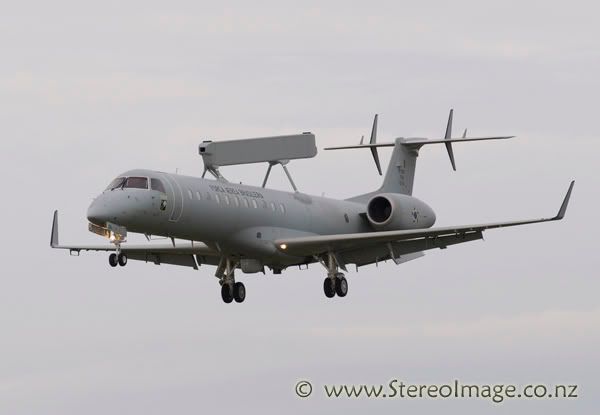
EMB 145 Erieye
According to a report carried in The Hindu, this may not be the final word on India’s AWACs fleet. India has a great deal of territory to cover, and even 6 AEW&C aircraft can easily mean just 4 operational aircraft at any given time. The Indian Air Force appears to be taking the “brittle swords lesson” to heart, and is looking for another 3 small-mid size surveillance aircraft to act as counterparts to the larger Ilyushin Phalcons.
While a G550 Phalcon would provide systems commonality, India’s platform of choice fr this project is Embraer’s ERJ 145 business/ regional jet. The Hindu reported a timeline that had aircraft delivery beginning in 2011, with full operational capability by 2013. The 3 aircraft together are expected to cost around R 1,800 crore (about $385 million) total when fully equipped.
Subsequent reports indicate a July 2008 contract with Embraer for the aircraft. Under the agreement, Brazil’s Embraer will act as the overall system integrator, supplying the jets, mounting the radar and electronics on or into the EMB-145 fuselage, and ensuring that the altered jets retain acceptable flight performance, and handling flight recertification.
The militarized ERJ 145 comes in several versions, including maritime surveillance and electronic intelligence versions. The most common variant, currently operated by Brazil and Greece, is the EMB 145 Erieye airborne early warning and control (AEW&C) aircraft1. It uses the same Saab Erieye AESA radar that will be mounted on Pakistan’s new Saab 2000 turboprop AEW&C fleet. There are some blind spots with its “dorsal blade” configuration, most notably to the front, but flight patterns can be planned around those gaps to ensure good coverage of the area in question.
The Hindu report did not specify the radar involved, except to say that it is “from the [Indian] Electronics and Radar Development Establishment”. A September 2005 ACIG report claimed that the radar would be similar to Saab’s Erieye, and the accompanying illustration from India’s DRDO Centre for Airborne Systems (CABS) certainly looks very similar.
This systems work with DRDO will be the real key to the Embraer AEW&C project’s success or failure.
India’s state-owned DRDO research and development agency will be heavily involved in a number of areas. According to The Hindu, the Bangalore-based Centre for Airborne Systems (CABS) is responsible for overall integration of the electronic systems, mission computer, display and data handling. CABS is reportedly working with the private sector firm Astra Microwave Products of Hyderabad to develop transmit-receive multimodules [JPG format] for the radar; doing so at a reasonable cost is always a challenge for AESA radars, however, and India’s experience with the type is limited. DRDO’s Defence Avionics Research Establishment will be involved with the jet’s self-protection systems, electronic warfare suites and communication support systems; their Defence Electronics Application Laboratory will be involved with the primary sensors, communication systems and data link; and DRDO’s Defence Electronics Research Laboratory will be involved with “counter-support measures.”
DRDO’s radar record is cause for some concern – the multimode radar being developed for the Tejas lightweight fighter isn’t performing properly yet, for instance, and foreign radars like the Elta M-2032 in India’s Sea Harriers are reportedly under consideration as substitutes in order to keep the already-late program on track. DRDO was also responsible for “Project Guardian/Airawat,” which suffered a disastrous project failure in 1999 when the HS-748 turboprop AWACS testbed aircraft crashed, killing several engineers and scientists who were critical to the project. The ERJ aircraft are the proposed successors to that effort.
Updates and Developments
Sept 18/08: The Times of India quotes Defence ministry sources as saying that the first IL-76 Phalcon will now land in India only around January-February 2009, though they are pushing IAI to deliver the aircraft before the end of 2008 despite “technical hitches in the integration work”.
The Times’ report adds that India signed a $210-million deal with Brazilian firm Embraer in July 2008 for 3 EMB-145 aircraft. The intent of the INR 18 billion (about $385 million) project is to modify them with DRDO-provided radar and command systems; if that works, the jets would begin arriving in 2011-2012.
India is also reportedly on course to acquire 4 more Israeli tethered aerostats and EL/M-2083 radars, at a cost of around $300 million. This follow-on to the aerostat radars inducted from 2004-2005 has reportedly been cleared by the Defence Acquisitions Council; if adopted, it would raise India’s total Airborne Early Warning aerostat purchases to about $445 million. Aerostat-mounted radars trade the advantage of mobility for incredible persistence, and are especially useful for watching key coastline and key border regions, or defending high value areas.
Sept 14/08: Zee News quotes Indian Army Maj. Gen. (Retd) Mrinal Suman, writing in the September issue of Indian Defence Review, as saying that India paid twice as much as it should have for its initial order of A-50 Phalcon AWACS aircraft.
”...inability to negotiate contracts astutely has been the biggest weakness of the entire defence procurement regime…. as the vendors exploit ambiguities in the contract language, especially with respect to delivery schedules, warranties, after sales support and penalties for default.”
Suman retired as Technical Manager (Land Systems) in the Indian Defence Ministry’s acquisition wing.
May 16/08: The Calcutta Telegraph reports that the first 3 IL-76 Phalcons will be delayed:
“A source in the Indian Air Force has confirmed that the delivery of the first Phalcon will be delayed. It was expected in September but is now more likely to reach India only at the end of the first quarter of 2009… delivery of two Aerostat radars… will also be delayed.
This is the second time that the delivery schedule of the Phalcons has been disrupted. The original schedule envisaged the delivery of the first aircraft in November 2007, the second in August 2008 and the third in the second half of 2009…. The delays, however, have not dissuaded the air force from working through a proposal to ask for three more Phalcons in a follow-on order estimated at $2 billion.”
April 13/08: India Defense reports that India is pleased enough to pick up the option for 3 more IL-76 Phalcon AWACS aircraft, in a deal worth up to $2 billion.
Jane’s Defence Weekly issued a concurring report later in the week, but placed the deal’s value at $1 billion. Assuming that the equipment sets are the same and inflation is 3% per year, note that repeating 2004’s $1.5 billion deal works out to about $1.7 billion by 2008. Delivery of these 3 additional planes would be expected to take place in 2011-12.
Footnotes
1 The terms AWACS and AEW&C can be used interchangeably. Many militaries are gravitating toward the more cubmersome “AEW&C” as standard nomenclature these days.
Additional Readings & Sources
Israeli Weapons – Phalcon
Spyflight – Boeing 707 Phalcon
The Hindu (April 20/08) – Brazilian jets to serve as eye in the sky for IAF
Domain-b (April 16/08) – India to place follow-on order for three Phalcon AWACS with Israel: report
Defense Technology International (April 2008) – Sky Watch: India’s air force is expanding surveillance operations. Shows an Indian IL-76/A-50, before it leaves for Israel.
Air Combat Information Group (Sept 12/05) – India’s flying Testbeds. Mentions the ill-fated HS-718 project, and adds an illustration of the planned ERJ-145 variant.
DID – Sweden Finalizes Saab 2000 AEW&C Contract With Pakistan. Includes details re: the Erieye radar.