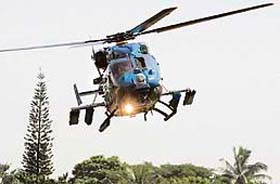
(NSI News Source Info) November 8, 2008: Israel is buying ANVIS/HUD night vision/head up display (HUD) attachments for its UH-60 and CH-53 helicopter pilots. This device enables helicopter pilots to fly more easily at night. The night vision device has been used for decades, but the built in HUD inserts essential aircraft information so that the pilot can turn his head and not lose sight of the HUD data. This is critical for flying a helicopter at night, because the night vision device provides a narrow field of view, forcing the pilot to constantly look around. With just the night vision device, the pilot gets tired quickly, because of the need to constantly look around, and back to the control panel. The ANVIS/HUD attachment (to the helmet) only weighs a pound, which is less than some night vision devices alone.
The ANVIS/HUD is made by an Israeli firm (Elbit), and has been on the market for a decade. Over 5,000 are in use, particularly in U.S. service. But Israel has held back on buying them for all their helicopter pilots. This was apparently because of budget constraints. But now the price has come down, and Israel is more concerned about using helicopters at night, particularly in another war with Hezbollah in Lebanon.
Saturday, November 08, 2008
Somalia A Lawless Country
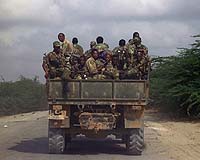
(NSI News Source Info) November 8, 2008: A growing number of countries are demanding that "something be done" about Somalia. The country has become a base for an increasing number of criminal operations. In the north there are the pirates, who are earning several million dollars a month by seizing ships passing through the Gulf of Aden. The ship owners simply tolerate higher insurance rates to pay for the ransoms and "danger pay" for the crews. Meanwhile, the men running those ships keep developing new tactics to avoid the pirates. A year ago, about half the pirate attacks would result in a captured ship. Now only about twenty percent of the attacks succeed, and that percentage keeps going down. But the growing number of newly wealthy pirates in Puntland (where most of the pirates are based) are attracting more Somalis to piracy. The two dozen or so foreign warships off the coast are no real problem. The pirates know that the warships will not attack them unless there is an actual attack on a merchant ship in progress. Otherwise, international Human Rights agreements protect the pirates from capture or punishment. This also prevents the warships from attacking pirate bases, either from the sea or by coming ashore.
Down south, the better organized, and motivated, Islamic radicals take control of more towns. These militias are only a minority of the armed groups that exist throughout the country. The non-religious warlords (mainly the Transitional National Government, or TNG) are unable to unite sufficiently to suppress the religious groups (the Alliance for the Re-liberation of Somalia, or ARS, which is the successor to the Islamic Courts Union, or ICU). Kenya and Ethiopia find their borders crossed more frequently by Somali raiders (something which has been going on for centuries), and are seeking Western nations that will help contain Somali aggression. So far, the only people seriously listening are those with counter-terrorism forces (mainly American, British and French) in Djibouti (Somalia's neighbor in the north.) But this force of commandos keeps its operations very secret. Apparently, this Djibouti based force monitors what goes on in Somalia, and occasionally intervenes to kill key al Qaeda operatives. There are more al Qaeda showing up in Somalia, and apparently they are leading a terror campaign against relatively peaceful warlords controlling most of northern Somalia (Puntland and Somaliland). The newly arrived terrorists are finding that Somalia is a very hostile environment. Over a third of the population faces starvation, and most Somalis depend, in whole or part, on food aid brought in by foreign aid groups. But many warlords make money by extorting or stealing from the foreign aid organizations. As a result, no matter how much food is brought in, some Somalis are not getting enough to prevent starvation deaths. Again, no foreign country is willing to go in and deal with this situation. That's because it's recognized that it would take a colonial type government to bring peace to Somalia, as most Somalis have shown, over the last two decades, that they cannot govern themselves. Since colonialism is very politically incorrect, the situation will have to get a lot worse before the world community will do anything decisive to shut down the horror show that has developed in Somalia.
The bodies of at least 60 Somalis and Ethiopians washed up on Yemeni beaches. Smugglers apparently pushed their passengers overboard too far off shore. It is believed that 1-2 percent of the nearly 4,000 illegal migrants crossing the Gulf of Aden each month, die this way. The smugglers don't like letting their passengers off too close to the shore, as that risks being spotted and captured by the Yemeni coast guard. At the very least, the smugglers could lose their boats. However, sometimes the smugglers demand more money (the usual fee for getting smuggled across the Gulf of Aden is about $100), and push those who will not, or cannot, pay off the boat while still far offshore. There appear to be about 20 percent more people trying to sneak into Yemen from Somalia this year than last.
November 5, 2008: Six foreign aid workers (two Kenyans and four Europeans) were kidnapped in the north (580 kilometers north of Mogadishu).
October 30, 2008: Off the north coast, pirates captured a Turkish ship, carrying iron ore from Canada to China, and its crew of 20. At least five other ships escaped similar attacks. In the southern town of Baidoa, someone threw a grenade into a market place, killing three people. This may have been part of an extortion attempt.
U.S. Air Force Acquiring 70 Sniper XR ATPs
(NSI News Source Info) November 8, 2008: The U.S. Air Force has ordered another 70 Sniper XR ATPs (advanced targeting pod), for about $2 million each. These pods are all the rage with fighter pilots. The air force is even installing Sniper XR targeting pods on some of its heavy bombers.
Sniper® advanced targeting pod (ATP) is high performance, affordable, and supportable
The magic comes from the fact that these pods contain FLIR (video quality night vision infrared radar) and TV cameras that enable pilots flying at 20,000 feet to clearly make out what is going on down there. The pods also contain laser designators for laser guided bombs, and laser range finders that enable pilots to get coordinates for JDAM (GPS guided) bombs. Safely outside the range of most anti-aircraft fire (five kilometers up, and up to fifty kilometers away), pilots can literally see the progress of ground fighting, and have even been acting as aerial observers for ground forces. These new capabilities also enable pilots to more easily find targets themselves, and hit them with highly accurate laser guided or JDAM bombs. While bombers still get target information from ground controllers for close (to friendly troops) air support, they can now go searching on their own, in areas where there are no friendly ground troops. The 440 pound pod hangs off a hard point, like a missile, bomb or fuel tank.
Seventeen years ago, the first targeting pods (the U.S. two pod LANTIRN system) were nearly ready for service. These first electronic targeting pods, that looked like a thin bomb, were hung under the wing of fighters, and contained laser designators and night vision equipment. The LANTIRN got a workout in the 1991 Gulf War, even though the system was still undergoing testing. Israel soon followed with a cheaper, more reliable and more capable Litening system. American manufacturers then brought out the Sniper XR pod. All this competition has made the pods (one pod is all that is needed now) more capable, easier to use, more reliable and cheaper. Pilots can either snag GPS coordinates for a smart bomb it is carrying, or use a laser designator, to drop bombs with extreme accuracy.
Greece And Turkey Still At Guard
China Aims IRBMs At India
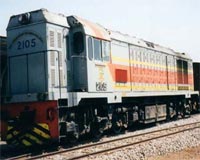
Nigeria suspends multi-billion-dollar Chinese rail project
(NSI News Source Info) Lagos - November 8, 2008: Nigeria has suspended a controversial 8.3 billion-dollar (6.5-billion-euro) contract awarded to a Chinese firm to upgrade its decrepit railway system, officials said Thursday.
A senior Nigerian presidency official confirmed the contract awarded to the China Civil Engineering Construction Corporation (CCECC) in 2006 had been suspended so the government could carry out a comprehensive review.
The government informed the company of the fact in an October 3 letter, CCECC representative Chin Hong Bing told a parliamentary committee.
While the government had only paid a small fraction, or 250 million dollars, of the project's cost, Bing said his firm had made some progress on the 1,315-kilometre (817 miles) Lagos-Kano double track standard gauge, which is the first phase of the 25-year-long modernisation project.
The media has criticised the Chinese firm for the slow pace of work at the site. The government of former president Olusegun Obasanjo, which signed the deal, has also been accused of inflating its costs.
Once Nigeria's pride, its railways, like much of the rest of the country's infrastructure, have slowly crumbled into disrepair.
Nigeria has a network of 3,505 kilometres (2,178 miles) of narrow-gauge single track lines, covering nine of the country's 36 states. Most of its 200 locomotives however, broke down long ago.
The only passenger service still operating in the country takes two hours to link central Lagos, the commercial capital, with Ijoko, a small commuter town less than 30 kilometres (20 miles) away.
Eritrea says Somalia peace efforts 'doomed to fail'
(NSI News Source Info) Nairobi - November 8, 2008: Eritrea said Tuesday that regional and UN efforts to restore stability in Somalia are doomed to fail and urged foreigners to let Somalis resolve their problems. Eritrea's government stressed "the solution to the problems in Somalia can only be ensured through the determination, choice, and participation of the entire people of Somalia," the foreign ministry said in a statement.
Asmara is "also certain that the conspiracies that are being weaved by Washington, with the servitude of the regime in Ethiopia, and facilitation of IGAD, is doomed to fail," the statement said.
Last week, an Inter-Governmental Authority on Development (IGAD) summit urged fueding Somali President Abdullahi Yusuf Ahmed and Prime Minister Nur Hassan Hussein to reconcile and form a new government in a bid to end nearly two decades of bloodletting.
Eritrea also rubbished recent deals reached between the Somali transitional government and its main Islamist-dominated political opposition group to end fighting and pave the way for Ethiopian troops to pull out of the country.
The deals, reached on October 26 at UN-mediated talks in Djibouti, violate "the territorial integrity of Somalia," and are "dangerous and conspiratorial engagements."
Ethiopian troops entered Somalia in late 2006 and helped oust Islamist militants who had taken control of much of the country.
Since then, the insurgents have waged a guerrilla war, saying they would only meet the government for peace talks after Ethiopian troops pull out of the country.
The UN and US have accused Eritrea of aiding Somali rebels, a claim rejected by Asmara.
Somalia has lacked an effective government since the 1991 ouster of president Mohamed Siad Barre touched off a bloody power struggle that has defied numerous attempts to restore stability.
Founded in 1986, IGAD has six active members: Ethiopia, Djibouti, Kenya, Somalia, Sudan and Uganda. Eritrea's membership was suspended in 2007 and has rejected several invitations to rejoin the group.
Pirates seize ship near Somalia with 8 Russians in crew
Iraq ready to keep order when U.S. troops pull out - minister
India's Chandrayaan-1 probe enters lunar orbit
Navistar to Deliver 822 Lighter MRAP in Afghanistan
(NSI News Source Info) WARRENVILLE, Ill. - November 8, 2008: Navistar Defense, LLC will deliver on its contract for 822 International MaxxPro Dash Mine Resistant Ambush Protected (MRAP) vehicles one month ahead of schedule to aid urgent needs in Afghanistan. Originally scheduled to be completed by the end of February 2009, the company has leveraged its extensive relationships with its supply base to provide the government with an even more aggressive delivery schedule. The company is now committed to delivering all units by the end of January.
Navistar has worked around the clock since receipt of this award and on Tuesday delivered 70 units – two weeks in advance of its already aggressive delivery schedule. “Navistar is prepared to rapidly provide the U.S. and its allies with MRAP vehicles at a time when hostilities call for more troops in Afghanistan,” said Archie Massicotte, president, Navistar Defense. “The Navistar team is going after an aggressive delivery commitment and we will be successful due to our partnering with the supply base. We are driven to provide our fighting men and women with the equipment they need as soon as possible.” The MaxxPro Dash, a lighter, more mobile Mine Resistant Ambush Protected (MRAP) variant was designed especially for the rugged terrain in Afghanistan. The Dash maintains the survivability system used on all MaxxPro MRAP variants while also allowing for greater mobility. A smaller turning radius and higher torque-to-weight ratio are among the improvements to its mobility. MaxxPro Dash is also capable of accommodating additional up-armoring. Supportability and maintainability are maximized with a high-degree of commonality of parts among all MaxxPro variants. The MaxxPro Dash is the sixth variant in 18 months from Navistar’s MaxxPro MRAP vehicle platform. Since the initial contract in May 2007, Navistar has won more than $3 billion in contracts to produce a total of 6,044 MaxxPro vehicles. Navistar Defense is an affiliate of Navistar International Corporation, a holding company whose subsidiaries and affiliates produce International brand commercial and military vehicles, MaxxForce brand diesel engines, IC brand school and commercial buses, and Workhorse brand chassis for motor homes and step vans.
India: Antony Asks HAL to Keep Pace with Changing Times
U.S. Lawmakers: Spend F-22 Money Now
Subscribe to:
Comments (Atom)