Thursday, July 31, 2008

RAF Readies Paveway Precision Weapon for Service

RAF Readies Paveway Precision Weapon for Service
31 July, 2008: LONDON - Britain's Royal Air Force (RAF) is almost ready to field its latest air-to-surface weapon following completion of operational evaluation trials July 22 at the U.S. Navy's China Lake air warfare center in California. The Paveway IV could see action on the Harrier in Afghanistan. The Ministry of Defence expects to get Raytheon System's Paveway 4 precision-guided weapon into service later this year after trials dropping 14 bombs from a RAF Harrier GR9 completed the test program, and demonstrated that the program's fuse problems had been overcome. The weapon could "potentially" be deployed on the Harrier in Afghanistan before the aircraft type is replaced on the front line by Tornado GR4 strike aircraft in spring 2009, according to MoD project leader Capt. Howard Holdsworth. Within the next two months, "several hundred" Paveway 4s will have been delivered to the MoD, Holdsworth said. To date, the Harrier is the only strike aircraft in the RAF inventory cleared to operate with the weapon. Integration is currently under way on the Tornado GR4, Typhoon and Joint Strike Fighter. Paveway 4 should have been in service last year, but the Thales Missile Electronics-developed all-electronic fuse suffered significant performance shortfalls during capability trials at China Lake in April 2007. That led to a major redesign of the fuse along with changes to a large number of components, according to Phil Jones, the managing director of Thales Missile Electronics. The cooperation between the MoD, Raytheon and Thales to overcome the problems in such a short time was a "remarkable achievement," Holdsworth said. Paveway 4 uses a 500-pound Mk82-type warhead with dual-mode laser and GPS guidance. The Aurora fuse is fully programmable with height-of-burst, post-impact and delay arming options. Raytheon System's precision systems director, Tobin Touchstone, said the company is already looking at growth options for the weapon and has started a dialogue with BAE Systems over the possibility of integrating Paveway 4 on its Mantis long-endurance UAV, unveiled at the Farnborough International Airshow earlier this month. Mantis is a technology demonstrator program initially aimed at investigating intelligence, surveillance, target-acquisition and reconnaissance capabilities, but later phases of the project could include arming the platform. Touchstone said Raytheon was already investing in future growth options, including work on potential integration on UAVs. He reckons the smart fuse would make Paveway 4 ideal for launch from a slow-moving platform. None of the officials would comment on whether the weapon could find its way onto RAF Reaper UAVs currently operating over Afghanistan. The weapons load on Reaper includes the enhanced Paveway 2, an earlier and larger member of the Paveway family operated by the British.

CH-47D/F / MH-47E Chinook Heavy Lift Helicopter, USA

CH-47D/F / MH-47E Chinook Heavy Lift Helicopter, USA
July 31, 2008: The CH-47D Chinook helicopter carries out transportation of troops, artillery, supplies and equipment to the battlefield. "The CH-47D Chinook heavy-lift helicopter is ideal for battlefield transportation." Other roles include medical evacuation, aircraft recovery, parachute drop, search and rescue, disaster relief, fire-fighting and heavy construction. 163 CH-47Ds took part in Operations Desert Shield and Desert Storm. Over 1,000 Chinooks are operational worldwide. Boeing has delivered more than 480 CH-47D Chinooks to the US Army and National Guard. Boeing has also exported the helicopter to military and commercial operators in Argentina, Australia, Canada, Japan, Norway, Spain, the UK and three Far East countries. Chinooks are under licensed production by Agusta of Italy and Kawasaki in Japan. Chinooks built by Agusta have been exported to Egypt, Greece, Iran, Libya and Morocco. UPGRADES AND ORDERS 397 of the US Army CH-47D helicopters are being upgraded to CH-47F standard. The LRIP contract for seven systems was signed in January 2003. Deliveries began in July 2004 and will conclude in 2018. In December 2003, the US Army ordered seven new CH-46F helicopters to replace those lost in action and, in January 2005, an additional ten new-build CH-47F helicopters. Deliveries began in June 2006 and are scheduled to complete in 2008. In January 2007, the US Army ordered 16 new and nine remanufactured CH-47F with options on 22 new and 19 remanufactured helicopters. The CH-46F was approved for full-rate production and entered operational service in August 2007. In February 2008, the US Army ordered another 11 new-build helicopters, bringing the number of new CH-47F ordered to 59. US Army Special Operations Forces also operate 36 Special Operations Chinooks, designated as MH-47D and MH-47E. These aircraft are being upgraded to MH-47G standard with a fully integrated digital Common Avionics Architecture System (CAAS). The first was delivered in May 2004. In November 2006, a version of the MH-47G, the HH-47, was selected for the USAF Combat Search and Rescue (CSAR-X) requirement for 141 new helicopters to replace the HH-60G Pave Hawk helicopters. However, in March 2007, the USAF announced that, following General Accounting Office (GAO) recommendations, it would issue a request for the resubmission of the CSAR-X proposals. In October 2007, the USAF decided to re-open the contest and issued new request for proposals. A contract award is expected in 2008. The CSAR helicopters are primarily to be used for rescuing downed aircrew and isolated troops in combat areas but may also be used for civilian rescue operations such as disaster relief. CSAR-X is scheduled to achieve Initial Operating Capability (IOC) in 2014. Boeing's team includes BAE Systems (digital flight control system), Keystone Helicopter (patient treatment area) and Kaman Aerospace (refueling probe). "The latest international model is theCH-47SD." In September 2006, the Netherlands requested the Foreign Military Sale of up to nine CH-47F helicopters with the common avionics architecture system and the upgrade of 11 CH-47D helicopters to CH-47F configuration, including the CAAS cockpit. An order for six new helicopters was placed in February 2007. Deliveries are planned for 2009–2010. In April 2008, Canada requested the sale of six CH-47D helicopters for short-term deployment to Afghanistan. Also in April 2008, Canada issued a request for proposal to Boeing for the longer term procurement of 16 medium-to-heavy lift (MHLH) Chinook helicopters. CH-47F The CH-47F design features alterations to the airframe structure to reduce the effects of vibration, as well as other structural enhancements the cockpit, cabin, aft section, pylon and ramp. The Rockwell Collins digital cockpit is fitted with the Common Avionics Architecture System (CAAS) with improved electrical, avionics and communication systems. CAAS includes: five multi-function displays, moving map display; digital modem; BAE Systems Digital Advanced Flight Control System (DAFCS); data transfer system storing preflight and mission data. The more powerful Honeywell T55-GA-714A engines are fitted with FADEC (Full Authority Digital Engine Control) and have thrust of 3,529kW (4,733shp). The operating range is increased to 609km (329nm) with mission radius of 370.4km (200nm). COCKPIT The cockpit accommodates two pilots and an observer. An advanced digital cockpit has been developed by Boeing and Honeywell. The cockpit is equipped with multifunction liquid crystal displays and electronic flight instruments. The crew is equipped with ANVIS-7 night-vision goggles from Elbit and the cockpit is Night-Vision Goggle (NVG) compatible. The communications suite includes jam resistant HF and UHF radio systems developed and supplied by Rockwell Collins and Raytheon. The helicopter is equipped with an AN/APX-100 Identification Friend or Foe (IFF) interrogator from AlliedSignal. WEAPONS Three machine guns can be mounted on the helicopter: two in the crew door on the starboard side and one window-mounted on the port side. "The engine provides a continuous power of 3,000shp and maximum power of 3,750shp." COUNTERMEASURES The Chinook is equipped with a suite of countermeasures systems selected by the customer country. The Special Forces variant of the Chinook, MH-47E, is fitted with the ATK AN/AAR-47 missile approach warner, Northrop Grumman ALQ-162 Shadowbox jammer, ITT ALQ-136(V) pulse jammer, Raytheon APR-39A radar warner and BAE Systems Integrated Defense Solutions (formerly Tracor) M-130 chaff and flare dispenser. The helicopter is equipped with a Rockwell Collins CP1516-ASQ target hand-off system. Australian Chinooks are being fitted with EADS AN/AAR-60 MILDS missile warning system. SENSORS The MH-47E is equipped with an advanced radar system, the Raytheon AN/APQ-174A, for terrain-following flight, air-to-ground ranging and ground mapping. A Raytheon AN/AAQ-16 Forward-Looking Infrared (FLIR) is installed in the nose of the helicopter and the cockpit is fitted with a moving map display. CARGO SYSTEMS The Chinook has a triple-hook system, which provides stability to large external loads or the capacity for multiple external loads. Large external loads such as 155mm howitzers can be transported at speeds up to 260kph using the triple-hook load configuration. Multiple external loads can be delivered to three separate destinations in one sortie. The central hook is rated to carry up to 12,000kg and the other two hooks 7,500kg each. Cargo handling systems are provided by AAR Corp, Cargo Systems of Goldsboro, North Carolina. The cabin provides 42m³ of cargo space and 21m² of cargo floor area and can accommodate two HMMWVs (High Mobility Multipurpose Wheeled Vehicle) or a HMMWV together with 105mm howitzer and gun crew. "The cabin provides 42m³ of cargo space and can accommodate two HMMWVs." The main cabin can hold from 33 fully equipped troops to 50 troops, according to the seating arrangements and equipment being carried. For medical evacuation, the cabin can accommodate 24 litters (stretchers). Ramp operations can be carried out on water using an optional power-down ramp and water dam configuration. ENGINES The helicopter is equipped with two T55-L-712 turboshaft engines from Honeywell (formerly AlliedSignal), which are pod-mounted on either side of the rear pylon under the rear rotor blades. The engine provides a continuous power of 3,000shp and maximum power of 3,750shp. The Honeywell T55-714 engine, which is being fitted to CH-47D, F and G models, is equipped with FADEC (Full Authority Digital Electronic Control) from Goodrich. The self-sealing fuel tanks are mounted in external fairings on the sides of the fuselage. The fixed tanks hold 3,900l of fuel. Three additional fuel tanks can be carried in the cargo area. The range of the helicopter can be extended by in-flight refuelling.

Boeing Team to Design New Spacecraft Power Generation System for DARPA

Boeing Team to Design New Spacecraft Power Generation System for DARPA ST. LOUIS, July 31, 2008 -- A team led by Boeing [NYSE: BA] Advanced Systems has been awarded a Defense Advanced Research Projects Agency (DARPA) contract for the first phase of the Fast Access Spacecraft Testbed (FAST) program. DARPA's FAST is a multiphase effort to design and develop a ground test prototype of a new High Power Generation Subsystem (HPGS) for spacecraft. During Phase 1, Boeing will develop a complete plan for a demonstration system. Team members include DR Technologies, Northrop Grumman Astro Aerospace, Texas A&M University, Spectrolab Inc. (a Boeing subsidiary), and key suppliers. "Boeing is honored to work with DARPA in developing this revolutionary system that will enable highly mobile spacecraft and ultra-high-power payloads," said Tom Kessler, FAST program manager for Boeing Advanced Network and Space Systems. "Boeing brings unique experience in high-power spacecraft and electric propulsion to this team as we help DARPA advance this promising technology." The Boeing HPGS is an innovative integration of solar-concentrator, power-conversion, and heat-rejection systems supported with an ultra-lightweight structure and deployment system for pointing toward and tracking the sun. When combined with electric thrusters, the Boeing HPGS will produce a lightweight power and propulsion system capable of providing responsive spacecraft maneuverability for on-orbit servicing, space-based situational awareness, and high-power payloads such as communication and radar systems. Boeing's experience includes more than 70 percent of the spacecraft ever flown with more than 15 kilowatts at beginning of life, and six operational high-power solar concentrator spacecraft, including 13 missions using 9 kilowatts for electric propulsion to help the spacecraft reach geosynchronous orbit. Upon DARPA approval, the Boeing team will perform Phase 2 work to include fabrication, assembly and testing of two HPGS test articles to validate performance characteristics in simulated space environments. An on-orbit demonstration of the system may be conducted following the ground test program.

Canada to lease Russian helicopters for Afghan mission

Canada to lease Russian helicopters for Afghan mission
Thursday July 31st, 2008: OTTAWA - Canada will lease up to eight Russian-built helicopters to ferry supplies around the battlefield in Afghanistan until it gets new U.S. choppers, says Defence Minister Peter MacKay. It is a stopgap measure meant to get Canadian army supply convoys off the bomb-laced roads of Kandahar, where explosives have been taking an increasingly deadly toll. Securing helicopter transport was a principal condition of the Manley commission report last winter and a key caveat of Parliament's extension of the combat mission until 2011. The Conservative government was given until February 2009 to come up with the helicopters and a flight of unmanned surveillance planes. A $375 million deal to acquire six CH-47-D Chinook's from the U.S. Army has been worked out, but those heavy-lift aircraft will not arrive until late this year -- or early next. In the meantime, MacKay said the Defence Department has worked out a lease involving "six to eight" Russian-made Mi-8 choppers. The former Soviet-era helicopters "have similar capacity to a Chinook," MacKay told reporters Wednesday heading into the Conservative caucus summer retreat in Levis, Que. "So they're heavy-lift...They'll be used to transport materials along the same routes, performing much the same purpose (as) the Chinooks would." The Mi-8s are in fact considered a medium-lift helicopter and date back in their original design to the 1960s. They were a familiar sight in the skies of Afghanistan during the Soviet occupation.

Pakistan: 13 killed as mortar shells hit houses in Kabal

Pakistan: 13 killed as mortar shells hit houses in Kabal
Thursday, July 31, 2008 - SWAT: Thirteen people have been killed when mortar shells fell on two houses in tehsil Kabal whereas 10 Taliban have been killed during operation.According to sources, a pesh imam, his wife and five children were killed when a mortar shell hit their house in Dulai area in Kabal tehsil.Also, six of a family was killed in Derai Sakai area of tehsil Kabal when a mortar fell at their house.Meanwhile, unidentified miscreants torched a girls school in Khawazakhel and two schools in Kashora areas.A couple was injured when a mortar shell landed at their house in Nusrat Kalay area.Security forces targeted Taliban hideouts with mortar shells in Sarbanda, Barmaba Khela, Peochar, Numl and Gutshor areas in tehsil Matta.Sources said that 10 Taliban were killed and several injured during the operation. Taliban attacked Kabal police station and Wanai check post. They were managed to flee after joint retaliatory action by police and security forces. Fresh contingents of FC have reached in Matta and Kabal areas.

INS Sindhuvijay to Join Indian Navy after Refit in Russia

INS Sindhuvijay to Join Indian Navy after Refit in Russia
31/7/2008: The INS Sindhuvijay diesel-electric submarine will set sail for India on August 5 to rejoin the Indian navy after an extensive overhaul at a shipyard in northern Russia, the company said on Tuesday.The Project 877EKM Kilo-class submarine had been undergoing a refit at the Zvezdochka shipyard in Severodvinsk since 2005. The overhaul was delayed for six months due to the unacceptable performance of its new SS-N-27 Club-S cruise missiles. In six consecutive pre-delivery test firings in September - November 2007, the Club missiles failed to find their targets and India refused to accept the delivery until all the problems had been fixed.The Club-S subsonic cruise missile is designed for launch from a 533 mm torpedo tube, or a vertical launch tube. It has a range of 160 nautical miles (about 220 km). It uses an ARGS-54 active radar seeker and Glonass satellite and inertial guidance. The new trials were completed in mid-July and were successful.Sindhuvijay is the 4th Indian navy submarine to have been refitted at the Zvyozdochka shipyard. The upgrade program also involved a complete overhaul of the submarine, including its hull structure, as well as improved control systems, sonars, electronic warfare systems, and an integrated weapon control system. The upgrades reportedly cost about $80 million.Russia's Kilo-class diesel-electric submarines have gained a reputation as extremely quiet boats, and have been purchased by China, India, Iran, Poland, Romania and Algeria.

U.S. assures Israel of possible attacks on Iran

U.S. assures Israel of possible attacks on Iran
Jul 31, 2008 - Iranian.ws: The U.S. government officials assured Israel that the option of attacking Iran over its nuclear program remains on the table, despite widespread Israeli concern that Washington has begun softening its position toward Tehran, According to The Los Angeles Times on Wednesday. The United States had not abandoned all possibility of a military attack on Iran, though U.S. officials are primarily seeking a diplomatic solution. The message was conveyed by Bush administration officials in meetings Monday and Tuesday with Israeli Defense Minister Ehud Barak, who is on a visit to Washington, the report said. At the same time, U.S. officials acknowledged that there is a rare divergence in the U.S. and Israeli approaches, with Israelis emphasizing the possibility of a military response out of concern that Tehran may soon have the know-how for building a nuclear bomb, according to the report. U.S. and Israeli officials believe Iran is enriching uranium with the aim of building nuclear weapons, but Iran says that its nuclear program was for peaceful and civilian energy purposes. Pentagon Press Secretary Geoff Morrell said in an interview that U.S. officials have often made it clear to Israeli officials that Washington prefers to try to mitigate the threat from Tehran by applying economic pressure. "The military option, although always available, is not our preferred route," Morrell said. "We have made that point clear to them and the world in our public statements and private meetings," he said. During his Washington visit, Barak was expected to try to talk the Bush administration out of what many Israelis perceive as a more conciliatory policy toward Iran. On Tuesday, the Israeli Defense Ministry released a statement saying that Barak had told U.S. Defense Secretary Robert M. Gates that "a policy that consists of keeping all options on the table must be maintained."

Support for Darfur mission urged

Support for Darfur mission urged The international community has been accused of failing to provide basic equipment vital to the peacekeeping mission in Sudan's Darfur region. The accusation was levelled in a report backed by 36 human rights groups and non-governmental organisations (NGOs). It comes on the first anniversary of the decision to deploy a UN-African Union force in war-torn region. Meanwhile, the UN Security Council is expected to vote on whether to extend the troops' mandate for another year. The UN estimates that five years of conflict in Darfur have left 300,000 people dead and more than 2 million people homeless. Khartoum says the scale of the violence and suffering has been exaggerated by the West for political reasons. It denies charges that it organised the Arab Janjaweed militias, accused of widespread atrocities against Darfur's black African population. It says military powers like the US, Britain and France are tied down in wars and other peacekeeping operations. But it named the Czech Republic, Italy, Romania, Spain, Ukraine and India, saying they have more than 70 suitable aircraft needed for the mission. Salim Ahmed Salim, a former secretary general of the Organisation of African Unity who was involved in putting together the report, told the BBC it was "mind-boggling" that despite international concern over Darfur, not a single helicopter had been provided. "The helicopters are there, what is lacking so far is the political will," he told the BBC's Network Africa programme. "All I can say is that if I were Darfurian I would really not only be distressed but would begin to question the extent of the solidarity." The report says a militia attack three weeks ago on a UN-AU convoy that left seven peacekeepers dead and 19 wounded underscores the critical importance of helicopters. The troops were outmanned and outgunned, and because of the lack of helicopters no rescue or reinforcement operation could be mounted, the report said. It also says the peacekeepers are short of other basic equipment, and that some soldiers are wearing blue plastic bags on their heads because they do not have the standard blue UN helmet. The report says the hybrid force is only part of the solution to the conflict in Darfur and that broad-based negotiations are essential. Only about a third of the intended 26,000 peacekeepers have so far been deployed. The UN Security Council decision on whether to renew the mandate for the peacekeeping force has became embroiled in the fallout over accusations that Sudan's President Omar al-Bashir has committed genocide in the troubled west of his country. The chief prosecutor at the International Criminal Court (ICC) has asked judges there for an arrest warrant for Sudan's president on charges of war crimes and genocide. The AU asked the UN Security Council to use its power to suspend the court's proceedings for a year, saying that indicting President Bashir would be a setback to peace in Darfur. Libya and South Africa, backed by Russia and China, wanted to include this in the resolution on renewing the mandate. But the UK, France, the US and central American countries objected, saying there should be no link between the peacekeeping force and whatever the court might do. Faced with the prospect that the force might not have its mandate renewed, a compromise has been found, after much wrangling between the 15 Council member states. The resolution takes note of the African Union's request for the Council to suspend the ICC's work, but does no more than that.

Japan raid over 'nuclear exports'

Japan raid over 'nuclear exports' 31 July, 2008: Police in Japan have raided the premises of a company suspected of illegally exporting machinery that could be used to make nuclear weapons. Officers targeted the headquarters of Horkos Corp and several related sites in the southern city of Fukuyama. The company is accused of exporting tools that could be used in enriching uranium without government permission. Police say the equipment, which was sent to South Korea, could have been sold to North Korea or the Middle East. The tools are normally used to manufacture automotive components, but they can be modified to produce the centrifuges used to enrich uranium. Export of these items requires approval from the government, but Horkos is accused of falsely labelling items to avoid the need for permission. Police suspect a batch of tools sent to South Korea in 2004 could then have been resold to a country for use in nuclear weapons' development, Kyodo news agency said. Japanese police have carried out similar raids in the past. Last year four former executives of precision equipment maker Mitutoyo were convicted of illegally exporting devices that could be used in nuclear weapons' production - one of which was reportedly found in Libya.

US troops killed three Iraqi civilians

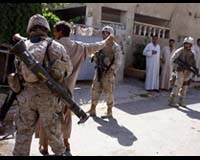
US troops killed three Iraqi civilians Samarra, Iraq (AFP) July 31, 2008: US soldiers killed three unarmed Iraqi civilians, including a woman, near the central city of Samarra, the American military said Wednesday. The incident which is under official investigation occurred early Wednesday as US troops carried out what the military described as operations targeting Al-Qaeda in the central zone of the war-ravaged country. It said that US soldiers moving towards a building had observed four "suspicious" individuals and had perceived "hostile" intent after being fired upon. "The force engaged them, killing two men and a woman, and wounding another woman. A third man who was detained on site admitted to working with explosives," the US statement said. But Nusayf Jassim, a resident on Samarra, 125 kilometres (80 miles) north of Baghdad, told AFP that US soldiers had raided his home in search of insurgents and in the ensuing gunfire his mother and two brothers were killed. "The US forces burst into our home at 2.00 am and opened fire in all directions, Jassim told AFP at his home on the edge of the city. "They killed my 50-year-old-mother and two of my brothers, aged 21 and 26," he said. US troops also wounded two of Jassim's sisters prior to detaining his 23-year-old brother, he said. Jassim added that the raiding US soldiers had told him that "terrorists" were living at his home. The US military said no weapons were found.