Dutch G-Wagen, XA-188 APC
Monday, September 08, 2008
Dutch Prepare for Large Utility Vehicle Buy
Dutch Prepare for Large Utility Vehicle Buy
(NSI News Source Info) September 8, 2008: The Netherlands’ Ministerie van Defensie has announced a EUR 250+ million project to replace nearly 8,000 light, medium and heavy wheeled logistics and patrol vehicles between 2011-2018. This will not include tactical vehicles such as the Landmacht’s Fennek reconnaissance vehicles, CV90/ YPR/ BvS10 armored personnel carriers, tanks, et. al., but it will replace a significant percentage of the Dutch patrol vehicle and truck fleet.
 Dutch G-Wagen, XA-188 APC
The project is looking to acquire 7,018 vehicles (including civilian vehicles) plus 3,617 modules, trailers et. al. to adapt the vehicles for specific tasks. The project also expects to order 1,020 modular protection kits, 120 Remotely controlled weapon systems and 1,260 gun mountings.
The accompanying briefing states that the operational vehicles, as opposed to vehicles bought under this program for civilian/domestic use, should be able to operate in the upper levels of the violence/war spectrum. This includes the option of modular add-on protection that can be changed as threat levels from projectiles, shrapnel, land mines, et. al. The mounting of electronic jammers to defeat remotely-detonated IED land mines is also contemplated, and the vehicles should be able to operate in extreme high and low temperature conditions.
The ‘light freight/cargo vehicle’ should be CH-47 transportable, either in the helicopter or underslung, as well as C-130 transportable. All of the operational vehicle types should be transportable in the C-17, AN-124 and A-400M, as well as with the country’s Rotterdam Class LPD ships, by civilian transport vessels and by train. Operational life should be at least 2 years, with a total lifespan of 10-15 years.
Dutch G-Wagen, XA-188 APC

Russia postpones launch of European GOCE satellite
 Russia postpones launch of European GOCE satellite
(NSI News Source Info) MOSCOW - September 8, 2008: The launch of a Russian Rockot carrier rocket bearing Europe's first GOCE satellite has been postponed, the Khrunichev State Research and Production Center said on Monday.
The decision to delay blast-off was made after a pre-launch inspection of the rocket showed glitches in one of the on-board devices. The new launch date will be announced shortly, Khrunichev said in its press release.
The carrier rocket, bearing a Gravity field and steady-state Ocean Circulation Explorer (GOCE) satellite, had originally been scheduled for lift off on September 10.
The Rockot launch vehicle is a modified version of the Russian RS-18 (SS-19 Stiletto) intercontinental ballistic missile. It uses the two original lower stages of the ICBM in conjunction with a Breeze-KM upper-stage for commercial payloads.
The launch will be carried out by Russia's Space Forces from the Plesetsk space center in northwest Russia and will put the GOCE satellite into a low earth orbit (LEO) of 270-300 km (170-186 miles).
GOCE, developed by the European Space Agency (ESA), is the first European satellite designed to provide unique models of the Earth's gravity field on a global scale and with unprecedented accuracy and spatial resolution.
The satellite, along with a host of support equipment, was delivered to the Plesetsk center from Amsterdam in July for pre-launch check and recently mounted on the rocket.
The contract to launch GOCE was concluded between the ESA and Eurockot Launch Services GmbH, a joint venture of the Khrunichev center (49%) and EADS Astrium (51%).
A total of seven launches of Rockot carrier vehicles have been made since 2000 under the Eurockot program, with 16 satellites owned by leading space agencies and organizations from the United States, Europe and Asia put into orbit.
Russian, French presidents to hold talks on Georgia in Moscow
 Russian, French presidents to hold talks on Georgia in Moscow
(NSI News Source Info) MOSCOW - September 8, 2008: The presidents of Russia and France will hold a meeting in Moscow on Monday to discuss developments in the Caucasus following the recent South Ossetia conflict.
Ahead of the French president's visit, Russian Foreign Ministry spokesman Andrei Nesterenko said "Nicolas Sarkozy would like to continue discussing the developments in the Caucasus" with his Russian counterpart, Dmitry Medvedev.
Medvedev signed a six-point ceasefire deal during Sarkozy's visit on August 12, under which Russia was to pull its troops back to the positions they held before Georgia's August 8 attack on breakaway South Ossetia. However, Russia says the plan allows for a continued "additional security measures" in a buffer zone within Georgia proper.
Russian Foreign Minister Sergei Lavrov said the "amended" document signed by Georgian President Mikheil Saakashvili bears no relation to that signed by Russia. In particular, he said that plans for discussions on the regions' future status, included in the sixth point of the document, were removed from the amended text.
The French delegation also includes European Commission President Jose Manuel Barroso and EU foreign policy chief Javier Solana. The group will later travel to Tbilisi.
Nesterenko said he was "not authorized" to comment on other issues to be on the Medvedev-Sarkozy agenda.
Moscow said hundreds of civilians were killed in Georgia's attack on South Ossetia, and thousands fled the devastated region.
Russia's General Staff said 64 servicemen were killed and 323 injured in its operation to force Georgia to peace in South Ossetia.
On August 26, Russia recognized South Ossetia and another Georgian breakaway republic, Abkhazia, as independent states.
Militant leader killed in special operation in Daghestan
 Militant leader killed in special operation in Daghestan
(NSI News Source Info) MAKHACHKALA - September 8, 2008: A militant leader was killed in a special operation in Daghestan in southern Russia, a spokesman for the republic's Interior Ministry said Monday.
"Three militants have been killed in a special operation near the village of Magaramkent in southern Daghestan," the source said. "The so-called 'emir of Daghestan,' Ilgar Malachiyev, was among the dead."
Malachiyev had been stopped in his car by federal troops and was killed when they returned fire. The source refused to give any further details, saying the operation was ongoing.
According to Daghestan's Interior Ministry, Malachiyev's militant group has some 40 members, three of whom are on the federal wanted list. In 2008, they are believed to have killed five people, including three policemen, and injured nine.
Azerbaijan's National Security Ministry and Prosecutor General's Office earlier said that Malachiyev and his accomplice Samir Makhdiyev were responsible for the August 17 blast in the country's largest Sunni mosque, Abu-Bekr, which left three people dead and 11 injured.
Sunday, September 07, 2008
Russia To Carry Out Naval Maneuvers off Venezuela
 Russia To Carry Out Naval Maneuvers off Venezuela
(NSI News Source Info) CARACAS - September 8, 2008: In a military first certain to raise eyebrows in the United States, Russia will carry out joint naval maneuvers in the Americas with Venezuela, the Venezuelan navy said Sept. 6.
Four Russian ships with almost 1,000 sailors aboard will carry out joint maneuvers with the navy of Caracas' leftist government in Venezuelan territorial waters November 10-14, the navy said in a statement.
"This is of great importance because it is the first time it is being done" in the Americas, Venezuela's navy joint chiefs strategic intelligence director, Rear Adm. Salbatore Cammarata Bastidas, said in a statement obtained by AFP.
Leftist-populist President Hugo Chavez is a harsh critic of the U.S. government. Moscow has been clashing with Washington over formerly Soviet Georgia.
Chavez, who has forged closer ties with Moscow including arms supply and production deals, is proud to claim a "strategic alliance" with Moscow. Chavez has supported Moscow in the Georgia conflict, and stressed that: "Russia is rising up again as a global power."
Cammarata Bastidas said the joint maneuvers also would include Venezuela's air force, and submarines.
Meanwhile in the U.S. administration's most hawkish remarks since Russia's five-day war with Georgia last month, Vice President Dick Cheney, traveling in Italy, reminded the West of its "responsibilities" and criticized Russia for its "chain of aggressive moves."
Cheney's tough talk came hours after Russian President Dmitry Medvedev warned that Moscow was a "force to be reckoned with," as tensions between Russia and the West soared to heights unseen since the Cold War.
Medvedev accused the United States of rearming Georgia under the guise of humanitarian aid, after the arrival Sept. 5 of the U.S. Navy's Mediterranean flagship at a key Georgian port close to where Russian troops are patrolling.
"I wonder how they would like it if we sent humanitarian assistance using our navy to countries of the Caribbean that have suffered from the recent hurricanes," Medvedev said.
Russia's defense ministry in July denied a report it was considering basing bomber aircraft in Cuba in retaliation for U.S. missile defense plans in Eastern Europe. "We regard these sorts of reports from anonymous sources as disinformation," RIA Novosti quoted defense ministry spokesman Ilshat Baichurin as saying.
Anti Missile Showdown Building Between East And West
 Anti Missile Showdown Building Between East And West
(NSI News Source Info) Moscow - September 8, 2008: The year 2008 has been the most productive for American missile shield plans since President Ronald Reagan launched his famed Strategic Defense Initiative in the 1980s.
But the 1980s are also remembered for an unprecedented level of military confrontation between the Soviet Union and the United States.
On Aug. 20 Secretary of State Condoleezza Rice signed a U.S.-Polish agreement on a third positioning area for the American missile system in Europe. It looks as if this situation is pushing Russia into another confrontation with the West and could reignite the nuclear missile threat on the European continent.
Today is not an occasion to argue whether Iran's missiles threaten Western Europe, though it is true that an Iranian rocket launched Aug. 18, as part of preparations for orbiting Iran's first satellite, points to a possible threat in the future.
But whether there is a threat from Iran, the Russian military and political establishment is convinced that American anti-missiles in Poland are only part of a plan to build up a U.S. nuclear potential in Europe directed against Russia. Naturally, Moscow is considering retaliatory options. Russian three-star Col.-Gen. Viktor Yesin, first vice president of the Academy for Security, Defense and Law Enforcement in Moscow, thinks that "in reply, Russia could reinforce its air grouping in the Kaliningrad region to neutralize missile silos in Poland."
Another Russian general, Leonid Ivashov, who heads the Academy of Geopolitical Problems in Moscow, believes that "in response, Russia could site Iskander theater missile systems and high-precision cruise missiles in the Kaliningrad region, western Russia, and Belarus."
The generals are right. All this could be done, and perhaps with a measure of success. But there are two factors that not only reduce the military effect of the proposed measures but also make them very dangerous for Western Europe and European Russia.
Under a clause in the agreement, the United States undertakes to provide Poland with 96 Patriot missile systems to modernize and strengthen its air defenses.
Another clause of the agreement declares that the United States will render Poland military assistance if it is threatened by a third state. Should Russia start acting strongly in the Western sector, Poland at once would remind the United States of that point. The Czech Republic and the Baltic states also would demand more guarantees for their security. That could mean only one thing: an immediate appearance near Russian borders of modern conventional weapons capable of hitting targets within European Russia.
On the other hand, such a buildup in areas bordering on Russia, which could tip the balance of strength in the West's favor, is well capable of burying the main instrument of European security -- the 1987 Treaty on Shorter and Medium Range Missiles. The military, including Russia's former chief of the General Staff, four-star army Gen. Yury Baluyevsky, time and again has paraded reasons for returning these missiles to Russia's arsenal.
If this happens, or rather if Moscow decides to withdraw from the treaty, the United States -- unlike Russia -- will not take long to restart production. The Tomahawk BGM-10G ground-based nuclear cruise missiles that were destroyed under the 1987 IMF Treaty are basically similar to sea- and air-launched cruise missiles currently in service with the U.S. air and naval forces.
Nor do things augur well for a new Russian-American document on strategic weapons limitation. Moreover, any moves to pull out of the treaty will put nuclear non-proliferation on the back burner for a long time.
Does Europe need to be "mined" once again to assuage fears of Iran?
Czechs say basic agreement reached on US staff at anti-missile baseThe Czech Republic and the United States have basically agreed on conditions for US forces to be sited at a US anti-missile base in the country, a defence ministry spokesman said on Friday. "During negotiation yesterday and today, a text was basically agreed upon," ministry spokesman Jan Pejsek told AFP. "There are still some details which have to be sorted out. We expect that to happen within the next days." Sealing the Status of Forces Agreement (SOFA) agreement would clear the way for Prime Minister Mirek Topolanek's fragile government to seek the required parliamentary approval for the US anti-missile package. The centre-right Czech government can be expected to discuss the proposed SOFA in September, the defence ministry said late last month when announcing that major issues around the second main Czech-US anti-missile agreement had been thrashed out. The main diplomatic deal on the base, justified by Washington as a shield against attack from "rogue" states such as Iran but vigorously opposed by Moscow as a threat to its own security, was signed by US Secretary of State Condoleezza Rice and Czech counterpart Karel Schwarzenberg in Prague last July. A few weeks later, Poland inked a deal with the United States to host 10 interceptor missiles, its contribution to the missile defence shield, sparking anger and threats of retaliation from Russia. However Topolanek's government is far from certain of winning a vote for the US base. Members of the junior coalition party, the Greens, have spoken out against it and the third coalition party, the Christian Democrats, are also cool to the idea.
US Ponders Whether To Arm And Support Local Afghan Militia Forces
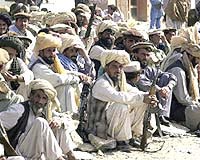 US Ponders Whether To Arm And Support Local Afghan Militia Forces
(NSI News Source Info) Washington - September 8, 2008: Experts are warning that it might prove counterproductive to extend to Afghanistan the U.S. strategy of forming and paying tribal militias to improve security -- though it has been credited with great successes in Iraq.
The U.S. military in Afghanistan denied such a move was being considered by senior officials, but the possibility is being discussed by officers on the ground.
"People are talking about it," said Vickram Singh, an expert with the centrist Center for a New American Security who returned recently from Afghanistan and told United Press International the idea of extending the strategy there had come up in briefings from the U.S. military.
He said detailed discussions about possibly supplying weapons and money were taking place "at an operational and tactical level -- identifying people who we (coalition military forces) could work with."
A spokesman for the U.S. military in Afghanistan denied that extending the strategy of arming and paying tribal militias was on the table. "We are not considering that," said Capt. Christian Patterson.
But it is being advocated, at least by some now outside the government.
Recently retired U.S. Army counterinsurgency expert Col. John Nagl welcomed the idea, saying that "buying off your enemies is ¿¿ a time-honored tactic in counterinsurgency with a proven track record of success."
"Over time, you try to incorporate those people into the government security organizations," Nagl added. "I absolutely think that there are tribal organizations in Afghanistan who could be incorporated. ¿¿ It would be a way to rapidly increase the size of (the Afghan National Police and National Army) with cohesive units."
But as UPI reported last month, the strategy of forming and paying Sunni tribal militias -- known variously as Awakening Councils or the Sons of Iraq -- to maintain security has run into trouble in Iraq, where efforts to integrate them into the nation's security forces have been stymied by the sectarian concerns of the Shiite-led government in Baghdad.
And several Afghanistan experts with whom UPI spoke said they had grave doubts about expanding the practice there, warning it would risk the fragile gains of the state-building strategy that the international community has been pursuing.
"At best, it would be a tactical gain, but also an immense strategic loss," said Ali Jalali, a former Afghan interior minister and now a visiting professor at the National Defense University, noting that by fragmenting power and undermining the authority of the central government, the strategy in the long run could actually worsen the instability it sought to ameliorate.
He called this "effort to gain peace through manipulating tribal dynamics" a "colonial approach."
Levels of corruption and instability were already much too high in the volatile border regions of the country, said retired Marine Col. Daniel Curfiss, also a professor at the National Defense University.
"My concern is, it would be throwing kindling on this (fire) ¿¿ to pay people who are already unwilling to relinquish power," he said.
"There are precedents, and the precedents are not terribly hopeful," said former U.S. Ambassador to Afghanistan James Dobbins, now at the Center for Strategic and International Studies and author of a recent study of state-building efforts in the war-ravaged country.
In the period immediately after the ouster of the Taliban government at the end of 2001, Dobbins said, the United States and its allies attempted to limit their military commitment by restricting peacekeeping troops to Kabul and using "tribal militias and warlords" to maintain security in the rest of the country.
"Over time it was found that that was not an adequate policy," said Dobbins.
Jalali said continuing efforts by coalition nations to work directly with tribal and other local leaders had been "one of the problems when I was interior minister" from 2003 to 2005. "They gave them weapons, money and vehicles."
In 2006, he said, the Afghan government of President Hamid Karzai tried itself to use tribally based militias -- with unhappy results.
Most of the 12,000 members of the militias, formally titled the Afghan National Auxiliary Police, "either deserted with their arms and equipment or were more or less forced to join the insurgents," he said, adding that the force was scheduled to be finally phased out of existence by the end of the current year.
He also pointed out that years of war and insurgency in the tribal areas of Afghanistan had physically decimated the tribal leadership and eroded their influence. "Over the past 30 years, the influence of the traditional leaders has waned," he said, adding that it was warlords and extremists who had replaced them.
Even those who think the idea is worth considering are keen to stress the differences between the two theaters.
The political dynamic is different in Afghanistan, said Singh, because there, you would not be buying off enemies, but arming your friends.
"The people that we'd start working with are people that already support the government," he said. "They are aware of what's happening in Iraq and they are saying, 'You should do it here.'"
Many local leaders were "all too eager to get in the game," Jalali said.
He said he had met a delegation of two dozen tribal elders who had come to town to petition the government about security in their remote border region. They were saying, in effect, "If you can't take care of the border, give us the weapons and we'll do it," he said.
Jalali said a strategy of working through local militias was putting the cart before the horse. "The tribes will only stand up (against the extremists) if they see that the government had authority in their areas ¿¿ that is not the case today."
The priority should be building the capacity of the central government, Jalali said. "Capacity-building is the central challenge in Afghanistan today."
Singh said that was one of his concerns about the proposal, too.
"No one is thinking at the strategic level ¿¿ if this is the right answer," he said, adding there was "no analysis by the coalition of how this would play out."
"There's a lot of downside," he concluded.
US-India nuclear accord approved
 US-India nuclear accord approved
(NSI News Source Info) September 8, 2008: India would get access to US civilian nuclear technology. The group of nations which regulates the global nuclear trade has approved a US proposal to lift restrictions on selling nuclear technology to India.
The controversial deal now needs to be ratified by the US Congress before it can be implemented.
India says the deal is vital for it to meet its civil energy demands.
The approval came after India pledged to keep its nuclear non-proliferation commitments and to uphold a voluntary moratorium on testing atomic weapons.
'End of isolation'
It took the 45-nation Nuclear Suppliers Group (NSG) nearly three days of protracted negotiations in Vienna to reach agreement.
Critics of the deal say it creates a dangerous precedent - effectively allowing India to expand its nuclear power industry without requiring it to sign the Non-Proliferation Treaty (NPT) as other nations must.
They say the deal would undermine the arguments for isolating Iran over its nuclear programme and be a disaster for international non-proliferation efforts.
Indian PM Manmohan Singh described the deal as "momentous". But US and Indian officials hailed the agreement as one that would help limit the unregulated spread of nuclear technology and material while allowing India to meet its energy demands with a "clean and reliable" supply.
Indian Prime Minister Manmohan Singh said the NSG decision "marks the end of India's decades-long isolation from the nuclear mainstream and of the technology denial regime".
Austria, New Zealand and Ireland lifted their objection to the US proposal after India made a formal pledge to not share sensitive nuclear technology or material and to uphold its moratorium on testing nuclear weapons.
The breakthrough reportedly came after US President George W Bush lobbied members of the NSG.
"This is a critically important moment for meeting the energy needs in India, and indeed dealing with the global need for clean and reliable energy supplies," said John Rood, acting US undersecretary of state for arms control.
'Huge difference'
The US restricted nuclear co-operation with India after it tested a nuclear weapon in 1974.
The current deal is the centrepiece of US efforts to bolster ties with India. However, the Bush administration must attempt to rush it through Congress before legislators break to prepare for November's elections - held at the same time as the presidential vote.
India's main opposition Bharatiya Janata Party (BJP) and the communists - former allies of the governing Congress party who withdrew support for the government over the nuclear deal - have accused the government of "deceiving" the country.
"There is a huge difference between what the US government is telling its Congress and what our government is telling us," BJP leader Yashwant Sinha told reporters.
Under the terms of the deal, India would open 14 civilian nuclear facilities to inspection - but its nuclear weapons sites would remain off-limits.
Critics fear assistance to India's civil programme could free-up additional radioactive material for bomb-making purposes.
Mi-24P (Mi-25 and Mi-35) Hind Attack / Transport Helicopter, Russia
Mi-24P (Mi-25 and Mi-35) Hind Attack / Transport Helicopter, Russia
(NSI News Source Info) September 7, 2008: The Mi-24 attack / transport helicopter is manufactured by the Mil Moscow Helicopter Plant, based in Moscow, Russia. It entered service with the Soviet Union in the late 1970s, and more than 2,500 have been produced.
The Mi-24 has been deployed in a number of conflicts including Afghanistan and in Chechnya.
The original model (NATO codename Hind-A), designed to carry eight combat troops, was later reconfigured to take on the gunship role (Hind-D).
Later versions, Mi-24P and the export Mi-35P, are also armed with anti-tank missile systems for the engagement of moving armoured targets, weapon emplacements and slow-moving air targets. All versions retain the troop transport capability.
The Mi-24 is in service with Russia and countries of the ex-Soviet Union and has been exported to Afghanistan, Algeria, Angola, Bulgaria, Cuba, Czech Republic, East Germany, Hungary, India, Indonesia, Iraq, the Ivory Coast, Libya, Mozambique, Nicaragua, North Korea, Peru, Poland, Vietnam and South Yemen. Ten Mi-35 helicopters were delivered by Russia to the Czech Republic in 2005/2006 as part of a debt repayment.
In 2005, ten Mi-35M helicopters were ordered by Venezuela. The first batch of four was delivered in July 2006, the second four in December 2006.
Indonesia placed an order for six additional Mi-35s in late 2006. Deliveries are due to begin in July 2008.
UPGRADES
Russian Army Mi-24s are being upgraded with new avionics including thermal imagers. Other upgrade packages are available, including that of Denel / Kentron of South Africa which includes Eloptro infrared sighting systems and Kentron Mokopa anti-tank missiles, and IAI Tamam which has HMOSP (Helicopter Multi-mission Optronic Stabilised Payload) with FLIR, TV and autotracker, embedded GPS (Global Positioning System) and cockpit multi-function displays.
"Later versions of the Mi-24P are armed with anti-tank missile systems."
The 'Visegrad Four' - Czech Republic, Hungary, Poland and Slovakia - signed an agreement in February 2003 to jointly upgrade up to 105 Mi-24D/V helicopters to NATO standards. This agreement has been abandoned.
However, two Polish Mi-24s are being upgraded to NATO standard as prototypes. In February 2004, BAE Systems was selected as integrator for the avionics systems, which will include an integrated electronic warfare suite.
In December 2005, Bulgaria signed a contract for the upgrade of 12 Mi-24 helicopters to a team led by Lockheed Martin and Elbit. However the contract was subsequently cancelled in February 2007.
 The Mi-24 attack / transport helicopter.
 Over 2,500 Mi-24 helicopters have been produced.
 The Mi-24 attack / transport helicopter.
 Over 2,500 Mi-24 helicopters have been produced.
DESIGN
The design of the Mi-24 is based on a conventional pod and boom, with a five-blade main rotor and three-blade tail rotor. It has retractable tricycle nose-wheel landing gear.
The two crew (pilot and weapons operator) are accommodated in tandem armoured cockpits with individual canopies and flat, bulletproof glass windscreens. The main cabin can accommodate eight troops or four stretchers.
WEAPONS
The helicopter has six suspension weapon units on the wingtips. The Mi24D (Mi-25) and the Mi-24V (Mi-35) are equipped with a YakB four-barrelled, 12.7mm, built-in, flexibly mounted machine gun, which has a firing rate of 4,000-4,500 rounds a minute and a muzzle velocity of 860m/s. The Mi-24P is fitted with a 30mm, built-in, fixed gun mount; the Mi-24VP with a 23mm, built-in, flexibly mounted gun.
The Mi-24P and Mi-24V have four underwing pylons for up to 12 anti-tank missiles. The Mi-24V (Mi-35) is armed with the Shturm anti-tank guided missile system. Shturm (NATO designation AT-6 Spiral) is a short-range missile with semi-automatic radio command guidance. The 5.4kg high-explosive fragmentation warhead is capable of penetrating up to 650mm of armour. Maximum range is 5km.
"Russian Army Mi-24s are being upgraded with new avionics including thermal imagers."
The Mi-24V can also carry the longer-range Ataka anti-tank missile system (NATO designation AT-9), as can the Mi-24P. The Ataka missile's guidance is by narrow radar beam, and the maximum range of the missile is 8km. The average target range is between 3-6km. The target hit probability of the Ataka missile is higher than 0.96 at ranges 3km-6km. The missile has a shaped-charge 7.4kg warhead, with a tandem charge for penetration of 800mm-thick explosive reactive armour.
All Mi-24 helicopters can also be armed with rockets and grenade launchers.
AVIONICS
The Mi-24D is equipped with the KPS-53A electro-optical sighting pod. The most recent Mi-24V and P variants have a digital PNK-24 avionics suite and multifunction LCD cockpit displays, and Geofizika ONV1 night-vision goggles, along with NVG-compatible cockpit lighting. They are fitted with the Urals Optical and Mechanical Plant GOES-342 TV/FLIR sighting system and a laser rangefinder. Countermeasures include infrared jammer, radar warner and flare dispensers. ENGINES
The helicopter is powered by two Isotov TV3-117VMA turboshaft engines, developing 2,200shp each. The air intakes are fitted with deflectors and separators to prevent dust particle ingestion when taking off from unprepared sites. An auxiliary power unit is fitted.
The internal fuel capacity is 1,500kg, with an additional 1,000kg in an auxiliary tank in the cabin or 1,200kg on four external tanks. The fuel tank has self-sealing covers and porous fuel tank filler for increased survivability, and the exhaust is fitted with infrared suppression systems.
China's Carrier programme Takes Shape
China's Carrier programme Takes Shape
(NSI News Source Info) September 7, 2008: The slower something moves, according to cognitive psychologists, the less likely people are to view it as a threat. Slow progress, however, is not no progress – even tiny movements can produce big results over a sufficiently long timeframe.
A case in point is China's aircraft carrier programme. Observers following the saga of the Varyag, the partially built Soviet aircraft carrier purchased by China from Ukraine in 1998, have speculated for years about the vessel's ultimate purpose. Construction on the Varyag stopped with the ship only 60% complete, and lacking electronics and propulsion systems. Did the Chinese plan for, then abandon, a massive retrofit?
In fact, the Varyag may already be performing its ultimate mission of training the next generation of Chinese sailors and naval aviators. More broadly, the Varyag is but one step in the proverbial thousand-mile journey, the outline of which is clearer with some long-term perspective.
 Observers following the saga of the Varyag, the partially built Soviet aircraft carrier purchased by China from Ukraine in 1998, have speculated for years about the vessel's ultimate purpose.
 China reached a deal with Russia in late 2006 for up to 50 Su-33 fighter aircraft, which the Sukhoi aviation bureau designed specifically for carrier operations.
 The Varyag did not actually make it to China until 2002 because Turkey feared that the vessel, which required towing, could founder in the Bosphorus and impede shipping.
CHINESE CARRIER AMBITIONS
Indeed, the first clear evidence of China's carrier ambitions emerged two decades ago. In 1985, China bought a decommissioned Australian aircraft carrier for scrap – but before it went under the torch, Chinese engineers apparently studied the ship's design and used the flight deck for pilot training.
After the fall of the Soviet Union, Chinese companies bought two decommissioned Russian anti-submarine carriers, the Minsk and Kiev. China converted both to civilian purposes, but again, Chinese naval architects had the opportunity to study both.
Sandwiched between these sales was the deal for the Varyag, which did not actually make it to China until 2002 because Turkey feared that the vessel, which required towing, could founder in the Bosphorus and impede shipping. After an extended drydock visit, the Varyag was moved to the northern Chinese port of Dalian, its current residence.
Recent speculation over the uses of the Varyag has focused on the repainting of the ship in navy gray and its apparent inactivity in terms of civilian uses. Although these facts are suggestive, they are not as significant as the tight perimeter security surrounding the ship.
Most significantly, China reached a deal with Russia in late 2006 for up to 50 Su-33 fighter aircraft, which the Sukhoi aviation bureau designed specifically for carrier operations.
While some analysts believe that China wants to deploy a carrier by 2010, skeptics raise a number of questions that cast doubt on the existence of such a goal. However, alternative answers are available for these questions – and taken together, the 'column B' answers are even more worrisome for those nations, such as India, who fear China's regional ambitions.
CARRIER PROGRAMME QUESTIONS
Why was the Varyag was bought stripped? In an age of rapidly evolving technology, China may have believed that the original electronics suite was obsolescent anyway. Similarly, China may have felt that its own steam turbine technology would be an improvement on the earlier-generation Russian propulsion systems, which were never the most reliable to begin with. What mattered was the implementation and effectiveness of the Varyag's structural design – the element of the ship least sensitive to technological change.
If seagoing aviation is so important to China, why did it scrap the Minsk and Kiev? Tellingly, the Soviets classified these ships as 'heavy aircraft-capable cruisers' primarily oriented toward anti-ship and anti-submarine operations.
China does not want a carrier for these reasons: consistent with its vision of asymmetric warfare, China would attack US surface warships with subs and long-range missiles, and may regard US sub-hunting as an overly challenging and expensive proposition relative to the rewards it could plausibly bring. China wants a carrier for the same reasons that US war planners like them so much: flexible inshore and overland power projection in remote locations such as the Indian littoral and Persian Gulf, which carries an ever-increasing supply of inbound oil and outbound trade.
"If seagoing aviation is so important to China, why did it scrap the Minsk and Kiev carriers?"
Why did the Chinese reportedly decline French and Spanish offers to build carriers for them in the 1990s? Tellingly, the Chinese were least impressed by the French offer, which was contingent on Chinese purchases of the accompanying electronics and aircraft (unlike the Russian fire sales of stripped-down vessels). Given its great-power aspirations, China probably feels duty-bound to make rather than buy – and may believe the learning experience of building its own may be more beneficial in the long term.
In this light the long gestation period of the Chinese aircraft carrier programme results neither from technological backwardness nor low prioritisation, but rather from a 'just-in-time' approach to assembling components of a grand maritime strategy.
**Don't operate a carrier until US carriers can be neutralised
**Don't subject a carrier to sea trials until the associated aircraft and pilots have been tested and trained – which can be done initially through simulated 'short runway, timed landing' training on land
**Don't fit a carrier out until the last minute, to allow component technology to develop as much as possible.
Patience, it seems, is not only a virtue, but good common sense as well.
 Observers following the saga of the Varyag, the partially built Soviet aircraft carrier purchased by China from Ukraine in 1998, have speculated for years about the vessel's ultimate purpose.
 China reached a deal with Russia in late 2006 for up to 50 Su-33 fighter aircraft, which the Sukhoi aviation bureau designed specifically for carrier operations.
 The Varyag did not actually make it to China until 2002 because Turkey feared that the vessel, which required towing, could founder in the Bosphorus and impede shipping.
Subscribe to:
Posts (Atom)