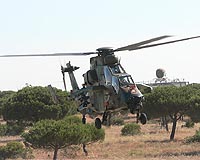
 Eurocopter Fires Spike Missile From HAD Tiger
(NSI News Source Info) El Arenosillo, Spain (SPX) September 19, 2008: As part of the development of the HAD (support and destruction helicopter) version of the Tiger, Eurocopter successfully completed a firing campaign using the Spike air-to-ground missile.
This campaign was conducted at the El Arenosillo firing range in Spain, which belongs to the Spanish National Institute for Aerospace Technology (INTA). For air-to-ground missions, the Spanish helicopters will be equipped with the fiber-optic guided Spike missile developed by the Israeli company Rafael.
Spain is currently one of two customers for the HAD version of the Tiger: the Spanish armed forces have ordered 24 of these aircraft, and France has ordered 40 HAD version Tigers.
For air-to-ground missions, the Spanish helicopters will be equipped with the fiber-optic guided Spike missile developed by the Israeli company Rafael.
Seven missiles were fired in El Arenosillo. Five were launched without their main propulsion units, as the sole aim was to validate the helicopter/weapon integration concept and to clear the firing envelope, ensuring that the weapon separated cleanly from the helicopter during firing. This was checked in hover and in forward flight.
The other two missiles were able to hit their targets six to eight kilometers away as these infrared guided missiles were equipped with their propulsion units.
The first missile was fired in the lock on before launch (LOBL) mode and the second in the lock on after launch (LOAL) mode. Six of the missiles were fired by an all-Eurocopter crew, and the seventh (fired in LOBL launch) by a crew made up of a Eurocopter pilot in the front seat and a Spanish gunner-commander in the rear.
All of the missiles were fired successfully.
Thursday, September 18, 2008
Eurocopter Fires Spike Missile From HAD Tiger
Eurocopter Fires Spike Missile From HAD Tiger
(NSI News Source Info) El Arenosillo, Spain (SPX) September 19, 2008: As part of the development of the HAD (support and destruction helicopter) version of the Tiger, Eurocopter successfully completed a firing campaign using the Spike air-to-ground missile.
This campaign was conducted at the El Arenosillo firing range in Spain, which belongs to the Spanish National Institute for Aerospace Technology (INTA). For air-to-ground missions, the Spanish helicopters will be equipped with the fiber-optic guided Spike missile developed by the Israeli company Rafael.
Spain is currently one of two customers for the HAD version of the Tiger: the Spanish armed forces have ordered 24 of these aircraft, and France has ordered 40 HAD version Tigers.
For air-to-ground missions, the Spanish helicopters will be equipped with the fiber-optic guided Spike missile developed by the Israeli company Rafael.
Seven missiles were fired in El Arenosillo. Five were launched without their main propulsion units, as the sole aim was to validate the helicopter/weapon integration concept and to clear the firing envelope, ensuring that the weapon separated cleanly from the helicopter during firing. This was checked in hover and in forward flight.
The other two missiles were able to hit their targets six to eight kilometers away as these infrared guided missiles were equipped with their propulsion units.
The first missile was fired in the lock on before launch (LOBL) mode and the second in the lock on after launch (LOAL) mode. Six of the missiles were fired by an all-Eurocopter crew, and the seventh (fired in LOBL launch) by a crew made up of a Eurocopter pilot in the front seat and a Spanish gunner-commander in the rear.
All of the missiles were fired successfully.

Japan shoots down test missile in US: ministry
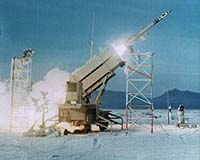 Japan shoots down test missile in US: ministry
(NSI News Source Info) Tokyo (AFP) September 19, 2008: Japan said Thursday it had shot down a mock missile in the US desert, taking another step to build a shield with the United States against a possible North Korean attack.
Japan became the first country other than the United States to test the new US-developed Patriot Advanced Capability-3 (PAC-3), a surface-to-air missile that tracks and hits incoming targets, the defence ministry said.
In the test Wednesday in the southwestern US state of New Mexico, Japan's air force shot down a mock missile that was launched from 120 kilometres (75 miles) away, a defence ministry spokesman said.
"The success of the test was significant as it proved that Japan's missile defence system will function effectively," the spokesman said.
In an irony of history, the White Sands range of Wednesday's missile test stands on the site where the United States conducted a key 1945 test to make the atomic bomb, which was later dropped on Japan.
Japan has been officially pacifist since defeat in World War II but has increasingly sought to play a larger role in security.
Washington and Tokyo have been working jointly to erect a missile shield against possible attacks from North Korea, which fired a missile over Japan's main island in 1998 and tested an atom bomb in 2006.
A South Korean newspaper said this week that North Korea, at a standstill with the United States over a disarmament deal, had carried out an engine ignition test for a missile believed capable of reaching the US west coast.
US military forces stationed in both Japan and South Korea have deployed PAC-3 missiles.
Japan in December carried out on a separate test in the Pacific Ocean of a Standard Missile 3 (SM-3) sea-to-air missile.
Japan plans to complete its missile shield by early 2011, deploying the PAC-3 missiles at 11 bases and setting up SM-3 missiles on four Aegis warships.
South African Defence Minister Hands Over Gripens to Air Force
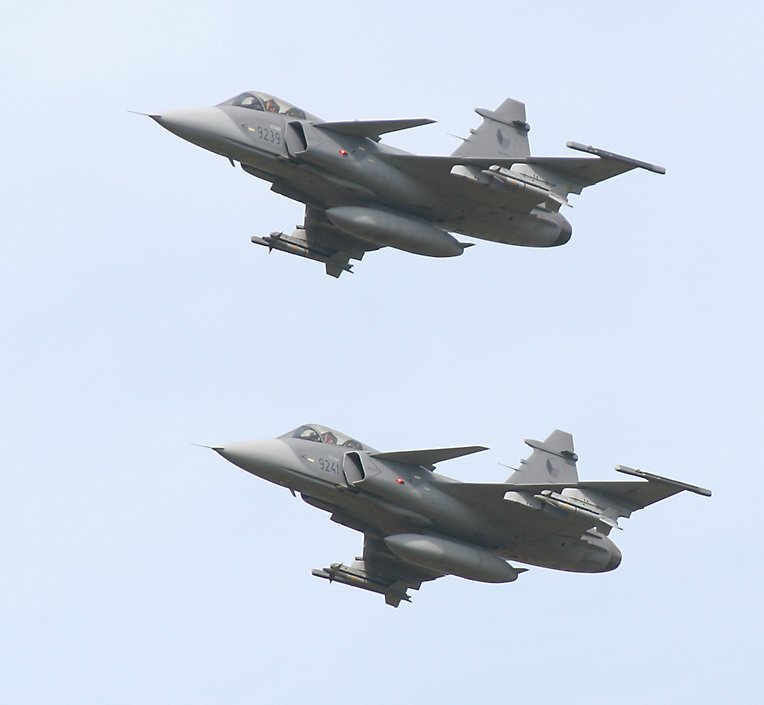 South African Defence Minister Hands Over Gripens to Air Force
(NSI News Source Info) September 19, 2008: In a spectacular ceremony at AAD, Africa’s premier aerospace show, South African Gripen fighters are welcomed into the South African Air Force. Today, on the first day of the biennial Africa Aerospace and Defence show, being staged at AFB Ysterplaat in Cape Town, South Africa, history was made when Defence Minister Mosiuoa Lekota officially handed over the first of the country’s fleet of new generation Gripen fighters to Lt. Gen. Carlo Gagiano, Chief of the South African Air Force. The occasion was marked in style with a fly past of four of South Africa’s fleet of twenty-six Gripen fighters, with the spectacular backdrop of Cape Town’s famous Table Mountain providing some memorable photo opportunities. Following the fly past, the four aircraft landed at Ysterplaat and taxied to a position in front of Defence Minister Lekota, Lt. Gen. Carlo Gagiano and other VIP guests from the Government, Air Force and industry and the media. The pilots, including South Africa pilots Musa Mbhokota and Charl Coetzee, then de-planed and joined in the ceremony which saw Gen. Gagiano officially accept the first Gripen fighter from Minister Lekota. South Africa has ordered twenty-six Gripen fighters of the latest C/D standard, 9 two-seaters and 17 single seaters. Deliveries commenced this year, with four aircraft already in-country, and the remainder scheduled to be delivered progressively until 2012.
Lockheed Martin Inducts First C-5A Into Avionics Modernization Program
 Lockheed Martin Inducts First C-5A Into Avionics Modernization Program
(NSI News Source Info) September 19, 2008: The first C-5A Galaxy has entered the Avionics Modernization Program (AMP), which has already upgraded 42 of the planned 111 aircraft. (USAF photo)MARIETTA, Ga. --- The Lockheed Martin C-5 Avionics Modernization Program (AMP) reached another milestone this week with the induction of the first U.S. Air Force C-5A into the program. "The combination of hardware and software afforded through AMP allows Air Force crews to fly unrestricted anywhere in the world," said George Shultz, Lockheed Martin's vice president of C-5 Modernization. "Modernizing the C-5As today with new avionics further ensures this unique national asset will continue to support the warfighter for many years to come." The AMP replaces the analog cockpit instruments and systems in the C-5 with digital displays and equipment. It also provides the necessary communications and navigational avionics to comply with Global Air Traffic Management (GATM) requirements, the new set of international standards for aircraft movement and reduced separation in flight. There are 111 C-5s to be modified through AMP with 42 production airplanes completed to date. The AMP installations are taking place at Dover AFB and Travis AFB and are scheduled to be completed in second quarter 2014. The C-5 AMP fleet has flown more than 9,400 sorties and 40,000 operational flight hours. The Air Force had the C-5As re-winged in the 1980s, increasing their structural service life to the equivalency of its C-5Bs. The C-5 has been the backbone of strategic airlift in every military engagement since it entered service and has supported U.S. humanitarian relief efforts around the globe. It is the only aircraft capable of carrying 100 percent of certified air-transportable cargo, with a dedicated passenger compartment enabling commanders to have troops and their equipment arrive in an area of operation simultaneously. Lockheed Martin is a pioneer in sustainment initiatives, offering a number of flexible and individually tailored support solutions. The company is a major supplier of logistics systems and services to military and civil government customers, and provides solutions for platform maintenance, modifications and repair, material readiness and distribution, and global supply chain command and control. Headquartered in Bethesda, Md., Lockheed Martin is a global security company that employs about 140,000 people worldwide and is principally engaged in the research, design, development, manufacture, integration and sustainment of advanced technology systems, products and services. The corporation reported 2007 sales of $41.9 billion.
Report: Russia May Sell Venezuela More Arms
 Report: Russia May Sell Venezuela More Arms
(NSI News Source Info) MOSCOW - September 19, 2008: Russia plans to sell Venezuela anti-aircraft systems, armored personnel carriers and fighter jets, the head of a Russian state industrial corporation was quoted as saying Sept. 18.
Russia and Venezuela "are holding talks on the supply of anti-aircraft systems, modern armored cars including BMP-3 armored personnel carriers," Sergei Chemezov, head of Russian Technologies, told the Kommersant daily.
Chemezov, whose corporation oversees Russian arms exports, said Venezuela was also interested in buying Su-35 fighter jets which are due to be produced beginning in 2010.
Referring to a visit by Russian Deputy Prime Minister Igor Sechin to Cuba and Venezuela this week, Kommersant said the three countries were discussing "alliance relations" as a rebuff to U.S. policies in the former Soviet Union.
Venezuelan President Hugo Chavez has said he will visit Moscow next week. The countries boosted military ties last week, when two Russian bombers landed in the South American country. Officials also are announcing plans for joint naval exercises.
Venezuela has already bought Russian fighter jets, tanks and assault rifles.
U.S. Navy Accepts First LCS, Anti-Sub Module
 U.S. Navy Accepts First LCS, Anti-Sub Module
(NSI News Source Info) September 19, 2008: The U.S. Navy took delivery Sept. 18 of its first littoral combat ship, the Freedom, one of two late-week milestones in the Littoral Combat Ship program, along with the scheduled rollout Sept. 19 of the anti-submarine mission module in San Diego.
"This is a truly exciting day for the Navy. Today marks a critical milestone in fulfilling the need and realizing the vision we began just a few years ago," said LCS program manager Capt. James Murdoch in an announcement Sept. 18. "Despite our challenges, the Navy and industry have continued to press on to build and deliver the first ship of a unique class, a ship class that will give our nation our own asymmetric advantages against future maritime threats."
The 3,000-ton, 378-foot Freedom is the first of the Navy's warships that accept interchangeable equipment to handle three different missions: anti-submarine warfare, mine countermeasures and surface combat. The Sept. 19 arrival of the ASW package - which includes new sensors; Mk 54 torpedoes for the MH-60R Seahawk helicopter; and a robot submarine - was expected to signal that the Navy had finished development work on each mission module.
The steel, monohull Freedom, built by Lockheed Martin, is one of two competing designs for LCS, along with the aluminum trimaran Independence, built in Mobile, Ala., by General Dynamics. Both ships are behind schedule and more than 60 percent over budget.
They represent a drastic break with the way the Navy has traditionally operated. Each LCS will have two core crews of 40 sailors apiece, which will alternate tours aboard the ship. Each mission module will have its own crew that will go aboard an LCS to operate the specialized equipment. The ships also will take aboard an aviation detachment, as do today's surface warships. All together, this will make for a comparatively small ship's company of about 75 sailors, the Navy hopes, possible because each LCS is so highly automated that many spaces will be unmanned.
The first members of the Freedom's Blue Crew were expected to begin moving aboard on Sept. 18 from its shipyard in Marinette, Wis. After more shakedown testing in Lake Michigan, the Freedom will sail to Milwaukee for its commissioning Nov. 8, and then out into the Atlantic, for stops at Naval Station Norfolk, Va., and Naval Surface Warfare Center Panama City, Fla., to test mission modules.
Russian strategic bombers return home from Venezuela
 Russian strategic bombers return home from Venezuela
(NSI News Source Info) MOSCOW - September 19, 2008: Two Russian Tu-160 Blackjack strategic bombers returned to their base in central Russia early on Friday after a 15-hour flight home from Venezuela, a Russian Air Force spokesman said. "After a 15-hour flight two Tu-160 strategic bombers landed at their home base in Engels at 01.16 Moscow time on Friday [09.16 GMT Thursday], Lt. Col. Vladimir Drik said.
The bombers arrived in Venezuela on September 10 and were accompanied by NATO fighters during their 13-hour flight to the South American country.
According to Drik, the bombers were carrying dummy missiles without warheads and their primary mission was to practice patrol sorties in a tropical climate.
The journey back to Russia was the longest flight in the history of Russian strategic patrols, and was conducted over neutral waters in the Atlantic and the Arctic oceans. During the flight, the aircraft conducted night-time aerial refueling for the first time in recent years.
Commenting on the results of the patrol mission, the deputy commander of the Russian Air Force's strategic aviation, Maj. Gen. Alexander Afinogentov said the experience of the mission would help reassess the capabilities of Tu-160 bombers and hone the crews' skills in prolonged instrumental flights.
Russia resumed strategic bomber patrol flights over the Pacific, Atlantic and Arctic oceans last August, following an order signed by then-president Vladimir Putin. Russian bombers have since carried out more than 90 strategic patrol flights and have often been escorted by NATO planes.
Russia has repeatedly stated that all strategic patrol have been performed in strict accordance with international rules on the use of airspace over neutral waters, without violating the borders of other states.
In addition, Russia's Foreign Ministry earlier said that the landing of strategic bombers in Venezuela did not mean that Russia had established a military base in the South American country.
"Russia does not have military bases in Latin America," Andrei Nesterenko, a spokesman for the Foreign Ministry said. "The landing at the Venezuelan airbase was carried out in line with prior agreements between Russia and Venezuela."
U.S. State Secretary Condoleezza Rice was biting in her remarks on Thursday concerning a patrol carried out along the South American coast by the Russian bombers during their mission.
"We are confident that our ties with our neighbors ... will in no way be diminished by a few aging Blackjack bombers visiting one of Latin America's few autocracies," she said.
The Tu-160 supersonic bomber with variable geometry wings has been manufactured since 1984 and was adopted by the Air Force in 1987.
The bomber is designed to strike strategic targets with nuclear and conventional weapons deep in continental theatres of operation.
The aircraft has all-weather, day-and-night capability and can operate at all geographical latitudes. Its two internal rotary launchers can each hold 6 Raduga Kh-55 cruise missiles or 12 Raduga Kh-15 short-range nuclear missiles.
Russia currently has 16 modernized Tu-160 bombers in service with the strategic aviation. They feature a new set of fire-control systems, overhauled navigation equipment and avionics.
Russia successfully test launches Bulava missile from submarine
 Russia successfully test launches Bulava missile from submarine
(NSI News Source Info) MOSCOW - September 19, 2008: The Russian Navy on Thursday successfully tested a Bulava sea-launched ballistic missile, which hit targets on testing grounds in Kamchatka in Russia's Far East, a spokesman for the Defense Ministry said.
The Bulava, designed by the Moscow Institute of Thermal Technology, is carried by Borey-class Project 955 nuclear-powered submarines.
Fourth-generation Borey-class nuclear-powered submarines armed with Bulava missiles will form the core of Russia's fleet of modern strategic submarines.
The first submarine in the series, the Yury Dolgoruky, was built at the Sevmash plant in the northern Arkhangelsk Region and will soon join the Russian Navy. It will be equipped with 16 Bulava (SS-NX-30) ballistic missiles, each carrying up to 10 nuclear warheads and having a range of 8,000 kilometers (5,000 miles).
Two other Borey-class nuclear submarines, the Alexander Nevsky and the Vladimir Monomakh, are currently under construction at the Sevmash plant.
Iran completes large-scale Air Force, air defense drills
 Iran completes large-scale Air Force, air defense drills
(NSI News Source Info) TEHRAN - September 19, 2008: Iran has completed a three-day series of Air Force and missile defense exercises throughout the country, the Air Force commander said Thursday.
"The exercise, named Defenders of Velayat, is successfully completed," Brigadier General Ahmad Mighani said. "We have accomplished all set tasks of the maneuvers."
Iran has conducted several high-profile war games this year, while promising a powerful retaliation in the event of any act of aggression against the country. The United States and Israel have consistently refused to rule out the possibility of military action against Iran over its refusal to halt its nuclear program.
Iran recently took delivery of 29 Russian-made Tor-M1 air defense missile systems under a $700 million contract signed in late 2005. Russia has also trained Iranian Tor-M1 specialists, including radar operators and crew commanders.
In July, Iran successfully launched an upgraded Shahab-3 ballistic missile with a range of 2,000 km (1,240 miles), and several missiles with a range of 350 kilometers (217 miles) as part of the Great Prophet III military exercise in the Persian Gulf and the Strait of Hormuz, drawing a new wave of international criticism.
Iran is currently under three sets of relatively mild UN Security Council sanctions for defying demands to halt uranium enrichment, which it says it needs purely for electricity generation despite Western accusations that the program is geared toward weapon production.
Pantsyr S1 Air Defense Missile / Gun System, Russia
Pantsyr S1 Air Defense Missile / Gun System, Russia
(NSI News S0urce Info) September 18, 2008: Pantsyr-S1 (also known as Pantsir) is a close-in air defence system designed to defend ground installations against a variety of weapons including both fixed-wing aircraft and helicopters, ballistic and cruise missiles, precision-guided munitions and unmanned air vehicles. It can also engage light-armoured ground targets.
It was designed by the KBP Instrument Design Bureau of Tula, Russia, and is manufactured by the Ulyanovsk Mechanical Plant, Ulyanovsk, Russia.
"Pantsyr-S1 (Pantsir) is a close-in air defence system designed to defend ground installations against a variety of weapons."
The system is undergoing trials with the Russian Air Force, with first deliveries of production systems due in 2008.
In May 2000, the United Arab Emirates ordered 50 Pantsyr-S1 systems, half to be mounted on tracked GM-352M1E vehicles from Minskiy Traktorniy Zavod of Belarus and half on wheeled chassis.
The first batch of was delivered in November 2004. However a new radar was requested by the UAE and first deliveries of the completed system are planned for 2007. Final deliveries are scheduled for 2009.
It has been reported that Syria has placed an order for 50 Pantsyr-S1 systems with deliveries to begin by the end of 2007. Jordan has also place an order for an undisclosed number of systems.
 Firing of the two 30mm 2A72 guns

 Firing of the two 30mm 2A72 guns

The Pantsyr-S1 air defence system.
ARMAMENT
Pantsyr-S1 carries 12 57E6 surface-to-air missiles on launchers. The missile has a bicalibre body in tandem configuration, separable booster and sustainer with separation mechanism. The sustainer contains the warhead and contact and proximity fuses. The fragmentation rod warhead weighs 16kg. The missile weighs 65kg at launch and has a maximum speed of 1,100m/s. Range is from 1km to 12km.
Two 2A72 30 mm guns are fitted with 750 rounds of a variety of ammunition - HE (High Explosive) fragmentation, fragmentation tracer, armour-piercing with tracer. Ammunition type can be selected by the crew depending on the nature of the target. Maximum rate of fire is 700 rounds per minute. Range is up to 4km.
FIRE CONTROL
The Pantsyr-S1 fire control system includes a target acquisition radar and dual waveband tracking radar, which operates in the mm and cm waveband. Detection range is 30km and tracking range is 24km for a 2cm² - 3cm² target. This radar tracks both targets and the surface-to-air missile while in flight.
As well as radar, the fire control system also has an electro-optic channel with long-wave thermal imager and infrared direction finder, including digital signal processing and automatic target tracking. A simplified, lower-cost version of Pantsyr-S1 is also being developed for export, with only the electro-optic fire control system fitted.
"The radar tracks both targets and the surface-to-air missile while in flight."
The two independent guidance channels - radar and electro-optic - allow two targets to be engaged simultaneously. Maximum engagement rate is 12 targets a minute.
The Pantsyr-S1E systems for the UAE will be fitted with a new MRLS fire control radar. MRLS is a phased array radar operating at 40 GHz (K-band), with a range of up to 28km.
VEHICLE
Pantsyr-S1 is mounted on a 10t Ural-5323 truck chassis with a turret that houses the armament, laying drives, sensors, control equipment and crew.
The Ural-5323 truck is four-axle, 8 x 8 all-wheel drive with single tyre wheels. The first and second axle wheels are steerable. The engine is an air-cooled diesel Ural-745.10 providing 290hp. The dual-plate mechanical clutch has a pneumatic booster and three-range five-speed gearbox. A two-stage transfer case has lockable symmetrical interaxle differential. Suspension is by rigid-axle bogie on longitudinal semi-elliptical leaf springs. Front suspension is fitted with hydraulic shock absorbers.
The Ural-5323 can ford up to 1.75m of water.
A shelter-based version of the Pantsyr-S1 is also being developed.
Subscribe to:
Posts (Atom)