 China training Navy pilots for Aircraft Carrier
(NSI News Source Info) September 20, 2008: China announced that its first class of carrier aviators had begun training at the Dalian Naval Academy. The naval officers will undergo a four year course of instruction to turn them into fighter pilots capable of operating off a carrier. China already has an airfield, in the shape of a carrier deck, built at an inland facility. The Russians have warned China that it may take them a decade or more to develop the knowledge and skills needed to efficiently run an aircraft carrier. The Chinese are game, and are slogging forward.
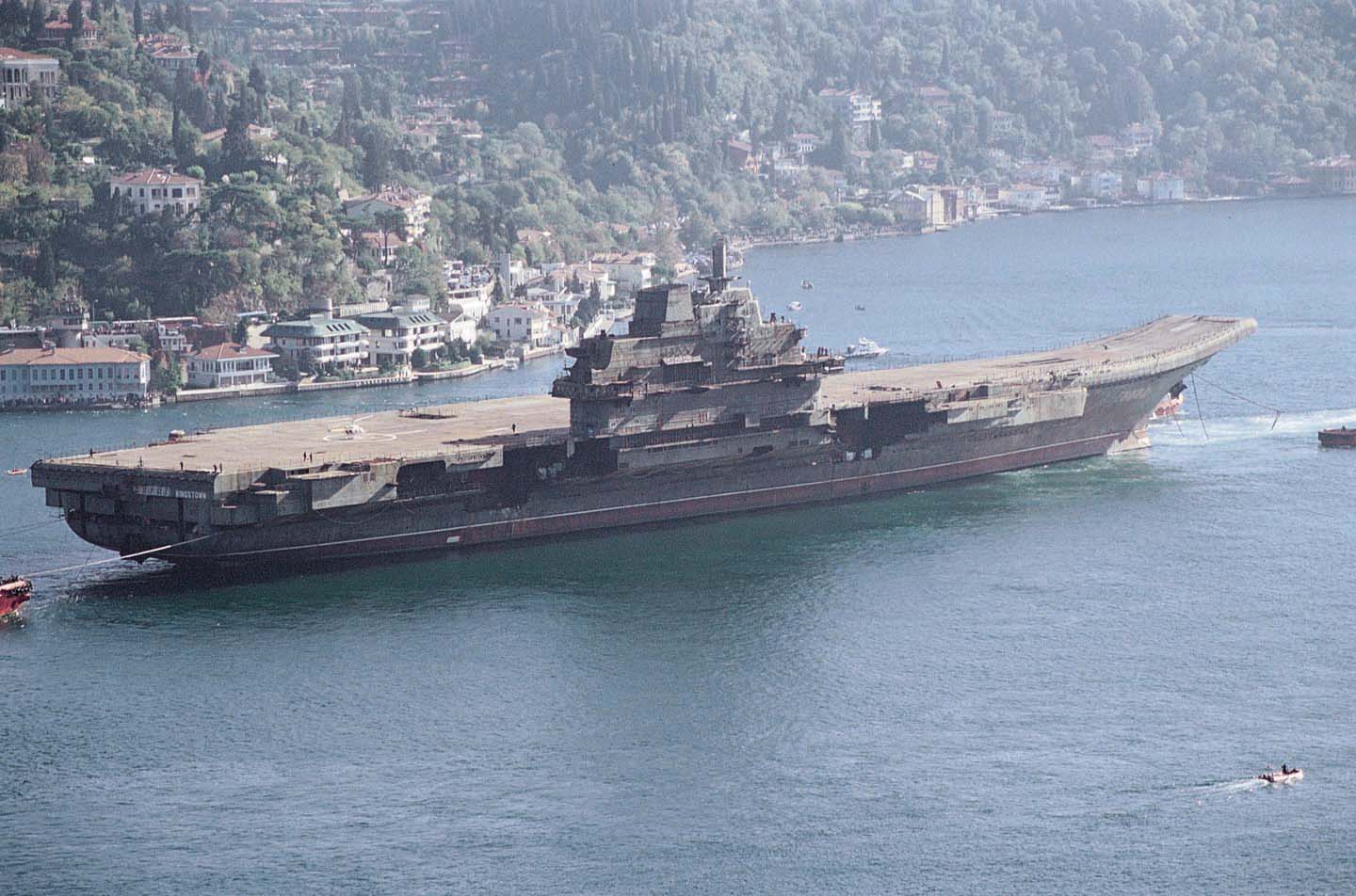
Earlier this year, the Russian aircraft carrier Varyag was renamed the Shi Lang (after the Chinese general who took possession of Taiwan in 1681, the first time China ever paid any attention to the island) and given the pennant number 83. The Chinese have been refurbishing the Varyag, one of the Kuznetsov class that Russia began building in the 1980s, for several years now. It is expected to be ready for sea trials by the end of the year.
The Varyag has been tied up in a Chinese shipyard at Dailan since 2002. While the ship is under guard, it can be seen from a nearby highway. From that vantage point, local military and naval buffs have noted that some kind of work is being done on the ship. The only visible signs of this work are a new paint job (in the gray shade used by the Chinese navy) and ongoing work on the superstructure (particularly the tall island on the flight deck.) Many workers can be seen on the ship, and material is seen going into (new stuff) and out of (old stuff) the ship. The new contracts are believed to be for more equipment for the Varyag, in addition to the non-custom stuff already going into the ship.
Originally the Kuznetsovs were conceived of as 90,000 ton, nuclear powered ships, similar to American carriers (complete with steam catapults). Instead, because of the cost, and the complexity of modern (American style) carriers, the Russians were forced to scale back their goals, and ended up with the 65,000 ton (full load ) ships that lacked steam catapults, and used a ski jump type flight deck instead. Nuclear power was dropped, but the Kuznetsov class was still a formidable design. The thousand foot long carrier normally carries a dozen navalized Su-27s (called Su-33s), 14 Ka-27PL anti-submarine helicopters, two electronic warfare helicopters and two search and rescue helicopters. But the ship can carry up to 36 Su-33s and sixteen helicopters. The ship carries 2,500 tons of aviation fuel, allowing it to generate 500-1,000 aircraft and helicopter sorties. Crew size is 2,500 (or 3,000 with a full aircraft load.) Only two ships of this class exist; the original Kuznetsov, which is in Russian service, and the Varyag. Currently, the Kuznetsov is operating in the Mediterranean.
The Chinese have been in touch with Russian naval construction firms, and may have purchased plans and technology for equipment installed in the Kuznetsov. Some Chinese leaders have quipped about having a carrier by 2010 (this would have to be a refurbished Varyag). Even that would be an ambitious schedule, and the Chinese have been burned before when they tried to build new military technology in a hurry.
Friday, September 19, 2008
China training Navy pilots for Aircraft Carrier
China training Navy pilots for Aircraft Carrier
(NSI News Source Info) September 20, 2008: China announced that its first class of carrier aviators had begun training at the Dalian Naval Academy. The naval officers will undergo a four year course of instruction to turn them into fighter pilots capable of operating off a carrier. China already has an airfield, in the shape of a carrier deck, built at an inland facility. The Russians have warned China that it may take them a decade or more to develop the knowledge and skills needed to efficiently run an aircraft carrier. The Chinese are game, and are slogging forward.
Earlier this year, the Russian aircraft carrier Varyag was renamed the Shi Lang (after the Chinese general who took possession of Taiwan in 1681, the first time China ever paid any attention to the island) and given the pennant number 83. The Chinese have been refurbishing the Varyag, one of the Kuznetsov class that Russia began building in the 1980s, for several years now. It is expected to be ready for sea trials by the end of the year.
The Varyag has been tied up in a Chinese shipyard at Dailan since 2002. While the ship is under guard, it can be seen from a nearby highway. From that vantage point, local military and naval buffs have noted that some kind of work is being done on the ship. The only visible signs of this work are a new paint job (in the gray shade used by the Chinese navy) and ongoing work on the superstructure (particularly the tall island on the flight deck.) Many workers can be seen on the ship, and material is seen going into (new stuff) and out of (old stuff) the ship. The new contracts are believed to be for more equipment for the Varyag, in addition to the non-custom stuff already going into the ship.
Originally the Kuznetsovs were conceived of as 90,000 ton, nuclear powered ships, similar to American carriers (complete with steam catapults). Instead, because of the cost, and the complexity of modern (American style) carriers, the Russians were forced to scale back their goals, and ended up with the 65,000 ton (full load ) ships that lacked steam catapults, and used a ski jump type flight deck instead. Nuclear power was dropped, but the Kuznetsov class was still a formidable design. The thousand foot long carrier normally carries a dozen navalized Su-27s (called Su-33s), 14 Ka-27PL anti-submarine helicopters, two electronic warfare helicopters and two search and rescue helicopters. But the ship can carry up to 36 Su-33s and sixteen helicopters. The ship carries 2,500 tons of aviation fuel, allowing it to generate 500-1,000 aircraft and helicopter sorties. Crew size is 2,500 (or 3,000 with a full aircraft load.) Only two ships of this class exist; the original Kuznetsov, which is in Russian service, and the Varyag. Currently, the Kuznetsov is operating in the Mediterranean.
The Chinese have been in touch with Russian naval construction firms, and may have purchased plans and technology for equipment installed in the Kuznetsov. Some Chinese leaders have quipped about having a carrier by 2010 (this would have to be a refurbished Varyag). Even that would be an ambitious schedule, and the Chinese have been burned before when they tried to build new military technology in a hurry.

German Missiles Defending South Korea
 German Missiles Defending South Korea
(NSI News Source Info) September 20, 2008: South Korea has begun installing a billion dollars worth of second hand German Patriot anti-aircraft missiles. The Germans don't need as many Patriot batteries since the Cold War ended in 1991. So they sold twelve batteries, and several hundred PAC 2 missiles, to South Korea, who want to improve their defenses against North Korean ballistic missiles. The PAC 2 can knock down the SCUD type missiles that North Korea has hundreds of.
Each Patriot battery is manned by about a hundred troops, and contains a radar, plus four launchers. A Patriot launcher can hold four PAC 2s, each of which weighs about a ton and has a range of 70 kilometers against missiles or aircraft.
Sudan: Lack of UN helicopters compounding additional hardship
 Sudan: Lack of UN helicopters compounding additional hardship
(NSI News Source Info) September 20, 2008: UNAMID (the UN-African Union hybrid force in Darfur) still suffers from a key equipment shortage: helicopters. Earlier this year the "helo shortage" received a lot of attention from UN leaders. There were promises, but the helicopter requests remain unfilled. The UN needs 18 transport helicopters and six attack helicopters. Now UN officers are complaining that claims of attacks by both the Sudan government and rebel groups are difficult to investigate because the observers lack air mobility. In milspeak, the "assessment missions are constrained," meaning the observers can't get to the battle site before the carnage is over and the militia, or soldiers, or guerrillas have gone. The helicopters would also serve a scout role to protect UN convoys by detecting ambushes. The UN has chartered some non-military helicopters as a means of moving staff from headquarters in EL Fasher to outlying areas.
Only 10,000 of the 26,000 peacekeepers have arrived, with about half the force expected to arrive by the end of the year. But because of a lack of helicopters, the peacekeepers have not had much impact on the fighting in the huge region. The government sees this failure as another victory for its strategy of denying its crimes and lying to the UN. Sudan has also quietly called on its Arab and other foreign allies to pressure the UN to get war crimes charges dropped against the Sudanese president.
September 17, 2008: The government is still waging its political war against the International Criminal Court. Now the government has enlisted Algeria in its effort to get the UN Security Council to get the court to delay acting on a prosecutor request an arrest warrant for Sudanese President Omar al-Bashir.
September 15, 2008: Heavy fighting continues in North Darfur state. A series of new attacks by the army and pro-government militias began in late August. It became clear that the effort was something more than the typical government offensive, when rebel groups reported on September 7 and 8 air attacks followed up by ground assault on towns in North Darfur state. NGOs and UN aid workers report that the civilians who fled that round of fighting are now without food. One sources reported that some of the villages in the area had not harvested their crops – suggesting that the attacks were timed to drive the villagers away from their homes and fields before harvest time. If this sounds like an attack to drive people into starvation, well, it probably is. The government rejected charges that it was conducting a sustained offensive. The government's official line is its forces are "securing roads" to protect them from bandits.
September 11, 2008: The Government of South Sudan (GOSS) said that the national elections scheduled for July 2009 "could be delayed." This has been a possibility for a long time. The 2005 Comprehensive Peace Agreement required the GOSS and Sudan's national government (Khartoum) to work out border and voting issues. Many of those issues have either led to trouble on the ground (like Abyei) or not been addressed at all.
September 10, 2008: The UN accused Sudan of launching a series of attacks in Darfur on unprotected civilians. Some of the attacks under investigation occurred in July. For example, UN investigators determined that Sudan aircraft attacked targets in Darfur 21 times during the first three weeks of July 2008. Most of the strikes were launched by Antonov transports rigged as bombers.
September 9, 2008: Sudan issued an apology to Kenya. Sudan acknowledged that "armed raiders" operating from Sudan had stolen cattle in Kenya and conducted at least one kidnapping.
September 8, 2008: Sudanese forces fought with the Sudan Liberation Army (SLA) in a series of battles in Darfur. An SLM spokesman reported that Sudan used Antonov transports to bomb three towns in North Darfur state: Tawila, Disa, and Birmaza. The government forces took control of Disa. The SLM claimed that civilians in the area had "fled into the desert." In warfare like this exposure (to include subsequent starvation) of displaced civilians usually kills more people than the actual attacks.
Algeria building defense industry
 Algeria building defense industry
(NSI News Source Info) September 20, 2008: Algeria is nearly tripling its defense budget from $2.5 billion to $6.25 billion. But that is a deceptive increase, since most of it is going to establish factories to produce military equipment and weapons. It's possible to produce a lot of the basic military equipment (uniforms, tents, protective gear) and weapons (rifles, grenades, ammunition) in Algeria. It's more expensive that way, and the quality isn't always as good, but you provide more jobs for Algerians. That's the main reason behind spending all this money to build this manufacturing capability. Foreign firms are willing to sell licenses to build proven weapons in Algeria, and other firms can be hired to help set up factories for less specialized gear (like uniforms and some types of ammunition). Training Algerians to run all these new factories may take five years or more, especially for more complex items.
Algeria sees this as a popular way to spend the additional income they have been receiving because of the higher oil prices. While there are still Islamic terrorists operating in Algeria, the security forces are well enough equipped to deal with that. The fundamental problem in Algeria is unemployment and government corruption. Anything that creates more jobs address that basic source of discontent, and removes enemy fighters from the battlefield.
Rolls Royce AE1107C jet engines are wearing out ahead of schedule
 Rolls Royce AE1107C jet engines are wearing out ahead of schedule
(NSI News Source Info) September 19, 2008: The Rolls Royce AE1107C jet engines (that drive the propellers) in the U.S. Marine Corps new tilt rotor V-22 aircraft, are wearing out ahead of schedule. That is endangering a unique maintenance program. Overall, V-22 engines last nearly 500 hours (and some have gone over 600 hours), but in Iraq, the average is not quite 400 hours. This is particularly bad news for Rolls Royce, which sold the Department of Defense a "power by the hour" maintenance agreement. The deal is what the name implies. The user pays Rolls Royce a variable amount for repairs and replacement of the engines, depending on how many hours the engine is used. This approach has become quite popular, and successful, for commercial, and now military, engines (and other equipment as well). This system gives the maintenance supplier (often the manufacturer) a financial incentive to build the gear to last, and to keep running without untimely failures. This works fine for equipment that is used in known conditions. The peculiar sand and dust in Iraq, in addition to the high temperatures, proved to be so extreme, that they wore down the AE1107C engines faster than Rolls Royce had anticipated. The maintenance deal is being renegotiated. If the "power by the hour" deal for the V-22 does not work, the V-22 will be more expensive to operate, and will be down for maintenance more often.
The MV-22s used by the marines can carry 24 troops 700 kilometers (vertical take-off on a ship, level flight, landing, and return) at 390 kilometers an hour. The V-22 is replacing the CH-46E helicopter, which can carry 12 troops 350 kilometers at a speed of 135 kilometers an hour. The V-22 can carry a 10,000-pound external sling load 135 kilometers, while the CH-46E can carry 3,000 pounds only 90 kilometers.
The marines began using the MV-22 in Iraq late last year, and have been satisfied with the results. However, it was expected that there might be problems with engine durability. Every other vehicle that uses a gas turbine engine in Iraq (from M-1 tanks to C-17 jet transports) have reported increased wear on their engines because of the copious and continuous dust and sand in Iraq.
For the V-22, another problem is that even frequent inspections won't always catch an engine that's about to die from too much dust and sand. Several MV-22s in western Iraq (Anbar province, where marine MV-22s were operating) have experienced engine failures. There have been no crashes, but there have been emergency landings (followed by quick engine changes so the $70 million, 20 ton aircraft could get home under its own power). The Rolls Royce T-406 engines weigh about a ton each, and put out 6,000 horsepower. Marine maintenance crews are trained to put a spare engine inside a V-22, along with needed tools, fly out to where another V-22 has made an emergency landing, do the engine change quickly, and get back to base in one piece.
UH-60 Black Hawk transport helicopters are being turned into gunships
 UH-60 Black Hawk transport helicopters are being turned into gunships
(NSI News Source Info) September 19, 2008: In the Persian Gulf, UH-60 Black Hawk transport helicopters are being turned into gunships. The UAE (United Arab Emirates) has ordered 14 American UH-60M transport helicopters, and some interesting accessories. The package includes six spare engines, and an defensive electronic warfare system for each helicopter (including laser and radar warning sensors as well as defenses against anti-aircraft missiles.) This purchase includes weapons systems for the new, and existing, UAE UH-60s. This includes equipping 23 of these aircraft to use Hellfire missiles. That includes 30 Hellfire launchers and 390 Hellfire missiles and 23,916 70mm (2.75 inch) unguided rockets. Gun systems include 22 of the three barrel 12.7mm GAU-19 Gatling gun (weighing 500 pounds.) The GAU-19 can also deliver 33 rounds a second. Also, 93 of the GAU-2/M-134 six barrel 7.62mm minigun, which can fire 66 rounds a second.
Thursday, September 18, 2008
Eurocopter Fires Spike Missile From HAD Tiger
 Eurocopter Fires Spike Missile From HAD Tiger
(NSI News Source Info) El Arenosillo, Spain (SPX) September 19, 2008: As part of the development of the HAD (support and destruction helicopter) version of the Tiger, Eurocopter successfully completed a firing campaign using the Spike air-to-ground missile.
This campaign was conducted at the El Arenosillo firing range in Spain, which belongs to the Spanish National Institute for Aerospace Technology (INTA). For air-to-ground missions, the Spanish helicopters will be equipped with the fiber-optic guided Spike missile developed by the Israeli company Rafael.
Spain is currently one of two customers for the HAD version of the Tiger: the Spanish armed forces have ordered 24 of these aircraft, and France has ordered 40 HAD version Tigers.
For air-to-ground missions, the Spanish helicopters will be equipped with the fiber-optic guided Spike missile developed by the Israeli company Rafael.
Seven missiles were fired in El Arenosillo. Five were launched without their main propulsion units, as the sole aim was to validate the helicopter/weapon integration concept and to clear the firing envelope, ensuring that the weapon separated cleanly from the helicopter during firing. This was checked in hover and in forward flight.
The other two missiles were able to hit their targets six to eight kilometers away as these infrared guided missiles were equipped with their propulsion units.
The first missile was fired in the lock on before launch (LOBL) mode and the second in the lock on after launch (LOAL) mode. Six of the missiles were fired by an all-Eurocopter crew, and the seventh (fired in LOBL launch) by a crew made up of a Eurocopter pilot in the front seat and a Spanish gunner-commander in the rear.
All of the missiles were fired successfully.
Japan shoots down test missile in US: ministry
 Japan shoots down test missile in US: ministry
(NSI News Source Info) Tokyo (AFP) September 19, 2008: Japan said Thursday it had shot down a mock missile in the US desert, taking another step to build a shield with the United States against a possible North Korean attack.
Japan became the first country other than the United States to test the new US-developed Patriot Advanced Capability-3 (PAC-3), a surface-to-air missile that tracks and hits incoming targets, the defence ministry said.
In the test Wednesday in the southwestern US state of New Mexico, Japan's air force shot down a mock missile that was launched from 120 kilometres (75 miles) away, a defence ministry spokesman said.
"The success of the test was significant as it proved that Japan's missile defence system will function effectively," the spokesman said.
In an irony of history, the White Sands range of Wednesday's missile test stands on the site where the United States conducted a key 1945 test to make the atomic bomb, which was later dropped on Japan.
Japan has been officially pacifist since defeat in World War II but has increasingly sought to play a larger role in security.
Washington and Tokyo have been working jointly to erect a missile shield against possible attacks from North Korea, which fired a missile over Japan's main island in 1998 and tested an atom bomb in 2006.
A South Korean newspaper said this week that North Korea, at a standstill with the United States over a disarmament deal, had carried out an engine ignition test for a missile believed capable of reaching the US west coast.
US military forces stationed in both Japan and South Korea have deployed PAC-3 missiles.
Japan in December carried out on a separate test in the Pacific Ocean of a Standard Missile 3 (SM-3) sea-to-air missile.
Japan plans to complete its missile shield by early 2011, deploying the PAC-3 missiles at 11 bases and setting up SM-3 missiles on four Aegis warships.
South African Defence Minister Hands Over Gripens to Air Force
 South African Defence Minister Hands Over Gripens to Air Force
(NSI News Source Info) September 19, 2008: In a spectacular ceremony at AAD, Africa’s premier aerospace show, South African Gripen fighters are welcomed into the South African Air Force. Today, on the first day of the biennial Africa Aerospace and Defence show, being staged at AFB Ysterplaat in Cape Town, South Africa, history was made when Defence Minister Mosiuoa Lekota officially handed over the first of the country’s fleet of new generation Gripen fighters to Lt. Gen. Carlo Gagiano, Chief of the South African Air Force. The occasion was marked in style with a fly past of four of South Africa’s fleet of twenty-six Gripen fighters, with the spectacular backdrop of Cape Town’s famous Table Mountain providing some memorable photo opportunities. Following the fly past, the four aircraft landed at Ysterplaat and taxied to a position in front of Defence Minister Lekota, Lt. Gen. Carlo Gagiano and other VIP guests from the Government, Air Force and industry and the media. The pilots, including South Africa pilots Musa Mbhokota and Charl Coetzee, then de-planed and joined in the ceremony which saw Gen. Gagiano officially accept the first Gripen fighter from Minister Lekota. South Africa has ordered twenty-six Gripen fighters of the latest C/D standard, 9 two-seaters and 17 single seaters. Deliveries commenced this year, with four aircraft already in-country, and the remainder scheduled to be delivered progressively until 2012.
Lockheed Martin Inducts First C-5A Into Avionics Modernization Program
 Lockheed Martin Inducts First C-5A Into Avionics Modernization Program
(NSI News Source Info) September 19, 2008: The first C-5A Galaxy has entered the Avionics Modernization Program (AMP), which has already upgraded 42 of the planned 111 aircraft. (USAF photo)MARIETTA, Ga. --- The Lockheed Martin C-5 Avionics Modernization Program (AMP) reached another milestone this week with the induction of the first U.S. Air Force C-5A into the program. "The combination of hardware and software afforded through AMP allows Air Force crews to fly unrestricted anywhere in the world," said George Shultz, Lockheed Martin's vice president of C-5 Modernization. "Modernizing the C-5As today with new avionics further ensures this unique national asset will continue to support the warfighter for many years to come." The AMP replaces the analog cockpit instruments and systems in the C-5 with digital displays and equipment. It also provides the necessary communications and navigational avionics to comply with Global Air Traffic Management (GATM) requirements, the new set of international standards for aircraft movement and reduced separation in flight. There are 111 C-5s to be modified through AMP with 42 production airplanes completed to date. The AMP installations are taking place at Dover AFB and Travis AFB and are scheduled to be completed in second quarter 2014. The C-5 AMP fleet has flown more than 9,400 sorties and 40,000 operational flight hours. The Air Force had the C-5As re-winged in the 1980s, increasing their structural service life to the equivalency of its C-5Bs. The C-5 has been the backbone of strategic airlift in every military engagement since it entered service and has supported U.S. humanitarian relief efforts around the globe. It is the only aircraft capable of carrying 100 percent of certified air-transportable cargo, with a dedicated passenger compartment enabling commanders to have troops and their equipment arrive in an area of operation simultaneously. Lockheed Martin is a pioneer in sustainment initiatives, offering a number of flexible and individually tailored support solutions. The company is a major supplier of logistics systems and services to military and civil government customers, and provides solutions for platform maintenance, modifications and repair, material readiness and distribution, and global supply chain command and control. Headquartered in Bethesda, Md., Lockheed Martin is a global security company that employs about 140,000 people worldwide and is principally engaged in the research, design, development, manufacture, integration and sustainment of advanced technology systems, products and services. The corporation reported 2007 sales of $41.9 billion.
Subscribe to:
Posts (Atom)