Pakistan Expands Unmanned Air Force
(NSI News Source Info) November 12, 2008: America's killer drones are getting all the attention, in the fight against Pakistani militants. But Pakistan's military has plenty of unmanned aerial vehicles, or UAVs, too. And they're being used to spy on suspected insurgents, and listen in on their phone calls.
Since 2002, Pakistan has dramatically expanded its robotic fleet in the sky, Defense News reports. The Pakistani Air Force has two UAV squadrons -- and is looking to build up to six.
"Al-Qaida and Taliban fighters use not just mobile and satellite phones for communication, but also sophisticated military radios," Defense News notes. So companies like East West Infiniti are building SIGINT [signals intelligence] for small drones and robotic blimps, to capture those conversations.
Designed for militaries unable to afford high-end, dedicated SIGINT platforms, [East West's] Whisper Watch [system] can detect and monitor electronic emissions up to 250 kilometers away and then retransmit to a ground station located out of harms way.
Karachi-based Integrated Dynamics actually exports its Border Eagle surveillance drone to the United States for border patrol duties. The company also makes drones the turbojet-powered Tornado decoy, which can fly up to 200 kilometers, and emit false radar signals to "confuse enemy air defenses into thinking they are attacking aircraft," Defense News says.
The gear will all be on display at the end of the month, at IDEAS, Pakistan's big military trade show.
Tuesday, November 11, 2008
Pakistan Expands Unmanned Air Force
Pakistan Expands Unmanned Air Force
(NSI News Source Info) November 12, 2008: America's killer drones are getting all the attention, in the fight against Pakistani militants. But Pakistan's military has plenty of unmanned aerial vehicles, or UAVs, too. And they're being used to spy on suspected insurgents, and listen in on their phone calls.
Since 2002, Pakistan has dramatically expanded its robotic fleet in the sky, Defense News reports. The Pakistani Air Force has two UAV squadrons -- and is looking to build up to six.
"Al-Qaida and Taliban fighters use not just mobile and satellite phones for communication, but also sophisticated military radios," Defense News notes. So companies like East West Infiniti are building SIGINT [signals intelligence] for small drones and robotic blimps, to capture those conversations.
Designed for militaries unable to afford high-end, dedicated SIGINT platforms, [East West's] Whisper Watch [system] can detect and monitor electronic emissions up to 250 kilometers away and then retransmit to a ground station located out of harms way.
Karachi-based Integrated Dynamics actually exports its Border Eagle surveillance drone to the United States for border patrol duties. The company also makes drones the turbojet-powered Tornado decoy, which can fly up to 200 kilometers, and emit false radar signals to "confuse enemy air defenses into thinking they are attacking aircraft," Defense News says.
The gear will all be on display at the end of the month, at IDEAS, Pakistan's big military trade show.

European Air Transport Fleet Launched
 European Air Transport Fleet Launched
(NSI News Source Info) November 11, 2008: European Defence Agency, launched today concrete initiatives and projects for improving European military capabilities. Decisions were taken on programmes related to air transport, maritime surveillance and helicopters, amongst others. "This is the concrete follow-up to the discussions which took place at the Informal EU Defence Ministers meeting in Deauville early October. We are seeing today that the Agency can very quickly translate political intentions into concrete proposals. These programmes will create tangible European capabilities and improve the capacity for crisis management operations”, said Head of the Agency Javier Solana, who chaired the meeting.
European Air Transport Fleet
European Defence Ministers launched today EDA work on establishing a European Air Transport Fleet (EATF). A Declaration of Intent on participation in the initiative was signed by Defence Ministers of Belgium, Czech Republic, France, Germany, Greece, Italy, Luxembourg, Netherlands, Portugal, Romania, Slovakia and Spain. The EATF aims at reducing European air transport shortfalls by pooling aircraft such as the A400M and C130. Participation can take different forms: making aircraft available; purchasing, providing or exchanging flying hours; or to provide and benefit from shared and/or pooled support functions (training, maintenance, etc.). Milestones have been set with the aim of reaching EATF initial operational capability by the next decade. “The EATF Declaration is most welcome, as pooling European aircraft and services will improve the lift capabilities and alleviate a significant European shortfall”, said Alexander Weis, the Agency’s Chief Executive.
Maritime Mine Counter-Measures
The Steering Board also launched two other projects. Ten Member States (Belgium, Estonia, Finland, France, Germany, Netherlands, Poland, Portugal, Romania and Sweden) plus Norway will work closely together in an EDA project for the future replacement of their maritime mine counter-measures capabilities in an EDA project. Activities will commence with an assessment phase, leading to recommendations for the selection of systems solutions and addressing all relevant aspects. Mine counter-measures in littoral sea areas has been identified as one of the initial 12 prioritised actions in the context of the Agency’s Capability Development Plan (CDP). Future Unmanned Aerial System
Another project, related to Maritime Surveillance, is the launch of work for a Future Unmanned Aerial System. Based on common requirements, seven Member States (Finland, France, Germany, Poland, Portugal, Spain and Sweden) will begin the preparations for the development of an unmanned aerial system, which will be able to take off and land on a ship’s deck. This future system will increase the capability for wide area surveillance in support of ESDP operations, a need which has been identified in the Capability Development Plan.
Space-based Earth Surveillance System
Five Member States (Belgium, France, Germany, Greece, Spain) signed a Letter of Intent on the second generation of space-based imaging capacity. This Multinational Space-based Imaging System for surveillance, reconnaissance and observation (MUSIS) project aims at continuity of service from 2015 onwards. The MUSIS partners intend to launch an EDA Category B project on the basis on their initiative, which will be open for other Member States' participation. Helicopters
The Steering Board endorsed a roadmap for the Helicopter Tactics Training Programme, part of the Agency’s work to improve availability of helicopters for ESDP operations. The contents of this programme will be defined in the course of 2009, based on the results of two studies – focussing on the requirements – and the lessons learned from an exercise, to take place in France in spring 2009. The Programme itself will start in 2010.
“The Agency is quickly progressing with its helicopter work. The Helicopter Tactics Programme is proving that in some cases training can provide additional capabilities in the short-term. Improving ESDP capabilities does not always require new equipment”, said Alexander Weis, EDA’s Chief Executive.
Ministers also took stock of the progress made on the Agency’s work on upgrading helicopters, with the aim to offer a detailed menu with upgrade options by spring 2009.
Germany and France informed the Steering Board of their intent to bring their bilateral initiative for a Future Transport Helicopter into the Agency in the near future, opening up the project to other interested Member States. The project aims at developing intra-theatre transport helicopter for the 2020+ timeframe.
European Defence Research and Technology Strategy
Ministers endorsed the European Defence Research and Technology (EDRT) Strategy to enhance and develop more effective research collaboration to deliver timely the right technologies in support of military capabilities. The Strategy defines “ends” (key technologies to invest in), “means” (how to invest better, such as through improved R&T collaborations) and “ways” (roadmaps and action plans). Four of the 12 priority actions of the Capability Development Plan have been chosen for identifying potential R&T projects: Counter-Man Portable Air-Defence Systems (C-MANPADS), Mine Counter- Measures, Counter-Improvised Explosive Devices (C-IED) and Chemical, Biological and Radiological or Nuclear (CBRN) - specifically detection of biological weapons.
The EDRT Strategy completes the EDA work on its strategic framework. With the CDP as the overall strategic tool this framework consists of the EDRT Strategy, the Armaments Cooperation Strategy (endorsed in October 2008) and the European Defence Technological and Industrial Base Strategy (endorsed in May 2007).
Innovative Concepts and Emerging Technologies
Ten Member States (Cyprus, France, Germany, Greece, Hungary, Italy, Poland, Slovakia, Slovenia and Spain) plus Norway signed the Programme Arrangement for the Joint Investment Programme on Innovative Concepts and Emerging Technologies (JIP-ICET). The Programme aims at promoting basic research cooperation, for example on an integrated navigation architecture and on nanotechnologies for soldier protection.
Forum for Military Airworthiness Authorities
Ministers decided to create a European Union-wide Forum for Military Airworthiness Authorities. This Forum will be used to harmonise the different national military airworthiness regulations within the European Union in order to stop duplication of work, to reduce costs and to shorten timelines for multinational procurement.
Work Programme
The Steering Board approved the Agency’s Work Programme for 2009. The focus of the Work Programme is on concrete projects, in particular related to the 12 prioritised actions stemming from the Capability Development Plan. The Agency will have a 2009 budget of EUR 30 million, including EUR 8 million operational budget for studies, and will recruit ten new staff. The budget was adopted by the General Affairs and External Relations Council in Defence Ministers formation.
Defence Data 2007
Ministers were informed on the results of the Agency’s defence data-collecting for 2007 and on the assessment of the collective benchmarks for Defence R&T and equipment procurement.
Germany Orders 198 Mowag Eagle IV Armored Vehicles
Germany Orders 198 Mowag Eagle IV Armored Vehicles
(NSI News Source Info) VIENNA, Austria - November 11, 2008: General Dynamics European Land Systems has entered a contract with the German Bundesamt fur Wehrtechnik und Beschaffung (BWB) for the delivery of 198 EAGLE IV protected Command and Function Vehicles, including 25 vehicles that were delivered earlier under an agreement reached in July.
 MOWAG EAGLE IV 4x4 Military Tactical Vehicle with 12.7mm Kongsberg remote weapon station. Ideally suited as a platform for various tactical mission roles such as reconnaissance, surveillance, command or military police tasks
The contract has a total value of 106 million Euros (approx. $141 million), including provision for development of a logistics and service-support organization. This contract is the largest order ever awarded for the new EAGLE IV vehicle. The 198 vehicles now under contract will be manufactured in Kreuzlingen, Switzerland, and Kaiserslautern, Germany. Deliveries will commence in 2008 and will extend to 2010. Within the framework of the "GFF Klasse 2" program - protected Command and Function vehicles - unprotected carrier vehicles of the Bundeswehr will be replaced by the EAGLE IV to enhance the safety of German soldiers wherever they may serve. Due to its high deployability, agility and tactical mobility, the EAGLE IV is suitable for the entire mission spectrum for this class of vehicles. The EAGLE IV can be used for various missions by applying modular add-on kits. Furthermore, the substantial payload capability - which is significant, despite the high level of crew protection - supports the growth potential required to fulfill future requirements. For self-protection, all vehicles will be equipped with a remotely controlled weapon station of the KMW FLW 100/200 type. In addition to its crew-protection and mobility advantages, the EAGLE IV also enjoys low operation and training costs. Lifecycle costs of the vehicle fleet will be further minimized by the high degree of logistic commonality among the EAGLE IV and the DURO IIIP tactical truck, which has already been successfully introduced in the German Bundeswehr as the RLS "YAK." The vehicles share many essential components, such as the engine, transmission, axles, wheel drives, differentials and brakes, helping reduce costs. The German Bundeswehr will share the cost advantage of a common EAGLE IV and DURO IIIP fleet previously enjoyed only by Denmark. In announcing the order, Lutz Kampmann, vice president of Wheeled Vehicles for General Dynamics European Land Systems, said, "This order is an important milestone for the international success of our EAGLE IV as well as for the continuous development of our relationship with Germany as a key customer. The contract demonstrates the German Bundeswehr's confidence in our products, particularly in the DURO IIIP vehicles which since 2003 have proven themselves in peace missions in Afghanistan and other places." "This order also will help open doors to new customers for the EAGLE IV," Kampmann said, "since the multi-purpose designs enables the vehicle to fulfill the rising need for highly protected transport capacity for the international peace missions of many countries." The baseline development of the EAGLE IV was completed with the roll-out of the first prototype at the end of 2003. Just two years later, the Danish Army ordered 90 vehicles. At the beginning of 2006, the German BWB purchased two EAGLE IV demonstrator vehicles for intensive comparative tests. In these demanding tests, the EAGLE IV proved its superior mobility, a high level of protection for the crew, a large usable volume, and a high payload.
Facts about the EAGLE IV 4x4
The EAGLE IV sets the standard for protected wheeled vehicles in the weight class of up to 9 t. The EAGLE IV has a length of 5.40 m, a height of 2.4 m, a width of 2.16 m, and it accommodates up to 5 persons. It reaches a top speed of 110 km/h on the road and manages gradients of up to 60%. The 245 hp Cummins turbocharged diesel engine, in connection with an Allison 5-speed automatic transmission, the unique DeDion axle system with the patented roll stabilizer, the tire pressure control system and the permanent all-wheel drive give the EAGLE IV superior on-road and off-road mobility. Thanks to the modular protection system, the EAGLE IV offers a very high level of protection against ballistic threats, mines, and IEDs. Furthermore, the vehicle is equipped with an NBC overpressure system. General Dynamics European Land Systems, headquartered in Vienna, Austria, is a business unit of General Dynamics Corporation, and conducts its business through four European operating sites located in Spain, Germany, Austria and Switzerland. With more than 3,250 highly skilled technical employees, General Dynamics European Land Systems' companies design, manufacture and deliver land combat systems, including wheeled, tracked, and amphibious vehicles, armaments and munitions, to global customers.
 MOWAG EAGLE IV 4x4 Military Tactical Vehicle with 12.7mm Kongsberg remote weapon station. Ideally suited as a platform for various tactical mission roles such as reconnaissance, surveillance, command or military police tasks
U.S. Sends 'X-Band' Missile-Detecting Radar to Israel to Confront Iranian Threat
U.S. Sends 'X-Band' Missile-Detecting Radar to Israel to Confront Iranian Threat
(NSI News Source Info) By Reena Ninan FOX News, JERUSALEM, Israel — November 11, 2008: The U.S. is providing Israel with high-powered X-band radar capable of detecting missile launches up to 1,500 miles away — and sensitive enough to detect small- and medium-range missiles being fired from Iran and Syria.
The radar will grant Israel about 60-70 seconds more warning time when missiles are launched. The system's massive range means targets as far away as southern Russia can be monitored.
Every second of warning counts, as Syrian missiles can hit Israel in just four minutes, and Iranian missiles can reach Israel's borders in just 11 minutes.
 The U.S. has installed X-band radar in Israel to provide early warning for missile launches from Iran. 120 American technicians and security guards will be based in Israel's Negev desert to man the machines
Israel will not have direct access to the intelligence the radar collects. American satellites will be used with the radar, and only Americans will have access to the technology and the information.
About 120 American technicians and security guards will be stationed in Israel's southern Negev Desert to oversee the operation, the first time in the country's 60-year history that they've allowed a foreign military presence to be based here.
In September the U.S. Senate passed an amendment allocating $89 million for activating and deploying the X-band radar. Iran was quick to attack the funding in an editorial in the Tehran Times.
"If it were proposed that this fraction of the tax revenues should be allocated to reduce the pains in the hearts of one thousand owners of foreclosed properties in the working class neighborhoods of Chicago ... no doubt the same senators who enthusiastically and unanimously voted for the bill would have rejected it outright with no hesitation or mercy," the paper wrote.
According to military experts, the radar was intended to send a message to Iran, and to Israel as well. It shows Iran the U.S. is beefing up its capabilities in the region, and it also is intended to calm Israel and prevent it from rushing into a military strike.
Israeli military analyst Alon Ben-David said this was Bush's last gift to Israel.
"Having a U.S. force deployed permanently in Israel is a gift, but it also binds Israel. Israel will have to take into account the presence of an American force before considering any military action that might generate a response from the other side," he told FOX News. "But on the other hand, this is a very clear signal of the U.S. commitment to the security of Israel."
 The U.S. has installed X-band radar in Israel to provide early warning for missile launches from Iran. 120 American technicians and security guards will be based in Israel's Negev desert to man the machines
U.S. Army Reservists host Indian army in exercises
U.S. Army Reservists host Indian army in exercises
(NSI News Source Info) November 11, 2008: A fictitious mid-Pacific continent faces political turmoil and unrest.
The leaders of four key countries are in control but overwhelmed.
Under a United Nations mandate, forces from the United States and India arrive to disarm the militia in the nation of "Mojave" and provide security for convoys bringing in humanitarian aid. Soldiers must establish checkpoints, send out patrols and dismantle roadside bombs.
That scenario occupied 48 Hawaii, Alaska and Guam Army reservists last week in a peacekeeping exercise at Fort Shafter. The overarching goal: to develop and expand personal and professional relationships between the U.S. and Indian armies.
During the past four years, the command-post exercise, known as Yudh Abhyas, which in Indian means "Preparing for War," was conducted by 25th Infantry Division soldiers.
But with two of the 25th Division's brigades either in Iraq or on the way, that task fell to Army Reserve. The 9th Mission Support Command handled the yearlong preparation and execution of the computer-simulated U.N. peacekeeping operations.
 Army Reserve Maj. John Lizama, standing, works on a problem with Indian Lt. Col. Deepak Nambiar, left, and Reserve Sgt. 1st Class Madeline Agpaoa at Fort Shafter during a training exercise involving Pacific Army reservists and India
Playing the role of military peacekeepers were the staffs of the California Army Reserve's 40th Brigade Combat Team and the 49th Brigade from India.
Brigadier Neeraj Bali, who led the 36 staff officers from India, described the exercise, which began on Oct. 24 and ended last week, as "pretty unique."
"This is the first time we are exercising such a mission at the brigade level," he said, "and the first time we are operating under a U.N. mandate."
Bali and his deputy, Army Reserve Col. Kurt Smith, directed the efforts of the U.S. and Indian brigades, whose tactical operations center was established a floor below them at Fort Shafter. There, California brigade officers sat alongside their counterparts from India, trying to resolve the battle-simulation problems tossed to them.
"We are learning a lot from them," said Smith, who in his civilian life works as a construction manager for CH2M Hill -- a global engineering and construction company in Idaho. He commutes to Hawaii to fulfill his Army Reserve obligations.
"And I think they (Indian officers) are learning from us. We also are building friendships that will go on."
Seven civilian contractors were hired to play the role of nongovernmental workers from agencies such as the Red Cross or Doctors Without Borders, which would be involved in any global humanitarian mission.
One of them was Colleen Ruru, who once served as public information officer for the New Zealand army. Her job in this exercise was to generate "negative" news reports on what the U.S. and Indian forces are doing.
"The idea here is to show them the long-term effects of what they are doing and to see how they react to offset them," she said.
 Army Reserve Maj. John Lizama, standing, works on a problem with Indian Lt. Col. Deepak Nambiar, left, and Reserve Sgt. 1st Class Madeline Agpaoa at Fort Shafter during a training exercise involving Pacific Army reservists and India
Russian accident sub intended for India: Reports
 Russian accident sub intended for India: Reports
(NSI News Source Info) MOSCOW - November 11, 2008: India's navy was supposed to lease the brand-new Russian nuclear submarine that suffered an accident over the weekend which killed 20 people, news reports said Monday.
An Indian naval spokesman would not comment Monday on leasing this or any submarine from Russia but his boss has said previously that India was interested.
The Akula-class sub was undergoing trials in the Sea of Japan when its fire-extinguishing system activated in error, spewing Freon gas that suffocated the victims and injured 21 others.
Russia's navy said the submarine itself was not damaged in Saturday's accident and returned to its Pacific coast port Sunday under its own power.
Russia's top business dailies Kommersant and Vedomosti reported Monday that the Nerpa was to be handed over to India's navy next year under a 10-year, $650-million lease.
India previously leased a nuclear-powered submarine from the Soviet Union in 1988-1991, and India's navy chief, Adm. Sureesh Mehta, was quoted as saying that India was negotiating with Moscow to lease two Russian nuclear submarines, the first of which could arrive next year.
Armed with cruise missiles capable of hitting targets 3,000 kilometers (1,860 miles) away, Akula-class subs are considered the quietest and deadliest of Russian attack submarines. A sub of that class could unsettle the military balance of power in Asia, dramatically bolstering India's navy capability as it jockeys with China for influence over energy supply routes in the Indian Ocean.
Phone calls to China's defense and foreign ministries seeking comment rang unanswered Monday night.
Vedomosti quoted an unidentified shipping industries official as saying the sub was intended for India's navy, which has already named it the Chakra.
Indian naval spokesman Cmdr. Nirad Sinha would not confirm whether the Nerpa was to be leased and said no Indians were on board the submarine when the accident occurred.
“It's a Russian submarine, and any concerns are Russian concerns," Sinha told The Associated Press.
Indian news reports said Monday the submarine was to join the southern Asian country's navy in August. The Indian Express newspaper also reported that Indian sailors had been scheduled to head to Russia later this month for on-board training.
Kommersant, meanwhile, quoted an unnamed shipyard official as saying the delivery of the submarine to India, originally set for August 2007, had been postponed twice already.
As investigators tried to determine what activated the firefighting system, Russian naval experts said overcrowding and human errors may have contributed to the accident.
The Nerpa had 208 people aboard when the accident occurred, including 81 seamen, according to the navy. Akula-class subs normally carry a crew of 73.
Retired submarine Capt. Alexander Pokrovsky said in a commentary that sea trials often pose increased safety risks.
Pokrovsky also criticized Freon-based fire-extinguishing systems, saying they are dangerous for the crew and need to be replaced with safer equipment.
Individual breathing kits should have saved the crew, but some former submariners said civilian shipyard workers usually have little experience in using them. Seventeen of those killed in the accident were civilians, the Russian navy said.
“Civilians were supposed to undergo training, but it usually is pretty informal," said Igor Kurdin, who heads an association of former submariners. He speculated the fire system could have been triggered by something as simple as someone smoking a cigarette near a safety gauge.
Oil falls to $60 as China spending optimism wanes
 Oil falls to $60 as China spending optimism wanes
(NSI News Source Info) SINGAPORE - November 11, 2008: Oil prices fell to near an 18-month low of $60 a barrel Tuesday as hopes waned that a huge Chinese spending plan will do much to avert a prolonged slowdown in the global economy.
Light, sweet crude for December delivery was down $2.27 to $60.14 a barrel in electronic trading on the New York Mercantile Exchange by midday in Europe. The contract overnight rose $1.37 to settle at $62.41.
In London, December Brent crude fell $2.13 to $56.95 a barrel on the ICE Futures exchange.
Oil closed at $60.77 on Nov. 6, the lowest closing price since March 2007, and has fallen about 59 percent since reaching a record $147.27 in mid-July.
Analyst Olivier Jakob of Petromatrix in Switzerland noted the high volatility accompanying falling prices.
While the Nymex contract is now trading near first-half 2007 prices, the difference then between daily highs and lows was around $1.50 a barrel, while now the average daily range is around $5.50 a barrel with recent daily peaks at $9.50, Jakob said.
Oil prices and stock markets jumped Monday after China said it planned to spend $586 billion in a bid to spur economic growth. But pessimism soon returned as investors focused again on a swooning U.S. economy, which faces its worst recession in decades.
Most Asian and European stock markets fell Tuesday, following the lead of the Dow Jones industrials average, which dropped 0.8 percent Monday. Japan's benchmark Nikkei 225 index slid 3 percent Tuesday, Hong Kong's Hang Seng index dropped 2.9 percent, while London's FTSE and Germany's DAX indexes were both down around 2 percent.
"The market is realizing that package can't prevent us from sliding into the mess we're heading toward," said Toby Hassall, an analyst with Commodity Warrants Australia in Sydney. "The economic outlook is pretty bleak."
Investors are grappling with how bad the recession in the U.S. could be, as government statistics and company results reflect an abrupt slowdown in consumer demand, bank lending and investment during the second half of the year.
Crude demand from the U.S., the world's largest consumer of energy, is a key driver of oil prices.
"We saw extremely poor car sales and pretty shocking unemployment numbers from the U.S. last week," Hassall said. "It wouldn't surprise me if oil edged down toward $50."
U.S. car sales fell to a 25-year low in October while the unemployment rate shot to a 14-year high of 6.5 percent last month.
Militants in Nigeria on Monday resumed attacks on the country's oil installations. The military said it killed eight people while guarding a facility in the oil-rich south of the country.
The Movement for the Emancipation of the Niger Delta, the region's main militant umbrella group, said it wasn't involved in any fighting. The military didn't say which militant faction the dead fighters represented.
Militants frequently attack oil facilities, seeking to hobble Africa's biggest petroleum industry and force Nigeria's federal government to send more oil funds to the southern states where the crude is pumped.
"The focus of the market has really been on the demand side," Hassall said. "I'd be surprised if supply side issues in Nigeria could change the mood of the market."
In other Nymex trading, heating oil futures fell 3.80 cents to $1.97 a gallon, while gasoline prices dropped 3.80 cents to $1.33 a gallon. Natural gas for December delivery slid 3.9 cents to $7.21 per 1,000 cubic feet.
Nigeria militants threaten new "oil war" if attacked
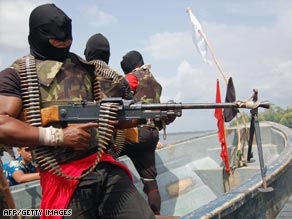 Nigeria militants threaten new "oil war" if attacked
(NSI News Source Info) ABUJA (Reuters) - November 11, 2008: Nigeria's most prominent militant group threatened on Monday to renew attacks on the oil sector if soldiers stormed its hideouts, but a military spokesman denied such plans.
The Movement for the Emancipation of the Niger Delta (MEND) said it believed the military was planning to launch an assault on two of its camps in Delta and Bayelsa states in southern Nigeria.
"This will be a big mistake as it will lead to another oil war where we are sure of a landslide victory," it said in an e-mailed statement.
Lieutenant-Colonel Chris Musa, spokesman for the military task force in Bayelsa, denied any plan to attack militant camps.
"It is always a media war. They are just trying to hype the tension," he said.
In September MEND staged what it called a six-day "oil war," attacking oil installations and forcing Royal Dutch Shell to warn it might not be able to meet all its export commitments from Nigeria.
The group has since declared a ceasefire and repeatedly accused the military of trying to provoke it into confrontation.
Attacks by MEND have cut Nigeria's oil output by around a fifth since early 2006. The country is currently pumping just under 2 million barrels per day, well below its capacity of around 3 million bpd, because of the insecurity and chronic funding shortfalls.
The militant group said on Sunday it would continue to hold two Britons hostage until the British government dropped plans to train Nigerian soldiers in the delta, the heart of the OPEC member's oil sector.
The two captives were among 27 oil workers kidnapped by gunmen in early September.
At least 21 of the hostages have been released and MEND said it freed four others late on Sunday. But a military spokesman on Monday could not confirm the release of the four hostages.
Nkunda warns Africa as fears grow of wider war
 Nkunda warns Africa as fears grow of wider war
(NSI News Source Info) November 11, 2008: GOMA, Congo: Congolese rebel chief Laurent Nkunda said on Monday he would fight African peacekeeping troops if they attacked him, as concerns grew that east Congo’s conflict could suck in neighbouring armies. Leaders from Africa’s southern and Great Lakes regions have offered to send troops to try to help pacify east Democratic Republic of Congo, where fighting between Nkunda’s Tutsi rebels and the army has uprooted hundreds of thousands of people. Aid agencies in Congo’s North Kivu province are struggling to provide shelter, food and medical care for more than 200,000 refugees around the provincial capital Goma, but say tens of thousands more are cut off in the bush. They warn of the risk of cholera and measles epidemics in the camps. African and Western governments are worried the recent upsurge in fighting in North Kivu, which borders Rwanda and Uganda, risks drawing in Congo’s neighbours as occurred during a previous 1998-2003 war. That war involved six African armies and the conflict and its aftermath killed several million people. Countries of the Southern African Development Community(SADC) said after a regional summit in South Africa on Sunday the group would send military advisers to help the government of Congolese President Joseph Kabila. SADC would send a peacekeeping force to east Congo “if and when necessary”, its executive secretary Tomaz Salamao said. Nkunda, whose Tutsi fighters are battling Congo government soldiers (FARDC) and their Rwandan Hutu rebel (FDLR) and Mai-Maimilitia allies, said he would welcome African peacekeepers if they came as an impartial force to stabilise North Kivu. But, speaking to Reuters by telephone from eastern Congo, he added: “If they come in and fight alongside the FARDC and the FDLR ... they will share the same shame as the DRC government.”. “If SADC engages like this, they will have made a mistake... I am ready to fight them,” Nkunda said. Some military experts expressed doubts about how quickly a SADC security force could be dispatched to east Congo and how effective it would be against Nkunda’s battle-hardened guerrilla army of 4,000, and against other marauding armed factions. “This is good rhetoric, but I’m not sure it will happen,” said Henri Boshoff, a military analyst for the Institute for Security Studies in Johannesburg, told Reuters. The United Nations, which already has its largest peacekeeping force in the world, 17,000 strong, in Congo, is seeking up to 3,000 extra troops to reinforce its operations there. It says its existing force is thinly stretched across a country the size of Western Europe where armed groups abound. It was not immediately clear whether the proposed African peacekeepers would operate under the UN mandate or separately. The North Kivu conflict traces its origins back to Rwanda’s 1994 genocide of Tutsis by Hutus which helped trigger the 1998-2003 Congo war. Kinshasa accuses Rwanda of backing Nkunda, who says he is defending Congolese Tutsis from attacks by FDLR Rwandan Hutu rebels he says fight with the Congolese army. Rwanda, which has twice invaded Congo before, officially to fight Hutu rebels there, denies this and in turn accuses the Congolese government of not acting to disarm the Hutu rebels. Analysts say to avert the risk of a wider regional war, world and regional powers need to exert firm pressure on both Congo and Rwanda to demobilise the rival rebel groups. “The international community has already invested billions of dollars to build and maintain peace in the Congo. To not invest hugely in diplomatic terms right now would risk it all,” Francois Grignon and Fabienne Hara, Africa programme director and vice president of International Crisis Group, wrote recently. African Great Lakes leaders, including Rwandan President Paul Kagame, called at a summit in Nairobi on Friday for a ceasefire and a political settlement in North Kivu, but said they could also send peacekeepers if required. Commenting on SADC’s offer of troops, Rwandan Foreign Minister Rosemary Museminali said: “There should be a ceasefire and a political solution.” European foreign ministers meeting in Brussels on Monday also called for a political settlement. Congo’s government has asked neighbour Angola, which backed it during the 1998-2003 war, for help. The appearance in North Kivu of Portuguese-speaking soldiers on the government side has fuelled speculation Angola may have already sent troops. But Angola’s Foreign Ministry denied this.
U.S. building bases in Afghanistan to aid drones
U.S. building bases in Afghanistan to aid drones
(NSI News Source Info) WASHINGTON — November 11, 2008: The Pentagon is building a series of air bases in eastern Afghanistan as part of its massive expansion of a system that uses drone aircraft to spy on and attack Taliban insurgents, according to interviews and documents.
 A crew checks an MQ-9 Reaper before it takes off for a mission in Afghanistan
In Afghanistan, harsh winters and a lack of airstrips near the fighting can hinder drone flights. It can take as long as three hours for a drone to reach battlefields, particularly in the rugged mountain area near the border with Pakistan. That area has seen some of the toughest fighting for U.S. troops. By contrast, it can take as little as 10 minutes for a drone to reach hot spots in Baghdad because the Iraqi capital has more air bases, said Dyke Weatherington, deputy director of the Pentagon's unmanned aerial systems task force.
"What the (Pentagon) is trying to do is go in and develop bases closer to those areas that we know we're going to have a sustained presence after a long period of time," Weatherington said. "In fact, recently we set up a couple of additional bases closer to the Pakistan border that cut down those transit times."
Col. Greg Julian, a military spokesman in Afghanistan, said in an e-mail that the military is adding more bases to accommodate drones and additional troops.
The military is developing drones with better deicing systems to help deal with the Afghan winters, he said.
Defense Secretary Robert Gates has made the expansion of intelligence, surveillance and reconnaissance capability a top priority at the Pentagon. The ability to covertly monitor insurgents' movement and communication in Iraq and Afghanistan has helped the military kill top terrorists and detect roadside bombs.
"There's an insatiable demand" for information that can help U.S. forces target insurgents before they can strike, said Dakota Wood, a military analyst at the Center for Strategic and Budgetary Assessments.
Marine Corps Maj. Gen. Mastin Robeson, who leads the Marines' special operations command, said prompt, accurate intelligence is key to defeating insurgents. The information provided to his Marines in Afghanistan has been "terrific, but there's never enough," Robeson said. "We absolutely can use more."
Much of the budget for intelligence collection is secret, but some figures are not classified. Last year, the Pentagon received authority from Congress to shift $1.3 billion in its budget to pay for more drones and the systems needed to fly them. It will shift at least $750 million this year. In addition, it will spend more than $3 billion to buy and develop new unmanned systems this year, Weatherington said.
The Pentagon has also bought more piloted planes, outfitted with cameras and other sensors, to survey the battlefield.
The use of drones, which supply 95% of the full-motion video images commanders use to watch insurgent activity, has skyrocketed in recent years. As recently as 2005, drones flew 100,000 hours, most of it in support of troops in combat in Iraq and Afghanistan. In 2008, the number of hours in flight increased to nearly 400,000.
Since last year, the military has added more than 600 unmanned aircraft, ranging from small hand-launched spy planes to missile- and bomb-carrying Reapers. The military has about 6,000 such aircraft, up from 167 drones at the beginning of the war in 2001.
Air Force surveillance flights in Iraq and Afghanistan have increased substantially.
In Iraq in September, the Air Force flew 862 surveillance sorties compared with 506 in September 2007.
In Afghanistan, the Air Force flew 462 surveillance flights in September compared with 248 a year earlier.
 A crew checks an MQ-9 Reaper before it takes off for a mission in Afghanistan
Subscribe to:
Posts (Atom)