 NATO forces fire on militants in Pakistan
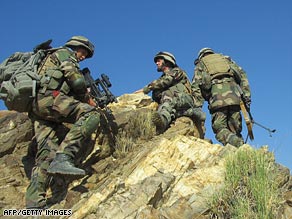
(NSI News Source Info) ISLAMABAD, Pakistan - November 18, 2008: The NATO-led alliance in Afghanistan said its troops fired at militants inside Pakistan in coordination with Pakistani soldiers.
The distinction is a noteworthy one because Pakistan has, in recent months, complained that international forces were violating the country's sovereignty by going after militants inside its borders.
The NATO-led International Security Assistance Force said Monday that the artillery fire Sunday was in response to an attack on an allied base in Paktika province, in eastern Afghanistan. Militants twice fired rockets into the base from across the border, the alliance said.
Once ISAF soldiers pinpointed the origin of the rocket launches, they fired 20 artillery rounds in coordination with the Pakistani military.
"ISAF and Pakistani soldiers observed all fired artillery rounds," an alliance statement issued on Monday said. "The Pakistan soldiers assured ISAF that they would engage any insurgents attempting to flee deeper into Pakistan." No NATO soldiers were hurt in the rocket attack.
ISAF also re-released a statement from September that said its forces can fire back on militants in self-defense under an agreement with Pakistani authorities.
About 40 countries have contributed troops to ISAF, which is charged with supporting the Afghan government in the battle against the Taliban and al Qaeda.
Pakistan has repeatedly raised objections to violations of its sovereignty during the Afghan conflict. A U.S. ground operation in September left several Pakistani civilians dead, and unmanned American drones have carried out several missile strikes inside Pakistan that have resulted in many more casualties.
The actions have not only rankled relations between the two countries, but Pakistan says the raids have undermined public support for its counterterrorism efforts.
The U.S-led coalition and ISAF have been seeking a way to effectively battle militants who are launching attacks from Pakistan's swath of tribal areas along the border with Afghanistan. They have become frustrated with Islamabad over the years, saying it is not being proactive enough against militants -- a claim Pakistan denies.
In western Afghanistan, coalition forces on Tuesday killed five militants and destroyed a weapons cache in Farah province, the U.S.-led coalition said.
"The militants were tracked to a remote location about 75 kilometers northwest of Farah city where they were observed loading weapons into a vehicle from a weapons cache. Coalition aircraft used precision munitions to destroy the militants, weapons and vehicle. There were no civilians or man-made structures in the vicinity of the operation," the coalition said.
Tuesday, November 18, 2008
NATO forces fire on militants in Pakistan
NATO forces fire on militants in Pakistan
(NSI News Source Info) ISLAMABAD, Pakistan - November 18, 2008: The NATO-led alliance in Afghanistan said its troops fired at militants inside Pakistan in coordination with Pakistani soldiers.
The distinction is a noteworthy one because Pakistan has, in recent months, complained that international forces were violating the country's sovereignty by going after militants inside its borders.
The NATO-led International Security Assistance Force said Monday that the artillery fire Sunday was in response to an attack on an allied base in Paktika province, in eastern Afghanistan. Militants twice fired rockets into the base from across the border, the alliance said.
Once ISAF soldiers pinpointed the origin of the rocket launches, they fired 20 artillery rounds in coordination with the Pakistani military.
"ISAF and Pakistani soldiers observed all fired artillery rounds," an alliance statement issued on Monday said. "The Pakistan soldiers assured ISAF that they would engage any insurgents attempting to flee deeper into Pakistan." No NATO soldiers were hurt in the rocket attack.
ISAF also re-released a statement from September that said its forces can fire back on militants in self-defense under an agreement with Pakistani authorities.
About 40 countries have contributed troops to ISAF, which is charged with supporting the Afghan government in the battle against the Taliban and al Qaeda.
Pakistan has repeatedly raised objections to violations of its sovereignty during the Afghan conflict. A U.S. ground operation in September left several Pakistani civilians dead, and unmanned American drones have carried out several missile strikes inside Pakistan that have resulted in many more casualties.
The actions have not only rankled relations between the two countries, but Pakistan says the raids have undermined public support for its counterterrorism efforts.
The U.S-led coalition and ISAF have been seeking a way to effectively battle militants who are launching attacks from Pakistan's swath of tribal areas along the border with Afghanistan. They have become frustrated with Islamabad over the years, saying it is not being proactive enough against militants -- a claim Pakistan denies.
In western Afghanistan, coalition forces on Tuesday killed five militants and destroyed a weapons cache in Farah province, the U.S.-led coalition said.
"The militants were tracked to a remote location about 75 kilometers northwest of Farah city where they were observed loading weapons into a vehicle from a weapons cache. Coalition aircraft used precision munitions to destroy the militants, weapons and vehicle. There were no civilians or man-made structures in the vicinity of the operation," the coalition said.

Moscow Mulls Purchase of Carrier Gorshkov
 Moscow Mulls Purchase of Carrier Gorshkov
(NSI News Source Info) MOSCOW - November 18, 2008: The latest development in the saga that has been the modernization of the Admiral Gorshkov for the Indian Navy, Russian naval and defense industry officials have indicated that Russia may acquire the vessel if India is unwilling to provide the $2 billion needed to finance the extensive retrofit.
On November 13, Deputy General-Director of Sevmash (Severodvinsk Machine Building Enterprise) Sergey Novoselov told RIA Novosti new agency that, "On the market, the price of an aircraft carrier like that varies from three to four billion dollars. The renovations being done at the moment at Sevmash are worth 60-70 per cent of the cost of a new aircraft carrier. That's an approximate sum of up to two billion dollars. Of course, that figure needs refining."
"We are essentially constructing a new aircraft carrier at the open assembly berth of Sevmash. In the last two years, work has only proceeded thanks to internal loans. The construction of any vessel, especially one like this, needs constant and uninterrupted financing," he added, as quoted in the report.
When the contract for the Admiral Gorshkov was signed by Russia and India in 2004, the cost of modernizing the aircraft carrier was agreed at $617 million dollars, Novoselov said, adding that there was no-one to blame for the difference that has formed between the initial and current prices.
"If India won't pay the money, we will keep the aircraft carrier ourselves. It will be very useful to us, because the situation in the world is complicated. Vessels like that are needed to patrol the waters of the Atlantic and the Mediterranean," noted a Russian defense industry official. In such a scenario, Russia would have to compensate India for the money it has already spent on modernizing the vessel. "That's about 400 million dollars," the source said, as quoted in the RIA Novosti report.
Canada Orders 38 Additional MRAP Vehicles
Canada Orders 38 Additional MRAP Vehicles
(NSI News Source Info) LADSON, S.C. - November 18, 2008: Force Protection, Inc. today announced that it has received a modification under contract M67854-07-C-5039 for the delivery of 14 of its Buffalo A2 route-clearance vehicles and 34 of its Cougar vehicles to the Canadian Government.
 Buffalo A2 route-clearance vehicles
The undefinitized contract modification carries a dollar value not to exceed $49.4 million and includes vehicles, spare parts and field support. The vehicles are scheduled for delivery in 2009. This represents the second order for Force Protection vehicles by the Canadian Government. In 2007, Force Protection delivered five Buffalo and five Cougar vehicles for the Canadian Expeditionary Force Command.
Michael Moody, Chairman and Chief Executive Officer of Force Protection, stated, “Our NATO allies continue to face threats from roadside bombs, landmines and many other types of improvised explosive devices. We are delighted that the Canadian military will be receiving this life saving equipment for use in supporting their operations in the global war on terror. This order further solidifies our belief that the Cougar and Buffalo are proving to be the most survivable, sustainable vehicles on the battlefield. We are very pleased that the Canadian government has chosen to procure additional vehicles from Force Protection.”
Force Protection, Inc. is a leading American designer, developer and manufacturer of life saving survivability solutions, predominantly ballistic- and blast-protected wheeled vehicles currently deployed by the U.S. military and its allies to support armed forces and security personnel in conflict zones. The Company’s specialty vehicles, the Cougar, the Buffalo and the Cheetah, are designed specifically for reconnaissance, forward command and control, and urban operations and to protect their occupants from landmines, hostile fire, and improvised explosive devices (IEDs, commonly referred to as roadside bombs). The Company is one of the original developers and primary providers of vehicles for the U.S. military’s Mine Resistant Ambush Protected, or MRAP, vehicle program.
 Buffalo A2 route-clearance vehicles
Eurofighter Test Fleet Surpasses 6,000 Flying Hours
 Eurofighter Test Fleet Surpasses 6,000 Flying Hours
(NSI News Source Info) HALLBERGMOOS, Germany - November 18, 2008: The international test fleet of Eurofighter Typhoon surpassed the 6,000 Flying Hours mark recently. With flight testing now focusing on further enhancements of Eurofighter Typhoon, recent major highlights were the conclusion of in-flight refuelling trials of the Italian Air Force and Alenia Aeronautica with KC-130J Hercules tankers and the beginning of similar trials of the German Air Force, the German Operational Test Centre Wehrtechnische Dienststelle 61 and EADS with Airbus A310 MRTT (Multi-Role Tanker Transport).
Also the first phase of flight tests for Phase 1 Enhancements were concluded at Alenia with IPA2 flying air-to-surface weapon Paveway IV in various configurations for flutter trials. Further trials will follow on IPA1 at BAE Systems and IPA4 at EADS CASA with Paveway IV and the 1000lb dual mode precision guided EGBU-16 bomb. The test data gained in these trials will allow the air vehicle aspects of the P1E capability development to be progressed.
The current test fleet consists of six Instrumented Production Aircraft plus one Instrumented Series Production Aircraft (ISPA1), while IPA3 is on loan to EADS for a flight evaluation in Switzerland.
Eurofighter Typhoon is the world's most advanced new generation multi-role/swing-role combat aircraft available on the market and has been ordered by six nations (Germany, Italy, Spain, United Kingdom, Austria and the Kingdom of Saudi Arabia). With 707 aircraft under contract, it is Europe's largest military collaborative programme and delivers leading-edge technology, strengthening Europe's aerospace industry in the global competition. More than 100,000 jobs in 400 companies are secured by the programme.
Eurofighter Jagdflugzeug GmbH manages the programme on behalf of the Eurofighter Partner Companies Alenia Finmeccanica, BAE Systems, EADS CASA and EADS Deutschland, Europe's foremost aerospace companies with a total turnover of EUR 72.8 billion (2007).
Sikorsky Flies First CH-148 Cyclone Helicopter
Sikorsky Flies First CH-148 Cyclone Helicopter
(NSI News Source Info) WEST PALM BEACH, Fla. - November 18, 2008: The first CH-148 Cyclone helicopter, which is being developed by Sikorsky Aircraft Corp. for the Canadian government as a replacement for its long-serving SEA KING helicopter fleet, has completed its first flight successfully at Sikorsky's Development Flight Center in Florida. Sikorsky is a subsidiary of United Technologies Corp.
 The CH-148 Cyclone will replace the CH-124 Sea King as Canada’s main ship-borne maritime helicopter. This state-of-the-art aircraft will fill the Canadian Forces’ operational demands well into the 21st century
 The CH-148 Cyclone will replace the CH-124 Sea King as Canada’s main ship-borne maritime helicopter. This state-of-the-art aircraft will fill the Canadian Forces’ operational demands well into the 21st century
The flight occurred Saturday, Nov. 15. Steered by Sikorsky Test Pilots John Armbrust and Rick Becker using state-of-the-art, fly-by-wire technology, the aircraft hovered and accomplished low-speed handling tasks including forward flight at speeds reaching 30 knots, and sideward and rearward maneuvers. The helicopter, Tail No. 801, will continue to undergo a series of increasingly demanding flight tests leading up to certification and production deliveries. Sikorsky will build 28 CH-148 helicopters for the Canadian government. "The CH-148 helicopter will be a world leader in sophistication and capability for maritime helicopters," said Program Manager Dan Hunter. "Today's successful first flight represents a huge milestone, transitioning the program from the prototype build to the flight test stage. The aircraft performed beautifully, easily achieving each maneuver attempted. We're extremely pleased." The CH-148 helicopter represents the next step in Sikorsky's long planned extension of the S-92 helicopter into the H-92 helicopter product line. It is equipped with a fully digital, fly-by-wire system designed to improve significantly the aircraft's maneuverability, safety and effectiveness. The CH-148 helicopter further builds upon Sikorsky's rugged S-92 helicopter, which meets the most demanding safety standards in North America and Europe. Among the most sophisticated rotary wing aircraft in the world, the production CH-148 helicopter will be an extremely versatile, multi-mission aircraft with capabilities including anti-submarine warfare, anti-surface warfare, search and rescue, and troop and cargo transport. It will be fully equipped for ship-based operations including automatic blade and tail fold systems and a deck to aircraft recovery assist system. Capitalizing on proven S-92 helicopter capabilities that include a glass cockpit with advanced avionics, systems allowing flight into known icing conditions, flaw tolerant components and state-of-the-art search and rescue equipment, the CH-148 helicopter will incorporate additional mission systems including Forward- Looking Infrared Radar (FLIR), 360 degree search radar, passive and active acoustics systems, threat surveillance and countermeasure capabilities, and network link communications. "The stringent qualification and certification standards of the S-92 helicopter will be further extended through the Canadian military certification process resulting in an aircraft that will meet the most exacting civil and military standards in the world," said Hunter. "Its proven and expanded design focused on reliability, maintainability and safety will provide operational capabilities at world-class life cycle support cost levels." Sikorsky Aircraft Corp., based in Stratford, Conn., is a world leader in helicopter design, manufacture and service. United Technologies Corp., based in Hartford, Connecticut, provides a broad range of high technology products and support services to the aerospace and building systems industries.
U.S. Marines Order More M72A7 Anti-Armor Weapons
 U.S. Marines Order More M72A7 Anti-Armor Weapons
(NSI News Source Info) November 18, 2008: Nammo Talley Defense, Inc., Mesa, Ariz., is being awarded a $15,460,047 firm fixed price contract for the procurement of 7,750 units of Light Weight Anti Armor Weapons rockets, M72A7, to replenish stockpiles. The M72A7, DODIC HA29, is a man-portable, shoulder launched rocket designed to destroy armored vehicles and covered enemy fighting positions.
Work will be performed in Mesa, Ariz., (70 percent); Camden, Miss., (16 percent); and Davidsville, Pa., (14 percent), and is expected to be completed by Apr. 2011. Contract funds will not expire at the end of the current fiscal year.
This contract was not competitively procured - sole source announced via Navy Electronic Commerce Office. The Marine Corps Systems Command, Quantico, Va., is the contracting activity (M67854-09-C-1003).
Portuguese Air Force (Força Aérea Portuguesa, FAP) Receives First C-295M Aircraft
Portuguese Air Force (Força Aérea Portuguesa, FAP) Receives First C-295M Aircraft
(NSI News Source Info) November 18, 2008: The Minister of National Defence, Nuno Severiano Teixeira, will today Nov. 18 preside over the ceremony marking the delivery of the first C-295M aircraft to the Portuguese air force (Força Aérea Portuguesa, FAP). The ceremony will take place at Getafe air base, Madrid.
 The new C-295 is a stretched derivative of the CN-235 transporter
The C-295M acquisition program, part of the current Military Program Law, is intended to provide the FAP with modern aircraft having high capabilities and operational versatility, and adequate levels of safety and protection. To equip the FAP, Portugal is acquiring 12 tactical transport aircraft (Aeronaves de Transporte Táctico), of which five configured for maritime patrol and surveillance, from the Spanish aerospace manufacturer EADS-CASA. The C-295M fleet will gradually replace the fleet of CASA C-212 Aviocars currently in service. The useful payload and range of the C-295M are more than triple those of the C-212. The C-295M made its first flight in 1998, and is currently operated by 11 air forces throughout the world. While in Getafe, Defence Minister Nuno Severiano Teixeira will hold a bilateral meeting with his Spanish counterpart, Carme Chacón Piqueras, who will also attend the delivery ceremony. The Minister of Defence will return to Lisbon in late afternoon.
 The new C-295 is a stretched derivative of the CN-235 transporter
RUAG Says Dornier 228 New-Gen On Track
 RUAG Says Dornier 228 New-Gen On Track
(NSI News Source Info) November 18, 2008: RUAG Aerospace is on track with its Dornier 228 NG (New Generation) relaunch project. After a successfully completed test programme for the new 5-blade propellers the production facility of Hindustan Aeronautics Limited in India has also been subjected to a successful auditing by the German Federal Office of Civil Aeronautics (LBA). The partner company Hindustan Aeronautics Limited (HAL) in Kanpur/India was successfully audited in October 2008 by the LBA, by order of EASA (European Aviation Safety Agency).
The production of structural assemblies for the new Dornier 228 NG aircraft is now running at full speed. Aircraft final assembly and outfitting of the aircraft components will be done at RUAG Aerospace in Oberpfaffenhofen/Germany.
The first items will be anticipated there in the first quarter of 2009. Furthermore, RUAG Aerospace can announce an additional customer of the Dornier 228 NG. Early in November 2008 a letter of contract was made with the Mexican Air Cancun for two aircraft, one aircraft as a firm-fixed order and one as an option. The aircraft planned for delivery late in 2010 and early in 2011 will be used by a large travel firm on the Yucatan peninsula.
BVT Launches Fourth Type 45 Destroyer For Royal Navy
 BVT Launches Fourth Type 45 Destroyer For Royal Navy
(NSI News Source Info) November 18, 2008: The Royal Navy's latest addition to the Type 45 destroyer fleet, to be called HMS Dragon, roared its way into the Clyde from BVT's shipyard at Govan today, complete with an 18 metre long Welsh Dragon attached to its bow. Dragon will join her sister ships as one of the largest and most powerful warships in the world.
As well as providing air defence over a wide area, including for the future aircraft carriers, the Type 45s will be highly versatile and able to conduct a variety of operations. They will be able to carry up to sixty Royal Marines Commandos and their equipment and operate a Chinook sized helicopter from the flight deck.
Minister of State for Defence Equipment and Support, Quentin Davies said: "I am delighted to be here today to witness the launch of our latest destroyer Dragon. She is a fine example of the UK's shipbuilding prowess and will boost the Royal Navy's capability when she enters service in 2012. "These are exciting times for shipbuilding here in the UK and today's launch marks another milestone in the T45 programme. Work for the Type 45 Destroyers and the Future Aircraft Carriers is sustaining thousands of jobs, not just here in Scotland but across the country. I look forward to watching Dragon's progress as she undergoes her sea trials next year."
Admiral Sir Mark Stanhope, Commander in Chief Fleet, said: "The launch of Dragon is another important landmark in delivering future Royal Navy capability. We are in the middle of the largest procurement programme for the Royal Navy in many years and today's event underlines the importance of the Royal Navy in the 21st Century. "The Type 45 destroyers will be powerful and versatile ships, capable of undertaking a wide range of military tasks. They are based on first-class innovation and engineering which will set new standards in air defence and they will ensure that the Royal Navy remains at the forefront of the world's navies."
Complete with the latest upgrade to satellite communications systems, the destroyer will carry the world-leading PAAMS system (Principal Anti-Air Missile System) allowing it to defend high value ships from the most dangerous air threats, including multiple attacks by sophisticated anti-ship missiles.
Speaking after the launch, Alan Johnston CBE, CEO of BVT Surface Fleet said: "The launch of Dragon is an excellent opportunity to celebrate the progress that is being made on this programme here on the Clyde and I am delighted that so many people have turned out to share this occasion with us. "Only four days ago, the second ship in the class, Dauntless, departed the Clyde on her maiden voyage, her first set of sea trials off the west coast of Scotland, and today we have seen their magnificent sister ship take to the water for the first time. "Each of these milestones on the Type 45 contract is testament to the innovation, design and engineering skills of our employees and partners and proof of our commitment to building the next generation of warships for the Royal Navy."
Dragon was named and launched by her Lady Sponsor, Mrs Susie Boissier, in front of several thousand members of the public, including over two thousand school children wearing dragon masks.
BACKGROUND NOTES:
1. The fourth Type 45 destroyer was launched from the BVT shipyard at Govan, on the Clyde, on Monday 17 November at 3pm.
2. The six ships are in various stages of build, outfit, and trials:
* The First of Class, Daring, successfully completed her final set of sea trials whilst in the Contractor's hands in September;
* Dauntless, the second of the T45s, started her initial set of sea trials on 14 November 2008, for a period of 4 weeks;
* Diamond, the third, is being fitted out on the Clyde and she will go to sea for the first time in the next 12 months;
* Dragon, the fourth, was launched today from Govan shipyard;
* The bow for the fifth T45, Defender, was rolled out at Portsmouth Naval Base in April 2008 and good progress continues to be made on her build;
* The steel cut for the sixth Type 45, Duncan, took place on 29 February 2008.
3. The Type 45 programme is good news for British Industry, currently providing 2, 500 in Portsmouth and the Clyde and many more jobs at sub-contractors around the country.
FACTS AND FIGURES
-- A Type 45 has a range of around 7000 nautical miles - that's New York and back without refuelling.
-- The hull structure is made of 2800 tonnes of steel which is more than the weight of the Blackpool Tower.
-- Her 152m length is equivalent to more than 16 double decker buses and she is as high as an electricity pylon.
-- Her fuel tanks have a volume equivalent to approximately half the volume of an Olympic swimming pool.
-- Approximately 40 tonnes of paint will have to be applied to cover an area of 100,000 square metres of steel.
-- Each PAAMS air defence missile is approximately the size of 10 beer barrels stacked end-on-end, weighing almost as much as a small car, and from launch accelerates to a speed twice that of Concorde in under 10 seconds.
U.S. Services Plan To Buy Electric Cars
 U.S. Services Plan To Buy Electric Cars
(NSI News Source Info) November 18, 2008: Aiming to save fuel and advance alternative-energy plans, the U.S. Army, Navy and Air Force intend to buy thousands of battery-powered, 35-mile-an-hour electric cars and light trucks to provide on-base transport, senior Army officials said.
The U.S. Army is looking to buy several thousand electrically powered vehicles. One candidate is the Columbia ParCar Mega.
The first of the cars, called Neighborhood Electric Vehicles, or NEVs, will be at Fort Belvoir, Va., by mid-December, said Paul Bollinger, deputy assistant Army secretary for energy and partnerships.
The Army plans to order the street-legal NEVs from E-Z-Go, Native American Biofuels International and other electric car makers. E-Z-Go, which is a subsidiary of defense giant Textron, makes golf carts that are listed online at about $1,300 each.
Some 800 cars will be delivered next year and 4,000 over the next three years. Ultimately, "we should be able to go to at least 10,000 vehicles overall," Bollinger said.
The Army's plan has persuaded its sister services to jump on board.
"The good news is that the Air Force and Navy have come to us and said that they want to piggyback on the order. Previously, the Air Force was looking at low-speed vehicles, which are actually still gasoline vehicles. We've skipped that and we are going straight to electric. We are eliminating the fuel issue, period," Bollinger said.
The Army is moving quickly; the purchase plans were unveiled in October as part of the service's ambitious new energy strategy, which also calls for the construction of solar and geothermal facilities.
Bollinger, citing General Services Administration figures, said each electric car would use an average of about $400 in electricity per year, compared with the roughly $2,400 in fuel needed to run a gas-powered car. Moreover, the 4,000 electric cars will save 11.5 million gallons of fuel per year, he said.
The first batch of vehicles likely will be leased from Native American Biofuels International through a small-business set-aside, Bollinger said. The Army expects to continue to lease the electric cars on a yearly basis and possibly buy them down the road. "We will not be paying any more for the NEV than for a standard gasoline-powered vehicle," Bollinger said.
"We are not going to buy enough to be a market maker, but we can be a market initiator," Bollinger said. "If we buy 10,000 of these vehicles, piggyback that with perhaps 10,000 by the Air Force and 10,000 for the Navy, that is 30,000 vehicles. Automobile manufacturers can then decide if there is a market for these. We have at least created the market to get something started."
Subscribe to:
Posts (Atom)