
 Pakistani police officers patrol in their vehicles along a street in Karachi on Tuesday, Dec. 2, 2008 in Pakistan
Pakistani police officers patrol in their vehicles along a street in Karachi on Tuesday, Dec. 2, 2008 in Pakistan
Pakistani police officers patrol in their vehicles along a street in Karachi on Tuesday, Dec. 2, 2008 in Pakistan
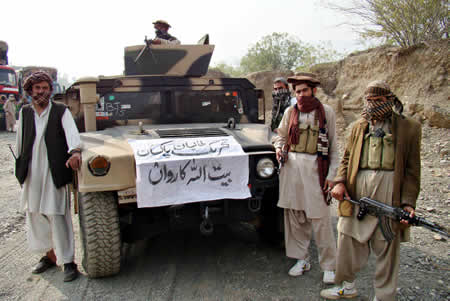 Baitullah Mehsud's Taliban pose in front of a captured US Humvee after hijacking a supply column on Nov. 10. Baitullah's Taliban flag is draped over the hood
A rocket attack at a truck terminal in Peshawar on Nov. 30 killed a driver and wounding another, and set three NATO shipping containers ablaze. The next day, a Taliban force of 25 men assaulted the truck terminal and killed two drivers and torched 21 trucks. Several Humvees being transported to Afghanistan were burned.
The Pakistani military launched a military operation with the intent of clearing the Taliban from the Peshawar district more than three weeks ago. In a press conference, a Pakistan Frontier Corps general briefed on the success of the operation, noting 25 Taliban fighters were killed and 40 captured. The operation, designed to relieve pressure on the provincial capital, was the second military offensive in Peshawar since the summer.
Taliban attacks on NATO trucking are only increasing. The most embarrassing incident occurred on Nov. 10, when a large Taliban force hijacked and looted a NATO convoy in the lawless neighboring tribal agency of Khyber.
Thirteen containers in all were seized and two Humvees were driven around by Taliban fighters loyal to Baitullah Mehsud, the same Taliban leader a senior Pakistani Army official described as a “patriot” just two days ago. The hijackers had time to take pictures and posed with a Taliban flag draped on the US-made vehicle.
A NATO official said the attacks are not a serious threat to operations in Afghanistan. “The attacks that have taken place on NATO supplies, while of concern, have not been of strategic significance,” said NATO spokesman James Appathurai. “They have not affected the operation in any substantial way.”
The increase in Taliban attacks comes as Pakistani military officials threatened to move some or all of the 100,000 troops based in northwestern Pakistan to the eastern border with India after tensions have risen over the Mumbai terror siege last week. The Indian government has demanded the Pakistani government hand over a list of 20 senior members and operatives of several terror groups openly operating inside Pakistan.
The withdrawal of Pakistani troops, or even the shift of some military units, could put NATO’s supply lines through Peshawar at risk. The Taliban control large swaths of terrirtory in Paksitan's northwest, while the military is bogged down in heavy fighting in Swat and Bajaur.
The Peshawar route is the most used by NATO to supply its forces in Afghanistan. An estimated 70 percent of NATO supplies move through Khyber to resupply troops fighting against the Taliban in Afghanistan. The bulk of NATO's supplies arrive in the port city of Karachi, move north to Peshawar, and head west to the Torkham crossing into Afghanistan and the final destination in Kabul. The rest of the supplies pass through the Chaman border crossing point in Baluchistan or arrive via air.
NATO is seeking alternative routes through the former Soviet republics and China, however the road and rail infrastructure is poor and the routes add a significant amount of time and expense to move supplies into Afghanistan.
Baitullah Mehsud's Taliban pose in front of a captured US Humvee after hijacking a supply column on Nov. 10. Baitullah's Taliban flag is draped over the hood
A rocket attack at a truck terminal in Peshawar on Nov. 30 killed a driver and wounding another, and set three NATO shipping containers ablaze. The next day, a Taliban force of 25 men assaulted the truck terminal and killed two drivers and torched 21 trucks. Several Humvees being transported to Afghanistan were burned.
The Pakistani military launched a military operation with the intent of clearing the Taliban from the Peshawar district more than three weeks ago. In a press conference, a Pakistan Frontier Corps general briefed on the success of the operation, noting 25 Taliban fighters were killed and 40 captured. The operation, designed to relieve pressure on the provincial capital, was the second military offensive in Peshawar since the summer.
Taliban attacks on NATO trucking are only increasing. The most embarrassing incident occurred on Nov. 10, when a large Taliban force hijacked and looted a NATO convoy in the lawless neighboring tribal agency of Khyber.
Thirteen containers in all were seized and two Humvees were driven around by Taliban fighters loyal to Baitullah Mehsud, the same Taliban leader a senior Pakistani Army official described as a “patriot” just two days ago. The hijackers had time to take pictures and posed with a Taliban flag draped on the US-made vehicle.
A NATO official said the attacks are not a serious threat to operations in Afghanistan. “The attacks that have taken place on NATO supplies, while of concern, have not been of strategic significance,” said NATO spokesman James Appathurai. “They have not affected the operation in any substantial way.”
The increase in Taliban attacks comes as Pakistani military officials threatened to move some or all of the 100,000 troops based in northwestern Pakistan to the eastern border with India after tensions have risen over the Mumbai terror siege last week. The Indian government has demanded the Pakistani government hand over a list of 20 senior members and operatives of several terror groups openly operating inside Pakistan.
The withdrawal of Pakistani troops, or even the shift of some military units, could put NATO’s supply lines through Peshawar at risk. The Taliban control large swaths of terrirtory in Paksitan's northwest, while the military is bogged down in heavy fighting in Swat and Bajaur.
The Peshawar route is the most used by NATO to supply its forces in Afghanistan. An estimated 70 percent of NATO supplies move through Khyber to resupply troops fighting against the Taliban in Afghanistan. The bulk of NATO's supplies arrive in the port city of Karachi, move north to Peshawar, and head west to the Torkham crossing into Afghanistan and the final destination in Kabul. The rest of the supplies pass through the Chaman border crossing point in Baluchistan or arrive via air.
NATO is seeking alternative routes through the former Soviet republics and China, however the road and rail infrastructure is poor and the routes add a significant amount of time and expense to move supplies into Afghanistan.
 of its fifth Gripen multi-role fighter as part of the SA Air Force’s modernisation and transformation programme. The aircraft, a dual seat operational type conversion variant, arrived in Cape Town on Saturday 29th November.
 OWN, Conn. - December 3, 2008: The international market for light wheeled combat vehicles remains a highly competitive and dynamic environment. In its annual analysis "The Market for Light Wheeled Vehicles" the Forecast International Weapons Group expects the market will produce over 71,300 light wheeled vehicles, worth in excess of $21.789 billion, through 2017.
 2, 2008: The Boeing Company, industry teammates and the U.S. Missile Defense Agency last week fired a high-energy laser through the Airborne Laser's (ABL) beam control/fire control system, completing the first ground test of the entire weapon system integrated aboard the aircraft.
During the test at Edwards Air Force Base, the laser beam traveled through the beam control/fire control system before exiting the aircraft through the nose-mounted turret. The beam control/fire control system steered and focused the beam onto a simulated ballistic-missile target.
"This test is significant because it demonstrated that the Airborne Laser missile defense program has successfully integrated the entire weapon system aboard the ABL aircraft," said Scott Fancher, vice president and general manager of Boeing Missile Defense Systems. "With the achievement of the first firing of the laser aboard the aircraft in September, the team has now completed the two major milestones it hoped to accomplish in 2008, keeping ABL on track to conduct the missile shootdown demonstration planned for next year."
Michael Rinn, Boeing vice president and ABL program director, said the next step for the program is a series of longer-duration laser firings through the beam control/fire control system. "Once we complete those tests, we will begin demonstrating the entire weapon system in flight," Rinn said. "The team is meeting its commitment to deliver this transformational directed-energy weapon system in the near term."
The program has logged many accomplishments over the past several years. In 2005, the high-energy laser demonstrated lethal levels of duration and power in the System Integration Laboratory at Edwards. In 2007, ABL completed numerous flight tests that demonstrated its ability to track an airborne target, measure and compensate for atmospheric conditions, and deliver a surrogate high-energy laser's simulated lethal beam on the target. In September 2008, the team achieved "first light" by firing the high-energy laser into a calorimeter aboard the aircraft.
Boeing is the prime contractor for ABL, which will provide speed-of-light capability to destroy all classes of ballistic missiles in their boost phase of flight.
The ABL aircraft is a modified Boeing 747-400F whose back half holds the high-energy laser, designed and built by Northrop Grumman. The front section of the aircraft contains the beam control/fire control system, developed by Lockheed Martin, and the battle management system, provided by Boeing.
2, 2008: The Boeing Company, industry teammates and the U.S. Missile Defense Agency last week fired a high-energy laser through the Airborne Laser's (ABL) beam control/fire control system, completing the first ground test of the entire weapon system integrated aboard the aircraft.
During the test at Edwards Air Force Base, the laser beam traveled through the beam control/fire control system before exiting the aircraft through the nose-mounted turret. The beam control/fire control system steered and focused the beam onto a simulated ballistic-missile target.
"This test is significant because it demonstrated that the Airborne Laser missile defense program has successfully integrated the entire weapon system aboard the ABL aircraft," said Scott Fancher, vice president and general manager of Boeing Missile Defense Systems. "With the achievement of the first firing of the laser aboard the aircraft in September, the team has now completed the two major milestones it hoped to accomplish in 2008, keeping ABL on track to conduct the missile shootdown demonstration planned for next year."
Michael Rinn, Boeing vice president and ABL program director, said the next step for the program is a series of longer-duration laser firings through the beam control/fire control system. "Once we complete those tests, we will begin demonstrating the entire weapon system in flight," Rinn said. "The team is meeting its commitment to deliver this transformational directed-energy weapon system in the near term."
The program has logged many accomplishments over the past several years. In 2005, the high-energy laser demonstrated lethal levels of duration and power in the System Integration Laboratory at Edwards. In 2007, ABL completed numerous flight tests that demonstrated its ability to track an airborne target, measure and compensate for atmospheric conditions, and deliver a surrogate high-energy laser's simulated lethal beam on the target. In September 2008, the team achieved "first light" by firing the high-energy laser into a calorimeter aboard the aircraft.
Boeing is the prime contractor for ABL, which will provide speed-of-light capability to destroy all classes of ballistic missiles in their boost phase of flight.
The ABL aircraft is a modified Boeing 747-400F whose back half holds the high-energy laser, designed and built by Northrop Grumman. The front section of the aircraft contains the beam control/fire control system, developed by Lockheed Martin, and the battle management system, provided by Boeing.
 hicles (UAVs).
"The goal of the exercise is to improve the combat readiness of the Iranian navy to counter potential external threats and to test modern weaponry developed by the Iranian defense industry," the admiral said.
Sayyari confirmed last week the delivery of two new domestically-built missile boats, Kalat (Fortress) and Derafsh (Flag), as well as a Ghadir-class light submarine to the Iranian navy.
Iran has launched a domestic weapons procurement campaign aimed at improving its defense capabilities and has announced the development of 109 types of advanced military equipment over the past two years.
Tehran has conducted several high-profile war games this year, while promising to strike back hard against in the event of any attack, including closing off the Strait of Hormuz, through which over 25% of world oil passes.
There has been continued speculation that the United States or Israel might launch air strikes against Iran's nuclear facilities. Washington and Tel Aviv have consistently refused to rule out the possibility of military action against Iran over its refusal to halt its controversial nuclear program. Iran says it needs the program for peaceful power generation.
hicles (UAVs).
"The goal of the exercise is to improve the combat readiness of the Iranian navy to counter potential external threats and to test modern weaponry developed by the Iranian defense industry," the admiral said.
Sayyari confirmed last week the delivery of two new domestically-built missile boats, Kalat (Fortress) and Derafsh (Flag), as well as a Ghadir-class light submarine to the Iranian navy.
Iran has launched a domestic weapons procurement campaign aimed at improving its defense capabilities and has announced the development of 109 types of advanced military equipment over the past two years.
Tehran has conducted several high-profile war games this year, while promising to strike back hard against in the event of any attack, including closing off the Strait of Hormuz, through which over 25% of world oil passes.
There has been continued speculation that the United States or Israel might launch air strikes against Iran's nuclear facilities. Washington and Tel Aviv have consistently refused to rule out the possibility of military action against Iran over its refusal to halt its controversial nuclear program. Iran says it needs the program for peaceful power generation.
 units of the Ukrainian Armed Forces received from Kharkiv 56 Bulat main battle tanks (MBT), which are an upgraded version of the T-64B battle tank. This was announced by Alexey Podgorniy, the acting director general of the Kharkiv-based State Enterprise Malyshev Plant.
The next year is to see delivery of another 30 upgraded tanks. If provided with relevant financial support, the Malyshev Plant will be able to establish in the near future the facilities for production of the first ten Oplot MBTs.
The Oplot MBT, which is to enter service with the separate tank brigade of the 6th Army Corps of the Ukrainian Army, is the first national tank of Ukraine.
The Oplot features a 1200 hp engine, automatic gearbox, new fire control system, excellent tactical and mobility characteristics, good crew ergonomics and, if compared with similar foreign tanks, low cost.
Besides, it is planned to supply three Atlet armoured repair and recovery vehicles and ten BTR-4 armoured personnel carriers. These armoured vehicles, according to the General Designer of Kharkiv Morozov Machine Building Design Bureau Lt Gen Mikhailo Borysiuk, are in many aspects are on a par with the most advanced foreign vehicles.
units of the Ukrainian Armed Forces received from Kharkiv 56 Bulat main battle tanks (MBT), which are an upgraded version of the T-64B battle tank. This was announced by Alexey Podgorniy, the acting director general of the Kharkiv-based State Enterprise Malyshev Plant.
The next year is to see delivery of another 30 upgraded tanks. If provided with relevant financial support, the Malyshev Plant will be able to establish in the near future the facilities for production of the first ten Oplot MBTs.
The Oplot MBT, which is to enter service with the separate tank brigade of the 6th Army Corps of the Ukrainian Army, is the first national tank of Ukraine.
The Oplot features a 1200 hp engine, automatic gearbox, new fire control system, excellent tactical and mobility characteristics, good crew ergonomics and, if compared with similar foreign tanks, low cost.
Besides, it is planned to supply three Atlet armoured repair and recovery vehicles and ten BTR-4 armoured personnel carriers. These armoured vehicles, according to the General Designer of Kharkiv Morozov Machine Building Design Bureau Lt Gen Mikhailo Borysiuk, are in many aspects are on a par with the most advanced foreign vehicles.
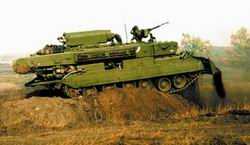 Info) December 2, 2008: On 24 November, 2008, the Ukrainian Minister of Defence took a decision to accept for service with the Ukrainian Army the Atlet armoured repair and recovery vehicle (ARRV) developed by the State Enterprise Kharkiv Morozov Machine Building Design Bureau.
This ARRV is intended to carry out the following missions: recover and tow a disabled tank, self-propelled artillery system, and other similar vehicles; repair the vehicles; and carry out welding and excavation work.
Info) December 2, 2008: On 24 November, 2008, the Ukrainian Minister of Defence took a decision to accept for service with the Ukrainian Army the Atlet armoured repair and recovery vehicle (ARRV) developed by the State Enterprise Kharkiv Morozov Machine Building Design Bureau.
This ARRV is intended to carry out the following missions: recover and tow a disabled tank, self-propelled artillery system, and other similar vehicles; repair the vehicles; and carry out welding and excavation work.
 The Philippines army soldiers assembled in readiness for a simultaneous inspections of troops inside a military headquarter in Fort Bonifacio, Taguig city, metro Manila November 28, 2008


 |












