Showing posts with label Mig-27 Fighter Jet. Show all posts

Monday, March 05, 2012

DTN News - INDIA DEFENSE NEWS: Air Force And Army Conducting Joint Military Exercise In NEFA

DTN News - INDIA DEFENSE NEWS:  Air Force And Army Conducting Joint 
Military Exercise In NEFA
*Ground-and-air war games, China in mind
Source: DTN News - - This article compiled by Roger Smith from reliable sources The Telegraph - Calcutta
(NSI News Source Info) TORONTO, Canada - March 5, 2012: The air force and the army are conducting an exercise across the eastern and northeastern states to test defences and special operations in the event of hostilities with China. This is the largest exercise of its kind.

“This time we are focused on the Brahmaputra Valley, Arunachal Pradesh, Sikkim and Mizoram to exercise our entire capabilities in all roles in conjunction with the army to disrupt enemy intrusion and take the battle to the adversary,” Air Marshal M. Matheswaran, senior air staff officer of the Shillong-headquartered Eastern Air Command, told The Telegraph.

Codenamed “Pralay”, the exercise was designed by the Calcutta-headquartered Eastern Army Commander, Lt General Bikram Singh, and the Eastern Air Commander, Air Marshal S. Varthaman.

The exercise area is spread over the eight northeastern states and Bengal but action is mostly concentrated along the Brahmaputra Valley and Arunachal.

The air force has also deployed its assets from other commands to the east and northeast for the exercise, which is expected to conclude on March 3. “Pralay” began on February 29 but the mobilisation for it started on February 20.

More than 70 aircraft — including the airborne warning and control system (AWACS) planes, Sukhoi 30MKi, MiG-29, MiG-27 and Mirage 2000 combat planes — have been deployed.

This is the first time that the Israeli Phalcon AWACS are being tested in a simulated combat environment on such a scale. AWACS are designed to detect, acquire and designate targets for other fighter aircraft. Mid-air refuellers have also been deployed to practise long-range strike missions.

“Drills that will help us validate joint operational directives in the valleys and the hills are being emphasised,” Matheswaran said.

The air force spokesperson, Wing Commander Gerard Galway, said the eastern command holds an annual exercise. But the deployment of assets from the western and central air commands to the east shows that the scale this time is much larger.

The war-gamed scenario is of a short but intense conflict. Matheswaran said the AFNET — the air force’s own optic-fibre cable grid — was being used for voice, data and visual communication.

“This exercise is bringing out the net-centric capabilities that we are developing,” he said. The exercise would culminate by concentrating on a few unspecified areas in Assam and Arunachal.

The army’s 33, 3 and 4 Corps, headquartered in Sukna (north Bengal), Tezpur (Assam) and Rangapahar (Nagaland), are in the loop for the exercise. The 33 and 4 Corps have dual responsibilities for counter-insurgency and the China front.

In an unrelated exercise, platoons of the Indonesian and Indian armies are practising at the Counter-Insurgency and Jungle Warfare School in Vairante, Mizoram.

“Exercise Garuda Shakti” is the first joint platoon-level training programme for the two armies. In an outdoor drill named “Chakravyuh”, the platoons practised busting an insurgent hideout in Mizoram’s Lushai Hills early on Thursday after a nightlong march.

“They are very sincere, devoted, well-prepared and eager to learn,” the school’s commandant, Major General A.K. Sen, said of the Indonesian troops as they “slithered” from the Indian Air Force’s Mi-17 helicopters, flown from the Kumbhirgram airbase in Silchar, Assam.

The training and attack drills were coordinated in two mixed platoons (of around 30 soldiers each) of Kostrad (the Indonesian army’s strategic reserve command) and Indian infantry troops. The exercise ends tomorrow.

China talks

India and China today agreed to soon start a maritime cooperation dialogue to prevent incidents between their growing naval forces. The suggestion had come from the Chinese.

S.M. Krishna and Yang Jiechi met today for the first foreign minister-level annual dialogue, their discussions focusing on confidence-building measures and strengthening the Brics (Brazil, Russia, India, China and South Africa) forum.

In another first, the Chinese embassy here issued a detailed statement on Yang’s meetings with Krishna, Vice-President Hamid Ansari and Prime Minister Manmohan Singh. The Chinese mission generally avoids engaging with much of the Indian media, which Beijing believes to be biased against China.

However, it would seem Beijing has eventually recognised the importance of the media in shaping public perceptions of India-China ties. Foreign ministry spokesperson Syed Akbaruddin today said China had agreed to allow Zee TV to broadcast in China.


*DTN India  @DTNIndia ~ Available on Twitter
Comprehensive Daily News on India Today ~ © Copyright (c) DTN News Defense-Technology News

*Link for This article compiled by Roger Smith from reliable sources The Telegraph - Calcutta
*Speaking Image - Creation of DTN News ~ Defense Technology News 
*This article is being posted from Toronto, Canada By DTN News ~ Defense-Technology News Contact:dtnnews@ymail.com 
©COPYRIGHT (C) DTN NEWS DEFENSE-TECHNOLOGY NEWS


Wednesday, June 24, 2009

DTN News: Pakistan Commander Blows The Lid On Islamabad's Kargil Plot /Gen. Pervez Musharraf As Army Chief Of Staff Had Engineered The Kargil Campaign

DTN News: Pakistan Commander Blows The Lid On Islamabad's Kargil Plot / Gen. Pervez Musharraf As Army Chief Of Staff Had Engineered The Kargil Campaign *Sources: Int'l Media / Indian Express / TIME (News upgraded June 24, 2009 ~ popular viewers demand) (NSI News Source Info) NEW DELHI - June 13, 2009: In the first account by a Pakistani military officer that nails Islamabad’s lie on Kargil, a former pilot who was Director of Operations of the Pakistan Air Force (PAF) during the 1999 conflict has given a blow-by-blow account of the preparations undertaken by his country’s Army that led to operations inside the Indian side of the Line of Control. A retired Pak military officer has revealed that entire Kargil operations were planned by Musharraf with tacit approval of Nawaz Sharif. The Kargil War, also known as the Kargil conflict, was an armed conflict between India and Pakistan that took place between May and July 1999 in the Kargil district of Kashmir. The cause of the war was the infiltration of Pakistani soldiers and Kashmiri militants into positions on the Indian side of the Line of Control (LOC), which serves as the de facto border between the two states. During and directly after the war, Pakistan blamed the fighting entirely on independent Kashmiri insurgents, but documents left behind by casualties and later statements by Pakistan's Prime Minister and Chief of Army Staff showed involvement of Pakistani paramilitary forces, led by General Ashraf Rashid. A part of Kashmir is under Pakistani control. This part is known as Pakistan-occupied Kashmir (PoK) in India and as Azad Kashmir (free or independent Kashmir) in Pakistan. Through this Pakistan was able to deploy Kashmiri fighters to fight alongside its regular forces. The Indian Army, late on supported by the Indian Air Force, attacked the Pakistani positions and, with international diplomatic support, eventually forced withdrawal of the Pakistani forces across the LOC. The war is one of the most recent examples of high altitude warfare in mountainous terrain, which posed significant logistical problems for the combating sides. This was only the second direct ground war between any two countries after they had developed nuclear weapons, after the Sino-Soviet border conflict of 1969; it is also the most recent. (India and Pakistan both test-detonated fission devices in May 1998, though the first Indian nuclear test was conducted in 1974.) The conflict led to heightened tension between the two nations and increased defence spending by India. In Pakistan, the aftermath caused instability of the government and the economy, and, on October 12, 1999, a coup d'etat by the military placed army chief Pervez Musharraf in power. Published in India in the latest issue of the 'Vayu Aerospace and Defence Review' magazine, PAF Air Commodore (retd) Kaiser Tufail, the man who “interrogated” IAF Flight Lieutenant K Nachiketa after his MiG-27 crashed in PoK during a bombing run in the initial days of the war, has laid bare the detailed Kargil plan by the Pakistan Army. He says that the “Army trio” of General Pervez Musharraf, 10 Corps Commander Lt Gen Mehmud Ahmad and Force Command Northern Areas commander Maj Gen Javed Hasan “took no one into confidence, neither its operational commanders, nor the heads of the other services”. Tufail, a decorated fighter pilot who was in charge of air operations during the war, has revealed that the Pak Army placed Stinger shoulder-fired anti-aircraft missiles on hill tops, moved artillery guns and ammunitions to posts that India had vacated during winter and drew plans to cut off the strategic Drass-Kargil road to choke supplies to the Siachen glacier. Now based in Lahore, Tufail says the entire operation was planned by Musharraf but had the tacit approval of then Prime Minister Nawaz Sharif who, after a presentation, said “‘General sahib, Bismillah karein’... not withstanding the denials we hear from him every new moon.” Recalling his meeting with top Army officers, including Lt Gen Mehmud Ahmad who was commanding the Rawalpindi Corps, Tufail writes that the Kargil plan was revealed on May 12, two weeks before India retaliated with air strikes, when Ahmad briefed him and others on the operation. “Come October, we shall walk in to Siachen — to mop up the dead bodies of hundreds of Indians left hungry, out in the cold,” Ahmad is quoted as having said during the briefing, adding that “I have Stingers on every peak” to counter the threat of Indian air strikes against Pakistani intruders. “The target was a vulnerable section of Drass-Kargil road, whose blocking would virtually cut off the crucial lifeline which carried the bulk of supplies needed for daily consumption as well as annual winter stocking in Leh-Siachen sector. He (Lt Gen Ahmad) was very hopeful that this stratagem could choke off the Indians in the vital sector for up to a month, after which monsoons would prevent vehicular movements and also suspend airlift by IAF,” Tufail writes on details of the briefing. Expressing surprise over the failure of Indian intelligence to detect Pakistani movements that led to the occupation of Indian Army posts on the heights of Kargil, Tufail says it was well known in Skardu, days before operations were launched, that “something big is imminent”. “Helicopter flying activity was feverishly high as Army Aviation Mi 17s were busy moving artillery guns and ammunition to the posts that had been vacated by the Indians during the winter season. Troops in battle gear were to be seen all over the city. Interestingly, Army messes were abuzz with war chatter amongst young officers. In retrospect, one wonders how Indian intelligence agencies failed to read any such signs many weeks before the operation unfolded,” Tufail writes. Bringing out the disagreement between the Pak Army and Air Force on the operations, Tufail writes that many senior PAF officers tried to explain to the Army that Indian air strikes would wipe out bunkers occupied by ground forces but these were dismissed by the Army after Lt General Ahmad said “troops were well camouflaged and concealed and that IAF pilots would not be able to pick out the posts from the air”. “Perhaps it was the incredulousness of the whole thing that led Air Commodore Abid Rao (Assistant Chief of Air Staff Operations) to famously quip, ‘After this operation, it’s going the be either a Court Martial or Martial Law’ as we walked out of the briefing room.” And for the first time, giving details of IAF success in bombing Pakistani positions during the war, Tufail writes that round the clock air attacks had made retention of posts by Pakistani infiltrators “untenable”.
Gen. Pervez Musharraf as Army Chief of Staff had engineered the Kargil campaign, the capturing of a few mountain peaks on the other side of the Line of Control, which was essentially a mini invasion of India.
“The Mirage 2000s scored at least five successful laser guided bomb hits on forward dumping sites and posts. During the last days of operations which ended on 12 July, it was clear that delivery accuracy had improved considerably,” he writes. Contrary to the Indian view that he was shot down, Tufail claims that Flt Lt Nachiketa’s MiG-27 went down due to engine trouble “caused by gas ingestion during high altitude strafing.” He writes: “Flt Lt Nachiketa, who ejected and was apprehended, had a tete-a-tete with this writer during an interesting ‘interrogation’ session.” He conceded that the PAF had trouble maintaining air patrols in the region to deter Indian fighters as its F-16 mainstay was facing shortage of supply parts due to American sanctions. “After one week of CAPs (combat air patrols), the F-16 maintenance personnel indicated that war reserves were being eaten into and the activity had the be ‘rationalized’, an euphemism for discontinuing it altogether,” Tufail writes. According to him, F-16 was the only fighter available with Pakistan to counter India but it was decided to discontinue patrols in case its services were needed during a full-blown war. “Those not aware of the gravity of the F-16 operability problem under sanctions have complained of the lack of cooperation by the PAF,” he writes.
Pictures & articles from the Kargil conflict (Click on links below) Well equipped Pakistani troops who were dug into the Kargil heights Captured Pakistani weapons wake India up to Pakistani involvement Pakistani soldiers angrily mourn their dead More coffins appear in Pakistan at the Pakistani government denies involvement Horror turns to anger in Pakistan as the death toll mounts Mpeg video clip: Indian artillery in direct fire mode - India's first televised war. Mpeg video clip: The IAF hits a Pak camp with pinpoint accuracy Ununiformed Pakistani men in retreat After the battle - victorious Indian troops Anger in Pakistan as the government admits involvement and sues for peace. Map of the area of operations
Time Magazine Pakistan: Under Fire

Wednesday, March 18, 2009

India’s Fighter Aircraft Of Russian Origin - Modernization

India’s Fighter Aircraft Of Russian Origin - Modernization 
(NSI News Source Info) New Delhi, India - March 18, 2009: India’s updated MiG-21 ‘Bisons’ before, and noted the trouble they have caused American opponents at COPE India 2004 & 2005. Deliveries on that $600+ million program continue; meanwhile the delivery date for the winning aircraft in India’s forthcoming light-medium fighter tender remains up in the air, and India’s indigenous Light Combat Aircraft (Tejas) program has been beset by numerous problems and ongoing delays. By 2010, the IAF will have phased out most of its 300-or-so MiG-21s, the 16-18 aircraft in its only remaining swing-wing MiG-23 ground attack squadron, around 100-110 related swing-wing MiG-27M Bahadur ground attack fighters that are not being upgraded, and the MiG-25 Foxbat strategic reconnaissance jets (already phased out). 125 MiG-21 Bis interceptors and 40 upgraded MiG-27ML fighters will remain. As the timelines for replacements stretch, India’s defense planners are concluding that more upgrades will be necessary in order to keep their existing fleet viable. February 2006 reports discussed a decision to upgrade India’s existing fleet of MiG-29B, MiG-29S, and two-seat MiG-29UB “Baaz” (Falcon) aircraft as well, in order to give them multi-role capabilities and improve their ability to carry advanced weapons. December 2006 reports from MosNews et. al. indicated that a contract has been signed, but it wasn’t until March 2008 that a deal was finalized. Now, India is reacting to Russia’s grounding of its own MiG-29 fleet, following some catastrophic accidents involving the fighter’s tail fins… Wanting a New Baaz: The Upgrades A Better Baaz: Program Updates India was the first international customer of the MiG-29. The Indian Air Force (IAF) placed an order for more than 50 MiG-29s in 1980 while the aircraft was still in its initial development phase. Since its induction into the IAF in 1985, the aircraft has undergone a series of modifications with the addition of new avionics, sub-systems, turbofan engines and radars. The upgraded Indian version is known as Baaz (Hindi for Hawk) and forms a crucial component of the second-line offensive aircraft-fleet of the IAF after the Sukhoi Su-30MKI. The MiG-29’s good operational record prompted India to sign a deal with Russia in 2005/06 to upgrade its 67 MiG-29s for US$888 million. Under the deal, Russia replaced the old N019 radar with the Phazatron Zhuk-M radar. Russia also gave India’s Hindustan Aeronautics Limited the license to manufacture 120 RD-33 series 3 turbojet engines for the upgrade. The MiG-29s were also upgraded for mid-air refueling to increase their endurance. In 2008, the IAF awarded the MiG Corporation another US$900 million contract to upgrade all of its 69 operational MiG-29s. The upgrade will include a new weapon control system, avionics, cockpit ergonomics, air-to-air missiles, high-accuracy air-to-ground missiles and "smart" aerial bombs. The upgraded MiG-29s will also have an enhanced beyond-visual-range combat ability. The first six MiG-29s will be upgraded in Russia while the remaining 63 MiGs will be upgraded at the Hindustan Aeronautics facility in India. India also awarded a multi-million dollar contract to Israel Aircraft Industries to provide avionics and sub-systems for the upgrade. In January 2004, the Indian Navy signed a contract for the delivery of 12 MiG-29K and 4 MiG-29KUB which will be operated from INS Vikramaditya. The first MiG-29KUB manufactured for the Navy took to the skies in May 2008. The first four aircraft were delivered to India in February 2009. There were also reports that the Indian Navy would purchase an additional 30 MiG-29Ks and -KUBs for the Indigenous Aircraft Carrier. The Indian Air Force expressed concern after 90 MiG-29s were grounded in Russia. After carrying out an extensive inspection, the IAF cleared all MiG-29s in its fleet. IANS reported in December 2006 that India was “finalizing” a proposal to have its fleet of MiG-29 lightweight fighters refurbished for $888 million by the Russian company RSK-MiG, which has a dedicated upgrade set designed to turn older MiG-29 air defense fighters into multi-role MiG-29SMT/UBT fighters. India’s focus on its domestic industries will ensure that its modifications will include their share of unique attributes and equipment, in addition to the standard set. The upgraded MiG-29s are expected to remain in service for 10-15 years after being fitted with upgraded weapons and a new avionics suite, including the Phazatron Zhuk-M radar. Phazotron’s Zhuk-M is a derivative of the baseline Zhuk radar, but its acquisition range has increased 1.5 times, with a wide scan and tracking area of + / – 85 deg. in azimuth and + / – 60 deg. in elevation, terrain following mode, and ground target acquisition including high-resolution modes. Normally, these moves would accompany weapons upgrades. India’s MiG-29s are already believed to be capable of firing the R-77/AA-12 “AMRAAMski” medium range air-air missile, but photos consistently show the R-27/ AA-10. The new systems will offer certain R-77 compatibility, along with the ability to mount precision air-to-ground weapons. Upgraded electronic warfare systems round out the package, to improve survivability against modern threats. In terms of aerodynamic performance, India’s MiG-29s will be upgraded with extra fuel tanks in a thickened center spine, but the MiG-29SMT upgrades will continue to suffer from “Soviet short-legs syndrome.” Adding mid-air refueling capability completes the upgrade, offering dramatic changes to their deployment range. Unspecified engine modifications may also correct some of the problems experienced with the R-33 engine, such as the visible smoke trails that have already been addressed in the MiG-29M2. This will not quite bring the older MiG-29s up to the status of the MiG-29M2 multi-role aircraft, let alone the thrust-vectoring MiG-29OVT/MiG-35 model that Russia is reportedly offering for India’s light-medium fighter competition. Nevertheless, India will be left with an aircraft that is comparable to the F-16C as a strike fighter, with overall air-to-air performance that is arguably superior to all but the F-16 Block 60s with their ultra-advanced AESA radar. Indian MiG-27M MiG-27L. This was an export variant of the MiG-27M provided in 1986 to India in knock-down kits for license-assembly. Same as MiG-27M except the undernose fairing for the infra-red search and track (IRST) sensor has a single window instead of several like the one on the original MiG-27M. A total of 130 were assembled by India. MiG-27H. This was a 1988 indigenous Indian upgrade of its license-assembled MiG-27L with French avionics, which provides the same level of performance but with much reduced size and weight. The space saved is used to house the French Agave radar. At least 120 were converted from MiG-27Ls. Reports indicate that RSK-MiG will be the sole vendor to perform the upgrades and service life extension tasks, but there have also been reports that components would come from a range of Indian, Russian, French, Israeli (Elbit has its own MiG-29 ‘Sniper’ upgrade program), and possibly even American vendors. The Americans would represent a new source, but the others all contributed to the MiG-21 Bis upgrade, and the $130+ million MiG-27ML upgrade sources equipment from Russia, Israel, and Britain (Vinten optical pod), and may include other countries as well.

Monday, February 16, 2009

India: After The Hawk, A Supersonic Trainer LCA

India: After The Hawk, A Supersonic Trainer LCA (NSI News Source Info) February 16, 2009: It took immense public pressure and the death of tens of Indian Air Force (IAF) pilots for the government to okay the purchase of 66 Hawk Advanced Jet Trainers (AJTs) for training rookie pilots on fast jets before sending them off to the MiG Operational Flying Training School (MOFTU) in Tezpur. There they are put into the cockpit of one of the world’s fastest and most unforgiving fighters — the MiG-21. It is no coincidence that accidents are dramatically down since training began on the Hawk. Now the IAF is purchasing another trainer that could equip its pilots even better for flying the high performance fighters — the upgraded Jaguars, MiG-21s, 27s and 29s, the Mirage 2000s, the brutally powerful Su-30MKI and the MMRCA, when that is inducted — which will comprise the new IAF. Top MoD sources have told Business Standard that the IAF will soon order from Hindustan Aeronautics Limited (HAL) twelve of the newly developed two-seater trainer version of the Tejas Light Combat Aircraft (LCA). DRDO chief M Natarajan confirms that the Tejas trainer is set to make its first flight within two months.The first squadron of the indigenously developed Light Combat Aircraft (LCA) named Tejas will be deployed down south in Tamil Nadu, when the first batch of the 20 fighter aircrafts are expected to be inducted by the Indian Air Force (IAF) in 2009-2010. This will give IAF pilots an additional stage of training. Currently, Stage I is carried out on a basic trainer, the HPT-32; Stage II on slightly faster and more complex aircraft like the Kiran; and Stage III on the jet-engined, but sub-sonic Hawk AJT. The induction of an LCA trainer will allow IAF pilots to fly a supersonic, light fighter before graduating to the combat squadrons. Most advanced western air forces do not conduct four stages of training; instead, they rely extensively on aircraft simulators. But the IAF, like some other air forces, has tended to prefer live flying. To benefit from such a demand, South Korea has built and is marketing a supersonic trainer called the T-50 Golden Eagle. Natarjan declared at Aero India 2009 that the Tejas trainer would compete effectively with the Golden Eagle. Ashok Nayak, Managing Director of HAL’s Bangalore Complex and the company’s next chief, explains that the Tejas assembly line will be busy until 2014, producing the IAF’s first order of 20 Tejas aircraft, which will include 16 single-seater fighters and 4 twin-seater trainers. Then, while the Tejas is reengineered and flight-tested with a new, more powerful engine, the assembly line will produce 12 more trainers. For HAL, the new order is a relief, as it will keep the Tejas assembly line rolling. Nayak points out: “It is not in the interest of the Air Force, or of HAL, to have a break in production.” Business Standard travelled to HAL for an exclusive look at the new Tejas trainer. From the outside, there is little to distinguish it from the single-seater fighter that performed aerobatics at the just-concluded Aero India 2009 show. A closer look, however, reveals an expanded cockpit, in which two pilots — an instructor and a trainee — sit one behind the other, both equipped with all the controls needed to fly the aircraft. The design team for the twin-seater Tejas trainer was led by two women engineers — Poongothai, and Mamatha K — of HAL’s Aircraft Research and Development Centre. They pointed out that the additional pilot’s seat and controls have all been squeezed into the existing airframe, obviating the need for time-consuming redesign of the single-seater Tejas’ airframe.

Friday, January 09, 2009

Indian Air Force Mig-27 Fighter Jet Offensive Capabilities To Be Enhanced

Indian Air Force Mig-27 Fighter Jet Offensive Capabilities To Be Enhanced (NSI News Source Info) January 10, 2009: India is upgrading its MiG-27 fighters to sharpen their strike capabilities, officials said on Wednesday, even as experts say the recent Mumbai attacks have exposed the country's need to modernise its defence forces.
Although the upgrade was planned well ahead of the attacks, officials said the defence ministry wants to speed up modernisation of its forces to tackle any future security threat.
The upgrading comes at a time when tension runs high with Pakistan over Mumbai and India is saying it has all options open to deal with "terror outfits" in Pakistan. India is spending $92 million to develop the fighters with precise navigational equipment, better weapons aiming and accurate ranging sensors for hitting ground targets.
"The hardware and avionics bit has already been fitted into 40 fighters, and the software is being loaded now," Suranjan Pal, a senior Defence Research and Development Organisation official, told Reuters. With the upgrading, the MiG fighters would last for another 10 years and have autopilot and auto weapon delivery facilities, a senior Indian Air Force official said.
India is looking to spend $30 billion on imports over the next five years to modernise its largely Soviet-era arms and is also trying to strengthen its navy by introducing new weapons systems. The MiG-27 aircraft was originally built in the former Soviet Union in the mid-1970s before it was licenced to be produced in India.
India, fast becoming one of the world's biggest arms importers, wants to modernise its air force, the fourth largest in the world, to cope with possible security threats in the region, security experts said. "This is something more than it meets the eye, India is now very keen to signal to all the people that are monitoring the country that India is modernising its defence units," C. Uday Bhaskar, a strategic affairs expert told Reuters.
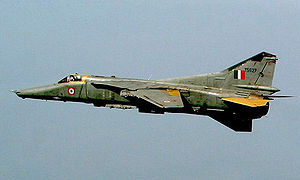
MiG-27L. This was an export variant of the MiG-27M provided in 1986 to India in knock-down kits for license-assembly. Same as MiG-27M except the undernose fairing for the infra-red search and track (IRST) sensor has a single window instead of several like the one on the original MiG-27M. A total of 200 were assembled by India. MiG-27H. This was a 1988 indigenous Indian upgrade of its license-assembled MiG-27L with French avionics, which provides the same level of performance but with much reduced size and weight. The space saved is used to house the French Agave radar. At least 165 were converted from MiG-27Ls.
"It seems we are now putting all the pieces together." India is also considering upgrading of its other fighter fleet, including Mirage 2000s, Jaguars and MiG 29s, ahead of procuring the new generation Sukhoi-30MKIs, officials said.It has also invited bids for a contract to supply 126 multi-role fighter jets, potentially worth more than $10 billion.