Showing posts with label Royal Family. Show all posts

Thursday, July 25, 2013

DTN News - ROYAL FAMILY NEWS: Belgium's Newly-Crowned King Phillipe Holidaying In France

DTN News - ROYAL FAMILY NEWS:  Belgium's Newly-Crowned King Phillipe Holidaying In France
Source: DTN News - - This article compiled by Roger Smith from reliable sources Pictures of The Day
(NSI News Source Info) TORONTO, Canada - July 25, 2013: Belgium's newly-crowned King Phillipe cycles with his sons Prince Emmanuel, centre, and Prince Gabriel as they begin a family holiday on the Ile d'Yeu, France.
Picture: EPA


*Presented & compiled By DTN News ~ Defense-Technology News


(Read complete story on Defense-Technology News - Click on link undermentioned)

*Link for This article compiled by Roger Smith from reliable sources Pictures of The Day
*Speaking Image - Creation of DTN News ~ Defense Technology News 
*Photograph: IPF (International Pool of Friends) + DTN News / otherwise source stated
*This article is being posted from Toronto, Canada By DTN News ~ Defense-Technology News Contact:dtnnews@ymail.com 
©COPYRIGHT (C) DTN NEWS DEFENSE-TECHNOLOGY NEWS

Tuesday, July 23, 2013

DTN News - ROYAL FAMILY NEWS: William And Kate Present Baby Prince

DTN News - ROYAL FAMILY NEWS: William And Kate Present Baby Prince
Source: DTN News - - This article compiled by K. V. Seth from reliable sources Pictures of The Day
(NSI News Source Info) TORONTO, Canada - July 23, 2013:   The new royal baby is the first child for the Duke and Duchess of Cambridge - and third in line to the throne.


The Duke and Duchess of Cambridge have emerged from St Mary's Hospital in west London with their new baby son.

Walking out with their baby to cheers from staff and well wishers, Kate said it was "a special time for any parent".

Prince William said they were "still working on a name".


The couple then went back inside the private Lindo Wing and placed their son in a car seat. A few minutes later they came outside again and the duke drove his family home to Kensington Palace. 

*Link for This article compiled by K. V. Seth from reliable sources Pictures of The Day
*Speaking Image - Creation of DTN News ~ Defense Technology News 
*Photograph: IPF (International Pool of Friends) + DTN News / otherwise source stated
*This article is being posted from Toronto, Canada By DTN News ~ Defense-Technology News Contact:dtnnews@ymail.com 
©COPYRIGHT (C) DTN NEWS DEFENSE-TECHNOLOGY NEWS

Sunday, July 21, 2013

DTN News - BELGIUM NEWS: King Albert II of Belgium Abdicates To Make Way For Philippe

DTN News - BELGIUM NEWS: King Albert II of Belgium Abdicates To Make Way For Philippe
Source: DTN News 
(NSI News Source Info) TORONTO, Canada - July 21, 2013: (BRUSSELS) -- Belgium's King Albert II has abdicated to make way for his son Philippe. The monarch spoke with a message of support for his heir and pleaded for unity in the linguistically and politically divided country.


Albert II signed the act of abdication at the royal palace after a 20-year reign.

His eldest son and crown prince Philippe will take the oath as the nation's new king later Sunday.

Albert II announced his abdication decision on July 3, citing "age and health" as the reasons for not continuing to carry out his duties. Albert II was sworn in as Belgium's sixth king in 1993, succeeding his brother Baudouin who died at the age of 62, and has become the first Belgian king to voluntarily step down.

Philippe, 53, is a fighter pilot and parachutist with degrees from the world's top universities.

King Albert II  ~ Related News;
Albert II (born 6 June 1934) reigned as King of the Belgians, following his elder brother's death, from 1993 until his abdication in 2013. He is a member of the royal house "of Belgium"; formerly this house was named Saxe-Coburg-Gotha. He is the uncle of the current reigning Grand Duke of Luxembourg, Henri.

On 3 July 2013, King Albert II attended a midday session of the Belgian cabinet. He then announced that on 21 July, he would abdicate the throne for health reasons. He will be succeeded by his son, Prince Philippe of Belgium. He will be the third European monarch to abdicate in 2013, following Pope Benedict XVI and Queen Beatrix of the Netherlands.[1] In doing so, he will also be the second Belgian king to abdicate following his father, King Leopold III, who abdicated in 1951, albeit under very different circumstances.

Albert is the second son of Leopold III (1901–1983) and his first wife, Astrid of Sweden (1905–1935). He ascended to the throne in 1993, following the death of his older brother, King Baudouin, who died without issue. His godparents were Felix of Bourbon-Parma and his paternal grandmother, Elisabeth of Bavaria. He is the first cousin of King Harald V, Princess Astrid, and Princess Ragnhild of Norway.

Prince Albert was born in Stuyvenberg Castle, Brussels. On 10 May 1940, at the time when Belgium was being invaded, Prince Albert, his elder sister Princess Joséphine-Charlotte and his elder brother Prince Baudouin, left the country for France and later Spain. The Prince and the Princess returned to Belgium on 2 August 1940. They continued their studies until 1944, either at Laeken, or at the Chateau of Ciergnon in the Ardennes. In June 1944, at the time of the Allied landings, King Leopold III, Princess Lilian – whom he married in 1941 – and the royal children were deported by the Germans to Hirschstein, Germany, and later to Strobl, Austria, where they were liberated by the American Army on 7 May 1945. Due to the political situation in Belgium, King Leopold and his family moved to the villa "Le Reposoir" in Pregny, Switzerland, when they left Austria in October 1945 and stayed until July 1950. During that time, Prince Albert would continue his education in a secondary school in Geneva. King Leopold III, accompanied by Prince Baudouin and Prince Albert, returned to Belgium on 22 July 1950.

In 1958, Prince Albert of Liege went to the Vatican to witness the coronation of Pope John XXIII. At a reception at the Belgian embassy, the prince met Italian Princess Paola Ruffo di Calabria. “We were both shy, so we only talked a little,” Paola said later about their first meeting. Shy but smitten, Prince Albert proposed marriage to Paola, and she accepted. Two months after their meeting, the Prince introduced his future wife to his family, and four months later to the press. Upon arriving in Brussels for the first time before her wedding, Princess Paola won over the Belgian media immediately.

They wanted a marriage at the Vatican at first, a setting promoted by both families, but the Belgian government did not approve of that. They did not want to keep a fairy tale wedding from the people of Belgium, who finally had an opportunity for organizing celebrations for their royal family. The Pope, after some diplomatic pressure, refused them a marriage at the Vatican, saying he would understand if the couple would want to get married amidst their people.

King Albert II and Queen Paola with US President George W. Bush and First Lady Laura Bush at the Royal Palace in Brussels in 2005.

On 2 July 1959 he married Donna Paola Ruffo di Calabria (born 11 September 1937) in Brussels. She is the daughter of Fulco VIII, Prince Ruffo di Calabria, 6th Duke of Guardia Lombarda and his wife, Countess Luisa Gazelli di Rossana e di Sebastiano (1896–1989). Together they have three children, two sons and a daughter.

*Link for This article compiled by Roger Smith - DTN News
*Speaking Image - Creation of DTN News ~ Defense Technology News 
*Photograph: IPF (International Pool of Friends) + DTN News / otherwise source stated
*This article is being posted from Toronto, Canada By DTN News ~ Defense-Technology News Contact:dtnnews@ymail.com 
©COPYRIGHT (C) DTN NEWS DEFENSE-TECHNOLOGY NEWS

Sunday, February 17, 2013

DTN News - Barack Obama's First Term: The US President's First Four Years In Pictures

DTN News - Barack Obama's First Term: The US President's First Four Years In Pictures
*DTN News would be posting selective pictures of US President Barack Obama's first four years term at the Oval office in the White House ~ Part #1
Source: DTN News &  Official White House Photo by Pete Souza 
(NSI News Source Info) TORONTO, Canada - February 17, 2013: This official portrait of President-elect Barack Obama was shot on January 13, 2009 and released by the Presidential Transition Team one week prior to Obama's inauguration. The photograph was the first official presidential portrait shot on a digital camera.


It was taken by the newly-announced White House Photographer Pete Souza. In this gallery, Mr Souza shares his thoughts on some of the photos he has taken of Barack Obama during his first term.

*Link for This article compiled by Roger Smith DTN News & Official White House Photo by Pete Souza
*Speaking Image - Creation of DTN News ~ Defense Technology News 
*This article is being posted from Toronto, Canada By DTN News ~ Defense-Technology News Contact:dtnnews@ymail.com 
©COPYRIGHT (C) DTN NEWS DEFENSE-TECHNOLOGY NEWS

Monday, September 10, 2012

DTN News - ROYAL FAMILY NEWS: Taliban Threaten To Kill Prince Harry

DTN News - ROYAL FAMILY NEWS: Taliban Threaten To Kill Prince Harry
Source: DTN News - - This article compiled by Roger Smith from reliable sources AFP
(NSI News Source Info) TORONTO, Canada - September 10, 2012: The Taliban said 
Monday it was determined to kill Britain's Prince Harry, serving in Afghanistan four years after his previous deployment was cut short over security concerns.

Prince Harry (L) is shown the Apache flight-line by a member of his squadron at Camp Bastion in Afghanistan's Helmand province on September 7. The Taliban said Monday it was determined to kill Harry, who is currently serving in Afghanistan.

A militia spokesman said the group had a "high-value plan" to attack the third in line to the British throne in southern province Helmand, one of the toughest battlefields in the 10-year war.

"We will do our best to kill Prince Harry and Britain's other troops based in Helmand," the spokesman, who gave his name as Zabihullah Mujahid, told AFP by telephone from an undisclosed location.

"It is not important for us to kidnap him. We will target him and we will kill him," he added.
The 27-year-old Apache helicopter pilot, who hit the headlines last month after he was photographed naked at a party in Las Vegas, will spend four months based at the heavily fortified Camp Bastion in Helmand.

"Whoever fights in our country is our enemy and we will do everything possible to kill him," said Mujahid.
Britain says Harry's squadron "will provide surveillance, deterrence and, when required, close combat attack capabilities as well as escort duties for other aircraft".

In 2008, the royal was hastily withdrawn from Afghanistan when a news blackout surrounding his deployment, on the ground directing aircraft in attacks on Taliban positions, was broken.

This time, however, the military has released photographs and video of him in Afghanistan from the start.

The Ministry of Defence said any risk "has been, and will continue to be, assessed".

Related Image;


*Link for This article compiled by Roger Smith from reliable sources AFP
*Speaking Image - Creation of DTN News ~ Defense Technology News 
*This article is being posted from Toronto, Canada By DTN News ~ Defense-Technology News Contact:dtnnews@ymail.com 
©COPYRIGHT (C) DTN NEWS DEFENSE-TECHNOLOGY NEWS

Sunday, July 22, 2012

DTN News - BELGIUM NEWS: Belgium Royal Family Prince Nicolas And Prince Laurent During Military Parade On National Day

DTN News - BELGIUM NEWS: Belgium Royal Family Prince Nicolas And Prince Laurent During  Military Parade On National Day
Source: DTN News - - This article compiled by Roger Smith from reliable sources Pictures of The Day
(NSI News Source Info) TORONTO, Canada - July 22, 2012:  Belgium's Prince Nicolas (R) wears the cap of his father Prince Laurent (L) while watching the traditional military parade on National Day in front of the Royal Palace in Brussels July 21, 2012. 


Belgium celebrates on Saturday its National Day and its 182th anniversary of independence.

*Link for This article compiled by Roger Smith from reliable sources Pictures of The Day
*Speaking Image - Creation of DTN News ~ Defense Technology News 
*This article is being posted from Toronto, Canada By DTN News ~ Defense-Technology News Contact:dtnnews@ymail.com 
©COPYRIGHT (C) DTN NEWS DEFENSE-TECHNOLOGY NEWS

DTN News - BELGIUM NEWS: Belgium Royal Family Princess Luisa Maria And Princess Astrid During Military Parade On National Day

DTN News - BELGIUM NEWS: Belgium Royal Family Princess Luisa Maria And Princess Astrid During  Military Parade On National Day
Source: DTN News - - This article compiled by Roger Smith from reliable sources Pictures of The Day
(NSI News Source Info) TORONTO, Canada - July 22, 2012:  Belgium's Princess Luisa Maria (L) and her mother Princess Astrid (R) watch the traditional military parade on National Day in front of the Royal Palace in Brussels July 21, 2012.


 Belgium celebrates its national day and its 182nd anniversary of independence on Saturday.   

*Link for This article compiled by Roger Smith from reliable sources Pictures of The Day
*Speaking Image - Creation of DTN News ~ Defense Technology News 
*This article is being posted from Toronto, Canada By DTN News ~ Defense-Technology News Contact:dtnnews@ymail.com 
©COPYRIGHT (C) DTN NEWS DEFENSE-TECHNOLOGY NEWS

Tuesday, June 19, 2012

DTN News - CANADIAN HISTORY: War of 1812 ~ Violence, Glory And A New Canadian-Ness

DTN News - CANADIAN HISTORY: War of 1812 ~ Violence, Glory And A New Canadian-Ness
Source: DTN News - - This article compiled by Roger Smith from reliable sources BBC News
(NSI News Source Info) TORONTO, Canada - June 19, 2012: Canada today is seen as a harmonious nation of hockey, mounties and maple leaves, in peaceful contrast to its often fractious and noisy neighbour to the south. But Canadian-ness itself was born amid the blood, gunpowder and glory of the War of 1812, writes Grant Stoddard.


As a British-born newcomer to Canada, I've noticed Canadians see their Canadian-ness as the sum total of their shared values, interests and beliefs.

By contrast, in other places national identity is more typically linked to battles, popular uprisings and improbable triumphs in the face of adversity: the Boston Tea Party, the storming of the Bastille, the October Revolution.
This led me to assume that while Canada is a wonderful place to live, it lacked a rousing origin story.
Imagine my surprise when I discovered that the story of the birth of Canadian-ness - which began 200 years ago this week - is as rollicking, bloody, stirring and inspiring as they come.
Canadians famously cannot bring themselves to brag, so I am taking it upon myself to recount the series of events that paved the long road to Canadian nationhood. Hold on to your toque!
Challenges and disunity
Lt Col Charles De SalaberryDe Salaberry led a combined forced of 1,350 that drove off 4,000 US troops.
In the years after the American Revolution, Britain set about creating a mirror-state to the north of the 13 rebellious former colonies.
Hoping in part to entice the US back into the empire, Britain aimed to demonstrate that life in North America could be happier and more stable under her administration.
There were challenges: the territory in what is now Canada was rugged, under-developed and thinly populated.
Furthermore, the main groups of people living there did not like each another very much.
First Nations tribes resented the unrelenting European expansion into the heart of the continent. Disaffected French Catholics had settled along the St Lawrence River in the early 1600s and remained after Britain finally wrested control of Canada from France in 1763. British inhabitants of Nova Scotia, known as the "14th Colony", had not joined their sister colonies in revolt.
And tens of thousands relocated north after the American War of Independence: refugee crown loyalists and former black slaves rewarded with their freedom for fighting alongside the British.
The new arrivals were so numerous that Britain carved a new colony - New Brunswick - out of Nova Scotia to accommodate them. Yet even after the influx, the US still had about 20 times the population of what was now called British North America.
The British government encouraged even more immigration from the US by offering free land and low taxes. These opportunist migrants, who had little loyalty to the British crown, were euphemistically called the Late Loyalists.
At the dawn of the 19th Century, what is now Canada was no melting pot or even patchwork quilt but rather a hodgepodge of disparate groups who held wildly varying opinions on British rule and American republicanism and a deep distrust of one another.
By 1812, with the British embroiled in war with France, US hawks moved to take advantage of their northern neighbour's disunity, finish the job of the revolution and kick the British off the North American continent once and for all.
Proponents of war were confident that the fractious Canadians would greet US forces as liberators, with former President Thomas Jefferson quipping that annexing the vast territory would be "a mere matter of marching" and could be completed within a few months.
An 1833 lithograph of the Battle of the ThamesNative leader Tecumseh was killed by a US soldier at the Battle of the Thames in Ontario, shown in a detail from an 1833 lithograph
One of the leaders of the invasion force was US General William Hull, a 58-year-old veteran of the revolution who had been reluctant to take part.
He promised the Canadians liberty and prosperity, while also threatening "instant destruction" and a "war of extermination" at the first whiff of collusion between the Canadians and the natives.
Though some Canadians took heed, others, regardless of their allegiances, were uninterested in receiving liberty and prosperity at the point of an American sword. So they took up arms.
Bravery and patriotism
In battles on both sides of the border, vastly outnumbered Canadian militiamen, British regular troops and First Nations warriors inspired by Shawnee warrior Tecumseh overcame the Americans.
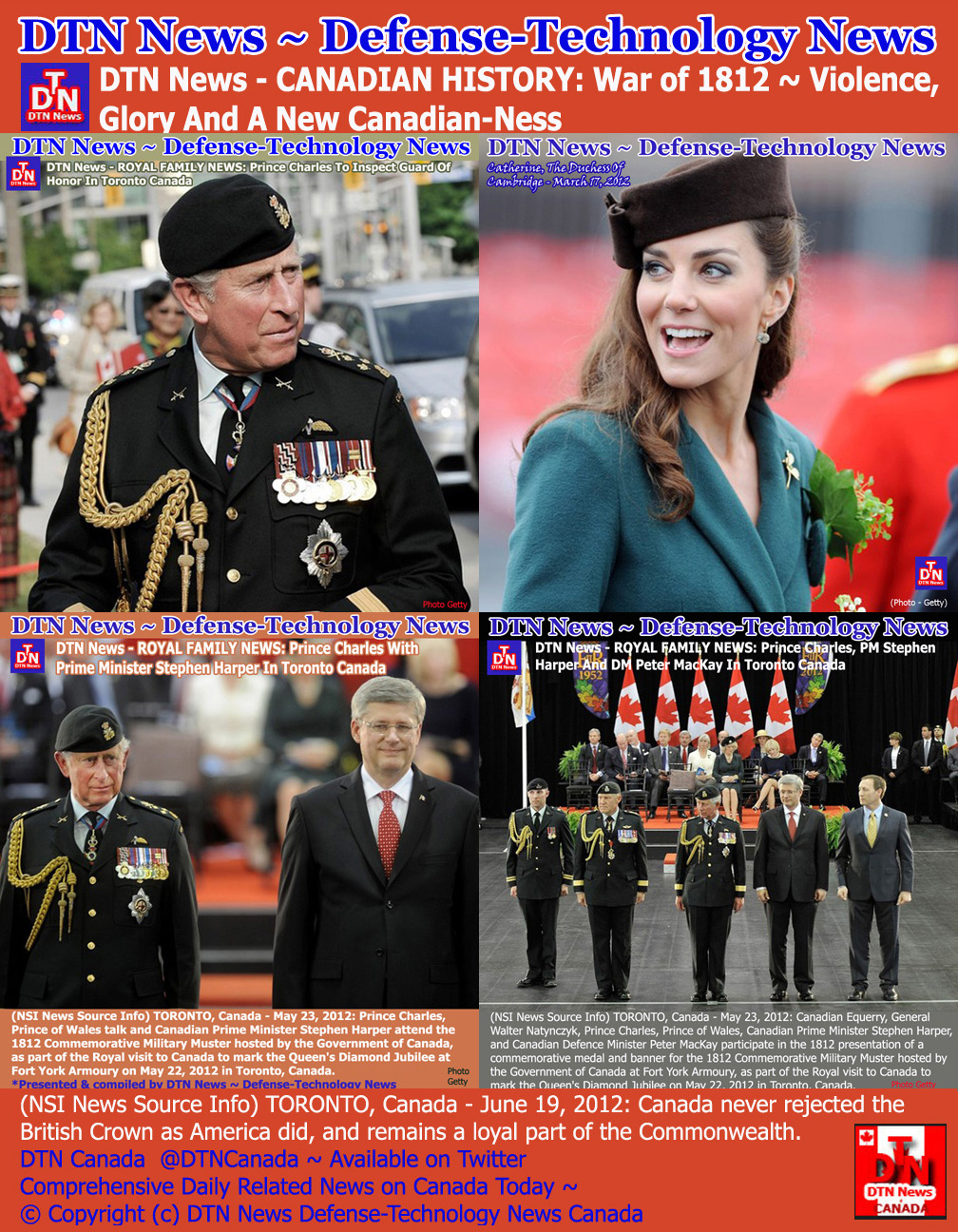
Stephen Harper and Prince CharlesCanada never rejected the British Crown as America did, and remains a loyal part of the Commonwealth
A force led by British Maj Gen Isaac Brock and Tecumseh captured Detroit from Gen Hull, taking almost 2,500 American regulars and militiamen captive with only 300 hundred British regulars, 400 Canadian militiamen and 600 natives.
At the Battle of the Chateauguay near Montreal, French Canadians repelled a US attack. Under the leadership of Charles de Salaberry, 50 regulars, 400 volunteers, 900 militiamen and 180 Mohawks drove off 4,000-strong US force.
Despite their difficult history with British rule, Les Canadiens had proved their bravery and patriotism beyond a doubt.
Their victory inspired yet another improbable defence of Canada just over two weeks later at the Battle of Crysler's Farm, in which 900 British regulars and Canadian militiamen repulsed 8,000 US troops.
By the war's end, both York (now Toronto) and Washington DC had been put to the torch by invaders; the British bombardment of Ft McHenry in Baltimore had inspired a new national anthem; and Gen Andrew Jackson had routed the British Army at the Battle of New Orleans.
But the map of North America had hardly changed.
Three native men who fought with the British, photographed in 1882Canada's First Nations tribes' hopes for an independent state died after the War of 1812; above, three men who fought with the British, photographed in 1882
The US withdrew to well within the boundaries of the 13 colonies. Inexperienced British diplomats gave away her territorial gains at the negotiating table, while bullish and skilled US negotiators rejected the British-backed idea of an independent "buffer state" for the indigenous tribes between the US and British North America.
This betrayal of the natives hastened the demise of native autonomy in North America, as the US turned its attention from annexing lands in the north to pushing west toward the Pacific Ocean.
The War of 1812 was declared in Washington 200 years ago yesterday.
The British and Americans drew and the natives lost, leaving the fledgling Canadians with the best claim to victory.
In the spirited defence of their way of life, they surprised both the invaders and one another with their resourcefulness, co-operation and tenacity in the face of an invasion force with an overwhelming numerical advantage.
In that sense, their struggle was not unlike the American Revolution a generation earlier.
What Canadian-ness actually means continues to evolve and remains a perennial topic of discussion both domestically and internationally.
Nevertheless, its beginnings can be traced back to 18 June 1812, when her fractious inhabitants stood together against subjugation by a foreign power.
The 33.5 million people living in Canada today - fully one-fifth of whom are foreign-born - have this patchwork vanguard to thank for their country's steady path to progressive prosperity.

*Link for This article compiled by Roger Smith from reliable sources BBC News
*Speaking Image - Creation of DTN News ~ Defense Technology News 
*This article is being posted from Toronto, Canada By DTN News ~ Defense-Technology News Contact:dtnnews@ymail.com 
©COPYRIGHT (C) DTN NEWS DEFENSE-TECHNOLOGY NEWS

Friday, July 01, 2011

DTN News - CANADA DAY NEWS / THE ROYAL FAMILY NEWS: William and Kate on Canada Day In Ottawa

DTN News - CANADA DAY NEWS / THE ROYAL FAMILY NEWS: William and Kate on Canada Day In Ottawa
(NSI News Source Info) TORONTO / OTTAWA, Canada - July 1, 2011: A shining sea of red and white well-wishers cascading over Parliament Hill is welcoming Prince William and Kate to Canada's birthday party.
Tens of thousands of spectators, festooned in all manner of Canadian colours, jammed the streets of Ottawa and the fields beneath the peace tower to greet the royal couple on Day 2 of their first official overseas visit.

They erupted in cheers when the landau bearing the Duke and Duchess of Cambridge rolled into view, then clamoured for handshakes as they strolled along the red carpet.
The din and smoke from a 21-gun salute filled the streets outside Parliament as Governor General David Johnston inspected the honour guard, the skirl of bagpipes in the background. The prince and his wife stood alongside the Centennial Flame as the band played the national anthem and “God Save the Queen.”
Kate was resplendent in Canadian colours — a cream dress by Reiss, complete with the Queen's Maple Leaf brooch, and a brilliant red fascinator by Sylvia Fletcher at Lock and Co. — while William wore an understated blue suit with red tie.
“Kate, you're beautiful,” one spectator bellowed. “Will and Kate,” others chanted.
The brooch, on loan from the Queen, is a diamond brooch in the form of a maple leaf that was first worn by Princess Elizabeth on her first visit to Canada in 1951, and again last year on Canada Day.
Earlier, the royal couple kicked off the day's events by presiding over a Canada Day citizenship ceremony, with hundreds of spectators gathered outside the Canadian Museum of Civilization in Gatineau, Que., just across the Ottawa River.
Parliament Hill was a checkerboard of red T-shirts, big hats and signs proclaiming love for the royal couple, who will see performances by Newfoundland band Great Big Sea, Quebec's Sam Roberts Band and YouTube sensation Maria Aragon.
Souvenir stands are also already popping up downtown, one selling a replica of Kate's engagement ring, which once belonged to William's mother Diana, the late Princess of Wales.
Today would have been Diana's 50th birthday.
On Thursday, throngs of delighted fans were on hand to greet the duke and duchess before they took part in a wreath-laying ceremony at the National War Memorial in the heart of the city's downtown core.
That was followed by a walkabout among the thousands of people lining the memorial square, many of whom had begun lining the streets several hours before the royal couple's arrival.
“Catherine and I are so delighted to be here in Canada, instilled in us by our parents and grandparents, who loved this country,” William told a welcome ceremony at Rideau Hall.
“We've been looking forward to this moment for a very long time. And before we were married, we had a longing to come here together.”
The duke and duchess will remain in Ottawa until Saturday, before travelling to Montreal, Quebec City, Charlottetown, Yellowknife and Calgary. They will leave for California on July 8.
*Speaking Image - Creation of DTN News ~ Defense Technology News
*This article is being posted from Toronto, Canada By DTN News ~ Defense-Technology News

©

COPYRIGHT (C) DTN NEWS DEFENSE-TECHNOLOGY NEWS

Thursday, June 23, 2011

DTN News - The Royal Family News: Queen's Diamond Jubilee Portrait Revealed

DTN News - The Royal Family News: Queen's Diamond Jubilee Portrait Revealed
(NSI News Source Info) TORONTO, Canada - June 23, 2011: A ''tender'' new portrait photograph of the Queen and the Duke of Edinburgh sitting together at their Windsor Castle home was unveiled today.
The portrait, commissioned to mark the Queen's forthcoming Diamond Jubilee, shows the monarch wearing a mint-coloured dress, seated with Prince Philip in the castle's Green Drawing Room.
It was taken by German artist Thomas Struth on April 7 this year and also marks the Duke's 90th birthday earlier this month.
The picture is to go on display at the Scottish National Gallery in Edinburgh tomorrow, part of its touring exhibition The Queen: Art & Image.
It is the first double portrait of the couple to be commissioned by the National Portrait Gallery, London, and the first portrait of the Queen since John Wonnacott's Royal Family group painting in 2000.
James Holloway, director of the Scottish National Portrait Gallery, said: ''I have no doubt that Thomas Struth's impressive and tender portrait of Her Majesty the Queen and His Royal Highness the Duke of Edinburgh will be seen as one of the definitive images of the Royal Family.
''I am delighted that the Scottish National Gallery has been given the opportunity to show this stunning work for the very first time.''
Paul Moorhouse, curator of The Queen: Art & Image, and the National Gallery's curator of 20th century portraits, said: ''Thomas Struth's portrait is a sensitive evocation of individuals within a magnificent setting composed in terms of light, colour, textures and formal arrangements.
''It is also a subtle exploration of human relationships.''
Sandy Nairne, director of the National Portrait Gallery, London, said: ''Thomas Struth has created an outstanding new portrait of Her Majesty the Queen and His Royal Highness the Duke of Edinburgh, that will happily contribute to the many celebrations of the Diamond Jubilee.''
Other highlights of the touring exhibition include Justin Mortimer's controversial painting in which the Queen's head appears to be separated from her body. The Queen: Art & Image is the most wide-ranging exhibition of images in different media devoted to a single royal sitter.
Related News;
*Speaking Image - Creation of DTN News ~ Defense Technology News
*This article is being posted from Toronto, Canada By DTN News ~ Defense-Technology News

©

COPYRIGHT (C) DTN NEWS DEFENSE-TECHNOLOGY NEWS