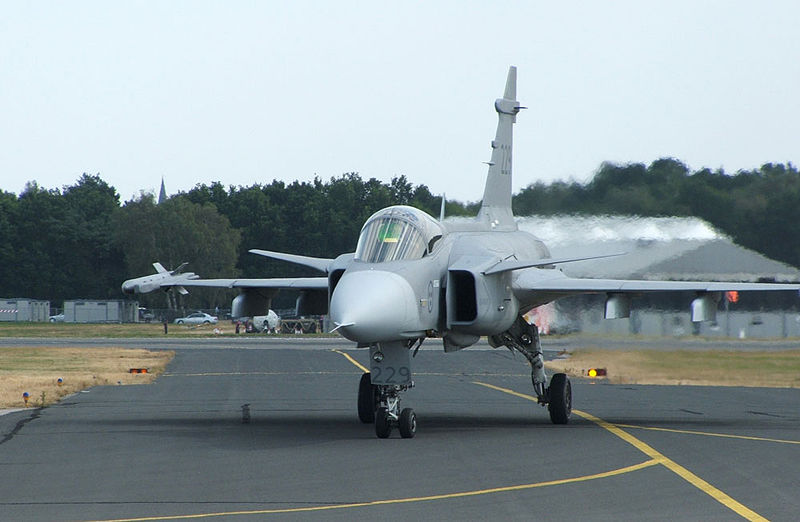
(NSI News Source Info) TORONTO, Canada - September 13, 2011: At the major international aero engine conference ISABE 2011 in Gothenburg today, Volvo Aero will present a number of technical solutions to increase the thrust produced by the RM12 Gripen engine.
 Volvo Aero has the main responsibility for the Gripen engine. The company is constantly faced with tough challenges: requirements placed on a military engine are considerably tougher than those on commercial engine; military engines need to withstand the effects flying at double the speed and double the altitude of commercial engines.
The Gripen aircraft reached an important milestone in the spring of 2011 when it passed 150 000 flying hours without having suffered a single engine related accident or incident. This was the result of proactive and methodical work between Volvo Aero, Saab, FMV (the Swedish Defence Material Agency) and the Air Forces operating the Gripen.
The Gripen will be in service for more than another 30 years so Volvo Aero is continually working to see how the RM12 can be developed in the future. In general, fighter aircraft are becoming heavier as they are required to manage several roles, and this in turn requires more thrust and increased cooling air.
When it comes to the thrust produced, the aim is an increase of 2% to 15%, depending on customer requirement.
In conjunction with the start of the major international aero engine conference, ISABE, Torbjörn Salomonsson, Project Leader at Volvo Aero, will present development opportunities for the RM12.
Increased thrust will be enabled through developments in three main areas:
• New engine control.
• A new or modified fan providing an increased mass flow through the engine. This relates to an advanced aero design and so called blisks (bladed disks).
• A new turbine with materials able to withstand higher temperatures, and an increased cooling flow. Volvo Aero's engineers will achieve this by adapting and modifying a more recent version of the turbine from General Electric.
”We have stated previously that it is possible to significantly increase the thrust of the existing RM12 engine at a very competitive cost. We will then have a more powerful and economical engine. It also means that we can upgrade the 220 engines that the Air Force already has whilst maintaining engine competence within country," says Henrik Runnemalm, Head of Research at Volvo Aero.
”From a financial perspective, it is a good thing that the RM12 can be further developed so that investments in the RM12 engine made by Gripen users can be fully realised. The average flight time is currently around 700-800 hours per engine. The remaining life per engine is up to four times this," he adds.
The presentation is taking place at the international ISABE-conference in Gothenburg, with some 350 aero engine experts from around the world. The conference continues until Friday Sept. 16th, and the program can be read at: http://www.isabe2011.com/
Volvo Aero has the main responsibility for the Gripen engine. The company is constantly faced with tough challenges: requirements placed on a military engine are considerably tougher than those on commercial engine; military engines need to withstand the effects flying at double the speed and double the altitude of commercial engines.
The Gripen aircraft reached an important milestone in the spring of 2011 when it passed 150 000 flying hours without having suffered a single engine related accident or incident. This was the result of proactive and methodical work between Volvo Aero, Saab, FMV (the Swedish Defence Material Agency) and the Air Forces operating the Gripen.
The Gripen will be in service for more than another 30 years so Volvo Aero is continually working to see how the RM12 can be developed in the future. In general, fighter aircraft are becoming heavier as they are required to manage several roles, and this in turn requires more thrust and increased cooling air.
When it comes to the thrust produced, the aim is an increase of 2% to 15%, depending on customer requirement.
In conjunction with the start of the major international aero engine conference, ISABE, Torbjörn Salomonsson, Project Leader at Volvo Aero, will present development opportunities for the RM12.
Increased thrust will be enabled through developments in three main areas:
• New engine control.
• A new or modified fan providing an increased mass flow through the engine. This relates to an advanced aero design and so called blisks (bladed disks).
• A new turbine with materials able to withstand higher temperatures, and an increased cooling flow. Volvo Aero's engineers will achieve this by adapting and modifying a more recent version of the turbine from General Electric.
”We have stated previously that it is possible to significantly increase the thrust of the existing RM12 engine at a very competitive cost. We will then have a more powerful and economical engine. It also means that we can upgrade the 220 engines that the Air Force already has whilst maintaining engine competence within country," says Henrik Runnemalm, Head of Research at Volvo Aero.
”From a financial perspective, it is a good thing that the RM12 can be further developed so that investments in the RM12 engine made by Gripen users can be fully realised. The average flight time is currently around 700-800 hours per engine. The remaining life per engine is up to four times this," he adds.
The presentation is taking place at the international ISABE-conference in Gothenburg, with some 350 aero engine experts from around the world. The conference continues until Friday Sept. 16th, and the program can be read at: http://www.isabe2011.com/
*Speaking Image - Creation of DTN News ~ Defense Technology News
*This article is being posted from Toronto, Canada By DTN News ~ Defense-Technology News
Contact:
©COPYRIGHT (C) DTN NEWS DEFENSE-TECHNOLOGY NEWS
©COPYRIGHT (C) DTN NEWS DEFENSE-TECHNOLOGY NEWS
©COPYRIGHT (C) DTN NEWS DEFENSE-TECHNOLOGY NEWS
COPYRIGHT (C) DTN NEWS DEFENSE-TECHNOLOGY NEWS
COPYRIGHT (C) DTN NEWS DEFENSE-TECHNOLOGY NEWS
COPYRIGHT (C) DTN NEWS DEFENSE-TECHNOLOGY NEWS
COPYRIGHT (C) DTN NEWS DEFENSE-TECHNOLOGY NEWS