Showing posts with label ASEAN. Show all posts

Saturday, January 24, 2015

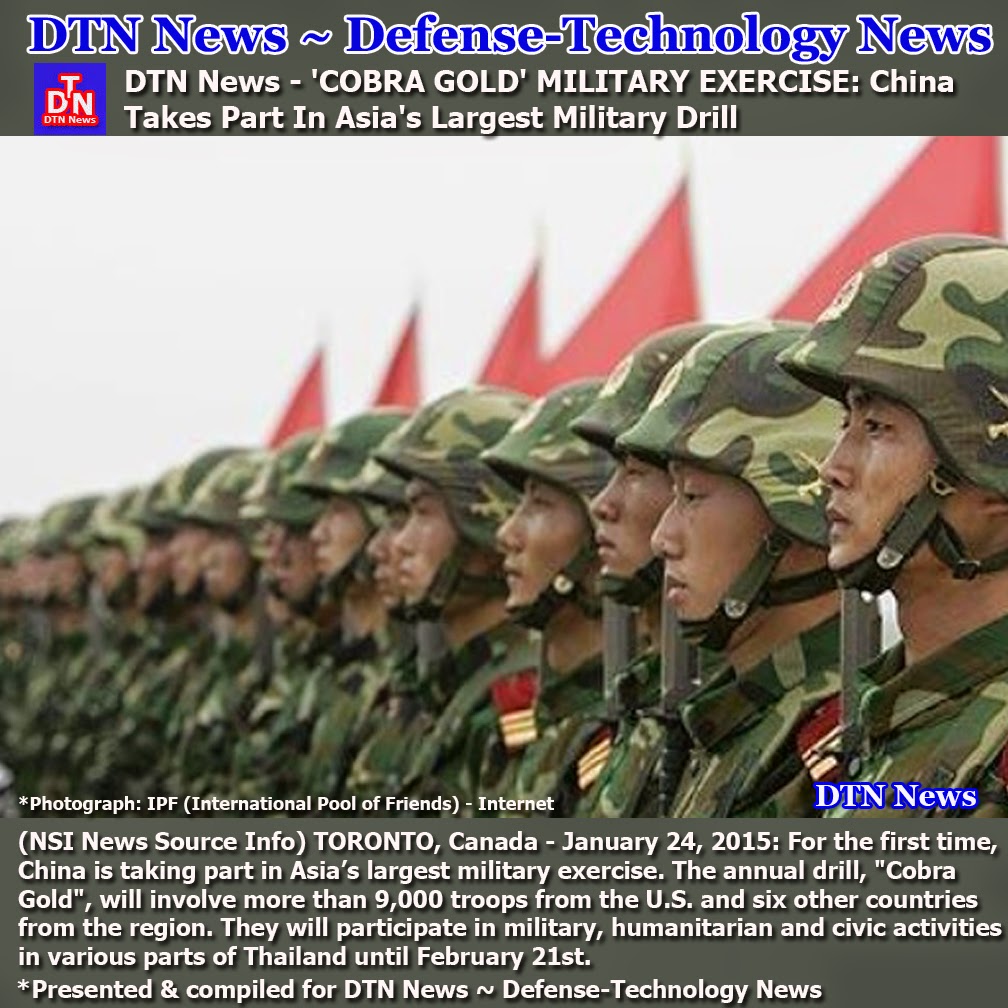
DTN News - 'COBRA GOLD' MILITARY EXERCISE: China Takes Part In Asia's Largest Military Drill

DTN News - 'COBRA GOLD' MILITARY EXERCISE: China Takes Part In Asia's Largest Military Drill
Source: DTN News - - This article compiled by K. V. Seth from reliable sources CCTV News
(NSI News Source Info) TORONTO, Canada - January 24, 2015: For the first time, China is taking part in Asia’s largest military exercise. The annual drill, "Cobra Gold", will involve more than 9,000 troops from the U.S. and six other countries from the region. They will participate in military, humanitarian and civic activities in various parts of Thailand until February 21st.

When the 33rd "Cobra Gold" multinational military exercise is over in a few days time, more than 50 families of Wat Ta Takien School in Thailand's province of Phitsanulok would be extremely happy. They will have a new one-storey multipurpose building for their children. It will be the outcome of four-week joint effort of Chinese, U.S. and Thai soldiers as part of engineering civic assistance projects under this year's exercise.

"There are no boundaries between the nations participating in this military exercise in terms of providing assistance to civilians. Having different nations work together gives us a chance to get to know each other and gain more knowledge," said Yang Bin of the People's Liberation Army.

For the local Thais, this would be the most tangible result of the region's largest military exercise.

China has been an observer in "Cobra Gold" since 2002 but has never taken part in the exercises until now. Although the role of the Chinese troops is limited to humanitarian drills, including providing engineering support and medical aid, many believe that their participation will boost military relations between China and ASEAN.

"In terms of cooperation between the military of the super powers, the U.S. and China, the operating personnel have developed good relationships with each other," said Col. Charnchai Romyen of Royal Thai Army. "With eight countries participating, the exercise will increase regional security, which I think is a great start."

Over the past three decades, "Cobra Gold" has evolved to include disaster relief and rescue operations.

While the ravages of tsunamis, earthquakes and floods have focused much of "Cobra Gold" on practicing humanitarian assistance efforts in recent years, simulated precision strikes and live fire exercises are a reminder of what militaries have always been designed to do. 
And this may see China's participation in the coming years ahead go through a transformation process to deeper and more challenging roles.

Related Images of 'COBRA GOLD' MILITARY EXERCISE;


*Link for This article compiled by K. V. Seth from reliable sources CCTV News
*Speaking Image - Creation of DTN News ~ Defense Technology News 
*Photograph: IPF (International Pool of Friends) + DTN News / otherwise source stated
*This article is being posted from Toronto, Canada By DTN News ~ Defense-Technology News Contact:dtnnews@ymail.com 
©COPYRIGHT (C) DTN NEWS DEFENSE-TECHNOLOGY NEWS

Saturday, November 19, 2011

DTN News - BOEING / AIRLINES NEWS: Boeing, Lion Air Announce Historic Commitment For Up To 380 737s

DTN News - BOEING / AIRLINES NEWS: Boeing, Lion Air Announce Historic Commitment For Up To 380 737s
(NSI News Source Info) TORONTO, Canada / BALI, Indonesia - November 19, 2011: Boeing (NYSE: BA) and Jakarta-based Lion Air today announced a commitment for the airline to order 201 737 MAXs and 29 Next-Generation 737-900 ERs (extended range). The agreement also includes purchase rights for an additional 150 airplanes.
"The 737 MAX will be the future of Lion Air," said Rusdi Kirana, Lion Air Founder and President Director. "The highly efficient, technologically advanced airplane will help Lion Air continue to bring low fares and allow us to open new destinations because of the longer range of the airplane."
With 230 airplanes at a list price of $21.7 billion, this deal when finalized will be the largest commercial airplane order ever in Boeing's history by both dollar volume and total number of airplanes. Boeing and Lion Air are working to finalize details of the agreement, at which time it will be a firm order posted on the Boeing Orders and Deliveries website. Lion Air will also acquire purchase rights for an additional 150 airplanes valued at more than $14 billion if exercised at list prices.
U.S. President Barack Obama witnessed the announcement at a ceremony today at the East Asia Summit in Bali, Indonesia.
"We're proud that Lion Air picked the 737 once again, building on our successful partnership," said Boeing Commercial Airplanes President and CEO Jim Albaugh. "Lion Air was a leader when it was the launch customer for the 737-900ER in 2005 and today it continues to be a leader as the first airline in Asia to commit to the 737 MAX."
The 737 MAX is a new engine variant of the world's best selling airplane and builds on the strengths of today's Next-Generation 737. The 737 MAX incorporates the latest-technology CFM International LEAP 1-B engines to deliver the highest efficiency, reliability and appeal.
Airlines operating the 737 MAX will see a 10-12 percent fuel burn improvement over today's most fuel efficient single-aisle airplanes and a 7 percent operating cost advantage over tomorrow's competition.
"Our customers tell us they want more efficient airplanes," said Ray Conner, senior vice president of Sales and Customer Support, Boeing Commercial Airplanes. "The 737 MAX will deliver fuel savings better than any competing single-aisle airplane on the market."
To date, the 737 MAX has commitments for more than 700 airplanes, while the Next-Generation 737 family has won orders for more than 6,000 airplanes and Boeing has delivered more than 3,800.
Lion Air, Indonesia's largest private airline, currently operates or has on order a total of 178 Next-Generation 737s.

Contact: Wilson Chow International Communications Boeing Commercial Airplanes +1 425-306-5921 wilson.chow@boeing.com

Doug Alder Media Relations Boeing Commercial Airplanes +1 206-544-1814 doug.alder-jr@boeing.com

Karen Crabtree Product Strategy Communications Boeing Commercial Airplanes +1 206-766-2930 karen.r.crabtree@boeing.com

More information: http://www.newairplane.com/737/737Max/LionAir

*Speaking Image - Creation of DTN News ~ Defense Technology News
*This article is being posted from Toronto, Canada By DTN News ~ Defense-Technology News

©

COPYRIGHT (C) DTN NEWS DEFENSE-TECHNOLOGY NEWS

Friday, October 23, 2009

DTN News: ASEAN TODAY October 23, 2009 ~ Thai, Filipino Feud On Rice Threatens ASEAN Pact

DTN News: ASEAN TODAY October 23, 2009 ~ Thai, Filipino Feud On Rice Threatens ASEAN Pact *Source: DTN News / Int'l Media (NSI News Source Info) HUA HIN, Thailand - October 23, 2009: The Philippines and Thailand are squaring off in an escalating row over rice that threatens to derail a trade pact at the heart of Southeast's bid to build an EU-style economic community by 2015. A worker repacks a kilo of rice into a plastic bag inside a warehouse of the National Food Authority, in Taguig city, south of Manila October 19, 2009. Thailand, the world's biggest rice exporter, repeated its threat on Friday that it would delay a Southeast Asian free trade agreement unless it can get a "fair deal" on tariffs from the Philippines, the world's biggest buyer of the food staple. The 10 members of the Association of South East Asian Nations -- of which Thailand and the Philippines are members -- are due to ratify an ASEAN Trade in Goods Agreement (ATIGA) at a summit that began on Friday in the Thai seaside town of Hua Hin. But whether they sign it depends on whether Thailand and the Philippines reach consensus on rice tariffs, said Thai Commerce Ministry spokesman Krisda Piampongsant. If ministerial talks fail on Saturday, their leaders will tackle it this weekend, he said. "If they can't agree at the ministerial level, we will escalate it to the leaders' level," Krisda said. "We will try our best to agree on rice to have the ATIGA signed. But if we can't, it won't be signed. "Many countries want ATIGA to be signed at this summit as it involves ASEAN's reputation." According to the ASEAN free trade pact, Philippine rice import tariffs should be cut to 20 percent from 40 percent by Jan. 1, 2010. But Manila insists rice is classified under a "highly sensitive list" allowing tariffs to stay at 35 percent. The Philippines is proposing to give Thailand a quota of 50,000 tonnes of tariff-free rice annually to compensate for not meeting the tariff target. Thailand has demanded 360,000 tonnes. "It's a very sensitive issue. We're friends. We need to talk this through. It's sensitive for Philippines. It's a major importer of rice affected immensely by the typhoon, so we understand the situation," said Thai deputy commerce minister Alongkorn Polabutr. TYPHOON DAMAGE Recent typhoons badly damaged farmlands and roads in northern Philippines, killing more than 900 people and forcing the country of 98 million people to import more rice rather than rely on cheaper, domestic supplies. "It's the right of the Philippines to decrease (import tariffs) or not, but we're moving towards an ASEAN economic community. So from the new year we have to show the same movement to decrease tariffs," Alongkorn said. Officials in Manila said rice had been taken off the agenda at the summit to allow Philippine President Gloria Macapagal to focus on other issues including climate change, disaster relief and human rights. But Thai officials said it remained on the agenda, noting that it was one of several issues that are crucial for ratification of the Trade in Goods Agreement, a key plank of an ambitious bid by ASEAN and its 540 million people to build an EU-style economic community by 2015. Thailand exported 10 million tonnes of rice in 2008 of which 599,677 tonnes went to the Philippines, according to Thailand's Commerce Ministry data. From January to August 2009, Manila bought 116,322 tonnes of rice from Thailand, mostly premium grade for high-end restaurants. Vietnam has mainly snatched the market for lower quality rice grades by offering better prices, traders said.

Saturday, August 15, 2009

DTN News: ASEAN, India Sign Free Trade Deal: Officials

DTN News: ASEAN, India Sign Free Trade Deal: Officials
*Source: DTN News / Int'l Media (NSI News Source Info) BANGKOK, Thailand - August 15, 2009: India and the Association of Southeast Asian Nations (ASEAN) signed a free-trade agreement on Thursday expected to raise annual trade to 60 billion dollars within seven years, officials said. "The signing today is a good sign of the extended trade between ASEAN and India," said Porntiva Nakasai, commerce minister of Thailand, which holds the 10-member regional bloc's rotating chairman ship. "The agreement comes at an appropriate time taking into account the current world economic crisis," she said in a statement. The agreement has been hailed as a milestone following years of tough negotiations between ASEAN and India, its seventh-largest trading partner. It covers billions of dollars in trade and a market of 1.7 billion people. The signing came ahead of a meeting in Bangkok this weekend of finance ministers from ASEAN and its regional partners China, Japan, South Korea, India, Australia and New Zealand. Trade between ASEAN and India totaled 47 billion dollars last year but would rise to 60 dollars billion under the pact, Dow Jones newswires quoted Thai Commerce Ministry spokesman Krisda Piampongsant as saying. The Southeast Asian bloc of about 550 million people is forging free trade pacts with key regional economies, including China and India, to ensure it does not become economically sidelined. ASEAN itself aims to achieve a single market and manufacturing base by 2015.

Friday, July 24, 2009

DTN News: US and North Korea Trade Sharp Barbs At ASEAN Meeting

DTN News: US and North Korea Trade Sharp Barbs At ASEAN Meeting
*Source: DTN News / Int'l News (NSI News Source Info) PHUKET, Thailand - July 24, 2009: North Korea and the United States exchanged harsh criticism Thursday at the conclusion of the Association of Southeast Asian Nations Regional Forum on Thailand's Phuket island. Most of the discussions focused on the security situation on the Korean peninsula and Pyongyang's efforts to build up its nuclear weapons program.
Foreign ministers and representatives from Association of Southeast Asian Nations (ASEAN) pose for photos during ASEAN Regional Forum in Phuket, Thailand, Thursday, July 23, 2009. Front row, from left are North Korea's chief delegate Pak Kun-gwang, Canada's Deepak Obhrai, China's Yang Jiechi, Cambodia's Hor Namhong, Brunei's Prince Mohamed Bolkiah, Bangladesh's Dipu Moni, Australia's Stephen Smith, Thailand's Kasit Piromya, Vietnam's Pham Gia Khiem, U.S. Secretary of State Hillary Clinton, East Timor's Deputy Prime Minister Jose Luis Guterres, Sri Lanka's Rohitha Bogollagama, Singapore's George Yeo, Russia's Sergei Lavrov and ASEAN Secretary-General Surin Pitsuwan. Back row, from left are Mongolia's Sukhbaatar, European Union High Representative for the Common Foreign and Security Policy Javier Solana, India's S.M. Krishna, Indonesia's Hassan Wirajuda, Japan's Hirofumi Nakasone, Laos' Thongloun Sisoulith, Malaysia's Anifah Aman, Myanmar's Nyan Win, New Zealand's Murray McCully, Pakistan's Makhdoom Shah Mahmood Qureshi, Philippines' Roberto Romulo, South Korea's Yu Myung-hwan and Papua New Guinea's Samuel Abal. Foreign ministers from mostly Southeast Asian and other Pacific-region nations ended their meetings in Thailand with smiles as they posed for pictures. Earlier the leaders from 27 nations did not come away with what they had hoped for: a commitment from North Korea to dismantle its nuclear program and return to six-party talks with the US, Japan, South Korea, China and Russia. North Korean delegate Ri Hung-sik told reporters at the forum his government was not against having a dialogue but he said "how can you have a dialogue with a knife at your back". "Until America's deep-rooted anti-North Korea attitude is solved, the problems will continue. Because of that, the Six-Party Talks are also over," he said. During the ASEAN forum the United States and other countries agreed on a package of incentives, including economic and energy aid, which could be offered to North Korea. But in a harsh criticism of Pyongyang, U.S. Secretary of State Hillary Clinton said the regime "had no friends left" to protect it from international efforts to end its nuclear program. She also expressed disappointment in comments by the North Korean delegation who attended the forum. "Unfortunately, the North Korean delegation offered only an insistent refusal to recognize that North Korea has been on the wrong course. In their presentation today, they evinced no willingness to pursue the path of de-nuclearization and that was troubling not only to the United States, but to the region and the international community," Clinton said. The meeting began with the hopes that North Korea would re-enter six-party talks on ending its nuclear program. North Korea dropped out of the six-party talks after the UN censured its long-range missile test in April. Thailand's foreign minister, Kasit Piromya, said ASEAN as a regional bloc will continue to play a role in the North Korean nuclear disarmament efforts. "The goal is to bring about peace and stability to the Korean peninsula and denuclearization of the Korean Peninsula. So we urge the DPRK (Democratic People's Republic of Korea) to return to the Six Party Talks, look beyond the past and join others in finding the way forward," Piromya said. Despite the request, North Korean officials told reporters there would be no prospect of resumption of the talks unless the United States ends what it termed as its anti-North Korean attitude. Meanwhile ASEAN leaders also pledged to support the implementation of recent United Nations sanctions against Pyongyang.

DTN News: U.S. Offers Burma Possible Benefits

DTN News: U.S. Offers Burma Possible Benefits
*U.S. Secretary of State Hillary Rodham Clinton Wants Nobel Laureate Aung San Suu Kyi Released
*Source: DTN News / Int'l News
(NSI News Source Info) PHUKET, Thailand - July 24, 2009: Secretary of State Hillary Rodham Clinton made an explicit appeal to Burma on Wednesday to release jailed Nobel Peace Prize laureate Aung San Suu Kyi, offering the prospect of direct U.S. investment in the repressive Southeast Asian nation.
U.S. Secretary of State Hillary Rodham Clinton and Vietnamese Foreign Minister Pham Gia Khiem shake hands at the end of a group photo session for the Association of Southeast Asian Nations (ASEAN) Regional Forum (ARF) summit on the resort island of Phuket, southern Thailand, Thursday, July 23, 2009. Other Foreign Ministers are from left, Thongloun Sisoulith of Laos, Kasit Piromya of Thailand, Anifah Aman of Malaysia, Nyan Win of Myanmar, Murray McCully of New Zealand, Makhdoom Shah Mahmood Qureshi of Pakistan, Zacarias Albano da Costa of East Timore, Alberto Romulo of the Philippines and Rohitha Bogollagama of Sri Lanka.
The release of Suu Kyi is "critical" to easing the strained relations between Burma and the United States, Clinton said. "If she were released, that would open up opportunities at least for my country to expand our relationship with Burma, including investments in Burma," she told reporters while attending a regional security forum. President Obama renewed a year-long investment ban on Burma on May 15, citing its "large-scale repression of the democratic opposition," and U.S. officials suggested he would reverse it if Burma took strides to ease political repression. The new administration has made an intensive effort to reach out to repressive governments with a long history of human rights abuses in an attempt to shift what officials consider stalemated policies. A brutal military junta that has orchestrated gang rape of ethnic minorities, crushed democracy efforts, and kept most of the nation's revenue from natural gas, gems and other natural resources rules Burma. State Department officials are also firmly convinced that the Burmese government is undergoing a wrenching internal debate over what to do about Suu Kyi, whose party, the National League for Democracy, won a landslide electoral victory in 1990 that the military leadership refused to accept. Since then, she has been under house arrest for most of the time, as have hundreds of her supporters. In May, just days before Suu Kyi's six-year term under house arrest was to expire, the government put her on trial for an incident involving a U.S. citizen who swam across Rangoon's Lake Inya to reach Suu Kyi's lakefront bungalow. Clinton's statement appeared intended to sharpen the choice for the Burmese government, but Suu Kyi's attorneys reported Wednesday that they have been denied a request to meet with her one more time before Friday's final court hearing. The secretary, in an interview with National Public Radio on Wednesday, attributed the many delays in the trial to internal angst among the junta. But other U.S. officials think the trial was postponed to avoid a confrontation at the security conference held by the Association of Southeast Asian Nations (ASEAN). After Clinton's remarks, a senior State Department official said the administration has privately presented Burma with "ideas about how to begin a process of dialogue and engagement that begins with Aung San Suu Kyi," including letting her "participate in the politics" of a planned 2010 election. The United States is also seeking the release of other political prisoners, he said, speaking on the condition of anonymity. "This is worth a shot," the official said. "We are not naive about this, and there is an understanding there is a good chance that the junta will say, 'No, thank you.' " U.S. officials reiterated Clinton's offer in a private meeting with Burmese officials Wednesday night. In two public appearances Wednesday, Clinton also sharpened her concern, first expressed Tuesday, about "the transfer of nuclear technology" from North Korea to Burma. "We have been very clear in stating that the United States would like to see changes in the behavior of the regime in Burma," she said. Despite the U.S. investment ban, countries such as India, Thailand, South Korea, Singapore and China have poured money into investments to exploit Burma's natural resources. At least 69 Chinese multinational corporations are involved in 90 hydropower, mining, and oil and natural gas projects in Burma, according to a 2008 report by the group EarthRights International. Before flying to this resort island for the ASEAN forum, Clinton told Thai television in Bangkok that the organization should consider expelling Burma from the 10-nation group if the military junta does not release Suu Kyi. But later in the day she backpedaled, saying that such a decision is up to ASEAN. To solidify relationships with the ASEAN countries, Clinton signed a nonbinding nonaggression pact that China -- a major economic competitor with the United States in the region -- signed six years ago. But she also said the United States would become the first non-ASEAN country to open an ambassador-level diplomatic post with the group. Clinton played down comments she had made earlier Wednesday, to Thai television, suggesting the United States would provide a "defense umbrella" for Persian Gulf allies if Iran acquired a nuclear bomb. She said she had indicated no new policy.

Monday, April 13, 2009

China Offers Funds To Boost Asean

China Offers Funds To Boost Asean
(NSI News Source Info) April 13, 2009: China has unveiled plans to establish a $10bn (£6.8bn) investment fund for south-east Asian countries. It has also offered credit of $15bn to the Association of South-East Asian Nations, or Asean. Chinese Prime Minister Wen Jiabao had planned to announce the fund at the cancelled Asean summit this weekend. China's premier Wen Jiabao (2nd L) meets unidentified officials, as he arrives at the U-Tapao military airport, some 170 km south-east of Bangkok on April 10, 2009 for the 14th Association of Southeast Asian Nations (ASEAN) Summit and Related Summits held in nearby Pattaya. Hundreds of protesters massed in the Thai beach resort of Pattaya where Asian leaders are holding a major summit April 10 to 12, opening a new front in rallies against the country's prime minister. Asean was set up in 1967 in part to counter influence from communist China but has since become a vehicle for close ties. The collapse of the Asean summit, scheduled in Pattaya, Thailand, this weekend, delayed the conclusion of a key investment agreement between China and the economic bloc. That deal is intended to create the world's largest free trade area, covering nearly two-billion people. China funds China's Foreign Minister, Yang Jiechi, announced the new funding plans in Beijing to a gathering of envoys from the 10 members of Asean - Indonesia, Singapore, Malaysia, Thailand, the Philippines, Brunei, Burma, Laos, Cambodia and Vietnam. The $10bn investment fund was designed for cooperation on infrastructure construction, energy and resources, information and communications, China's state news agency Xinhua quoted Mr Yang as saying. Over the next three to five years, China planned to offer $15bn in credit, including loans with preferential terms of $1.7bn in aid for cooperation projects. China also planned to offer 270 million yuan ($39.7m) in special aid to Cambodia, Laos and Myanmar to meet urgent needs, inject $5m into the China-Asean Cooperation Fund, and donate $900,000 to the cooperation fund of Asean Plus-3, the side grouping of Asean plus China, Japan and the South Korea. Several South- East Asian economies rely heavily on exports to China. China said it would provide 300,000 tons of rice for the emergency East Asia rice reserve, and more government scholarships. "The overall thought for China-Asean cooperation is that the two sides should rise to difficulties in face of the grim global financial crisis, and make efforts to convert unprecedented challenge into opportunity for closer pragmatic cooperation and common development," Mr Yang said. Region watching China has played a larger role in recent years in the export-dependent economies of South East Asia, as a market for goods and raw materials and as a source of investment. It has been active in building roads and other transport links through Laos, Burma and Cambodia, linking southern China to South East Asian resources and ports. During the financial crisis of 1997-98, China also offered support to South East Asian economies. Analysts have noted that while its economic role is increasing, Asean remains strategically linked to the stronger military power of the US. Tensions persist between China and the many south-east Asian claimants to groups of islands in the South China Sea.