Showing posts with label Tata. Show all posts

Thursday, February 12, 2015

DTN News - INDIA DEFENSE NEWS: Indian Firms Set Teams For Helicopter Tender

DTN News - INDIA DEFENSE NEWS: Indian Firms Set Teams For Helicopter Tender
Source: DTN News - - This article compiled by K. V. Seth from reliable sources By Vivek Raghuvanshi ~ DefenseNews
(NSI News Source Info) TORONTO, Canada - February 12, 2015 In (NEW DELHI) India's first helicopter competition reserved for domestic defense companies, teams have been established between top defense companies Larsen & Toubro with Airbus Helicopters and Tata Advanced Systems with Sikorsky Aircraft to produce a light utility helicopter (LUH).

Other corporate arrangements include Mahindra Defence Systems teaming up with Bell Helicopter and Punj Lloyd with Russian Helicopters. The domestic companies have to respond by Feb. 17 to a request for information (RFI) they received in October to provide the helicopters on a Buy and Make (India) basis in the $2.5 billion tender.

State-owned Hindustan Aeronautics also is negotiating a tie up with Russian Helicopters.

None of the overseas or domestic companies would discuss their partnerships.

A Ministry of Defence official said there is no certainty that the helicopters built by the domestic companies would be cheaper than importing them directly.

"The idea is to build capabilities in India to build the defense industrial base and have in-house life-time support and maintenance," the official added.

While the RFI describes purchase of 197 light utility helicopters — 133 for the Army and 64 for the Air Force — India has a requirement for more than 400, said an Air Force official.

Defense analyst Nitin Mehta, however, is not sure if the program will ever take off in the domestic sector.

"The fresh procurement process for LUH, which has begun after the cancellation of the earlier global tenders, will further delay the acquisition of the much-needed helicopters. The domestic private sector companies, having no experience in making helicopters and will begin from scratch, will add to the delay which will ultimately prove counterproductive," Mehta said.

"At [some point] India will have to buy the much-needed LUH from the global market on a fast-track basis," Mehta said.

Russian President Vladimir Putin, during talks with Prime Minister Narendra Modi in New Delhi Dec. 11, had offered to build in India the Ka 226 LUH for domestic and export purposes. However, the government decided to pursue an open competition.

The RFI says the LUH will be needed for reconnaissance and surveillance, to direct artillery fire, for quick-reaction teams for special missions, aerial photography, serving a scout role in conjunction with attack helicopters, and to monitor nuclear, biological and chemical incidents.

The tie ups only represent an initial intent to partner in the helicopter tender and become formal only after responding to the RFP.

When the Modi government came to power in May 2014, it canceled a 2009 global re-tender to purchase 197 LUHs and instead issued the RFI only to domestic defense majors as part its policy to build domestic industry capabilities. At the time of cancellation of the tender, Eurocopter's (now Airbus Helicopters ) AS550 helicopter was in competition with Russia's Ka-226T built by Kamov.

In August, the MoD also canceled a 2012 tender to buy 56 naval utility helicopters in which Airbus Helicopters and AgustaWestland were competing.

*Link for This article compiled by K. V. Seth from reliable sources By Vivek Raghuvanshi ~ DefenseNews
*Speaking Image - Creation of DTN News ~ Defense Technology News 
*Photograph: IPF (International Pool of Friends) + DTN News / otherwise source stated
*This article is being posted from Toronto, Canada By DTN News ~ Defense-Technology News Contact:dtnnews@ymail.com 
©COPYRIGHT (C) DTN NEWS DEFENSE-TECHNOLOGY NEWS


Wednesday, March 28, 2012

DTN News - DEFEXPO 2012 INDIA: Firms Flock To Delhi To Woo World's Top Arms Importer

DTN News - DEFEXPO 2012 INDIA:  Firms Flock To Delhi To Woo World's Top Arms Importer
Source: DTN News - - This article compiled by Roger Smith from reliable sources TOI - The Times of India
(NSI News Source Info) TORONTO, Canada / NEW DELHI, India - March 28, 2012: The message is embarrassing but clear: with India failing to get its act together to build a strong defence-industrial base (DIB) unlike China, it will continue to be the world's largest arms importer in the foreseeable future.
 
So, gleeful global armament giants are again lining up to hard-sell their aircraft, helicopters, drones, submarines, howitzers, futuristic infantry combat vehicles, missiles, assault rifles and carbines at India's biennial arms jamboree here.

There are going to be 232 foreign firms, mainly from the US, Russia, France, Israel, the UK and Germany, and 60 official delegations in town this week for the four-day "DefExpo-2012' that begins on Thursday.

Over 335 Indian exhibitors, including major ones like Tatas, Punj Lloyd, L&T and Mahindra, will also be there to explore tie-ups and joint ventures with foreign companies as well as DRDO, defence PSUs and domestic shipyards.

"We understand fully well that indigenization cannot happen through only defence PSUs...we have taken several steps to encourage the private sector," said Shekhar Agarwal, secretary (defence production).

The defence ministry has been pushing for JVs and technology transfers to strengthen the DIB, albeit in a haphazard manner, even as it continues to restrict FDI to only 26% in the defence production sector.

Foreign vendors who bag arms deals over Rs 300 crore, of course, have to plough back at least 30% of the contract value into India as "offsets" in the defence industrial, civil aerospace, homeland security and training sectors.

The gigantic $20 billion MMRCA (medium multi-role combat aircraft) project to acquire 126 fighters, in fact, has a 50% offset clause. Offset contracts worth over Rs 50,000 crore are set to materialize over the next two to three years, say officials.

But India, with its fledgling DIB, still remains far away from reversing the current trend of being forced to import 70% of its military hardware and software. This also leaves it vulnerable to supply lines being choked in times of conflict.

Just earlier this month, Swedish think-tank SIPRI dubbed India the world's largest arms importer, accounting as it did for 10% of global arms imports in the 2007-2011 timeframe to display China. With an aggressive DIB, often propelled by "reverse engineering", China is becoming a major arms exporter to countries like Pakistan.

But if India inked arms deals worth $50 billion mainly with foreign vendors in the decade after the 1999 Kargil conflict, it will spend well over double that amount in the current decade.

The Army has pointed at huge operational gaps in fields ranging from artillery, aviation, air defence and night-fighting to ATGMs (anti-tank guided missiles), PGMs (precision guided munitions) and specialized tank and rifle ammunition.

After taking it up with defence minister A K Antony, the force now wants to brief the PM since it will need around Rs 41,000 crore to make up just its existing "critical hollowness'' in ammunition and equipment, say sources.

Indian arms bazaar

Aircraft:
-- India in final commercial negotiations with French Dassault Aviation for the $20 billion MMRCA project to acquire 126 fighters.

-- Over $1.5 billion contract for six new mid-air refueling aircraft in final stage between AirbusMilitary's A330 MRTT and Ilyushin IL-78MK tankers.

-- Acquisition of 75 Swiss Pilatus PC-7 trainer aircraft for over Rs 3,000 crore awaiting final nod.

-- Three major "follow-on" deals with US companies in pipeline: Six more C-130J "Super Hercules" tactical airlift planes (over $1.2 billion), four P-8I long-range maritime patrol aircraft (over $1 billion) and six C-17 Globemaster-III strategic airlift aircraft (over $2.4 billion).

Helicopters:
Army, Navy, IAF and Coast Guard on course to induct over 600 helicopters, ranging from heavy-lift and attack to maritime multi-role and light utility ones, the majority from foreign companies, for over Rs 20,000 crore in the coming decade.

Submarines:
Global tender for over Rs 50,000 crore `Project-75 India' to construct six advanced diesel-electric stealth submarines, armed with both land-attack missile capabilities and air-independent propulsion (AIP), to be issued soon.

Artillery:
Over Rs 20,000 crore 155mm artillery modernization programme to acquire 1,580 towed guns, 814 mounted gun systems, 180 self-propelled wheeled guns, 100 self-propelled tracked guns and 145 air-mobile ultra-light howitzers. 


*DTN India  @DTNIndia ~ Available on Twitter

Comprehensive Daily News on India Today ~ © Copyright (c) DTN News Defense-Technology News

*Link for This article compiled by Roger Smith from reliable sources TOI - The Times of India
*Speaking Image - Creation of DTN News ~ Defense Technology News 
*This article is being posted from Toronto, Canada By DTN News ~ Defense-Technology News Contact:dtnnews@ymail.com 
©COPYRIGHT (C) DTN NEWS DEFENSE-TECHNOLOGY NEWS


Monday, March 05, 2012

DTN News - INDIA DEFENSE NEWS: Helicopter Makers Such As Boeing, Sikorsky Aircraft Corp, Bell Helicopter Eye Indian Military Deals

DTN News - INDIA DEFENSE NEWS: Helicopter Makers Such As Boeing, Sikorsky Aircraft Corp, Bell Helicopter Eye Indian Military Deals
Source: DTN News - - This article compiled by Roger Smith from reliable sources Economic Times
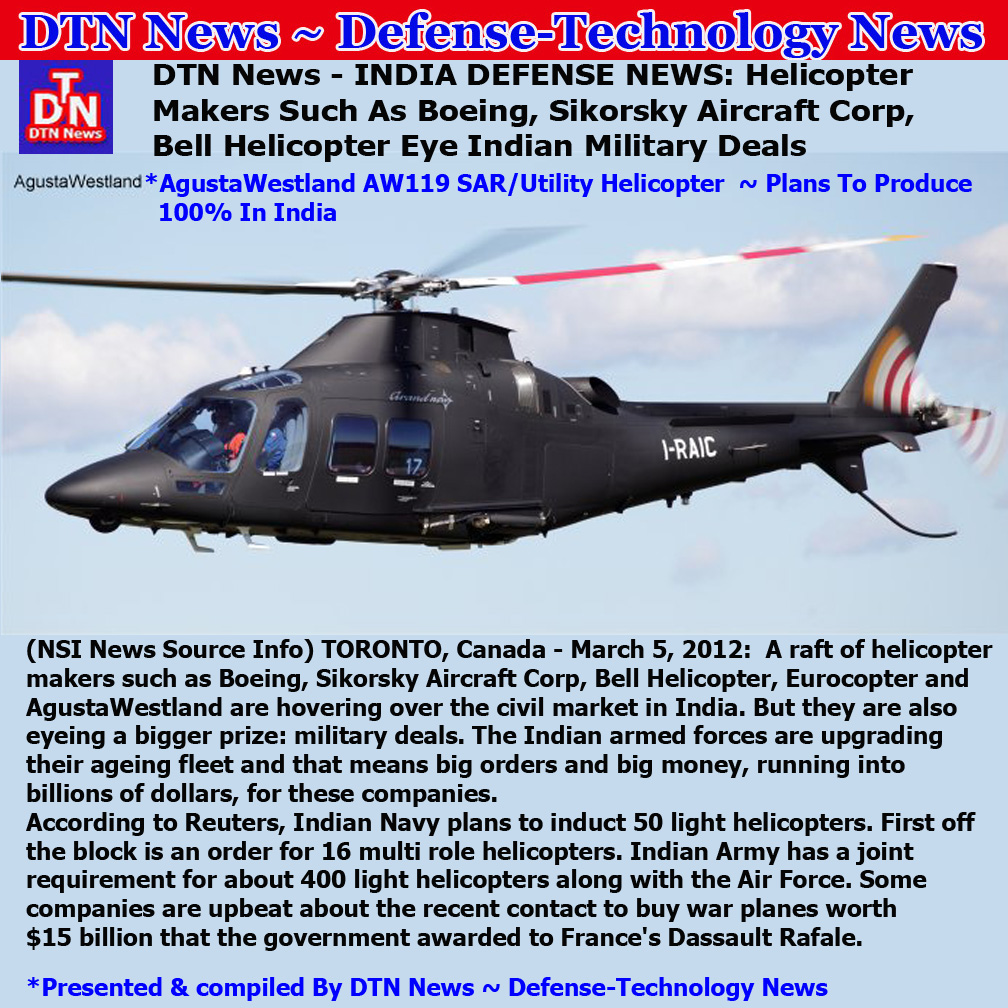
(NSI News Source Info) TORONTO, Canada - March 5, 2012:  A raft of helicopter makers such as BoeingSikorsky Aircraft CorpBell HelicopterEurocopter andAgustaWestland are hovering over the civil market in India. But they are also eyeing a bigger prize: military deals. The Indian armed forces are upgrading their ageing fleet and that means big orders and big money, running into billions of dollars, for these companies. 

According to Reuters, Indian Navy plans to induct 50 light helicopters. First off the block is an order for 16 multi role helicopters. Indian Army has a joint requirement for about 400 light helicopters along with the Air Force. Some companies are upbeat about the recent contact to buy war planes worth $15 billion that the government awarded to France's Dassault Rafale. 

Mick Maurer, president of Sikorsky Military Systems, says the procurement process in India is getting better. "It is more rigorous and more transparent. We believe that suits us very well." Maurer says in the long term, Sikorsky sees a 3:1 ratio vis-a-vis the military and commercial sales in terms of the size of the market. But he says both are very complementary markets. Many of the machines can be used for commercial and quasi-defence activities. 

If the civil copter market in India has come alive, it is thanks to the armed forces. Foreign companies in the defence market are bound by what is called offset obligations. India's defence procurement policy rules that foreign companies require that win contracts of 300 crore or more must procure equipment worth at least 30% of the deal amount from local suppliers to boost the homegrown arms industry. 

The Indian military has also become smarter, according to foreign company executives. "Sometimes manufacturers give a special price on aircraft, but raise the price on the support side. India has become aware of this and now looks at the total lifecycle costs in deals," says Maurer. 

The upshot is that companies like Sikorsky and Eurocopter have partnered Indian counterparts to set up base in India. Sikorsky has formed two joint ventures with the Tatas to make helicopter cabins and aircraft components. Eurocopter, which formed an Indian unit in 2010, has tieups with the Mahindras, the Tatas and governmentowned Hindustan Aeronautics Limited. AgustaWestland, the helicopter unit of Finmeccanica SpA of Italy, has a joint venture with the Tatas called Indian Rotorcraft. 

All these companies plan to expand in India. Textron, the parent company of Bell Helicopter, has opened a new global technology centre in Bangalore with more than 400 engineers. Bell plans to expand the workforce there over the next year, says the company's India head, BS Singh Deo. An AgustaWestland spokesman says the company recently opened a new larger office in Delhi. Copter makers are also expanding the customer support network by establishing authorised service centres along with a posse of engineers and technicians. 

All this bodes well for the commercial market. The AgustaWestland spokesman says construction work is about to start on the Indian Rotorcraft's facility in Hyderabad , which will produce the company's eight-seat utility helicopter AW119. Sikorsky eventually plans to produce helicopters that are virtually "100% done here" . "We are already a local company," says Maurer.


*DTN India  @DTNIndia ~ Available on Twitter
Comprehensive Daily News on India Today ~ © Copyright (c) DTN News Defense-Technology News

*Link for This article compiled by Roger Smith from reliable sources Economic Times
*Speaking Image - Creation of DTN News ~ Defense Technology News 
*This article is being posted from Toronto, Canada By DTN News ~ Defense-Technology News Contact:dtnnews@ymail.com 
©COPYRIGHT (C) DTN NEWS DEFENSE-TECHNOLOGY NEWS


Thursday, March 03, 2011

DTN News - DEFENSE NEWS: Sikorsky To Make Helicopters In India For Local, Overseas Markets

DTN News - DEFENSE NEWS: Sikorsky To Make Helicopters In India For Local, Overseas Markets
**US company looking at manufacturing choppers by 2015-16; will design and make both civilian and military helicopters
(NSI News Source Info) TORONTO, Canada - March 3, 2011:

US-based Sikorsky Aircraft Corp. plans to design and manufacture civilian and military helicopters in India for the local and Asia-Pacific market in four years, the first time a foreign aircraft company will use the country’s aerospace know-how to make choppers for the overseas market.

“We are looking at manufacturing an indigenous helicopter by 2015-16. We already have the helicopters that are suitable for the Indian climate,” said Arvind Jeet Singh Walia, managing director (India and South Asia) at Sikorsky Aircraft. “We intend developing further technologies to cater to defence requirements for high-altitude and high-performance machines.”

A unit of United Technologies, the U.S. helicopter maker said it was in talks with a string of Indian companies to build Black Hawks.

"We will bring the Black Hawk here with the option to improve the horse power ...," Sikorsky Vice President Steve Estill said, adding that the additional power was being introduced to operate the helicopter between 14,000 and 15,000 feet.

He did not give details of the investment involved in the proposed manufacturing plan.

Sikorsky, a unit of American military contractor United Technologies Corp. and one of the world’s largest helicopter makers, has an existing tie-up with Tata Advanced Systems Ltd, a Tata group company, to make helicopter cabins for the global market.

A boom in India’s civil aviation market, among the fastest growing in the world, and a military upgradation plan that may be worth $100 billion (Rs.4.5 trillion) in the next 10 years, is persuading global aircraft makers to form joint ventures with local companies to take advantage of the business opportunity. India has an offset clause for high-value defence purchases that requires overseas companies to base part of the manufacturing in the country.

At the same time, global aerospace firms, facing a shortage of skilled workers back home, are seeking to take advantage of local talent groomed by India’s nascent aerospace industry, which is led by state-run Hindustan Aeronautics Ltd (HAL), the only company that has the capability of manufacturing helicopters in the country.

Roughly a quarter of the 637,000 aerospace workers in the US could be eligible for retirement this year, raising fears that the country may face a skills shortage in factories that make commercial and military aircraft, Aerospace Industries Association president and chief executive Marion Blakey was cited as saying by trade publication Airport Business on 12 January.

HAL’s home-grown aerospace products include the Tejas light combat aircraft, the Dhruv advanced light helicopter and the intermediate jet trainer. Three new helicopters, including the light combat helicopter and the light utility helicopter, are being built for the Armed Forces.

HAL has orders for 1,500 helicopters, including 100 Dhruvs, 300 light utility helicopters and 400 Indian multi-role helicopters.

Besides this, HAL has orders for 159 Dhruvs from the army and the air force.

“Manufacturing indigenous helicopters is eventually possible for Sikorsky,” said Dhiraj Mathur, India leader for aerospace and defence at audit and consulting firm PricewaterhouseCoopers International Ltd. “Essentially, it will be shifting some of its manufacturing facilities to India in a phased manner. It will be highly beneficial if Sikorsky can make India a hub for the Asia-Pacific region.”

However, the 26% limit on stakes in military projects held by overseas companies is discouraging investment, he said.

Walia said his company would be keen to increase its holding in local firms as and when the government relaxes the limit.

He estimates India’s market potential for the company at $21.4 billion in 2011-31. Out of this, $14.4 billion will be military-related and the rest for civil use.

Tata Advanced Systems has set up a unit in Hyderabad to make cabins for the Sikorsky S-92, following a June 2009 agreement.

“As of now, this partnership is restricted to component manufacturing,” Walia said. “We will explore future possibilities based on certain milestones set by the joint venture company.”

The Tata group’s public relations company said the association with Sikorsky was restricted to component manufacturing and nothing had been finalized for the future.

Sikorsky, apart from Italy’s AgustaWestland NV, is in the race to sell 123 helicopters for general use by different departments of the Indian military as well as other agencies. The deal is valued at $4 billion.

“We have already sold five Sikorsky VVIP helicopters in India. We just signed an agreement to sell one more to the government of Maharashtra and are in dialogue with police department of the state,” Walia said.

The company also plans to set up a maintenance, overhaul and repair facility for helicopters in India. “India has a huge talent base and skills that can be exploited to achieve our objectives,” he said.

Tata Advanced Systems, which focuses on aerospace, defence, homeland security and disaster management, signed an agreement in mid-February with Lockheed Martin Corp. to form a joint venture, Tata Lockheed Martin Aerostructures, to build components for the C-130 aircraft produced by the US company.

Tata Industries Ltd, another group company, formed a joint venture with Boeing Co. in 2008 to manufacture defence-related aerospace components in India for export to Boeing and its clients worldwide.

The deals have boosted the Tata group’s chances of becoming the preferred local partner of US firms bidding to sell medium multi-role combat aircraft to India in the world’s largest fighter jet deal.

*Speaking Image - Creation of DTN News ~ Defense Technology News
*This article is being posted from Toronto, Canada By DTN News ~ Defense-Technology News

© COPYRIGHT (C) DTN NEWS DEFENSE-TECHNOLOGY NEWS

Monday, August 23, 2010

DTN News: Tata Jaguar Land Rover Plans To Assemble Freelander2 From Chikhli Plant From November

DTN News: Tata Jaguar Land Rover Plans To Assemble Freelander2 From Chikhli Plant From November
Source: DTN News - - This article compiled by Roger Smith from reliable sources
(NSI News Source Info) NEW DELHI, India - August 23, 2010: Tata group firm Jaguar Land Rover is understood to have geared up to start assembly of sports utility vehicle Freelander2 from November this year at Chikhli facility in Maharashtra, used earlier by Mercedes Benz. According to sources close to the development, Tata Motors is currently conducting maintenance work and installing machineries on behalf of Jaguar Land Rover (JLR) at Chikhli to start the assembly around November.
"JLR has decided to start assembling vehicles with their cheapest offering in India, which is Freelander2. It wants to start production soon. So it has decided to utilise Tata Motors' almost ready facility at Chikhli," a source said. Tata Motors had earlier given the Chikhli facility to Mercedes Benz on lease. The German luxury carmaker handed over the facility again in December 2009. The plant had a capacity to produce 3,500 units in single shift.
When contacted, a JLR spokesperson told PTI from Gaydon: "It has been confirmed that JLR plans to assemble Land Rover vehicles in India, for the Indian market, from next year... we have no further information to share at this time."
In June, JLR had announced plans to assemble Land Rover SUV in India from next year. Currently all vehicles of the two British brands are imported from their facilities in the UK.
Local assembly of the SUV will result in considerable reduction in prices as currently very high import duty is tagged alongwith the vehicle. Freelander2 is available for a starting price of Rs 33.55 lakh (ex-showroom, Delhi).
Sources said the company will carry out extensive quality checks with the locally produced Freelander2 and this is one of the main reasons for advancing the assembly of the SUV.
"Besides, the company is expecting spurt in demand after the price will be lowered. So not to have long order backlogs, JLR wants to have sufficient buffer," a source said.
Earlier, JLR had said that it would more than double its dealerships in India within this fiscal to increase sales as part of the British marque's plan to focus more on emerging markets.
The company, which currently has three dealerships at two cities in India, will add four more outlets in 2010-11. The company currently sells the entire range of JLR products in India, including XF, XKR and XJ from Jaguar, and Range Rover and Discover from Land Rover's portfolio.
*This article is being posted from Toronto, Canada By DTN News ~ Defense-Technology News, contact: dtnnews@ymail.com

Friday, February 19, 2010

DTN News: Tata Motors Enters Combat Vehicle Market

DTN News: Tata Motors Enters Combat Vehicle Market *Source: DTN News / Int'l Media (NSI News Source Info) NEW DELHI, India - February 19, 2010: India's domestic manufacturer Tata Motors, best known for cars and trucks, is to enter the combat vehicle market and bid for sales with the Indian army, senior management said. The announcement was made as Tata unveiled its new Mine Protected Vehicle at the Sixth International Land and Naval Defense Systems Exhibition in New Delhi. Tata, the country's largest vehicle maker and which has supplied the army since 1958, already manufactures troop carriers and logistics trucks. The addition of the MPV to its lineup is part of company's strategy to widen its defense business to include frontline combat vehicles, a company statement said. P.M. Telang, managing director of Tata Motors' Indian operations, said the aim "is to participate in the entire defense value chain" and also look for partnerships with foreign and national manufacturers, including other divisions of the wider Tata Group. Tata's air-conditioned three-door MPV has a V-shaped hull that deflects blasts under the vehicle away from the unit, making it ideally suited for counterinsurgency operations, Tata said. It includes two roof-top observation hatches, nine firing ports and a 360-degree roof-mounted rotating turret for either light or heavy machine guns. Underbelly protection can be customized to order. Similarly, it comes in troop carrier, battlefield ambulance and combat post variants with capacity for eight to 12 occupants. Interior space is also available for an ADNAV system allowing night operations and mobility in extremely poor weather conditions. The 245 PS diesel engine has a top speed of just less than 65 mph and handles a 60 percent gradient with its 860-mm ground clearance. Power-to-weight ratio is 20 horse power per ton. Operating temperature ranges from minus 20C to 55C and tires are all run-flat systems. Tata will offer the vehicle also to paramilitary and police forces, the statement said. Tata officials would not comment openly on numbers of any new contract with the Indian army but a first order is believed to be as high as 1,000 units, a report by the national vehicle news Web site Wheels Unplugged said. Tata's MPV will be up against a similar unit from Defense Land Systems India, a joint venture between the Indian company Mahindra and Mahindra and global defense manufacturer BAE Systems. It's new Mine Protected Vehicle India, the first product from the joint venture, is based on BAE System's RG family of vehicles derived from mine-protected vehicles from South Africa. The MPV-I was developed for the counterinsurgency work against the communist Naxalite movement in the northeast state of West Bengal. Also in the running is Ashok Leyland with an MPV based on its Stallion 4x4 armored car, joint development with South African company Paramount Group. It has a maximum road speed of nearly 50 mph and a road range exceeding 600 miles without refueling, Ashok Leyland claims. Tata displayed several of its production vehicles at Defexpo. These included its mobile 8x8 weapon platform, a light specialist vehicle for fast mobility and its 4X4 LPA 713 light armored troop carrier. The ATC has a maximum speed of around 65 mph and has optional automatic transmission. According to Wheels Unplugged, another senior Tata official said the company would "participate in production of futuristic infantry combat vehicles which would work as a system integrator, besides participating in the upgrading and overhaul program of the Indian army's T-72 tank."

Friday, January 29, 2010

DTN News: Technology News TODAY January 29, 2010 ~ Nippon Steel Joins Japanese Rivals In Indian Auto Steel Push

DTN News: Technology News TODAY January 29, 2010 ~ Nippon Steel Joins Japanese Rivals In Indian Auto Steel Push *Source: DTN News / Bloomberg By Debarati Roy and Abhishek Shanker (NSI News Source Info) MUMBAI, India - January 29, 2010: Nippon Steel Corp. followed its two largest Japanese rivals in forging Indian automobile steel ventures to tap surging demand in Asia’s third-biggest car market as domestic sales decline. Nippon Steel, the world’s second-largest steelmaker, agreed yesterday to invest as much as 35 billion yen ($388 million) with Tata Steel Ltd. to make auto-grade steel in India by March 2013. JFE Holdings Inc., Japan’s No. 2 steelmaker, said in November it will cooperate with Mumbai-based JSW Steel Ltd., while Sumitomo Metal Industries Ltd. said last month it may buy a stake in Bhushan Steel Ltd.’s proposed mill in eastern India. Car sales in India grew at the fastest pace in three years in 2009, as Japan’s auto market contracted to a 32-year low. Having Indian partners allows the steelmakers to skirt government delays, said Bharath S., an analyst in Chennai at Sundaram BNP Paribas Mutual Fund. “This is the easy way out for all companies who want to be in India and are aware of the practical problems here,” he said. “You will hear of more global companies wanting to pick up stakes in the India growth story.” Sundaram BNP holds 1.31 million Tata Steel shares, according to Bloomberg data. Tata Steel, Steel Authority of India Ltd., and JSW Steel raised prices this month on higher demand. Higher material costs prompted Maruti Suzuki India Ltd. and the Indian unit of Hyundai Motor Co. to increase prices of some of their cars. Ford Motor Co. and Volkswagen AG have also expanded factories and introduced new models. ‘On a Roll’ “India’s automobile industry is on a roll,” Tata Steel Managing Director H.M. Nerurkar said in an interview yesterday in Mumbai. India’s $1.2 trillion economy may expand 6.9 percent in the year ending March 31, according to the median estimate of a survey conducted in December of forecasters such as the New Delhi-based National Council of Applied Economic Research. ArcelorMittal, the world’s largest steelmaker, and South Korea’s Posco, Asia’s most profitable mill, have failed for the past four years to buy land to build plants in the eastern states of Jharkhand and Orissa that would have more than doubled India’s production. Luxembourg-based ArcelorMittal bought a 5.6 percent stake in Uttam Galva Steels Ltd. in September, after failing to secure land for two $10 billion factories in the country. ArcelorMittal said in October 2005 it plans to set up a factory with a capacity of 12 million metric tons in Jharkhand and the following year it announced another plant of the same size in neighboring Orissa state. JFE-JSW Tokyo-based JFE Steel will also collaborate with JSW Steel, India’s third-largest producer, on a planned factory in West Bengal, JSW Managing Director Sajjan Jindal said on Nov. 19. The companies will consider buying stakes in each other later, JFE said in a statement on its Web site that day, without giving more details. “Indian automotive industry has done distinctively well compared with the rest of the world and so has the two-wheeler industry,” Nerurkar said. Bhushan, a maker of automotive steel, offered Sumitomo as much as a 40 percent share in a factory it plans to build in West Bengal. Sumitomo is in talks with Bhushan about the venture and will decide on a stake purchase by the middle of next year, Sumitomo President Hiroshi Tomono said last month. India’s steel demand is beating a global slump as federal stimulus packages and declining interest rates boost consumer spending. Ford Motor Co., General Motors Co., Volkswagen AG and other carmakers will add at least six more minicars and hatchbacks in the next two years as automakers invest $6 billion in India. At least 10 models were unveiled at the Delhi Auto Show on Jan. 7 as global carmakers rush to India to boost sales and counter a slump in the U.S., Europe and Japan. Companies including Nissan Motor Co. and General Motors Co. plan to use the nation as a hub for small-car exports. “We need technology to produce high strength cold-rolled steel,” Nerurkar said. “This value-added automotive steel has a premium of $20-odd per ton.” --Editors: Indranil Ghosh, Aaron Sheldrick. To contact the reporters on this story: Debarati Roy in Mumbai at +91-22-6633-9025 or droy5@bloomberg.net; Abhishek Shanker in Mumbai at +91-22-6633-9030 or ashanker1@bloomberg.net. To contact the editor responsible for this story: Andrew Hobbs at +61-2-9777-8642 or ahobbs4@bloomberg.net.

Sunday, July 05, 2009

DTN News: Tata Introduces Limping Luxury Brands To India

DTN News: Tata Introduces Limping Luxury Brands To India *Source: DTN News / The New York Times By Nick Kurczewski (Click here)
(NSI News Source Info) MUMBAI, India - July 5, 2009: Tata Motors has introduced its Jaguar and Land Rover brands in India, one of the world’s fastest-growing automobile markets. But the celebratory announcement to mark the occasion has been tempered by plummeting sales and the threat of job cuts and factory closures at both brands. Ratan Tata, the chairman of Tata Motors, stands far left with Jaguar Land Rover executives at the brands’ introduction in India. For the first time in eight years, Tata reported an annual loss. The culprit: a $504 million drain inflicted by struggling Jaguar Land Rover on the Indian company’s bottom line. Tata bought the historic brands for $2.3 billion from Ford in March 2008. Unfortunately for Tata, the purchase was soon followed by a collapse in the global economy. Sales of luxury sedans and S.U.V.’s – core to the Jaguar Land Rover portfolio – have been hit especially hard. According to Reuters, during a 10-month period ending in March, Jaguar Land Rover sales fell to 167,000 vehicles, compared to 246,000 in the same period the previous year. Mr. Tata maintained his optimism during ceremonies held last Sunday welcoming the British makes to India. “We at Tata Motors are proud to have these brands,” he said, according to The Economic Times, saying it was a “terrific decision.” Keith Bedford/Bloomberg News Tata Motors is better known for economical cars, like the Nano. Tata Motors says it hopes to sell the ultra-cheap Nano in the United States in two years. But how?
But questions linger as to how Tata — relatively unknown outside of India and a specialist in budget-minded vehicles — can align its operations with two British companies synonymous with prestige, power and a well-heeled clientele. Base versions of the Tata Nano city car start at $2,200 (taxes and fees included), whereas prices for Jaguar Land Rover products in India will begin at more than $120,000. While the Nano has been well received by the media – including my test drive of the range-topping LX version – the fact remains that the tiny four-door has none of the frills (and even less of the social status) typical to Jaguar and Land Rover vehicles. The Indian lineup of Jaguar and Land Rover vehicles will include the XF and XFR sedans, sporty XKR coupe, Land Rover Discovery 3 and the Range Rover S.U.V. Tata Motors said it would develop a dealer network for Jaguar Land Rover this year and next. According to a report in The Business Standard, Land Rover is also negotiating with the Indian government to supply military vehicles to the armed forces. That news might provide little relief for Jaguar Land Rover employees in Britain. The Birmingham Post reports that Prime Minister Gordon Brown of Britain has held talks with Tata regarding the company’s threats to close British factories to stem the flow of red ink. Belt-tightening by Tata could also put a crimp on the development of future models, such as a hybrid version of the Jaguar XJ sedan and an eco-themed XE sports car.

Sunday, June 14, 2009

DTN News: Tata Group And Sikorsky Aircraft Seal Agreement To Manufacture S-92(R) Helicopter Cabins In India

DTN News: Tata Group And Sikorsky Aircraft Seal Agreement To Manufacture S-92(R) Helicopter Cabins In India
*Source: Int'l Media (NSI News Source Info) MUMBAI, India - June 14, 2009: The Tata Group and Sikorsky Aircraft Corp., a subsidiary of United Technologies Corp., today completed an agreement for Tata Advanced Systems Limited (TASL) to manufacture Sikorsky S-92® helicopter cabins in India. The S-92 helicopter is the most advanced aircraft in Sikorsky's civil product line, certified to the most stringent safety requirements of the Federal Aviation Administration (FAA) and the European Aviation Safety Agency (EASA). The helicopter's advanced health and usage monitoring system sets a new level of reliability and enables cutting-edge fleet management services. The first cabin is scheduled for delivery in late 2010 from a new greenfield facility that TASL will construct at Hyderabad in the state of Andhra Pradesh. Tata Advanced Systems is a wholly owned subsidiary of Tata Sons and is a lead company for providing integrated solutions for aerospace, defence, homeland security and disaster management. "We're excited and proud to have the highly admired Tata Group join our global supply chain," said Sikorsky President Jeffrey P. Pino. "India's aerospace market is poised for significant growth, and we are thrilled to have the opportunities to support that growth and to tap into the capabilities of India's highly skilled aerospace workforce." Speaking on the occasion, Mr. Ratan N. Tata, Chairman, Tata Sons, said, "We are pleased to enter into a long-term supply relationship with Sikorsky and believe that the manufacture of the S-92 cabin in India is a significant first step in the growth of India as a global hub for aerospace manufacturing. The Tata Group greatly values its association with the UTC Group of companies and looks forward to further strengthening the same in the future." The S-92 helicopter is the first helicopter in its class certified by the U.S. Federal Aviation Administration to the most rigorous standards. The aircraft also is certified by the European Aviation Safety Agency to its stringent safety standards. Nearly 100 S-92 helicopters have been produced to date, and the worldwide operating fleet has accumulated more than 150,000 flight hours. The aircraft perform a variety of missions including search and rescue off the U.K. coast, and Head of State transport for the leaders of several nations. The S-92 helicopter also has become the helicopter of choice for transporting oil workers to offshore platforms. The agreement signed today strengthens the link between UTC and the Tata Group, two of the world's largest and most respected diversified industrial enterprises. UTC reported 2008 revenues of $58.7 billion, and Tata Group had 2007-2008 revenues of $62.5 billion. Both companies derive the majority of their revenues from outside their native countries, and both employ hundreds of thousands of people worldwide. While the agreement marks the first for the manufacture of Sikorsky products in India, UTC's other subsidiaries have a significant presence there. Combined, UTC's Hamilton Sundstrand aerospace systems, Pratt & Whitney aircraft engines, Otis Elevator, Carrier air conditioning and UTC Fire & Security units today occupy more than 100 offices and factories in nearly 50 cities, and employ approximately 4,000 people in India. "India represents a strategic growth opportunity for UTC due to its favorable demographics and accelerating modernization," said Jothi Purushotaman, President, UTC India, who attended the signing ceremony. "We are pleased to be associated with the Tata Group, and we look forward to a long and mutually beneficial relationship." "The signing of the contract represents a significant step forward in Tata Advanced Systems' plans to establish a meaningful presence in the manufacture of aerostructures," said Lt. Gen. (Retd.) Davinder Kumar, Chief Executive Officer, TASL. "We believe the combination of Tata's manufacturing capabilities and skill sets, and India's productivity benefits can deliver tremendous efficiencies for aerospace OEMs." Sikorsky Aircraft Corp., based in Stratford, Connecticut, USA, is a world leader in helicopter design, manufacturing and service. The company's mission statement reflects its long commitment to safety and innovation: "We pioneer flight solutions that bring people home everywhere...every time(TM)." United Technologies Corp., based in Hartford, Connecticut, USA, provides a broad range of high technology products and support services to the aerospace and building systems industries. Tata companies operate in seven business sectors: communications and information technology, engineering, materials, services, energy, consumer products and chemicals. They are, by and large, based in India and have significant international operations. The total revenue of Tata companies, taken together, was $62.5 billion (around Rs. 251,543 crore) in 2007-08, with 61 per cent of this coming from business outside India, and they employ around 350,000 people worldwide. The Tata name has been respected in India for 140 years for its adherence to strong values and business ethics. Every Tata company or enterprise operates independently. Each of these companies has its own board of directors and shareholders, to whom it is answerable. The major Tata companies are Tata Steel, Tata Motors, Tata Consultancy Services (TCS), Tata Power, Tata Chemicals, Tata Tea, Indian Hotels and Tata Communications.

Wednesday, June 03, 2009

DTN News: Tata-Sikorsky Deal Ends HAL Aerospace Monopoly

DTN News: Tata-Sikorsky Deal Ends HAL Aerospace Monopoly
(NSI News Source Info) NEW DELHI - June 3, 2009: The monopoly held by India's state–owned aeronautic manufacturer, Hindustan Aeronautics Ltd. (HAL), has been broken by the private firm Tata Advanced Systems Ltd. [TASL], which struck a joint venture with U.S.-based Sikorsky Aircraft to manufacture helicopters here. An executive of TASL said the helicopters will be built for both defense and civil purposes, and include utility and strike versions for the armed forces. Sikorsky is already in the race for India's program to procure 197 utility helos, along with AgustaWestland of the United Kingdom, Eurocopter of France , Kamov of Russia and Bell Helicopter of the United States. The joint venture between TASL and Sikorsky is being set up near the central Indian city of Hyderabad in an Aerospace Special Economic Zone. The joint venture will be built at a cost of $200 million and the plant will be commissioned in one year, added the TASL executive. Tata Group, which is the parent of TASL, already has an agreement with U.S. aerospace major Boeing to handle an initial $500 million of defense-related aerospace component work in India for export to Boeing. Last year, TASL announced that it is joining hands with EADS to bid for the Indian Army's $1 billion advanced tactical communications system project. TASL also signed a memorandum of understanding last year with Israel Aerospace Industries to set up a defense technology company in India to jointly produce a wide range of defense and aerospace products.

Tuesday, March 31, 2009

TATA Advanced Systems To Supply Surface To Air Missile Launchers To Indian Air Force

TATA Advanced Systems To Supply Surface To Air Missile Launchers To Indian Air Force
(NSI News Source Info) March 31, 2009: The Tata Group's defence arm, Tata Advanced Systems, has bagged an order for supplying 16 indigenous Akash surface to air missile (SAM) launchers for the Indian Air Force (IAF).
The Strategic Electronics Division received the Rs 182 crore order for the launchers on Monday, even as the group celebrated the launch of its Nano small car.
The order for the missile launchers is bigger than the Rs 172 crore order for Pinaka multi-barrel rockets manufactured by the group for the Indian army in 2007.
The total contract for two regiments of Akash SAMs worth an estimated Rs 1,200 crore was placed by the IAF on public sector undertaking Bharat Electronics Limited (BEL) earlier this year and deliveries are to be completed in three years.
While public sector undertaking BDL is manufacturing the missiles, BEL is producing the Rajendra phased array radar.

Friday, February 13, 2009

AW-Tata JV To Assemble AW119 Helicopter In India / AgustaWestland And Tata Sons Sign MoU For AW119 Helicopter Final Assembly In India

AW-Tata JV To Assemble AW119 Helicopter In India / AgustaWestland And Tata Sons Sign MoU For AW119 Helicopter Final Assembly In India
(NSI News Source Info) February 13, 2009: AgustaWestland, a Finmeccanica company, and Tata Sons are pleased to announce the signature of a Memorandum of Understanding (MoU) for the formation of an Indian joint venture company which will establish a final assembly line for the AW119 helicopter in India. The agreement was signed at the Aero India air show today by Mr. Giuseppe Orsi, CEO, AgustaWestland and Mr. Ratan Tata, Chairman, Tata Sons. The agreement was signed at the Aero India air show today by Mr. Giuseppe Orsi, CEO, AgustaWestland and Mr. Ratan Tata, Chairman, Tata Sons. The joint venture company will be responsible for AW119 final assembly, completion and delivery to customers worldwide while AgustaWestland will retain responsibility for worldwide marketing and sales.
The joint venture company will be responsible for AW119 final assembly, completion and delivery to customers worldwide while AgustaWestland will retain responsibility for worldwide marketing and sales. The first aircraft is scheduled to be delivered from the new facility in 2011 with production forecast to rise to 30 aircraft per year to meet worldwide demand.
Mr. Giuseppe Orsi, CEO, AgustaWestland speaking after the signing ceremony said "We are proud to have achieved this important agreement with such an important and strong industrial partner in India. Establishing an AW119 final assembly line in India will allow us to meet the growing demand in the world market for a modern single engine helicopter and to further expand our presence in India where we see strong future business opportunities."
The AgustaWestland AW119 Koala (Agusta A119 Koala prior to the Agusta-Westland merger) is an eight-seat utility helicopter powered by a single turboshaft engine and produced for the civil market. It is intended to appeal to operators for whom the lower running costs of a single-engine aircraft outweigh the redundancy of a twin.
He added, "AgustaWestland is also committed to offering the best and most cost effective solution for the Indian Armed Forces' Reconnaissance and Surveillance Helicopter requirement. We will also work together with other partners in India to best serve the needs of the Indian market."
It is envisaged that the joint venture company would be a supplier for the current Reconnaissance and Surveillance Helicopter (RSH) programme of the Indian Armed Forces, for which AgustaWestland has already proposed the AW119 to be manufactured in India. Additionally, AgustaWestland and Tata companies plan to explore additional commercial opportunities in India for AgustaWestland helicopters and the subsequent industrial co-operation.
Tata is a rapidly growing business group based in India with significant international operations. Revenues in 2007-08 are estimated at $62.5 billion (around Rs251,543 crore), of which 61 per cent is from business outside India. The group employs around 350,000 people worldwide. The Tata name has been respected in India for 140 years for its adherence to strong values and business ethics. The business operations of the Tata group currently encompass seven business sectors: communications and information technology, engineering, materials, services, energy, consumer products and chemicals.

Monday, February 09, 2009

Saab, Tata Team Up To Develop Fighter Jet

Saab, Tata Team Up To Develop Fighter Jet
(NSI News Source Info) BANGALORE - February 10, 2009: Swedish aeronautics maker Saab said Feb. 9 it had tied up with India's Tata group to develop a new variant of its Gripen fighter jet as it pitches for a 12-billion-dollar deal from New Delhi. Saab executive Kjell Moller said the tie-up with Tata Consultancy Services (TCS) was not only aimed at jointly developing the Gripen but also at getting a chance at the biggest fighter jet deal in the world in years. The Swedish company is competing with firms from Russia, Europe and the United States to sell 126 warplanes to the Indian air force. The Saab JAS 39 Gripen is a 4.5 generation fighter aircraft manufactured by the Swedish aerospace company Saab. Gripen International acts as a prime contracting organisation and is responsible for marketing, selling and supporting the Gripen fighter around the world. The aircraft is in service with the Swedish Air Force, the Czech Air Force, the Hungarian Air Force and the South African Air Force, and has been ordered by the Royal Thai Air Force. A total of 236 Gripens have been ordered as of 2008. India, which will begin trials in April of the shortlisted jets including the Gripen, has said it will buy about two dozen units in flyaway condition and manufacture the remaining 100 or so planes at a local state-run facility here. "We will transfer technology and competencies to TCS, which will play a key role in the development of the next-generation Gripen and other products," Moller said ahead of the air show this week in Bangalore. "The contract will continue irrespective of us getting the Indian order," the Saab vice president said. U.S.-based Lockheed Martin's F-16 and Boeing's F-18 Superhornet have emerged as the front-runners for the Indian contract, industry sources said. The European Aeronautic Defence and Space Company (EADS) has offered its Typhoon Eurofighter. France's Dassault, which makes the Mirage, has put forward its Rafale. Russian manufacturers of the MiG-35 and MiG-29 are also in the race along with Saab. The Indian air force - the fourth largest in the world - has 51 Mirage-2000 war planes made by Dassault with electronics from Thales that need a major upgrade.