Showing posts with label People's Liberation Army PLA. Show all posts

Saturday, January 24, 2015

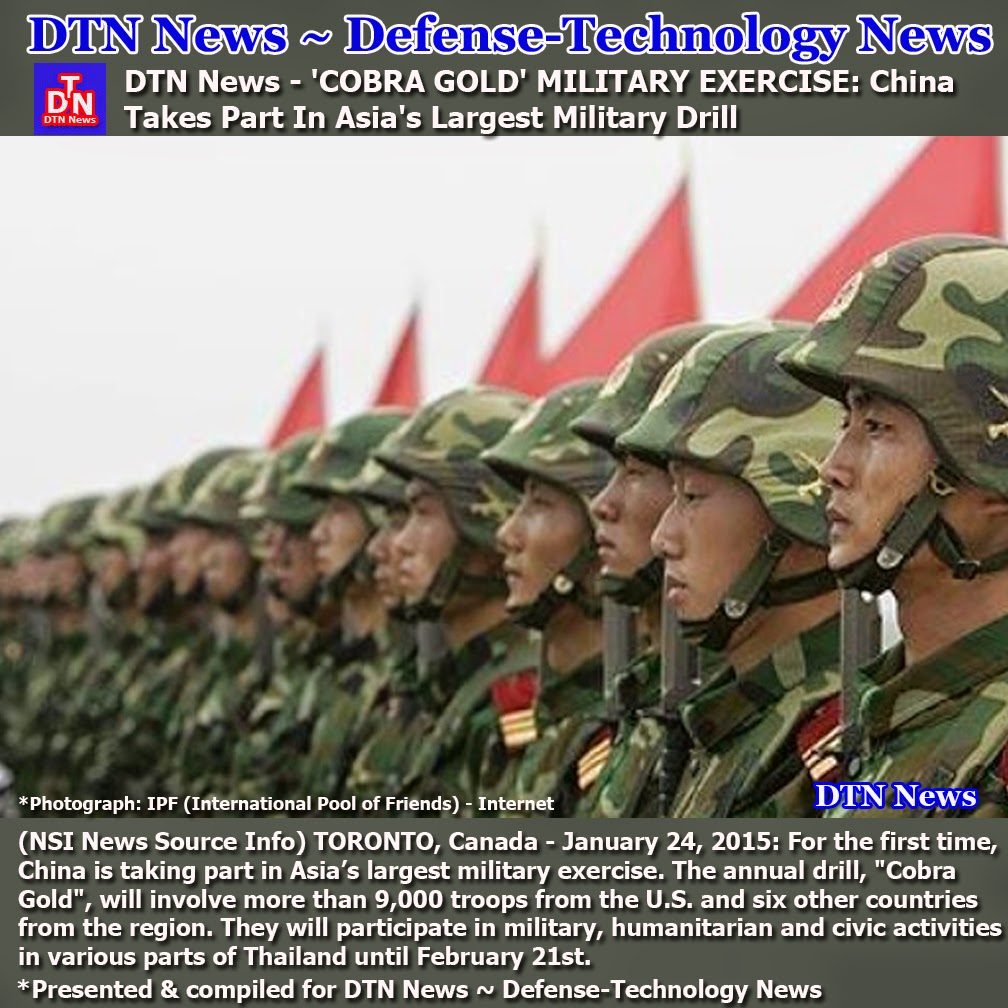
DTN News - 'COBRA GOLD' MILITARY EXERCISE: China Takes Part In Asia's Largest Military Drill

DTN News - 'COBRA GOLD' MILITARY EXERCISE: China Takes Part In Asia's Largest Military Drill
Source: DTN News - - This article compiled by K. V. Seth from reliable sources CCTV News
(NSI News Source Info) TORONTO, Canada - January 24, 2015For the first time, China is taking part in Asia’s largest military exercise. The annual drill, "Cobra Gold", will involve more than 9,000 troops from the U.S. and six other countries from the region. They will participate in military, humanitarian and civic activities in various parts of Thailand until February 21st.

When the 33rd "Cobra Gold" multinational military exercise is over in a few days time, more than 50 families of Wat Ta Takien School in Thailand's province of Phitsanulok would be extremely happy. They will have a new one-storey multipurpose building for their children. It will be the outcome of four-week joint effort of Chinese, U.S. and Thai soldiers as part of engineering civic assistance projects under this year's exercise.

"There are no boundaries between the nations participating in this military exercise in terms of providing assistance to civilians. Having different nations work together gives us a chance to get to know each other and gain more knowledge," said Yang Bin of the People's Liberation Army.

For the local Thais, this would be the most tangible result of the region's largest military exercise.

China has been an observer in "Cobra Gold" since 2002 but has never taken part in the exercises until now. Although the role of the Chinese troops is limited to humanitarian drills, including providing engineering support and medical aid, many believe that their participation will boost military relations between China and ASEAN.

"In terms of cooperation between the military of the super powers, the U.S. and China, the operating personnel have developed good relationships with each other," said Col. Charnchai Romyen of Royal Thai Army. "With eight countries participating, the exercise will increase regional security, which I think is a great start."

Over the past three decades, "Cobra Gold" has evolved to include disaster relief and rescue operations.

While the ravages of tsunamis, earthquakes and floods have focused much of "Cobra Gold" on practicing humanitarian assistance efforts in recent years, simulated precision strikes and live fire exercises are a reminder of what militaries have always been designed to do. 
And this may see China's participation in the coming years ahead go through a transformation process to deeper and more challenging roles.

Related Images of 'COBRA GOLD' MILITARY EXERCISE;


*Link for This article compiled by K. V. Seth from reliable sources CCTV News
*Speaking Image - Creation of DTN News ~ Defense Technology News 
*Photograph: IPF (International Pool of Friends) + DTN News / otherwise source stated
*This article is being posted from Toronto, Canada By DTN News ~ Defense-Technology News Contact:dtnnews@ymail.com 
©COPYRIGHT (C) DTN NEWS DEFENSE-TECHNOLOGY NEWS

Wednesday, March 05, 2014

DTN News - CHINA DEFENSE NEWS: China Announces Surge In Military Spending To Almost $132 Billion

DTN News - CHINA DEFENSE NEWS: China Announces Surge In Military Spending To Almost $132 Billion
*China continues years of double-digit rises in military spending to alarm of Asian nations and US
Source: DTN News - - This article compiled by K. V. Seth from reliable sources Telegraph UK
(NSI News Source Info) TORONTO, Canada - March 5, 2014China has announced a 12 per cent increase on its military, already the largest in the world, sparking concerns among its Asian neighbours and the US.

Beijing has for years been raising spending on the People's Liberation Army (PLA) in double-digit steps, reflecting its military ambitions as it asserts its new-found economic might and its claims in a series of territorial disputes with Japan and others.

"The appropriation for national defence is 808.23 billion yuan (£79 billion), up 12.2 percent," said a budget report prepared for the annual session of the National People's Congress (NPC), China's Communist-controlled parliament, which began on Wednesday.

"We will resolutely safeguard China's sovereignty, security and development interests," Premier Li Keqiang said at the opening session.

"We will safeguard the victory of World War II and the post-war international order, and will not allow anyone to reverse the course of history," he said - a phrase China often uses in relation to rival Japan.

Beijing would also "place war preparations on a regular footing" and "build China into a maritime power", Li added.

In comments ahead of the gathering, NPC spokeswoman Fu Ying sought to play down foreign worries about China's defence expenditure.

"Certain countries have been selling the idea of China as a major threat," she said. "Based on our history and experience, we believe that peace can only be maintained by strength."

This year's stated increase follows rises of 10.7 percent in 2013, 11.2 percent in 2012 and 12.7 percent in 2011.

Analysts believe China's actual military spending is significantly higher than publicised, with the Pentagon estimating it at between $135 billion and $215 billion in 2012.

The United States itself remains far ahead as the global leader in defence spending, with Washington approving a 2014 budget of $633 billion in December.

China devotes about three times as much as India to defence, and more than neighbours Japan, South Korea, Taiwan and Vietnam combined.

Beijing's spending could match that of Washington by the 2030s, the International Institute for Strategic Studies said in February, but added that its capabilities, expertise and ability to project power would require several more years to catch up.

Nonetheless the increases have raised concerns in the US and Asia, particularly in Japan, with the two countries embroiled in an escalating row over East China Sea islands called Diaoyu in Chinese and Senkaku in Japanese.

After the latest figure was revealed, Japan expressed concern about Beijing's level of openness about the PLA.

"The transparency of China's defence policy and military capacity, or lack thereof, has become a matter of concern for the international community, including Japan," Chief Cabinet Secretary Yoshihide Suga told reporters.

China's actions will both fuel the concern of its neighbours and encourage them to beef up their security cooperation with each other and the US, said Denny Roy, an expert on China's military at the East-West Center in Hawaii.

"This would add to the momentum of something that's already in motion," he told AFP.
In December, the cabinet of Japan's hawkish Prime Minister Shinzo Abe agreed to spend 24.7 trillion yen (£144 billion) between 2014 and 2019 in a strategic military shift towards areas of the country facing China - a five per cent boost to the defence budget over five years.

China decried Japan's increase at the time as an issue of "great concern to neighbouring countries in Asia and the international community".

*Related Images By DTN News ~ Defense-Technology News;


*Link for This article compiled by K. V. Seth from reliable sources Telegraph UK
*Speaking Image - Creation of DTN News ~ Defense Technology News 
*Photograph: IPF (International Pool of Friends) + DTN News / otherwise source stated
*This article is being posted from Toronto, Canada By DTN News ~ Defense-Technology News Contact:dtnnews@ymail.com 
©COPYRIGHT (C) DTN NEWS DEFENSE-TECHNOLOGY NEWS

Tuesday, September 10, 2013

DTN News - DEFENSE NEWS: U.S.-China Defense Consultative Talks

DTN News - DEFENSE NEWS: U.S.-China Defense Consultative Talks
Source: K. V. Seth DTN News & U.S. Department of Defense No. 642-13 September 10, 2013
(NSI News Source Info) TORONTO, Canada - September 10, 2013: Pentagon Press Secretary George Little provided the following readout:

Officials from the United States and China met Sept. 9, 2013 in Beijing for the 14th annual Defense Consultative Talks. Dr. James Miller, undersecretary of defense for policy, and Lt. Gen. Wang Guanzhong, deputy chief of the People’s Liberation Army General Staff, led their respective country’s delegations. The U.S. delegation included representatives from the Joint Staff, U.S. Pacific Command, the National Security Staff and the State Department.

Miller and Wang underscored the accomplishments that the U.S.-China military-to-military relationship has achieved thus far this year. They discussed how to sustain the positive momentum in building a constructive military relationship and advance a new model of military-to-military relations into the future. In this regard, the two agreed to further the exploration of the two proposals on military confidence building offered by President Xi at Sunnylands.

The two leaders discussed how to enhance strategic trust and build upon opportunities to expand cooperation in areas of mutual interest, including humanitarian assistance, disaster relief, peacekeeping, and maritime safety. They also discussed ways to enhance communications to improve understanding and avoid misperception. Both agreed to continue discussions between maritime legal experts, and sustain dialogue in key strategic areas including nuclear, missile defense, space, and cyber.

The two sides also exchanged views on the East and South China Sea. On North Korea, Miller emphasized the significant concerns of the United States regarding North Korea's nuclear and missile developments and called on China to maintain and increase pressure on North Korea to bring the regime back to credible and authentic negotiations aimed at denuclearization.

*Link for This article compiled by K. V. Seth DTN News & U.S. Department of Defense No. 642-13 September 10, 2013 
*Speaking Image - Creation of DTN News ~ Defense Technology News 
*Photograph: IPF (International Pool of Friends) + DTN News / otherwise source stated
*This article is being posted from Toronto, Canada By DTN News ~ Defense-Technology News Contact:dtnnews@ymail.com 
©COPYRIGHT (C) DTN NEWS DEFENSE-TECHNOLOGY NEWS

Monday, April 29, 2013

DTN News - CHINA SECURE ITS ENERGY/OIL SUPPLY IN AN UNETHICAL MANNER: China Grabs India's Land

DTN News - CHINA SECURE ITS ENERGY/OIL SUPPLY IN AN UNETHICAL MANNER: China Grabs India's Land
*China is eyeing to become Hans empire on Soviet Union era set up by grabbing, annexing, claiming and bullying its neighbors and has territorial disputes with Bhutan, North Korea, South Korea, Japan, Philippines, Malaysia, Vietnam, Brunei, India by showing off its newly acquired military might to secure its energy/oil supply in an unethical manner
Source: DTN News - - This article compiled by Roger Smith also sourced from Deccan Herald
(NSI News Source Info) TORONTO, Canada - April 29, 2013: The area along the Line of Actual Control (LAC) with China has 'shrunk' over a period of time and India has lost 'substantial' land in the last two decades, according to an official report.

At a recent meeting in Leh, attended by officials from the Jammu and Kashmir government, Union Ministry of Home Affairs and the Army, it was agreed that there was difference in the maps of various agencies and that there was lack of proper mapping of the area.

Crossing the line
*Lack of institutional memory in various agencies
* China grabbing Indian land by inches in a slow process
* Chinese threaten the nomadic people in the Dokbug area
* LAC with China has “shrunk” over a period of time *
* Lack of proper mapping of the area

The meeting was chaired by Commissioner (Leh) A K Sahu and attended, among others, by the 14 Corps Brigadier General Staff Brig Sarat Chand and Colonel Inderjit Singh.

While the absence of proper maps was agreed upon, the meeting all the same felt: “However, it is clear and accepted that we are withdrawing from LAC and our area has shrunk over a period of time. This process is very slow but we have lost substantial amount of land in 20-25 years.”

According to the minutes of the meeting, it was also identified that “there is a lack of institutional memory in various agencies as well as clear policy on this issue which in the long run has resulted in loss of Indian territory in favour of China.”

The meeting was called to ensure proper protection to nomads who move with their cattle to the Dokbug area of Nyoma sector during the winter months every year. In December 2008, Chinese People’s Liberation Army (PLA) had damaged their tents and threatened them to vacate the land.

“They (Chinese) have threatened the nomadic people, who had been using the Dokbug area (in Ladakh sector) area for grazing for decades, in a way to snatch our land in inches. A Chinese proverb is famous in the world — better do in inches than in yards,” a report filed by former sub divisional magistrate (Nyoma) Tsering Norboo had said.

Complaints
Norboo was deputed by the state government to probe the complaints of incursion of the Chinese Army in the Dokbug area and threats to the local shepherds to leave the land as it belonged to them. 

The area has been used by the shepherds to graze their livestock as the area is warmer compared to other parts of Ladakh.

The SDM contended that it was another attempt by the Chinese to term, and claim, the territory disputed in the same fashion as they had taken Nag Tsang area opposite to Phuktse airfield in 1984, Nakung in 1991 and Lungma-Serding in 1992.

Last year, Chinese troops had entered nearly 1.5 km into the Indian territory on July 31 near Mount Gya, recognised as International border by India and China, and painted boulders and rocks with “China” in red spray paint.

The 22,420 feet Mount Gya, also known as “fair princess of snow” by the Army, is located at the tri-junction of Ladakh in Jammu and Kashmir, Spiti in Himachal Pradesh, and Tibet. Its boundary was marked during the British era and regarded as International border by the two countries.

Before this, Chinese helicopters had violated Indian air space on June 21 along the Line of Actual Control in Chumar region and also dropped some expired food.


*Link for This article compiled by Roger Smith also sourced from Deccan Herald 
*Speaking Image - Creation of DTN News ~ Defense Technology News 
*Photograph: IPF (International Pool of Friends) + DTN News / otherwise source stated
*This article is being posted from Toronto, Canada By DTN News ~ Defense-Technology News Contact:dtnnews@ymail.com 
©COPYRIGHT (C) DTN NEWS DEFENSE-TECHNOLOGY NEWS

Tuesday, April 23, 2013

DTN News - DEFENSE NEWS: China-India Border Talks Pivot On Tibet

DTN News - DEFENSE NEWS: China-India Border Talks Pivot On Tibet
Source: DTN News - - This article compiled by Roger Smith from reliable sources  By Namrata Goswami and Jenee Sharon 
(NSI News Source Info) TORONTO, Canada - April 23, 2013: Throughout the protracted Sino-Indian border dispute, Tibet and its status has always been a predominant influence, whether implicitly or explicitly on the negotiating table. This has both historical and contemporary ramifications. 

India, much to China's chagrin, utilized the Tibet issue as a key point of departure in order to strike a grand bargain with Beijing after China occupied Tibet in 1949. Jawaharlal Nehru was of the firm conviction that China and India could encapsulate a grand cooperation in Tibet based on which India would recognize Tibet as part of China while China would recognize Tibetan autonomy. 

To Nehru, Tibetan autonomy meant safeguarding Tibet's cultural and social uniqueness. It also meant that China would not militarize Tibet with a massive People's Liberation Army (PLA) presence which could pose a security threat to India. 

Propelled by this belief, Nehru recognized Tibet as part of China in 1954. Mao Zedong, however, interpreted Nehru's insistence on Tibetan autonomy as a diabolical plan to turn Tibet into an Indian "protectorate or colony". In the several meetings that he conducted with his Politburo colleagues in the run-up to the 1962 war with India, he argued that the "Indian expansionist" had devious plans to occupy Tibet. 

In an essay titled "The Revolution in Tibet and Nehru's Philosophy", published in The People's Daily on May 6, 1959, at the behest of Mao, Nehru was faulted for his sympathy for the Tibetan people and accused of upholding the Tibetan upper-class structure to the detriment of what the essay termed as "Tibetan serfs". 

Nehru, the essay argued, wanted to turn Tibet into an "Indian colony". By extension, India's "forward policy" activated since November 1961 to establish forward posts in unoccupied territory that China and India each viewed as its own was also interpreted by Mao as an Indian design to create the logistical conditions to occupy Tibet in the long run. 

These differences and a "no-negotiation" posture by India on the border from 1961 onwards in the face of what Nehru interpreted as Chinese aggression on Aksai Chin led to the China-India border war in October 1962 in which India suffered defeat. 

While both countries have come a long way since then, having re-activated diplomatic relations in 1976 and border negotiations since 1981, the border talks were stalled at this stage due to increased Chinese territorial posture in 1985 especially with regard to Tawang. In 1988, a Joint Working Group (JWG) was institutionalized during the visit of Rajiv Gandhi to China. 

At present, there is talk of "progress" on the border issues and statements from high-level officials representing both parties on not letting the border dispute affect the bilateral working relationship. Yet, both China and India remain deeply entrenched in their rigid negotiating positions. 

The border dispute, especially in the eastern side, is becoming financially costly to both parties, particularly as resources are diverted to build up militarily at the border to deter the other while additional political resources are utilized to continue the negotiations in official diplomatic fora. 

India has planned to invest US$100 billion in military modernization in the next decade, with $15 billion already under negotiations for 126 French Rafale Multi Medium Role Combat Aircraft to be deployed in the eastern sector. China has also visibly demonstrated its military presence in Tibet with nearly 300,000 PLA troops and fighter aircraft like the J-10 deployed at the Gonggar airport in Lhasa. Military exercises by both China and India along the eastern frontier have also increased since 2012. 

The territorial dispute has lingered for decades, crippling the bilateral relationship and thus preventing the two countries from working as closely together as could have been possible had the border dispute been resolved. The bottom line: as China and India rise as global powers, now is the time to pursue real conflict resolution on the border dispute. 

The border dispute will only continue to divert resources and time from both countries which could better contribute to enhance China and India on their way to becoming stronger global actors on the world stage. 

Why is the border dispute so intractable and why has it continually resisted resolution in the past 60 years? The answer is threefold - the inflexibility of negotiation positions, the choice of conflict resolution mechanisms utilized, and the mistrust that perpetuates and further prevents progress from being made toward a lasting resolution. 

With regard to flexibility, at present, both parties seemingly remain firmly committed to their territorial claims and these claims are at times strategically utilized as leverage in the negotiations. China maintains its claim to Arunachal Pradesh, which India has administered since the British left India in 1947, while India seeks control of Aksai Chin, which is under Chinese control. 

Despite China's claims, India firmly maintains that Arunachal Pradesh is and will remain Indian territory, while implicitly utilizing the Tibet issue and India's spiritual connection to the Dalai Lama, a great insecurity for China, as leverage. 

The Tibet issue is distinctly intertwined with the greater Sino-Indian border dispute along the borders of Arunachal Pradesh because China maintains that Tibet is an integral part of Chinese sovereign territory and considers Arunachal Pradesh to be "Southern Tibet". 

Recently, a Chinese scholar from Huazhong University, Du Dacai, argued that "solving the problem of our territory of South Tibet [as China refers to Arunachal Pradesh]" should be China's fourth priority territorial unification issue after Taiwan, the Diaoyu (or Senkaku) Islands and the South China sea issue "to realize the Chinese dream and China's unification." 

This conceptualization of "Southern Tibet," whether legitimate in the minds of the Chinese or a negotiation tactic to try to gain control of Arunachal Pradesh from India, links the Tibet issue to the border dispute because if China and India's borders are to be delineated, Tibet's borders with India must also be determined. 

The fact that Tibet's status within China itself is not accepted by many Tibetans and that the Tibetan government-in-exile and Dalai Lama reside in India, threatens China. This also contributes to the intensity of mistrust among both parties and complicates the already complex process of negotiating the disputed borders. 

In order to resolve the dispute through negotiations, both China and India should seek to take another evaluation of their core interests and determine possible areas of flexibility on certain issues. 

The Tibet issue is also incredibly important to both China and India because the Tibetans' struggle for independence affects both countries greatly from a national security standpoint. China views the Tibetans' struggle for independence as a great source of instability because it directly threatens China's domestic social stability and territorial integrity. 

India's spiritual connection to the Dalai Lama and tenuous relationship with the Tibetan government in exile further exacerbates this insecurity. The Indian government has made public statements expressing India's "official" policy of not supporting the Tibetans or the Dalai Lama, such as Prime Minister Manmohan Singh's comments that "India will not allow Tibetans to conduct anti-China activities in the country [India]", but India may hesitate to make further statements regarding the status of Tibet while China is pressuring India to do so. Despite these official statements, the Dalai Lama holds spiritual significance in India, thus making China more dubious about India's intentions. 

In this respect, India isn't exactly helping to resolve that tension by refusing to make bolder statements on China's claim to Tibet, and from the Indian perspective, why should it? From a purely bargaining perspective, India retains more leverage to potentially use against China to gain concessions in the border negotiations. The real issue here is that ultimately, this play for leverage further breaks down trust and makes the process of negotiating more difficult. 

Another key issue at play, is that of Tawang, which is in Arunachal Pradesh, closely linked to the Tibet issue and considered to be a holy place for Tibetans. This further complicates the Tibet issue and thus the overall border negotiations because if Tibet is a part of China and Tibetans consider Tawang to be culturally linked to Tibet, then China has an incentive for why it should obtain Arunachal Pradesh from India in the negotiations. 

If Tibetans seek independence from China, this claim becomes less legitimate, but as the Tibetan government-in-exile and Dalai Lama currently reside in India, it again causes insecurity for China. India has likely recognized this concern and in response to China's aggressive posturing towards Arunachal Pradesh, India has increased the civilian and military presence in that area, similar to what China has done in increasing the Han Chinese and PLA presence in Tibet. 

Another key concern on the Tawang issue is whether the next Dalai Lama will come from Tawang, and if so, will that further complicate the Tibet issue and tensions between China and India if China does not approve of the new Dalai Lama? The Dalai Lama will always have spiritual connections with India, even if the current Dalai Lama has renounced former political ties, and given that it is a religious issue, it is not plausible that India would break these spiritual and cultural ties it has historically respected. 

As long as the Tibet issue remains unresolved and the questioning of Chinese legitimacy over Tibet continues, China remains fearful of India's intentions for Tibet, and as long as India does not make those intentions more clear, it will be increasingly more difficult to resolve the ongoing border dispute. 

Although China and India have made progress in developing economic and diplomatic relationships with an attempt to disregard the Tibet issue, the border issue is time and time again raised. The current pace of negotiations has not resulted in progress on the resolution of the border dispute. 

China and India have less to lose and more to gain by rethinking how to resolve this dispute. First off, the mechanisms for resolution should be expanded. On their own, the Special Representative talks set up since 2003 may not be enough to come to a mutually beneficial negotiated solution. 

There are other possibilities for creating a common border mechanism outside of the Special Representative talks to supplement conflict resolution efforts, such as talks on the Track I5 levels. Within the field of conflict resolution, one such conflict resolution method is known as the "Problem-Solving Workshop" (PSW). 

The PSW emerged from the field of social psychology and was pioneered by several scholars and practitioners including Herbert Kelman, John Burton, Benjamin Broome, Ronald Fisher, and Leonard Doob. This method of conflict resolution was designed to bring together influential people who have connections to high-level decision makers but the flexibility to more freely discuss the key issues, various parties' perspectives, and explore creative options for conflict resolution, all the while building trust among the participants. 

In the beginning, this could be conducted as unofficial sessions internally within India and China respectively to explore key issues and perspectives before meeting with their counterparts. Once the participants become comfortable with the process, Indian and Chinese influentials could be brought together to engage in a PSW on the border issue. 

In addition to PSW among influentials, a forum should be created between the think tanks and academic communities (Track II) in China and India to bring together the brightest minds working on these issues. While there are many within both China and India who work on these issues and related ones, there is little sharing or joint work among these individuals and groups together. 

A joint forum, roundtable discussion or partnership among think tanks working on these issues would act as a way in which to collective brainstorm with a problem-solving approach to determine options for resolution of the border dispute. 

At this point in time, it is clear that official negotiations alone may not resolve the border dispute. Additional mechanisms of conflict resolution like the Track II should be sought after, and if deemed appropriate by each party internally, Problem Solving Workshops and partnerships among those working on these issues may provide additional methods in which to unofficially explore options that could be proposed to the negotiators with an aim at resolving the border dispute. 

Dr Namrata Goswami is a senior fellow at the United States Institute of Peace (USIP), Washington, DC and research fellow at the Institute for Defence Studies and Analyses (IDSA), New Delhi. Jenee Sharon is a research assistant at the USIP. The views expressed in this article are solely that of the authors. 

*Link for This article compiled by Roger Smith from reliable sources By Namrata Goswami and Jenee Sharon 
*Speaking Image - Creation of DTN News ~ Defense Technology News 
*Photograph: IPF (International Pool of Friends) + DTN News / otherwise source stated
*This article is being posted from Toronto, Canada By DTN News ~ Defense-Technology News Contact:dtnnews@ymail.com 
©COPYRIGHT (C) DTN NEWS DEFENSE-TECHNOLOGY NEWS

Monday, December 03, 2012

DTN News - U.S., CHINA JOINT MILITARY EXERCISE: China And U.S. Militaries In Joint Disaster Exercise

DTN News - U.S., CHINA JOINT MILITARY EXERCISE: China And U.S. Militaries In Joint Disaster Exercise
Source: DTN News - - This article compiled by Roger Smith 
(NSI News Source Info) SINGAPORE - December 2, 2012: The Chinese and U.S. militaries held joint disaster response exercises Nov. 30 as Beijing increases its global reach and Washington continues its “pivot” to the Pacific.

The joint drill, which saw officers from both nations express hopes for closer ties, came amid rising concerns in Japan, the Philippines and Vietnam over China’s territorial claims in disputed seas.

During the mock drills at a Chinese military base on the outskirts of Chengdu, the two sides worked together on computer-generated disaster scenarios in fictionalized countries.

“China and the U.S. are separated by the Pacific Ocean. Our two militaries joining hands ... answers to the aspirations of the two sides,” Tang Fen, of the People’s Liberation Army, told reporters after the two-day exercise finished.

“This plays a very important role in relations between our two nations and two militaries.”

U.S. Maj. Gen. Stephen Lyons said, “If there is a country out there, and inevitably there will be, that will have a natural disaster, and they call for international help, if U.S. forces and Chinese forces respond, then indeed we’ll find ourselves working together in the field.”

Earlier this week, visiting U.S. Navy Secretary Ray Mabus welcomed China to participate in future U.S.-led joint naval exercises and reiterated an invitation made by Defense Secretary Leon Panetta when he visited in September.

“The Chinese side thanks the U.S. side for the invite and will give it positive consideration,” Geng Yansheng, spokesman for the Chinese defense ministry, said in remarks posted on its website Nov. 30.

The U.S. invitation comes as Washington tries to reassure Beijing over its strategic “pivot” to the Pacific, while China is becoming increasingly assertive in territorial disputes with several of its neighbors — with new passports showing its claims causing diplomatic rows this week.

China said Nov. 25 one of its fighter jets had landed on its new aircraft carrier for the first time, a move that extends Beijing’s ability to project military might.

Tensions between China and Japan, a U.S. ally, have risen dramatically in recent months over islands in the East China Sea that Beijing claims and calls the Diaoyus and Tokyo, which administers them, names the Senkakus.

Beijing is locked in similar rows with Vietnam and the Philippines over disputed territory in the South China Sea.

At a key Communist Party congress earlier this month, outgoing President Hu Jintao urged China to push forward fast-paced military modernization and set the goal of becoming a “maritime power.”


*Link for This article compiled by Roger Smith - DTN News
*Speaking Image - Creation of DTN News ~ Defense Technology News 
*This article is being posted from Toronto, Canada By DTN News ~ Defense-Technology News Contact:dtnnews@ymail.com 
©COPYRIGHT (C) DTN NEWS DEFENSE-TECHNOLOGY NEWS

Saturday, November 03, 2012

DTN News - CHINA DEFENSE NEWS: Chinese Troops In Field Tactical Stages Island-Landing Drill

DTN News - CHINA DEFENSE NEWS: Chinese Troops In Field Tactical Stages Island-Landing Drill
Source: DTN News - - This article compiled by Roger Smith 
(NSI News Source Info) TORONTO, Canada - November 3, 2012: The Nanjing Military Area Command (MAC) of the Chinese People's Liberation Army has conducted a live ammunition island-landing exercise which involves infantry, artillery and army aircraft. 

The mission: to land and capture an island target. Special Forces are equipped with multiple long-distance detection instruments.


Information about the enemy is quickly sent to headquarters which guides joint fire to open a landing field, attacking the enemy's advanced positions and radar systems.

Surveillance helicopters send pictures of the strikes to headquarters. Gunships strike the remaining targets.

Half-an-hour later, two transport helicopters arrive at a predetermined landing area. 

Soldiers seize the vantage ground and consolidate and expand the captured position to cover main forces landing on the battlefield.

After a successful landing, combat forces engage in ground fighting. When the enemy start to fight back, four gunships launch air strikes. After less than two hours, the joint forces have successfully landed on the island. Under powerful fire, the enemy is destroyed.

The Commanding Officer of Nanjing Military Area Command says the aim of the exercise was to examine and improve joint operation and airstrike capabilities.

*Link for This article compiled by Roger Smith - DTN News
*Speaking Image - Creation of DTN News ~ Defense Technology News 
*This article is being posted from Toronto, Canada By DTN News ~ Defense-Technology News Contact:dtnnews@ymail.com 
©COPYRIGHT (C) DTN NEWS DEFENSE-TECHNOLOGY NEWS

Tuesday, October 11, 2011

DTN News - CHINA DEFENSE NEWS: China's Military Buildup - How Far Along Is It?

DTN News - CHINA DEFENSE NEWS: China's Military Buildup - How Far Along Is It?
(NSI News Source Info) KOTTAKKAL, Kerala, India - October 11, 2011: China's faster-than-expected military buildup has alarmed the United States and its Asian allies and could help the Pentagon gird against deeper defense cuts threatened in some corners of Congress.
But even though the sophistication of China's People's Liberation Army has exceeded US military forecasts, there is a recognition within the Pentagon that some of its most-cited conventional capabilities are still in their infancy.
China's first aircraft carrier, a refurbished Soviet-era vessel known as the Varyag bought from the Ukraine, began sea trials in July. Chinese sources said Beijing is also building two indigenous carriers, a claim the US military believes is misleading at best.
Admiral Robert Willard, commander of US forces in the Pacific, told Reuters that while China might be pursuing procurement or some other embryonic action on an indigenous carrier, it would be premature to say "a keel is laid."
"The only ship that anyone has seen and that they have discussed with any level of fidelity is the Varyag, this particular ship that has floated," Willard said in an interview.
But the refurbished Soviet-era carrier is not yet fully operational. China, the last permanent member of the U.N. Security Council to get carrier capability, will not be able to effectively field an aircraft carrier with any combat aircraft aboard for years, according to Pentagon estimates.
A Pentagon assessment to Congress noted Brazil's navy offered to provide China training in carrier operations.
"However, Brazil's limited capabilities in this area and the extensive problems with Brazil's own carrier program raise some questions as to the implications of the offer," it said.
Not ten feet tall
Then there is question of China's stealth fighter jet, the J-20, which did its first test flight during a visit by the US defense secretary to China in January.
Despite the attention given to the J-20, the Pentagon does not expect it to achieve an effective operational capability before 2018.
There are also questions about how effective its stealth capability may be. The J-20's test flight proved its stealth design but did not reveal other attributes to help it avoid detection that might come later, sources say.
"China faces several hurdles as it moves toward J-20 production, including the mastery of high performance jet engine production," the Pentagon report said.
The United States has had a proper stealth fighter since Lockheed Martin's F-117 Nighthawk made its first flight 30 years ago. That aircraft was retired from service in 2007.
Prior "low-observable" US aircraft date back to the 1950s with the U-2A high-altitude reconnaissance plane.
The PLA is also still some way from mastering the ability to mount large joint force operations, which will be needed to make the most of newfound capabilities grabbing headlines.
The US military has spent the past decade of war honing joint operations that weave together teams and skills from across its armed forces -- a hard-won but potent tool.
The US Navy's top intelligence officer warned before retiring earlier this year against overestimating Chinese military capabilities.
"I don't view them as 10 feet tall," Vice Admiral David Dorsett said. "Have we seen large joint sophisticated exercises? No ... They are at the front end of developing their military capability."
Is China "on the march"?
At the same time, the US military believes China appears on track to field a modern, regionally focused military by 2020. A comprehensive strategy to maintain the US edge in the Pacific will require investment, a tough challenge in an era of budget cuts.
The Pentagon now counts a base budget, excluding war costs, of over half a trillion dollars. China downplays its defense spending but acknowledged in March a 12.7 percent rise in 2011 defense outlays to 600 billion yuan ($94 billion).
Still, the US military, while expressing confidence in future funding for the Asia-Pacific region, is not parroting some of the more volatile China rhetoric seen in parts of Congress.
"I know some folks like to sugarcoat the terms in describing China as a rival or competitor but the fact is Communist China is an enemy of democracy," David Rivera, a lawmaker on the House of Representatives Foreign Relations Committee, said in a recent hearing on Taiwan.
The US military's estimates of China offer a more mixed view. This year's assessment noted China's lack of operational experience and large amounts of antiquated hardware but said the PLA was "steadily closing the technological gap with modern armed forces."
Dean Cheng, a China expert at the Heritage Foundation think-tank in Washington, said future Chinese advances like improvements in its anti-ship ballistic missile would influence US risk assessments when deploying near its shores.
That is not to say China will be able to flat-out deny US access to nearby waters any time soon.
"Denial is a function of risk -- what level of risk are we willing to accept in order to do whatever it is we're going to do out there," Cheng said, noting US submarines, for example, can be very difficult to detect.
The PLA's aggressive posture in the South China Sea and its increasing military edge over Taiwan are sources of concern -- as are its investments in nuclear submarines, which suggest China is seeking to support operations well beyond Taiwan.
Those concerns have found fertile ground in Congress, where the chairman of the House Intelligence Committee accused China of widespread cyber espionage.
Some lawmakers have reacted angrily to the US decision to give Taiwan a $5.85 billion arms package including upgrades to F-16 A/B fighter aircraft, instead of also delivering the late-model F-16 C/D fighters that Taipei wanted.
"China is on the march in Asia, and its primary target remains democratic Taiwan," said the House Foreign Relations Committee's chairwoman, Ileana Ros-Lehtinen.
China sees Taiwan, a self-ruled island, as an illegitimate breakaway from Beijing's rule that must accept eventual reunification.
The United States switched diplomatic ties from Taiwan to mainland China in 1979 but it is obligated by law to supply Taiwan sufficient arms for self-defense.
As China's regional military ambitions come into view, so does discussion of its global goals. But Dorsett noted China's global aspirations are longer term, seeking to turn its navy into a global power "by the middle years of this century."
"That's their timeline," said.
"Should we expect them to be much more competent 10 years from now than they are today? As long as their economy's robust, absolutely."
*Speaking Image - Creation of DTN News ~ Defense Technology News
*This article is being posted from Toronto, Canada By DTN News ~ Defense-Technology News

©

COPYRIGHT (C) DTN NEWS DEFENSE-TECHNOLOGY NEWS