 Source: DTN News - - This article compiled by Roger Smith from reliable sources By David Leigh - guardian.co.uk
The London embassy sent a secret cable back to Washington last autumn reporting conversations with the two civil servants, Richard Freer and Judith Gough, in which they cast doubt on the significance of Brown's announcement at the UN general assembly that Britain might cut the number of planned new Trident submarines from four to three.
It is not clear from the cables whether or not the Britons were speaking to the Americans on Brown's authority. In the dispatches, US embassy officials describe them as "HMG [Her Majesty's Government] sources" and mark that their identities should be protected.
Freer is one of Whitehall's most influential officials and a member of David Cameron's small team of private secretaries at Downing Street.
According to the leaked cables, US anxiety about the future of Britain's Trident missiles followed Brown's speech at the UN in September 2009 on global nuclear disarmament.
In London, Freer and Gough told the Americans that Brown's words came as a surprise to them because there was no actual change of British nuclear policy under way. There would continue to be "no daylight" between the US and the UK on the existing £20bn Trident replacement scheme, the Americans were assured.
One US dispatch, classified "secret … noforn", meaning only for US eyes, says: "[Brown's] announcement of a proposed fleet reduction caught many in the MoD, FCO and Cabinet Office by surprise."
It continued: "Dr Richard Freer (strictly protect) head of defence and security policy … told Poloff [political officer] September 23 that 'in an ideal world we'd have done a bit more pre-vetting [of the speech]'. One of Freer's Cabinet Office deputies was blunter, telling Poloff that the announcement was 'unexpected' …
"Both Freer and Judith Gough (strictly protect), deputy head of the security policy group at the Foreign and Commonwealth Office, stressed to Poloff that HMG has not formally decided to scale back the deterrent but would only do so if a government defence review determines, in Freer's words, that it would be 'technically feasible' to maintain 'continuous deterrence patrols' with three submarines …
"Freer criticised media for exaggerating the significance of Brown's announcement, opining that it was 'not really a major disarmament announcement'."
The cable added: "Julian Miller, the deputy head of the foreign and defence policy secretariat at the Cabinet Office, assured the political minister counsellor September 24 that HMG would consult with the US regarding future developments concerning the Trident deterrent to assure there would be 'no daylight' between the US and UK."
A Foreign Office spokesman refused to say yesterday whether or not the two officials had authority to talk to the US.
US concern about the future of Trident had first surfaced a few weeks earlier, before Brown's speech to the UN, when British media carried unattributed political briefings which suggested the Labour government intended to defer crucial Trident replacement decisions.
The nuclear-armed French, like the Americans, initially believed this news was significant, with one French official telling the US: "The UK is starting to seem really convinced that disarmament is possible, since it may abandon its Trident submarine-launched ballistic missile programme."
The French were so upset they protested to US diplomats that Labour ministers were acting like "demagogues". Brown's stance that nuclear weapons in general were immoral was, by implication, threatening "an essential part of French strategic identity", they complained. British civil servants said the hints of disarmament were confined to the Cabinet Office.
The US chargé d'affaires, Richard LeBaron, told Washington Gough had also named the British official behind the off-the-record media briefings. "Judith Gough (protect) … told Poloff July 21 that the unnamed official who had briefed the press was Simon McDonald, the Cabinet Office head of foreign and defence policy. She said that press reports about HMG plans to defer Trident replacement design work 'came as news' to FCO and MoD officers …
"Diana Venn (protect), an officer in the Cabinet Office's foreign and defence policy secretariat, told Poloff July 23 that there had been a 'slight misunderstanding' when McDonald briefed the press. She stressed that 'Trident is not on the table … we won't disarm unilaterally.'"
The new Conservative administration is described as pro-Trident in the dispatches. "Conservative party defence sources have privately affirmed to embassy officers their commitment to the Trident deterrent," diplomats cabled before the general election.
The Conservative government's current public position is that a Trident replacement decision is being deferred for several years, past the next general election.
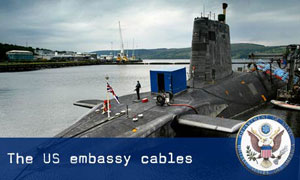
Trident missiles are leased from the US. The cables detail how Britain's submarines, which carry the missiles with nuclear warheads, depend on "substantial American design assistance".

 DTN NEWS ON TWITTER (30 SUBJECTS)


.gif)












