(NSI News Source Info) December 17, 2008: On December 13th, the I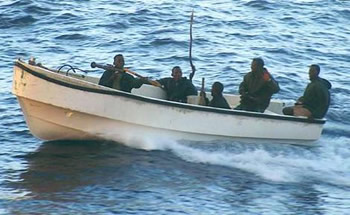 ndian warship, INS Mysore, interrupted a pirate attack on a merchant ship, tracked the speedboats back to their mother ship, and captured it and 23 pirates (12 Somalis and 11 Yemenis) along with weapons, communications and GPS gear.
ndian warship, INS Mysore, interrupted a pirate attack on a merchant ship, tracked the speedboats back to their mother ship, and captured it and 23 pirates (12 Somalis and 11 Yemenis) along with weapons, communications and GPS gear. The incident occurred 250 kilometers east of the Yemeni port of Aden. The Mysore was 25 kilometers away from the merchant ship when they got the distress call.
The Mysore promptly dispatched its helicopter, which chased the two pirate speed boats away and found the mother ship. The Mysore rushed to the scene, and sent commandos to capture the mother ship,
Since all this happened in international waters, there is a problem with finding a country that will accept, and prosecute, the pirates.
The Indian Foreign Ministry is working on that, and may be doing so for a while. Since World War II, national and international laws for dealing with pirates (which used to mean trying and executing the pirates on the spot) have been discarded. But nothing took the place of those procedures, because it was believed that piracy was no longer a problem.
Some nations working the anti-piracy patrol, have signed deals with Kenya, which sends pirates captured off the Somali coast, to Kenyan courts for prosecution. These deals provide cash to help defer the costs of prosecution and incarceration, which would otherwise be a burden for a poor nation like Kenya.


 The Russian offer comes as Indian Navy has formulated a 20 year plan to produce indigenously 24 conventional submarines. At the same time, the official had ruled out any plans by Moscow to strike similar deals with China.
"Yes, there is a real possibility of leasing for ten years several of our nuclear powered multi-role submarines of Project 971 of 'Shchuka-B' class," the Director of Federal Service for Military-Technical Cooperation (FSVTS) Mikhail Dmitriyev was quoted as saying by ITAR-TASS. (Note: NATO designation is Akula class—Ed.)
The Russian offer comes as Indian Navy has formulated a 20 year plan to produce indigenously 24 conventional submarines. New Delhi had also contracted for two nuclear submarines from Moscow, but navy has projected that in the next 10 years India would need to acquire or build another 10-12 nuclear subs. These nuclear submarines would be similar to the 'Nerpa' class, which was involved in an accident in November during final sea trials in Sea of Japan. "This possibility can materialise in the coming years," he added. Dmitriyev also denied that Moscow was negotiating supply of nuclear submarines to China.
"The question of supply of our multi role nuclear submarines to China does not exist, as unlike India, China never asked for them. That's why we never negotiated with China on their lease or sale," Dmitriyev said. "This issue was also not raised at the Russian-Chinese Intergovernmental Commission session on December 11 in Beijing," he said. The offer is only for leasing of the submarines to the Indian navy and not their sale to India, Dmitriyev specified. According to earlier reports, under a deal as part of the larger Gorshkov aircraft carrier package, Russia was to lease two "Shchuka-B" (NATO codename -Akula-II) nuclear attack submarines to India. Until the last-month's accident on board 'Nerpa' nuclear submarine, when 21 crew and technical staff suffocated to death due to accidental release of toxic Freon gas used in fire-suppressing system, Moscow was silent on the deal.
Built on advances reportedly paid by the Indian government, the nuclear submarine is expected to join Indian Navy as 'INS Chakra' sometime next year, sources said. They claimed that India's advanced technology vessel (ATV) project to develop an indigenous nuclear submarine was based on the Russian 'Shchuka-B' design.
The Russian offer comes as Indian Navy has formulated a 20 year plan to produce indigenously 24 conventional submarines. At the same time, the official had ruled out any plans by Moscow to strike similar deals with China.
"Yes, there is a real possibility of leasing for ten years several of our nuclear powered multi-role submarines of Project 971 of 'Shchuka-B' class," the Director of Federal Service for Military-Technical Cooperation (FSVTS) Mikhail Dmitriyev was quoted as saying by ITAR-TASS. (Note: NATO designation is Akula class—Ed.)
The Russian offer comes as Indian Navy has formulated a 20 year plan to produce indigenously 24 conventional submarines. New Delhi had also contracted for two nuclear submarines from Moscow, but navy has projected that in the next 10 years India would need to acquire or build another 10-12 nuclear subs. These nuclear submarines would be similar to the 'Nerpa' class, which was involved in an accident in November during final sea trials in Sea of Japan. "This possibility can materialise in the coming years," he added. Dmitriyev also denied that Moscow was negotiating supply of nuclear submarines to China.
"The question of supply of our multi role nuclear submarines to China does not exist, as unlike India, China never asked for them. That's why we never negotiated with China on their lease or sale," Dmitriyev said. "This issue was also not raised at the Russian-Chinese Intergovernmental Commission session on December 11 in Beijing," he said. The offer is only for leasing of the submarines to the Indian navy and not their sale to India, Dmitriyev specified. According to earlier reports, under a deal as part of the larger Gorshkov aircraft carrier package, Russia was to lease two "Shchuka-B" (NATO codename -Akula-II) nuclear attack submarines to India. Until the last-month's accident on board 'Nerpa' nuclear submarine, when 21 crew and technical staff suffocated to death due to accidental release of toxic Freon gas used in fire-suppressing system, Moscow was silent on the deal.
Built on advances reportedly paid by the Indian government, the nuclear submarine is expected to join Indian Navy as 'INS Chakra' sometime next year, sources said. They claimed that India's advanced technology vessel (ATV) project to develop an indigenous nuclear submarine was based on the Russian 'Shchuka-B' design.