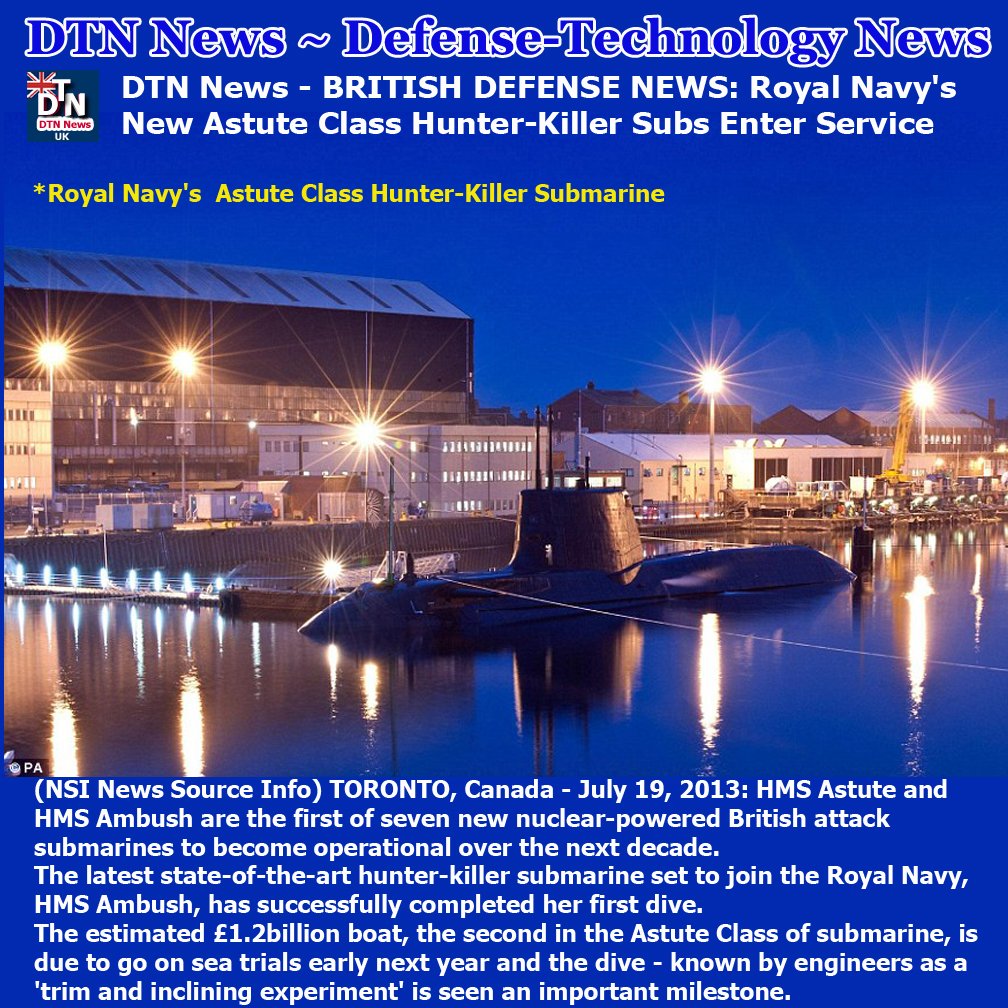
DTN News - BRITISH DEFENSE NEWS: Royal Navy's New Astute Class Hunter-Killer Subs Enter Service
*The Navy’s two most advanced hunter-killer submarines ever have entered service after years of delays.
 Source: DTN News - - This article compiled by Roger Smith from reliable sources By Ben Farmer, Defence Correspondent 5:39PM BST 19 Jul 2013
(NSI News Source Info) TORONTO, Canada - July 19, 2013: HMS Astute and HMS Ambush are the first of seven new nuclear-powered British attack submarines to become operational over the next decade.
 The Astute class submarines have cost more than £1 billion each and are among the most advanced in the world. They can circumvent the globe without surfacing, carrying a payload of dozens of cruise missiles and torpedoes.
Their sonar is so sensitive that one lurking in the Solent would be able to detect a ship leaving New York harbour 3,500 miles across the Atlantic. Advanced acoustic tiles mean they are virtually silent. They can also stay underwater indefinitely, only needing to surface if the 100-strong crew has run out of food.
The new boats are replacing the Navy's Trafalgar class submarines and the programme has been bedevilled by delays, faults and runaway costs since it began in the mid-1990s.
Naval commanders also faced embarrassment in 2010 when HMS Astute ran aground on rocks off Scotland during sea trials.
Rear Admiral Simon Lister, director of submarines at the Ministry of Defence, said the seven Astute class vessels would be the “backbone of the submarine fleet”.
He said: “They do the power projection, intelligence gathering, patrolling and have that deterrent effect.”
Three more of the 106-yard-long and 7,400 tonne submarines are currently in various stages of production in the vast BAE Systems assembly hall in Barrow-in-Furness and this week the keel was laid for Agamemnon, the sixth submarine. Barrow-in-Furness in Cumbria has built 311 Royal Navy submarines since 1901.
Stuart Godden, engineering director, said the programme to build the submarines was Britain’s most complex engineering project and as difficult as a space programme.
He said: “I think it’s at least as complex as the NASA space programme.”
The submarines have no periscope, but are equipped with an array of powerful sensors which can allow them to carry out spying and eavesdropping missions. Each submarine’s electronics means it has more than 60 miles of cabling.
The Astute class is also the first where every submariner gets their own bed, rather than having to “hot bed” and sleep in shifts.
Engineers say the boats can stay underwater indefinitely, with the only limits to dives being the amount of food they carry and the morale and endurance of the crew.
Most patrols from their base in Faslane, Scotland, will be three months long.
Ricki Rotimi, leading chef on HMS Artful which is nearing completion, said his team would cook four meals a day for the entire crew.
He said: “The rubbish thing is when we start running out of fresh vegetables and fruit, but you just have to get on with it.”
The submarines became operational in the week a Liberal Democrat review of Trident concluded that Britain can maintain a credible nuclear deterrent without a like-for-like replacement of its Trident submarine fleet.
The review, led by Treasury Chief Secretary Danny Alexander, said there are alternatives to the UK's current stance of round the clock patrols by nuclear armed submarines.
Philip Hammond, defence secretary, was scathing about the alternatives, saying they would create a “part time deterrent” and save as little as £50 million a year.
HMS Astute and HMS Ambush are the first submarines in Class accepted by Navy Command, which is responsible for operating all of the Royal Navy’s vessels.
The next three submarines in the Class: Artful, Audacious and Anson are all at varying stages of build and today’s keel laying for Agamemnon marks the next key milestone for the programme.
BAE Systems Maritime Submarines (BAES (MS)) is responsible for delivering all seven Astute Class submarines and for the design of the successor to the Vanguard class, which will carry the UK’s nuclear deterrent.
The MoD has agreed a new contract with BAES (MS) that will not only help to sustain the thousands of highly skilled defence jobs based at Barrow-in-Furness but drive down the costs of building future submarines.
 Minister for Defence Equipment, Support and Technology Philip Dunne today signed a new contract will deliver £380M of savings over the next eight years.
This will ensure that the Royal Navy’s submarine capability is delivered efficiently and provides good value for money for the taxpayer.
Minister Dunne, said:
“The keel laying of the sixth submarine, Agamemnon, and the handover of HMS Astute and HMS Ambush to the Royal Navy are huge milestones reflecting significant progress in the programme.
“By ensuring the UK’s submarine programme remains affordable, this new contract will help deliver the Astute Class and pave the way for the future Successor nuclear deterrent submarines and secure around 5,000 jobs at BAE Systems and thousands more who work in over 400 suppliers across the UK submarine supply chain.”
Rear Admiral Simon Lister, the MoD’s Director of Submarines, said:
“This is the sixth submarine in the Astute Class and we expect her to be built more quickly and efficiently than her predecessors, demonstrating the effectiveness of the national submarine building capability in Barrow-in-Furness.
“New techniques by skilled staff in the back office and on the shop floor will deliver this key capability for the Royal Navy."
Related News;
16 Nov 2012
22 Oct 2010
27 Nov 2010
23 Apr 2012
*Link for This article compiled by Roger Smith from reliable sources By Ben Farmer, Defence Correspondent 5:39PM BST 19 Jul 2013
*Speaking Image - Creation of DTN News ~ Defense Technology News
*Photograph: IPF (International Pool of Friends) + DTN News / otherwise source stated
*This article is being posted from Toronto, Canada By DTN News ~ Defense-Technology News Contact:dtnnews@ymail.com
©COPYRIGHT (C) DTN NEWS DEFENSE-TECHNOLOGY NEWS
*The Navy’s two most advanced hunter-killer submarines ever have entered service after years of delays.
Source: DTN News - - This article compiled by Roger Smith from reliable sources By Ben Farmer, Defence Correspondent 5:39PM BST 19 Jul 2013(NSI News Source Info) TORONTO, Canada - July 19, 2013: HMS Astute and HMS Ambush are the first of seven new nuclear-powered British attack submarines to become operational over the next decade.
Their sonar is so sensitive that one lurking in the Solent would be able to detect a ship leaving New York harbour 3,500 miles across the Atlantic. Advanced acoustic tiles mean they are virtually silent. They can also stay underwater indefinitely, only needing to surface if the 100-strong crew has run out of food.
The new boats are replacing the Navy's Trafalgar class submarines and the programme has been bedevilled by delays, faults and runaway costs since it began in the mid-1990s.
Naval commanders also faced embarrassment in 2010 when HMS Astute ran aground on rocks off Scotland during sea trials.
Rear Admiral Simon Lister, director of submarines at the Ministry of Defence, said the seven Astute class vessels would be the “backbone of the submarine fleet”.
He said: “They do the power projection, intelligence gathering, patrolling and have that deterrent effect.”
Three more of the 106-yard-long and 7,400 tonne submarines are currently in various stages of production in the vast BAE Systems assembly hall in Barrow-in-Furness and this week the keel was laid for Agamemnon, the sixth submarine. Barrow-in-Furness in Cumbria has built 311 Royal Navy submarines since 1901.
Stuart Godden, engineering director, said the programme to build the submarines was Britain’s most complex engineering project and as difficult as a space programme.
He said: “I think it’s at least as complex as the NASA space programme.”
The submarines have no periscope, but are equipped with an array of powerful sensors which can allow them to carry out spying and eavesdropping missions. Each submarine’s electronics means it has more than 60 miles of cabling.
The Astute class is also the first where every submariner gets their own bed, rather than having to “hot bed” and sleep in shifts.
Engineers say the boats can stay underwater indefinitely, with the only limits to dives being the amount of food they carry and the morale and endurance of the crew.
Most patrols from their base in Faslane, Scotland, will be three months long.
Ricki Rotimi, leading chef on HMS Artful which is nearing completion, said his team would cook four meals a day for the entire crew.
He said: “The rubbish thing is when we start running out of fresh vegetables and fruit, but you just have to get on with it.”
The submarines became operational in the week a Liberal Democrat review of Trident concluded that Britain can maintain a credible nuclear deterrent without a like-for-like replacement of its Trident submarine fleet.
The review, led by Treasury Chief Secretary Danny Alexander, said there are alternatives to the UK's current stance of round the clock patrols by nuclear armed submarines.
Philip Hammond, defence secretary, was scathing about the alternatives, saying they would create a “part time deterrent” and save as little as £50 million a year.
HMS Astute and HMS Ambush are the first submarines in Class accepted by Navy Command, which is responsible for operating all of the Royal Navy’s vessels.
The next three submarines in the Class: Artful, Audacious and Anson are all at varying stages of build and today’s keel laying for Agamemnon marks the next key milestone for the programme.
BAE Systems Maritime Submarines (BAES (MS)) is responsible for delivering all seven Astute Class submarines and for the design of the successor to the Vanguard class, which will carry the UK’s nuclear deterrent.
The MoD has agreed a new contract with BAES (MS) that will not only help to sustain the thousands of highly skilled defence jobs based at Barrow-in-Furness but drive down the costs of building future submarines.

This will ensure that the Royal Navy’s submarine capability is delivered efficiently and provides good value for money for the taxpayer.
Minister Dunne, said:
“The keel laying of the sixth submarine, Agamemnon, and the handover of HMS Astute and HMS Ambush to the Royal Navy are huge milestones reflecting significant progress in the programme.
“By ensuring the UK’s submarine programme remains affordable, this new contract will help deliver the Astute Class and pave the way for the future Successor nuclear deterrent submarines and secure around 5,000 jobs at BAE Systems and thousands more who work in over 400 suppliers across the UK submarine supply chain.”
Rear Admiral Simon Lister, the MoD’s Director of Submarines, said:
“This is the sixth submarine in the Astute Class and we expect her to be built more quickly and efficiently than her predecessors, demonstrating the effectiveness of the national submarine building capability in Barrow-in-Furness.
“New techniques by skilled staff in the back office and on the shop floor will deliver this key capability for the Royal Navy."
Related News;
HMS Astute groun
d after catalogue of errors, finds report
*Link for This article compiled by Roger Smith from reliable sources By Ben Farmer, Defence Correspondent 5:39PM BST 19 Jul 2013
*Speaking Image - Creation of DTN News ~ Defense Technology News
*Photograph: IPF (International Pool of Friends) + DTN News / otherwise source stated
*This article is being posted from Toronto, Canada By DTN News ~ Defense-Technology News Contact:dtnnews@ymail.com
©COPYRIGHT (C) DTN NEWS DEFENSE-TECHNOLOGY NEWS


+of+DTN+LOGOS+CHART+YELLOW+RED+0.6)
 The commissioning pennant is raised on HMS Astute [Picture: LA(Phot) A J MacLeod, Crown Copyright/MOD 2010]
HMS Astute, which officially becomes 'Her Majesty's Ship' today, is quieter than any of her predecessors, meaning she has the ability to operate covertly and remain undetected in almost all circumstances despite being fifty per cent bigger than any attack submarine in the Royal Navy's current fleet.
The latest nuclear-powered technology means she will never need to be refuelled and can circumnavigate the world submerged, manufacturing the crew's oxygen from seawater as she goes.
The submarine has the capacity to carry a mix of up to 38 Spearfish heavyweight torpedoes and Tomahawk land-attack cruise missiles, and can target enemy submarines, surface ships and land targets with pinpoint accuracy, while her world-beating sonar system has a range of 3,000 nautical miles (5,500km).
The First Sea Lord, Admiral Sir Mark Stanhope, said:
"The Astute Class is truly next generation - a highly versatile platform, she is capable of contributing across a broad spectrum of maritime operations around the globe, and will play an important role in delivering the fighting power of the Royal Navy for decades to come.
The commissioning pennant is raised on HMS Astute [Picture: LA(Phot) A J MacLeod, Crown Copyright/MOD 2010]
HMS Astute, which officially becomes 'Her Majesty's Ship' today, is quieter than any of her predecessors, meaning she has the ability to operate covertly and remain undetected in almost all circumstances despite being fifty per cent bigger than any attack submarine in the Royal Navy's current fleet.
The latest nuclear-powered technology means she will never need to be refuelled and can circumnavigate the world submerged, manufacturing the crew's oxygen from seawater as she goes.
The submarine has the capacity to carry a mix of up to 38 Spearfish heavyweight torpedoes and Tomahawk land-attack cruise missiles, and can target enemy submarines, surface ships and land targets with pinpoint accuracy, while her world-beating sonar system has a range of 3,000 nautical miles (5,500km).
The First Sea Lord, Admiral Sir Mark Stanhope, said:
"The Astute Class is truly next generation - a highly versatile platform, she is capable of contributing across a broad spectrum of maritime operations around the globe, and will play an important role in delivering the fighting power of the Royal Navy for decades to come. Astute arriving at her home base on the Clyde in November 2009[Picture: LA(Phot) J J Massey, Crown Copyright/MOD 2009]
"A highly complex feat of naval engineering, she is at the very cutting-edge of technology, with a suite of sensors and weapons required to pack a powerful punch.
"Today is an important milestone along the road to full operational capability which will follow after a further series of demanding seagoing trials testing the full range of the submarine's capabilities."
Following the successful completion of her first rigorous set of sea trials, which began at the end of 2009, HMS Astute has also now achieved her in-service date, signalling that she has proven her ability to dive, surface and operate across the full range of depth and speed independently of other assets, thereby providing an initial level of capability.
Rear Admiral Simon Lister, Director of Submarines, who oversees the build programme of the class for the MOD, said:
"To my mind Astute is a 7,000-tonne Swiss watch. There is an extraordinary amount of expertise that goes into putting one of these submarines together. There are stages when it's like blacksmithing and there are stages when it's like brain surgery.
"So to see Astute commissioned is momentous not only for the Royal Navy, who have been eagerly anticipating this quantum leap forward in capability, but for the thousands of people around the country who have been involved in the most challenging of engineering projects."
Astute arriving at her home base on the Clyde in November 2009[Picture: LA(Phot) J J Massey, Crown Copyright/MOD 2009]
"A highly complex feat of naval engineering, she is at the very cutting-edge of technology, with a suite of sensors and weapons required to pack a powerful punch.
"Today is an important milestone along the road to full operational capability which will follow after a further series of demanding seagoing trials testing the full range of the submarine's capabilities."
Following the successful completion of her first rigorous set of sea trials, which began at the end of 2009, HMS Astute has also now achieved her in-service date, signalling that she has proven her ability to dive, surface and operate across the full range of depth and speed independently of other assets, thereby providing an initial level of capability.
Rear Admiral Simon Lister, Director of Submarines, who oversees the build programme of the class for the MOD, said:
"To my mind Astute is a 7,000-tonne Swiss watch. There is an extraordinary amount of expertise that goes into putting one of these submarines together. There are stages when it's like blacksmithing and there are stages when it's like brain surgery.
"So to see Astute commissioned is momentous not only for the Royal Navy, who have been eagerly anticipating this quantum leap forward in capability, but for the thousands of people around the country who have been involved in the most challenging of engineering projects."  Her Royal Highness The Duchess of Cornwall is escorted by Commander Andy Coles, the Commanding Officer of HMS Astute, at the commissioning ceremony for HMS Astute [Picture: LA(Phot) Stuart Hill, Crown Copyright/MOD 2010]
Following the commissioning, HMS Astute will return to sea for further trials before she is declared as operational.
As the base port of all the Royal Navy's submarines from 2016, Faslane will be home to the whole Astute Class, including Ambush, Artful and Audacious which are already under construction.
Astute was built by BAE Systems at Barrow-in-Furness, with hundreds of suppliers around the country contributing component parts, including Rolls-Royce, Derby (nuclear plant); Thales UK, Bristol (visual system and Sonar 2076); and Babcock, Strachan & Henshaw, Bristol (weapon handling and discharge system). Astute is affiliated to the Wirral in the North West.
About HMS Astute
-She is 97 metres from bow to stern.
-She has a beam of 11.2 metres.
-She displaces 7,400 tonnes of seawater.
-Her cabling and pipework would stretch from Glasgow to Dundee.
-She is the first Royal Navy submarine not to have a traditional periscope, instead using electro-optics to capture a 360-degree image of the surface for subsequent analysis by the commanding officer.
-Astute is the first submarine to have an individual bunk for each crew member.
-She manufactures her own oxygen from seawater as well as her own drinking water.
-She could theoretically remain submerged for her 25-year life, if it were not for the need to restock the crew's food supplies.
-She is faster under the water than she is on the surface - capable of speeds in excess of 20 knots (37km/h), although her top speed is classified.
-Astute's crew of 98 are fed by five chefs who, on an average patrol, will serve up 18,000 sausages and 4,200 weetabix for breakfast
Her Royal Highness The Duchess of Cornwall is escorted by Commander Andy Coles, the Commanding Officer of HMS Astute, at the commissioning ceremony for HMS Astute [Picture: LA(Phot) Stuart Hill, Crown Copyright/MOD 2010]
Following the commissioning, HMS Astute will return to sea for further trials before she is declared as operational.
As the base port of all the Royal Navy's submarines from 2016, Faslane will be home to the whole Astute Class, including Ambush, Artful and Audacious which are already under construction.
Astute was built by BAE Systems at Barrow-in-Furness, with hundreds of suppliers around the country contributing component parts, including Rolls-Royce, Derby (nuclear plant); Thales UK, Bristol (visual system and Sonar 2076); and Babcock, Strachan & Henshaw, Bristol (weapon handling and discharge system). Astute is affiliated to the Wirral in the North West.
About HMS Astute
-She is 97 metres from bow to stern.
-She has a beam of 11.2 metres.
-She displaces 7,400 tonnes of seawater.
-Her cabling and pipework would stretch from Glasgow to Dundee.
-She is the first Royal Navy submarine not to have a traditional periscope, instead using electro-optics to capture a 360-degree image of the surface for subsequent analysis by the commanding officer.
-Astute is the first submarine to have an individual bunk for each crew member.
-She manufactures her own oxygen from seawater as well as her own drinking water.
-She could theoretically remain submerged for her 25-year life, if it were not for the need to restock the crew's food supplies.
-She is faster under the water than she is on the surface - capable of speeds in excess of 20 knots (37km/h), although her top speed is classified.
-Astute's crew of 98 are fed by five chefs who, on an average patrol, will serve up 18,000 sausages and 4,200 weetabix for breakfast












