Showing posts with label Jamaatul Daawa (JuD). Show all posts

Wednesday, April 04, 2012

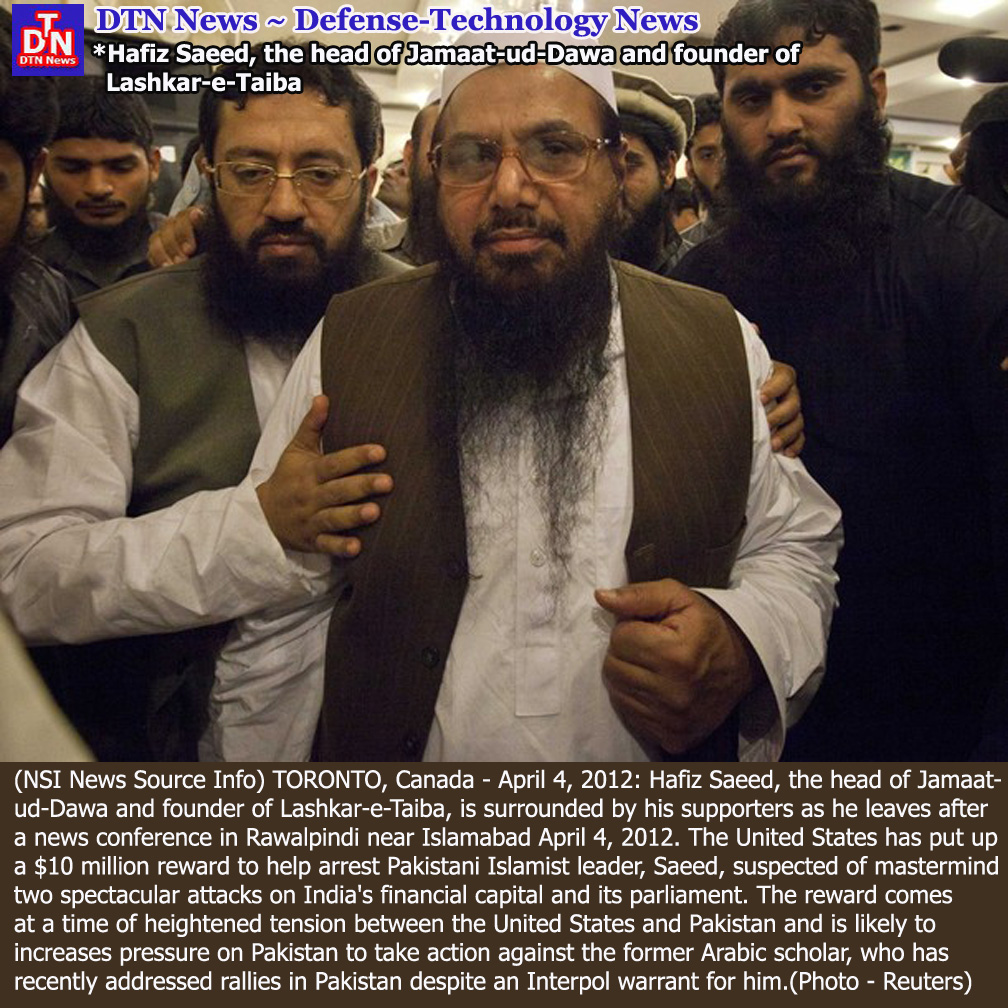
DTN News - PAKISTAN NEWS: Pakistani Islamist Leader Hafiz Saeed Mocks U.S. Over $10Million Bounty At News Conference

DTN News - PAKISTAN NEWS: Pakistani Islamist Leader Hafiz Saeed Mocks U.S. Over $10Million Bounty At News Conference
*Lashkar-e-Taiba founder decries 'ridiculous' US bounty
Source: DTN News - - This article compiled by Roger Smith from reliable sources BBC News
(NSI News Source Info) TORONTO, Canada - April 4, 2012: The founder of Pakistan-based militant group Lashkar-e-Taiba (LeT) has described a $10m (£6.2m) bounty on his head - announced by the US on Tuesday - as "regrettable and misdirected".

In an interview with the Associated Press news agency, Hafiz Saeed said that such rewards "are usually for those who live in caves and mountains".

Mr Saeed travels widely in Pakistan from his base in the city of Lahore.

He now heads the Jamaat-ud-Dawa (JuD) group, widely seen as a LeT front.

LeT is blamed for the 2008 Mumbai attacks in India. The three-day rampage by 10 gunmen in November 2008 left 165 people dead. Nine of the attackers were also killed.

Local media on Wednesday quoted Pakistan interior ministry sources as saying that the government cannot proceed against Mr Saeed without "hard and undeniable evidence that can withstand judicial scrutiny".

He has consistently denied any suggestion that either he or JuD - which he says is a charity - played any role in militant violence.

Pakistan arrested LeT's senior leaders after the Mumbai attacks. But most of them, including Mr Saeed, were later freed on appeal.

'Regrettable'
In his interview with AP, Mr Saeed said that the US only announced the reward because of his demonstrations against reopening supply lines through Pakistan to Nato troops in Afghanistan.

The supply routes were closed down in November when 24 Pakistani soldiers on the border with Afghanistan were accidentally killed in a US air strike.

"We are organising massive public meetings to inform the nation about all the threats which Pakistan will face after the restoration of the supplies," he told AP in a mosque in Islamabad on Tuesday.

"With the grace of God, we are doing our work in Pakistan openly. It is regrettable that America has no information about me. Such rewards are usually for those who live in caves and mountains."

The US has designated both LeT and JuD as foreign terrorist organisations. Intelligence officials say LeT has extended its focus beyond India in recent years - plotting attacks in Europe and Australia.

Correspondents say that the reward represents a change in US thinking - previously it was thought that pursuing the JuD leadership would cause too much friction with the Pakistani government.

The US State Department says that Mr Saeed continues "to spread ideology advocating terrorism, as well as virulent rhetoric condemning the United States, India, Israel and other perceived enemies".

It said that six of the 166 people killed in the 2008 attacks were American citizens.

The sole surviving gunman, Pakistani national Mohammad Ajmal Amir Qasab, was captured and sentenced to death by a court. His appeal is pending.

India has welcomed the reward, saying it sent a strong signal to LeT members that "the international community remains united in combating terrorism" and bringing to justice those behind the Mumbai attacks.

*Link for This article compiled by Roger Smith from reliable sources BBC News
*Speaking Image - Creation of DTN News ~ Defense Technology News 
*This article is being posted from Toronto, Canada By DTN News ~ Defense-Technology News Contact:dtnnews@ymail.com 
©COPYRIGHT (C) DTN NEWS DEFENSE-TECHNOLOGY NEWS


Sunday, February 28, 2010

DTN News: Pakistan TODAY March 1, 2010 ~ JuD Chief Saeed Advocates War, If India Doesn’t Talk

DTN News: Pakistan TODAY March 1, 2010 ~ JuD Chief Saeed Advocates War, If India Doesn’t Talk Source: DTN News / ANI (NSI News Source Info) ISLAMABAD, Pakistan - March 1, 2010: Jamat ud Dawa (JuD) chief Hafiz Mohammad Saeed on Sunday said Pakistan will have to “fight a war at all cost” if India is not prepared to hold talks. In an interview given to a Pakistan news channel, Saeed said: “India wants war… If India is not prepared to hold talks, Pakistan will have to fight a war at all costs.” Commenting over India’s accusations about his (Saeed) involvement in 26/11 Mumbai attack, Saeed said: “Let India prove it in any court, I will be ready to accept everything.” Saying the people should go to Kashmir for ”jehad” against India, Saeed also criticized the Pakistan Government calling it as “coward.” Saeed, was placed under house arrest in Lahore in December 2008 after the JuD was declared a terrorist group by the UN Security Council in the wake of the Mumbai terror attacks. He was freed after about six months on the orders of the Lahore High Court. The Pakistan Government challenged his release in the Supreme Court, but no hearing has been held in the matter for various reasons.

Thursday, August 27, 2009

DTN News: Interpol Seeks Pakistani Militant Wanted In India

DTN News: Interpol Seeks Pakistani Militant Wanted In India
*Source: DTN News / Int'l Media (NSI News Source Info) ISLAMABAD, Pakistan - August 27, 2009: The international police agency Interpol has issued a "red notice" alert for a Pakistani Islamist wanted in India in connection with attacks in Mumbai that strained relations between the nuclear-armed rivals. Hafiz Mohammed Saeed, center, chief of an Islamic charity Jamaat-ud-Dawa, leaves under tight security after appearing before the judicial review board of High Court in Lahore, Pakistan on Tuesday, May 5, 2009. Saeed was detained under house arrest last year as part of Pakistan's investigation into the Mumbai attacks. India says Hafiz Saeed, founder of the Lashkar-e-Taiba (LeT) militant group, was the mastermind of November's attacks in India's commercial hub in which 166 people were killed. Saeed was detained in Pakistan in December, after a U.N. Security Council resolution put him on a list of people and organisations supporting al Qaeda. But in June, a court released him on grounds of insufficient evidence, prompting the Pakistani government to lodge an appeal with the Supreme Court for his re-arrest. That case is pending. India has been insisting that Pakistan act against Saeed and other members of the LeT, which is banned in Pakistan. Pakistan says it has insufficient evidence against him. Interpol says a red notice is not an international arrest warrant but is issued after authorities in a country issue a warrant to help with the identification or location of a suspect with a view to their arrest or extradition. India's foreign minister, S.M. Krishna said the world had to take notice of the Interpol alert against Saeed. "I think the world should take note of these developments and then you know they will have to come to their own conclusions," Krishna told reporters on Wednesday. "India can only do this much and nothing beyond, and we have done whatever we can and we will continue to impress on Pakistan the desirability of curbing terror." A notice on Interpol's website identified the suspect as Hafiz Saab Sayed. The agency said an arrest warrant for him had been issued in Mumbai for various offences including "crimes against life and health", kidnapping and terrorism. Interpol says many of its member countries consider a red notice a valid request for provisional arrest. Pakistani government spokesmen were not available for comment. INFORMATION "REJECTED" India has on several occasions given Pakistan information with the aim of helping build a case against Saeed, but Krishna said the information had been rejected. Pakistani Interior Minister Rehman Malik told a Pakistani television station on Tuesday that the government still needed "solid evidence" against Saeed. Pakistan has arrested at least five people and put them on trial for the Mumbai assault, but Indian officials say Saeed's case is a test of whether Pakistan was serious about dismantling the "terrorist network" on its soil. Saeed is one of 38 people, including Pakistani nationals, accused by India of planning the guns-and-grenades attack by 10 gunmen India says were Pakistanis. India broke off a 5-year-long peace process with Pakistan after the Mumbai attack saying talks could resume only if Pakistan acted against the planners and prevented more attacks. The neighbours have fought three wars since 1947. Saeed heads the Jamaat-ud-Dawa charity which the United Nations said in December was a front for the LeT. A charity spokesman, Yahya Mujahid, said India was trying to deceive the world in its effort to link Saeed to Mumbai. "We'll fight our legal battle. It doesn't bother us," Mujahid said of the Interpol notice. "We have a Pakistani high court verdict saying there's no evidence of Mr Saeed's involvement in the Mumbai attack."

Tuesday, August 18, 2009

DTN News: Indian Prime Minister Manmohan Singh Says Pakistan Militants Planning Fresh Attacks

DTN News: Indian Prime Minister Manmohan Singh Says Pakistan Militants Planning Fresh Attacks *Source: DTN News / Int'l Media (NSI News Source Info) NEW DELHI, India - August 18, 2009: Indian Prime Minister Manmohan Singh said Monday that militants in Pakistan were plotting new attacks on India as he urged security forces to stay on high alert. Kashmiri militants shout slogans during a public meeting to mark the Kashmir Solidarity Day in Muzaffarabad, the capital of the Pakistan-administered Kashmir. Around a dozen Kashmiri militant groups gathered publicly to urge Pakistan to lift bans against the Islamist organisation India blames for the Mumbai attacks and its political arm. "We appeal on the government of Pakistan to lift the ban against Lashkar-e-Taiba (LeT) and Jamaat-ud-Dawa (JuD) because no Kashmiri jihadi organisation was involved in the Mumbai attacks," Syed Salahuddin, head of the militant Hizbul Mujahideen, told the gathering of around 1,000 people. "There is credible information of ongoing plans of terrorist groups in Pakistan to carry out fresh attacks," Singh told a summit on internal security attended by the chief ministers from India's states. "After the Mumbai attacks, we have put in place additional measures. There is need for continued utmost vigilance," added Singh, who also pointed to the threat posed by left-wing militants in the east of the country. India has boosted its security to prevent assaults after the attacks in the country's financial capital Mumbai in November, in which gunmen killed 166 people. "All states need to actively share intelligence information to avert any terror attack," he said. India's intelligence-gathering techniques were severely criticised after their collective failure to thwart the bloody Mumbai attacks. India accuses Pakistan of arming and training cross-border militants in Muslim-majority Kashmir -- a charge Islamabad vehemently denies. Singh said cross-border terrorism remained a "most pervasive" threat. The two nuclear-armed countries have fought three wars since independence in 1947 and came dangerously close to a fourth following an attack on the Indian parliament in 2001 by militants New Delhi said came from Pakistan. Singh said militants were operating far beyond the confines of the insurgency-hit northern state of Jammu and Kashmir. "There has been a surge in infiltration this year, which is disturbing," he said. On Saturday's 62nd anniversary of India's independence from British rule, the prime minister had stated in his speech that the government was working to eradicate violent extremism from the country's soil. India's Home Minister Palaniappan Chidambaram told the summit that the country had faced no terror strike after the Mumbai attacks but "it does not mean that the threat of terror has vanished or receded". In the wake of the comments, Pakistan assured India of its "fullest cooperation" in preventing fresh acts of terror. India's deputy high commissioner was called to Pakistan's foreign ministry and told Singh's remarks "warrant serious and prompt attention", the ministry said in a statement. "In all sincerity, we would request India to share information that they have and for our part we stand ready to cooperate fully in pre-empting any act of terror," the Pakistan statement added. The prime minister also said India faced another serious challenge from left-wing extremism, namely Maoists who have inflicted heavy casualties on security forces. India's Maoists, also known as the Naxals, say they are fighting for the rights of neglected tribal people and landless farmers. They are now active in more than half of the country's 29 states -- particularly in the east, the poorest part of India. Estimates of their numbers nationwide range between 10,000 and 20,000, but little is known about their shadowy leadership. To deal with the Maoist crisis, Chidambaram announced a multi-pronged strategy at the summit. "We will talk, we will act, we will restore order and we will undertake developmental activities in Naxal-hit areas," he said.

Wednesday, July 29, 2009

DTN News: Pakistan Has Not Yet Tagged al-Qaeda A Terrorist Group

DTN News: Pakistan Has Not Yet Tagged al-Qaeda A Terrorist Group *Source: DTN News / M E Transparent Amir Mir (NSI News Source Info) LAHORE, Pakistan - July 29, 2009: The provincial government of the Pakistani Punjab’ sudden move on July 15, 2009 to dissociate itself from the Hafiz Mohammad Saeed detention case in the Supreme Court of Pakistan was driven by the fact that the PPP’s central government lacked substantial evidence against the Jamaatul Daawa (JuD) ameer Hafiz Mohammad Saeed to convince the court to allow his continued preventive detention, thus making it difficult for the right-wing Sharif government to yet again seek his house arrest for an indefinite period. As a three-member Supreme Court bench, comprising of Chief Justice Iftikhar Mohammad Chaudhry, Justice Sair Ali and Justice Jawad Khawaja, was hearing two identical petitions filed by the federal and Punjab governments against the June 3 release of Hafiz Saeed by the Lahore High Court, the Advocate General Punjab Raza Farooq surprised everyone in the court room on July 15 by seeking withdrawal of the Punjab government’s appeal. Stating that it was not possible to pursue the petition on the basis of the evidence that the Punjab government had against Hafiz Saeed, the Advocate General said he had instructions from the provincial government to withdraw the petition. Despite the fact that the appeal does not stand withdrawn as of now, legal experts have a unanimous opinion that the federal government will have no other choice but to let this happen if the Punjab government so desires. Six months after being placed under house arrest by the Punjab government [which was actually acting under the instructions of the federal government], the Lahore High Court ordered the release of Saeed, saying the authorities had failed to justify his detention under the Maintenance of Public Order (MPO). Mr A. K. Dogar, the counsel for the petitioner argued before the court that Hafiz Saeed cannot be detained only to please the Indian lobby on the false propaganda that he is involved in the Mumbai attacks - a bald allegation being leveled only to conceal the Indian security lapses. Rejecting the government’s contention that Hafiz Mohammad Saeed had been put under house arrest due to his alleged al-Qaeda and Taliban links and that he should remain behind bars in the interest of Pakistan and for his own security, comprising Justice Ijaz Ahmad Chaudhry, Justice Hasnat Ahmad Khan and Justice Zubdatul Hussain ruled that the government has no evidence of Hafiz Saeed’s links with al-Qaeda or his involvement in any anti-state activity except for the Indian allegations that he had been involved in the 26/11 Mumbai terror attacks. On May 30, 2009, hardly three days before the LHC verdict was announced, the Attorney General of Pakistan Latif Khosa had presented documentary evidence to the three-member Lahore High Court bench, linking the JuD to al-Qaeda and Taliban and pleading that the JuD ameer should remain under house arrest. Khosa further told the court that Hafiz Mohammad Saeed was detained after the United Nations declared his group a terrorist outfit in the wake of the Mumbai attacks. He pleaded that the action of the UNSC Sanctions Committee obliged the Pakistan government to act against the JUD leadership. When the LHC judges did not agree with his contention and asked him whether the government had any independent evidence of its own, Latif Khosa met the three honourable judges privately and told them that one of the culprits involved in the Mumbai attack – Commander Zakiur Rehman Lakhvi - has known links with Hafiz Saeed. He pleaded that the lone surviving Mumbai attacker Ajmal Kasab has already admitted to being a Pakistani national and having been trained for the 26/11 attacks by Lakhvi, the LeT’s chief operational commander and a close associate of Hafiz Saeed. Latif Khosa then showed the judges what he claimed was independent evidence of the JuD’s links with al-Qaeda. Interestingly, however, the LHC judges wanted to see a copy of the government notification under which the al-Qaeda had been declared a terrorist organisation. Two days later, on June 1, 2009, the Attorney General went back to the court and told the judges that the Pakistan government had not yet declared al-Qaeda a terrorist organisation. The court subsequently told the Attorney General if that was the case, Hafiz Saeed’s having links with al-Qaeda was no offence under the law of the land. The LHC released its detailed verdict on June 6, 2009, making public the grounds on which it had ordered the release of the JuD chief. One of the grounds said: “It would be relevant to mention here at this juncture that the security laws and anti-terrorism laws of Pakistan are so far silent about the fact that al-Qaeda was a terrorist organisation”. The Lahore High Court judgment further added: “Even after the perusal of the documents presented by the government, we do not find any material declaring that Hafiz Saeed’s detention was necessary for the security of the petitioner and there was no evidence that the petitioner had any links with either al-Qaeda or any other terrorist movement. The material provided by the government to the court in chamber against petitioners was mostly based on reports of intelligence agencies which had been obtained after their detention, but even then, there was no solid evidence or source to supplement the reports”. “As regard the contention of the Attorney General of Pakistan that the petitioners are being blamed to be involved in Mumbai attacks, not a single document was brought on the record showing that the JuD or the petitioners were ever involved in the incident. As far as the allegation in the UN resolution that Hafiz Saeed and Zaki Lakhvi had links with al-Qaeda, we have found that in the earlier judgment, as reported in Mamoona Saeed Vs the Government of Punjab etc (PLD 2007 Lahore 128), it was observed that there was no evidence against the JuD for its links with al-Qaeda”. About the legality of the detention orders, the LHC bench observed as per Article 10 (5) of the Constitution, it was mandatory on the detaining authority to provide grounds for detention on which the order had been made within 15 days. However, the relevant authority made clear violation of explicit provisions of the Pakistani Constitution, which deprived the JuD petitioners from assailing their detention before the competent forum and also to know the allegations against them”. Concluding the verdict, all three judges on the bench observed with a unanimous view that the writ petition in form of habeas corpus was maintainable as prima facie the Pakistan government had no sufficient grounds to detain the petitioners for preventive measures. “So far as resolution of the UN is concerned, there was no matter before this court about its vires and the federal government can act upon the same in letter in spirit, if so advised, but relying upon the same their detention cannot be maintained as it was even not desired thereby. Hence the writ petition is allowed and the impugned detention orders are quashed”, the three-member LHC bench had observed in its verdict.