Showing posts with label 5th Generation Stealth Aircraft. Show all posts

Thursday, April 24, 2014

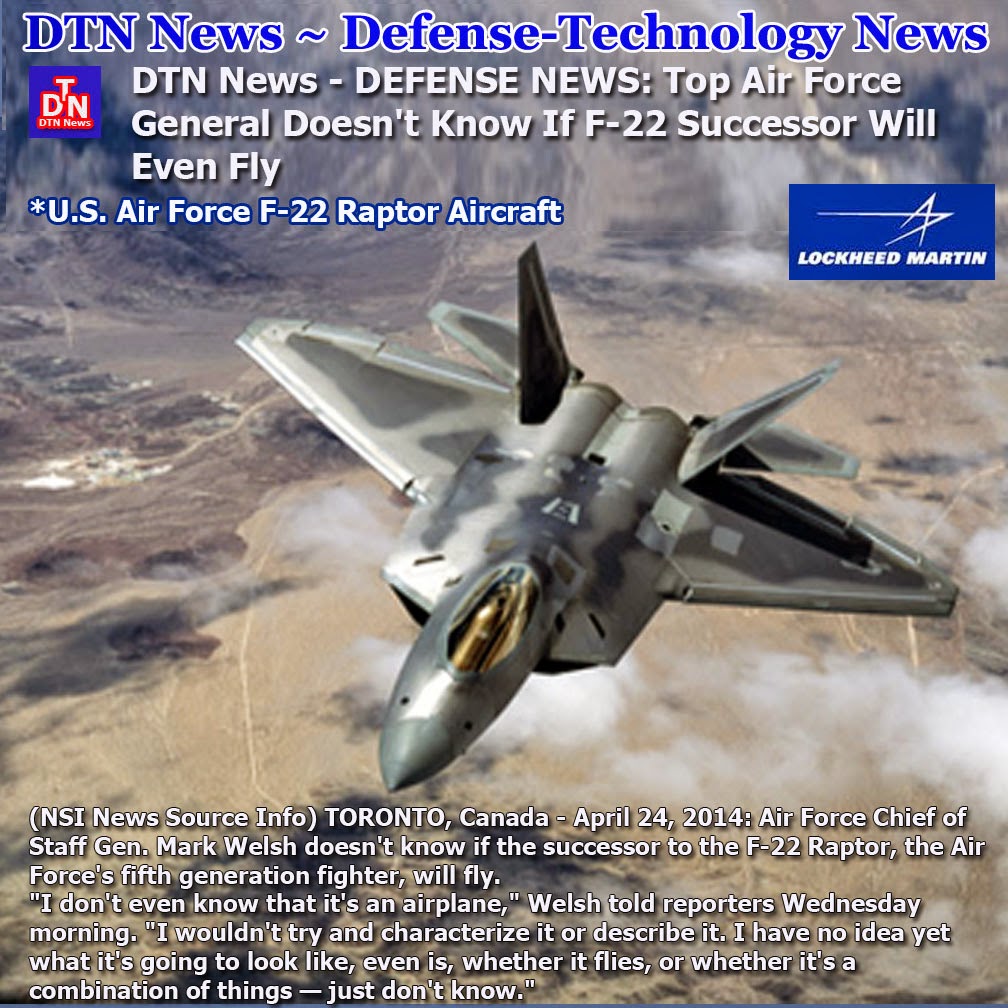
DTN News - DEFENSE NEWS: Top Air Force General Doesn't Know If F-22 Successor Will Even Fly

DTN News - DEFENSE NEWS: Top Air Force General Doesn't Know If F-22 Successor Will Even Fly
Source: DTN News - - This article compiled by K. V. Seth from reliable sources By Joel Gehrke - Washington Examiner
(NSI News Source Info) TORONTO, Canada - April 24, 2014Air Force Chief of Staff Gen. Mark Welsh doesn't know if the successor to the F-22 Raptor, the Air Force's fifth generation fighter, will fly.

"I don't even know that it's an airplane," Welsh told reporters Wednesday morning. "I wouldn't try and characterize it or describe it. I have no idea yet what it's going to look like, even is, whether it flies, or whether it's a combination of things — just don't know."

Welsh said that Air Force officials have to begin thinking about "what does air superiority look like 30 years from now" because the government doesn't react quickly enough to be prepared with the necessary technology if the research doesn't begin very far in advance.

Lockheed Martin, which made the F-22, would like the fighter's successor to have "greater speed, range, stealth and self-healing structures; developments that will require new breakthroughs in propulsion, materials, power generation and weapon technology," according to a 2012 report from Air Force Technology.

The development of the F-22 was undermined by high costs, though. "Alarmed by soaring costs, the Defense Department shut down production last year after spending $67.3 billion on just 188 planes -- leaving the Air Force to rely mainly on its fleet of 30-year-old conventional fighters," the Los Angeles Times noted in 2013.

"The Air Force began laying plans to build the F-22 in the early 1980s. A decade later, it estimated it would take nine years and $12.6 billion to develop the jet, but it ended up taking 19 years and costing $26.3 billion, not including the production of any aircraft. By the time production was completed, the F-22 cost an average of $412 million each, up from the original estimate of $149 million."

Related U.S. Air Force F-22 Raptor Aircraft Images;


*Link for This article compiled by K. V. Seth from reliable sources By Joel Gehrke - Washington Examiner
*Speaking Image - Creation of DTN News ~ Defense Technology News 
*Photograph: IPF (International Pool of Friends) + DTN News / otherwise source stated
*This article is being posted from Toronto, Canada By DTN News ~ Defense-Technology News Contact:dtnnews@ymail.com 
©COPYRIGHT (C) DTN NEWS DEFENSE-TECHNOLOGY NEWS

Friday, March 14, 2014

DTN News - DEFENSE NEWS: New Chinese Stealth Jet Built With Stolen F-35 Component Designs

DTN News - DEFENSE NEWS: New Chinese Stealth Jet Built With Stolen F-35 Component Designs
Source: DTN News - - This article compiled by K. V. Seth from reliable sources RT
(NSI News Source Info) TORONTO, Canada - March 14, 2014A new Chinese stealth fighter jet’s design includes details obtained in a Chinese cyber-spying operation conducted seven years ago against the F-35 Lightning II, according to a new report based on conversations with US military officials and contractors.

The Chinese espionage plot, dubbed Operation Byzantine Hades by US intelligence agencies, primarily targeted government as well as US industry. While the US Office of National Intelligence is known to have more details about the plot, Bill Gertz of the Washington Free Beacon reported that new Chinese planes have incorporated technology previously only found in the F-35.

A video posted on a Chinese military message board was reportedly the first evidence that such a theft had taken place. The websites featured images of a newer version of the J-20 stealth jet, a twin engine aircraft currently under development by the Chinese People Liberation’s Army.

The initial J-20 prototype was revealed in 2011, however the aircraft shown in the video was equipped with a new electro-optical targeting system under its nose, an updated coating that will help the plane hide from radar, and newly hidden engine nozzle, according to the Free Beacon.

Pentagon officials have said that the data was first taken by a Chinese military group called the Technical Reconnaissance Bureau based in Chengdu province. The information was then given to the Aviation Industry Corp. (AVIC). The AVIC then passed it on to a subsidiary, the Chengdu Aircraft Industry Group, to incorporate the information into the new design.

The US military first began development on the F-35 in 2006. Since then, the stealth fighter has a reported 100 percent success rate in its weapons testing in recent years, according to Michael Brissenden of ABC news in Australia, although reliability issues with the plane mean its design is not yet complete.

Reuters / Yuri Gripas Reuters / Yuri Gripas

The F-35 was designed to carry out ground attacks and air missions, with advanced sensors attached to make up for any maneuvering vulnerabilities. Richard Fisher, a specialist on Chinese weapon systems, told the Free Beacon that technology installed under the J-20’s nose is remarkably similar to the F-35’s sensors.

“This targeting system and a set of distributed high-power infrared sensors give the F-35 a previously unrivaled ‘situational awareness,’ but now it is clear that the J-20 will have a similar targeting system and its own set of distributed sensors,” he said.

“If as part of their espionage, China had also gained engineering insights into the F-35’s very advanced sensor systems, that could prove disastrous to its combat potential barring a rapid redesign and improvements before entering service.”

Last year US officials denied that the Chinese had gained an edge on American military capabilities, although they did not refute that cyber-espionage is becoming more common in the tense world of geopolitics.

“The viciousness, and just the volume of attacks, not only by the Chinese but Russians and others trying to get the blueprints of our most sensitive material is just breathtaking – and they’re getting better,” Rep. Mike Rogers, chairman of the House Intelligence Committee, told CNN.

“It costs billions and billions of dollars extra to try to make sure that we’re staying ahead of our adversaries with technology. When they steal it, they leap ahead. That means we have to invest more, and change that technology. It is a serious problem,” he said.

*Link for This article compiled by K. V. Seth from reliable sources RT
*Speaking Image - Creation of DTN News ~ Defense Technology News 
*Photograph: IPF (International Pool of Friends) + DTN News / otherwise source stated
*This article is being posted from Toronto, Canada By DTN News ~ Defense-Technology News Contact:dtnnews@ymail.com 
©COPYRIGHT (C) DTN NEWS DEFENSE-TECHNOLOGY NEWS

Thursday, February 20, 2014

DTN News - CHINA DEFENSE NEWS: Chinese Stealth Jet Set For Maiden Flight

DTN News - CHINA DEFENSE NEWS: Chinese Stealth Jet Set For Maiden Flight
Source: DTN News - - This article compiled by K. V. Seth from reliable sources ecns.cn
(NSI News Source Info) TORONTO, Canada - February 20, 2014: China is said to be planning the maiden flight soon of the upgraded version of the J-20 stealth fighter.

A number of photos recently taken by aviation enthusiasts at an unidentified base, and widely circulated on websites that follow the Chinese military, show a prototype of the twin-engine, fifth-generation aircraft with the serial code "2011" painted on both sides of the cockpit.

Active members on cjdby.net and fyjs.cn, the two most-visited sites that cover the Chinese military, said the first test flight of the prototype aircraft is imminent.

The flight is expected to take place in Chengdu, where the aircraft's developer, Chengdu Aircraft Industry Group, is headquartered.

An employee of the Aviation Industry Corp of China, parent company of the Chengdu industry group, speaking on Wednesday on condition of anonymity, said that he could neither confirm nor deny the rumors.

Recent media reports about China's military hardware testing have confirmed many of the rumors published by Chinese military enthusiasts. Many of the followers claim to have a great deal of knowledge about weapons, and sources with defense contractors.

The newest J-20 is the stealth fighter's third prototype since the aircraft's debut three years ago.

In January 2011, the J-20's first prototype made its maiden flight at an unidentified airfield in Chengdu. The 15- minute flight made China the third nation in the world to "develop and test-fly a full-size stealth combat aircraft prototype", after the United States and Russia, according to Western media outlets.

China launched its stealth fighter programs in the late 1990s. It is also developing a single-engine, radar-evading fifth-generation jet fighter called the J-31. That aircraft has undergone several test flights.

China reportedly conducted test flights of a second J-20 prototype in Chengdu in May 2012. Pictures of a J-20 prototype firing from its side weapons bays surfaced in March 2013. It's unclear which prototype was tested in March.

Chinese aviation enthusiasts said a series of improvements have been made to the stealth fighter. It reportedly has a new air intake design, shorter engine nozzles and a sensor technology that helps pilots detect and track enemy aircraft or missiles in every direction simultaneously.

An upcoming test would indicate that its engineers and designers have made remarkable strides to finalize the J-20 project, said Wang Ya'nan, deputy editor-in-chief at Aerospace Knowledge magazine.

"Most of the changes made to the third prototype seem to be about its aerodynamics," he said. "I think the upgraded version will have better avionics, stealth capability and stronger survivability in combat."

But Wang emphasized that it is too early to tell if the aircraft's design has been finalized, pointing out that the United States spent many years on its jet fighters and adopted numerous changes.

"China only has a short history of developing advanced aircraft. There is still a long road for us before our aircraft can compete with others," he said.

Frank Kendall, the US under-secretary of defense for acquisition, technology and logistics, recently told The Wall Street Journal that US defense officials "expect the Chinese to have export versions of the equipment that they have built".

Kendall said China is expected to put the J-20 into active military service in the next few years and added it could export the aircraft to other nations.

*Link for This article compiled by K. V. Seth from reliable sources ecns.cn
*Speaking Image - Creation of DTN News ~ Defense Technology News 
*Photograph: IPF (International Pool of Friends) + DTN News / otherwise source stated
*This article is being posted from Toronto, Canada By DTN News ~ Defense-Technology News Contact:dtnnews@ymail.com 
©COPYRIGHT (C) DTN NEWS DEFENSE-TECHNOLOGY NEWS

Wednesday, September 19, 2012

DTN News - CHINA DEFENSE NEWS: Two Models of Chinese 5th-Gen Fighter In Works (PHOTOS)

DTN News - CHINA DEFENSE NEWS: Two Models of Chinese 5th-Gen Fighter In Works (PHOTOS)
Source: DTN News - - This article compiled by Roger Smith from reliable sources RT
(NSI News Source Info) TORONTO, Canada - September 19, 2012: The Chinese military has leaked first photos of a brand new lightweight fighter with external characteristics that allow the jet fifth-generation attribution. Some pictures suggest it could be used on future Chinese aircraft carriers.


Shenyang Aircraft Industry Group (SAC), one of the leading aircraft design and manufacturing corporations of China’s aviation industry, has rolled out a prototype that might eventually become Chinese analogue to America’s F-35.
The aircraft bears a certain resemblance to Lockheed Martin’s F-35 Lightning II, and even reportedly has the codename F-60. Though absolutely no characteristics of the prototype have been unveiled, one major difference is obvious: unlike its American relative, China’s F-60 has two engines.
The pictures of the Chinese technology demonstrator suggest that the engines the aircraft is currently equipped with do not have thrust vectoring nozzles which might suggest the prototype is at too early a stage of testing to get more sophisticated and powerful propulsion package.
Inclined twin vertical tail and wide-spaced ram air inlets are reminiscent of Lockheed Martin’s F-22 Raptor Joint Strike Fighter.
A blurred photo from China Military Report website is the only proof that SAC’s F 60 aircraft has successfully been airborne.
The suspected photo of China′s SAC F 60 fighter test flight. (Image from http://wuxinghongqi.blogspot.com)
The suspected photo of China's SAC F 60 fighter test flight. (Image from http://wuxinghongqi.blogspot.com)
Now it has become obvious that in the race for possession of fifth generation aircraft the Chinese military placed its bets on two horses: Chengdu Aircraft Corporation, which is heavily testing its J-20 “Mighty Dragon” fifth generation heavy fighter-bomber, and Shenyang Aircraft Industry Group with its F-60 lightweight fighter.
The F-60 prototype jet bears the side number 31001, which may be a reference to Chengdu’s J-20 heavy fighter jet. The first two J-20 prototypes have “2001” and “2002” side numbers respectively.
Yet, the F-60 and J-20 are not likely to be regarded as competitors because it appears the aircraft will have different specializations.

China’s future sea-based fighter jet

China’s first aircraft carrier, dubbed Shi Lang, laid down by the Soviet Union in the late 1980s and almost finished now by Chinese engineers, is expected to be put into service by the end of 2012. Still, Beijing has informed the warship will be not ready for action till 2017.
A vessel reported to be the Ukrainian-made aircraft carrier "Varyag", which China bought in the 1990s, is seen at a port in Dalian, Liaoning province. (Reuters/Jacky Chen )
The People’s Liberation Army Air Force (PLAAF) already has fighter jets to form the aircraft wing for Shi Lang. China produces J-15, a copycat of the Soviet-made Su-33. The J-15 copycat has been made by Shenyang Aircraft Industry Group. But the Su-33 was designed in the 1980s and cannot be regarded a proper sea-based aircraft in the 2010s. Probably since SAC already proved it can make a sea-based aircraft, Beijing commissioned a great challenge of creating a fifth generation fighter jet for naval use to this corporation.
Chinese Military Review website has published computer-generated images of the F-60 fifth generation fighter jet in action with a whole range of various air to air missiles. On at least two pictures the aircraft is depicted with an extended arrest hook that the sea-based aircraft use to stop after landing on the deck of an aircraft carrier.

Computer-generated imagery (CGI) of the J-31/ F-60 fifth generation fighter jet in action with beyond visual range (BVR) air to air missiles and fifth generation short range infrared homing air-to-air missiles. (Image from http://chinesemilitaryreview.blogspot.com)
The two-wheeled front rack chassis of the real F-60 prototype also suggests the aircraft is being engineered for naval use, like sea-based versions of Dassault’s Rafale in France, Lockheed Martin’s F/A-18 E/F Super Hornet and the Soviet-made Su-33. At the same time there are no signs the prototype is capable of short take off and vertical landing, which the F-35B STOVL version has.
A brief look at the computer-generated images also exposes another feature the F-60 has in common with Lockheed Martin’s F-35 Lightning II: an extremely limited space in the internal weapon bays. A stealth aircraft must have all of its weapons hidden inside the hull to decrease the aircraft’s visibility to enemy radars. The Chinese F-60, just like the American F-35, can only carry small-sized short range missiles in true stealth mode.
To get seriously armed the F-60 would have to carry long-range missiles externally, which would nullify its stealth capabilities. If so, the F-60 will have limited capabilities.
Probably the biggest problem of the modern Chinese aviation industry is the deadlock with military jet engines it currently finds itself in. For both Chengdu’s J-20 and Shenyang’s F-60 there are no reliable Chinese-made jet engines with technical characteristics appropriate for a fifth generation fighter. Still, Chinese engineers are known not only for copycat efforts, but for outstanding persistence in achieving their objectives. 
It cannot be altogether excluded that by 2017, when the Shi Lang aircraft carrier will be commissioned and more warships of the kind be under construction, Chinese engineers will probably decrease or eliminate the dependence on Russian jet engines and spare parts and put the F-60 on a proper flight.

Computer-generated imagery (CGI) of the J-31/ F-60 fifth generation fighter jet in action with beyond visual range (BVR) air to air missiles and fifth generation short range infrared homing air-to-air missiles. (Image from http://chinesemilitaryreview.blogspot.com)

*Link for This article compiled by Roger Smith from reliable sources RT
*Speaking Image - Creation of DTN News ~ Defense Technology News 
*This article is being posted from Toronto, Canada By DTN News ~ Defense-Technology News Contact:dtnnews@ymail.com 
©COPYRIGHT (C) DTN NEWS DEFENSE-TECHNOLOGY NEWS

Tuesday, August 21, 2012

DTN News - INDIA DEFENSE NEWS: Fifth Gen Fighter Aircraft To Be Unveiled In India By 2014

DTN News - INDIA DEFENSE NEWS: Fifth Gen Fighter Aircraft To Be Unveiled In India By 2014
Source: DTN News - - This article compiled by Roger Smith from reliable sources Zeenews.com
(NSI News Source Info) TORONTO, Canada - August 21, 2012:  The initial version of a fighter plane, being jointly developed by India and Russia and tipped to be one of the most-advanced in the world, will be unveiled in India in 2014. 

The Fifth Generation Fighter Aircraft (FGFA) with stealth features is slated to be inducted in the Indian Air Force by 2022. 

The two sides are close to signing a key contract expected to be worth over USD 11 billion for research and development phase of the project in the near future. 

"The first prototype of the FGFA is scheduled to arrive in India by 2014 after which it will undergo extensive trials at the Ojhar air base (Maharashtra)...We are hopeful that the aircraft would be ready for induction by 2022," IAF Chief Air Chief Marshal N A K Browne told a news agency.

The IAF Chief was in Russia in the second week of August where he reviewed the progress made in the programme and the prototypes of the aircraft developed by the Sukhoi Design Bureau at Zhukovsky there. 

The second prototype will arrive in India in 2017 and the third prototype will arrive in 2019. Based on the experience of test-flights of the each prototype, the final version of the FGFA would be developed for operational service, Browne said. 

India plans to acquire 214 of these fighter planes by the end of 2030 at an estimated cost of over USD 30 billion. 

Russia has already developed three prototypes of the aircraft which are being used for carrying out test-flights. The aircraft will have stealth features and its size would be smaller than that of the frontline Su-30 MKI. 

*Link for This article compiled by Roger Smith from reliable sources Zeenews.com
*Speaking Image - Creation of DTN News ~ Defense Technology News 
*This article is being posted from Toronto, Canada By DTN News ~ Defense-Technology News Contact:dtnnews@ymail.com 
©COPYRIGHT (C) DTN NEWS DEFENSE-TECHNOLOGY NEWS

Friday, May 18, 2012

DTN News - RUSSIA DEFENSE NEWS: Russian AF To Get First T-50 Fighters In 2013

DTN News - RUSSIA DEFENSE NEWS: Russian AF To Get First T-50 Fighters In 2013
Source: DTN News - - This article compiled by Roger Smith from reliable sources Ria Novosti
(NSI News Source Info) TORONTO, Canada - May 18, 2012: The Russian Air Force will receive the first batch of prototypes of its fifth-generation T-50 fighter for performance testing in 2013, Col. Gen. Alexander Zelin said on Thursday.

The T-50, developed under the PAK FA program (Future Aviation System for Tactical Air Force) at the Sukhoi experimental design bureau, is Russia's first new major warplane designed since the fall of the Soviet Union.
“The work on the fifth-generation fighter is going according to schedule,” Zelin, a former Air Force commander, told a news conference in Voronezh (central Russia). “The third prototype has joined the testing program and the fourth is being built.”
The T-50 made its maiden flight in January 2010 and three prototypes have since been undergoing flight tests.
Zelin earlier said that the number of T-50 aircraft involved in testing would be increased to 14 by 2015.
The fighter was first shown to the public in August 2011, in Zhukovsky near Moscow, at the MAKS-2011 air show.
It has been decided to equip current fighter models with available thrust-vectoring engines. The first batch of upgraded fighters will be handed over to the Air Force by late 2020. It is also planned that all new T-50 fighters will have become operational by then.
“When a plane powered by a regular engine is taken to a wide angle of attack at low speeds, it loses control and stability and starts moving independently of the pilot’s commands, i.e. the plane moves randomly. The Su-35 has perfect controllability at any speed, even at negative speeds, for instance, when the plane drops tail-forward. The pilot can effectively put the plane in any angular position,” Sergei Bogdan, a Su-35 and T-50 test pilot, explained to Izvestiya.
The world’s first thrust-vectoring engine appeared in the export version of the Su-30 meant for India. The first contract for the delivery of such planes was signed more than 10 years ago. India currently operates 150 Su-30 aircrafts and plans to contract the delivery of another 100 machines. Furthermore, Russia supplies Su-30 models powered by these engines to Malaysia and Algeria.

Related Review

The maiden flight of the T-50 / Project 701 / PAK FA, the first Russian fifth-generation fighter jet was completed successfully on Friday morning, 29 January 2010 at Komsomol'sk-na-Amur. This event is signfincant for several reasons.
  1. The PAK FA is generally similar in appearance to the American F-22, though there are so many differences in detail that it is clearly an original design rather than a knock-off copy. A direct comparison with the F-22 is probably not meaningful on an unclassified basis, but Russian marketers will probably sell it as roughly equivalent in combat potential. While the F-35 is also a fifth generation stealth fighter, the low observable characteristics of this attack aircraft are said to be markedly inferior to the all-around stealth of the F-22 air supremacy fighter.
  2. As of January 2010 a total production run of at least 150-200 aircraft for the Russian Air Force and 200 aircraft for the Indian Air Force was envisioned. If these production objectives are met, the United States might wind up with the world's third largest fleet of stealth fighters, after India and Russia.
  3. In June 2001, India was offered 'joint development and production' of this new 5th generation fighter by Russia. Russia had been trying to sell this concept both to China and India for some time. It seems probable that China declined to participate in this project given a belief that Russia stood to gain more from Chinese participation than did China. That is, it would seem that China had determined that it could produce a superior product without Russian help. With the first flight of the Russian stealth fighter in 2010, an arguably superior Chinese steath fighter might be expected to take to the skies not too long thereafter.
  4. The prospect that a country like Iran might buy even a few dozen PAK FA aircraft from Russia may well awaken interest in the F-22 in Israel, if not Saudi Arabia. The emergence of a Chinese counterpart stealth fighter may also re-awaken Japanese interest in the F-22. Production of large numbers of PAK FA by India would place Pakistan in a rather difficult position, unless it purchased similar numbers of stealth fighters from China.

Related News

Multimedia


*Link for This article compiled by Roger Smith from reliable sources Ria Novosti
*Speaking Image - Creation of DTN News ~ Defense Technology News 
*This article is being posted from Toronto, Canada By DTN News ~ Defense-Technology News Contact:dtnnews@ymail.com 
©COPYRIGHT (C) DTN NEWS DEFENSE-TECHNOLOGY NEWS


Monday, March 05, 2012

DTN News - DEFENSE NEWS: Fifth Generation Fighters Crucial To Air Superiority

DTN News - DEFENSE NEWS: Fifth Generation Fighters Crucial To Air Superiority
Source: DTN News - - This article compiled by Roger Smith from reliable sources U.S. Air Force
(NSI News Source Info) TORONTO, Canada - March 5, 2012: The Air Force is the world's most advanced air and space force and, with the integration of fifth generation aircraft, is gaining new tactical advantages that transcend beyond just stealth into areas such as enhanced maneuverability, multi-role capabilities and fused sensor and avionics systems that can communicate with other weapons systems.

That's why it is imperative that U.S. forces continue to develop and begin to use fifth-generation fighters as they transition to the new Pacific-based strategy, according to Lt. Gen. Herbert J. "Hawk" Carlisle, Deputy Chief of Staff for Operations, Plans and Requirements, Headquarters U.S. Air Force.
During the Air Force Association monthly breakfast here Feb. 28, he said fifth-generation fighters, such as the F-35 Joint Strike Fighter and the F-22 Raptor, are critical to maintaining air superiority and global precision attack core competencies.
"The threat environment is continuing to grow, so as we look at how we're going to maintain those competencies in the future, that's where fifth generation fighters come in," he said. "It's not just about stealth."
"The F-22 is better than any other aircraft in the world at air-to-ground except for the F-35, and the F-35 is better than any other aircraft in the world at air-to-air except for the F-22," said Carlisle.
The general said the Air Force can continue to maintain the most elite fourth generation aircraft in the world, but that won't prepare the U.S. to handle threats in the future.
"Our Air Force has got to keep evolving to meet these new challenges as we move forward into the future," said Carlisle.
To illustrate this evolution and fifth generation fighter jet technology, the general shared a scenario in which an F-22 data-links coordinates to a Navy submarine-launched tomahawk missile onto a target.
"Now you have two stealth platforms, a submarine and an F-22, communicating with naval ordnance," he said.
That level of interoperability is a large part of what makes the fifth generation aircraft so vital to the Air Force and U.S. military in general, he added. Aircraft must not only be stealth, but also be highly maneuverable, be able to conduct multiple roles, and these aircraft must also be able to handle sensor and avionics information in a network integrated way not only for the pilot, but for the entire joint force.
"We have to have a fused system capability and have them networked and integrated across the force," he said. "To me, that's as important on a fifth-generation fighter as anything."
 
*DTN Aviation - - @DTNAviation ~ Available on Twitter
Comprehensive Daily News on The Aviation World of Today ~ © Copyright (c) DTN News Defense-Technology News

*Link for This article compiled by Roger Smith from reliable sources U.S. Air Force
*Speaking Image - Creation of DTN News ~ Defense Technology News 
*This article is being posted from Toronto, Canada By DTN News ~ Defense-Technology News Contact:dtnnews@ymail.com 
©COPYRIGHT (C) DTN NEWS DEFENSE-TECHNOLOGY NEWS


Friday, February 17, 2012

DTN News - DEFENSE NEWS: Lockheed Martin’s Fighting Falcon Evolves With New F-16V

DTN News - DEFENSE NEWS: Lockheed Martin’s Fighting Falcon Evolves With New F-16V
Source: DTN News - - This article compiled by Roger Smith from reliable sources Lockheed Martin
(NSI News Source Info) TORONTO, Canada - February 17, 2012: Lockheed Martin [NYSE: LMT] unveiled a new version of the F-16 today at the Singapore Airshow. The F-16V will feature enhancements including an active electronically scanned array (AESA) radar, an upgraded mission computer and architecture, and improvements to the cockpit – all capabilities identified by the U.S. Air Force and several international customers for future improvements.

With nearly 4,500 F-16s delivered, this is a natural step in the evolution of the world’s most successful 4th generation fighter.  The Fighting Falcon program has continually evolved as it began with the F-16 A/B as the lightweight fighter then transitioned to F-16 C/D and Block 60 versions as customers’ requirements changed. 

AESA radars offer significant operational capability improvements. Lockheed Martin has developed an innovative solution to affordably retrofit this key technology into existing F-16s.  The F-16V configuration is an option for new production jets and elements of the upgrade are available to most earlier-model F-16s. The “V” designation is derived from Viper, the name fighter pilots have called the F-16 from its beginnings.

“We believe this F-16V will satisfy our customers’ emerging requirements and prepare them to better interoperate with the 5th generation fighters, the F-35 and F-22,” said George Standridge, Lockheed Martin Aeronautics’ vice president of business development.

The F-16 is the choice of 26 nations. The F-16 program has been characterized by unprecedented international cooperation among governments, air forces and aerospace industries.

Headquartered in Bethesda, Md., Lockheed Martin is a global security company that employs about 123,000 people worldwide and is principally engaged in the research, design, development, manufacture, integration and sustainment of advanced technology systems, products and services. The Corporation's net sales for 2011 were $46.5 billion.


*Link for This article compiled by Roger Smith from reliable sources Lockheed Martin
*Speaking Image - Creation of DTN News ~ Defense Technology News 
*This article is being posted from Toronto, Canada By DTN News ~ Defense-Technology News Contact:dtnnews@ymail.com 
©COPYRIGHT (C) DTN NEWS DEFENSE-TECHNOLOGY NEWS


Wednesday, June 22, 2011

DTN News - INDIA DEFENSE NEWS: After F-16 Rejection, US Offers F-35 Stealth Aircraft To India

DTN News - INDIA DEFENSE NEWS: After F-16 Rejection, US Offers F-35 Stealth Aircraft To India
(NSI News Source Info) TORONTO, Canada / LE BOURGET, PARIS., France - June 22, 2011: After India rejected its F-16 jets, US defence major Lockheed Martin on Monday said it is willing to offer the latest F-35 stealth fighter planes if the US government approves it. "The decision has to be taken by the (US) government.
There has not been any discussion between us and the Indian Government," Lockheed's Martin Director of Communications of F-35 Michael J Rein said, saying his firm is willing to rejoin the bid for the $11 billion fighter jet deal for procurement of 126 Medium-Multi Role Combat Aircraft.
The Indian Government had rejected Lockheed's offer of F-16 along with another US firm Boeing's offer of F/A-18 Super Hornet from the race for procurement of the jets.
Rein said the offer of F-35 stealth fighter to India has been mentioned in a draft Senate Bill and it was up to the US Government to take it forward.
The proposal to allow sale of F-35 stealth fighter has brightened the prospects of Lockheed Martin returning to the race for the deal, a top official of an Aerospace firm attending the Paris Air Show said.
Meanwhile, the air show here is abuzz with speculation that Lockheed Martin is trying to rejoin the MMRCA bid with its fifth-generation fighter aircraft (FGFA), F-35, which is still under development. Lockheed Martin's F-16 offer, along with those from other contenders, was rejected by India in April. Its head of corporate strategy and business development Patrick Dewar said the US Senate Armed Services Committee had "asked the defence department to study the 'desirability and feasibility' of a joint strike fighter sale to India".
Both Boeing and Lockheed Martin had been aggressively biding for the anticipated $11 billion deal.
Rein, who is here to as part of Lockheed Martin’s delegation to Paris Air Show, was replying to a question on reports that the US defence major will offer its F-35 jets to India to rejoin the race for the MMRCA contract, billed as one of the largest in recent times world-wide.
Lockheed Martin had offered the F16IN Super Viper to India which was rejected by the Indian government along with Boeing's F-18 Super Horne and Russian MiG.
India has shortlisted two European contenders, French Dassault Rafale and European Eurofighter for procuring 126 Medium-Multirole Combat Aircraft (M-MRCA) deal for the Indian Air Force (IAF) in April.
However, another executive, not wished to be named, said it would be difficult for Lockheed Martin to rejoin the competition as Indian government has already completed the shortlisting exercise.
India, however, has already launched the joint development of its own FGFA with Russia. Moreover, weeks after the MMRCA rejection, in a move seen widely as meant to compensate the US, India approved the $4.1 billion purchase of 10 C-17 Globemaster transport aircraft, manufactured by Boeing. The deal is expected to sustain 23,000 jobs in the US.
*Speaking Image - Creation of DTN News ~ Defense Technology News
*This article is being posted from Toronto, Canada By DTN News ~ Defense-Technology News

©

COPYRIGHT (C) DTN NEWS DEFENSE-TECHNOLOGY NEWS