Showing posts with label Lashkar-e-Taiba. Show all posts

Wednesday, April 04, 2012

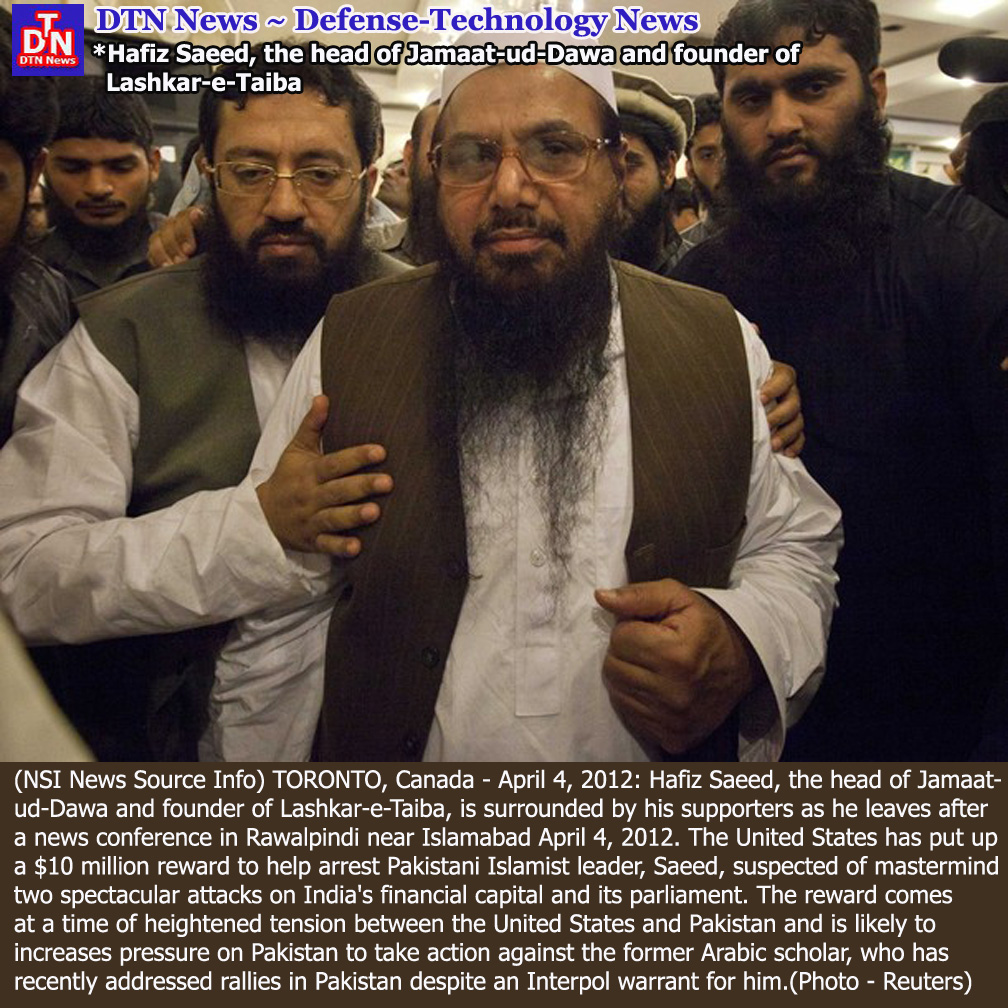
DTN News - PAKISTAN NEWS: Pakistani Islamist Leader Hafiz Saeed Mocks U.S. Over $10Million Bounty At News Conference

DTN News - PAKISTAN NEWS: Pakistani Islamist Leader Hafiz Saeed Mocks U.S. Over $10Million Bounty At News Conference
*Lashkar-e-Taiba founder decries 'ridiculous' US bounty
Source: DTN News - - This article compiled by Roger Smith from reliable sources BBC News
(NSI News Source Info) TORONTO, Canada - April 4, 2012: The founder of Pakistan-based militant group Lashkar-e-Taiba (LeT) has described a $10m (£6.2m) bounty on his head - announced by the US on Tuesday - as "regrettable and misdirected".

In an interview with the Associated Press news agency, Hafiz Saeed said that such rewards "are usually for those who live in caves and mountains".

Mr Saeed travels widely in Pakistan from his base in the city of Lahore.

He now heads the Jamaat-ud-Dawa (JuD) group, widely seen as a LeT front.

LeT is blamed for the 2008 Mumbai attacks in India. The three-day rampage by 10 gunmen in November 2008 left 165 people dead. Nine of the attackers were also killed.

Local media on Wednesday quoted Pakistan interior ministry sources as saying that the government cannot proceed against Mr Saeed without "hard and undeniable evidence that can withstand judicial scrutiny".

He has consistently denied any suggestion that either he or JuD - which he says is a charity - played any role in militant violence.

Pakistan arrested LeT's senior leaders after the Mumbai attacks. But most of them, including Mr Saeed, were later freed on appeal.

'Regrettable'
In his interview with AP, Mr Saeed said that the US only announced the reward because of his demonstrations against reopening supply lines through Pakistan to Nato troops in Afghanistan.

The supply routes were closed down in November when 24 Pakistani soldiers on the border with Afghanistan were accidentally killed in a US air strike.

"We are organising massive public meetings to inform the nation about all the threats which Pakistan will face after the restoration of the supplies," he told AP in a mosque in Islamabad on Tuesday.

"With the grace of God, we are doing our work in Pakistan openly. It is regrettable that America has no information about me. Such rewards are usually for those who live in caves and mountains."

The US has designated both LeT and JuD as foreign terrorist organisations. Intelligence officials say LeT has extended its focus beyond India in recent years - plotting attacks in Europe and Australia.

Correspondents say that the reward represents a change in US thinking - previously it was thought that pursuing the JuD leadership would cause too much friction with the Pakistani government.

The US State Department says that Mr Saeed continues "to spread ideology advocating terrorism, as well as virulent rhetoric condemning the United States, India, Israel and other perceived enemies".

It said that six of the 166 people killed in the 2008 attacks were American citizens.

The sole surviving gunman, Pakistani national Mohammad Ajmal Amir Qasab, was captured and sentenced to death by a court. His appeal is pending.

India has welcomed the reward, saying it sent a strong signal to LeT members that "the international community remains united in combating terrorism" and bringing to justice those behind the Mumbai attacks.

*Link for This article compiled by Roger Smith from reliable sources BBC News
*Speaking Image - Creation of DTN News ~ Defense Technology News 
*This article is being posted from Toronto, Canada By DTN News ~ Defense-Technology News Contact:dtnnews@ymail.com 
©COPYRIGHT (C) DTN NEWS DEFENSE-TECHNOLOGY NEWS


Saturday, August 20, 2011

DTN News - INTELLIGENCE REPORTS: Annual Report On Terrorism Says Al-Qaeda Remained Preeminent Threat To U.S.

DTN News - INTELLIGENCE REPORTS: Annual Report On Terrorism Says Al-Qaeda Remained Preeminent Threat To U.S.
(NSI News Source Info) TORONTO, Canada - August 20, 2011: The United States' annual report on terrorism says Al-Qaeda remained the preeminent terrorist threat to the United States in 2010.
Strategic assessment of the National Counter-terrorism Center, which prepared the "Country Reports on Terrorism 2010," is that though the terrorist network's core in Pakistan has become weaker, it retained the capability to conduct regional and transnational attacks.
Cooperation between Al-Qaeda and Afghanistan- and Pakistan-based militants was critical to the threat the group posed, says the report released by the State Department on Thursday.
In addition, the danger posed by Lashkar-e Taiba (LeT) and increased resource-sharing between Al-Qaeda and its Pakistan-based allies and associates such as Tehrik-e Taliban Pakistan (TTP) and the Haqqani Network meant the aggregate threat in South Asia remained high.
The report points out that the Al-Qaeda affiliates have grown stronger. While Al-Qaeda senior leadership continued to call for strikes on the U.S. homeland and to arrange plots targeted at Europe, the diversity of these efforts demonstrated the fusion of interests and the sharing of capabilities among Al-Qaeda groups with different geographical focuses.
TTP provided support to U.S. citizen Faisal Shahzad, who sought to carry out a car bombing in Times Square in May. Al-Qaeda in the Arabian Peninsula (AQAP) continued to demonstrate its growing ambitions and a strong desire to carry out attacks outside of its region. The group followed up its December 25, 2009 attempt to destroy an airliner bound for Detroit with an October 2010 effort to blow up several U.S.-bound airplanes by shipping bombs that were intended to detonate while in the planes' cargo holds.
Information about potential Al-qaeda plots in Europe prompted several European countries to raise their terror alerts toward the end of the year.
Similarly, al-Shabaab in East Africa, some of whose senior leaders have declared adherence to the Al-Qaeda brand of violent extremism, gained strength in 2010. Al-Shabaab's widening scope of operations, safe haven in Somalia, and ability to attract Western militants, made it a continuing threat to U.S. interests in the region.
In addition to operations, Al-Qaeda affiliates have taken on a greater share of the propaganda work. In a troubling trend, English-speaking militants increasingly connected to each other through online venues like militant discussion forums and video-sharing platforms, which encouraged both violent behavior and individual action. Many participants in online communities have real-world relationships with extremists who bolster their radicalism and mobilize them toward violent action.
Five Pakistani Americans contacted by a Taliban recruiter through YouTube encouraged one another to travel to Pakistan to train for warfare against the United States; they remained in Pakistani custody at year's end. Several Somali Americans decided to go overseas to fight with al-Shabaab - a decision that was likely shaped by a combination of online propaganda, face-to-face recruitment, and supportive real-world peer networks.
Not all of AQ's formal affiliates and informal allies presented as grave a threat to U.S. interests in 2010. No group has made a bigger name for itself in the kidnapping for ransom business than Al-Qaeda in the Islamic Maghreb (AQIM), which relies on ransom payments to sustain and develop itself in the harsh Saharan environment.
The apparent blow suffered by Al-Qaeda had no significant effect on other terrorist groups with deep roots in the Middle East, as both Hamas and Hizballah continued to play destabilizing roles in the region.
The Congressionally mandated report, which provides an assessment of trends and events in international terrorism that transpired from January 1 to December 31 2010, says more than 11,500 terrorist attacks occurred in 72 countries during the period, resulting in more than 13,200 deaths.
Although the number of attacks rose by almost 5 percent from the previous year, the number of deaths declined for a third consecutive year, dropping 12 percent from 2009. For the second consecutive year, the largest number of reported attacks occurred in South Asia and the Near East, with more than 75 percent of the world's attacks and deaths occurring in these regions.
*Speaking Image - Creation of DTN News ~ Defense Technology News
*This article is being posted from Toronto, Canada By DTN News ~ Defense-Technology News

©

COPYRIGHT (C) DTN NEWS DEFENSE-TECHNOLOGY NEWS

Wednesday, April 13, 2011

DTN News - INTELLIGENCE REPORT/NEWS: India Still Main LeT Target, But It Has Spread Wings: US Commander

DTN News - INTELLIGENCE REPORT/NEWS: India Still Main LeT Target, But It Has Spread Wings: US Commander
(NSI News Source Info) WASHINGTON - April 13, 2011:

Although India remains the main target of Pakistan-based terror outfit Lashkar-e-Taiba (LET), it has spread its influence internationally to Europe and broader Asia-Pacific region, a top US general has told the US Congress.

'It has historically been focused on the Kashmir region, particularly in order to conduct attacks inside India. And it was responsible for the (26/11) attack in Mumbai that we're all very familiar with,' Admiral Robert Willard, commander of the US Pacific Command said Tuesday.

'Unquestionably, they have spread their influence internationally, and they are no longer solely focused in South Asia and on India, although that continues to be their main training ground, and India continues to be their main target,' he told the Senate Armed Services Committee.

LeT, blamed for the November 2008 Mumbai terror attacks, has not only established its base in South Asian countries including Nepal and Bangladesh, but the US has evidence of LeT's presence in Europe and the broader Asia-Pacific region, he said.

The United States was actively working with South Asian governments including Nepal, Bangladesh, Sri Lanka, the Maldives and India to contain LeT, he said, as 'We know that Lashkar-e-Taiba is currently laid down throughout South Asia.'

In containing terrorist activity in the region, the US is focused on its partnership with India, Willard said. 'It's a longstanding relationship that requires a great deal of attention given India's prominence in South Asia and the many challenges that surround India.'

'And we're currently working with India and the regional nations on containing the terrorist activity, particularly Lashkar-e-Taiba and that particular terrorist organisation, which, as you'll recall, attacked Mumbai and continues to pose a threat throughout South Asia,' he said.

'Lashkar-e-Taiba is historically linked in that capacity. The government of Pakistan has denounced that linkage between LeT. The Indian government would offer that it still exists,' Willard said.

Responding to questions about Pakistan's relationship with LeT, Willard said: 'The discussion regarding the government of Pakistan's relationship to LeT is a very sensitive one.'

'Given the US relationship with both India and Pakistan, and the importance that we place on those relationships, it's important that this particular discussion continue to take place and that we continue to work with the government of Pakistan to root out terrorism that exists within their borders,' he said.

(Arun Kumar can be contacted at arun.kumar@ians.in)

*Speaking Image - Creation of DTN News ~ Defense Technology News
*This article is being posted from Toronto, Canada By DTN News ~ Defense-Technology News

©

COPYRIGHT (C) DTN NEWS DEFENSE-TECHNOLOGY NEWS

Sunday, December 05, 2010

DTN News - BREAKING NEWS: WikiLeaks Cables Portray Saudi Arabia As A Cashpoint For Terrorists

DTN News - BREAKING NEWS: WikiLeaks Cables Portray Saudi Arabia As A Cashpoint For Terrorists
** Hillary Clinton memo highlights Gulf states' failure to block funding for groups like al-Qaida, Taliban and Lashkar-e-Taiba
Source: DTN News - - This article compiled by Roger Smith from reliable sources Declan Walsh in Islamabad guardian.co.uk, Sunday 5 December 2010 12.00 GMT
(NSI News Source Info) ISLAMABAD, Pakistan - December 5, 2010: Saudi Arabia is the world's largest source of funds for Islamist militant groups such as the Afghan Taliban and Lashkar-e-Taiba – but the Saudi government is reluctant to stem the flow of money, according to Hillary Clinton.

"More needs to be done since Saudi Arabia remains a critical financial support base for al-Qaida, the Taliban, LeT and other terrorist groups," says a secret December 2009 paper signed by the US secretary of state. Her memo urged US diplomats to redouble their efforts to stop Gulf money reaching extremists in Pakistan and Afghanistan.

"Donors in Saudi Arabia constitute the most significant source of funding to Sunni terrorist groups worldwide," she said.

Three other Arab countries are listed as sources of militant money: Qatar, Kuwait and the United Arab Emirates.

The cables highlight an often ignored factor in the Pakistani and Afghan conflicts: that the violence is partly bankrolled by rich, conservative donors across the Arabian Sea whose governments do little to stop them.

The problem is particularly acute in Saudi Arabia, where militants soliciting funds slip into the country disguised as holy pilgrims, set up front companies to launder funds and receive money from government-sanctioned charities.

One cable details how the Pakistani militant outfit Lashkar-e-Taiba, which carried out the 2008 Mumbai attacks, used a Saudi-based front company to fund its activities in 2005.

Meanwhile officials with the LeT's charity wing, Jamaat ud Dawa, travelled to Saudi Arabia seeking donations for new schools at vastly inflated costs – then siphoned off the excess money to fund militant operations.

Militants seeking donations often come during the hajj pilgrimage – "a major security loophole since pilgrims often travel with large amounts of cash and the Saudis cannot refuse them entry into Saudi Arabia". Even a small donation can go far: LeT operates on a budget of just $5.25m (£3.25m) a year, according to American estimates.

Saudi officials are often painted as reluctant partners. Clinton complained of the "ongoing challenge to persuade Saudi officials to treat terrorist funds emanating from Saudi Arabia as a strategic priority".

Washington is critical of the Saudi refusal to ban three charities classified as terrorist entities in the US.

"Intelligence suggests that these groups continue to send money overseas and, at times, fund extremism overseas," she said.

There has been some progress. This year US officials reported that al-Qaida's fundraising ability had "deteriorated substantially" since a government crackdown. As a result Bin Laden's group was "in its weakest state since 9/11" in Saudi Arabia.

Any criticisms are generally offered in private. The cables show that when it comes to powerful oil-rich allies US diplomats save their concerns for closed-door talks, in stark contrast to the often pointed criticism meted out to allies in Pakistan and Afghanistan.

Instead, officials at the Riyadh embassy worry about protecting Saudi oilfields from al-Qaida attacks.

The other major headache for the US in the Gulf region is the United Arab Emirates. The Afghan Taliban and their militant partners the Haqqani network earn "significant funds" through UAE-based businesses, according to one report. The Taliban extort money from the large Pashtun community in the UAE, which is home to 1 million Pakistanis and 150,000 Afghans. They also fundraise by kidnapping Pashtun businessmen based in Dubai or their relatives.

"Some Afghan businessmen in the UAE have resorted to purchasing tickets on the day of travel to limit the chance of being kidnapped themselves upon arrival in either Afghanistan or Pakistan," the report says.

Last January US intelligence sources said two senior Taliban fundraisers had regularly travelled to the UAE, where the Taliban and Haqqani networks laundered money through local front companies.

One report singled out a Kabul-based "Haqqani facilitator", Haji Khalil Zadran, as a key figure. But, Clinton complained, it was hard to be sure: the UAE's weak financial regulation and porous borders left US investigators with "limited information" on the identity of Taliban and LeT facilitators.

The lack of border controls was "exploited by Taliban couriers and Afghan drug lords camouflaged among traders, businessmen and migrant workers", she said.

In an effort to stem the flow of funds American and UAE officials are increasingly co-operating to catch the "cash couriers" – smugglers who fly giant sums of money into Pakistan and Afghanistan.

In common with its neighbours Kuwait is described as a "source of funds and a key transit point" for al-Qaida and other militant groups. While the government has acted against attacks on its own soil, it is "less inclined to take action against Kuwait-based financiers and facilitators plotting attacks outside of Kuwait".

Kuwait has refused to ban the Revival of Islamic Heritage Society, a charity the US designated a terrorist entity in June 2008 for providing aid to al-Qaida and affiliated groups, including LeT.

There is little information about militant fundraising in the fourth Gulf country singled out, Qatar, other than to say its "overall level of CT co-operation with the US is considered the worst in the region".

The funding quagmire extends to Pakistan itself, where the US cables detail sharp criticism of the government's ambivalence towards funding of militant groups that enjoy covert military support.

The cables show how before the Mumbai attacks in 2008, Pakistani and Chinese diplomats manoeuvred hard to block UN sanctions against LeT's charity wing Jamaat ud Dawa.

But in August 2009, nine months after sanctions were finally imposed, US diplomats wrote that "we continue to see reporting indicating that JUD is still operating in multiple locations in Pakistan and that the group continues to openly raise funds". JUD denies it is the charity wing of LeT.

© Copyright (c) DTN News Defense-Technology News

  •