Showing posts with label Russian Military. Show all posts

Thursday, September 20, 2012

DTN News - RUSSIA DEFENSE NEWS: Russian Military To Receive 2nd Batch of Pantsir-S Systems

DTN News - RUSSIA DEFENSE NEWS: Russian Military To Receive 2nd Batch of Pantsir-S Systems
Source: DTN News - - This article compiled by Roger Smith from reliable sources Ria Novosti
(NSI News Source Info) TORONTO, Canada - September 20, 2012: Russia’s Aerospace Defense Forces will receive the second batch of Pantsir-S air defense systems by November this year, the Defense Ministry said.


Pantsir-S is a short-to-medium range combined surface-to-air missile and antiaircraft artillery system designed to protect point and area targets. The Russian military took delivery of the first batch (more than 10 units) in 2011.
“The second delivery is expected in September-October this year,” a Defense Ministry spokesman told reporters on Tuesday.
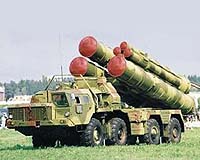
“The main purpose of this system is to protect S-400 Triumf air defense systems at their deployment sites from enemy air and missile strikes,” the official said.
Commenting on recent media reports that the military refused to accept the Pantsir-S for service with the Ground Forces, the spokesman said that the work on variants for Ground Forces and the Navy is still under way.
“As soon as this work is done, the system's prototype will undergo field tests," he said, adding that the Pantsir-S version for aerospace defense units fully meets performance requirements for this type of weaponry.
The Defense Ministry has so far ordered 100 Pantsir-S units for Aerospace Defense Forces, which are expected to be delivered in the next few years.
The export version of the system, Pantsir-S1, has been sold to the United Arab Emirates, Syria and Algeria.
Russia will showcase Pantsir-S1 at the Africa Aerospace and Defense arms show in South Africa on September 19-23.

Related News

Multimedia


OPERATORS AND COMBAT HISTORY (WIKIPEDIA)

A Pantsir-S1 unit of the Syrian Armed Forces reportedly scored the first combat kill of the type by downing a Turkish Air Force RF-4E carrying out a reconnaissance flight over the Syrian coast near Latakia on 22 June 2012.[8]

  •  Algeria: An estimated 38 on order; signed March 2006 as part of an arms package worth about US$ 8 billion[10]. Whereas Moscow Timesreported in February 2006 that Algeria had ordered TunguskasRIA Novosti later reported in March 2007 that Algeria had ordered Pantsir-S1 instead

  •  Iran: 10 units are in use from 2008. 
  •  Jordan: According to what Jane's Defence Weekly reported in 2007 a complete Russian Pantsir-S1 short-range air-defence system was being field tested in Jordan and that the kingdom is set to place an order. Army-Technology reported that Jordan placed an order for an undisclosed number of systems. Russia Today reported Jordan as being a customer for Pantsir-S1, and that they were likely to purchase between 50-75 combat vehicles.
  •  Syria: 36 to 50 on order; signed 2006 as part of arms package worth about US$ 1 billion; deliveries began in August 2007; Jane's Defence Weekly reported in May 2007 that 50 systems are on order by Damascus and that at least ten of those Pantsirs would be handed over to Iran by the end of 2008. According to Jane's Defence Weekly, Iran is reported to be the main sponsor of the deal and is paying Syria for its services as intermediary. Deliveries to Iran are categorically denied by a range of top Russian officials including First Deputy Prime Minister Sergei Ivanov.

  •  United Arab Emirates: 50 on order; Launch customer of Pantsir-S1. Ordered in May 2000, half of them tracked, the other half wheeled. Due to deliver in three batches by the end of 2005 - 12 in 2003, 24 in 2004 and 14 in 2005. Prices given where US$ 734 million ( including a US$100 million pay in advance to complete R&D ), with the price per single unit being about US$ 15 million. Delivery postponed after new design decisions were taken and UAE is said to have paid additional US$ 66 Million to cover major improvements. All 50 systems will now be wheeled on MAN SX 45 8x8 trucks from Germany, as well as the support vehicles. Delivery of the prototype occurred in 2007. With that the MAN SX45 is the only "western" vehicle that can accommodate the S1 system and has a worldwide logistics and support network through their importer network. Delivery of the 50 systems ordered in 2000 began in 2007 with the first two serially produced systems. British Jane's Defence Weekly reported on October 30.; delays in further deliveries. Based on test-firing data, some further optimisation of the systems is required. Deliveries will take place over the next three years under an amended schedule. As reported by Kommersant in June 2006 UAE has expressed interest in acquiring an additional 28 systems[24] and has likely signed an option for the delivery in 2009–2010.
  • Unidentified(?): RIA Novosti quoted Kommersant in March 2007 that KBP has obligations to deliver to an "unidentified country". The official order backlog of KBP of US$ 2,6 bn for Pantsir-S1 systems per July 2007 compared to the system prices given by the launch order suggests that there are probably unidentified customers for about 50 or so Pantsir-S1 systems.


*Link for This article compiled by Roger Smith from reliable sources Ria Novosti 
*Speaking Image - Creation of DTN News ~ Defense Technology News 
*This article is being posted from Toronto, Canada By DTN News ~ Defense-Technology News Contact:dtnnews@ymail.com 
©COPYRIGHT (C) DTN NEWS DEFENSE-TECHNOLOGY NEWS

Tuesday, January 05, 2010

DTN News: Russian Military Considers Armored Trains For Railroad Defense

DTN News: Russian Military Considers Armored Trains For Railroad Defense *Source: DTN News / RT (NSI News Source Info) MOSCOW, Russia - January 06, 2010: Russia’s Defense Ministry may deploy in the Caucasus two armored trains, which were withdrawn from Chechnya two years ago. This is linked to the aggravation of the security situation in Russia’s southern republics of Dagestan, Chechnya and Ingushetia, Interfax reports, citing its sources in law-enforcement bodies. The trains have not been used since their withdrawal and are currently stationed in the neighboring Stavropol region. They are equipped with special devices for the removal of landmines and heavy weapons capable of countering an attack by armed militants along the railways. On Monday a cargo train was blasted in Ingushetia near the city of Nazran. There were no casualties according to the republic’s Interior Ministry.

Friday, August 21, 2009

DTN News: Russian State Defense Order For 2010 Planned At $35 Billion

DTN News: Russian State Defense Order For 2010 Planned At $35 Billion
*Source: DTN News / RIA Novosti
(NSI News Source Info) MOSCOW, Russia - August 21, 2009: Russia's military-industrial commission has submitted to the Finance Ministry a draft 2010 state defense order for 1.109 trillion rubles ($35 bln), a deputy premier said on Thursday. "The total sum in the 2010 draft is 1.109 trillion rubles, which exceeds the state defense order for this year," Sergei Ivanov said. Defense orders in 2009 are expected to amount to 1 trillion rubles ($31.6 bln), with 332 billion ($10.7 bln) being spent on purchases and maintenance of military equipment. Ivanov said the draft document stipulates a sharp increase in expenditures on housing for military personnel, up to 104 billion rubles ($3.3 bln). Russia will spend 470 billion rubles ($15 bln) on arms, equipment and maintenance of its Armed Forces in 2010, Ivanov added. Russian Prime Minister Vladimir Putin earlier identified the priorities for the financing of the Armed Forces as "Maintenance and development of the nuclear capability and missile and space defense forces, providing troops with modern offensive weapons, as well as command and control, communication and intelligence systems, and strengthening military infrastructure in key strategic sectors."

Friday, August 07, 2009

DTN News: Venezuela Could Order T-72 Tanks From Russia

DTN News: Venezuela Could Order T-72 Tanks From Russia *Source: DTN News / RIA Novosti (NSI News Source Info) MOSCOW, Russia - August 7, 2009: The tanks that Venezuela is planning to buy from Russia could be of the T-72 type, a Russian military analyst said on Thursday. The T-72, which entered production in 1971, was first seen in public in 1977. The T-72, introduced in the early 1970s, is not a further development of the T-64, but rather a parallel design chosen as a high-production tank complementing the T-64. The T-72 retains the low silhouette of the T-54/55/62 series, featuring a conventional layout with integrated fuel cells and stowage containers which give a streamlined appearance to the fenders. While the T-64 was deployed only in forward-deployed Soviet units, the T-72 was deployed within the USSR and exported to non-Soviet Warsaw Pact armies and several other countries. In addition to production in the USSR it has been built under license in Czechoslovakia, India, Poland and former Yugoslavia. Venezuelan President Hugo Chavez said at a press conference on Wednesday that the country plans to buy several battalions of Russian tanks in response to a possible increase in U.S. military personnel in neighboring Colombia. "The tanks in question are most likely the T-72 model, which best fit the needs of the Latin American market," said Konstantin Makiyenko, deputy director of the Center for Strategic Analysis, a Moscow based think tank. He added that Venezuela could afford even new T-90 tanks, but that due to the low price of oil on current markets, it would be more logical to expect the purchase of the T-72. The price of a T-90 main battle tank (MBT), manufactured by Russia's Uralvagonzavod plant is $5-7 million, while the price of a T-72 model is $1-2 million, the analyst said. A Russian tank battalion comprises 31 tanks. Last year, Uralvagonzavod produced a total of 165 T-90 tanks. Over half of the vehicles were exported, and the remaining tanks replaced some of the T-72s in the Russian Armed Forces. The analyst said Russia may have enough T-72 tanks available for the sale to Venezuela. Venezuela has already spent around $4 billion since 2005 on Russian arms, including helicopters, fighter planes, and Kalashnikov assault rifles.

Thursday, August 06, 2009

DTN News: Why Are Russian Submarine Patrolling Off East Coast Of U.S.?

DTN News: Why Are Russian Submarine Patrolling Off East Coast Of U.S.? *Pentagon Says They Are Not Concerned About Russia's Recent Submarine Patrols *Source: DTN News / ABC News By LUIS MARTINEZ (NSI News Source Info) WASHINGTON - August 6, 2009: The Pentagon has detected two Russian-attack submarines patrolling several hundred miles off the East coast of the United States, but it's not clear if this is a sign that Russia is trying to reassert military capabilities severely weakened since the end of the Cold War. Yuri Dolgoruky, a new Russian nuclear submarine, is seen in the waters off the Sevmash factory in the northern city of Severodvinsk July 2, 2009. Russia's President Dmitry Medvedev visited the factory on Thursday, a well-equipped shipbuilding complex that builds and repairs submarines. Two Defense Department officials confirm to ABC News that the submarines have been detected in international waters more than 200 miles from the U.S. coastline for the past two weeks, and that their actions have been determined to not be provocative. Both Defense officials said one of the Russian submarines remained in international waters about 200 miles off the southeastern coast of the United States, and that the other submarine was operating off Greenland. American territorial waters begin 12 miles out to sea. A statement by U.S. Northern Command confirmed the American military's tracking of the Russian submarines. "We have been monitoring them during transit and recognize the right of all nations to exercise freedom of navigation in international waters according to international law," said the statement. At a Pentagon briefing on today, press secretary Geoff Morrell told reporters that the submarine patrol had not raised red flags because the Russian navy is free to operate in international waters as much as the U.S. Navy does. "It doesn't cause any alarm within this building," he said. "It doesn't pose any threat." A Wave of Russian Military Maneuvers First reported by The New York Times, the incident is another sign of the Russian military's increased activity in the Western Hemisphere. Last year, Russia resumed flights by Tu-95 "Bear" bombers in international airspace near Alaska. Also, last December the Russian navy sent three ships to participate in joint exercises with Venezuela, the first such deployment to the region since the end of the Cold War. One of the Defense officials said it's unclear what the Russian navy's intent is other than freedom of navigation. He added there is no intelligence that suggests the vessels have any upcoming ports of call in the Western Hemsiphere. Morrell said the United States did not know specifically what the vessels were doing, but said it appeared to be part of an effort on Russia's part "to project force around the world, or at least to take excursions around the world." "So we don't look at this action and automatically see threatening motives," Morrell said. "We view this, we are mindful of it, we watch it, but we do not assign motives that we don't believe are there." Russian submarine activity off the American coastline was a common occurrence during the Cold War, but became rare as a Russian navy depleted by budget cuts hardly strayed far from Russia's coastline. Comments by Russian navy officials suggested nothing out of the ordinary by the ships' presence off the U.S. coastline. The Russian state-run news service RIA Novosti quoted a senior Naval officer as saying, "Russian submarines have never stopped patrolling the world's oceans, but their movements are of a secret nature and are never commented on by representatives of the Navy." Why Are Russian Submarines Patroling Eastern Atlantic? The Interfax news agency quotes another unnamed high-ranking "military-diplomatic"official who downplayed any "hysteria" about the submarines' movements in international waters. "The movement of military ships in international waters cannot be called a violation in any way," the official told Interfax. "The Russian navy systematically detects NATO submarines, particularly U.S. submarines close to Russian territorial waters." The official continued, "However, this has never been a reason to create a fuss in the press since international maritime law is not being violated. Therefore, any hysteria is out of place in this case." Though the submarine activity has raised eyebrows at the Pentagon, Defense Secretary Robert Gates told a Senate committee this past January that he was not too concerned by the Russian navy's renewed capabilities in the region last fall. "I felt that our best response to the Russian ship visits to Venezuela was nonchalance," he told the Senate Armed Services Committee. "In fact, if it hadn't been for the events in Georgia in August, I would've tried to persuade the president to invite the Russian ships to pay a port call in Miami, because I think they would've had a lot better time than they did in Caracas." Gates told the committee that the drop in world's oil prices had reduced Russia's income and its ability to build up its navy."At 40 dollar oil the Russian navy does not bother me very much."

Friday, July 24, 2009

DTN News: Ukraine Halts Missile-Loaded Russian Convoy

DTN News: Ukraine Halts Missile-Loaded Russian Convoy *Source: DTN News / Int'l Media
(NSI News Source Info) SEVASTOPOL, Ukraine - July 24, 2009: Ukraine has stopped two Russian military convoys, one of which was transporting missiles to the disputed naval base of Sevastopol.
Police stopped a convoy of three vehicles and found each was transporting a cruise missile to Russia's fleet in the Black Sea, the Ukrainian interior ministry said.
The convoy did not have the necessary authorization from Ukraine but was later allowed to continue its journey, the ministry added. Russia has had a fleet in the Ukrainian port of Sevastopol for more than 200 years, but the base has recently become a source of tension as relations between the two nations frayed.
Moscow has a lease on the base until 2017 and Ukrainian officials have repeatedly called for the fleet to leave when the lease expires.
Vasyl Kyrylych, the Ukrainian Foreign Ministry Spokesman, told Interfax that Russia must beware to avoid "possible violations" of Ukrainian law and agreements on the Russian fleet.
The Russian Black Sea fleet is just one of several disputes driving a wedge between Moscow and Kyiv.

Thursday, July 16, 2009

DTN News: Kazakhstan Not Against 2nd Russian Base Opening In Kyrgyzstan

DTN News: Kazakhstan Not Against 2nd Russian Base Opening In Kyrgyzstan *Source: DTN News / Int'l Media
(NSI News Source Info) ASTANA, Kazakhstan - July 16, 2009: Kazakhstan is not opposed to the possible opening of a new Russian military base in Kyrgyzstan and welcomes measures to strengthen security in the region, the Kazakh Foreign Ministry said Monday. A Russian government delegation visited Kyrgyzstan last week, holding closed meetings with the republic's leadership. A source in the Kyrgyz government said the expansion of Russia's military presence was discussed, in particular, the opening of a military base in the south of the country. "The opening of a Russian base on Kyrgyz territory is an issue of purely bilateral relations," ministry spokesman Yerzhan Ashikbayev told an Astana briefing. He said that if there were plans to discuss multilateral interaction, Kazakhstan would have been informed of that and taken part in the discussions. Russian President Dmitry Medvedev on Friday neither confirmed nor denied reports that Russia was holding talks with Kyrgyzstan on a new military base. Russia has since 2003 operated an airbase in the city of Kant, some 20 kilometers (12 miles) outside the capital, Bishkek. A high-ranking source in the government of Uzbekistan told RIA Novosti on Sunday that his country was against establishing new bases in neighboring countries. The U.S. State Department said it was up to Kyrgyzstan to decide.

Friday, June 12, 2009

DTN News: Russia To Lease Nuclear Submarine In Deadly Accident To India

DTN News: Russia To Lease Nuclear Submarine In Deadly Accident To India
*Sources: Defense Media News / AFP
(NSI News Source Info) MOSCOW - June 12, 2009: A Russian nuclear submarine in which 20 died in a toxic gas accident will be leased to India later this year, Interfax news agency reported Wednesday, citing a Russian military source.
The K-152 Nerpa accident was an incident that occurred aboard the Russian submarine K-152 Nerpa on 8 November 2008, which resulted in the deaths of 20 people and injuries to 41 more. Three of the dead were military personnel and the rest were civilians from the Vostok, Zvezda, Era and Amur shipbuilding yards who were members of the acceptance team. The deaths and injuries were caused by an unsanctioned release of fire suppressant gas during a submerged test run during the vessel's sea trials in the Sea of Japan. The Nerpa itself was not damaged by the incident, which was the worst Russian submarine disaster since the Kursk sank in 2000. "Immediately after the completion of all tests, the vessel will be given to the active-duty fleet of the Russian navy, after which its handover under lease to our Indian partners will take place," he was quoted as saying. "This is expected to take place before the end of this year," he told Interfax, which identified him as a source in the Russian naval command. A navy spokesman declined to confirm the report. The vessel in question is the attack submarine Nerpa, which was undergoing trials in the Sea of Japan in November when it suffered an accident that killed 20 sailors and shipyard workers and injured 22, Interfax said. The accident -- in which the submarine's fire-fighting system went off, filling it with a toxic gas -- was the latest in a string of tragedies to hit Russia's submarine fleet in recent years. State media said at the time that the Nerpa was to be delivered to India, under a deal in which New Delhi would pay Moscow two billion dollars for two submarines with an option to buy them when the lease runs out.

Tuesday, June 02, 2009

DTN News: Russian Military Helicopters Might Displayed During Victory Day Ceremony

DTN News: Russian Military Helicopters Might Displayed During Victory Day Ceremony
(NSI News Source Info) MOSCOW - June 2, 2009: Military helicopters fly in formation over Red Square in Moscow during a Victory Day ceremony May 9, 2009.
President Dmitry Medvedev warned against "military adventurism" on Saturday, saying Russia would firmly defend its interests -- just as it did during World War Two when the Soviet Union defeated fascism.
Medvedev, opening the biggest and most spectacular Victory Day parade in modern Russia's history, clearly aimed his warning at post-Soviet neighbour Georgia which Russia defeated in a five-day war last August.

Sunday, March 29, 2009

Russia Feeling A Pinch To Upgrade Military Arsenal

Russia Feeling A Pinch To Upgrade Military Arsenal
(NSI News Source Info) March 29, 2009: There is a debate going on within the Russian military over how to proceed with reforming the military. Many generals believe that the military industries that produced a wide range of weapons for the Soviet Union are now either gone or no longer capable of producing competitive weapons or equipment.
An example is the Mi-8 helicopter. This was Russia's answer to the radical American UH-1 ("Huey"). While the UH-1 was replaced by the much improved UH-60 in the 1980s, the Mi-8 has gone through lots of upgrades (to the current Mi-171), but never a new design. Russian industry has a new design, the Mi-38, but no customers. Even the Russian military cannot afford to buy the more expensive, which is competitive with the UH-60.
The Euromil Mi-38 is a cargo helicopter designed by Mil but being developed and marketed by the Euromil international consortium. Originally intended as a replacement for the Mil Mi-8 and the Mi-17, it is being marketed in both military and civil versions. It flew for the first time on 22 December 2003.
This is typical of the fundamental situation throughout the Russian military. They cannot afford modern equipment, and as a result, Russian military industries are not getting the orders required to keep them in business. The government has, in the last decade, announced that it was going to buy new equipment for the military. But the new stuff never shows up. Oh, some does, in fits and starts. But, as many of the generals and admirals have noted, the money isn't there. And with the low price of oil, and other raw materials Russia exports, the money won't be there for a while. Many generals oppose the current reforms, which includes dismissing thousands of generals and disbanding the mass reserve army. For over a century, this reserve army was organized to raise millions of troops, armed with low-tech weapons and poorly trained, to defend Russia from invasion. Further investigation has revealed that the Cyber War attacks on Estonia and Georgia (which temporarily shut down Internet access in those countries), while carried out by nationalistic Russian hackers, was done at the instigation of Russian government officials (who got in touch with leaders of Russian hacker groups and requested the attacks). The government has reduced the list of weapons subject to export control (you need permission to sell abroad). The weapons still on the list are; shoulder fired surface-to-air missile systems, portable antitank guided missile launchers (ATGMs), portable anti-tank rocket grenade launchers (RPGs), and portable flamethrowers. Several weapon types, which used to be controlled, are no longer. These include revolvers and self-loading pistols, rifles, sub-machineguns, automatic rifles, light machineguns, antiaircraft machineguns, antitank guns, and light and medium mortars (caliber less than100 mm). In another attempt to clean up the corrupt and inefficient national police, a code of conduct has been issued for the force. Bribery, drinking on the job and adultery (among many other forms of misbehavior) are now forbidden. The government has ordered army and police authorities in Chechnya to set up a timetable to officially end their operations there. Chechen police have been taking over more of the security work in the province for the last few years. While corrupt and brutal, the local police are capable of dealing with local gangsters and trouble makers (Islamic radicals and anti-Russian nationalists.) The official end to the war would make it easier for Chechen companies to import and export goods. The Russian Navy announced its intention to resume the use of nuclear warheads for some of its anti-ship missiles (those launched via torpedo tubes by submarines). This would enable these missiles to destroy a group of warships, and to avoid defensive weapons (like Phalanx and SeaRAM). The U.S. and Russia withdrew their tactical nuclear weapons from their navies at the end of the Cold War. Canada and Russia are engaged in a growing dispute over who controls certain Arctic waters, and natural resources that may be present on the seabed beneath. Russia says it is going to set up a special military force to patrol Arctic waters it believes it "owns". Precisely who controls Arctic waters has never been spelled out by international treaty, and the Russians have expressed a determination to define what they own, by themselves, and see who will do what to oppose these claims. March 21, 2009: In Dagestan, three days of fighting in a wooded area, left five policemen and at least a dozen rebels (a combination of gangsters, Islamic radicals and people just angry at the corrupt local government) dead. March 20, 2009: The government admitted that permanent military bases were being established in the former Georgian provinces of Abkhazia and South Ossetia. These two areas have joined Russia, becoming the first Russian territorial annexation since the Soviet Union was dissolved in 1991 (and broke up an empire that took four centuries to put together.) March 16, 2009: Two IL-38 maritime reconnaissance aircraft flew over a U.S. aircraft carrier off the South Korean coast. The Russia aircraft were escorted by U.S. Navy carrier fighters, as the IL-38s came in at 500 feet. All this had no military significance, and was mainly a publicity stunt. This is about all the elderly IL-38s are good for these days. The Russian Navy only has about 30 IL-38s, which are roughly equivalent to the American P-3s, but have not had their sensors and communications equipment updated since the Cold War. There is new equipment for the IL-38s, but only export customers, like India, can afford it. March 15, 2009: A Russian Air Force general casually mentioned that Russia might base long range maritime recon aircraft (Tu-142) and bombers (Tu-160) in Cuba and Venezuela. This caused an uproar in the Western hemisphere, with Cuba and Venezuela expressing interest, while there was a less friendly reaction in the United States. But the Russian government soon announced that there was never any intention to build bases in South America, simply to land there and refuel before flying back to northern Russia. Cuba was such a base during the Cold War, but the maritime recon missions were of limited use, because space satellites did the job more efficiently. Making those flights today are PR exercises. March 13, 2009: A third of Russia's 290 Mig-29 jet fighters have passed inspection and allowed to fly again. But 90 of them are grounded because corrosion was discovered. What was most disturbing was that some of the grounded aircraft had only spent a few hundred hours in the air. But these aircraft had also spent years on the ground, because there was no money to buy fuel or spare parts so they could fly. India is not grounding its 70 MiG-29s, mainly because they are better maintained and flown more frequently.

Wednesday, March 18, 2009

Russia To Begin Large-Scale Rearmament Of Armed Forces In 2011

Russia To Begin Large-Scale Rearmament Of Armed Forces In 2011
(NSI News Source Info) MOSCOW - March 18, 2009: A comprehensive rearmament of Russia's Armed Forces will begin in 2011, President Dmitry Medvedev said on Tuesday. "Last year we equipped a number of military units with new weaponry, and we will start large-scale rearmament of the Armed Forces in 2011," Medvedev said at a meeting with Defense Ministry officials. He said that the current military-political situation in the world calls for a thorough modernization of the Russian Armed Forces, primarily its strategic nuclear forces. "They must be able to accomplish all tasks aimed at ensuring Russia's military security," Medvedev said, adding that this process would involve the enhancement of combat readiness of all military units. The president reiterated that "despite the current financial difficulties, Russia has never had better favorable conditions to create modern and highly efficient armed forces." Medvedev also said that the Russian Security Council would soon endorse a national security strategy for the period up to 2020. "Long-term plans in the defense sphere should be based on a Russian national security strategy for the period up to 2020, which the Security Council should endorse in the near future," Medvedev said. The president announced last year that Russia would make the modernization of its nuclear deterrent and Armed Forces a priority in light of the August military conflict with Georgia. Russia's military expenditure has been steadily growing recently, and the country reportedly plans to increase the current defense budget of $40 billion by 50% in the next three years. Defense Minister Anatoly Serdyukov said on Tuesday that the share of modern weaponry in the Russian Armed Forces would reach 30% by 2015, and would total 70% by 2020.

Friday, March 13, 2009

Iran 'One Or Two Years' From Nuclear Weapon: Russian Expert / Iran Missile, Nuclear Threat 'Real, Dangerous' - Russian Analyst

Iran 'One Or Two Years' From Nuclear Weapon: Russian Expert / Iran Missile, Nuclear Threat 'Real, Dangerous' - Russian Analyst
(NSI News Source Info) March 13, 2009: Russia and the West would be making a big mistake if they ignored or underestimated the potential missile and nuclear threat coming from Iran, a Russian military expert said on Thursday. "Iran is actively working on a missile development program. I won't say the Iranians will be able to develop intercontinental ballistic missiles in the near future, but they will most likely be able to threaten the whole of Europe," said Maj. Gen. Vladimir Dvorkin, head of the Moscow-based Center for Strategic Nuclear Forces. Some Western and Russian sources claim that Iran may be currently running a program, dubbed Project Koussar, to develop a totally different missile with a range of 4,000-5,000 km (2,500-3,300 miles). "Iran has long abandoned outdated missile technologies and is capable of producing sophisticated missile systems," Dvorkin said at a news conference in RIA Novosti. Iran successfully launched last year an upgraded Shahab-3 ballistic missile as part of a navy exercise, dubbed Great Prophet 3, in the Persian Gulf and the Strait of Hormuz. With a reported range of 2,000 kilometers and armed with a 1-ton conventional warhead, the Shahab-3 puts Israel, Turkey, the Arabian peninsula, Afghanistan and Pakistan within striking distance. Western powers led by the United States, along with Israel, accuse Tehran of attempting to develop nuclear weapons and ballistic missile technology for their delivery. Iran says it needs its nuclear program for the peaceful generation of electricity and missile program for space exploration. Iran has consistently defied international demands to halt its nuclear program and insists it plans to use enriched uranium fuel produced at a uranium enrichment facility at Natanz in its first domestically-built nuclear power plant, in the town of Darkhovin, which is scheduled to become operational in 2016. Tehran announced in late February that it had 6,000 operating centrifuges at Natanz and was planning to install a total of 50,000 over the next five years. Commenting on the Iranian nuclear program, Dvorkin said the potential danger of its military aspect was not the possibility of a nuclear strike against some countries, but the ability to assume a more bold approach in dealing with the international community after becoming a nuclear power. "The real threat is that Iran, which is already ignoring all resolutions and sanctions issued by the UN Security Council, will be practically 'untouchable' after acquiring nuclear-power status, and will be able to expand its support of terrorist organizations, including Hamas and Hezbollah," the expert said. He added that the possession of nuclear weapons by Iran could force non-nuclear countries to seek similar weapons and ballistic missile technologies thus starting a nuclear race and increasing the possibility of a nuclear conflict. Dvorkin has had a role in writing all major strategy documents for the Strategic Nuclear Forces and the Strategic Missile Forces. As an expert in the field he participated in preparing the Intermediate-Range Nuclear Forces (INF) Treaty and the START I and START II pacts, and has made a significant contribution to formulating Soviet and Russian positions at negotiations on strategic offensive arms control and reduction.

Thursday, March 12, 2009

Russia To Stage Large-Scale Military Drills In Siberia

Russia To Stage Large-Scale Military Drills In Siberia
(NSI News Source Info) NOVOSIBIRSK - March 12, 2009: A major one-week military exercise will be held in southwest Siberia later this month, regional military officials said on Wednesday. The exercise will take place March 16-23 in the Kemerovo region and involve more than 5,000 personnel and up to 400 armored vehicles. The drills, under the command of Gen. Vladimir Boldyrev, chief of Russia's Ground Forces, will also involve ground attack, fighter and reconnaissance aircraft, and combat and transport helicopters. The units involved in the exercise will, among other things, practice interoperability and transfer from a peacetime to wartime footing.

Friday, March 06, 2009

Russian Munitions In Smuggling Case Listed As Metal - Source

Russian Munitions In Smuggling Case Listed As Metal - Source
(NSI News Source Info) MOSCOW - March 6, 2009: Russian military officials tried to smuggle 30 anti-submarine missiles and 200 aviation bombs via Tajikistan to China under the guise of nonferrous metal deliveries, a law enforcement source said on Friday. Russia's chief military prosecutor said in late February that a criminal investigation had been launched against a group of Russian Navy officials and a number of businessmen suspected of attempting to smuggle naval munitions worth a total of $18 million to Tajikistan for sale to China. "According to investigators, all the munitions were transported by rail and listed in customs declarations as non-ferrous scrap metal," the source said. Some media reports earlier said high-ranking Navy officials, including vice admirals and rear admirals, may have been involved in the scheme. Under the scheme, the munitions were reportedly 'destroyed' and a commercial firm received over 1.6 million rubles ($45,000) from the federal budget for the work. In reality, the bombs and missiles were prepared for sale and smuggled abroad, the source said. Capt. 1st Rank Igor Dygalo said the smuggling operation was prevented by "the Navy, in conjunction with the Chief Military Prosecutor's Office and the Federal Security Service (FSB)." Police and military investigators have also launched a wave of probes at various ammunition storage facilities in Russia to uncover other possible cases of arms smuggling.

Wednesday, January 28, 2009

Russia 'Halts Missile Deployment' / Too Soon To Implement Iskander Plans - Russian Defense Source

Russia 'Halts Missile Deployment' / Too Soon To Implement Iskander Plans - Russian Defense Source (NSI News Source Info) January 28, 2009: Russia's military has announced it will halt its plans to deploy short-range missiles in its Baltic enclave Kaliningrad, Interfax news agency says. A Russian military official said a change in US attitude had prompted the latest decision, Interfax reports. Russian missile complex "Iskander" on display during a military equipment exhibition in the Siberian town of Nizhny Tagil. Russia could counter a planned US anti-missile defence system in central Europe by deploying missiles in neighbouring ally Belarus, a senior Russian general said Wednesday. Belarus, a close ally of Russia which borders Poland, said earlier Wednesday that it was purchasing Russia's Iskander-E conventional missile system by 2020, which is designed to destroy air defences, but has a range of just 280 kilometres (174 miles). The US envoy to Nato, Kurt Volker, said that if true, the suspension would be a "very positive step", the Reuters news agency reported. Russia had said the US missile shield plan in Europe was a direct threat. In November last year, President Dmitry Medvedev responded by announcing the Russian plan, saying it was to counteract moves by the US. The US has insisted that its plan to base radars and interceptor missiles in Poland and the Czech Republic is designed solely to guard against attack by "rogue states", such as Iran. While the Russian defence ministry has not confirmed the latest Interfax report, the BBC's James Rodgers in Moscow says the agency is often used by the Kremlin to float proposals. Interfax quoted an unnamed military official as saying that "the implementation of these plans has been halted in connection with the fact that the new US administration is not rushing through plans to deploy" parts of its missile defence shield in eastern Europe. If the official's statement is borne out it may signal a wider hope in the Kremlin that the US under President Barack Obama will roll back the plans for the missile defence shield in Europe, our correspondent says. If Russia does shelve its Iskander deployment, it would be a substantial conciliatory measure to the new US administration, our correspondent adds. President Obama spoke to President Medvedev by telephone on Monday. The two men pledged to stop the "drift" in their countries' relations, the White House said. 'Moscow infuriated' The US has agreements in place with Poland and the Czech Republic to plug what the US has said is a gap in its global system of missile defence. The proposed system has Nato-wide backing. The US has said Iran is working on long-range missile technology and that the US missile shield would counter this. The US plan infuriated Moscow and soured relations with the US. Mr Medvedev said in November that short-range Iskander missiles would be deployed in the western enclave of Kaliningrad, bordering Poland, to neutralise any perceived US threat.

Friday, January 16, 2009

Russian Military Spending To Reach $125 Billion By 2011

Russian Military Spending To Reach $125 Billion By 2011 (NSI News Source Info) MOSCOW - January 16, 2009: The state will earmark 4 trillion rubles ($125 billion) for arms procurements by 2011, including 1 trillion rubles ($31 billion) in 2009, the Russian prime minister said on Thursday. Vladimir Putin said the modernization of defense related enterprises would continue despite the global financial crisis. "The modernization of defense industry enterprises as well as the development of modern weapons should continue," he said. He added that federal defense programs need to be reviewed and "streamlined," in particular with regard to production volumes. Russian Finance Minister Alexei Kudrin said earlier on Thursday the state had earmarked $10 billion for 'core enterprises' and defense-related sectors of industry.