Showing posts with label AgustaWestland. Show all posts

Wednesday, January 09, 2013

DTN News - CHINA DEFENSE NEWS: China Bulk Inventory of Attack Helicopters Are The Z-10

DTN News - CHINA DEFENSE NEWS: China Bulk Inventory of Attack Helicopters Are The Z-10
*DTN News has enhanced and further elaborated on the subject of the relevant topic respectively for the benefit of the readers with due respect to the author of this article ~ "China Goes All In With The Z-10"
Source: DTN News - - This article compiled by Roger Smith from reliable sources Strategy Page
(NSI News Source Info) TORONTO, Canada - January 9, 2013: China’s new Z-10 helicopter gunship is apparently in mass production. In the last year the Z-10 has been photographed serving with four of the five aviation brigades in the army. There is a squadron (12 helicopters) of Z-10s in each brigade. The move to mass production of the Z-10 was a surprise because this aircraft has been in development for over 14 years and the several prototypes encountered numerous problems. This led to failed attempts to buy or steal helicopter gunship technology from Russia and South Africa.

Two years ago some of the Z-10 prototypes were sent to Chinese Army aviation units for field testing. While not a failure, the newer and lighter Z-19 was apparently seen as a better candidate for mass production. Work continued on the Z-10 because the Z-19 is basically an armed scout helicopter. China always wanted something more like the American AH-64 Apache. That would be the Z-10, at least once all the development problems were overcome. The seven ton Z-10 is smaller than the 10 ton AH-64 and also has a crew of two. The Z-10 is armed with 30mm autocannon and can carry up to a ton of rockets or missiles.

For three years now the Z-19 armed scout helicopter has been spotted in the air, most recently painted in military colors. The Z-19 was earlier known as the Z-9W. The Z-19 is yet another Chinese helicopter based on the Eurocopter Dauphin (which has been built under license in China for two decades). The Z-19 is a 4.5 ton, two seat armed helicopter. It can carry a 23mm autocannon and up to half a ton of munitions (missiles, usually). Cruising speed is 245 kilometers an hour and range is 700 kilometers. The Z-19 is basically an upgraded Z-9W.


Z-10 Thunderbolt
An Army Aviation Z-10 attack helicopter is shown here. Co-developed by the 602 Institute, CHAIC and HAIG as the first dedicated modern attack helicopter for PLA Army Aviation since 1998, Z-10 is generally believed in the same class as South African Rooviak and Italian A129, yet still not as capable as American AH-64 Apache

The helicopter adopts a standard gunship configuration with a narrow fuselage and stepped tandem cockpit with the gunner in the front seat and the pilot in the backseat. The fuselage appears to have a stealthy diamond shaped cross section to reduce RCS. It also have a 5-blade main rotor made of composite material and an AH-64 style 4-blade tail rotor. All the vital areas of the fuselage including the cockpit and fuel tanks are believed to be protected by the armor plates. 

It weighs about 5.5 tons and was powered initially by two P&W PT6C-76C turboshaft engines (rated @ 1,250kW each) on the prototypes. However domestic developed engines (upgraded WZ-9) are being used in production batches due to the embargo imposed by the west. Its rotor and transmission systems may have been designed with extensive technical assistance from Eurocopter France and Agusta. 

Its main weapon are 8 newly developed KD-10 ATGMs in the same class of American AGM-114 Hellfire. A 23mm cannon is mounted under the chin, aimed via gunner's helmet mounted display. Also up to 8 PL-90 AAMs can be carried against enemy helicopters and slow-moving fixed wing aircraft. Its range can be further extended by external fuel tanks. Similar to AH-64, Z-10 features nose mounted PNVS and TVDS housing FLIR, TV camera, laser range finder and designator. RWR and radar jammer antennas are installed on both sides of the forward and aft fuselage. In addition, two laser warning receivers was installed on top of the pylon tips. The helicopter may have been fitted with an integrated communication/navigation system, a comprehensive ECM suite, IFF, chaff/flare launchers, 1553B data bus, HOTAS and a glass cockpit

The development started in 1998. 2 prototypes were built in 2003 and 6 more were built in 2004. The first flight of 02 prototype took place on April 29, 2003. Several Z-10 prototypes powered by PT6C-76C engine were evaluated by the Army in 2007. However the production was halted due to the embargo of PT6C-76C engine imposed by the Canadian government. 

In 2009 it was reported that an "optimized" version (Z-10A?) was under development and expected to enter the mass production. This version is powered by the less powerful WZ-9 engines (~1,000kW) thus was forced to have its weight reduced by eliminating certain less-critical parts such as less armor protection, smaller PNVS/TVDS on the nose similar to that of Z-9WA and a smaller weapon load. 

The first batch of 12 Z-10s entered the service with PLA Army Aviation (S/N LH951xx) in late 2010. More Z-10s are entering the service with the Army (S/N LH981xx,961xx941xx991xx) since late 2011. However some still carry the original PNVS/TVDS installed on the prototypes but are powered by WZ-9 turboshafts. This version also features additional equipment such as anIR jammer (?) installed on the cockpit roof. It has been speculated that Z-10 could be powered by the new WZ-16 turboshaft engine (~1,500kw) in the future.


*Link for This article compiled by Roger Smith from reliable sources Strategy Page
*Speaking Image - Creation of DTN News ~ Defense Technology News 
*This article is being posted from Toronto, Canada By DTN News ~ Defense-Technology News Contact:dtnnews@ymail.com 
©COPYRIGHT (C) DTN NEWS DEFENSE-TECHNOLOGY NEWS

Wednesday, October 03, 2012

DTN News - POLAND DEFENSE NEWS: Poland Ups Military Helicopter Contest To 70 Aircraft

DTN News - POLAND DEFENSE NEWS: Poland Ups Military Helicopter Contest To 70 Aircraft
Source: DTN News - - This article compiled by Roger Smith from reliable sources AFP, AgustaWestland & Polish Air Force
(NSI News Source Info) TORONTO, Canada - October 3, 2012: NATO-member Poland is in the market for 70 new military helicopters, more than double the number it first sought in March, Prime Minister Donald Tusk said Wednesday.

"We're determined to speed up and expand our helicopter plans with the immediate decision to buy 70 helicopters for the Polish army," the PAP news agency quoted Tusk as saying.

Delivery of the first choppers is expected by 2014, he said, describing the cost of the project as "gigantic", but declining to name a figure.

In March, Warsaw announced a tender to buy 26 multipurpose helicopters for its army worth an estimated 1.5-3.0 billion zlotys (360-720 million euros, $480-960 million).

The move is seen as a significant step in the Polish army's drive to replace 250 Soviet-era helicopters in the years to come.

A former communist state of 38.2 million, among the first to join NATO in 1999 and member of the European Union since 2004, Poland has two helicopter plants, run by British-Italian AgustaWestland and the US Sikorsky Aircraft respectively.

Polish media have tipped them as the odds-on favourites in the tender.

AgustaWestland in 2010 bought Polish helicopter producer PZL Swidnik, which makes the Sokol helicopters used in rescue operations, by firefighters and for transport, and above all by the army.

It sells its helicopters in Poland, the Czech Republic and South Korea.

AgustaWestland plans to start producing AW 109, AW 119 and AW 139 helicopters in Swidnik in southern Poland, alongside parts for the AW 101 model.

Sikorsky has started to produce a new version of the Black Hawk S70i for export in the PZL Mielec plant, also in southern Poland

Tusk was on Wednesday visiting a military exercise range in Drawsko, northwest Poland, where Polish forces are currently staging their largest annual military exercise, code-named Anakonda 12.

He also announced that Poland's failed attempt to build its first naval corvette-type vessel -- a decade-old project dubbed Gawron and mired in allegations of high-level corruption -- will be salvaged by completing the craft as a patrol boat.


Helicopters used today by the Polish Air Force:

The first two Bell 412HP helicopters were delivered to Poland in 1991 during the preparations for the pilgrimage of the Pope ? John Paul II. At the time they were both rented from the United States. The first Polish Bell 412HP was delivered in July 1993 and was designated with the side nr 02. Today it remains in service at the 36th Special Air Transport Regiment, Warsaw-Okecie.

The Bell 412 HP is a multi-role lightweight helicopter capable of carrying up to 7 passengers.

Maximum altitude: 2100 m. Maximum velocity: 230 km/h. Maximum range: 745 km. Maintenance costs per hour: 13,973 PLN.

The first Mi-2 (W-2) prototype was show to the public in 1961 in the USSR. After signing an agreement with Poland, the Russians moved part of their helicopter production plants to Swidnik. In 1965 the Mi-2 conducted its first test flight. Mass production of the Russian Mi-2 (W-2) began during summer 1966.

Poland acquired its first military version of the Mi-2 in December, 1966. Mass production began in 1967 with various version being released: transport, farming, civilian, training, rescue and combat. Altogether, over 5500 Mi-2 helicopters have been produced at the helicopter factories. 280 of them were directed to Polish military units and the majority ? exported to the USSR.

Maximum altitude: 4000 m. Maximum velocity: 200 km/h. Maximum range: 797 km. Maintainance costs per hour: 3,268 PLN.

The Mi-8 and Mi-17 helicopters were designed and constructed in a crude but durable manner. Even today, they still remain as the most common and reliable medium range transport helicopters used worldwide. The first Mi-8 (W-8) test flight was conducted in June 1961. The prototype used a single AL-24W engine and a four-bladed rotor. During the next two years a double-engine prototype was introduced. It was equipped with two TW2-117 engines and a five-bladed rotor. Mass production of the helicopter began at the Kazan aircraft factory in October 1965. In 1970 a second production facility in Ulan-Ude began constructing the Mi-8 (W-8). Since then, over 10,000 Mi-8 helicopters have been built.At first, the Mi-8T version served as a transport platform for soldiers and equipment. In 1968 a combat version ? the MI-8TW ? optimized for combat-strike mission was constructed. It featured two posts fitted on either side of the aircraft?s body with four UB16-57UD Cal. 57 mm rocket launcher pylons. This version was later equipped with a stronger, TW3-117 engine and named as the Mi-8MT. Serial  production of this model began in 1975.

The Polish Army acquired its first Mi-8 transport helicopters in 1968. During their first years of service, the helicopters were used mainly for transport operations. Some of them were later used at construction sites as ?flying cranes?. Currently, over thirty Mi-8 helicopters remain in service in the Polish Air Force.

Maximum altitude: 4500 m. Maximum velocity: 250 km/h. Maximum range: 985 km. Maintainance costs per hour: 10,843 PLN.

The first two prototypes of the W-3 helicopter were built at the PZL Swidnik aircraft construction plant in 1979. These models were however prepared only for ground tests. The first flight tests were conducted in 1982 on a third prototype designated SP-PSB. After completing the tests and acquiring permission from the USSR, serial production of the W-3 began.

The Polish Navy was the first branch of the Polish Armed Forces to acquire two of the W-3 transport helicopters. In 1993, more W-3 helicopters were purchased for the Polish Air and Air Defence Forces. A few years ago the W-3 achieved the ?A? category of the American certificate FAR-29 that allows aircraft to conduct flights over populated areas. The aircraft?s type number was then changed to W-3WA.

Maximum altitude: 4600 m. Maximum velocity: 255 km/h. Maximum range: 1125 km. Maintainance costs per hour: 7,160 zł. 


The PZL SW-4 is a lightweight training helicopter purchased especially for the Polish Air Force Academy in Deblin. It is capable of carrying 5 people ? 1 pilot and 4 passengers and an additional payload of 150 kilograms. The military version of the SW-4 is adapted for installation of night-vision optics as well as a small-caliber machinegun. A total of 20 SW-4 helicopters have been purchased for the Polish Air Force Academy but the majority is still being implemented to active service.

Maximum altitude: 5200 m. Maximum velocity: 260 km/h. Maximum range: 790 km.


*Link for This article compiled by Roger Smith from reliable sources AFP, AgustaWestland & Polish Air Force
*Speaking Image - Creation of DTN News ~ Defense Technology News 
*This article is being posted from Toronto, Canada By DTN News ~ Defense-Technology News Contact:dtnnews@ymail.com 
©COPYRIGHT (C) DTN NEWS DEFENSE-TECHNOLOGY NEWS

Monday, March 05, 2012

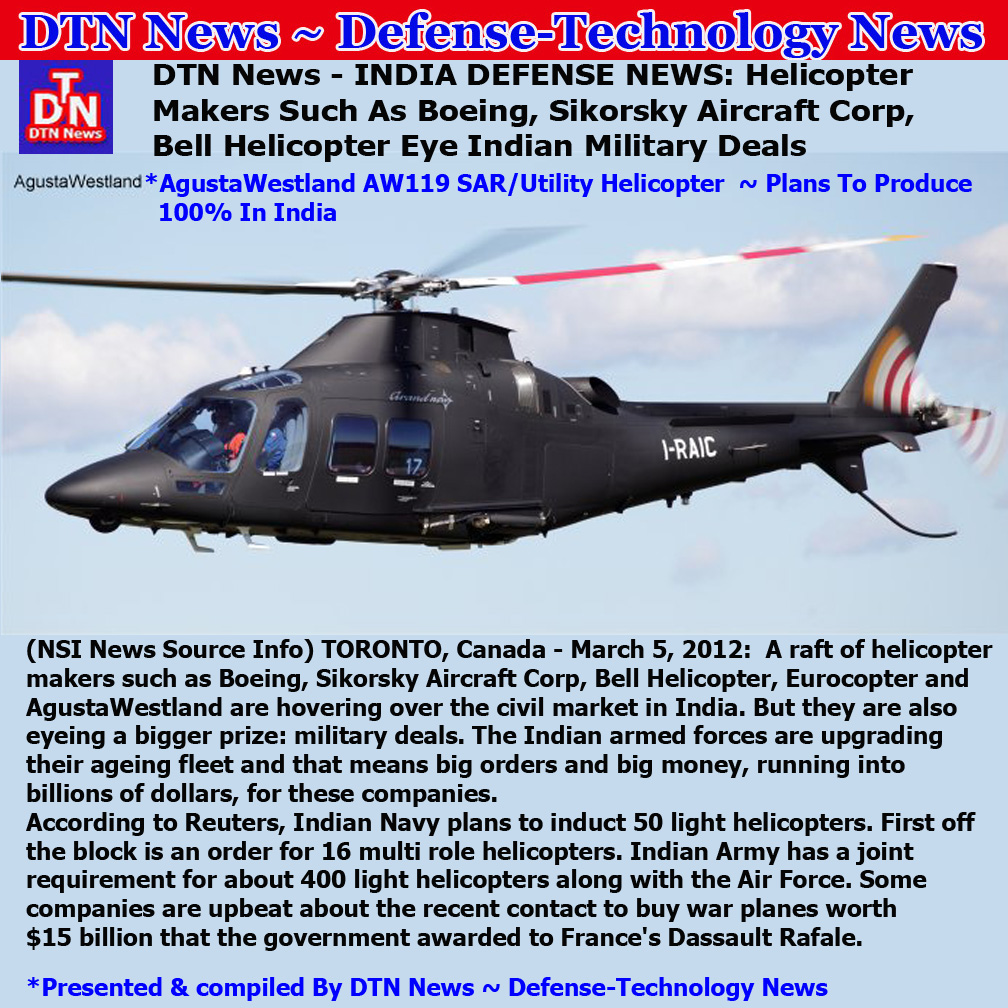
DTN News - INDIA DEFENSE NEWS: Helicopter Makers Such As Boeing, Sikorsky Aircraft Corp, Bell Helicopter Eye Indian Military Deals

DTN News - INDIA DEFENSE NEWS: Helicopter Makers Such As Boeing, Sikorsky Aircraft Corp, Bell Helicopter Eye Indian Military Deals
Source: DTN News - - This article compiled by Roger Smith from reliable sources Economic Times
(NSI News Source Info) TORONTO, Canada - March 5, 2012:  A raft of helicopter makers such as BoeingSikorsky Aircraft CorpBell HelicopterEurocopter andAgustaWestland are hovering over the civil market in India. But they are also eyeing a bigger prize: military deals. The Indian armed forces are upgrading their ageing fleet and that means big orders and big money, running into billions of dollars, for these companies. 

According to Reuters, Indian Navy plans to induct 50 light helicopters. First off the block is an order for 16 multi role helicopters. Indian Army has a joint requirement for about 400 light helicopters along with the Air Force. Some companies are upbeat about the recent contact to buy war planes worth $15 billion that the government awarded to France's Dassault Rafale. 

Mick Maurer, president of Sikorsky Military Systems, says the procurement process in India is getting better. "It is more rigorous and more transparent. We believe that suits us very well." Maurer says in the long term, Sikorsky sees a 3:1 ratio vis-a-vis the military and commercial sales in terms of the size of the market. But he says both are very complementary markets. Many of the machines can be used for commercial and quasi-defence activities. 

If the civil copter market in India has come alive, it is thanks to the armed forces. Foreign companies in the defence market are bound by what is called offset obligations. India's defence procurement policy rules that foreign companies require that win contracts of 300 crore or more must procure equipment worth at least 30% of the deal amount from local suppliers to boost the homegrown arms industry. 

The Indian military has also become smarter, according to foreign company executives. "Sometimes manufacturers give a special price on aircraft, but raise the price on the support side. India has become aware of this and now looks at the total lifecycle costs in deals," says Maurer. 

The upshot is that companies like Sikorsky and Eurocopter have partnered Indian counterparts to set up base in India. Sikorsky has formed two joint ventures with the Tatas to make helicopter cabins and aircraft components. Eurocopter, which formed an Indian unit in 2010, has tieups with the Mahindras, the Tatas and governmentowned Hindustan Aeronautics Limited. AgustaWestland, the helicopter unit of Finmeccanica SpA of Italy, has a joint venture with the Tatas called Indian Rotorcraft. 

All these companies plan to expand in India. Textron, the parent company of Bell Helicopter, has opened a new global technology centre in Bangalore with more than 400 engineers. Bell plans to expand the workforce there over the next year, says the company's India head, BS Singh Deo. An AgustaWestland spokesman says the company recently opened a new larger office in Delhi. Copter makers are also expanding the customer support network by establishing authorised service centres along with a posse of engineers and technicians. 

All this bodes well for the commercial market. The AgustaWestland spokesman says construction work is about to start on the Indian Rotorcraft's facility in Hyderabad , which will produce the company's eight-seat utility helicopter AW119. Sikorsky eventually plans to produce helicopters that are virtually "100% done here" . "We are already a local company," says Maurer.


*DTN India  @DTNIndia ~ Available on Twitter
Comprehensive Daily News on India Today ~ © Copyright (c) DTN News Defense-Technology News

*Link for This article compiled by Roger Smith from reliable sources Economic Times
*Speaking Image - Creation of DTN News ~ Defense Technology News 
*This article is being posted from Toronto, Canada By DTN News ~ Defense-Technology News Contact:dtnnews@ymail.com 
©COPYRIGHT (C) DTN NEWS DEFENSE-TECHNOLOGY NEWS


Monday, June 20, 2011

DTN News - AGUSTAWESTLAND NEWS / PARIS AIR SHOW NEWS: AW159 Makes Its First Paris Air Show Appearance

DTN News - AGUSTAWESTLAND NEWS / PARIS AIR SHOW NEWS: AW159 Makes Its First Paris Air Show Appearance

(NSI News Source Info) TORONTO, Canada - June 20, 2011: AgustaWestland, a Finmeccanica company, is pleased to announce that the first production AW159 helicopter will be making its first appearance at the Paris Air Show. Sixty two AW159s have been ordered by the UK Ministry of Defence for the Army and Royal Navy to fulfil both over land and maritime missions with a common platform. The AW159, whilst building on the pedigree of the current Lynx, is a new 6-tonne multi-role military helicopter featuring a new marinised airframe, all new avionics, new mission sensors and new generation weapon systems. The AW159 programme has achieved several major milestones so far in 2011 and continues on time and on budget ready to deliver the first aircraft to the UK Ministry of Defence at the end of 2011. The first production aircraft performed its maiden flight on 20th April 2011 at AgustaWestland’s Yeovil facility and a further six production aircraft are now undergoing final assembly on a new state-of–art assembly line.
The three trials aircraft which first flew in November 2009, October 2010 and November 2010 have now completed over 250 flying hours of a 600 hour integrated flight test programme. The three aircraft are set to undertake a number of proving trials in the coming months. Later this month aircraft #1 will start hot and high trials in the USA and aircraft #3 will undertake Shipborne Helicopter Operating Limit (SHOL) trials in October 2011. Aircraft #2s flight testing has been focusing on the successful integration of the avionics and mission sensors and recently completed chaff and flare firing trials. AgustaWestland will start to train initial British Army pilots in early 2012 and the aircraft is set to become fully operational with the Army in 2014 and the Royal Navy in 2015. The British Army’s AW159 Lynx Wildcat will perform a wide range of tasks on the battlefield including reconnaissance, command and control, transportation of troops and materiel, and the provision of force protection. The Royal Navy variant will provide an agile maritime capability providing anti-surface warfare capability and force protection and will operate in support of amphibious operations and be an important element in defending ships against surface threats. There will be a high degree of commonality between the Army and Royal Navy helicopters that will mean that an aircraft can switch roles easily, principally through the changing of role equipment.
In March 2011 AgustaWestland signed a contract with the UK Ministry of Defence (MoD) to design and develop an integrated training solution for the AW159 Lynx Wildcat helicopter which includes the building and equipping of a state-of-the-art training centre at RNAS Yeovilton in South West England, alongside Royal Navy and British Army AW159 Lynx Wildcat squadrons. The facility will provide training courses for Army aircrew and maintainers starting in January 2013, with training for Royal Navy aircrew and maintainers starting in January 2014. The Lynx Wildcat Training Centre will be equipped to provide air crew and maintainer training using a wide range of synthetic training technology including two Full Mission Simulators (FMS), Flight Training Device (FTD) and Cockpit Procedures Trainer (CPT). All devices will be capable of delivering Army or Royal Navy conversion and mission training. Each of the Full Mission Simulators has six degrees of freedom to provide the acceleration sensations associated with helicopter flying together with a visual system that complies with JAR-FSTD-H Level D, to give highly realistic and cost effective training. The maintenance training facility will be equipped with a suite of synthetic training devices covering the aircrafts mechanical, avionic and weapon systems. The training centre will also contain a suite of briefing rooms, integrated electronic classrooms and a learning management system will be operational and providing training for the Army from early 2013 and for Royal Navy from early 2014. AgustaWestland is also working with the UK MoD to develop an Integrated Operational Support (IOS) solution to provide cost effective through life support for the entire fleet of 62 aircraft. The AW159 programme for the UK MoD continues to be on time and on budget and was the first major project to be awarded under the Strategic Partnering Arrangement signed by the UK Ministry of Defence and AgustaWestland in June 2006. AgustaWestland has also signed partnering agreements with a number of key suppliers on the AW159 programme including Selex Galileo, a Finmeccanica company; GKN Aerospace, LHTEC – a partnership between Rolls-Royce and Honeywell, General Dynamics UK, Thales UK and GE Aviation.
AgustaWestland Related News;
Located in strategic sites around the globe based on regional demand and requirements, AgustaWestland’s Technical Representatives are now numbering more than 40 and this will be increased to more than 50 by 2012.
SEE MORE
AgustaWestland boasts a strong presence in Malaysia as well as in the region and operators will benefit from ever increasing levels of service quality, whilst also reducing operating costs.
SEE MORE
This order adds to the contract for three offshore-configured AW139s in 2010 and is part of a Framework Agreement for the purchase of a total of five AW139s plus options for additional four.
SEE MORE
The AW149 is the only all new aircraft in its class and is ideally suited to replace thousands of older and ageing helicopters over the next 30 years.
A new generation affordable multi-purpose twin-engine 8-tonne class helicopter designed in response to the growing market demand for higher payload, longer range and higher productivity.
SEE MORE
The company has signed for two EMS-configured GrandNew light twin helicopters and four GrandNew light twin and one AW139 medium twin helicopters for offshore transport.
SEE MORE
As the first AgustaWestland Authorized Service Centre in Russia for the AW139, the appointment of HeliClub marks a significant milestone in AgustaWestland’s strategy to expand its presence in Russia.
SEE MORE
This latest contract brings the total amount of AW139s sold in Russia and the CIS countries to fifteen in just two years.
SEE MORE
This customer adds to the long list of operators who have chosen products from the AgustaWestland's range of light twins for corporate transport duties in Australia.
SEE MORE
The contract marks the entrance of the GrandNew model into the Turkish helicopter market.
SEE MORE
AgustaWestland is committed to exceeding its customer’s expectations and believe the modern, best selling AW139 will be a valued asset for the Egyptian Air Force’s helicopter fleet
*Speaking Image - Creation of DTN News ~ Defense Technology News
*This article is being posted from Toronto, Canada By DTN News ~ Defense-Technology News

©

COPYRIGHT (C) DTN NEWS DEFENSE-TECHNOLOGY NEWS