Showing posts with label Nuclear Power Submarines. Show all posts

Friday, July 19, 2013

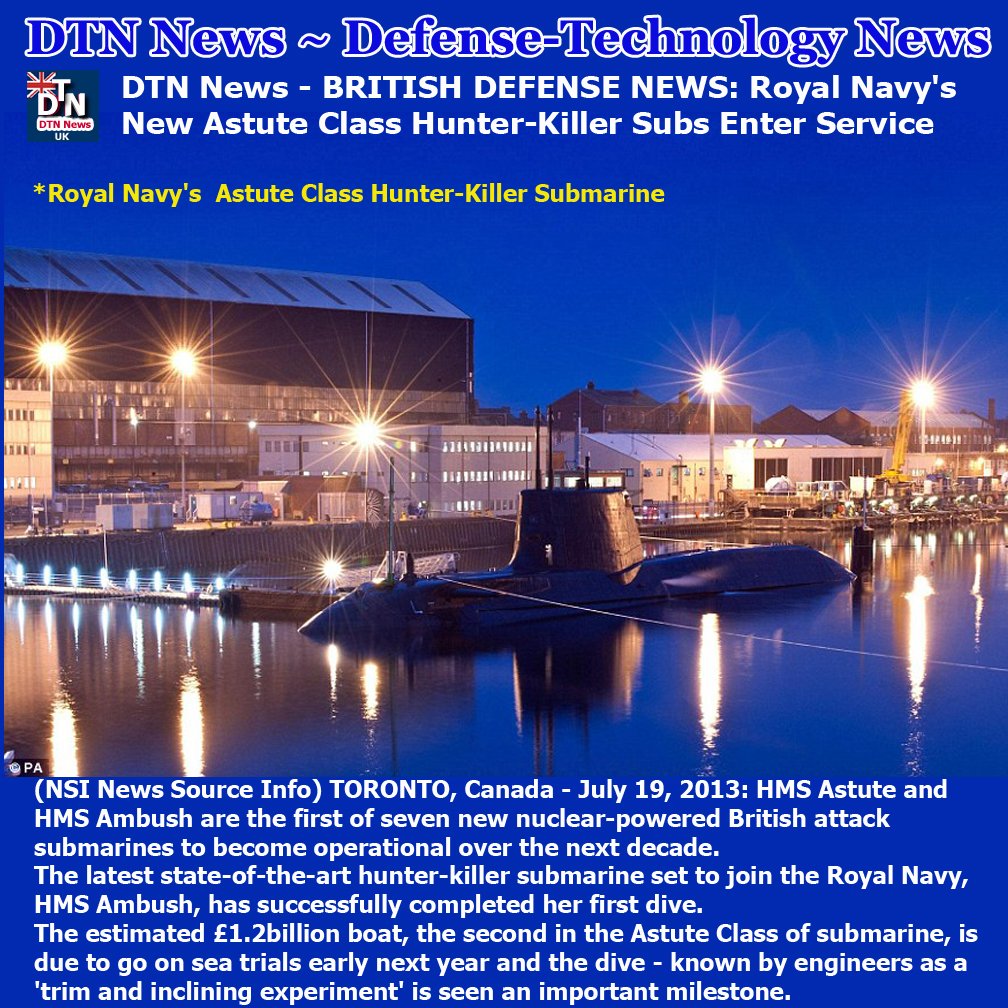
DTN News - BRITISH DEFENSE NEWS: Royal Navy's New Astute Class Hunter-Killer Subs Enter Service

DTN News - BRITISH DEFENSE NEWS: Royal Navy's New Astute Class Hunter-Killer Subs Enter Service
*The Navy’s two most advanced hunter-killer submarines ever have entered service after years of delays.
Source: DTN News - - This article compiled by Roger Smith from reliable sources By Ben Farmer, Defence Correspondent 5:39PM BST 19 Jul 2013
(NSI News Source Info) TORONTO, Canada - July 19, 2013: HMS Astute and HMS Ambush are the first of seven new nuclear-powered British attack submarines to become operational over the next decade.

The Astute class submarines have cost more than £1 billion each and are among the most advanced in the world. They can circumvent the globe without surfacing, carrying a payload of dozens of cruise missiles and torpedoes.

Their sonar is so sensitive that one lurking in the Solent would be able to detect a ship leaving New York harbour 3,500 miles across the Atlantic. Advanced acoustic tiles mean they are virtually silent. They can also stay underwater indefinitely, only needing to surface if the 100-strong crew has run out of food.

The new boats are replacing the Navy's Trafalgar class submarines and the programme has been bedevilled by delays, faults and runaway costs since it began in the mid-1990s.
Naval commanders also faced embarrassment in 2010 when HMS Astute ran aground on rocks off Scotland during sea trials.

Rear Admiral Simon Lister, director of submarines at the Ministry of Defence, said the seven Astute class vessels would be the “backbone of the submarine fleet”.

He said: “They do the power projection, intelligence gathering, patrolling and have that deterrent effect.”

Three more of the 106-yard-long and 7,400 tonne submarines are currently in various stages of production in the vast BAE Systems assembly hall in Barrow-in-Furness and this week the keel was laid for Agamemnon, the sixth submarine. Barrow-in-Furness in Cumbria has built 311 Royal Navy submarines since 1901.

Stuart Godden, engineering director, said the programme to build the submarines was Britain’s most complex engineering project and as difficult as a space programme.
He said: “I think it’s at least as complex as the NASA space programme.”

The submarines have no periscope, but are equipped with an array of powerful sensors which can allow them to carry out spying and eavesdropping missions. Each submarine’s electronics means it has more than 60 miles of cabling.

The Astute class is also the first where every submariner gets their own bed, rather than having to “hot bed” and sleep in shifts.

Engineers say the boats can stay underwater indefinitely, with the only limits to dives being the amount of food they carry and the morale and endurance of the crew.

Most patrols from their base in Faslane, Scotland, will be three months long.

Ricki Rotimi, leading chef on HMS Artful which is nearing completion, said his team would cook four meals a day for the entire crew.

He said: “The rubbish thing is when we start running out of fresh vegetables and fruit, but you just have to get on with it.”

The submarines became operational in the week a Liberal Democrat review of Trident concluded that Britain can maintain a credible nuclear deterrent without a like-for-like replacement of its Trident submarine fleet.

The review, led by Treasury Chief Secretary Danny Alexander, said there are alternatives to the UK's current stance of round the clock patrols by nuclear armed submarines.

Philip Hammond, defence secretary, was scathing about the alternatives, saying they would create a “part time deterrent” and save as little as £50 million a year.

HMS Astute and HMS Ambush are the first submarines in Class accepted by Navy Command, which is responsible for operating all of the Royal Navy’s vessels.

The next three submarines in the Class: Artful, Audacious and Anson are all at varying stages of build and today’s keel laying for Agamemnon marks the next key milestone for the programme.

BAE Systems Maritime Submarines (BAES (MS)) is responsible for delivering all seven Astute Class submarines and for the design of the successor to the Vanguard class, which will carry the UK’s nuclear deterrent.

The MoD has agreed a new contract with BAES (MS) that will not only help to sustain the thousands of highly skilled defence jobs based at Barrow-in-Furness but drive down the costs of building future submarines.

Minister for Defence Equipment, Support and Technology Philip Dunne today signed a new contract will deliver £380M of savings over the next eight years.

This will ensure that the Royal Navy’s submarine capability is delivered efficiently and provides good value for money for the taxpayer.

Minister Dunne, said:

“The keel laying of the sixth submarine, Agamemnon, and the handover of HMS Astute and HMS Ambush to the Royal Navy are huge milestones reflecting significant progress in the programme.

“By ensuring the UK’s submarine programme remains affordable, this new contract will help deliver the Astute Class and pave the way for the future Successor nuclear deterrent submarines and secure around 5,000 jobs at BAE Systems and thousands more who work in over 400 suppliers across the UK submarine supply chain.”

Rear Admiral Simon Lister, the MoD’s Director of Submarines, said:

“This is the sixth submarine in the Astute Class and we expect her to be built more quickly and efficiently than her predecessors, demonstrating the effectiveness of the national submarine building capability in Barrow-in-Furness.


“New techniques by skilled staff in the back office and on the shop floor will deliver this key capability for the Royal Navy."

Related News;
  • 16 Nov 2012
  • 22 Oct 2010
  • 27 Nov 2010
  • HMS Astute groun
    d after catalogue of errors, finds report

    23 Apr 2012

  • *Link for This article compiled by Roger Smith from reliable sources By Ben Farmer, Defence Correspondent 5:39PM BST 19 Jul 2013
    *Speaking Image - Creation of DTN News ~ Defense Technology News 
    *Photograph: IPF (International Pool of Friends) + DTN News / otherwise source stated
    *This article is being posted from Toronto, Canada By DTN News ~ Defense-Technology News Contact:dtnnews@ymail.com 
    ©COPYRIGHT (C) DTN NEWS DEFENSE-TECHNOLOGY NEWS

    Tuesday, August 31, 2010

    DTN News: UK's Most Powerful Submarine Joins The Navy

    DTN News: UK's Most Powerful Submarine Joins The Navy
    Source: DTN News / British Ministry of Defence (MoD) Dt. 27 Aug 10
    (NSI News Source Info) LONDON, U.K. - August 31, 2010: The UK's most powerful attack submarine, HMS Astute, has been welcomed into the Royal Navy today in a commissioning ceremony overseen by the boat's patron, the Duchess of Cornwall.The commissioning pennant is raised on HMS Astute [Picture: LA(Phot) A J MacLeod, Crown Copyright/MOD 2010] HMS Astute, which officially becomes 'Her Majesty's Ship' today, is quieter than any of her predecessors, meaning she has the ability to operate covertly and remain undetected in almost all circumstances despite being fifty per cent bigger than any attack submarine in the Royal Navy's current fleet. The latest nuclear-powered technology means she will never need to be refuelled and can circumnavigate the world submerged, manufacturing the crew's oxygen from seawater as she goes. The submarine has the capacity to carry a mix of up to 38 Spearfish heavyweight torpedoes and Tomahawk land-attack cruise missiles, and can target enemy submarines, surface ships and land targets with pinpoint accuracy, while her world-beating sonar system has a range of 3,000 nautical miles (5,500km). The First Sea Lord, Admiral Sir Mark Stanhope, said: "The Astute Class is truly next generation - a highly versatile platform, she is capable of contributing across a broad spectrum of maritime operations around the globe, and will play an important role in delivering the fighting power of the Royal Navy for decades to come.Astute arriving at her home base on the Clyde in November 2009[Picture: LA(Phot) J J Massey, Crown Copyright/MOD 2009] "A highly complex feat of naval engineering, she is at the very cutting-edge of technology, with a suite of sensors and weapons required to pack a powerful punch. "Today is an important milestone along the road to full operational capability which will follow after a further series of demanding seagoing trials testing the full range of the submarine's capabilities." Following the successful completion of her first rigorous set of sea trials, which began at the end of 2009, HMS Astute has also now achieved her in-service date, signalling that she has proven her ability to dive, surface and operate across the full range of depth and speed independently of other assets, thereby providing an initial level of capability. Rear Admiral Simon Lister, Director of Submarines, who oversees the build programme of the class for the MOD, said: "To my mind Astute is a 7,000-tonne Swiss watch. There is an extraordinary amount of expertise that goes into putting one of these submarines together. There are stages when it's like blacksmithing and there are stages when it's like brain surgery. "So to see Astute commissioned is momentous not only for the Royal Navy, who have been eagerly anticipating this quantum leap forward in capability, but for the thousands of people around the country who have been involved in the most challenging of engineering projects." Her Royal Highness The Duchess of Cornwall is escorted by Commander Andy Coles, the Commanding Officer of HMS Astute, at the commissioning ceremony for HMS Astute [Picture: LA(Phot) Stuart Hill, Crown Copyright/MOD 2010] Following the commissioning, HMS Astute will return to sea for further trials before she is declared as operational. As the base port of all the Royal Navy's submarines from 2016, Faslane will be home to the whole Astute Class, including Ambush, Artful and Audacious which are already under construction. Astute was built by BAE Systems at Barrow-in-Furness, with hundreds of suppliers around the country contributing component parts, including Rolls-Royce, Derby (nuclear plant); Thales UK, Bristol (visual system and Sonar 2076); and Babcock, Strachan & Henshaw, Bristol (weapon handling and discharge system). Astute is affiliated to the Wirral in the North West. About HMS Astute -She is 97 metres from bow to stern. -She has a beam of 11.2 metres. -She displaces 7,400 tonnes of seawater. -Her cabling and pipework would stretch from Glasgow to Dundee. -She is the first Royal Navy submarine not to have a traditional periscope, instead using electro-optics to capture a 360-degree image of the surface for subsequent analysis by the commanding officer. -Astute is the first submarine to have an individual bunk for each crew member. -She manufactures her own oxygen from seawater as well as her own drinking water. -She could theoretically remain submerged for her 25-year life, if it were not for the need to restock the crew's food supplies. -She is faster under the water than she is on the surface - capable of speeds in excess of 20 knots (37km/h), although her top speed is classified. -Astute's crew of 98 are fed by five chefs who, on an average patrol, will serve up 18,000 sausages and 4,200 weetabix for breakfast
    *This article is being posted from Toronto, Canada By DTN News ~ Defense-Technology News, contact: dtnnews@ymail

    Wednesday, April 14, 2010

    DTN News: Russia Delays Launch Of New Nuclear Submarine

    DTN News: Russia Delays Launch Of New Nuclear Submarine Source: DTN News / RIA Novosti
    (NSI News Source Info) MOSCOW, Russia - April 14, 2010: Russia will not float out a new nuclear-powered multipurpose attack submarine as planned on May 7 due to technical reasons, a source in the shipbuilding industry said on Tuesday. Construction of the Severodvinsk, the first Project 885 Yasen (Graney) class submarine, began in 1993 at the Sevmash shipyard in the northern Russian city of Severodvinsk but has since been dogged by financial setbacks. Russia planned to float out the submarine on May 7 to mark the 65th anniversary of the victory over Nazi Germany in May 1945. "The launch of the new Severodvinsk submarine has been delayed for technical reasons," the source said, adding that the sub would be floated out and pass sea trials later this year. Graney class nuclear submarines are designed to launch a variety of long-range cruise missiles (up to 3,100 miles or 5,000 km) with nuclear warheads, and effectively engage submarines, surface warships and land-based targets. The submarine's armament includes 24 cruise missiles, including the 3M51 Alfa SLCM, the SS-NX-26 Oniks SLCM or the SS-N-21 Granat/Sampson SLCM. It is also equipped with eight torpedo launchers, as well as mines and anti-ship missiles such as SS-N-16 Stallion.
    The Severodvinsk is expected to enter service with the Russian Navy by late 2010 - early 2011. Last year, work started on the second sub in the series, the Kazan, which will feature more advanced equipment and weaponry. Russia's Navy commander, Adm. Vladimir Vysotsky, has called the construction of new-generation nuclear-powered ballistic missile and attack submarines a top priority for the Russian Navy. Related News Russia to float out new nuclear sub on May 7 No radiation danger as scrapped nuclear sub catches fire in north Russia New Russian nuclear submarine to enter service in 2010 Russian Navy takes delivery of a new submarine for lease to India

    Monday, March 15, 2010

    DTN News: Russia To Float Out New Nuclear Submarine On May 7

    DTN News: Russia To Float Out New Nuclear Submarine On May 7 Source: DTN News / Ria Novosti (NSI News Source Info) MOSCOW, Russia - March 16, 2010:A new Russian nuclear-powered multipurpose attack submarine will be floated out on May 7, a shipyard spokesman said on Monday. Construction of the Severodvinsk, a Project 885 Yasen (Graney) class submarine, began in 1993 at the Sevmash shipyard in the northern Russian city of Severodvinsk but has since been dogged by financial setbacks. "A floating out ceremony for Russia's new Severodvinsk nuclear submarine at the Sevmash shipyard has been scheduled for May 7," the official said. Graney-class nuclear submarines combine the ability to launch a variety of long-range cruise missiles (up to 3,100 miles or 5,000 km) with nuclear warheads, and effectively engage submarines, surface warships and land-based targets. The submarine's armament includes 24 cruise missiles, including the 3M51 Alfa SLCM, the SS-NX-26 Oniks SLCM or the SS-N-21 Granat/Sampson SLCM. It will also have eight torpedo launchers, as well as mines and anti-ship missiles such as SS-N-16 Stallion. Severodvisk is expected to enter service with the Russian Navy by late 2010. Last year, work started on the second sub in the series, the Kazan, which will feature more advanced equipment and weaponry. Russia's Navy commander, Adm. Vladimir Vysotsky, has said that the construction of new-generation nuclear-powered ballistic missile and attack submarines was a top priority for the Russian Navy.

    Wednesday, December 02, 2009

    DTN News: Northrop Grumman-Built Submarine New Mexico (SSN 779) Returns From Successful Sea Trials

    DTN News: Northrop Grumman-Built Submarine New Mexico (SSN 779) Returns From Successful Sea Trials *Source: DTN News / Northrop Grumman (NSI News Source Info) NEWPORT NEWS, Va., - December 3, 2009: New Mexico (SSN 779), the nation's newest and most advanced nuclear-powered submarine, returned to Northrop Grumman Corporation's (NYSE:NOC) Shipbuilding sector in Newport News, Va. after completing the ship's first round of successful sea trials on Nov. 26. New Mexico (SSN 779), the nation's newest and most advanced nuclear-powered submarine, returned to Northrop Grumman Shipbuilding sector in Newport News, Va. after completing the ship's first round of successful sea trials on Nov. 26. Sea trials provide an opportunity to test all systems, components and compartments and include submerging for the first time, high-speed runs while on the surface and submerged, and a demonstration of the submarine's other capabilities. "The first sea trial is a milestone that the entire shipbuilding and Navy team has been working hard to achieve," said Becky Stewart, vice president for Northrop Grumman Shipbuilding's submarine program. "This accomplishment is a testament to the craftsmanship, dedication, persistence, and pride that our people take in the product they build -- a very complex and high quality submarine." New Mexico is the sixth ship of the Virginia class and is in the final stages of construction and testing at the company's Newport News shipyard. Delivery to the Navy is scheduled by the end of this year. The keel for New Mexico was authenticated April 12, 2008. The ship was christened on Dec. 13, 2008. New Mexico is named for "The Land of Enchantment." Upon delivery to the Navy this year, it will be the most modern and sophisticated attack submarine in the world, providing undersea supremacy well into the 21st century. Northrop Grumman Newport News is teamed with General Dynamics Electric Boat to build the first 18 ships of the Virginia class. Current plans call for 30 Virginia-class submarines in the fleet. Using millions of parts from over 4,000 suppliers in 47 states and the District of Columbia, Virginia-class submarines incorporate dozens of new technologies and innovations and are the first major combatants designed with the post-Cold War security environment in mind. Northrop Grumman Corporation is a leading global security company whose 120,000 employees provide innovative systems, products, and solutions in aerospace, electronics, information systems, shipbuilding and technical services to government and commercial customers worldwide.

    Sunday, November 29, 2009

    DTN News: Astute Nuclear Powered Attack Submarine Leaves For Sea Trials

    DTN News: Astute Nuclear Powered Attack Submarine Leaves For Sea Trials *Source: DTN News / BAE Systems (NSI News Source Info) Barrow-in-Furness, UK - November 29, 2009: The first of class Astute nuclear powered attack submarine left BAE Systems’ shipyard at Barrow-in-Furness for the first stage of sea trials designed to prove its capability as the most formidable vessel of its kind ever operated by the Royal Navy. BAE Systems is building three Astute Class nuclear-powered attack submarines for the UK Royal Navy. Astute is now on her way to Her Majesty’s Naval Base Clyde at Faslane where she will be based for her operational life. BAE Systems Submarine Solutions Managing Director John Hudson said: “The first of class Astute submarine successfully departed Barrow for sea trials on Sunday 15 November.“After leaving Ramsden Dock early Sunday morning, Astute began the journey to HMNB Clyde at Faslane. “I would like to take this opportunity to personally thank every single person in the business who have played their part in helping deliver the boat, in particular the Dockside Test Organisation and Astute team who have been an absolute strength over the past few months.”During the transit from Barrow to Scotland, Astute is scheduled to start a period of sea trials that will continue for many months. For much of that time the Royal Navy crew will be accompanied on board by BAE Systems engineers and technicians who will work alongside them to monitor and measure every element of the submarine’s performance against the design parameters.BAE Systems will also have personnel based at Faslane to deliver the initial in-service support for the submarine.Astute is the most advanced attack submarine ever supplied to the Royal Navy, incorporating the latest stealth technology combined with a world class sonar system and equipped with Spearfish torpedoes and state of the art Tomahawk land attack missiles to make her a supremely effective naval asset.Astute is designed to fulfil a range of key strategic and tactical roles including anti-ship and anti-submarine operations, surveillance and intelligence gathering and support for land forces. Displacing 7,400 tonnes and measuring 97 metres from bow to propulsor, Astute is significantly larger than the Swiftsure and Trafalgar class submarines that she will replace but requires fewer crew to operate her due to the advanced technology and automated systems on board.That technology encompasses many innovations designed to improve operational effectiveness while also reducing costs to help achieve the affordability challenges facing the Ministry of Defence. The 2076 Sonar system is the most effective in the world, giving Astute a key tactical advantage in locating and identifying other vessels, while the stealth characteristics of the submarine design make it the quietest the Navy has ever operated, enabling it to avoid detection and fulfil its role within the ‘Silent Service’, as submarines are known.Unlimited power is provided by the pressurised water nuclear reactor that is capable of powering a city the size of Southampton, and the Astute is capable of remaining submerged and circumnavigating the globe during a 90-day patrol, creating her own air and fresh water from the ocean. Astute is equipped with a digital optical mast system to replace the traditional periscope and this offers low light and infra-red capabilities to enable her to rapidly capture and analyse visual data, and share it with other fleet assets.Luxury is not a word that normally appears in the submarine vocabulary – Astute is all about operational capability – but her crew will be the first to each have their own bunk, removing the need for ‘hot bunking’ when during shifts one crewman would occupy a bunk vacated by another. Astute also has a comparatively large and extremely well-equipped galley to ensure the meals that punctuate the round the clock watch system are of the highest standard. About BAE Systems BAE Systems is the premier global defence, security and aerospace company delivering a full range of products and services for air, land and naval forces, as well as advanced electronics, security, information technology solutions and customer support services. With approximately 105,000 employees worldwide, BAE Systems' sales exceeded £18.5 billion (US $34.4 billion) in 2008. BAE Systems Related News....for full stories click on the links below ~ BAE Systems to showcase defence and aerospace products at LIMA 2009 27 Nov ~ Technology to combat piracy in the high seas 27 Nov ~ BAE Systems Hawk AJT creates a buzz at RAF Valley 27 Nov ~ Further BAE Systems Bae 146 success in Indonesia 27 Nov ~ BAE Systems Strengthens Its Global Maritime Business 27 Nov

    Thursday, October 29, 2009

    DTN News: Dmitry Donskoy Submarine Prepares For Future Bulava Missile Tests

    DTN News: Dmitry Donskoy Submarine Prepares For Future Bulava Missile Tests *Source: DTN News / RIA Novosti (NSI News Source Info) MOSCOW, Russia - October 29, 2009: Russia's Dmitry Donskoy strategic nuclear-powered submarine returned on Wednesday from a short sea test run to prepare for upcoming test launches of the troubled Bulava missile. "The sub left the base in Severodvinsk on Monday to test the readiness of the equipment for future launches of the Bulava missile," a Severodvinsk administration official said, without specifying the date for the next test of the missile. The Typhoon-class submarine, based at a naval facility in northern Russia's Severodvinsk, is the only vessel in service with the Russian Navy capable of testing the new Bulava submarine-launched ballistic missile (SLBM). The Russian military expects the Bulava, along with Topol-M land-based ballistic missiles, to become the core of Russia's nuclear triad. However, the Bulava's development has been dogged by a series of setbacks, which has officially suffered six failures in 11 tests. The latest Bulava failure during the launch from Dmitry Donskoy in the North Sea on July 15 was caused by a defective steering system in its first stage, a defense industry source said on Monday. The future development of the Bulava has been questioned by some lawmakers and defense industry officials, who have suggested that all efforts should be focused on the existing Sineva SLBM. But the Russian military has insisted that there is no alternative to the Bulava and pledged to continue testing the missile until it is ready to be put in service with the Navy. The Bulava (SS-NX-30) SLBM carries up to 10 MIRV warheads and has a range of over 8,000 kilometers (5,000 miles). The three-stage solid-propellant ballistic missile is designed for deployment on Borey-class nuclear-powered submarines.

    Saturday, September 12, 2009

    DTN News: Royal Navy's Most Advanced Attack Sub Prepares For Sea Trials

    DTN News: Royal Navy's Most Advanced Attack Sub Prepares For Sea Trials *Source: DTN News / BAE Systems (NSI News Source Info) Barrow-in-Furness, UK - September 12, 2009: The largest, most powerful and stealthiest nuclear attack submarine ever built for the Royal Navy is preparing to leave the BAE Systems shipyard in Barrow-in-Furness for sea trials. BAE Systems is building three Astute Class nuclear-powered attack submarines for the UK Royal Navy. BAE Systems is responsible for the design, build and initial in-service support for the Astute submarine class currently under construction at the company's shipyard in Barrow-in-Furness. The first of class HMS Astute is undergoing final test and commissioning work before leaving for extensive sea trials prior to entering service with the Royal Navy. A further three Astute class vessels, Ambush, Artful and Audacious are currently under construction with long lead orders placed for equipment for a fifth submarine. The keel for Audacious was laid at the shipyard earlier this year. Design and construction of the Astute class involves over 7,000 design drawings and more than 1 million components. The construction method for a nuclear submarine means that the first of class presents the challenges of both a prototype and a first production model, with many of the design elements proved and refined during the construction cycle, takes from concept design to a finished nuclear powered submarine. Powered by a nuclear reactor more complex than those found in power stations, Astute is designed to operate over 25 years without refuelling, patrolling for up to 90 days submerged and undetected. Safety is a primary consideration as the boat's 98 crew live and work in close proximity to the reactor while operating in the harshest environment on the planet, the deep ocean. Astute is capable of undertaking a variety of mission roles including anti-ship and anti submarine action, intelligence gathering and support for land forces. She is armed with heavyweight Spearfish torpedoes and Tomahawk Land Attack Missiles capable of delivering pinpoint strikes up to 1000 kilometres from the coast. Astute is also equipped with the latest stealth technology to avoid detection and the advanced Sonar 2076 system to locate and identify other vessels.

    Monday, August 03, 2009

    DTN News: Russia ~ Yury Dolgoruky Submarine To Undergo 5-6 Tests Before Commissioning

    DTN News: Russia ~ Yury Dolgoruky Submarine To Undergo 5-6 Tests Before Commissioning *Source: DTN News / RIA Novosti (NSI News Source Info) MOSCOW, Russia - August 3, 2009: Russia's newest Borey class strategic nuclear submarine, the Yury Dolgoruky, will undergo up to six more sea trials before being commissioned with the Russian Navy, the Sevmash plant said on Monday. The submarine, which is expected to be armed with the new Bulava sea-launched ballistic missiles (SLBM), successfully completed its first round of sea trials in the White Sea on July 10. "According to our estimates, the submarine still needs at least five or six sea trials before commissioning," said Anastasia Nikitinskaya, a spokesperson for Sevmash plant. The vessel is 170 meters (580 feet) long, has a hull diameter of 13 meters (42 feet), a crew of 107, including 55 officers, a maximum depth of 450 meters (about 1,500 feet) and a submerged speed of about 29 knots. It can carry up to 16 ballistic missiles and torpedoes. The construction cost of the submarine totaled 23 billion rubles (about $713 mln), including 9 billion rubles ($280 mln) for research and development. Two other Borey class nuclear submarines, the Alexander Nevsky and the Vladimir Monomakh, are currently under construction at the Sevmash plant and are expected to be completed in 2009 and 2011. Russia is planning to build eight of these submarines by 2015. According to Navy officials, fourth-generation Borey class nuclear-powered submarines will form the core of Russia's fleet of modern strategic submarines, and will be deployed with Russia's Northern and Pacific fleets. However, the commissioning of the submarine could be delayed by setbacks in the development of the troubled Bulava missile, which has suffered six failures in 11 tests. The future development of the Bulava has been questioned by some lawmakers and defense industry officials, who have suggested that all efforts should be focused on the existing Sineva SLBM. But the Russian military has insisted that there is no alternative to the Bulava and pledged to continue testing the missile until it is ready to be put in service with the Navy.

    Sunday, July 26, 2009

    DTN News: India Launches First Nuclear-Powered Submarine

    DTN News: India Launches First Nuclear-Powered Submarine
    *Source: DTN News / Int'l Media (NSI News Source Info) NEW DELHI, India - July 26, 2009: India launched its first nuclear-powered submarine on Sunday, officials said, underlining the military advances made by the rapidly developing nation. Prime Minister Manmohan Singh called it a "historic milestone in the country's defence preparedness" as the 6,000-tonne INS Arihant (Destroyer of Enemies) was named in the southern city of Visakhapatnam. The submarine, the first of five planned, is powered by an 85-megawatt nuclear reactor and can reach 44 kilometres an hour (24 knots) underwater, according to defence officials. It will be armed with torpedoes and ballistic missiles, and carry a crew of 95 men. "We don't have any aggressive designs nor do we seek to threaten anyone," the Press Trust of India quoted Singh as saying at the launch. "We seek an external environment in our region and beyond that is conducive to our peaceful development and protection of our value systems." India is now part of an exclusive group of nations -- including China, France, the United States, Britain and Russia -- which own nuclear-powered submarines. The vessel will undergo two years of sea trials in the Bay of Bengal before being commissioned for full service, according to PTI. India previously leased a Russian-built nuclear submarine, and in 2005 signed contracts worth 2.4 billion euros (three billion dollars) to receive six diesel-electric Franco-Spanish Scorpene submarines. The launch came as India marked the tenth anniversary of the brief but bloody Kargil conflict with arch-rival Pakistan in the disputed Kashmir region. More than 1,100 people, mostly Indian and Pakistani soldiers, died in the high-altitude offensive in the spring and summer of 1999 when Pakistan-based infiltrators crossed the icy frontier that separates the two countries. At a service earlier in New Delhi, Singh paid tribute to the Indian troops who died during the conflict. "They sacrificed their lives in defence of Indian unity and integrity," he said. A year before Kargil, India conducted nuclear weapons tests and Pakistan responded with its own tests a few days later.
    The nuclear submarine is 110 meters in length and 11 meters in width, and has a surface displacement of 6000 tonnes. Navy sources said that work is in progress for building a second nuclear submarine. With Sunday’s launch, India enters the exclusive club of five countries comprising US, Russia, France and China, which have capabilities to develop nuclear submarines that operate nuclear submarine with the launch of the top-secret Advanced Technology Vessel (ATV), called silent killers for its ability to remain under water for a long period due to its nuclear-powered engines. The INS Arihant (destroyer of enemies) is a copy of Russian Charlie class nuclear submarine leased in 1980s. The trials of submarine here will prove its nuclear power plant and auxiliary systems before it goes to the Bay of Bengal for sea trials and weapon trials. The INS Arihant will begin its underwater journey from Shipbuilding Centre here. Once submerged, it will undergo two years of extensive trials, first in harbour and then at sea, before formally joining the navy. INS Arihant is a ballistic missile submarine armed with twelve K-15 missiles, each capable of carrying a 500-kg nuclear warhead to a target 750-km away. At present submarines used by the Indian Navy are the diesel electric versions that have to come up to recharge their batteries, increasing their chances of being spotted. For a brief period of three years from 1988-91 India used a nuclear submarine leased by Russia. Since then it has been trying to build one of its own. India will also get couple of nuclear-powered Russian Akula class submarines this year. The INS Chakra, an Akula-2 class nuclear powered attack submarine, is already undergoing sea trials in the Pacific Ocean before coming to India for induction.

    Sunday, July 12, 2009

    DTN News: Russia's New Nuclear Submarine Completes First Round Of Sea Trials

    DTN News: Russia's New Nuclear Submarine Completes First Round Of Sea Trials
    *Source: DTN News / RIA Novosti
    (NSI News Source Info) MOSCOW - July 12, 2009: Russia's newest Borey class strategic nuclear submarine, the Yury Dolgoruky, has completed the first round of sea trials and is returning to a shipyard in northern Russia, the Sevmash plant said on Friday. The construction of the submarine started 13 years ago, but today Yury Dolgoruky could finally sail out from Sevmash shipyard in Severodvinsk. The submarine is of the Borey-class, supposed to be armed with the new Bulava intercontinental missiles (ICBMs), but they are not yet ready, so the submarine is without armament. Yury Dolgoruky will be out in the White Sea for approximately 20 days. After that the first sea trials with diving will start. Before sailing from Severodvinsk on Friday afternoon, the vessel had its final inspection done by the Russian navy’s top commander, Admiral Vladimir Vysotsky, reports Vesti.ru. Both reactors onboard are reported to work normally. The total costs for the submarine is 23 billion roubles, or some USD 760 millions. Sea trials of the submarine, which is expected to be armed with new Bulava sea-based ballistic missiles, started on June 24 in the White Sea. "A team of workers and submariners has successfully completed the set tasks," Sevmash general director Nikolai Kalistratov said. He added that the Yury Dolgoruky would still have to pass a number of sea trials later this year to test equipment and performance levels. The vessel is 170 meters (580 feet) long, has a hull diameter of 13 meters (42 feet), a crew of 107, including 55 officers, a maximum depth of 450 meters (about 1,500 feet) and a submerged speed of about 29 knots. It can carry up to 16 ballistic missiles and torpedoes. The construction cost of the submarine totaled 23 billion rubles (about $713 mln), including 9 billion rubles ($280 mln) for research and development. Two other Borey class nuclear submarines, the Alexander Nevsky and the Vladimir Monomakh, are currently under construction at the Sevmash plant and are expected to be completed in 2009 and 2011. Russia is planning to build eight of these submarines by 2015. According to Navy officials, fourth-generation Borey class nuclear-powered submarines will form the core of Russia's fleet of modern strategic submarines, and will be deployed with Russia's Northern and Pacific fleets.

    Tuesday, June 23, 2009

    DTN News: Russia To Lease A Nuclear Submarine To India - Report

    DTN News: Russia To Lease A Nuclear Submarine To India - Report
    *Sources: DTN News / Defense Media
    (NSI News Source Info) MOSCOW- June 23, 2009: A Russian government official dismissed on Monday media rumors that Russia planned to lease several nuclear submarines to India, saying a contract envisioned only the transfer of the Nerpa vessel. India is reportedly paying two billion dollars for the completion of two Akula-II class submarines which were 40-60% completed. Three hundred Indian Navy personnel are being trained in Russia for the operation of these submarines. India has finalized a deal with Russia, in which at the end of the lease of these submarines, it has an option to buy them.The first submarine will be named INS Chakra. Whereas the Russian Navy's Akula-II submarine is equipped with 28 nuclear-capable cruise missiles with a striking range of 3,000 kilometers, the Indian version was reportedly expected to be armed with the 300 km range 3M-54 Klub nuclear-capable missiles. Missiles with ranges greater than 300 kilometers cannot be exported due to arms control restrictions, since Russia is a signatory to the MTCR treaty. "We will lease only one submarine. In my opinion, India needs the sub more for enhancing its prestige rather than for accomplishing specific goals," Vyacheslav Dzirkaln, deputy head of the Federal Service for Military-Technical Cooperation, said in an exclusive interview with RIA Novosti. India reportedly paid $650 million for a 10-year lease of the 12,000-ton K-152 Nerpa, an Akula II class nuclear-powered attack submarine. Indian media have reported that the construction of the vessel was partially financed by the government. On November 8, 2008, while the Nerpa was undergoing sea trials in the Sea of Japan, its on-board fire suppression system went off, releasing a deadly gas into the sleeping quarters. Three submariners and 17 shipyard workers were killed. There were 208 people, 81 of them submariners, on board the vessel at the time. According to Russian navy officials, the trials will resume in early July and the submarine will be delivered to India by the end of 2009. Akula II class vessels are considered the quietest and deadliest of all Russian nuclear-powered attack submarines.

    Tuesday, June 02, 2009

    DTN News: Russian Navy To Commission Nerpa Submarine In Fall - Report

    DTN News: Russian Navy To Commission Nerpa Submarine In Fall - Report
    (NSI News Source Info) MOSCOW - June 2, 2009: A nuclear attack submarine involved in a fatal accident during sea trials last year will be commissioned by the Russian Navy in the fall and then leased to the Indian Navy, a source said on Tuesday. The K-152 Nerpa is a 8,140-tonne (8,010-long-ton) Project 971 Shchuka-B (NATO: Akula II) type nuclear-powered attack submarine. Construction was started in 1993, but suspended due to lack of funding. K-152 Nerpa was launched in October 2008 and was planned to be leased to the Indian Navy in 2009 as the recommissioned INS Chakra. While K-152 Nerpa was undergoing sea trials in the Sea of Japan on 8 November 2008, an accident caused the deaths of some twenty sailors and injury to twenty-one others. A fire suppression system discharged gas in the bow of the sub, suffocating civilian specialists and navy crew members. The Nerpa nuclear-powered submarine was undergoing sea trials in the Sea of Japan on November 8 last year when its on-board fire safety system went off, releasing deadly gas into the sleeping quarters. Three submariners and 17 shipyard workers were killed. There were 208 people, 81 of them submariners, on board the vessel at the time. "Following new official state sea trials in the summer, the sub will be put in service with the Navy in the fall of this year," the Russian naval source said. He added that the Nerpa would be leased to the Indian Navy shortly after the commissioning, and said India had paid over $500 million for a 10-year lease of the 12,000-ton nuclear attack submarine. Indian media have reported that the construction of the vessel was partially financed by the country's government. The construction of the Akula II class Nerpa nuclear attack submarine started in 1991, but was suspended for over a decade due to a lack of funding. Akula II class vessels are considered the quietest and deadliest of all Russian nuclear-powered attack submarines. India is one of the main buyers of Russian weaponry, with contracts including the delivery of Admiral Gorshkov aircraft carrier with at least 16 MiG-29K Fulcrum-D carrier fighters, the Smerch MLRS, and licensed production of T-90 tanks in India. Russia signed in March last year a contract with the Indian Defense Ministry to upgrade around 70 MiG-29 fighters, in service since the 1980s, and agreed to develop a fifth-generation fighter together with India. Russia and India jointly developed the BrahMos supersonic cruise missile, whose sea-based and land-based versions have been successfully tested and put into service with the Indian army and navy.

    Monday, June 01, 2009

    DTN News: Russian Navy 8 Strategic Submarines Are Combat-Ready Out Of 12 - Analyst

    DTN News: Russian Navy 8 Strategic Submarines Are Combat-Ready Out Of 12 - Analyst
    (NSI News Source Info) MOSCOW - June 1, 2009: Russia's navy has 12 nuclear-powered ballistic missile submarines in service, but only eight of them are combat-capable, a Russian military analyst said on Monday. The Typhoon class submarine is a type of nuclear-powered ballistic missile submarine deployed by the Soviet Navy in the 1980s. With a maximum displacement of 26,000 tonnes (26,000 long tons), Typhoons are the largest class of submarine ever built. The source of the NATO reporting name remains unclear, although it is often claimed to be related to the use of the word "typhoon" by Leonid Brezhnev in a 1974 speech while describing a new type of nuclear ballistic missile submarine. In its day it was one of the most feared weapons of mass destruction ever made. Although technically able to successfully deploy their long-range nuclear missiles while moored at their docks, Soviet doctrine for these vessels was to have them attack North America while submerged under the arctic circle, avoiding the traversal of the GIUK gap to remain safe from enemy attack submarines and anti-submarine forces. The cost of operations for the Typhoon submarines was so high that the Russian Navy retired all but one of them in favor of older Delta class SSBNs after the collapse of the Soviet Union. "Out of 12 vessels, Northern Fleet's Typhoon class Dmitry Donskoi submarine has been overhauled to test new Bulava sea-based ballistic missiles, six Delta-IV class units are being refitted with modernized version of the R-29RM (SS-N-23) missile, known as Sineva, and five Delta-III class submarines are deployed with the Pacific Fleet" said Mikhail Barabanov, editor-in-chief of the Moscow Defense Brief magazine. "Submarines of the Delta-III class are being gradually decommissioned. About eight [strategic] submarines in total are considered combat-ready," the analyst said. He added that two Typhoon class submarines, the Arkhangelsk and the Severstal, remain in reserve at a naval base in Severodvinsk in north Russia, but they are not fitted with missiles and need further repairs. Typhoon class subs will be replaced by new-generation Borey class strategic submarines, which will be equipped with Bulava sea-based ballistic missiles. Russia started mooring trials of the first Borey class vessel, the Yury Dolgoruky, in March. The vessel is 170 meters (580 feet) long, has a hull diameter of 13 meters (42 feet), a crew of 107, including 55 officers, maximum depth of 450 meters (about 1,500 feet) and a submerged speed of about 29 knots. It can carry up to 16 ballistic missiles and torpedoes. Two other Borey class nuclear submarines, the Alexander Nevsky and the Vladimir Monomakh, are currently under construction at the Sevmash shipyard and are expected to be completed in 2009 and 2011. Russia is planning to build a total of eight submarines of this class by 2015. In addition, the Russian Navy has about 30 nuclear-powered attack subs equipped with either SS-N-19 Shipwreck long-range anti-ship cruise missiles or torpedo tubes, but only 17 of them are operational, the analyst said. Diesel-electric submarines are represented by about 20 Kilo class vessels. They will be gradually replaced by Project 667 Lada class submarines. The sub features a new anti-sonar coating for its hull, an extended cruising range, and advanced anti-ship and anti-submarine weaponry, including Club-S cruise missile systems. According to Barabanov, the Russian Navy has at least seven 'special purpose' submarines designed for testing of new technologies and weaponry. Some open sources earlier reported the existence of Project 20120 B-90 Sarov diesel-electric submarine, which has a nuclear reactor as a supplementary power generator. The vessel was commissioned in 2007 and according to some reports may be used by Russia's Northern Fleet as a spy vessel in northern waters.

    Thursday, May 07, 2009

    U.K. Shuffles Ships, Submarines, Work Around Naval Bases

    U.K. Shuffles Ships, Submarines, Work Around Naval Bases
    (NSI News Source Info) LONDON - May 7, 2009: Britain will shake up its Royal Navy base structure, swapping around the nuclear submarine fleet, the surface fleet and maintenance work among Faslane, Devonport and Portsmouth. By 2017, Faslane Naval Base will become the only dedicated nuclear submarine base in Britain. (MAURICE MCDONALD / AGENCE FRANCE-PRESSE) The decision marks the end of a lengthy review undertaken by the Ministry of Defence to optimize base requirements as the size of the Royal Navy declines. In the biggest restructuring of Britain's naval bases for years, Devonport will be stripped of its nuclear attack submarine fleet and possibly its Type 23 frigates. Instead, Western Europe's largest naval facility of its kind will handle most surface ship refits and, subject to final approval, welcome a force of Royal Marine landing craft. The base will retain its position as the home for the Royal Navy's amphibious warships such as HMS Bulwark, HMS Ocean and survey vessels. Subject to commercial negotiations, the switch to Devonport of most of the surface ship refit work will get under way once work on two new aircraft carriers ramps up in the next couple of years. Refit work is currently split between Babcock Marine operations in Devonport and Rosyth in Scotland and BVT Surface Fleet in Portsmouth. Rosyth and Portsmouth will both be engaged in aircraft carrier construction work. In a statement May 6, Armed Forces Minister Bob Ainsworth said no decision had been made on the location of a nuclear submarine dismantling facility. That could end up in Devonport, where contractor Babcock Marine operates a nuclear submarine update and refueling facility. By 2017, Faslane will become Britain's only dedicated nuclear submarine base. The Scotland base is already home to the Navy's four Vanguard nuclear ballistic missile boats and several aging Swiftsure attack submarines. The three newest Trafalgar-class boats will move incrementally from Devonport to Faslane, while their remaining four sister subs will remain in the west of England until they are retired. Britain's attack submarines are being replaced by the seven Astute-class subs to be built by BAE Systems. The MoD announcement said that the third base, Portsmouth, in southern England, will be home to the first and most complex variant of the Royal Navy's next generation of frigates, the Future Surface Combatant. The FSC fleet, which is likely to include more than one type of warship, will replace Type 23s presently based at Portsmouth and Devonport-based Type 22s. Subject to MoD decisions, FSC deliveries are likely starting around 2018. Six new Type 45 destroyers and two new 65,000-ton aircraft carriers will also be based at Portsmouth. Some major refit work will occasionally be done at Portsmouth to retain skill levels, said the MoD. The MoD statement said it will look carefully at less complex variants of the FSC and consider the optimal base porting for these vessels, taking into account similarities with existing classes. "This work will inform the decision about whether there is any case to change the base porting of the Type 23 frigates," it said. Ainsworth said that the results of the review meant that "Each of our naval bases has a strong future under the plans we have laid out today. We have undertaken an extensive review to ensure that we match the infrastructure in place at the naval bases to the needs of the Royal Navy of the future. The review has identified changes that will align the way in which we provide that support, reducing overhead and excess infrastructure by developing the specializations at each of the bases - and we're confident these changes will lead to savings of several hundreds of millions of pounds," he said. No base porting changes will take place for five years, said the Armed Forces minister.

    Sunday, April 26, 2009

    China Parades Naval Might / China Has High Naval Ambitions

    China Parades Naval Might / China Has High Naval Ambitions
    (NSI News Source Info) BEIJING - April 26, 2009: China paraded its warships and nuclear submarines April 23 in an unprecedented display of maritime might attended by 14 other nations to mark the 60th anniversary of its navy. Fifty-six Chinese subs, destroyers, frigates, missile boats and planes were displayed off the eastern port city of Qingdao just weeks after tensions flared after a naval stand-off with the U.S. in the South China Sea. A Chinese Navy nuclear-powered submarine sails during an international fleet review to celebrate the 60th anniversary of the founding of People's Liberation Army Navy Thursday, April 23, 2009 off Qingdao, China's Shandong Province. China on Thursday displayed for the first time its nuclear-powered submarines, a sign of the navy's growing confidence and its aspirations to become a major sea power. The review - only the fourth to take place since 1949 and the first on such a large and international scale - was opened by two of China's nuclear-powered submarines, the first time in history they have been unveiled to the public. President Hu Jintao boarded the destroyer Shijiazhuang, after having sought to reassure the heads of foreign navy delegations that China's maritime power posed no threat to anyone. "Both now and in the future, no matter to what extent we develop, China will never seek hegemony," he said, in comments reported by Xinhua. State television showed Hu standing on the deck of the Shijiazhuang saluting and calling out to the ships that passed before him. But Jean-Pierre Cabestan, professor of political science at Hong Kong Baptist University, described the event as "a show of force, of power." "It's a public relations display with a double message - China as an integrator, showing it is keeping with the rules of the international game, but also showing it is now in the big power arena," he said. Ships from 14 countries, including the U.S., Russia and France, took part in the fleet review, which Chinese officials have said is aimed at promoting understanding about China's military development. "Suspicions about China being a 'threat' to world security are mostly because of... lack of understanding about China," Ding Yiping, deputy commander of the navy, told the official Xinhua news agency this week. China has always stressed its military build-up, watched with a wary eye by the U.S. - which accuses the Chinese of a lack of transparency - does not pose a threat to other countries. A number of recent incidents at sea have heightened tensions. In March, the U.S. complained that Chinese boats had harassed one of its ships in the South China Sea, forcing it to take action to prevent a collision. China denied the claim and accused the U.S. vessel of "illegal activities". Early this month, China's dispatch of civilian patrol vessels to waters around disputed islands in the same sea - the Spratlys - sparked concern in the Philippines, which also claims sovereignty over the archipelago. China's increasing maritime confidence was also reflected in its decision to send ships to the Gulf of Aden, off the coast of Somalia, for an anti-piracy assignment in the first potential combat mission for its navy beyond its territorial waters. And the navy's commander-in-chief, Admiral Wu Shengli, said in April China would develop a new generation of warships and aircraft to give it much longer-range capabilities. But Hong Kong Baptist University's Cabestan said China's navy still lagged behind other countries, with no aircraft carriers despite plans to build some. "In terms of technology they are still far behind the Americans, the Japanese, or even the Russians, but in tonnage, they have now become the first navy in Asia," he said. The U.S., which has sent navy chief Admiral Gary Roughead and the destroyer Fitzgerald to the event, would be watching the parade very closely, according to the professor. "The United States are participating, they are playing the card of integration, of the policy of engagement," he said. "But they are also watching attentively the progress of the People's Liberation Army (PLA), all the new missions that the Chinese navy do." Sixty years ago, the PLA's navy was formed when a unit of the Kuomintang's coastal defense fleet defected to the rival communists, bringing with it nine warships and 17 other boats. Kuomintang nationalist forces had been locked in a civil war with the communists, who eventually won and came to power on Oct. 1, 1949.