Sweden's Saab JAS 39 Gripen 4.5 Generation Fighter Aircraft Proven High Reliability And Good Maintainability (NSI News Source Info) January 10, 2009: The Saab JAS 39 Gripen is a 4.5 generation fighter aircraft manufactured by the Swedish aerospace company Saab. A major goal in designing the Gripen was to provide a quick, easy and flexible maintenance concept to meet today's challenging operational requirements. To achieve this, Gripen provides excellent inherent support attributes such as high reliability and 'testability', along with excellent maintainability and accessibility features for ground personnel.
Gripen International acts as a prime contracting organisation and is responsible for marketing, selling and supporting the Gripen fighter around the world.
The aircraft is in service with the Swedish Air Force, the Czech Air Force, the Hungarian Air Force and the South African Air Force, and has been ordered by the Royal Thai Air Force. A total of 236 Gripens have been ordered as of 2008.
By the late 1970s a replacement for Sweden's ageing Saab 35 Drakens and Saab 37 Viggens was needed. A new fighter was being considered by 1979, with design studies beginning the following year. The development of the Gripen began in 1982 with approval from Swedish Parliament.
The Gripen was designed for performance, flexibility, effectiveness and survivability in air combat. The designation JAS stands for Jakt (Air-to-Air), Attack (Air-to-Surface), and Spaning (Reconnaissance), indicating that the Gripen is a multirole or swingrole fighter aircraft that can fulfill each mission type. The JAS 39 got its name Gripen through a public competition in 1982. The griffin is the heraldry on Saab's logo and suited the multirole characteristics of the aircraft. Furthermore, the griffin is the symbolic animal on the coat of arms of Östergötland, the province in which Saab AB is headquartered (Linköping).
Sweden chose to develop the Gripen rather than purchase a variant of the F-16, F/A-18A/B, or the "F-5S" version of the Northrop F-20 Tigershark.
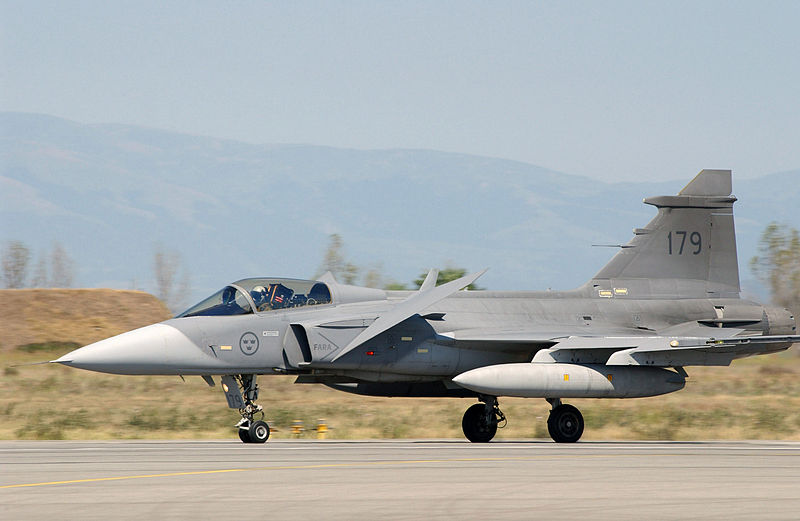
Empire Test Pilots' School Saab JAS 39B Gripen taxis after landing at RIAT 2008, England.
The first Gripen was rolled out on 26 April 1987, marking Saab's fiftieth anniversary. The first prototype first flew on 9 December 1988.
On the 26 November 2008, the final aircraft of the latest 64 jet Batch 3 contract was delivered to FMV. This was accomplished at a 10% less than agreed price for the whole batch putting the Gripen 39C fly-away price at under USD 30 million.
Radar
The Gripen uses the modern PS-05/A pulse-doppler X-band radar, developed by Ericsson and GEC-Marconi, and based on the latter's advanced Blue Vixen radar for the Sea Harrier (which inspired the Eurofighter's CAPTOR radar as well).
The radar is capable of detecting, locating, identifying and automatically tracking multiple targets in the upper and lower spheres, on the ground and sea or in the air, in all weather conditions. It can guide four air to air missiles (e.g. AIM-120 AMRAAM, MBDA MICA) simultaneously at four different targets.
Cockpit
The cockpit has three full colour head down displays and digital emergency instrument presentation unique to the aircraft. The cockpit layout provides a human-machine interface that eases pilot workload substantially and increases situational awareness, but still provides substantial future growth potential. The pilot flies the aircraft by means of a centre stick and left hand throttles.
The cockpit provides a display area some 30 percent larger than that available in most other fighters, with the multi-function displays taking up around 75 percent of available space.
It is dominated by three large (15.7 x 21 cm) active-matrix, liquid crystal, multi-function displays and a wide angle (20 x 28 degree) head-up display (HUD). The displays are equipped with light sensors for computer assisted brightness and contrast control.
 Expeditionary capabilities
One interesting feature is the Gripen's ability to take off and land on public roads, which was part of Sweden's war defence strategy. The aircraft is designed to be able to operate even if the air force does not have air superiority.
During the Cold war, the Swedish Armed Forces were preparing to defend against a possible invasion from the Soviet Union. Even though the defensive strategy in principle called for an absolute defence of Swedish territory, military planners calculated that Swedish defence forces could eventually be overrun. For that reason, Sweden had military stores dispersed all over the country, in order to maintain the capacity of inflicting damage on the enemy even if military installations were lost.
Accordingly, among the requirements from the Swedish Air Force was that the Gripen fighter should be able to land on public roads near military stores for quick maintenance, and take off again. As a result, the Gripen fighter can be refueled and re-armed in ten minutes by a five man mobile ground crew operating out of a truck, and then resume flying sorties.
In the post-Cold War era, these dispersed operation capabilities have proved to be of great value for a different purpose. The Gripen fighter system is expeditionary in nature, and therefore well suited for peace-keeping missions worldwide, which has become the new main task of the Swedish Armed Forces.
 Source: DTN News - - This article compiled by Roger Smith from reliable sources By Robert Hewson ZHUHAI, China - Aviation Week
 DTN News on Twitter (25 subjects)