DTN News - DEFENSE NEWS: U.S. DoD Awarded Contract To General Electric, Lynn Mass., For U.S. Navy F/A 18 A-D Aircrafts Engine Repair, Replacement And Program Support
 Source: DTN News - - This article compiled by Roger Smith from reliable sources U.S. Department of Defense No. 941-12 December 03, 2012
(NSI News Source Info) SINGAPORE - December 4, 2012: General Electric, Lynn Mass., is being awarded a $265,000,000 three year performance based logistics requirements contract to provide repair, replacement and program support of 35 F404 engine (F/A 18 A-D) aircraft components.

Work will be performed at the Fleet Readiness Center Southeast, Jacksonville, Fla., and is expected to be completed by Dec. 31, 2015.
The applicable Navy Working Capital Funds will not expire at the end of the current fiscal year. No funds will be obligated at the time of award.
This contract was competitively procured with six offers solicited, and one offer received from the solicitation.
NAVSUP Weapon Systems Support, Philadelphia, Pa., is the contracting activity (N00383-13-D-001M).
F/A-18C/D Hornet
Following a successful run of more than 400 A and B models, the US Navy began taking fleet deliveries of improved F/A-18C (single seat) and F/A-18D (dual seat) models in September 1987. These Hornets carry the Advanced Medium Range Air-to-Air Missile (AMRAAM) and the infrared imaging Maverick air-to-ground missile. Two years later, the C/D models came with improved night attack capabilities. The new components included a navigation forward looking infrared (NAVFLIR) pod, a raster head-up display, night vision goggles, special cockpit lighting compatible with the night vision devices, a digital color moving map and an independent multipurpose color display.
F/A-18Cs have synthetic aperture ground mapping radar with a doppler beam sharpening mode to generate ground maps. This ground mapping capability that permits crews to locate and attack targets in adverse weather and poor visibility or to precisely update the aircraft's location relative to targets during the approach, a capability that improves bombing accuracy. New production F/A-18Cs received the APG-73 radar upgrade radars starting in 1994, providing more precise and clear radar displays.
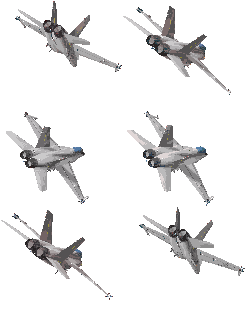
The F/A-18C Nigh Attack Hornet has a pod-mounted Hughes AN/AAR-50 thermal imaging navigation set, a Loral AN/AAS-38 Nite Hawk FLIR targeting pod, and GEC Cat's Eyes pilot's night vision goggles. Some 48 F/A-18D two-seat Hornets are configured as the F/A-18D (RC) reconnaissance version, with the M61A1 cannon replaced by a pallet-mounted electro-optical suite comprising a blister-mounted IR linescan and two roll-stabilized sensor units, with all of these units recording onto video tape.
On the first day of Operation Desert Storm, two F/A-18s, each carrying four 2,000 lb. bombs, shot down two Iraqi MiGs and then proceeded to deliver their bombs on target. Throughout the Gulf War, squadrons of U.S. Navy, Marine and Canadian F/A-18s operated around the clock, setting records daily in reliability, survivability and ton-miles of ordnance delivered.
The Navy announced 18 May 1998 that its East Coast F/A-18 squadrons will relocate to Naval Air Station Oceana in Virginia Beach VA and Marine Corps Air Station Beaufort in Beaufort, SC. The jets will move from Naval Air Station Cecil Field in Jacksonville FL which was ordered closed by the 1995 Base Realignment and Closure Commission. Nine operational squadrons and the Fleet Replacement Squadron -- a total of 156 planes -- will move to Oceana. Two squadrons totaling 24 planes will move to Beaufort. The first squadron will move in the fall of 1998 and all 11 fleet squadrons and the Fleet Replacement Squadron completed their moves by October 1999.
Throughout its service, annual upgrades to F/A-18 weapon systems, sensors, etc. continued. The latest lot of the F/A-18C/D has grown to be far more capable (night attack, precision strike, low observable technologies, etc.) than the original F/A-18A/B; however, by 1991, it was becoming clear that avionics cooling, electrical, and space constraints would begin to limit future growth.
Additionally, another operational deficiency was beginning to develop. As the F/A-18C/D empty weight increased the aircraft were returning to the carrier with less than optimal reserve fuel and/or unexpended weapons. The additional range and "bring back" is not as essential to shore based operations. F/A-18A/B/C/D aircraft will fly for years with the U.S. Marine Corps and eight international customers: Australia, Canada, Finland, Kuwait, Malaysia, Spain, Switzerland and Thailand. Although the F/A-18C/D's future growth is now limited, it will also continue to fill a critical role in the U.S. Navy's carrier battle group for many years to come and will be an excellent complement to the larger, longer range, more capable F/A-18E/F Super Hornet.
*Link for This article compiled by Roger Smith from reliable sources U.S. Department of Defense No. 941-12 December 03, 2012
*Speaking Image - Creation of DTN News ~ Defense Technology News
*This article is being posted from Toronto, Canada By DTN News ~ Defense-Technology News Contact:dtnnews@ymail.com
©COPYRIGHT (C) DTN NEWS DEFENSE-TECHNOLOGY NEWS
Source: DTN News - - This article compiled by Roger Smith from reliable sources U.S. Department of Defense No. 941-12 December 03, 2012(NSI News Source Info) SINGAPORE - December 4, 2012: General Electric, Lynn Mass., is being awarded a $265,000,000 three year performance based logistics requirements contract to provide repair, replacement and program support of 35 F404 engine (F/A 18 A-D) aircraft components.

Work will be performed at the Fleet Readiness Center Southeast, Jacksonville, Fla., and is expected to be completed by Dec. 31, 2015.
The applicable Navy Working Capital Funds will not expire at the end of the current fiscal year. No funds will be obligated at the time of award.
This contract was competitively procured with six offers solicited, and one offer received from the solicitation.
NAVSUP Weapon Systems Support, Philadelphia, Pa., is the contracting activity (N00383-13-D-001M).
F/A-18C/D Hornet
Following a successful run of more than 400 A and B models, the US Navy began taking fleet deliveries of improved F/A-18C (single seat) and F/A-18D (dual seat) models in September 1987. These Hornets carry the Advanced Medium Range Air-to-Air Missile (AMRAAM) and the infrared imaging Maverick air-to-ground missile. Two years later, the C/D models came with improved night attack capabilities. The new components included a navigation forward looking infrared (NAVFLIR) pod, a raster head-up display, night vision goggles, special cockpit lighting compatible with the night vision devices, a digital color moving map and an independent multipurpose color display.
F/A-18Cs have synthetic aperture ground mapping radar with a doppler beam sharpening mode to generate ground maps. This ground mapping capability that permits crews to locate and attack targets in adverse weather and poor visibility or to precisely update the aircraft's location relative to targets during the approach, a capability that improves bombing accuracy. New production F/A-18Cs received the APG-73 radar upgrade radars starting in 1994, providing more precise and clear radar displays.
The F/A-18C Nigh Attack Hornet has a pod-mounted Hughes AN/AAR-50 thermal imaging navigation set, a Loral AN/AAS-38 Nite Hawk FLIR targeting pod, and GEC Cat's Eyes pilot's night vision goggles. Some 48 F/A-18D two-seat Hornets are configured as the F/A-18D (RC) reconnaissance version, with the M61A1 cannon replaced by a pallet-mounted electro-optical suite comprising a blister-mounted IR linescan and two roll-stabilized sensor units, with all of these units recording onto video tape.
On the first day of Operation Desert Storm, two F/A-18s, each carrying four 2,000 lb. bombs, shot down two Iraqi MiGs and then proceeded to deliver their bombs on target. Throughout the Gulf War, squadrons of U.S. Navy, Marine and Canadian F/A-18s operated around the clock, setting records daily in reliability, survivability and ton-miles of ordnance delivered.
The Navy announced 18 May 1998 that its East Coast F/A-18 squadrons will relocate to Naval Air Station Oceana in Virginia Beach VA and Marine Corps Air Station Beaufort in Beaufort, SC. The jets will move from Naval Air Station Cecil Field in Jacksonville FL which was ordered closed by the 1995 Base Realignment and Closure Commission. Nine operational squadrons and the Fleet Replacement Squadron -- a total of 156 planes -- will move to Oceana. Two squadrons totaling 24 planes will move to Beaufort. The first squadron will move in the fall of 1998 and all 11 fleet squadrons and the Fleet Replacement Squadron completed their moves by October 1999.
Throughout its service, annual upgrades to F/A-18 weapon systems, sensors, etc. continued. The latest lot of the F/A-18C/D has grown to be far more capable (night attack, precision strike, low observable technologies, etc.) than the original F/A-18A/B; however, by 1991, it was becoming clear that avionics cooling, electrical, and space constraints would begin to limit future growth.
Additionally, another operational deficiency was beginning to develop. As the F/A-18C/D empty weight increased the aircraft were returning to the carrier with less than optimal reserve fuel and/or unexpended weapons. The additional range and "bring back" is not as essential to shore based operations. F/A-18A/B/C/D aircraft will fly for years with the U.S. Marine Corps and eight international customers: Australia, Canada, Finland, Kuwait, Malaysia, Spain, Switzerland and Thailand. Although the F/A-18C/D's future growth is now limited, it will also continue to fill a critical role in the U.S. Navy's carrier battle group for many years to come and will be an excellent complement to the larger, longer range, more capable F/A-18E/F Super Hornet.
*Link for This article compiled by Roger Smith from reliable sources U.S. Department of Defense No. 941-12 December 03, 2012
*Speaking Image - Creation of DTN News ~ Defense Technology News
*This article is being posted from Toronto, Canada By DTN News ~ Defense-Technology News Contact:dtnnews@ymail.com
©COPYRIGHT (C) DTN NEWS DEFENSE-TECHNOLOGY NEWS












