Showing posts with label Flight International. Show all posts

Wednesday, June 23, 2010

DTN News: EADS Pitches A400M, C-295 To Australia

DTN News: EADS Pitches A400M, C-295 To Australia
Source: DTN News / Flight International By Leithen Francis
(NSI News Source Info) TORONTO, Canada - June 23, 2010: EADS, which is preparing to start deliveries of air tankers to the Royal Australian Air Force, has also been busy promoting its Airbus Military A400M and C-295 in Australia. The A400M would be useful to Australia because "it is twice the size of the Lockheed Martin C-130 and carries twice the weight", says EADS corporate vice-president of international development for Asia Pacific and South America Christian Duhain. "It is a stronger aircraft and can take off from rugged airfields," he adds.
EADS has also been putting forward the C-295 to meet the military's requirement for fixed-wing short take-off and landing aircraft. The requirement has come about because late last year the air force retired its last de Havilland Canada DHC-4 Caribou transports. Some of the Caribou's roles will be fulfilled by utility helicopters, but the Australian Defence Force has said publicly that it will also need fixed-wing aircraft. This procurement will come under the Department of Defence's Project 8000 phase two, which calls for "first pass" approval in the 2010-11 to 2011-12 fiscal year and a decision in either 2012-13 or 2014-15. As an interim solution, the service has been relying on Beechcraft King Air 350s. While EADS may be hoping Australia can become the A400M's second export customer outside Europe, it is continuing to work to deliver five Airbus A330 multi-role tanker transports to the air force. Duhain says the programme's first two aircraft are supporting test activities in Spain, and will be delivered by the end of the year. These were modified by Airbus Military and Qantas Defence Services, respectively, with the latter to also prepare the remaining three examples. "We are trying to make Australia part of our global supply chain," says Duhain, who notes that EADS's Eurocopter subsidiary also owns Australian Aerospace in Brisbane. The company assembles the Tiger armed reconnaissance helicopter for the Australian Army. "Our approach is not about offsets: rather our approach is long term," he says. Duhain confirms that there may be an opportunity for Australian Aerospace to make helicopters for export customers.
*This article is being posted from Toronto, Canada By DTN News ~ Defense-Technology News, contact: dtnnews@ymail.com

Wednesday, June 09, 2010

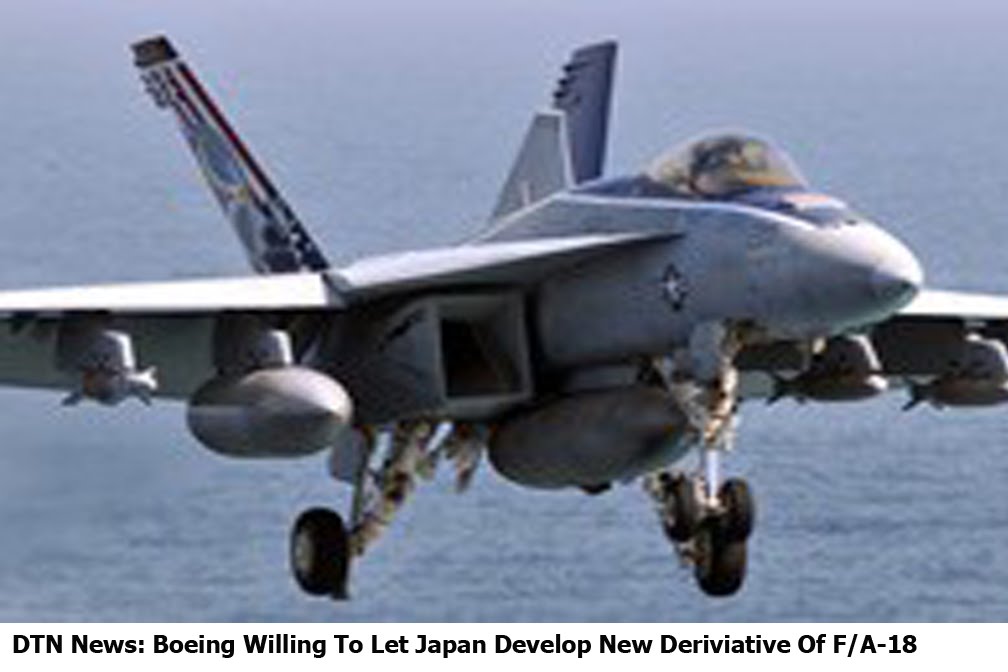
DTN News: Boeing Willing To Let Japan Develop New Deriviative Of F/A-18

DTN News: Boeing Willing To Let Japan Develop New Deriviative Of F/A-18
Source: DTN News / Flight International By Leithen Francis
(NSI News Source Info) TOKYO, Japan - June 10, 2010: Boeing, which is proposing the F/A-18E/F for Japan's forthcoming FX fighter competition, would be willing to let the nation develop its manufacturing capability through the joint development of a new derivative of the Super Hornet. If Japan wanted to further develop the Super Hornet, by coming up with a new derivative, then Boeing would respond positively, says Defense, Space and Security vice-president for international business development Mark Kronenberg. "We would want to come up with a package that helps them with their aspirations," he adds. Japan has yet to issue a request for proposals for the FX competition, but plans to buy 40-50 fighters to replace some of its McDonnell Douglas F-4s.
In the early 1990s, Lockheed Martin worked with Japanese industry to develop the Mitsubishi F-2, a derivative of its F-16, but US law-makers at the time blocked it from transferring some technology. But Kronenberg says technology transfer, with regards to Japan, is less of an issue today. In the 1980s and early 1990s, Japan seemed to be "20ft tall", because the country's corporations were buying so many businesses overseas, but times have changed and US law-makers are now less wary of it, he says. When asked if it is feasible to manufacture 40-50 fighters in Japan under licence, Kronenberg says: "It depends on how much you want to pay to get that new manufacturing capability. I think Japan is willing to pay." He adds that Tokyo's long-term objective is to have the technological and manufacturing capability to develop its own fighter. Some industry observers predict that whichever company wins the FX competition is also likely to win in a subsequent FXX requirement. This is likely to seek over 100 fighters to replace some of Japan's older Boeing F-15s. In a separate development, Japan's nearest neighbour South Korea announced in January that it is studying whether to develop an indigenous fighter. Its government says that if it decides to proceed, completion of the first aircraft would be in 2021. Boeing would also be interested in assisting Seoul with its KFX indigenous fighter programme "if it was part of a long-term path", says Kronenberg. "We would rather partner in significant markets like Korea rather than compete," he says. Maybe longer-term some F-15SE technology could be applied, he adds. The South Korean already operates F-15Ks.

Tuesday, June 08, 2010

DTN News: Boeing To Offer F-35-Like Cockpit Display For Super Hornet

DTN News: Boeing To Offer F-35-Like Cockpit Display For Super Hornet
Source: DTN News / Flight International By Stephen Trimble
(NSI News Source Info) LONDON, U.K. - June 8, 2010: Boeing plans to offer an F/A-18E/F Super Hornet with large-area cockpit displays similar to the Lockheed Martin F-35 Joint Strike Fighter as the company pursues new foreign sales from Canada to Japan. The cockpit upgrade for the Super Hornet is intended to equalise one of the perceived advantages offered by the F-35's multifunction, touchscreen display, which measures 8 x 20in (20 x 51cm). Boeing has evaluated a display with the same dimensions as the F-35, but found that pilots have preferred a larger 11 x 19in screen, says F/A-18E/F programme manager Mike Gibbons. The single display can be configured to digitally mimic the Super Hornet's existing cockpit layout, or allow pilots to overlay data from several sources on to a single screen, Gibbons says. The displays can be integrated into both seats for the F/A-18F. The technology remains in developmental form, but can be integrated in time to meet the timelines for any future sales in foreign markets, he says. Boeing is evaluating bids from undisclosed suppliers to manufacture the displays. The US Navy, however, has already rejected Boeing's overtures to retrofit the display on its fleet. Although Boeing believes the upgrade would reduce lifecycle maintenance costs, the service does not want to operate two different display technologies at the same time, Gibbons says. The new cockpit display made its public debut at the Navy League exhibit hall in early May. Boeing also showed off the new technology in Ottawa in early June at the CANSEC conference and exhibition. Boeing plans to offer the F/A-18E/F for Canada's requirement to replace its ageing CF-18 fleet later this decade. Canada has invested $150 million to participate in the F-35 development programme, but plans to stage a competition for the procurement contract. Meanwhile, Boeing is also offering the Super Hornet to buyers in Brazil, Denmark, India, Japan and Kuwait. The F/A-18E/F's first international buyer, Australia, has no plans to order the upgraded cockpit, having already received the first five of its 24 two-seat aircraft.


