Showing posts with label Asian Defense News. Show all posts

Tuesday, January 05, 2016

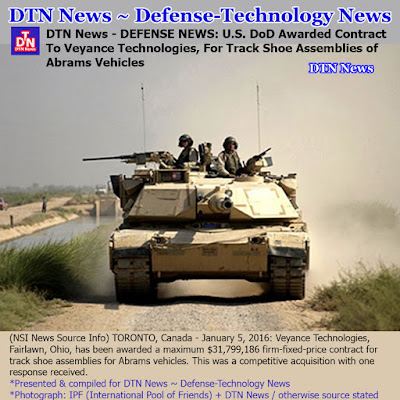
DTN News - DEFENSE NEWS: U.S. DoD Awarded Contract To Veyance Technologies, For Track Shoe Assemblies of Abrams Vehicles

DTN News - DEFENSE NEWS: U.S. DoD Awarded Contract To Veyance Technologies, For Track Shoe Assemblies of Abrams Vehicles
Source: DTN News + U.S. DoD issued No. CR-001-16 January 4, 2016
(NSI News Source Info) TORONTO, Canada - January 5, 2016: Veyance Technologies, Fairlawn, Ohio, has been awarded a maximum $31,799,186 firm-fixed-price contract for track shoe assemblies for Abrams vehicles. This was a competitive acquisition with one response received. 
This is a one-year contract with no option periods. Location of performance is Ohio, with a Jan. 3, 2017, performance completion date. Using military service is Army. Type of appropriation is fiscal 2016 through fiscal 2017 Army working capital funds. 

The contracting activity is the Defense Logistics Agency Land and Maritime, Warren, Michigan (SPRDL1-16-C-0035).

Brief Highlights on Abrams Vehicles;
The M1 Abrams is an American third-generation main battle tank produced by the United States. It is named after General Creighton Abrams, former Army Chief of Staff and Commander of U.S. military forces in the Vietnam War from 1968 to 1972. Highly mobile, designed for modern armored ground warfare, the M1 is well armed and heavily armored. Notable features include the use of a powerful multifuel turbine engine, the adoption of sophisticated composite armor, and separate ammunition storage in a blow-out compartment for crew safety. Weighing nearly 68 short tons (almost 62 metric tons), it is one of the heaviest main battle tanks in service.

The M1 Abrams entered U.S. service in 1980, replacing the M60 tank. It served for over a decade alongside the improved M60A3, which had entered service in 1978. The M1 remains the principal main battle tank of the United States Army and Marine Corps, and the armies of Egypt, Kuwait, Saudi Arabia, Australia and Iraq.


Three main versions of the M1 Abrams have been deployed, the M1, M1A1, and M1A2, incorporating improved armament, protection and electronics. These improvements and other upgrades to in-service tanks have allowed this long-serving vehicle to remain in front-line service. In addition, development for the improved M1A3 version has been known since 2009


*Link for This article compiled by K. V. Seth from reliable sources - DTN News + U.S. DoD issued No. CR-001-16 January 4, 2016
*Speaking Image - Creation of DTN News ~ Defense Technology News 
*Photograph: IPF (International Pool of Friends) + DTN News / otherwise source stated
*This article is being posted from Toronto, Canada By DTN News ~ Defense-Technology News Contact:dtnnews@ymail.com 
©COPYRIGHT (C) DTN NEWS DEFENSE-TECHNOLOGY NEWS


Saturday, June 18, 2011

DTN News - ASIA DEFENSE NEWS: Asia Muscles Up To Protect Its Patch

DTN News - ASIA DEFENSE NEWS: Asia Muscles Up To Protect Its Patch
**Terrorism Is Main Factor For Asia Arms BuildUp, Second Factor - China (Forthcoming Article): DTN News
(NSI News Source Info) TORONTO, Canada - June 18, 2011: The proverbial ''pet-shop galah" can recite facts about how Australia is benefiting from Asia's economic transformation, the Reserve Bank governor, Glenn Stevens, declared this week.
That's how deeply the once-in-a-century bonanza accruing to us from the rise of China, India and other Asian nations is now etched into Australian folklore.
But we hear much less about another important spin-off of Asia's growth miracle: the regional arms build-up. Just as the global economic balance has shifted towards Asia, so has the military balance.
Advertisement: Story continues below
And in the same way the global economic transformation is taking place faster than anticipated, the military balance is shifting more quickly than many expected.
Figures published by the Stockholm International Peace Research Institute show that military expenditure in the Asia-Pacific region grew steadily during the 1990s but then picked up sharply in the past decade. Between 2000 and 2010 expenditure surged from about $US161 billion to just under $US290 billion, an increase of nearly 80 per cent.
India is now the world's biggest arms importer, the institute says. It received 9 per cent of the volume of international arms transfers between 2006 and 2010. The next three largest importers of conventional weapons in that period were also from Asia: China 6 per cent, South Korea 6 per cent and Pakistan 5 per cent.
Indonesia, Malaysia, Singapore, Thailand and Vietnam are all investing in air and naval capabilities. Despite its lingering economic woes, Japan has also announced a significant improvement in its military capability.
Global economic trends are behind the shift in the relative military balance away from Western powers towards Asia. The damage to government finances in Europe and North America caused by the global financial crisis has eroded their military spending capacity. Defence spending in Europe and North America has stagnated. Meanwhile, Asia's economic vitality - coupled with the distrust that exists between countries in the region - is driving a sustained military modernisation and expansion. Countries in Asia have not significantly changed the proportion of gross domestic product being devoted to defence. But rapid and sustained economic expansion has delivered the additional government revenue needed.
A study of the global military balance, by the International Institute of Strategic Studies said it's "already clear that as a result of shifts in the global distribution of economic power and consequently the resources available for military spending, the United States and other Western powers are losing their monopoly in key areas of defence technology".
Asia's hasty military build-up was a key topic at this month's Shangri-La Dialogue, a meeting involving some of Asia's top military leaders convened by the institute each year in Singapore. In his opening remarks, the institute's director-general, John Chipman, asked: "Can there be smart procurement and the avoidance of arms races?"
In a sign of Australia's concern about regional military trends, the Defence Minister, Stephen Smith, told the Shangri-La Dialogue that the Asia-Pacific was a "region in strategic flux" and urged countries to build institutions that can help manage regional security challenges.
Economic success has not only provided the resources for Asia's military build-up. It has also added to the incentive.
As countries get wealthier they have new economic interests they need to protect.
Many Asian states are ramping up their military capacity in order to do just this.
A driving factor is protecting energy supply lines, especially the sea routes used to transport oil and other raw materials.
Asian powers also have a growing motivation, and capacity, to protect their citizens under threat in other parts of the world. India and China both launched operations to rescue their citizens stranded in Middle East nations recently troubled by unrest. New Delhi will purchase 10 C-17 Globemaster III aircraft from Boeing in a deal worth $4.1 billion.
Once these planes are delivered, India will possess the largest fleet of the huge Globemaster III aircraft after the United States. These heavy-lift, long-range military transport aircraft can lift soldiers and military cargo, or be used during humanitarian evacuations.
We are used to seeing Western powers deploy military hardware to protect their citizens when they are in trouble and now major Asian powers are getting the military capabilities to do the same.
Given the large Chinese and Indian diaspora in developing countries, armed evacuations by Beijing and New Delhi to rescue their nationals are likely to become more common. It's possible the Chinese and the Indians could eventually use their military assets to rescue nationals of other countries.
There are many legitimate reasons for Asia's military expansion, but it comes with the potential for suspicion and mistrust.
The growing power and assertiveness of China, which accounts for nearly half of Asia's defence spending, has given its neighbours added motivation to beef up their arsenals.
Nuclear-armed India, for example, is raising new army divisions on its border with China. Arun Kumar Singh, a retired Indian vice-admiral turned security analyst, says New Delhi's strategy is to make the potential cost of both conventional and nuclear conflict with China too high.
"We need to have the nuclear and conventional capacity to deter a war," he told the Herald. "The whole idea is that the military is an insurance against war.
''I suspect India will continue to invest fairly heavily, especially in its conventional capability, to prevent one from ever starting."
Military analysts say the simultaneous build-up of advanced weaponry in the Asia-Pacific region is on a scale and pace not seen since the Cold War arms race between America and the Soviet Union.
Meanwhile, trade and investment between countries in Asia is booming.
The question is: will Asia's growing economic independence be enough to prevent the weaponry from being used?
*Speaking Image - Creation of DTN News ~ Defense Technology News
*This article is being posted from Toronto, Canada By DTN News ~ Defense-Technology News

©

COPYRIGHT (C) DTN NEWS DEFENSE-TECHNOLOGY NEWS

Wednesday, April 13, 2011

DTN News - Asian Defense News: Singapore News ~ Is The PAP Finding It Harder To Recruit?

DTN News -
Asian Defense News: Singapore News ~ Is The PAP Finding It Harder To Recruit?
(NSI News Source Info) SINGAPORE - April 13, 2011:
In a departure from recent history, the powerful People's Action Party (PAP) has found it hard to recruit talent from the private sector to stand as its election candidates.

This contrasts with the past when it enjoyed widespread popularity with little problem in persuading high achievers from private and public organisations to rally to its banner.

The relative failure comes at a time when opposition parties have made significant gains in attracting quality candidates.

It is posing a setback — at least temporarily — to the PAP's plan to use the election, which is expected next month, to produce the next Prime Minister and Cabinetleaders.

Of the 18 newly-recruited PAP candidates announced, only five hailed from the private sector — an assistant professor, two lawyers and two bankers, one of whom is an executive in the government-controlled DBS Bank.

The remaining 13 — or 72 percent — were top people who had served and resigned from public office to contest under the PAP banner.

They were from the civil service, the army, the statutory boards or PAP-controlled unions. The PAP-controlledNational Trades Union Congress (NTUC) contributed five.

Two army generals gave up their stars to take up politics and are tipped to be core members of the fourth generation Cabinet.

The political leaders have described it as a good, diverse team but it is obvious that the inability to attract private talent weighs heavily on officials' minds.

The paucity was confirmed by Senior Minister Goh Chok Tong who admitted that the PAP had difficulty attracting private-sector high flyers to join efforts to form the PAP leadership team.

Extensive efforts, which included 200 "tea sessions" (interviews) to recruit election candidates from the private sector "have not been that successful," he admitted.

For the PAP, which has not lost a single election in the last 50 years, it is a dismal show especially in the face of a resurging opposition which seems to have less difficulty in this area.

Few analysts are predicting this will be a permanent PAP dilemma or that it will cause the PAP to lose the election, but it may have adverse consequences for the party in future.

Bringing together a diverse team comprising the best candidates is fast becoming an impossible task.

The trouble is that some of the targeted high-flyers either do not support the PAP's current strategy for Singapore or some of its political, economic and social policies.

The potential slate would include successful managers, businessmen, academicians and professionals, people that recruiters have paid special interest to.

How will it affect the future? Firstly, it could erode some of the PAP's support among voters which is already in decline over the mass intake of foreigners.

And, secondly, the reduced number of MPs from the private sector could lower the PAP's performance in Parliament.

"To have too many people with civil service or army background may not be a good idea. Parliament may lose touch with the people," one surfer said.

"What about diversity? Where are the professional social workers, the musicians and poets?" she asked.

The issue, which has become a hot topic, has prompted a National University of Singapore (NUS) undergrad to raise it with PM Lee Hsien Loong during a campus dialogue last week.

How is it, he wanted to know, that despite the high salaries, the PAP had not attracted private talents — but the opposition had.

Lee replied: "I'm not sure whether we're looking for exactly the same people. We're looking for a certain type of person ... (one with) commitment, integrity and purpose."

The preferred people, he added, were already set in their careers and not keen to change tracks or face the high risk of a political life.

Not everyone agrees with his explanation. One commentator said: "The real reason is that many of them refused to join because they disagreed with PAP policies. "They don't want to degrade themselves by having to toe the party line."

The fast expanding social media which alternates between being informative to punishing people it doesn't like, also adds to the reluctance of people to seek election for public office. Many successful people are not prepared to have their private lives or their family members be subjected to critical scrutiny or even insults.

What is putting paid to this is the opposition's apparent success in attracting quality candidates to contest, despite all the arguments about privacy and risks.

By entering politics, an opposition candidate is generally seen as facing a higher risk of defeat or failure and financial losses than the one who stands for the PAP, with its superior resources.

"Yet they are pushing ahead with their principles, unfazed," said an admiring female undergrad — a little too innocently to describe the tough world of politics. Not every politician who fights for the weaker team — or who joins the winning one — does so for a selfless cause.

The reward in Singapore that comes with political success can be very large — for all aspirants.

The high Cabinet salaries, which exceed those of even the richest nations in the world, have attracted top talent to help build Singapore's collective wealth.

But as the public backlash rises, it may be contributing to dissuading successful high flyers from joining the government for fear of becoming a target of criticism and even insults.

In other words, this high pay system may even deter a few potential leaders from joining the political arena.

Related Article:

Opposition: an emerging breed

A former Reuters correspondent and newspaper editor, the writer is now a freelance columnist writing on general trends in Singapore. This post first appeared on his blog, www.littlespeck.com, on 9 April 2011.

*Source: By Elena Torrijos | SingaporeScene

*Speaking Image - Creation of DTN News ~ Defense Technology News
*This article is being posted from Toronto, Canada By DTN News ~ Defense-Technology News

©

COPYRIGHT (C) DTN NEWS DEFENSE-TECHNOLOGY NEWS

Monday, April 11, 2011

DTN News - Asian Defense News: China News ~ China's Car Sales Rise 6.5% In March As Market Rebounds

DTN News -
Asian Defense News: China News ~ China's Car Sales Rise 6.5% In March As Market Rebounds
(NSI News Source Info) TORONTO, Canada - April 11, 2011:
China's auto market rebounded in March as car sales rose by 6.5%, compared with the same month a year ago.

New passenger car sales stood at 1.35m, according to the latest data by the China Association of Automobile Manufacturers (CAAM).

That marks a 39% jump from the previous month. The numbers were being closely watched, after sales in February grew at the slowest pace in two years.

China overtook the US in 2009 to become the world's biggest auto market.

Car sales for the first three months of the year grew by 9.1%, compared with the first quarter last year.

The rebound in the sector was led by Toyota. The world's biggest car manufacturer saw sales surge by 37.4% in March, from the same time a year ago.

However, rival Japanese car makers Mazda and Honda reported a slide in their sales.

Chinese car manufacturer BYD, which is backed by billionaire investor Warren Buffett, also reported a fall in its sales numbers, despite announcing a massive price cut earlier in the year.

*Source: BBC World News

Global Car / Automobile Industry

*Speaking Image - Creation of DTN News ~ Defense Technology News
*This article is being posted from Toronto, Canada By DTN News ~ Defense-Technology News

©

COPYRIGHT (C) DTN NEWS DEFENSE-TECHNOLOGY NEWS

DTN News - Asian Defense News: Automobile News ~ China Auto Sales Rebound But Growth Weak

DTN News -

Asian Defense News: Automobile News ~ China Auto Sales Rebound But Growth Weak
(NSI News Source Info) TORONTO, Canada - April 11, 2011:
China's auto sales rebounded in March but growth was well below last year's rapid expansion asgasoline pricesrose and government incentives wound down.

An industry group, the China Association of Automobile Manufacturers, says sales rose 5.4 percent over a year ago to 1.8 million vehicles. That was up from February's 4.6 percent increase but below 2010's 30 percent expansion.

China passed the United States in 2009 to become the biggest auto market by number of vehicles sold.Industry analysts expect total Chinese sales to rise 10 to 15 percent this year though growth should be much slower than in 2010.

*Source: AP - Associated Press - The Associated Press

Global Car / Automobile Industry

  1. News for China Auto Sales

    INAUTONEWS
  2. China auto sales rebound but growth weak 1 hour ago
    AP , 04.11.11, 04:25 AM EDT SHANGHAI -- China's auto sales rebounded in March but growth was well below last year's rapid expansion as gasoline prices rose ...
    Forbes - 43 related articles
  3. China auto sales up 4.6% last month - Taipei Times

    10 Mar 2011 ... Auto sales in China, the world's largest car market, rose by 4.57 percent last month from a year earlier, data from an industry group showed ... www.taipeitimes.com/News/biz/archives/2011/03/10/2003497791 - Cached
  4. China's auto sales growth seen near 2010 rate-exec | Reuters

    11 Mar 2011 ... BIRMINGHAM, Mich., March 11 (Reuters) - The Chinese automarket'ssalesgrowth in 2011 will be close to last year's 32percent increase ... www.reuters.com/article/.../china-autos-idUSN1129734320110311 - Cached
  5. China Auto Industry: GM First Quarter China Auto Sales Up 10% - CNBC

    3 Apr 2011 ... General Motors said on Saturday it sold 685583 vehicles in China in the first quarter, up 10 percent from a year earlier. www.cnbc.com/id/.../GM_First_Quarter_China_Auto_Sales_Up_10 - Cached
  6. With Tax Incentives Gone, Chinese Auto Sales Drop Like A Rock

    9 Mar 2011 ... China's automobile sales market just tanked, declining 33%, month-over-month ... Definitely a slow down auto investors should take note of. ... www.businessinsider.com/china-auto-sales-february-2011-3 - Cached
  7. Chinese auto sales hit monthly record - Business - CBC News

    18 Feb 2011 ... Factory sales of Chinese passenger cars rose 16.8 per cent in January from the same month a year earlier, an industry grouped reported ... www.cbc.ca/news/business/story/2011/02/.../china-auto-factory-orders.html
  8. China Auto Sales Jump 27 Percent in November | CNSnews.com

    9 Dec 2010 ... Shanghai (AP) - China's auto sales powered ahead in November, jumping 27 percent to 1.7 million vehicles as car buyers rushed to beat ... www.cnsnews.com/news/.../china-auto-sales-jump-27-percent-novembe

*Speaking Image - Creation of DTN News ~ Defense Technology News
*This article is being posted from Toronto, Canada By DTN News ~ Defense-Technology News

©

COPYRIGHT (C) DTN NEWS DEFENSE-TECHNOLOGY NEWS