
Sunday, July 13, 2008
China breaking UN embargo in Sudan

Friday, July 11, 2008
The JAS-39 Gripen: Sweden’s 4+ Generation Wild Card

The JAS-39 Gripen: Sweden’s 4+ Generation Wild Card
July 11, 2008: As a neutral country with a long history of providing for its own defense against all comers, Sweden also has a long tradition of building excellent high-performance fighters with a distinctive look. From the long-serving Saab-35 Draken (“Dragon,” 1955-2005) to the Mach 2, canard-winged Saab-37 Viggen (“Thunderbolt,” 1971-2005), Swedish fighters have stressed short-field launch from dispersed/improvised air fields, world-class performance, and leading-edge design. This record of consistent project success is nothing short of amazing for a country whose population over this period has ranged from 7-9 million people.
The JAS-39 Gripen (“Griffon”) is a canard-winged successor to the Viggen, built as one of the world’s first 4+ generation fighters. Gripen remains the only lightweight 4+ generation fighter type in service, its performance and operational economics are both world-class, and it has become one of the most recognized fighter aircraft on the planet. Unfortunately for its builders, that recognition has come from its appearance in Saab-Volvo TV commercials, rather than from hoped-for levels of military export success. With its 4+ generation competitors clustered in the $60-120+ million range vs. the Gripen’s claimed $40 million, is there a light at the end of the tunnel for Sweden’s lightweight fighter?
This is DID’s FOCUS Article for background, news, and contract awards related to the JAS-39 Gripen. We will continue adding to and filling in this article as new information and opportunities arise, with new material highlighted in green type as is our convention. The most recent news includes a set of upgrades to Sweden’s fleet…
Stryker ICV for US Army

Stryker ICV 8-Wheel Drive Armoured Combat Vehicles, USA
July 11, 2008: Stryker is a family of eight-wheel drive combat vehicles, transportable in a C-130 aircraft, being built for the US Army by General Dynamics Land Systems - Canada (formerly General Motors Defense) and General Dynamics Land Systems Division of USA.
Stryker is based on the GDLS Canada LAV III 8x8 light armoured vehicle, in service since early 2001. The LAV III is itself a version of the Piranha III built by Mowag of Switzerland, now part of GDLS - Europe.
Iran episode

Rice warns Iran: US will defend Israel
Tbilisi July 11, 2008: US Secretary of State Condoleezza Rice warned Iran on Friday that Washington had beefed up its security presence in the Gulf and would not hesitate to defend Israel and other allies in the region.
"We will defend American interests and the interests of our allies," Rice said, answering a question on an Iranian threat to "set fire" to Israel.
"We take very strongly our obligation to defend our allies and we intend to do that," she said at a news conference in Tbilisi.
"In the Gulf area, the United States has enhanced its security capacity, its security presence and we are working closely with all our allies... to make (sure) they are capable of defending themselves," she said.
The comments by the United States' top diplomat came after Iran again ratcheted up its rhetoric against the West and test-fired a series of missiles on Wednesday and Thursday. One of the missiles tested has the range to reach Israel and US bases in the Gulf.
Rice did not specify the steps the United States had taken to boost its security presence in the Gulf, but said its plans focused on Washington's "determination to prevent Iran from threatening our interests or the interests of our friends and allies.
"I don't think the Iranians are too confused either about the capabilities and power of the United States," Rice said on a brief visit to the former Soviet republic of Georgia.
An escalation in tensions has fuelled international concern that the stand-off over the contested Iranian nuclear drive might lead to armed conflict.
US Defence Secretary Robert Gates played down such fears on Wednesday, saying war between the United States and Iran was not close and that everyone realised "what the consequences of any kind of a conflict would be."
The West and particularly Israel fear Iran may be trying to develop nuclear weapons under cover of its stated aim of developing a civilian nuclear energy programme. Iran denies that allegation.
On Tuesday an aide to Iranian supreme leader Ayatollah Ali Khamenei, Ali Shirazi, said Iran would "set on fire" Israel and the US navy in the Gulf as its first response to any American attack over its nuclear programme.
Iran's President Mahmoud Ahmadinejad also called for US military bases across the world to be "eradicated."
Then on Wednesday Iran drew an international outcry by test-firing from the Iranian desert a missile capable of reaching Israel.
Tests continued on Thursday with the firing of missiles by Iranian naval forces, Iranian state television said.
Rice on Thursday said Iran had been offered incentives in negotiations aimed at ending the stand-off over Iran's nuclear intentions and called for Tehran to respond positively.
She said it was time for Iran to "get on the right side of the international community. It ought to be talking about that, not about threats against America or threats against America's allies because frankly it's not going to do them any good," Rice said.
In Moscow Russian Deputy Foreign Minister Sergei Kislyak maintained Moscow's generally soft-spoken approach, urging Tehran to take up technological and economic incentives that the West had offered in return for suspending uranium enrichment.
"If our Iranian colleagues look seriously at the opportunities these proposals represent, there is a huge field for serious, constructive cooperation," Kislyak was quoted by RIA Novosti news agency as saying.
Rice meanwhile also alluded to US plans for a missile defence system in eastern Europe intended in part to reduce the Iranian threat.
She had previously signed an agreement in Prague by which the Czech Republic would host part of the proposed missile shield.
Rice said the system would "make it more difficult for Iran to threaten, be bellicose and say terrible things."
Ex-Soviet Georgia is a close ally of the United States and is located north of Iran in the Caucasus mountains.
Rice was here to affirm US support for the pro-Western course of Georgian President Mikheil Saakashvili.
France's hi-tec AVE Drone
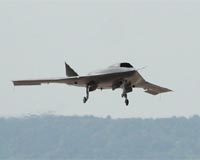
First Fully Autonomous Flight For AVE Drone
France Jul 11, 2008 The Dassault Aviation AVE-D drone completed its first fully autonomous demonstration flight near Toul, France.
The flight, watched by representatives of France's Delegation Generale pour l'Armement (DGA) armaments procurement agency, comprised a completely automated sequence: roll from parking spot, runway alignment, takeoff, in-flight maneuvers, landing, braking and rolling back to the parking apron.
This AVE-D flight marks a significant first for Dassault Aviation, confirming the company's expertise in Uninhabited Air Vehicles, or drones. The demonstration flight is a key development milestone for a technology essential to the successful pursuit of the European nEUROn Unmanned Combat Air Vehicle Demonstrator program.
The AVE (Aeronefs de Validation Experimentale) series is a family of scale model experimental unmanned aircraft developed by Dassault Aviation.
These aircraft enable Dassault Aviation to carry out flight validation tests of technological advances in the field of Uninhabited Air Vehicles, or UAVs, including stealth and autonomous flight.
Achieving maximum stealth is a decisive factor for the success of observation or attack missions in a hostile combat environment.
The first AVE aircraft-called AVE-D, for "discretion"-made its maiden flight in July 2000, becoming the first stealth drone to fly in Europe.
Indian Navy expanding in the seven seas
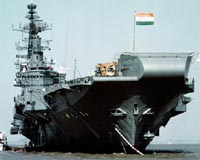
The Rise Of The Asian Navies.
Jul 11, 2008 Russia's Yantar Shipyard currently is building a second batch of three Type 1135.6 FFGs for the Indian navy.
The first three vessels of this model were built at the Baltic Sea Shipyard, but the contract for the latest three vessels has been awarded to the Yantar Shipyard, which has no experience building this type of missile frigate.
Apparently Russia intends to bail out the Yantar Shipyard, which has not received such an order in recent years through Russia's system of allocating contracts. For this reason, it is worth watching the progress of this construction project to see if the shipyard can deliver a quality product. India is also concerned whether the overall price of building these vessels will rise as a result.
India has also begun building its own indigenous aircraft carrier, which is proceeding faster than China's program. India is building its aircraft carrier at Cochin Shipyard and is expected to complete it in 2013. However, past experience has shown that the Indian navy's vessel construction projects are usually delayed by two to three years.
With the Italian Fincantieri Co. providing design assistance, this indigenous Indian aircraft carrier has a full-load displacement of 37,000 tons and will be powered by four LM-2500 heavy-duty gas turbines, with a maximum speed of 28 knots. China's first indigenous aircraft carrier also very likely will be powered by heavy gas turbines.
The design blueprint of the Indian aircraft carrier already has been published, with a deck length of 830 feet and a runway of 600 feet. The aircraft use ski-jump takeoff and landing. The steel plate used to build the aircraft was imported from Russia, and the cutting process was completed in 2007.
As for the Admiral Gorshkov aircraft carrier that India purchased from Russia, it should have been delivered to the Indian navy within this year, according to the original agreement. The retrofitted Admiral Gorshkov's full-load displacement has been increased to 45,400 tons, and it will be equipped with 12 MiG-29K fighters. India and Russia held the latest round of meetings concerning this aircraft carrier in February in Moscow, and the two sides reached a final consensus on the increased price of retrofitting the carrier. The new delivery time is now set at 2011.
It is not presently known what production plans the Chinese navy has in terms of the construction of large-tonnage surface battleships before 2010. Yet, judging from the current status of shipbuilding within the People's Liberation Army navy, and with two aircraft carriers entering service in the Indian navy before 2012, India will resume its absolute technological and tonnage lead in the construction of surface warships above 6,000 tons. Of course, with China initiating its aircraft carrier construction soon, such a trend may be reversed later.
As far as the construction of conventional submarines is concerned, China still holds an obvious lead. The PLA navy is already armed with two Yuan Class submarines, about 10 Song Class submarines, four Kilo 877 and eight Kilo 636M submarines.
The Indian navy has a fleet of more than 10 Kilo 636 and four Type 209 1500 submarines. India's most ambitious submarine construction plan is to build Scorpene Class submarines at its Mazagon Shipyard under license, code-named P-75.
The first batch of P-75s involves importing and assembling six submarines, and India plans to assemble the first P-75 independently in 2012. After that, production of the P-75 will proceed at the pace of one submarine each year. Based on this calculation, the whole project will not be completed until the end of 2017.
India's latest plan shows the Indian navy may very likely expand its Scorpene sub fleet to 12. In terms of shipbuilding technology and production craftwork, however, especially in such production processes as cutting, welding and spray-painting, the military vessels produced by China -- particularly those vessels built at the two shipyards in Shanghai -- are far superior to the Indian navy ships.
Thursday, July 10, 2008
Pakistan and Taliban

Indian Intelligence Agencies Predicted Afghanistan Embassy Attack as Pakistan Signs Agreements with Taliban
July 10, 2008: Two weeks before the suicide bombing at the Indian Embassy in Kabul that killed 41 people, Indian intelligence agencies had alerted Afghan authorities of the possibility of such an attack by the Taliban.Four Indians, including a defence attache and a high-ranking diplomat, were among those killed in the terror attack on Monday. Government sources said the involvement of Pakistan in the latest terrorist attacks could not be ruled out, with Pak military intelligence trying to strike a deal with the Taliban.Soon after the attack, Afghanistan too had blamed a 'foreign intelligence agency' for the bombing of the Indian Embassy in Kabul, making a veiled reference to Pakistan. Security at the Indian Embassy in Kabul was increased and new barricades were erected around it two days before the bomber blew himself up.According to sources, the loss of human life in Monday's suicide bombing would have been 'much, much higher' had new efforts to buttress security at the mission had not been taken. Ruing that 'there is little anyone can do when someone decides to blow themselves up,' sources did mention that this attack on the Indian mission in Kabul was 'serious' and 'we will not let them (those responsible for sheltering, arming and funding enabling terrorists) go.'Indian security forces are on high alert within the country and at all Indian missions abroad following a threat perception from terrorists through Pakistan. Referring to the recent suicide bombing near the Lal Masjid in Islamabad that killed 20 people, Indian government sources said that with 'Pakistan too experiencing bombings and attacks that left innocent civilians dead or maimed, it might learn the cost of terrorism and work towards wiping out the menace.'The Indian Embassy in Kabul will soon be shifted in a new and more secure building in Kabul, sources said. Despite the attacks, India has vowed to intensify its efforts to help with the reconstruction work in Afghanistan and to ensure stability in the country.Meanwhile, a member of Parliament, on Wednesday, claimed that it is a deliberate design by the Pakistan military intelligence to perpetrate horrific acts of terrorism in India and Indian installations in nations like Afghanistan, and also within Pakistan to derail the peace process between the two neighbours. He said the Pakistan military is trying to create a state of unrest among people in an attempt to show the new dispensation in Islamabad in poor light and thereby seize back power.
Air Tanker Wars Back To Square One

Pentagon To Re-Bid Air Force Tanker Contract
July 10, 2008: The Pentagon has spiked a controversial $35 billion contract for a new Air Force refueling tanker and will reopen the competition, Defense Secretary Robert Gates said July 9. In addition, Gates has taken the source selection process for the KC-X tanker out of the Air Force's hands and directed John Young, undersecretary of defense for acquisition, technology and logistics, to serve as the new source selection authority and to appoint a new source selection committee. Gates said that was done "with the full support of the Air Force." Young said the cancellation was in the form of a stop-work order on the contract the Pentagon had signed with Northrop Grumman and EADS. The cancellation opens the door for rival Boeing to get its losing bid reevaluated. The Pentagon acted after the Government Accountability Office last month upheld Boeing's protest of the award to build 179 tanker aircraft, sustaining what Gates said were eight of more than 100 issues raised by Boeing. The issues included the Air Force's failure to acknowledge that Boeing's proposal provided more optional systems than Northrop's; "misleading and unequal discussions" with Boeing; and the service's inaccurate estimate of both tankers' life-cycle costs. All of the GAO findings will be addressed, Gates said. At a Pentagon news conference, Gates said that while the KC-X process has gone on "far too long," he believes the new competition can be completed, and a contract awarded, by December. That can be accomplished, he said, "by running a process that is transparent to the competing companies, by complete communication with those companies so that there are no surprises, no considerations that have not been discussed, no criteria that have not been discussed, nothing done that is unfair." But Young later said that December is "a goal" and that the Pentagon has called for "modified proposals," meaning that Boeing, for instance, could submit a completely different airframe for consideration. Young said the Pentagon would be following a "normal acquisition process," including a draft for proposals amended by the GAO's findings. But he and Gates both said they do not anticipate issuing new evaluation criteria. Young said the Pentagon believes it has a valid requirements document. "We believe that we can ask both bidders to modify their proposals to address those concerns based on how we will implement those findings in that amended request for proposals and move forward," he said. Acting Air Force Secretary Michael Donley, in office just 2 1/2 weeks, acknowledged that GAO's decision on the KC-X award "has been sufficient to cast doubt on the Air Force's management of the overall process." But Gates and Young denied that GAO's conclusions - coming 1 1/2 years after it canceled the Air Force's November 2006 contract award to Boeing for a combat search-and-rescue helicopter - mean that the Air Force's acquisition process is broken. "I have confidence in the acquisitions team," Gates said. "I think that Secretary Donley has indicated that there are some areas where there needs to be improvement, but I think we will go forward with that." That confidence extends to Sue Payton, the Air Force assistant secretary in charge of acquisition, Gates said. But he added that placing his top acquisitions chief in charge of the selection process "is an appropriate and necessary step to ensure congressional and public confidence that DoD can and will successfully manage to completion a large, complex procurement such as the KC-X. It is essential for the department, working with Congress, to maintain both internal and public confidence in our acquisition process. "This is the third time we've gone at this," Gates said. "And under those circumstances, it seemed to me that we were most likely most quickly to gain the confidence of Congress in the way forward by having the undersecretary oversee this particular contract." Once the contract is awarded, the Air Force will manage it and execute the program, Young said. Young said officials decided not to do a competitive "fly-off" because both aircraft are essentially commercial models being modified with booms and probes, and there's "not as much technical risk" as with a program being built from scratch, such as the Joint Lightweight Tactical Vehicle. "We're already getting the benefit in this program of a commercial marketplace that delivered something like 400 aircraft in each company last year," Young said. "We're going to buy 12 to 15 aircraft per year. We're getting huge benefit from getting commercial market pricing and riding on that commercial industrial base. "So it's not clear to me that competition at the prototyping or production level will pay us great dividends," Young said. "It will add significant costs for us in terms of training, that development money, the testing money, the training money, the additional spares, and a long-term lifecycle of two aircraft." Splitting the buy between the two groups also was ruled out because of the potential costs. "We would have to spend the development money and the testing money to develop and test two tankers," Young said. Subsequently, he said, "We would probably have to cut the buy to six, seven, eight aircraft a year between two companies. That would drive the price up further even yet. Then I would have to train people in two different aircraft. "And, frankly, if I spent the money to develop both tankers, you'd have to ask yourself, well, would you really have another competition at KC-Y?" he said, referring to this first phase of a three-phase acquisition process for the tanker. Congressional leaders were briefed earlier July 9, Gates said. Rep. Duncan Hunter, R-Calif., the top Republican on the House Armed Services Committee, said Gates' decision "is a win for America's workers and taxpayers, as well as our war fighters deployed around the world." Northrop partner EADS - the European Aeronautic Defence and Space Company - is the parent company of Boeing rival Airbus. The House Armed Services Committee will hold a hearing on the tanker debacle Thursday at 2 p.m. Young will testify, along with two GAO investigators
Russia's Sukhoi Su-35 fighter
 Russia's Su-35 fighter makes first demonstration flight
July 10, 2008: ZHUKOVSKY (Moscow Region) - Russia's new state-of-the-art Su-35 Flanker multirole air superiority/strike fighter successfully completed its first demonstration flight on Monday.
During the six-minute flight it carried out a number of stunts and maneuvers.
The demonstration was attended by Vladimir Mikhailov, former commander of Russia's Air Force.
Deliveries of the new aircraft, billed as "4++ generation using fifth-generation technology," to foreign clients will start in 2011, the chief executive of the Sukhoi aircraft maker said earlier on Monday.
"We have a large number of orders for this aircraft. Deliveries will be made both for the Russian Air Force and foreign clients... We will start deliveries in 2011," Mikhail Pogosyan said.
The manufacturer said previously the Su-35 would enter service with the Russian Air Force in two to three years.
Russia's Air Force commander Alexander Zelin said that Russian Air Force regiments could receive the new aircraft.
"We plan to train two to three regiments to fly the Su-35 aircraft," he said.
The Su-35, powered by two AL-37F engines, combines high maneuverability and the capability to effectively engage several air targets simultaneously using both guided and unguided missiles and weapon systems.
The Su-35 prototype made its maiden flight on February 18, and two more aircraft are being prepared for similar tests at an aircraft manufacturing plant in Russia's Far East.
Sukhoi, which is part of Russia's United Aircraft Corporation, is planning to export more than 40 combat aircraft in 2008.
In 2007, Sukhoi exported about 50 Su-30MK2, Su-30MKM and Su-30MKI aircraft to countries including Algeria, India, Malaysia, Indonesia and Venezuela.
The company also announced that its 2007 sales had grossed over 50 billion rubles ($2 billion).
DTN News: Iran Test-Fired Nine Long- And Medium-Range Missiles Wednesday
DTN News: Iran Test-Fired Nine Long- And Medium-Range Missiles Wednesday
(NSI News Source Info) TEHRAN, Iran - July 10, 2008: Iran test-fired nine long- and medium-range missiles Wednesday during war games that officials said were intended to show the country can retaliate against any U.S. or Israeli attack, state television reported.
The test-firings were widely condemned in the United States, notably by the White House and the two main presidential candidates.
The exercise was being conducted at the mouth of the Strait of Hormuz, a strategic waterway through which about 40 percent of the world's oil passes. Iran has threatened to shut down traffic in the strait if attacked.
long- and medium-range missiles Wednesday during war games that officials said were intended to show the country can retaliate against any U.S. or Israeli attack, state television reported.
The test-firings were widely condemned in the United States, notably by the White House and the two main presidential candidates.
The exercise was being conducted at the mouth of the Strait of Hormuz, a strategic waterway through which about 40 percent of the world's oil passes. Iran has threatened to shut down traffic in the strait if attacked.
long- and medium-range missiles Wednesday during war games that officials said were intended to show the country can retaliate against any U.S. or Israeli attack, state television reported.
The test-firings were widely condemned in the United States, notably by the White House and the two main presidential candidates.
The exercise was being conducted at the mouth of the Strait of Hormuz, a strategic waterway through which about 40 percent of the world's oil passes. Iran has threatened to shut down traffic in the strait if attacked.
Subscribe to:
Posts (Atom)












