Wednesday, August 20, 2008

Medvedev: Russian troops to pull out from Georgia by Friday

Medvedev: Russian troops to pull out from Georgia by Friday
(NSI News Source Info) MOSCOW August 20, 2008: Russian President Dmitry Medvedev said Tuesday Moscow will withdraw its troops from Georgia by Friday under the terms of a French-brokered peace plan, the Kremlin said in a statement. "Some of the peacekeepers will be pulled back to the temporary security zone by Aug. 22," Medvedev told his French counterpart Nicolas Sarkozy by phone.
"The rest of the (Russian) military contingent, which was sent to reinforce peacekeepers, will be withdrawn to South Ossetia and Russia," the RIA Novosti news agency quoted Medvedev as saying. Russia declared a halt to its military offensive in Georgia last Tuesday after days of conflict in Georgia's breakaway region of South Ossetia. Medvedev on Saturday signed the peace plan, under which Georgian troops should return to their bases and Russian forces should pull back to its previous positions. Russian troops and armored vehicles have begun to pull out from the Georgia on Monday.

Musharraf to stay in Pakistan after resignation

Musharraf to stay in Pakistan after resignation August 20, 2008 NSI News Source Info STORY HIGHLIGHTS ·Musharraf said on Wednesday that he would stay in Pakistan after resignation. ·"Musharraf said ...he will stay along with his family in Islamabad," Geo TV reported. ·Musharraf on Monday announced his resignation for the interests of Pakistan. (NSI News Source Info) ISLAMABAD August 20, 2008: Former Pakistani President Pervez Musharraf said on Wednesday that he would stay in Pakistan after resignation, local TV channel reported. "Musharraf said he has no plans to leave the country and will stay along with his family in Islamabad," Geo TV reported. Musharraf made the remarks while meeting a 40-member delegation of former ruling party Pakistan Muslim League-Quaid (PML-Q), according to the television. Musharraf on Monday announced his resignation for the interests of Pakistan. There have been mounting speculations that he might leave Pakistan after resignation.

Indian Navy acquires state-of-the-art Australian Minesweeping System news

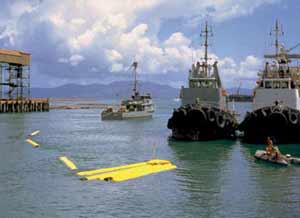
Indian Navy acquires state-of-the-art Australian Minesweeping System news (NSI News Source Info) 20 August 2008: The Australian Minesweeping System (AMAS), developed by Australia's Defence Science and Technology Organisation (DSTO), has secured a major export order with the Indian Navy now becoming the latest client for its innovative system that protects ships from underwater mines. The organisation said that the sale to India was the largest single overseas order for this technology since its first export in 1992. The system is now in service with the navies of Australia, USA, Denmark, Poland, Japan, UAE, Indonesia and Thailand. It is marketed by Thales Australia on a global basis.The DSTO-designed system is the world's first operational sweep which emulates magnetic signals of ships, causing sea mines to detonate prematurely, and safely, out of range of target vessels. The technology has been further improved in collaboration with Thales Australia.
The Australian Minesweeping System was used during the 2003 Gulf War when it was used by the Royal Navy to clear smart mines from the port of Umm Qasr. The system requires no form of power from the towing platform and can be towed by a variety of platforms for autonomous and remote control minesweeping operations. AMAS is a systems approach to minesweeping, comprising a magnetic, acoustic, and electric multi-influence sweep; a sweep tracker monitor system; mission planning support system software; an ECDIS based minesweeping navigation and control system; a remote controlled minesweeping system and a range of integrated logistic support products and services including a shorting band kit and deployment containers. The sweep can be deployed from mine counter-measure vessels (MCMV), naval support craft, remote controlled drones and Craft of Opportunity, such as fishing vessels.

India places $2 billion missile order: report

India places $2 billion missile order: report (NSI News Source Info) MOSCOW August 20, 2008: The Indian army has placed a two billion dollar (1.36 billion euro) order for cruise missiles from the Russo-Indian company BrahMos, the Interfax news agency said Tuesday. "The order by the Indian armed forces comes to two billion dollars," the firm's chief executive Sivanthanu Pillai was quoted as saying by the Russian Interfax news agency. BrahMos Aerospace is a joint Russian-Indian venture established in 1998 to design, develop, produce and market a cruise missile. The BrahMos missile has a range of 280 kilometres (175 miles). Russia is India's main arms supplier. New Delhi was one of the key allies of the erstwhile Soviet Union.

Northrop Grumman Completes Center Fuselage for First U.S. Navy F-35 Aircraft

Northrop Grumman Completes Center Fuselage for First U.S. Navy F-35 Aircraft
(NSI News Source Info) PALMDALE, Calif., August 20, 2008 (GLOBE NEWSWIRE) -- Northrop Grumman Corporation (NYSE:NOC) today completed -- on budget and on schedule -- the center fuselage for the first U.S. Navy F-35C Lightning II aircraft, an aircraft carrier-capable variant designated CF-1. Northrop Grumman has completed the center fuselage for the first U.S. Navy F-35C Lightning II, a carrier variant designated CF-1. Northrop Grumman celebrated the completion of the center fuselage for the first U.S. Navy F-35C Lightning II with a brief ceremony Aug. 19 at its Palmdale F-35 assembly facility. In the photo, Mark Tucker, VP and F-35 program manager for Northrop Grumman addresses the audience of more than 200 employees. The company celebrated the production milestone with a brief ceremony at the Palmdale facility where it assembles center fuselages for F-35 prime contractor Lockheed Martin. More than 200 Northrop Grumman employees shared the historic occasion with executives from the U.S. Department of Defense's F-35 Lightning II Joint Program Office, and F-35 prime contractor Lockheed Martin. "Today's event represents not only the completion of a major aircraft assembly for the F-35 program, but also the delivery on a promise by Northrop Grumman," said Mark Tucker, vice president and F-35 program manager for Northrop Grumman's Integrated Systems sector. "We've shown that we can design and produce a common center fuselage that will meet the operational and logistic support requirements of all three variants of the F-35. And that we're ready to transition to the production phase of the program." The CF-1 center fuselage will be the seventh of ten center fuselages that Northrop Grumman plans to deliver to Lockheed Martin this year, he added. "Meeting this delivery commitment on time helps ensure that the F-35C Lightning II will begin flight test on-schedule in 2009. This important step is vital to our commitment to fielding the F-35C for the U.S. Navy as planned in 2015," said Maj. Gen Charles R. Davis, the Defense Department's F-35 Lightning II Program Executive Officer. "The F-35 carrier variant will give the Navy a powerful, multi-role strike fighter that can begin to assume the duties of the F/A-18 Hornet A/B/C/D aircraft that have been successfully protecting and extending the reach of the U.S. fleet since 1983." The CF-1 center fuselage is one of 19 center fuselages that Northrop Grumman is producing for the system development and demonstration (SDD) phase of the F-35 program. To date, the company has completed center fuselages for 12 aircraft, including AA-1, a conventional take-off and landing (CTOL) variant and the first F-35 aircraft to fly, and BF-1, the first F-35B short take-off/vertical landing (STOVL) variant to fly. The remaining seven SDD center fuselages are currently in the assembly flow in Palmdale. Northrop Grumman is also currently producing center fuselages for the first two phases of the F-35 low rate initial production program. The F-35 Lightning II is a stealthy, supersonic multi-role fighter designed to replace a wide range of aging fighter and strike aircraft. It is being produced in three variants -- CTOL, STOVL, and a carrier variant (CV) -- to meet the diverse performance needs of the U.S. Air Force, the U.S. Marine Corps, the U.S. Navy and allied defense forces worldwide. The three variants use a high degree of commonality to meet strict affordability requirements. Northrop Grumman uses disciplined design, manufacturing and assembly processes to ensure the performance and reliability of the F-35 center fuselage. The structure's all-composite inlet and aft ducts are produced in El Segundo, Calif. then mated in Palmdale with the upper and lower subassemblies of the center fuselages, which include the fuel tanks. The aircraft's outer skins, also made from composites, are then applied and drilled using automated, high precision drilling machines. Final systems installation and testing of hydraulics, actuator doors, the power thermal management system and wire harnesses complete the center fuselage assembly process. As a principal member of the Lockheed Martin-led F-35 global industry team, Northrop Grumman plays a critical role in the development and production of the weapons system. The company's contributions include: producing and integrating a major section of aircraft's structure; producing key radar and electro-optical subsystems; producing key avionics and communications subsystems; developing mission systems and mission-planning software; developing pilot and maintenance training systems; and developing logistic support hardware and software. The F-35 team also includes BAE Systems. Northrop Grumman Corporation is a global defense and technology company whose 120,000 employees provide innovative systems, products, and solutions in information and services, electronics, aerospace and shipbuilding to government and commercial customers worldwide.

U.S. Marine

Marine during a training exercise to face in future deployments in Iraq or Afghanistan. August 20, 2008 NSI News Source Info Marine help another Marine scale a wall during a training exercise at Marine Corps Base Camp Pendleton, Calif., on Aug 12, 2008. The training is designed to simulate urban combat situations that the Marines will face in future deployments. The Marines are assigned to Echo Company, 2nd Battalion, 1st Marine Division. U.S. Marines from Echo Company, 2nd Battalion, 1st Marine Division move from point to point during an urban warfare training session as part of an exercise in the simulated town, known as combat town, at Camp Pendleton, Calif., on Aug. 12, 2008.

India eyes new-generation Russian tank

India eyes new-generation Russian tank (NSI News Source Info) MOSCOW August 20, 2008: India could consider plans to produce a new-generation tank jointly with Russia, the managing director of the BrahMos Aerospace joint venture said on Tuesday. Sivathanu Pillai said that while the new tank had yet to be developed, it could be built in Russia. He offered no indication of when the project could be launched, however. Russian experts earlier said Russia and India could launch production of a new tank in the near future. India currently assembles T-90S main battle tanks under a Russian license. The T-90S version is in service with the Indian Army, and the local production of T-90S Bhishma tanks started recently in India. In 2001, India bought 310 T-90S tanks from Russia. Established in 1998, BrahMos Aerospace designs, produces and markets supersonic missiles, whose sea-based and land-based versions have been successfully tested and put into service with the Indian army and navy.

Syria says ready to consider Russian air defense deal - paper

Syria says ready to consider Russian air defense deal - paper (NSI News Source Info) MOSCOW August 20, 2008: Syria is ready to discuss deploying Iskander missile-defense systems on its territory, but it has not received any proposals from Russia, the country's president told a Russian business daily. President Bashar Assad, who arrived in Russia on a two-day working on Wednesday, said in an interview with Kommersant before his trip: "Our position is that we are ready to cooperate with Russia in any project that can strengthen its security... I think Russia really has to think of the response it will make when it finds itself closed in a circle." Israeli media reported on Monday that Russia was planning to place Iskander surface missiles in Syria and its Baltic exclave of Kaliningrad, in a response to a U.S. missile shield in Central Europe and U.S.-Israeli military aid to Georgia. When asked if Syria, a major importer of Russian arms, would agree to consider the Russian air defense offer, Assad said: "In principle, yes. We have not yet thought about it." He said the issue of installing Iskander missile-defense systems had been raised by Syria several years ago. Speaking on the recent conflict between Georgia and Russia over Georgia's breakaway republic of South Ossetia, Assad said: "On this issue we fully support Russia. The war, which was unleashed by Georgia, is the culmination of attempts to encircle and isolate Russia." Georgia launched a major offensive to seize control of South Ossetia on August 8, prompting Russia to send several hundred tanks and thousands of troops into the region. Moscow announced the end of its operation to "force Georgia to peace" on August 12. "We oppose all these attempts, as we think that this is a continuation of U.S. Cold War-era policy. What Russia has done is to defend its legitimate interests," Assad told the newspaper. The Syrian president said that Russia is facing a situation similar to that once faced by Syria. "Georgia started the crisis, but the West is blaming Russia. Everywhere there is total disinformation, distortion of facts, and international attempts to isolate Russia." Answering a question on whether Russia could become a "rogue state," Assad said: "The resolution of the important problems in Central Asia, the Caucasus and Europe is impossible without Russia... I think that after the crisis with Georgia, Russia has become only stronger." "It's important that Russia takes the position of a superpower, and then all the attempts to isolate it will fail," Bashar Assad said.

Russia rejects UN draft on Georgia

Russia rejects UN draft on Georgia (NSI News Source Info) UNITED NATIONS August 20, 2008: Russia has blocked a UN Security Council draft resolution calling for an immediate withdrawal of Russian troops from Georgia, saying the document contradicts a previously agreed peace plan. The draft, submitted by France on Tuesday on behalf of the European Union and backed by the United States, did not go to a vote at the Security Council, where Russia has the power of veto. Russia's UN envoy Vitaly Churkin said: "The Russian Federation cannot support this... Putting it to a vote would be a waste of time." He said the draft omits four parts of the six-point peace plan brokered by French President Nicolas Sarkozy in Moscow, while distorting the remaining two points. "Taking separate parts of the Moscow plan and reinterpreting them for political propaganda - this is not a constructive route," he said. Notably, the Moscow plan recognized Russia's right to take necessary security measures, and did not call for an "immediate" withdrawal, Churkin said. Earlier on Tuesday French Foreign Minister Bernard Kouchner, who had also visited Moscow to mediate in a peace deal after Russian troops entered Georgia following Tbilisi's offensive in breakaway South Ossetia, accused Moscow of breaking its promise to withdraw troops. Explaining the new draft, French Deputy Ambassador Jean-Pierre Lacroix told the Security Council that while Paris still backs the plan agreed by Sarkozy and his Russian counterpart, Dmitry Medvedev, "in order for this plan to be implemented, there is an essential prerequisite which is the withdrawal of Russian forces." The draft also calls for Georgian forces to return to their positions before the conflict, which broke out in the early hours of August 8 when Georgia began a major ground and air offensive on South Ossetia, in which Russia says 1,600 civilians were killed. The draft would have committed Security Council members to "the sovereignty, independence and territorial integrity of Georgia within its internationally recognized borders." However, Russia has said that South Ossetia, along with Georgia's other rebel province Abkhazia, must be allowed to make their own decisions on their status. The Security Council's emergency session came hours after NATO froze ties with Russia, saying "business as usual" could not continue until a complete Russian withdrawal from Georgia. Russian Foreign Minister Sergei Lavrov hit back at NATO's statement on Tuesday, calling it "biased" and aimed at supporting Georgia's "aggressive regime." "NATO is trying to turn an aggressor into a victim, is attempting to whitewash a criminal regime and save a fallen regime, and is taking a course toward re-arming the current Georgian leaders," he said. The Sarkozy-Medvedev six-point plan stipulated renouncing the use of force, halting all military action, providing free access to humanitarian aid, the return of Georgian Armed Forces to their bases, the return of Russia's Armed Forces to their positions prior to combat, and the start of international discussions on the future status of South Ossetia and Abkhazia and on ways to ensure their security.

Southwest China hit by new earthquake

Southwest China hit by new earthquake (NSI News Source Info) BEIJING August 20, 2008: An aftershock measuring 5.0 on the Richter scale struck China's southwest Yunnan province on Wednesday, causing buildings to collapse, Xinhua said. The quake struck the county of Yingjiang at 5:35 a.m. local time (21:35 GMT), the agency said resulting in the evacuation of around 1,200 people. No reports of casualties have been reported. Many houses collapsed in the epicenter, about 46 km from Yingjiang, and several neighborhoods have reported damage, which is being evaluated by the authorities. The latest tremor occurred just one day after China marked 100 days since the country's southwest Sichuan province was hit by a massive earthquake measuring 8.0 on the Richter scale, the most powerful to hit the region in thirty years. At least 70,000 people were killed and 10 million displaced. Chinese authorities said on Tuesday that China's Sichuan province would not be hit by a similar quake for 1,000 years in a move to try and attract investment into the region. Direct economic losses from China's May 12 earthquake have exceeded $150 billion.