Saturday, October 18, 2008

Venezuela Buying More Russian Tanks

Venezuela Buying More Russian Tanks (NSI News Source Info) CARACAS - October 18, 2008: Venezuela is buying more Russian weapons, including armored personnel carriers and tanks, to replace aging ordnance and to improve the country's security and defense capabilities, a top military commander said Oct. 16. "We could be talking about 100 to 500 tanks," said Strategic Operations Command chief Gen. Jesus Gonzalez. "Right now it's impossible to know ... because strategic research studies are still underway [and] we're still negotiating."
BMP-3 Russian Infantry Fighting Vehicle (IFV)
The general was confirming an Interfax news agency report Oct. 15 about a Russian weapon shipments to Venezuela, which Russian arms export agency deputy director Igor Sevastyanov said included "a large number of BMP-3 armored personnel carriers" and multiple rocket launchers. The move follows increasingly closer Russian-Venezuelan relations and $4.4 billion in bilateral arms deals signed since 2005 that have raised U.S. concerns, especially in view of Venezuelan President Hugo Chavez's fierce anti-American stance. After meeting with a top-level Russian delegation headed by Security Council secretary Nikolai Patrushev, Gonzalez said "nobody should be surprised or afraid" about the arms deal and growing friendship between the two countries. "Our security and defense require the purchase of airplanes, helicopter and tanks," he added, without mentioning a price tag for the recent weapons deal. Moscow, he said, "is now supplying us with the materials we need for our defense," including armored personnel carriers. He said Venezuela needed tanks "because the French AMX tanks we got 30 years ago are quite old now, and the Scorpio tanks from Britain are also quite old. We're buying mid-sized T-62 [Russian] tanks ... reconnaissance tanks and other models offered us." Venezuela and Russia's "decision to have bilateral, technical-military trade is firm and permanent," the Venezuelan general stressed. Venezuela has already bought 24 Sukhoi fighter jets, 50 helicopters and 100,000 Kalashnikov assault rifles from Russia. During a visit by Venezuelan President Hugo Chavez to Moscow last month, Russia announced it was giving Venezuela a $1 billion credit to buy Russian weapons and the two countries discussed nuclear energy cooperation. They are also planning joint naval exercises in the Caribbean in November. U.S. military chiefs have said they are concerned about the military buildup in Venezuela, and the U.S. State Department has said it will be watching the Russian-Venezuelan naval exercises "very closely."

India Deploys Warship to Fight Piracy

India Deploys Warship to Fight Piracy (NSI News Source Info) NEW DELHI - October 18, 2008: India said Oct. 17 it is deploying a warship to protect its merchant vessels in the pirate-infested Gulf of Aden off the coast of Somalia. The move comes after the MT Stolt Valor, carrying mainly Indian crew was hijacked Sept. 17 by Somali pirates in the gulf. "The government has approved the deployment of one warship with immediate effect to patrol the route followed by Indian flagships between Oman and Yemen," a defense ministry official said. The number of warships could be increased later, he added. The "anti-piracy patrol" vessel will have helicopters and marine commandos onboard, an Oct. 16 ministry statement said.
India Deploys Warship to Fight Piracy
The deployment follows weeks of protests by shipworkers and families of the detained crew who have been demanding rescue efforts for the 22 aboard the MT Stolt Valor. Eighteen crew members are Indians, while there are two Filipinos, a Bangladeshi and a Russian. "The presence of Indian Navy in the area will help to protect our seaborne trade and instill confidence in our seafaring community, as well as function as a deterrent for pirates," the statement said. The Gulf of Aden is a "major strategic choke point in the Indian Ocean region and provides access to the Suez Canal through which the sizeable portion of India's trade flows", the statement noted. Warships from several other nations patrol the Gulf of Aden, one of busiest shipping lanes in the world. The International Maritime Bureau reported more than 24 known attacks off the Somali coast between April and June, and more have been committed in recent months. Many attacks go unreported along Somalia's 3,700-kilometer (2,300-mile) coast where pirates operate high-powered speedboats and carry heavy machine guns and rocket launchers.

More Automatic Ammunition-Handling on Stryker for Meggitt

More Automatic Ammunition-Handling on Stryker for Meggitt
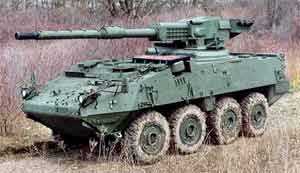
(NSI News Source Info) October 18, 2008: Meggitt Defence Systems has won another 80 automatic 105 mm ammunition replenisher systems for the M1128 Stryker Mobile Gun System (MGS) worth around $11.5 million. Developed under contract to General Dynamics Land Systems, over 100 systems including spares, support, and reset have been delivered since 2004.
The Stryker MGS replenisher, which holds ten 105 mm rounds in the vehicle’s hull and automatically transfers ammunition into the ready magazine in the turret, has seen extensive combat duty in Iraq since its deployment in 2006. Greg Hill, Director of Meggitt’s ammunition handling system business area team, said, “We are proud to be part of GDLS’ Stryker team and the combat record we have helped build with our system.” The equipment will be manufactured at Meggitt’s facility in Irvine, California. Meggitt Defence Systems, a Meggitt group company, specialises in the design, development and production of ammunition-handling, environmental control and training systems. Its products are found on many of the world’s leading military platforms including the Abrams main battle tank, Stryker Mobile Gun System, the F-16 Falcon, the F/A-18 Hornet, AC-130 Spectre Gunship, and the AH-64D Apache Attack Helicopter. The Meggitt group, headquartered in the UK, designs and makes high performance components and systems for aerospace and defence. The group employs c. 8,000 people across 34 operating companies.

Israeli Military Unveils Armed Patrol Robot

Israeli Military Unveils Armed Patrol Robot
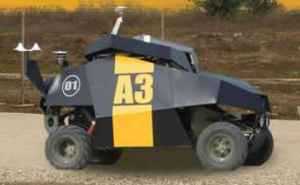
(NSI News Source Info) NES TZIONA, Israel — October 18, 2008: Israel's newest soldier can see at night, never nods off on sentry duty and can carry 660 pounds without complaining.
The Guardium, an unmanned ground vehicle commissioned by the Israeli military and shown to The Associated Press on Monday, is essentially a robotic soldier, among the first in the world to be operational. It can replace human soldiers in dangerous roles, cutting casualty rates. Like the pilotless drones that have become a mainstay of air forces in Israel, the U.S. and elsewhere, the four-wheeled Guardium is operated from a command room that can be far from the front line. It can be mounted with cameras, night-vision equipment and sensors, as well as more lethal tools like machine guns. Following pre-programmed routes, it can navigate alone through cities — the vehicle knows how to deal with intersections, traffic and road markings. It can patrol borders, its cameras scanning 360 degrees at all times, and alert operators if it spots anything suspicious. The Guardium never mentally wanders or falls asleep, as soldiers have been known to do during mind-numbing guard or patrol missions. And it doesn't have a family that will miss it when it's away on reserve duty. "Representatives of armies with troops who are taking high casualties in asymmetric warfare from threats like roadside bombs get excited about this product," said Erez Peled, general manager of G-Nius Unmanned Ground Systems, the company that developed the robot. The control panel includes two large screens and a joystick. If the operator wants to take control, he can do so from a steering wheel and gas and brake pedals that lend the console the look of a video arcade game. "Any kid who grew up with a PlayStation will be able to come in here and learn this in seconds," Peled said. A vehicle alone costs approximately $600,000. With the operating system, the price runs to several million dollars, depending on what equipment is installed on the robot. The Israeli military said the Guardium has yet to enter operational service, and would provide no further comment. John Pike, director of the Virginia-based military think tank Globalsecurity.org, said there is only one other similar vehicle operational — a South Korean robot used to patrol the demilitarized zone with North Korea. With the details of the Korean vehicle classified, Pike could not say which was more advanced. Robots like this are potentially the future of ground warfare, Pike said. "A robot does what it's told, and you'll be able to get them to advance in ways its hard to get human soldiers to do. They don't have fear, and they kill without compunction." But more importantly, he said, "A robot means you don't have to write a condolence letter."

Ukrainian Army to Purchase New Oplot MBTs

Ukrainian Army to Purchase New Oplot MBTs
(NSI News Source Info) Kharkov, Ukraine – October 18, 2008: According to an announcement made by the Ministry of Defence of Ukraine, the Ukrainian Armed Forces are ready to place an order for ten Oplot main battle tanks (MBT), three Atlet Armoured Repair and Recovery Vehicles (ARRV) and 10 BTR-4 Armoured Personnel Carriers (APC). This was announced by the Chief of General Staff and Commander-in-Chief of the Armed Forces of Ukraine General Sergey Kirichenko during his visit to the State-owned Enterprise Kharkov Morozov Machine Building Design Bureau (KMDB). The task of accepting for service the new vehicles developed by KMDB and commencing purchasing them was given to the Army by the President of Ukraine Victor Yushchenko. Meanwhile, procurement of the upgraded Bulat MBTs will continue. While visiting KMDB, General Sergey Kirichenko familiarized himself with the latest Ukrainian-designed armoured vehickes, including the upgraded Oplot MBT, Atlet ARRV, BTR-4 and Dozor-B APCs as well as the simulators for the BMP-2 infantry fighting vehicle crew. The upgraded Oplot MBT differs in many aspects from its previous version that was demonstrated during the parade in Kiev in 2001. According to some media reports, this tank is the most protected MBT in the world, as it is immune to all existing and newest-generation anti-tank projectiles (with a slight increase of weight in comparison with the previous version). No detailed information about this tank has been unveiled, but the vehicle seems to be considerably lighter and smaller than any European or American tank. The pictures of the upgraded Oplot show some innovations into its traditional design, including a panoramic sight and remote-controlled anti-aircraft machine gun system positioned next to it (this feature was recently also adopted to the design of the German Leopard MBT and French Leclerc MBT).

Japan concerned over Chinese submarines near maritime borders

Japan concerned over Chinese submarines near maritime borders (NSI News Source Info) TOKYO - October 18, 2008: Chinese submarines have recently increased their activity near Japan's maritime borders in the East China Sea, a Japanese military source said on Friday. According to the source, the Japan Maritime Self-Defense Force detected the presence of a Chinese Han-class nuclear-powered submarine and a Song-class diesel attack submarine in the region as the U.S. George Washington nuclear aircraft carrier was heading to the South Korean port of Pusan on a friendly visit. The USS George Washington is stationed at a U.S. naval base in Yokosuka, Japan. The source said the Chinese submarines did not violate Japanese territorial waters, but described their activities as attempts "to gather data on noise signatures emitted by all automated systems of the U.S. aircraft carrier" and "some sort of intimidation." In response to the Chinese moves, Tokyo and Washington increased the number of patrol flights by Japan's P-3C Orion ASW aircraft and deployed additional U.S. reconnaissance satellite assets to monitor the area. The Chinese Navy's submarine fleet includes at least two nuclear-powered attack submarines, and its 13 Song-class submarines are extremely quiet and difficult to detect when running on electric motors. In October 2006, an undetected Chinese Song-class submarine popped up in the middle of a U.S. task force during an exercise in the Pacific at the distance of only 5 miles from the USS Kitty Hawk aircraft carrier. The Chinese vessel slipped past at least a dozen other American warships which were supposed to protect the carrier from hostile aircraft or submarines.

Friday, October 17, 2008

India develops new UAVs

India develops new UAVs
(NSI News Source Info) October 17, 2008: India is reportedly developing a new generation of UAVs designed to deploy laser target designators deep inside enemy territory."We are planning to base LTDs on UAVs to cut down the risk of our troops getting caught inside enemy territory while illuminating targets for attack and save the cost of sending another aircraft for doing the task," explained a senior Defence Ministry official. The new UAV project will be led by the DRDO, in partnership with the Army, Navy and the IAF. As IT Examiner previously reported, the crowded Indian defence market has led numerous officials to express concern over a perceived lack of indigenous self-reliance. To be sure, air chief marshall F M Major recently recommended that New Delhi reduce its dependency on aerospace imports by embarking on a "strategic shift [that] will offer the required thrust towards building skills and infrastructure for engineering and manufacturing."As such, the MoD has taken several notable steps to develop advanced military technology. For example, the Indian Combat Vehicles Research and Development Establishment (CVRDE) is designing a number of unmanned infantry combat vehicles. According to CVRDE director S Sundaresh, Medak Plant workers are fitting Russian infantry combat vehicles with advanced robotic components at a cost of Rs 60 crore. Sundaresh also noted that the all-terrain vehicles would be utilised to detect mines, as well as nuclear, biological and chemical weapons. In addition, the DRDO has announced plans to develop missiles that are lighter and less costly than current indigenous models. An independent centre for composite testing and evaluation is being established at the Hyderabad-based Advanced Systems Laboratory (ASL) -- which was primarily responsible for designing the long-range Agni missile. Avinash Chander, Director of the Laboratory under DRDO, explained that the ASL already maintains a composites production centre (Comproc) responsible for the fabrication of lightweight missile material. However, Chander noted that the ASL wanted to make "all the stages of the Agni missile composite structured."

DTN News: Norwegian Industry Wants Sweden's Gripen Jets - Report

DTN News: Norwegian Industry Wants Sweden's Gripen Jets - Report (NSI News Source Info) October 17, 2008: The best decision for the Norwegian industry would be the purchase of Swedish JAS 39 Gripen fighter jets and not US F-35 Lightning II, a common report by two industry organisations and a labour union showed on Wednesday.

The Norwegian Defence and Security Industries Association (FSi), trade union Landsorganisasjonen (LO) and Norwegian Society of Engineers (NITO), with a total one million members, recommended in the report the authorities to invest in 48 new JAS 39 Gripen jets instead of in US F-35 Lightning II, know as Joint Strike Fighter (JSF), made by Lockheed Martin Corp. Gripen is manufactured by Swedish defence and aerospace group Saab AB. Gripen is the best alternative from the industrial perspective, FSi administrative director Torbjorn Svensgard told Norwegian daily Dagsavisen today. Gripen has already identified much more projects in Norway, to take part in, compared with JSF, and these projects are spread across the whole country. A JSF choice will have negative consequences for the expansion and further development of the Norwegian defence industry, according to the report. If Norway chooses Gripen, this will enable large production, as well as research and development, and more work places, FSi said. Although the report is important, the LO union has not taken a final position in the discussion yet, LO's leader Roar Flathen said. Norway's government is due to make a decision about the fighters before Christmas.

DoD Announces Non-Certification of Armed Reconnaissance Helicopter Program

DoD Announces Non-Certification of Armed Reconnaissance Helicopter Program (NSI News Source Info) October 17, 2008: Yesterday, the Department of Defense notified the Congress and the contractor, Bell Helicopter, that it will not certify the U.S. Army Armed Reconnaissance Helicopter (ARH) program for continuation. John Young, undersecretary of defense for acquisition, technology and logistics, in consultation with senior Defense and Army officials, has determined that the fundamental cost and schedule basis underlying award of the ARH contract is no longer valid. The ARH contract was awarded for an expected development cost of $359 million and a procurement average unit cost of $8.56 million. Currently, DoD estimates that development will cost $942 million and the procurement average unit cost will be $14.48 million. Delivery of ARH to the Army was originally scheduled to take place by 2009, but the current projection is for 2013. “Rather than continue this program”, Young said, “I have decided that the best course of action is to provide the Army with an opportunity to define a coherent, disciplined Kiowa Warrior helicopter replacement program, and to obtain more rigorous contract terms for its development.” Secretary of the Army Pete Geren stated, “The cost and schedule that were the focus of the decision to award the contract to Bell Helicopter are no longer valid. We have a duty to the Army and the taxpayer to move ahead with an alternative course of action to meet this critical capability for our Soldiers at the best price and as soon as possible.”

Wednesday, October 15, 2008

India to Upgrade An-32 Transport Aircraft

India to Upgrade An-32 Transport Aircraft (NSI News Source Info) NEW DELHI - October 15, 2008: The Indian Air Force is set to upgrade all of the approximately 110 An-32 transport aircraft it bought from the former Soviet Union. The upgrade of the An-32 fleet is part of the air force's policy to upgrade all aircraft in its inventory, a senior air force official said. The upgrade is intended to improve the avionics, increase the engine lifespan, and improve the aircraft's range and payload so it can remain operational for another 15 to 20 years.
An-32 transport aircraft
The air force is likely to call for global bids early next year for the upgrade. Sources said some An-32 aircraft also will be upgraded with systems so they can perform maritime patrol functions. The An-32 was built for India by Antonov of Ukraine to operate under hot climate conditions to withstand temperatures of up to 55 degrees Celsius. Early this year, the Indian Air Force bought six C-130J transport aircraft from the U.S. to increase its ability to land and take off on short airfields and without lights. The aircraft will be used to move special forces on short notice. Currently, the air force uses two Russian military transports, the An-32 and Il-76.



