Sunday, November 16, 2008

Pakistan blocks U.S. convoy route

Pakistan blocks U.S. convoy route (NSI News Source Info) ISLAMABAD, Pakistan - November 16, 2008: Pakistan has indefinitely blocked travel for convoys, carrying food and military supplies to U.S. troops in Afghanistan, through a key mountain pass.
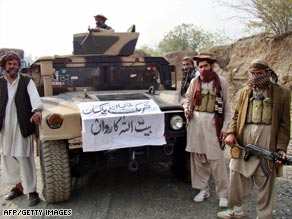
Armed militants pose next to a captured armored vehicle near the Pakistan-Afghanistan border
The decision to suspend travel through the Khyber Pass in northwest Pakistan was taken due to security concerns, said Gula Jan, a security official in Khyber Agency, on Sunday. The mountain pass links Pakistan to its neighbor, Afghanistan. It is in the Khyber Agency, one of seven semiautonomous tribal agencies along the Afghan border. Because Afghanistan is landlocked, many supplies for NATO-led troops fighting Islamic militants there have to be trucked in from Pakistan. Officials said militants aligned with the Taliban and al Qaeda have carried several attacks there. The Pakistani central government has little control in the area, and the area is believed to be a haven for militants. On Tuesday, as many as 60 to 70 armed militants launched back-to-back assaults on convoys. The militants seized 13 trucks -- 12 carrying wheat into Afghanistan as part of a World Food Programme convoy, and one transporting Humvees to the U.S.-led coalition, Khyber Agency officials said. Jan said the decision to suspend travel came after local leaders met with representatives of some of the shipping firms. He said trucks will be allowed through the pass once the security situation improves, but did not specify a date. Dozens of trucks idled by the side of roads Sunday in the Khyber Agency and in Peshawar waiting for the greenlight.

Saturday, November 15, 2008

Light Platforms to Dominate World Military Helicopter Market

Light Platforms to Dominate World Military Helicopter Market (NSI News Source Info) November 15, 2008: In a new study, “The Market for Light Military Rotorcraft,” Forecast International projects that 2,176 light rotorcraft will be produced for military use during the 10-year period from 2008 through 2107. The Connecticut-based firm estimates the value of this production at $22.3 billion, in constant 2008 U.S. dollars. The new study generally defines a rotorcraft as “light” when it has a maximum gross weight of less than 6,804 kilograms (15,000 lb).
A number of factors are driving the growth in the light military rotorcraft market. One is the ongoing restructuring of U.S. Army aviation, which involves a number of new procurement programs. Two of these programs, the troubled Armed Reconnaissance Helicopter (ARH) and the Light Utility Helicopter (LUH) produced by EADS, will see the Army take delivery of hundreds of new light helicopters in coming years. Rebooting ARH? While LUH is progressing well, ARH encountered problems right from the start and is currently moving to a new competition, after the cancellation of the contract awarded to Bell in 2005, for the production of 368 helicopters that would replace the OH-58D 'Kiowa Warrior' currently used in this role. Replacement of this helicopter has been long overdue, as it was originally scheduled to be replaced by the Army's futuristic stealth rotorcraft known as RAH-66 "Comanche'' which has also been axed in 2004. Following the termination of the Armed Reconnaissance Helicopter (ARH) contract with Bell Helicopter the U.S. Army is currently reassessing the ARH performance requirements in an attempt to fulfill the critical, long overdue requirement for scout helicopters. The Army plans to acquire up to 512 new Armed Reconnaissance Helicopters capable of operating at low to medium altitude (hover out of ground effect at 6,000 ft/95 degrees Fahrenheit). While the armed scout carries weapons, its primary role is reconnaissance. Most targets detected by the helicopters will be engaged by other platforms, while the ARH has its own weapons, which could be employed for self defense or against targets of opportunity, when the situation dictates rapid actionable response. The world market for lightweight helicopters is growing, the choices of armed helicopters that the US Army can choose from are quite limited –the Boeing company OA-6 'little bird', which is already operating with the US Special Operations Command and the Bell 407 that already won the Army's selection but failed to deliver. Although Bell lost the contract with the same aircraft, the new program could involve buying more aircraft and could enable the company to better price their offer. After winning the ARH contract Bell realized the work involves excessive costs that turned this program into a loss-making venture. Bell was hopeful that an increase in production volume could streamline the program into profitability but after losing the Indian Army tender to Eurocopter in 2007, and an estimated cost increase of 40%, the ARH had nowhere to go. Only a year passed, and the arena has changed dramatically. Eurocopter lost their Indian contract, which is moving back into a competition, but on this round the stakes are higher. The Indian Army and Air Force have merged their requirements doubling their planned buy from nearly 190 to about 384 helicopters. The US Army is gearing to reopen the ARH competition, which will aim at increased quantities. New competitors are appearing as well, Boeing is back on the line, reopening their OA-6 (MD500) production line to provide for international orders for about 24 helicopters. These came just in time for Boeing to warm up its engines for the next ARH round. Global Market Growth Worldwide, light helicopter platforms are abundant from well established players such as Bell, Sikorsky, Eurocopter and Agusta Westland. According to Forecast International Senior Aerospace Analyst Raymond Jaworowski, “Manufacturers are striving to ramp up production of civil and military models alike. At the same time, they are pressuring and cajoling their suppliers to accelerate component production.” The Forecast International projections indicate that annual light military rotorcraft production will more than double within the next several years. Yearly production is projected to rise steadily from an estimated 132 rotorcraft in 2008 to 291 rotorcraft in 2014. According to the study, this growth will make the light military segment the most dynamic part of the world rotorcraft market during this time period. The overall rotorcraft market is experiencing considerable strength, and the light military segment is expected to lead the way. Market share projections included in the new Forecast International study indicate that Eurocopter and Bell will be the top two manufacturers in the light military rotorcraft market during the next 10 years. Eurocopter will lead in units produced, while Bell is expected to be second. The order is reversed in terms of value of production, with Bell taking the top spot and Eurocopter placing second. The projections indicate that AgustaWestland will be third, and Hindustan Aeronautics Ltd (HAL) will be fourth, in both unit production and value of production.

Russia's Medvedev hopes for success of G20 Washington summit

Russia's Medvedev hopes for success of G20 Washington summit (NSI News Source Info) WASHINGTON - November 15, 2008: Russian President Dmitry Medvedev said Saturday he was hopeful the G20 summit in Washington on the world financial crisis would be a success. "We have arrived in Washington to resolve complicated problems between our countries and other states. I hope good luck will favor us," Medvedev said at a meeting with German Chancellor Angela Merkel. Merkel was also positive about the G20 summit. "I proceed from the assumption that we will hold it successfully," she said. Speaking about Friday's EU-Russia summit in Nice, Merkel said she was very glad that "Russia-European Union cooperation is developing successfully." "I am glad we can strengthen it, and glad it is connected with the partnership and cooperation agreement," she said. At the summit in the French resort city, the EU and Russia agreed to restart talks on a new partnership and cooperation agreement. Medvedev hailed the end of the delay in the talks, which were frozen due to the five-day war between Russia and Georgia over breakaway South Ossetia in August, and Moscow's subsequent recognition of South Ossetia and Abkhazia, another separatist Georgian republic, as independent states. Western powers were initially critical of Russia's reaction to Georgia's attack on the breakaway republic, but this stance has softened of late. The 27-nation European bloc said on Monday that talks on a partnership agreement, suspended on September 1, would resume later this month, despite opposition from Lithuania.

Saab was selected as supplier of the NLAW for the British army

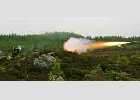
Saab was selected as supplier of the NLAW for the British army (NSI News Source Info) November 15, 2008: The demonstration took place on a cold and damp Wednesday deep in the forests of Sweden. About fifty guests from thirteen different countries were present. Shooters from the existing customer countries, Sweden, United Kingdom and Finland, fired three missiles; two at moving targets and one at a concealed Main Battle Tank from confined space. All shots resulted in direct hits and demonstrated the system’s unique hit probability. With these three missiles, a total of 62 live firings have been made, of which 61 have been successful. Without competition NLAW is a unique project in many ways. The deal with the United Kingdom was won in the face of extremely tough competition at the highest level. A condition of winning the contract was that British industry would be involved in the production to the greatest possible degree. Today, the project has approximately 20 sub-contractors spread across the whole United Kingdom. Final assembly takes place at Thales in Northern Ireland, while all development work takes place at Saab. At the end of 2005, Sweden also ordered the NLAW system. “NLAW is a unique weapons system that does not have any direct competitors. This is shown by the fact that Finland came on board as a customer in 2007, before the system was fully developed,” says Michael Ekenstedt, who is programme manager for NLAW. According to plan It has been a difficult, and not uncomplicated, journey to bring the NLAW project safely into harbour. The date of introduction into service in the United Kingdom has had to be rescheduled a number of times but now production is under way, according to plan. “The design phase is complete and we are meeting all the contracted milestones. The British army will get their first delivery at the beginning of November and Sweden and Finland have already had small quantities delivered for evaluation and training purposes. Deliveries for operational use to Sweden and Finland will start during 2009,” says Christer Axelsson, assistant programme manager for NLAW. Bright future The demonstration in Karlskoga was the start of more intensive marketing for NLAW. A lot of countries have already shown considerable interest and there is a definite need for NLAW’s capability. Anders Haster was responsible for the implementation of the demonstration and was very pleased with the result: “It feels great to have really shown that we have a product that lives up to what we have been telling people for several years. We are now looking forward to starting a number of sales campaigns at the end of the year and during next year. Hopefully, several of these will also generate contracts.”

EADS Takes A400M Hit but Raises 2008 Target

EADS Takes A400M Hit but Raises 2008 Target (NSI News Source Info) November 15, 2008: European aerospace group EADS took a new €341m charge for its delayed A400M military project on Friday but said it would exceed its full-year profit target as it posted third-quarter results above expectations. The Airbus parent said it had swung to a quarterly operating profit, or earnings before interest and tax, of €860m compared with a €711m loss a year earlier. EADS sales rose 6% to €9.701bn. The world's second-largest aerospace group behind Boeing reported a third-quarter net profit of €679m compared with a year-earlier loss of €776m. Planemaker subsidiary Airbus posted a €789m operating profit on revenues of €5.859bn. Analysts had on average forecast third-quarter group EBIT of €679m on revenues of €9.234bn, including Airbus EBIT of €179m on revenues of €5.944bn, according to a Reuters poll. Analysts had also forecast net profit of €377m. EADS said it was well-placed to weather the financial crisis with a record €9bn in net cash, but again blamed the propulsion system that includes the engine for delays to the A400M, a €20bn European Nato troop and cargo lifter. EADS, which last year took €1.4bn in provisions as it pushed Europe's biggest military project back by six to 12 months, on Friday announced a new third-quarter charge of €341m for the A400M and said it would face new delays. EADS also acknowledged problems with 'equipment and systems integration', a phrase echoing problems which were blamed for two-year delays in its biggest civil project, the A380 superjumbo. It announced an accounting change pending clarification of the A400M schedule, which boosted revenues by altering the rate at which milestone payments are recognised. Once the schedule is updated, the charges will be updated again, it said. "EADS is more determined than ever to get this complex programme under control," chief executive Louis Gallois said in a statement. New cost savings EADS has clashed with a consortium of British, French and German engine makers over delays in testing the plane's engines and is in talks with buyers to try to waive delivery penalties. France has said it is prepared to discuss a compromise but Germany has taken a tough line saying the contract must stand. EADS said it would likely exceed its full-year EBIT forecast of €1.8bn after making €2bn in the first nine months. "This excludes any additional impact for the A400M, due to the uncertainties of the programme," it said. EADS continued to forecast full-year revenues of over €40bn based on 470 Airbus aircraft deliveries. It doubled its forecast for 2008 free cash flow excluding customer financing to more than €2bn ($2.50bn). EADS forecasts continue to be based on a euro at $1.45. The European currency currently fetches around $1.27. EADS has until recently been grappling with a weak dollar that penalises its revenues when converted back into euros. The company said the prospect of economic slowdown overshadowed the dollar's recovery and relief from record oil prices that have severely squeezed airline customers. It said a slower market could lead to order deferrals and cancellations, but visibility on this is limited. Airbus has already suspended increases in aircraft production. EADS announced a new cost-saving plan on top of its Power8 restructuring programme involving 10,000 job cuts at Airbus. The four-year Power8 plan aims to achieve €2.1bn of recurring EBIT savings at Airbus by 2010. In July EADS extended this by another €1bn for 2011-2012 and spread about a third of the extra burden across the rest of the group. On Friday, EADS said it would seek additional savings of at least €200m in 2011-12 through further cost-savings and integration between its headquarters and divisions. With headquarters in both Paris and Munich, EADS recently denied a report it was planning to axe its German base.

Norwegians Favour Swedish Jet Over US F-35

Norwegians Favour Swedish Jet Over US F-35
(NSI News Source Info) November 15, 2008: Norwegians tend to want their government to buy Sweden's Gripen combat fighter planes instead of the American F-35, an opinion poll showed on Friday. Although the poll did not ask people why they preferred one plane to another, the outcome seems to signal that many Norwegians favour boosting Scandinavian defence cooperation and loosening dependence on the US defence industry. Nato-member Norway aims to decide by the end of the year on a purchase of 48 jet fighters to replace aging F-16s, needed to better control its vast territories in the Arctic, a region where Russia has increased military activities in recent years. The deal, expected to be worth as much as $14bn over the lifetime of the planes, will be the biggest defence investment ever made by the Nordic nation of 4.8 million people. Among Norwegians who had an opinion, most supported buying the Swedish jet, although 'don't knows' outnumbered both those in favour of the Gripen and those preferring the F-35, the poll for national broadcaster NRK showed. 37% said they wanted Norway to buy Saab's Gripen, 18% supported the F-35, also known as the joint strike fighter produced by Lockheed Martin, and 45% had no opinion on the matter, NRK reported. The survey by the Norstat polling agency showed that supporters of the opposition Conservative Party wanted Norway to choose the American jet, which would mark a continuation of decades of Norwegian-US cooperation in defence procurement. Most supporters of other parties wanted the Swedish alternative. Saab and Swedish politicians have said that if Norway chooses the Gripen, it would herald a new era in closer defence cooperation between the neighbouring Scandinavian countries. Many leftist Norwegians support that idea. Some Norwegian media reports have also said the F-35 will cost much more than the Gripen, though US officials have said such reports are unfounded and based on unfair comparisons. The manufacturers and the government have been tight-lipped about the price tag for the planes, partly because the cost will hinge on industrial cooperation agreements as part of the procurement package. Estimates mentioned in Norwegian media put costs of the aircraft at Nkr40bn to Nkr60bn ($5.62bn to $8.43bn) and total costs of ownership over the lifetime of the planes at up to over Nkr100bn ($14.04bn). The Labour-led coalition government has said it will buy the "best plane at the best price." The Socialist Left (SV) party, one of two junior coalition partners, has made it clear that it favours the Swedish jet. But opposition Conservative Party Leader Erna Solberg said: "This will not be decided by opinion polls, it will be decided by whichever is technically the best plane."

At G20, India tells how to freeze meltdown

At G20, India tells how to freeze meltdown (NSI News Source Info) Washington - November 15, 2008: Seeking a global response to the financial crisis, Prime Minister Manmohan Singh on Saturday called for a multi-pronged response to arrest the deepening recession and avoid another one in future. "Since the crisis is global, it calls for a coordinated global response and this summit is, therefore, timely," he said as world leaders from the Group of 20 (G20) leading economies met for the second day in a summit. The historic summit convened by US President George Bush brings together Group of Seven industrial nations, a dozen emerging markets like India, China, Brazil, and South Africa and the European Union which together account for 90 percent of the global economy. Among the measures suggested by Manmohan Singh were a coordinated fiscal stimulus to mitigate the severity and duration of the recession, special initiatives to counter the shrinkage of capital flows to developing countries and a reform of the global financial architecture to prevent similar crises in future. "An obvious issue is to consider whether the emergence of recessionary trends calls for some fiscal stimulus," said Manmohan Singh, suggesting "a coordinated fiscal stimulus by countries that are in a position to do so would help to mitigate the severity and duration of the recession. "It would also send a strong signal to investors around the world. Resort to fiscal stimulus may be viewed as risky in some situations, but if we are indeed on the brink of the worst downturn since the Great Depression, the risk may be worth taking," he said. Manmohan Singh stressed the "need to distinguish between the immediate priority, which must be to bring the crisis under control as quickly as possible with as little adverse effect on developing countries, and the medium term objective of reforming the global financial architecture to prevent similar crises in future. "The international community needs to consider special initiatives to counter the shrinkage of capital flows to developing countries that is almost certain to occur over the next two years," Manmohan Singh said. Seeking a new global financial architecture reflecting changes in economic realities, he said: "The new architecture we design must include a credible system of multilateral surveillance, which can signal the emergence of imbalances that are likely to have systemic effects." It "should also put in motion a process of consultation that can yield results in terms of policy coordination," he added. The summit had raised expectations of a Bretton Woods-II, Manmohan Singh said. "The world has certainly changed sufficiently to need a new architecture, but this can only be done on the basis of much greater preparation and consultation. "We can, however, signal that we are serious about starting a process that will, in time, produce an architecture suited to the new challenges and vulnerabilities facing the world economy and reflective of the changes that have taken place in the economic structure. "We need to ensure that the processes we set in motion today safeguard and promote the welfare of our future generations," the Prime Minister said.

Iskander Cruise Missile In High Demand

Iskander Cruise Missile In High Demand (NSI News Source Info) November 15, 2008: For the second time this month, Russia has changed its policy regarding its new SS-26 (9M723K1, or "Iskander") ballistic missiles. First it said it was sending some to Kaliningrad, as a way to threaten the new NATO anti-missile system being built in Poland (to protect Europe from Iranian missiles). Now Russia says it will halt any exports of the Iskander missile until it has produced the hundred or so it plans to send to Kaliningrad. Syria, Kuwait, South Korea, India, Malaysia, Singapore and the United Arab Emirates were all interested in Iskander. The export version, Iskander-E, would have a shorter range (280 kilometers) and fewer countermeasures for the warhead. Russia now plans to send five brigades of Iskander (60 launchers, each with one missile, plus reloads, which could amount to over a hundred missiles) to Kaliningrad. Iskander is just entering production, and it would take several years, at least, to produce that many. Actually, it might take five or more years to produce enough missiles for five brigades, because Russian missile production capabilities have sharply deteriorated since the end of the Cold War in 1991. This is one reason why the current Russian government is making so much noise about this imaginary NATO plot to surround and subdue Russia. Losing the Cold War did not go down well in Russia. Rather than forget and move on, many Russians prefer to remember, and use the imagined evil intentions of their Cold War foes to explain away defects in the Russian character. This Russian deployment to Kaliningrad is all about a unique feature of Iskander, which is that it is not a traditional ballistic missile. That is, it does not fire straight up, leave the atmosphere, then come back down, following a ballistic trajectory. Instead, Iskander stays in the atmosphere and follows a rather flat trajectory. It is capable of evasive maneuvers and deploying decoys. This makes it more difficult for anti-missile systems to take it down. Russia is buying a special version of the Iskanders for its own military. This version has a longer range (500 kilometers) and more countermeasures (to interception). Russia will not provide details. Russia has admitted that it could use Iskander to destroy the U.S. anti-missile systems in a pre-emptive attack. Just in case Russia wanted to start World War III for some reason or another. This Iskander deployment is mainly a publicity stunt, unless you want to seriously consider the possibility that the Russians are trying to start a nuclear war. Kaliningrad is the perfect place for Russia to start World War III. The city is the former German city of Konisgberg, which was captured at the end of World War II, and kept by Russia, as the boundaries of Eastern Europe were rearranged in the late 1940s. Until 1991, Kaliningrad was on the Soviet Union's western border. But when the Soviet Union dissolved that year, and more than half the Soviet Union split away to regain their independence as 14 new nations, Kaliningrad found itself nestled between Poland and the newly reestablished Lithuania. The small (200 square kilometers, 400,000 Russians, the Germans were expelled 60 years ago) city is still the headquarters of the Russian Baltic fleet and protected by a large force of troops and warplanes. The Iskander missiles will feel right at home. The Iskander finally completed its development in the last few years. The 3.8 ton missile has a range of 280-500 kilometers, and a 900 pound warhead. Russia sells several different types of warheads, including cluster munitions, thermobaric (fuel-air explosive) and electro-magnetic pulse (anti-radar, and destructive to electronics in general.) There is also a nuclear warhead, which is not exported. Guidance is very accurate, using GPS, plus infrared homing for terminal guidance. The warhead will land within 30 feet of the aim point. Iskanders are carried in a 20 ton 8x8 truck, which also provides a launch platform. There is also a reload truck that carries two missiles. Russia developed the solid fuel Iskander to replace its Cold War era SS-23 battlefield ballistic missiles (which in turn had replaced SCUD). The SS-23 had to be withdrawn from service and destroyed by 1991, because the 1987 Intermediate Nuclear Forces (INF) treaty prohibited missiles with ranges between 500 and 5,300 kilometers. When post Cold War financial problems slowed down development of Iskander, this left Russia dependent on the shorter range (120 kilometers) SS-21 system, along with some aging SCUDS, for battlefield ballistic missile support. Russia used some of these older missiles against Chechen rebels in the 1990s.
Are Indian's MiG-21s A Flying Coffin?

Are Indian's MiG-21s A Flying Coffin? (NSI News Source Info) November 15, 2008: India has lost three more MiG-21 fighters this year, and three other aircraft at well. That's the good news, sort of. The Indian Air Force has made its MiG-21s safe, or at least safer, to fly. It hasn't been easy, or cheap. But for a long time, India lost at least ten MiG-21s a year. Six years ago, the poor safety record of the MiG-21 reached crises proportions. The Indian Air Force lost 102 of its Russian-made MiG-21 fighters and 39 pilots to crashes, between 1 April 1992 to 31 March 2002. The defense ministry insisted that the losses were due to human error, bird hits and technical defects. But pilots had been quite blunt in pointing out that the 1950s era MiG-21 design had never been a safe aircraft to fly. Back then, the Indian Air Force still had over 700 MiG-21s, with the most modern variant being the MiG 21bis. This was an upgrade of older MiG-21s, costing over $5 million per aircraft, which replaced electronic and mechanical items that had been identified as responsible for many accidents. This reduced the loss rate to about one crash for every 20,000 flight hours. The upgrade also made the aircraft viable for another decade. The 125 MiG-21 Bis aircraft, have a good safety record. But the other, older, models are what produced the nearly two crashes per 10,000 flight hours. The Bis model is good for another 15 years or so. By then, India expects to have replaced all the MiG-21 aircraft with more modern fighters. The Indians have become quite expert in making MiG-21s safer to fly. They found, and replaced components (like fuel pumps) that were responsible for many accidents. A major problem, however, was that the MiG-21 was not built to be flown as much as Western fighters. In other words, the Russians purposely did not let their pilots fly as much as their Western counterparts. Partly, this was to save money (even for a MiG-21, it cost several thousand dollars per flight hour), and partly to have more aircraft if a war came. The Russians were, when the MiG-21 was designed, more into quantity than quality. They have since changed their minds, but the MiG-21s still around are the product of another era. Meanwhile, India has been trying to make those MiG-21s fly as frequently as Western warplanes, with disastrous results.

Turkey Follows USA On Counter-Terrorism Laws

Turkey Follows USA On Counter-Terrorism Laws (NSI News Source Info) November 15, 2008: Turkey is increasing its counter-terrorism efforts by giving the Interior Ministry more authority. The Minister of the Interior will be promoted to a Vice Prime Minister, making him senior to all the other ministers. The head of the National Police will now control the Coast Guard as well. Within the Interior Ministry, two new agencies will be created (the High Council on Interior Security and the General Secretary of Interior Security) to create new strategies, collect and analyze data and develop new counter-terror techniques. It's all something like the U.S. Department of Homeland Security, created after September 11, 2001. But the Turkish situation is somewhat different, as they have two sources of terrorism; Kurdish separatists and Islamic radicals. Another difference is that the battle is largely taking place in Turkey itself, with terrorists taking refuge in neighboring countries (especially Iraq.) Thus the Turks have the police and military working closely together. By giving the Interior Minister a promotion, it is hoped that it will be easier to get the military and intelligence services on board with whatever strategies the Interior Ministry comes up with. One of the first new strategies is to open offices in Iraq, Iran, Syria and Europe to work with local counter-terrorism organizations, to identify and halt terrorist operations aimed at Turkey. This is mainly aimed at expatriate Kurds, especially those in Iraq and Europe, who use these foreign countries as safe havens for fund raising and recruiting. The Interior Ministry also wants to insure that the military does not undertake any strategies or tactics that will anger the civilian population. Sometimes the army, and even the police, can be rough with Kurdish civilians, and civilians in general in eastern Turkey. This just antagonizes the civilians, and makes them less likely to provide information about the Kurdish rebels, or Islamic terrorists. While the Islamic terrorism is relatively recent, the Kurdish rebels have been out there for several decades (or centuries, if you count the long term Kurdish resistance efforts), and more Turks are willing to try new solutions.