GTV, Navistar-BAE Systems and Lockheed Martin will develop JLTV
(NSI News Source Info) November 26, 2008: The U.S. Army narrowed the list of potential JLTV bidders to three, awarding development contracts for each of the three teams, to continue the 27 month technology development of the proposed Joint Light Tactical Vehicle.
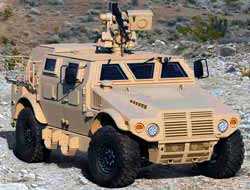
The finalist to be selected at the end of this phase could win orders to deliver more than 60,000 armored vehicles over an eight year span augmenting and replacing part of the 160,000 HMMWVs currently in service with U.S. armed services.
General Tactical Vehicles, Sterling Heights, Mich., was awarded Oct. 29, 2008 a $45,061,720 cost share contract for Joint Light Tactical Vehicle Family of Vehicles technology development phase. Work will be performed in Livonia, Mich., Sterling Heights, Mich., Muskegon, Mich., and South Bend, Ind., with an estimated completion date of Jan. 31, 2011. Bids were solicited via the Web with seven bids received.Tank & Automotive Command, Warren, Mich., is the contracting activity ((W56HZV-08-C-0430).
General Tactical Vehicles is a joint venture between AM General and General Dynamics Land Systems, a business unit of General Dynamics (NYSE: GD), formed to provide the U.S. Army and U.S. Marine Corps a low-risk, affordable, technically advanced and economically sustainable solution to their Joint Light Tactical Vehicle requirements.
The GTV JLTV solution will provide the U.S. Army and Marine Corps with a family of more survivable vehicles with greater protection, payload and mobility than the High Mobility Multipurpose Wheeled Vehicle (HMMWV). The innovative GTV JLTV design features a robust light-weight hybrid hull, semi-active suspension system, digital cockpit, and over 95 percent common components across the entire JLTV family of vehicles.
Key deliverables under the JLTV TD contract include seven vehicles and four trailers representing the three mission role variants (infantry, general purpose, utility) comprising the JLTV Family of Vehicles; designs for each of 10 sub-configurations; and ballistic hulls and sample armor components for government testing.
“The GTV solution meets or exceeds the JLTV protection, payload and performance requirements, offering a low-risk, innovative, adaptable family of vehicles and trailers with commonality of components exceeding 95 percent, resulting in speed to production and low life-cycle cost,” said Don Howe, GTV senior program director.
“The GTV JLTV design ensures capability growth opportunities and planned product improvements and the GTV Team’s significant experience with deployed global forces provides a unique and valuable insight to the needs of the warfighter. The GTV Team offers our customer the optimum combination of survivability, innovation, performance, reliability, supportability and affordability,” said Howe.
“The GTV Team is very appreciative of the confidence that the Army and Marines have shown in our JLTV solution and joint capabilities. GTV offers a full-spectrum combat and tactical platform capable team, with the strength of more than 120 years of combined experience in the design, production and global support of over one million combat and tactical vehicles,” Howe said.
BAE Systems Land & Armaments-Grounds System Division, Santa Clara, Calif., was awarded Oct. 29, 2008 a $40,493,203 cost share contract for Joint
Light Tactical Vehicle (JLTV) Family of Vehicles technology development phase. Work will be performed in Santa Clara, Calif., Warrenville, Ill., Johnson City, N.Y., and Troy, Mich., with an estimated completion date of Jan. 31, 2011. Bids were solicited via the Web with seven bids received. Tank & Automotive Command, Warren, Mich., is the contracting activity ((W56HZV-08-C-0426).
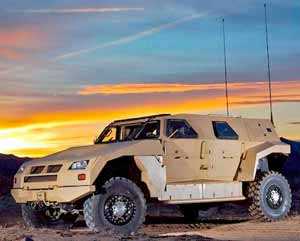
The BAE Systems-Navistar JLTV proposal is named the Valanx. Valanx is a family of v-hulled, blast-resistant vehicles that optimize what's referred to as the "iron triangle" – payload, protection and performance – to meet all requirements of the JLTV program. There are several variations of the Valanx designed to meet scouting, general mobility, infantry carrying, ambulatory and other needs for combat troops.
Vehicle models for the various Valanx variations will be designed and fabricated during 2009 and tested in 2010, leading to the selection of two teams for a JLTV system development and demonstration (SDD, Milestone B) in 2011.
"We believe the Valanx provides the foundation for a family of vehicles that will offer unmatched strength, protection and support for the Warfighter for decades to come," said Kevin Thomas, director, product creation for Navistar Defense, an affiliate of Navistar International Corporation. "Our team is eager to move forward and continue our partnership with the Joint Services as they determine the best tactical vehicle solution for our men and women in uniform.” The Valanx design incorporates lessons learned from the U.S. Department of Defense's Mine Resistant Ambush Protected (MRAP) vehicle program and features the latest in lightweight, advanced armor and a v-shaped hull design to provide unmatched crew protection. The vehicle will out-perform existing tactical systems by providing exportable power that exceeds JLTV requirements and existing MRAP capabilities. Its modular design maximizes commonality across JLTV variants and enables the seamless integration of future technologies.
The team unveiled its first Valanx prototype in February 2008.
The BAE Systems Ground Systems-Navistar team builds off the two company’s current leadership in armored and tactical vehicle development and support, which includes the team working together for the benefit of the joint U.S. customer on programs like MRAP. Combined, the BAE Systems Ground Systems-Navistar team maximizes JLTV program value through proven capabilities, lean manufacturing and extensive worldwide logistics support.
The team also includes Arvin Meritor to manufacture the lightweight independent suspension and drivetrain solutions for the Valanx. The company is a leading designer and manufacturer of automotive advanced mobility systems and is the largest axle supplier to the U.S. military.
The BAE Systems-Navistar team draws on top talent from across the country. Sites participating in the development include: York, Pennsylvania; Ontario, San Diego and Santa Clara, California; Dearborn Heights, Sterling Heights and Troy, Michigan; Minneapolis, Minnesota; Johnson City, New York; Austin, Texas; Nashua, Hew Hampshire; Reston, Virginia; Melrose Park and Warrenville, Illinois; Fort Wayne, Indiana; West Point, Mississippi; Huntsville, Alabama; and Laurinberg and York, South Carolina.
Lockheed Martin Systems Integration, Owego, N.Y., was awarded Oct. 29, 2008, a $35,942,059 cost plus fixed fee contract. The contract is for Joint Light Tactical Vehicle (JLTV) Family of Vehicles technology development phase. Work will be performed in Owego, N.Y., and Sealy, Texas with an estimated completion date of Jan. 31, 2011. Bids were solicited via the Web with seven bids received.Tank & Automotive Command, Warren, Mich., is the contracting activity (W56HZV-08-C-0431).
“We are honored that trust has been placed in Lockheed Martin and our JLTV Team to continue development of this vital program,” said Louis DeSantis, vice president and general manager of Ground Vehicle Systems at Lockheed Martin. “We are committed to meeting the demanding program requirements and providing the lowest-risk, most technically innovative vehicle that serves our Soldiers and Marines.”
The technology development contract will be 27 months in duration. The first 15 months require competitors to develop and deliver seven JLTV variants, four trailers, four blast hulls, and ballistic panels that will be used for testing. The remaining 12 months are scheduled for government testing. The Technology Development phase will then be followed by a Systems Design and Development phase and, later, by a production contract.
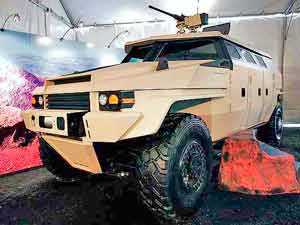
Lockheed Martin currently has three operational prototypes: the JLTV Category B model, which is designed as an infantry carrier and was unveiled in October 2007; the Utility Vehicle Light Category C model, which is designed with a focus on payload and was introduced in February 2008; and the General Purpose Mobility Category A model, which was unveiled earlier this month at the Association of the United States Army’s Annual Meeting and Exhibition.
Lockheed Martin is currently in the process of building its fourth JLTV prototype, an additional variant of the Infantry Carrier, and anticipates completing production in November.
The Lockheed Martin-led JLTV Team includes:
*BAE Systems Mobility & Protection Systems, providing advanced armor solutions and production facilities for high volume assembly;
*Alcoa Defense, supplying materials experience, design services and aluminum components that give the vehicle its structural strength at reduced weight; and
*JWF – Defense Systems, offering state-of-the-art machining and cost-effective fabrication.
Lockheed Martin serves as the prime contractor and design agent, providing systems engineering, platform integration, design expertise, and program and supply chain management.
 25 today announced that the Royal Netherlands Navy has successfully test-launched two Boeing Harpoon missiles from air defense and command frigate (LCF) HMS De Zeven Provinciën. The exercise, which was the first LCF launch of a Harpoon, was held off the coast of Virginia on Nov. 8.
In the exercise scenario, a hostile ship attacked the Dutch frigate, which responded with a salvo of two Harpoon Block IC missiles, marking the first time the Dutch Navy has launched multiple Harpoons on a single target. Both Harpoons hit and destroyed the target. The Netherlands has been a Harpoon customer since 1975.
"We are extremely pleased with the performance of the Harpoon Weapon System during this test, and we congratulate the Royal Netherlands Navy on achieving this new milestone," said Jan Browne, Boeing director of Stand-Off Strike Weapons. "Harpoon is an extremely reliable weapon system in use by the United States and 27 allied countries. We are proud of Boeing Weapons Programs' 33-
25 today announced that the Royal Netherlands Navy has successfully test-launched two Boeing Harpoon missiles from air defense and command frigate (LCF) HMS De Zeven Provinciën. The exercise, which was the first LCF launch of a Harpoon, was held off the coast of Virginia on Nov. 8.
In the exercise scenario, a hostile ship attacked the Dutch frigate, which responded with a salvo of two Harpoon Block IC missiles, marking the first time the Dutch Navy has launched multiple Harpoons on a single target. Both Harpoons hit and destroyed the target. The Netherlands has been a Harpoon customer since 1975.
"We are extremely pleased with the performance of the Harpoon Weapon System during this test, and we congratulate the Royal Netherlands Navy on achieving this new milestone," said Jan Browne, Boeing director of Stand-Off Strike Weapons. "Harpoon is an extremely reliable weapon system in use by the United States and 27 allied countries. We are proud of Boeing Weapons Programs' 33- year relationship with the Netherlands."
Boeing has delivered more than 7,000 missiles to U.S. and allied navies. The Harpoon Block I missile is capable of flying in excess of 67 nautical miles and carries a 500-pound warhead. In 2001, Boeing delivered the first Harpoon Block II missile, which incorporates a Global Positioning System navigation system to provide autonomous, over-the-horizon capabilities, even in adverse weather. The Harpoon Block III missile, which includes a data link system for in-flight target updates, is currently in development.
year relationship with the Netherlands."
Boeing has delivered more than 7,000 missiles to U.S. and allied navies. The Harpoon Block I missile is capable of flying in excess of 67 nautical miles and carries a 500-pound warhead. In 2001, Boeing delivered the first Harpoon Block II missile, which incorporates a Global Positioning System navigation system to provide autonomous, over-the-horizon capabilities, even in adverse weather. The Harpoon Block III missile, which includes a data link system for in-flight target updates, is currently in development.


 The steering system for the rig is a two-axle Ackerman (front and rear) with integral hydraulic with dual steering gears on the front axle (20.1:1 front steering gear ratio, 25.0:1 rear steering gear ratio and 2.21:1 rear steering reduction ratio).
The suspension system in the front is a Hendrickson parabolic taper leaf spring and in the rear is a Tridem Hendrickson-Turner air ride. The 1070F has an auxiliary diesel power pack consisting of a Lister Petter LPA2 twin-cylinder direct-injection diesel to provide backup hydraulic power for adjustment of the live 'Hydroneck', power steering system balance pressure adjustment and power override, and the suspension system raise / lower facility. This can also be used in a cold start for the main engine.
The steering system for the rig is a two-axle Ackerman (front and rear) with integral hydraulic with dual steering gears on the front axle (20.1:1 front steering gear ratio, 25.0:1 rear steering gear ratio and 2.21:1 rear steering reduction ratio).
The suspension system in the front is a Hendrickson parabolic taper leaf spring and in the rear is a Tridem Hendrickson-Turner air ride. The 1070F has an auxiliary diesel power pack consisting of a Lister Petter LPA2 twin-cylinder direct-injection diesel to provide backup hydraulic power for adjustment of the live 'Hydroneck', power steering system balance pressure adjustment and power override, and the suspension system raise / lower facility. This can also be used in a cold start for the main engine.
 The RG33 is manufactured in several configurations including the category I 4×4, category II 6×6, the heavy armored ground ambulance (HAGA) and the special operations command (SOCOM) vehicle. The RG33 series is in the medium weight class, providing survivability, advanced mobility, mission flexibility, rapid availability and vehicle commonality.
The initial contract for the USMC was placed in January 2007 for two 4×4 and two 6×6 RG33 vehicles. In February 2007, the USMC ordered 15 RG33 category I 4×4 and 75 category II MRAP vehicles.
"The RG33 is a family of mine-protected ambush vehicles manufactured by BAE Systems."
In June 2007, BAE Systems was awarded a contract for 425 category I and 16 category II. In October 2007, the USMC ordered 399 category II MRAP, 112 category II ambulances and 89 SOCOM vehicles.
In August 2008, the US Marine Corps placed a $43.5m contract on BAE Systems for 40 RG33 MRAP vehicles: 36 special operations command variants, two RG33 MRAP category II 6×6 variants, and two category II HAGAs. In June 2008, BAE Systems was awarded a $53m contract for 40 SOCOM MRAP vehicles.
The RG33 vehicle hull production is being carried out at BAE Systems' York, Pennsylvania, facility and final assembly, integration, and test is carried out at the Letterkenny Army Depot (LEAD) in Chambersburg, Pennsylvania.
The RG33 is manufactured in several configurations including the category I 4×4, category II 6×6, the heavy armored ground ambulance (HAGA) and the special operations command (SOCOM) vehicle. The RG33 series is in the medium weight class, providing survivability, advanced mobility, mission flexibility, rapid availability and vehicle commonality.
The initial contract for the USMC was placed in January 2007 for two 4×4 and two 6×6 RG33 vehicles. In February 2007, the USMC ordered 15 RG33 category I 4×4 and 75 category II MRAP vehicles.
"The RG33 is a family of mine-protected ambush vehicles manufactured by BAE Systems."
In June 2007, BAE Systems was awarded a contract for 425 category I and 16 category II. In October 2007, the USMC ordered 399 category II MRAP, 112 category II ambulances and 89 SOCOM vehicles.
In August 2008, the US Marine Corps placed a $43.5m contract on BAE Systems for 40 RG33 MRAP vehicles: 36 special operations command variants, two RG33 MRAP category II 6×6 variants, and two category II HAGAs. In June 2008, BAE Systems was awarded a $53m contract for 40 SOCOM MRAP vehicles.
The RG33 vehicle hull production is being carried out at BAE Systems' York, Pennsylvania, facility and final assembly, integration, and test is carried out at the Letterkenny Army Depot (LEAD) in Chambersburg, Pennsylvania.

 The RG33 6×6 is a proven, survivable, blast-protected vehicle that can operate in explosive hazardous environments, carrying out missions such as route and area clearance, explosive hazards reconnaissance and explosive ordnance disposal operations. Troop-friendly features include large ballistic windows, a rear ramp for rapid entry and exit of the crew and robotic systems. A common weapon ring may be mounted to the rooftop for integration of a wide variety of weapon systems, to include the army's gunner protection kit.
The modular RG33 6×6 vehicle is mission adaptable, with roles including infantry carrier, explosive ordnance disposal (EOD), convoy protection, weapons carrier, utility, command and control, communications shelter and ambulance.
Optional equipment for the RG33 6×6 includes add-on armour, hydraulic rear ramp, medical equipment, explosives ordnance disposal arm, 6kW auxiliary power unit, 120/240 AC import / export power, secondary battery suite, thermal driver's vision enhancer, tail-light camera, central tire inflation system, transparent armour gun shield and a remote weapons station.
The RG33 6×6 is a proven, survivable, blast-protected vehicle that can operate in explosive hazardous environments, carrying out missions such as route and area clearance, explosive hazards reconnaissance and explosive ordnance disposal operations. Troop-friendly features include large ballistic windows, a rear ramp for rapid entry and exit of the crew and robotic systems. A common weapon ring may be mounted to the rooftop for integration of a wide variety of weapon systems, to include the army's gunner protection kit.
The modular RG33 6×6 vehicle is mission adaptable, with roles including infantry carrier, explosive ordnance disposal (EOD), convoy protection, weapons carrier, utility, command and control, communications shelter and ambulance.
Optional equipment for the RG33 6×6 includes add-on armour, hydraulic rear ramp, medical equipment, explosives ordnance disposal arm, 6kW auxiliary power unit, 120/240 AC import / export power, secondary battery suite, thermal driver's vision enhancer, tail-light camera, central tire inflation system, transparent armour gun shield and a remote weapons station.
 "The RG33 series provides a large volume under armour to provide maximum troop-carrying capacity."
A common weapon ring is mounted to the rooftop for integration of a wide variety of weapon systems, including the army's gunner protection kit, or remote weapon systems.
The modularity allows the vehicle to be adaptable for multiple missions including reconnaissance, tube-launched, optically tracked, wire-guided weapon systems (TOW ) / improved target acquisition system (ITAS) / long-range acquisition / surveillance system (LRAS), weapons carrier, utility and convoy protection.
Optional equipment is the same as for the 6×6, with the exception of the ordnance disposal arm.
Mine-resistant recovery and maintenance vehicle (MRRMV)
A new variant of the RG33 is the mine-resistant recovery and maintenance vehicle (MRRMV) for retrieval and repair of disabled mine-resistant ambush-protected vehicles, medium mine-protected vehicles and other medium tactical vehicles in combat situations.
The MRRMV has a two-man crew and carries equipment and spare parts to conduct on-site vehicle repairs. The vehicle supports field maintenance tasks that require lifting, welding, cutting and heating and has the capacity to carry two recovered crew and combat spares. The MRRMV was first shown at the Association of the US Army's (AUSA) winter symposium in Ft Lauderdale, Florida, in February 2008.
"The RG33 series provides a large volume under armour to provide maximum troop-carrying capacity."
A common weapon ring is mounted to the rooftop for integration of a wide variety of weapon systems, including the army's gunner protection kit, or remote weapon systems.
The modularity allows the vehicle to be adaptable for multiple missions including reconnaissance, tube-launched, optically tracked, wire-guided weapon systems (TOW ) / improved target acquisition system (ITAS) / long-range acquisition / surveillance system (LRAS), weapons carrier, utility and convoy protection.
Optional equipment is the same as for the 6×6, with the exception of the ordnance disposal arm.
Mine-resistant recovery and maintenance vehicle (MRRMV)
A new variant of the RG33 is the mine-resistant recovery and maintenance vehicle (MRRMV) for retrieval and repair of disabled mine-resistant ambush-protected vehicles, medium mine-protected vehicles and other medium tactical vehicles in combat situations.
The MRRMV has a two-man crew and carries equipment and spare parts to conduct on-site vehicle repairs. The vehicle supports field maintenance tasks that require lifting, welding, cutting and heating and has the capacity to carry two recovered crew and combat spares. The MRRMV was first shown at the Association of the US Army's (AUSA) winter symposium in Ft Lauderdale, Florida, in February 2008.