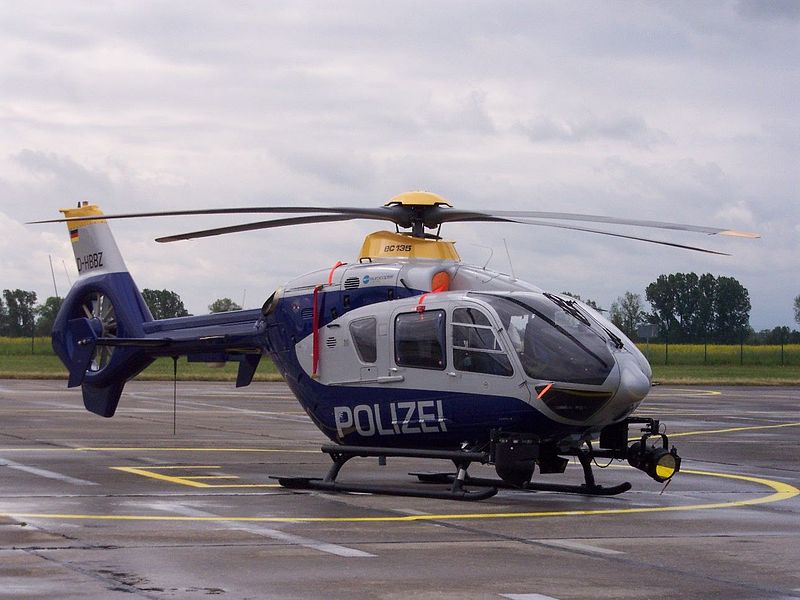
 (Photo/Image: Eurocopter EC135 P2 of the German Police). The EC 135 is a twin-engine civil helicopter produced by Eurocopter, widely used amongst police and ambulance services, and for executive transport. It is capable of flight under instrument flight rules (IFR). The EC135 can trace its history back to before the formation of Eurocopter. It was started as the BO 108 by MBB of Germany in the mid-eighties. A technology demonstrator ('V1') flew for the first time on 17 October 1988, powered by two Allison 250-C20R/1 engines. A second BO 108 ('V2') followed on 5th June 1991, this time with two Turboméca TM319-1B Arrius engines. Both these machines had a conventional tail rotor.
Japan buys most of its military equipment from the United States, with which it has a security alliance.
Eurocopter, part of the European Aeronautic Defence and Space Company, which includes Airbus, was bidding for the contract against British-Italian firm AgustaWestland.
French Transport Minister Dominique Bussereau, visiting Tokyo for talks on global warming, welcomed the deal.
"I have thanked Japan," Bussereau said. "This is a very major contract as it marks the first time that Eurocopter has signed a contract with the Japanese navy."
Eurocopter has sold choppers in Japan since 1964 but until now has sold only for civilian use.
The value of the contract has yet to be decided. Industrial sources said Japan would initially buy two choppers, but that the order could go up to 15.
The order comes as a European consortium including EADS tries to sell to Japan its Eurofighter jets.
Japan has been seeking the next-generation U.S. F-22A Raptor, which can evade radar detection at supersonic speeds. But the U.S. Congress forbids any exports of the advanced stealth jets.
Friday, January 16, 2009
Japan Places First Order With Eurocopter / Japan Military Picks Eurocopter EC135 Helicopters For First Time: Official
Japan Places First Order With Eurocopter / Japan Military Picks Eurocopter EC135 Helicopters For First Time: Official
(NSI News Source Info) TOKYO - January 16, 2009: Japan's military will for the first time buy helicopters from Eurocopter, ordering training choppers from the unit of European aerospace giant EADS, officials said Jan. 16.
Japan's defense ministry said on its Web site that it selected the EC135 Eurocopter as part of "bidding for training helicopters for the Maritime Self-Defence Forces," pacifist Tokyo's official name for its navy. (Photo/Image: Eurocopter EC135 P2 of the German Police). The EC 135 is a twin-engine civil helicopter produced by Eurocopter, widely used amongst police and ambulance services, and for executive transport. It is capable of flight under instrument flight rules (IFR). The EC135 can trace its history back to before the formation of Eurocopter. It was started as the BO 108 by MBB of Germany in the mid-eighties. A technology demonstrator ('V1') flew for the first time on 17 October 1988, powered by two Allison 250-C20R/1 engines. A second BO 108 ('V2') followed on 5th June 1991, this time with two Turboméca TM319-1B Arrius engines. Both these machines had a conventional tail rotor.
Japan buys most of its military equipment from the United States, with which it has a security alliance.
Eurocopter, part of the European Aeronautic Defence and Space Company, which includes Airbus, was bidding for the contract against British-Italian firm AgustaWestland.
French Transport Minister Dominique Bussereau, visiting Tokyo for talks on global warming, welcomed the deal.
"I have thanked Japan," Bussereau said. "This is a very major contract as it marks the first time that Eurocopter has signed a contract with the Japanese navy."
Eurocopter has sold choppers in Japan since 1964 but until now has sold only for civilian use.
The value of the contract has yet to be decided. Industrial sources said Japan would initially buy two choppers, but that the order could go up to 15.
The order comes as a European consortium including EADS tries to sell to Japan its Eurofighter jets.
Japan has been seeking the next-generation U.S. F-22A Raptor, which can evade radar detection at supersonic speeds. But the U.S. Congress forbids any exports of the advanced stealth jets.
(Photo/Image: Eurocopter EC135 P2 of the German Police). The EC 135 is a twin-engine civil helicopter produced by Eurocopter, widely used amongst police and ambulance services, and for executive transport. It is capable of flight under instrument flight rules (IFR). The EC135 can trace its history back to before the formation of Eurocopter. It was started as the BO 108 by MBB of Germany in the mid-eighties. A technology demonstrator ('V1') flew for the first time on 17 October 1988, powered by two Allison 250-C20R/1 engines. A second BO 108 ('V2') followed on 5th June 1991, this time with two Turboméca TM319-1B Arrius engines. Both these machines had a conventional tail rotor.
Japan buys most of its military equipment from the United States, with which it has a security alliance.
Eurocopter, part of the European Aeronautic Defence and Space Company, which includes Airbus, was bidding for the contract against British-Italian firm AgustaWestland.
French Transport Minister Dominique Bussereau, visiting Tokyo for talks on global warming, welcomed the deal.
"I have thanked Japan," Bussereau said. "This is a very major contract as it marks the first time that Eurocopter has signed a contract with the Japanese navy."
Eurocopter has sold choppers in Japan since 1964 but until now has sold only for civilian use.
The value of the contract has yet to be decided. Industrial sources said Japan would initially buy two choppers, but that the order could go up to 15.
The order comes as a European consortium including EADS tries to sell to Japan its Eurofighter jets.
Japan has been seeking the next-generation U.S. F-22A Raptor, which can evade radar detection at supersonic speeds. But the U.S. Congress forbids any exports of the advanced stealth jets.

South Korea Seeks To Buy Older Apaches Attack Helicopters / South Korea Plans To Buy An Additional Batch Of Older Apaches Attack Helicopters
South Korea Seeks To Buy Older Apaches Attack Helicopters / South Korea Plans To Buy An Additional Batch Of Older Apaches Attack Helicopters
(NSI News Source Info) SEOUL - January 16, 2009: South Korea's arms procurement agency has been in close consultation with the U.S. government to purchase 36 refurbished Apache attack helicopters to deploy in 2012, when South Korean commanders take over wartime operational control of their troops from the U.S. military, a source said Jan. 14.
The Defense Acquisition Program Administration (DAPA) wants to receive the first batch of 18 Block II Apache Longbow models modified from the Block I standard in 2012, and the second batch of the older units, dubbed MIMEX, in 2014, said the source privy to negotiations.
The AH-64 Apache is an all-weather day-night military attack helicopter with a four-bladed main and tail rotor and a crew of two pilots who sit in tandem. The main fixed armament is a 30 mm M230 Chain Gun under the aircraft's nose. It can also carry a mixture of AGM-114 Hellfire and Hydra 70 rocket pods on four hardpoints mounted on its stub-wing pylons. The AH-64 is the principal attack helicopter of the United States Army, and a successor to the AH-1 Cobra.
In a related move, the agency plans to start a feasibility study this month on the acquisition of Apaches, he said.
The moves follow U.S. Forces Korea (USFK)'s announcement in November that it will pull a fleet of 24 Apache helicopters out of the Korean Peninsula in March for rotational deployment to Iraq or Afghanistan this fall.
Public jitters have grown here since then over a possible security vacuum, as the U.S. Apache units are in charge of key missions to deter North Korean armored units in case of war.
"I heard that DAPA's international product team is receptive to the U.S. Army Apache program manager meeting with DAPA and also with JUSMAG-K, and that there is strong interest in 18 MIMEX in 2012 and 18 more in 2014,'' the source said on condition of anonymity.
JUSMAG-K refers to the Joint U.S. Military Affairs Group-Korea, which coordinates South Korean purchases of U.S. weapons through the Pentagon's government-to-government Foreign Military Sales program.
The DAPA has shown interest in Block II models, so the U.S. government may want Boeing to do the upgrade, he said.
The source, however, said the agency was still "keeping all options open," including the introduction of the up-to-date AH-64D Apache Longbow heavy attack helicopters through a commercial deal with Boeing, given the proposed refurbishment would cost more than buying new models.
"I'm sure the ROK Army wants the latest and greatest, but also wants capability fast. It also must be affordable. These are the issues,'' he said.
To help boost the Army's independent anti-tank and fire support capabilities after the wartime control transition, South Korea has pushed to buy the older Apaches, separately from the Korea Attack Helicopter project aimed at building an indigenous helicopter with technological support from foreign helicopter manufacturers.
Last year, the two governments opened negotiations over the MIMEX program, with the United States offering for sale about 260 Block I Apaches available for upgrades, according to the JUSMAG-K.
South Korea proposed that the U.S. government sell 36 second-hand Apaches for about 1 trillion won ($744 million), and said later that it would make a final decision as late as August, according to JUSMAG-K officials.
The Apache Longbow is armed with AGM-114 Hellfire air-to-surface missiles, AIM-9 Sidewinder air-to-air missiles and Hydra 70 laser-guided rockets. Their main missions are to help prevent North Korean special forces from infiltrating the South by sea and neutralize North Korean armored units crossing the military demarcation line in case of war.
The USFK maintains two Apache battalions here.
On Jan. 12, U.S. and South Korean military officials announced that 12 F-16 fighter jets would temporarily replace the departing Apache battalion. Previously, the USFK said 12 A-10 attack aircraft would replace the Apaches' air-to-ground and close-air-support missions.
Col. Mike Chandler, chief of staff of the U.S. 7th Air Force, said the change of plans was due to "a structural issue'' with the A-10's airframe.
"The air-to-ground mission and the close-air-support mission are primarily to support the soldiers on the ground,'' Chandler said. "Helicopters, the A-10 platform and the F-16 platform are all capable of performing that mission."
Despite USFK's explanations, critics here say the "flip-flop" could cause a security vacuum due to different mission capabilities between Apaches and F-16s.
Some experts say F-16s are outstanding performers but not well suited for conducting missions against enemy tanks at low air speeds and altitude. They also speculate the F-16 deployment signals USFK's mission shift to an air- and naval-centric support of South Korean troops after the transition to wartime operational control in 2012.
"The F-16's combat-proven record is well known and will provide an enhanced deterrent capability on the Korean Peninsula," USFK Commander Gen. Walter Sharp said in a press release. "This deployment also increases Republic of Korea-United States training opportunities, which further strengthens Combined Forces Command's ability to defeat any North Korean aggression."
According to the release, the F-16 is a multirole fighter capable of conducting a broad range of missions, including close air support, precision strike and counter-air.
Zimbabwe Plans To Unveil 100 Trillion Dollar Note / Zimbabwe Rolls Out Z$100 Trillion Note
Zimbabwe Plans To Unveil 100 Trillion Dollar Note / Zimbabwe Rolls Out Z$100 Trillion Note
(NSI News Source Info) January 16, 2009: The Reserve Bank of Zimbabwe said on Friday it was introducing a 100 trillion Zimbabwe dollar bill as part of anti-inflation measures, the African Press Agency reported.
The new note is worth about 300 U.S. dollars on the black market.
The agency said Zimbabwe was also introducing 10 trillion, 20 trillion and 50 trillion Zimdollar notes.
The move set to provide easier access for workers to their salaries from banks comes just four days after the country circulated 50 billion Zimdollar bills on Monday amid the deepening economic crisis.
Zimbabwe's inflation is officially put at 231 million %, while independent financial institutions it could be estimated at more than 500 quintillion %.
The extended economic crisis has devastated Zimbabwe's healthcare system, leaving the country virtually incapable of dealing with a cholera epidemic that has already killed over 2,100 people.
Info) January 16, 2009: The Reserve Bank of Zimbabwe said on Friday it was introducing a 100 trillion Zimbabwe dollar bill as part of anti-inflation measures, the African Press Agency reported.
The new note is worth about 300 U.S. dollars on the black market.
The agency said Zimbabwe was also introducing 10 trillion, 20 trillion and 50 trillion Zimdollar notes.
The move set to provide easier access for workers to their salaries from banks comes just four days after the country circulated 50 billion Zimdollar bills on Monday amid the deepening economic crisis.
Zimbabwe's inflation is officially put at 231 million %, while independent financial institutions it could be estimated at more than 500 quintillion %.
The extended economic crisis has devastated Zimbabwe's healthcare system, leaving the country virtually incapable of dealing with a cholera epidemic that has already killed over 2,100 people.
Russian Military Spending To Reach $125 Billion By 2011
Russian Military Spending To Reach $125 Billion By 2011
(NSI News Source Info) MOSCOW - January 16, 2009: The state will earmark 4 trillion rubles ($125 billion) for arms procurements by 2011, including 1 trillion rubles ($31 billion) in 2009, the Russian prime minister said on Thursday.
Vladimir Putin said the modernization of defense related enterprises would continue despite the global financial crisis.
"The modernization of defense industry enterprises as well as the development of modern weapons should continue," he said.
He added that federal defense programs need to be reviewed and "streamlined," in particular with regard to production volumes.
Russian Finance Minister Alexei Kudrin said earlier on Thursday the state had earmarked $10 billion for 'core enterprises' and defense-related sectors of industry.
4 trillion rubles ($125 billion) for arms procurements by 2011, including 1 trillion rubles ($31 billion) in 2009, the Russian prime minister said on Thursday.
Vladimir Putin said the modernization of defense related enterprises would continue despite the global financial crisis.
"The modernization of defense industry enterprises as well as the development of modern weapons should continue," he said.
He added that federal defense programs need to be reviewed and "streamlined," in particular with regard to production volumes.
Russian Finance Minister Alexei Kudrin said earlier on Thursday the state had earmarked $10 billion for 'core enterprises' and defense-related sectors of industry.
Sudan Fears US Military Intervention Over Darfur / Sudan Increasingly Fearful US Will Resort To Military Intervention
Sudan Fears US Military Intervention Over Darfur / Sudan Increasingly Fearful US Will Resort To Military Intervention
(NSI News Source Info) January 16, 2009: Sudan's government is increasingly fearful that the incoming US administration will resort to military intervention to end the six-year-old crisis in Darfur that has killed up to 200,000 people and left 2.7 million homeless, diplomatic sources in Khartoum say.
"There is a great need for us to sound the alarm again about Darfur," Hillary Clinton, who was endorsed as secretary of state yesterday, told the US Senate this week. "It is a terrible humanitarian crisis compounded by a corrupt and very cruel regime in Khartoum."
Clinton said the Obama administration, which takes office on Tuesday, was examining a wide range of options, including direct intervention in support of a joint UN-African Union peacekeeping force, known as Unamid, which has struggled to make an impact after beginning operations last year.
"We have spoken about other options, no-fly zones, other sanctions and sanctuaries, looking to deploy the Unamid force to try to protect the refugees but also to repel the militias," Clinton said. "There is a lot under consideration." Clinton has previously asserted that the US has a "moral duty" to help Darfurian civilians.
The US accuses Khartoum's leadership of committing genocide in Darfur. Washington has eschewed direct military involvement since the crisis erupted in 2003, despite growing pressure to act from Sudanese insurgents, exiles, and evangelical Christian groups.
But in a surprise move last week, President George Bush ordered the Pentagon to begin an immediate airlift of vehicles and equipment for the peacekeeping force.
Alain LeRoy, head of UN peacekeeping operations, told the Security Council last month that violence in Darfur was intensifying and stepped-up international involvement was urgently required to avoid a descent into "mayhem".
Influential US-based pressure groups such as the Save Darfur Coalition and Enough are meanwhile demanding that US president-elect Barack Obama act swiftly to fulfil campaign pledges to take more robust action.
"I will make ending the genocide in Darfur a priority from day one," Obama said in April. He has also previously backed a toughening of sanctions and said the US might help enforce a no-fly zone.
"Obama is the [ruling] National Congress party's worst nightmare," said a diplomat in Khartoum. "They wanted [John] McCain and the Republicans to win. They thought they were pragmatists. They think the Democrats are ideologues. They haven't forgotten it was the Democrats who bombed them."
That was a reference to a retaliatory US cruise missile attack on a suspect pharmaceutical factory in Khartoum in 1998, ordered by President Bill Clinton after al-Qaida attacked US embassies in Kenya and Tanzania. Sudan provided a base for the al-Qaida leader, Osama bin Laden, from 1991 until he moved to Afghanistan in 1996.
A source in Khartoum said Sudan's president, Omar al-Bashir, was especially alarmed by Obama's selection of Susan Rice, a former Clinton national security council adviser on Africa, as a cabinet member and US ambassador to the UN.
Rice has spoken passionately in the past of the need for US or Nato air strikes, or a naval blockade of Sudan's oil exports, to halt the violence in Darfur.
Referring to the 1994 Rwanda genocide, she said: "I swore to myself that if I ever faced such a crisis again, I would come down on the side of dramatic action, going down in flames if that was required."
Bashir felt only "fear and loathing" for Rice and had told aides: "I don't want to see her face here," the source said.
Khartoum's concerns about American intervention extend to southern Sudan, fuelled by reports, denied by the US, that Washington is arming the separatist Sudan People's Liberation Army.
The SPLA is the military wing of the Sudan People's Liberation Movement with which the north fought a 30-year civil war. Salva Kiir, the SPLM leader and Bashir's likely rival in elections due later this year, received red carpet treatment by Bush at the White House last week.
"The government knows the US does not arm the SPLA. They're already heavily armed," a Khartoum-based diplomat said. "But the US does train them. It helps with logistics, planning, and so on. And they (the SPLA) do need air defence. Whether to provide air defence to the south will be a key question for the Obama administration."
Fears of direct confrontation with Washington are being fuelled by expectations that the International Criminal Court, backed in this instance by the US, will issue an arrest warrant for Bashir within the coming weeks. The ICC chief prosecutor charged Bashir last year with genocide, war crimes and crimes against humanity relating to Darfur.
A call this week by a leading Sudanese opposition figure, Hassan al-Turabi, for Bashir to surrender himself to the ICC to avoid further confrontation with the US and the west has added to tensions in Khartoum. According to family members, Turabi was subsequently arrested.
Info) January 16, 2009: Sudan's government is increasingly fearful that the incoming US administration will resort to military intervention to end the six-year-old crisis in Darfur that has killed up to 200,000 people and left 2.7 million homeless, diplomatic sources in Khartoum say.
"There is a great need for us to sound the alarm again about Darfur," Hillary Clinton, who was endorsed as secretary of state yesterday, told the US Senate this week. "It is a terrible humanitarian crisis compounded by a corrupt and very cruel regime in Khartoum."
Clinton said the Obama administration, which takes office on Tuesday, was examining a wide range of options, including direct intervention in support of a joint UN-African Union peacekeeping force, known as Unamid, which has struggled to make an impact after beginning operations last year.
"We have spoken about other options, no-fly zones, other sanctions and sanctuaries, looking to deploy the Unamid force to try to protect the refugees but also to repel the militias," Clinton said. "There is a lot under consideration." Clinton has previously asserted that the US has a "moral duty" to help Darfurian civilians.
The US accuses Khartoum's leadership of committing genocide in Darfur. Washington has eschewed direct military involvement since the crisis erupted in 2003, despite growing pressure to act from Sudanese insurgents, exiles, and evangelical Christian groups.
But in a surprise move last week, President George Bush ordered the Pentagon to begin an immediate airlift of vehicles and equipment for the peacekeeping force.
Alain LeRoy, head of UN peacekeeping operations, told the Security Council last month that violence in Darfur was intensifying and stepped-up international involvement was urgently required to avoid a descent into "mayhem".
Influential US-based pressure groups such as the Save Darfur Coalition and Enough are meanwhile demanding that US president-elect Barack Obama act swiftly to fulfil campaign pledges to take more robust action.
"I will make ending the genocide in Darfur a priority from day one," Obama said in April. He has also previously backed a toughening of sanctions and said the US might help enforce a no-fly zone.
"Obama is the [ruling] National Congress party's worst nightmare," said a diplomat in Khartoum. "They wanted [John] McCain and the Republicans to win. They thought they were pragmatists. They think the Democrats are ideologues. They haven't forgotten it was the Democrats who bombed them."
That was a reference to a retaliatory US cruise missile attack on a suspect pharmaceutical factory in Khartoum in 1998, ordered by President Bill Clinton after al-Qaida attacked US embassies in Kenya and Tanzania. Sudan provided a base for the al-Qaida leader, Osama bin Laden, from 1991 until he moved to Afghanistan in 1996.
A source in Khartoum said Sudan's president, Omar al-Bashir, was especially alarmed by Obama's selection of Susan Rice, a former Clinton national security council adviser on Africa, as a cabinet member and US ambassador to the UN.
Rice has spoken passionately in the past of the need for US or Nato air strikes, or a naval blockade of Sudan's oil exports, to halt the violence in Darfur.
Referring to the 1994 Rwanda genocide, she said: "I swore to myself that if I ever faced such a crisis again, I would come down on the side of dramatic action, going down in flames if that was required."
Bashir felt only "fear and loathing" for Rice and had told aides: "I don't want to see her face here," the source said.
Khartoum's concerns about American intervention extend to southern Sudan, fuelled by reports, denied by the US, that Washington is arming the separatist Sudan People's Liberation Army.
The SPLA is the military wing of the Sudan People's Liberation Movement with which the north fought a 30-year civil war. Salva Kiir, the SPLM leader and Bashir's likely rival in elections due later this year, received red carpet treatment by Bush at the White House last week.
"The government knows the US does not arm the SPLA. They're already heavily armed," a Khartoum-based diplomat said. "But the US does train them. It helps with logistics, planning, and so on. And they (the SPLA) do need air defence. Whether to provide air defence to the south will be a key question for the Obama administration."
Fears of direct confrontation with Washington are being fuelled by expectations that the International Criminal Court, backed in this instance by the US, will issue an arrest warrant for Bashir within the coming weeks. The ICC chief prosecutor charged Bashir last year with genocide, war crimes and crimes against humanity relating to Darfur.
A call this week by a leading Sudanese opposition figure, Hassan al-Turabi, for Bashir to surrender himself to the ICC to avoid further confrontation with the US and the west has added to tensions in Khartoum. According to family members, Turabi was subsequently arrested.Russian Warship Leaves Cape Town For Indian Ocean
Russian Warship Leaves Cape Town For Indian Ocean
(NSI News Source Info) MOSCOW - January 16, 2009: The Pyotr Veliky nuclear-powered missile cruiser has left the South African port of Cape Town after a three-day visit, a Russian Navy spokesman said on Thursday.
"The Pyotr Veliky cruiser will continue its tour of duty, which includes taking part in joint naval exercises with the Indian navy, scheduled for the end of January," Capt. 1st Rank Igor Dygalo said.
INDRA is a biennial Russian-Indian exercise aimed at practicing cooperation in enforcing maritime law and countering piracy, terrorism and drug smuggling. INDRA-2009 is the fourth such exercise since 2003 and will involve a number of live-fire drills.
The Pyotr Veliky will join up with warships from the Pacific Fleet for the INDRA-2009 exercise. The Udaloy class destroyer Admiral Vinogradov, a tugboat and two fuel tankers are already in the Indian Ocean, having left Russia's Far East a month ago.
The Admiral Vinogradov destroyer has recently replaced the Neustrashimy (Fearless) missile frigate from Russia's Baltic Fleet in the Gulf of Aden protecting commercial shipping from pirate attacks off the Somali coast.
The International Maritime Bureau's piracy reporting center in Malaysia said on Wednesday that the destroyer helped foil a pirate attack on a Dutch container ship.
Info) MOSCOW - January 16, 2009: The Pyotr Veliky nuclear-powered missile cruiser has left the South African port of Cape Town after a three-day visit, a Russian Navy spokesman said on Thursday.
"The Pyotr Veliky cruiser will continue its tour of duty, which includes taking part in joint naval exercises with the Indian navy, scheduled for the end of January," Capt. 1st Rank Igor Dygalo said.
INDRA is a biennial Russian-Indian exercise aimed at practicing cooperation in enforcing maritime law and countering piracy, terrorism and drug smuggling. INDRA-2009 is the fourth such exercise since 2003 and will involve a number of live-fire drills.
The Pyotr Veliky will join up with warships from the Pacific Fleet for the INDRA-2009 exercise. The Udaloy class destroyer Admiral Vinogradov, a tugboat and two fuel tankers are already in the Indian Ocean, having left Russia's Far East a month ago.
The Admiral Vinogradov destroyer has recently replaced the Neustrashimy (Fearless) missile frigate from Russia's Baltic Fleet in the Gulf of Aden protecting commercial shipping from pirate attacks off the Somali coast.
The International Maritime Bureau's piracy reporting center in Malaysia said on Wednesday that the destroyer helped foil a pirate attack on a Dutch container ship.
Soviet Union/Russia Biggest User Of Helicopters In Military And Civilian Roles / Russia Biggest Exporter Of Helicopters To Other Countries
Soviet Union/Russia Biggest User Of Helicopters In Military And Civilian Roles / Russia Biggest Exporter Of Helicopters To Other Countries
(NSI News Source Info) January 16, 2009: A hundred years ago, the French Breguet brothers, borrowing a page the Wright brothers across the ocean, lifted off in a flying apparatus for the first time, thus marking the birth of the ‘vertical ascent plane.'
In Russia, it was Nikolai Kamov and Alexander Mil who designed helicopters. Kamov's company marks its 60 anniversary this year, while Mil is just one year older.
By competing and vying with each other, the two design bureaus have gained world fame: their 5,200 helicopters have flown in more than 80 countries; they also sport the flags of the UN and the Red Cross. The Mil outfit has produced 15 basic models and more than 200 versions. The Mi-28N Night Hunter is not an upgrade, but the first military helicopter on the post-Soviet space and the main combat vehicle for Russia's Defense Ministry.  The Mil Mi-28 NATO reporting name "Havoc" is a Russian all-weather day-night military tandem two-seat anti-armour attack helicopter. It is a dedicated attack helicopter with no intended secondary transport capability, better optimized than the Mil Mi-24 for the anti-tank role. It carries a single gun in an undernose barbette, plus external loads carried on pylons beneath stub wings. The Mi-28 has two heavily armoured cockpits, a nose full with electronic equipments, and a narrow-X tail rotor. Engines are two 2,200 hp Isotov TV-3-117VM (t/n 014) gas turbines. The X-type tail rotor (55 deg) has reduced noise characteristics. While the Mi-28 is not intended for use as a transport, it does have a small passenger compartment capable of carrying three persons. The planned purpose of this is to enable the rescue of downed helicopter crews.
The Kamov firm, starting with systems for the navy, has become the only company in the world to launch a serial production of ‘co-axial helicopters' (two counter-rotating blades give increased maneuverability and stability to the craft). And now recall the killing ability of Black Sharks, and the two-seater Alligator, which has a strike potential unequalled anywhere else in the world. It has an onboard digital computer, while pilots are provided with helmet-mounted target designators, thermal imagery technology.
In the post-Soviet period, the two firms experienced nasty bumps on the road to the free market. They paid exorbitant prices for materials and parts, and suffered arrears from customers. Meanwhile, the profit-bringing export flow must never flag, and besides Russian oil workers, rescue services, businesses and the military also need helicopters as good as those supplied to the West. The current demand for civilian helicopters alone is more than 2,000 units. But the industry has its specifics, Mikhail Kazachkov from the Helicopter Industry Association told RIA Novosti in an interview. Its bane is the lengthy production time: an idea to finished product takes, on average, 12 years.
The authorities have decided to restructure the helicopter industry, to optimize its cash flows and make it more competitive. For that purpose they brought its separate branches under one umbrella, called Helicopters of Russia. Reformers from the Industry and Trade Ministry and the Oboronprom Corporation are currently integrating the design bureaus, manufacturing facilities, and service centers more vigorously than in aircraft building. Things are moving toward the unification of research, technical and production policies. And in order to lay a good groundwork for continued efforts, a unified scientific and engineering council, and an innovation engineering center have been set up. According to Sergei Mikheyev, Kamov's general designer, a competitive and creative spirit, emphasis on extra-corporate aims, and the merging of the two teams, although seemingly paradoxical, have produced excellent results.
The reform pursues strategic aims: to make Russia the world leader in seven years, bring the output of helicopters to 450-500 units per year by 2015 (the current figure is 120), and to corner 15% of the world market, while increasing sales to 400 billion rubles. Asset concentration, effective management, and optimization of intellectual resources, production facilities and costs are the overriding objectives.
New projects have great importance as well. According to Andrei Shibitov, the head of Helicopters of Russia, the first project in the development program through 2015-2020 will be a basic high-speed helicopter: "Its concept is not just high speed, it is a combination of many new features." The second project will be a light helicopter in the weight class of 1.5 to 2.5 tons. "Today we are working on the Mi-34, but it is not a helicopter of the future. Western equipment compels us to go one better," he said. Designers are not going to catch up with the Robinson company, but are aiming at an entirely new product with an advanced Russian engine. The third project concerns helicopter gunships. Russia is not going to upgrade the Night Hunter or Alligator, but will develop whole new systems of the fifth generation. Finally, there will be a project to develop a multi-role unmanned aerial vehicle.
Different versions of the Ka-32 successfully operate in Canada, Korea, Chile, Mexico, Spain, Portugal, Japan and China. Contracts have been signed to supply Mi-24NPs to the Russian air force and Mi-35Ms to Venezuela. Work is under way on secret projects for security agencies.
Helicopters in Russia are a must, they provide transport services where there are no roads or waterways. According to the Industry and Trade Ministry, Russia has less than 14 civilian helicopters per one million of population, while in Canada the figure is 56; in the U.S., 40; and in Japan, 15.
Northrop Grumman Gets $374 Million U.S. Navy Deal / Northrop Grumman to Build New Gerald R. Ford-Class Aircraft Carrier - Report
Northrop Grumman Gets $374 Million U.S. Navy Deal / Northrop Grumman to Build New Gerald R. Ford-Class Aircraft Carrier - Report
(NSI News Source Info) WASHINGTON - January 16, 2009: Northrop Grumman  Corp has won a $373.5 million U.S. Navy contract to prepare for construction of a second Gerald R. Ford-class aircraft carrier, the Defense Department said on Thursday.
The deal includes engineering, logistics support and procurement of components that take a long time to produce, the Pentagon said in its daily contract digest.
Work will be performed in Newport News, Virginia, and is expected to be completed by October 2010, the Pentagon said, adding the award had not been the subject of competition.
Corp has won a $373.5 million U.S. Navy contract to prepare for construction of a second Gerald R. Ford-class aircraft carrier, the Defense Department said on Thursday.
The deal includes engineering, logistics support and procurement of components that take a long time to produce, the Pentagon said in its daily contract digest.
Work will be performed in Newport News, Virginia, and is expected to be completed by October 2010, the Pentagon said, adding the award had not been the subject of competition.Thursday, January 15, 2009
Iraq: Sectarian Violence Keeps Sunnis and Shias Apart
Iraq: Sectarian Violence Keeps Sunnis and Shias Apart
(NSI News Source Info) January 16, 2009: Sunni Arab radicals aren't finished with Iraq. Having run the region for centuries, many Sunni Arab Iraqis are willing to die rather than let the Shia majority rule. But as the number of fanatics shrink, and the government security forces grow larger and more competent, it has become more difficult to carry out bombing attacks.
 This has caused a shift to using women and children as suicide bombers. Especially in the Sunni Arab community (which refused economic aid for years) there is lots of poverty. Then there are the widows and orphans created by men who went off to fight the newly elected government and got killed. These widows and orphans are easier to recruit.
And kids as young as nine or ten can be trained to carry an explosive vest, and detonate it at the right moment (or have that done for them remotely by a nearby adult controller). This sort of pointless fanaticism is still admired by many in the region, especially Iraq. Here, the Shia sect is basically founded on the concept of a lost cause that will ultimately be put right. For whatever reason, most Iraqis shrug their shoulders when they hear about the women and children being used as suicide bombers.
For one thing, there are far fewer attacks than a year ago. Then there is the hatred the majority (about 85 percent of Iraqis are not Sunni Arab) have for the Sunni Arab minority. The decades of harsh rule by Saddam Hussein (one of many Sunni Arab tyrants over the last few centuries), followed by seven years of Sunni Arab terrorism has merely convinced any doubters that the Sunni Arabs are bad for Iraq and not to be trusted.
While the Sunni Arab political parties pledge their support for the government, it's obvious that the Sunni Arab terrorists are finding sanctuary in some Sunni Arab neighborhoods, and as long as that continues, so will the harsh security measures (searches and checkpoints) in those areas. This is all being done by Iraqi security forces. If American troops want make a raid they have to (since January 1st) get a court order from an Iraqi judge.
Much of the Sunni Arab violence is in Kirkuk province, an area long contested by Sunni Arabs and Kurds (along with several minorities that want to hold onto whatever they have). These northern areas were largely Kurdish (for centuries) until Saddam Hussein began forcing Kurds out and bringing Sunni Arabs from the south to take over the Kurdish homes and businesses. Thus the Iraqis who have lived in the area for 10-20 years are being confronted by the previous Kurdish owners, and these confrontations often get ugly.
The Sunni Arab terror groups are attacking the Iraqi police and soldiers, as well as Kurdish militias. The Shia dominated government doesn't want to back the Sunni Arabs in their claims to stolen Kurdish property, but the Shia politicians also don't want the Kurds to get control of all the oil fields in Kirkuk province. As with politics anywhere, if you want to find out what's driving events, just follow the money.
While most Sunni Arabs want to live in peace, that's about all they can agree on. There are dozens of factions within the Sunni Arab community, ranging from secular to Islamic radicals. The latter tend to predominate. Sunni Arabs still see themselves as victims, and the revenge filled rants of Islamic radical politicians and clerics still resonate.
Shia politics is not much different, and the national elections at the end of the month are expected to change the composition of the Shia coalition that controls the government now. All nations in the region are watching how democracy plays out in Iraq, for they see it as a model for the Islamic world in general. Many Moslems don't believe democracy can work in Iraq, and that eventually a religious or secular tyrant will take over.
Turkey believes that its Winter campaign against the PKK Kurdish separatists in northern Iraq has been a success. The constant bombing, and occasional commando raids, into northern Iraq has destroyed the bases that the rebels use as cold weather shelters. Late last year, the Turks believed there were 3,000 PKK operatives in northern Iraq, and another 2,000 in Eastern Turkey (living in small groups among an often friendly Kurdish population.)
The loss of the northern Iraq bases has forced most of those 3,000 PKK fighters to disperse to Kurdish villages, or even urban areas. But this meant that much equipment, and many weapons, had to be left behind. In addition, hundreds, perhaps over a thousand, of the dispersed PKK men appear to have simply walked away from the terrorist organization. This was partly because of growing pressure from the Kurdish government of northern Iraq, which has made a deal with the Turks to help dismantle the PKK operations in Iraq.
Iraqi border guards are coming under assault by opium and heroin smugglers, trying to get these drugs from Afghanistan to lucrative European markets via the Iran-Iraq-Turkey route. The border guards are being hit with bribes, not bullets, and some are accepting the offer. American intel analysts can spot where it is likely that border guards are accepting bribes, by the pattern of smugglers caught, and intel on smuggling activity elsewhere.
At the moment, the Iraqi government is leaning on the border guards to stop the drug smugglers, but those big bribes are hard to resist. It's pretty easy to discover which border guards are on the take, as the bribes are usually quickly spent. So any border guards who suddenly have a new house, a car or a flat screen TV, probably didn't win the lottery or come into an unexpected inheritance.
The U.S. has recently completed, and moved into, the largest U.S. embassy ever built. This one covers 104 acres, cost nearly $600 million and houses 1,200 people working for the State Department, and 13 other U.S. government agencies.
Iraq has become the 186th nation to join an international agreement to not develop, produce, stockpile or use chemical weapons. In the 1980s, Iraq became the first major user of chemical weapons in combat since World War I (Italy used them in Ethiopia in the 1930s, Japan in China in the 1940s and Egypt in Yemen in the 1960s, but mostly against civilians and irregulars). Iran responded, and both nations fired enormous quantities of mustard and nerve gas at each others troops. Iraq became the first nation to use nerve gas in combat.
Many Iraqis still believe these chemical weapons (production of which can be resumed within months using the many Iraqis who now know the technology for it) is their ultimate defense against foreign invasion (by Iran or Turkey, both of which have defeated Arab armies many times in the past).
French Muslim Troops Refuse Afghan Duty
French Muslim Troops Refuse Afghan Duty
(NSI News Source Info) January 16, 2009: French Muslim soldiers have refused to serve in Afghanistan, saying their faith forbids them from fighting fellow Muslims, a military spokesman confirmed to AFP.
"The refusal to be assigned to a mission for religious reasons is a micro-phenomenon concerning fewer than five cases per year," said Colonel Benoit Royal, confirming a report on the website of left-wing daily Liberation.
Liberation's respected "Defence Secret" blog reported Wednesday that an infantry soldier in eastern France had in October refused to be stationed in Afghanistan but later agreed, after meeting with a Muslim chaplain.
Soldiers who refuse a mission face disciplinary action and in most cases are discharged from the army, Royal said.
The army spokesman said the refusal by some soldiers showed a "lack of understanding of their commitment which is to bear arms for France to defend its interests and values at all times and everywhere."
France has 2,600 troops serving in NATO's Afghan mission to shore up the weak government of President Hamid Karzai and battle the Taliban, who were driven out of Kabul in late 2001.
France's force is one of the largest there, after the United States, Britain, Canada and Germany. In all, 25 French soldiers have died on the mission, with casualties increasing since they were reinforced last year.
their faith forbids them from fighting fellow Muslims, a military spokesman confirmed to AFP.
"The refusal to be assigned to a mission for religious reasons is a micro-phenomenon concerning fewer than five cases per year," said Colonel Benoit Royal, confirming a report on the website of left-wing daily Liberation.
Liberation's respected "Defence Secret" blog reported Wednesday that an infantry soldier in eastern France had in October refused to be stationed in Afghanistan but later agreed, after meeting with a Muslim chaplain.
Soldiers who refuse a mission face disciplinary action and in most cases are discharged from the army, Royal said.
The army spokesman said the refusal by some soldiers showed a "lack of understanding of their commitment which is to bear arms for France to defend its interests and values at all times and everywhere."
France has 2,600 troops serving in NATO's Afghan mission to shore up the weak government of President Hamid Karzai and battle the Taliban, who were driven out of Kabul in late 2001.
France's force is one of the largest there, after the United States, Britain, Canada and Germany. In all, 25 French soldiers have died on the mission, with casualties increasing since they were reinforced last year.
Subscribe to:
Posts (Atom)