Saturday, January 17, 2009

Nato Forces And Taliban Are Almost On Equal War Footing In Southern Afghanistan - Report

Nato Forces And Taliban Are Almost On Equal War Footing In Southern Afghanistan - Report / Taliban United To Keep Afghan and Foreign troops Out Of Southern Afghanistan
(NSI News Source Info) January 17, 2009: The Taliban are shifting strategy in response to heavy losses fighting foreign troops. The Taliban has not been able to come up with a counterstrategy for the smart bomb and UAVs, which give foreign troops an unassailable advantage in battles.
The word has gotten around, and Afghans are demanding more money to take up arms and join a bunch of Taliban. The Taliban still need these large groups of armed men.
Just threatening Afghans about their girls schools, video and music stores, and not having a beard, does not work unless you can show up once in a while with a large bunch of armed friends, and punish those who defy you.
But over 5,000 Taliban fighters were killed last year, and about as many badly wounded or arrested. Some of these were actually working for drug gangs, who employ a lot of the groups of armed men prowling the countryside.
But both the drug gangs and Taliban are united in their desire to keep Afghan and foreign troops out of southern Afghanistan, and often collaborate in that effort. They share information, and the wealthier drug lords often subsidize the Taliban payroll (Holy War or not, the Taliban have to live and that takes cash). Pakistani children stand on the rubble of a damaged portion of a government school wrecked by Islamic militants with explosives in Saidu Sharif, an area of Pakistan's Swat Valley, Saturday, Jan. 17, 2009. In a northern valley where Taliban guerrillas have been waging a bloody war against security forces for more than a year, hard-liners have blown up or burned down some 170 schools, most of them for girls. U.S. troops have been operating in Afghanistan for eight years now, and have established special training courses back in the United States to prepare troops for the unique combat situations they will encounter. Over 100,000 U.S. soldiers and marines have served in Afghanistan, and these are usually the instructors for these preparation courses.
Most of these troops have also served in Iraq, and they know they must warn Iraq veterans to forget about some skills and tactics that worked in Iraq, but won't in Afghanistan. There are also special courses for commanders, who must be prepared to deal with tribal politics in Afghanistan, which is somewhat different than it is in Iraq.
The U.S. Army has collected so much information on troops dealing with Afghans that it has created an online simulation (it looks like a video game) where players can realistically interact with Afghans in a wide variety of situations. This helps to eliminate a lot of opportunities for misunderstandings because of cultural differences. At the same time, the troops in Afghanistan now are trying out new tactics for taking down the Taliban and drug gangs. The U.S. is expanding its intelligence operations in Afghanistan, bringing in a lot of the equipment, and specialists, who were so useful in Iraq. The U.S. Army has developed intelligence tactics that provide "information dominance" that makes it difficult for the enemy to carry out attacks (without the U.S. knowing about it), and more vulnerable to American raids and sweeps.
The information based tactics concentrate on capturing or killing the enemy leadership and specialists (mostly technical, but religious leaders and media experts are often valuable targets as well).
The Australian commandos have specialized in this approach, and made themselves much feared by the Taliban (who will make an extra effort to avoid dealing with the Australians). The U.S. and NATO commanders know that the Taliban leadership is in trouble, with a new generation of leaders only recently shoving the older guys (veterans of the 1980s war with Russia) out of the way, and introducing more vicious tactics (more terrorism against reluctant civilians).
This is backfiring, as it did in Iraq, and the Taliban leadership is not having an easy time trying to come up with a new strategy.
One strategy that is working is making a big deal whenever foreign troops kill Afghan civilians (about 80 percent of civilian deaths are caused by the Taliban, but that has successfully been played down, a real spin victory for the Islamic radicals). This has caused NATO commanders to issue increasingly restrictive rules of engagement to their troops, which the Taliban eagerly exploit to save their butts in combat. The U.S. cultural training for troops concentrates on the Pushtun minority, which has created the Taliban (mostly from a few tribes around Kandahar) and most of the violence (over 80 percent of the Afghan heroin and opium is produced by Pushtun tribes, and lot of "Taliban" violence is actually drug related).
The Pushtun account for about 40 percent of the Afghan population (12 out of 30 million), and have 25 million more Pushtun just across the border in Pakistan. There are also some Pushtun in eastern Iran, but the Iranians are trying for force all these refugees from the 1980s war with Russia, to move back to Afghanistan.
The Pushtun have long (we're talking thousands of years) dominated the region. Not as rulers, the Pushtuns are constantly fighting each other, but as a force that will unite if anyone else tries to dominate them.
Modern Afghanistan (only a few centuries old) came about when non-Pushtun tribes to the north (Uzbek, Hazara, Tajik) agreed to become allies with the Pushtuns in order to keep foreigners (Russians, Iranians, British) out of their little piece of the world. Although the Pushtuns were the minority, they were the largest minority, and it was understood that the Pushtuns would take the lead. So the king of Afghanistan, has almost always been a Pushtun. So is the current president of Afghanistan.
But the Pushtuns believe that president Karzai is too generous to the "lesser (non-Pushtun) tribes" who backed Karzai in the elections (and political bargaining) in becoming president. The Pushtun resent the presence of foreign troops because these heavily armed outlanders threaten Pushtun domination of the northern tribes. In many ways, the current war in Afghanistan is a struggle between the northern (non-Pushtun) tribes and the Pushtun.
Many of the Afghan soldiers and police are from the north, and very few of the foreign troops are of Pushtun ancestry. The Taliban is further weakened by the fact that most Pushtun tribes do not back the Taliban (on most days, such attitudes seem to change with the weather in Afghanistan.)
Fighters with Afghanistan's Taliban militia stand on a hillside at Maydan Shahr in Wardak province, west of Kabul. After years allowing Taliban militants to operate in the rugged tribal areas bordering Afghanistan, Pakistan is now torn over how to respond to US calls for decisive action against extremists. The northern tribes remember that, when September 11, 2001 happened, they were still fighting the Taliban government that had not yet gained control over all of Afghanistan (the "Northern Alliance" of non-Pushtun tribes was still holding out). The United States sent in a few hundred Special Forces and CIA operators, a hundred million dollars in cash and a few thousand smart bombs to help the Northern Alliance out, and the Taliban were broken and fleeing the country within two months.
The northern tribes don't mind Pushtuns getting the top jobs in the government, but are no longer willing to meekly follow the Pushtun lead blindly. The Pushtun see it differently, claiming (with some truth) that they did most of the fighting against the Russians in the 1980s, and that many of the northern tribes cut deals with the Russians (as did some Pushtun tribes, something the Pushtuns don't like to talk about). That had more to do with Afghan politics, (the northern and southern tribes disagreed on how to deal with Russia and modernization) than with anything else. Then came the Taliban (a cynical invention of the Pakistanis, created from Pushtun refugees convinced that a Holy War would bring peace to Afghanistan). Meanwhile, the heroin trade (growing poppies and using a chemical process to turn the sap from these plants into opium and heroin) moved from Pakistan (where the government saw it as a curse) to Afghanistan. Many of the same tribes that produced the refugees who became the Taliban, also produced the most successful drug lords. The Pushtun are many things, including well organized and ambitious. Now both the Taliban and the drug gangs are under attack, and the Pushtun blame the northern tribes and their foreign allies. Outsiders don't see it this way, but most Afghans do. To the Pushtuns, anyone who is not Pushtun is "them." Same deal with the northern tribes, who are weakened by their lack of ethnic and tribal unity (the Uzbeks are Turks, the Hazara are Mongols and the Tajiks are, like the Pushtuns, cousins to the Iranians and Indians). Thus no matter how successful the Taliban might be in the south, among their fellow Pushtun (many of them anti-Taliban), they still have to face the northern tribes, who now have powerful foreign allies that proved invincible in 2001, and can do so again if called on. The Taliban are trying to adopt the Iraq "bombs not bullets" strategy against the unbeatable foreign troops. The use of roadside and suicide bombings are up. But these tactics don't kill enough foreign troops to make a difference, unless the foreign media can be manipulated into declaring the bombing losses as proof that the war in Afghanistan is hopeless. The Taliban are having some success from that, but victory is elusive. That's because the foreign troops themselves know that the Taliban are playing a weak hand and this story keeps getting out to confuse a public accustomed to all the gloom and doom reporting about Afghanistan.
The British and Dutch have recently conducted successful "anti-leadership" campaigns, which disrupted Taliban operations by capturing or killing leaders and destroying bases (caches of weapons, food and equipment) and destroying buildings used by the Taliban (if it was determined that the owners had willingly rented space to the terrorists).
When it is known that the Taliban are forcing the locals to provide aid, the troops just go after the Taliban, and win points with the locals for chasing out these nasty "outsiders."

Pakistan's Former President Pervez Musharraf Analyzes Terrorism In Stanford Lecture / Sounds Strange Pervez Musharraf Debating On Terrorism....

Pakistan's Former President Pervez Musharraf Analyzes Terrorism In Stanford Lecture / Sounds Strange Pervez Musharraf Debating On Terrorism....It Is Common Knowledge 1) Engineered Kargil Episode 2) Used Islamic Militants For Proxy Wars Against Afghanistan & India 3) Milk the American for $10 Billion & Escalating War In Afghanistan
(NSI News Source Info) PALO ALTO - January 17, 2009: Pakistan's former president says anyone involved in November's terrorist attacks in Mumbai must be punished, AP reports. Former President Pervez Musharraf offered his thoughts on combating terrorism and Islamic extremism during a talk Friday at Stanford University. In this photo provided by the Stanford News, former Pakistani President Pervez Musharraf gives a keynote address at Stanford University in Stanford, Calif. Friday, Jan. 16, 2009. - AP Photo While calling for punishment for those involved in the attacks, Musharraf also warned that ‘hysteria’ over the deadly siege in India's financial capital threatens stability on the Indian subcontinent. The Pakistani government has arrested scores of suspects after an investigation linked the attacks to a Pakistan-based militant group. But many Indian officials say not enough is being done to bring the perpetrators to justice.

Friday, January 16, 2009

Russia Hopes U.S. Will Review Missile Defense Plans - Lavrov / FM :Russia Seeks Co-operation With New U.S. Administration

Russia Hopes U.S. Will Review Missile Defense Plans - Lavrov / FM :Russia Seeks Co-operation With New U.S. Administration (NSI News Source Info) MOSCOW - January 17, 2009: Moscow is hoping that U.S. President-elect Barack Obama will review Russia's proposal for a collective Russian-American-European missile defense network, the Russian foreign minister said on Friday. "We have noticed that President-elect Obama is willing to take a break on the issue of missile defense...and to evaluate its effectiveness and cost efficiency," Sergei Lavrov told a news conference in Moscow. Moscow has strongly opposed the possible deployment by the U.S. of 10 interceptor missiles in Poland and a radar in the Czech Republic as a threat to its security and nuclear deterrence. Washington says the defenses are needed to deter possible strikes from "rogue states." "We hope that while studying the [missile defense] project, he [Obama] will pay attention to the breakthrough proposals made by Russia in 2007 on the collective Russian-American-European network for monitoring the global risks of missile proliferation and joint measures to tackle these risks," the minister said. Last November, Russian President Dmitry Medvedev said that Moscow would deploy Iskander missile systems in its Baltic exclave of Kaliningrad, sandwiched between NATO members Lithuania and Poland, in response to any deployment by Washington of elements of a missile defense shield in Europe. Lavrov also said that Moscow is closely following statements made by possible future members of the Obama administration prior to his inauguration on January 20, reiterating that Russia is open for a dialogue on equal terms. Russia-U.S. relations have been frayed by Washington's plans to deploy elements of a missile shield in Central Europe, Russia's five-day war with Georgia over South Ossetia last August, and NATO's eastward expansion. "We are listening to and studying all statements made by people from Obama's circle, as well as the U.S. president-elect himself, and we are open for a dialogue on equal terms," the Russian minister said. At a confirmation hearing before the Senate Foreign Relations Committee on Tuesday, Obama's choice for secretary of state, Hillary Clinton, said she planned to work very closely with Russia on key economic, security, nonproliferation, and arms control issues. Lavrov also said he hoped that once Obama assumes office the Iran Six group of world powers will resume contact with Tehran on the resolution of its controversial nuclear program. "Our position is that Iran, which has answered many questions from the IAEA [International Atomic Energy Agency], should continue its active cooperation with this agency to resolve remaining problems that are still in the Iranian [nuclear] dossier," Lavrov said. Russia has repeatedly called on the Iran Six group, which also involves the United States, China, France, Britain and Germany, to support the work of the UN nuclear watchdog, while the United States wants to strengthen sanctions against Iran. Tehran is under three sets of relatively mild UN Security Council sanctions over its refusal to suspend its nuclear program, which many Western powers led by the United States say is a covert nuclear weapons program, a claim that Iran has dismissed.

Pakistan Needs To Go Further, Faster On Mumbai -UK / Pakistan Extends Crackdown On Mumbai Suspects

Pakistan Needs To Go Further, Faster On Mumbai -UK / Pakistan Extends Crackdown On Mumbai Suspects (NSI News Source Info) ISLAMABAD - January 17, 2009: Pakistan must go further and faster in prosecuting people involved in the November attacks on the Indian city of Mumbai and in rooting out terrorism, British Foreign Secretary David Miliband said on Friday. Pakistan's Prime Minister Yousaf Raza Gilani, right, shakes hands with visiting British Foreign Secretary David Miliband in Islamabad, Pakistan on Friday, Jan. 16, 2009. Miliband, who received great appreciation for his statement in favor of Pakistan over Mumbai attacks, is on a two-day visit to defuse the ongoing tension between Pakistan and India. Pakistan assured Miliband that it would conduct a transparent inquiry into the attacks in which 179 people were killed, and promised to bring the perpetrators to justice. Miliband said he believed Pakistan was sincere in its commitment to prosecute those behind the assault, which both he and India said was the work of the banned Pakistan-based Lashkar-e-Taiba (LeT) Islamist militant group. "They have taken steps since the end of November to detain significant numbers of people associated with the LeT organisation, this is welcome," Miliband told a news conference. "But .. the action needs to go further and the action needs to go faster," said Miliband, who arrived in Pakistan from India. Tensions have run high between the nuclear-armed South Asian neighbours since the assault on India's financial hub, with India increasingly frustrated with what it sees as Pakistan's lack of action in response. For its part, Pakistan has been angered by an Indian suggestion Pakistani state agencies were involved and what it sees as repeated Indian hints of military action. But the chances of a military confrontation have receded, according to analysts, thanks in part to the diplomacy of the United States and other powers. Pakistan has in the past used Islamist militants to further foreign policy objectives: in Afghanistan to fight Soviet occupiers in the 1980s and later to oppose Indian rule in the disputed Kashmir region. Pakistan has detained scores of members of the LeT and an affiliated Islamic charity, the Jamaat-ud-Dawa, but India is demanding it dismantle what it calls the "infrastructure of terrorism". "FULL FACTS" Miliband, who said in India the Pakistani state was not linked to the Mumbai attacks, held talks with Prime Minister Yousaf Raza Gilani and Foreign Minister Shah Mehmood Qureshi. He was due to meet President Asif Ali Zardari and army chief General Ashfaq Kayani. Pakistan condemned the Mumbai attack from the outset and denied involvement of any of its agencies. It has offered to cooperate with India in the investigation. "Pakistan remains determined to uncover full facts pertaining to the Mumbai incident," the Foreign Ministry quoted Qureshi as telling Miliband. Qureshi said Pakistan would use information provided by India as well as Pakistan's own investigations "to establish legally tenable evidence to bring the perpetrators to justice". Miliband said terrorism posed a "mortal threat" to Pakistan and its neighbours and Pakistanis faced a choice between building a decent society and an alternative in which a small minority held the rest of the country to ransom.
A member of bomb disposal squad tries to detect an explosive planted at road side near Bannu, Pakistan, on Friday, Jan. 16, 2008. Pakistani security forces are engaged with militants and Taliban in the northern Pakistan. Indian Foreign Minister Pranab Mukherjee reiterated that India wanted the Mumbai attack plotters to be extradited to India despite a report that he had earlier said the accused could be tried and punished in Pakistan. Pakistan has ruled out sending Pakistanis to face trial in India. Miliband, who in India had shown no support for India's demand for extradition of the accused, said India's "first preference" was to see suspects put on trial in India but that did not rule out successful prosecutions in Pakistan.

Ex-German Leopard Tanks Have Military Buyers / German Main Battle Tank Technology Compatible To Best In The World - Analyze

Ex-German Leopard Tanks Have Military Buyers / German Main Battle Tank Technology Compatible To Best In The World - Analyze
(NSI News Source Info) January 17, 2009: Last year Chile received 136 second hand Leopard II tanks from Germany. Most (93) of them were used to form three tank battalions. Chile already has six battalions of older Leopard I tanks, and one battalion (30) of these are being sold to Ecuador. Price was not disclosed, but is believed to be about half a million dollars per tank. The Leopard (or Leopard 1) is a tank designed and produced in Germany, that first entered service in 1965. It was used as the main battle tank by over a dozen countries worldwide. It is a fairly conventional tank, armed with a German-built version of the British L7 105-mm gun. The Leopard is known for its good cross-country speed. The design started as a collaborative project between Germany and France in the 1950s, but the partnership ended and the final design was ordered by the Bundeswehr, production starting in 1965. In total 6,485 Leopard tanks have been built, of which 4,744 were battle tanks and 1741 were utility and anti-aircraft variants, not including eighty prototypes and pre-series vehicles. Since 1990, the Leopard 1 has gradually been relegated to secondary roles in most armies. In the German Army, the Leopard 1 MBTs have been phased out in 2003 while Leopard 1 derived vehicles are still widely used. The Leopard 2 MBTs have taken over the MBT role. Until the 1980s, the Leopard I was considered one of the best tanks available. First built in the late 1960s, it was the first post-World War II German tank design. Although a contemporary of the American M-60A3, the German tank was considered superior. For this reason, Germany was able to export Leopards to many nations, including Australia. Most of the 4,744 produced (plus 1,741 Leopard chassis adapted to other uses, like recovery and anti-aircraft) have been retired (in storage) or scrapped. Many owners of may have to melt it's Leopard Is down, for there's not much of a market left for 44 ton tanks, even those equipped with a lot of nifty upgrades. The original buyers of Leopard I have already flooded the market. The export market is further clouded by legal restrictions, as Germany still retains the right to reject any buyer for the tanks. Thus prospective buyers must pass muster with German public opinion. No nations suffering from bad PR need apply. The second hand Leopard I market is made worse by the availability of the Leopard II. This is basically a contemporary of the U.S. M-1, and often considered superior to the M-1. But the M-1 has an impressive combat record, and no Leopard II has ever seen action. Still, on paper, and in training exercises, the Leopard II has been impressive. Some 3,000 Leopard IIs are out there, and Germany is still marketing them. Many surplus M-1s are available, and a few Leopard IIs. Add to this the thousands of late model Russian tanks available, and it's no wonder why second hand tanks like the Leopard I go for such low prices.

Slovakia Air Force Selected Light Transport Aircraft C-27J: Report / Slovakia Chooses Alenia’s C-27J Light Transport Aircraft

Slovakia Air Force Selected Light Transport Aircraft C-27J: Report / Slovakia Chooses Alenia’s C-27J Light Transport Aircraft
(NSI News Source Info) January 17, 2009: Around the world, buyers of light military transport aircraft face 3 main choices: Alenia’s C-27J Spartan, EADS-CASA’s C-295M, or Russia’s AN-32. EADS-CASA began with notable leads in orders and customers over its C-27J rival. Spain, Algeria, Brazil, Finland, Jordan, Poland, and Portugal picked the C-295M, which offers better range, more cost-efficient operation, and more standard cargo pallets in its longer fuselage.
The Alenia C-27J Spartan is a medium-sized military transport aircraft. The C-27J is an advanced derivative of the company's G.222 (C-27A Spartan in US service), with the engines and systems of the Lockheed Martin C-130J Super Hercules. The aircraft was selected as the Joint Cargo Aircraft for the United States military.
Then the USA’s Joint Cargo Aircraft program made Alenia a winner, and will order at least 78 C-27Js. That tipped the production balance, and appears to be adjusting decision calculations as well. The C-27J’s customers now include Italy, Bulgaria, Greece, Lithuania, Morocco, Romania, and the USA. Its larger fuselage diameter and reinforced floor let it carry tactical loads like vehicles and small helicopters as well as pallets, and its design gives it both a higher top speed and commonalities with the global C-130J Hercules medium transport fleet. If US Special Operations Command has its way, an AC-27J “Baby Spooky” gunship variant may be next. Slovakia has now become the latest country to opt for the C-27J, beating rumored offers from EADS-CASA (C-295M) and Lockheed Martin (C-130J). Alenia was named as the preferred bidder in late December 2008, and negotiations will now focus on Slovakia’s 100% requirement for industrial investment offsets. Alenia’s key partners Rolls Royce (engines) and the Czech Republic’s Aero Vodochody (center wing boxes) are also likely to be involved in these discussions. The order is unlikely to be large, as the country has just 2 AN-26 and 1 AN-24 aircraft to replace. Another AN-24 was lost over Hungary in January 2006 when it crashed while returning from Kosovo, killing all 42 soldiers on board. Previous approval discussions for the Slovakian program focused on figures of about $112 million equivalent, which would suffice for 2-3 aircraft plus the usual spares, training, and other costs associated with a new aircraft type.

Pentagon Giving 8,500 Armored Humvees To Iraqi Army / U.S. Forces Give Humvees To Iraqi Army

Pentagon Giving 8,500 Armored Humvees To Iraqi Army / U.S. Forces Give Humvees To Iraqi Army
(NSI News Source Info) CAMP TAJI, Iraq - January 17, 2009: As part of an ongoing effort to enhance the Iraqi army’s combat effectiveness, the U.S. military has turned over thousands of armored Humvees.
The program is a joint effort between the U.S. Army and the U.S. Air Force as part of Multinational Security Transition Command Iraq, with the intent to turn over 8,500 of the vehicles to the Iraqis by July, officials said.
Army Col. Michael Sage of the command’s supply division manages a $200 million contract to refurbish the vehicles before they are sold to the Iraqis.
The High Mobility Multipurpose Wheeled Vehicle (HMMWV or Humvee) is a military 4WD motor vehicle created by AM General. It has largely supplanted the roles formerly served by the M151 1/4 ton MUTT, the M561 "Gama Goat", their M718A1 and M792 ambulance versions, the CUCV, and other light trucks with the United States military, as well as being used by a number of other countries and organizations.
"Our aim is to provide the Iraqi security forces, military and police, with a proven, reliable, and capable vehicle that will build their forces' capability and enable [them] to engage in the counter-insurgency fight," he said. The command’s mission is to generate, train, and help to sustain Iraqi security forces so they become capable and self-reliant.
Humvees destined for service in the Iraqi army or police force start the transition process at the Redistribution Property Assistance Team yard here, a few miles north of Baghdad. Once at Camp Taji, the Humvees face a rigorous validation process.
"The vehicles are cleaned, inspected and processed through a maintenance program that refurbishes the vehicles from the ground up," Sage said.
After that process, every Humvee receives a follow-up inspection, is repainted for the Iraqi army or national police forces, and undergoes a joint inspection by Iraqi and U.S. officials before it is accepted, the colonel added.
Mechanics of the 1538th Transportation Company, 165th Combat Sustainment Support Battalion, 10th Sustainment Brigade, conduct the initial inspection.
"It's a huge mission that involves players all over the country, and the whole thing is focused right here at Camp Taji," said Army Sgt. 1st Class Russell Hullaby, who heads up the inspection process. "Every Humvee transferred to the Iraqis comes through us. It's really something that my guys can be proud of."
The 536th Maintenance Company, 419th Combat Sustainment Support Brigade, 10th Sustainment Brigade, is a direct-support unit assigned to the 165th CSSB that assists in major repair work.
"We're equipped to fix minor problems on site," Hullaby said, "but major jobs like engine or transmission replacement have to be handed over to the 536th."
The Air Force-controlled Redistribution Property Assistance Team main office validates 50 cleared Humvees per week and assigns a batch number for transfer to the Iraqi Defense Ministry.
"Our program turns over armored Humvees only," said Maj. Sharon Ramp, on-site director of the Iraqi Humvee turnover program here.
Ramp said since the program's inception, it has transferred more than 3,000 Humvees to the Iraqis, averaging 400 vehicles per month.

Singapore's Formidable-class Frigate Squadron Fully Operational / Singapore Commissions Final Two Stealth Frigates

Singapore's Formidable-class Frigate Squadron Fully Operational / Singapore Commissions Final Two Stealth Frigates
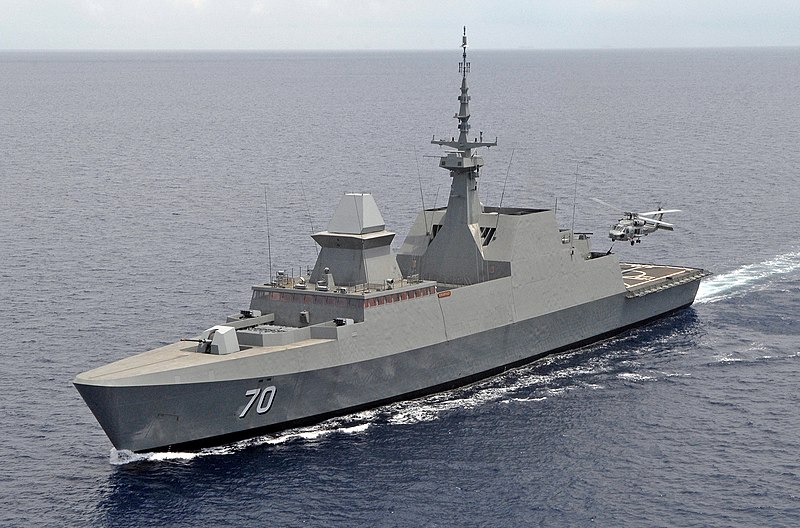
(NSI News Source Info) January 17, 2009: The final two of a fleet of six stealth frigates, RSS Stalwart and RSS Supreme, were commissioned at the Changi Naval Base today. With all six frigates brought into service, the Republic of Singapore Navy's (RSN) Formidable-class Frigate Squadron is fully operational.
Officiating at the commissioning ceremony, Minister for Defence Teo Chee Hean said "the frigates, with their longer range and reach, will significantly increase the RSN's ability to protect our Sea Lines of Communication. This is a critical mission as the lion's share of Singapore's trade is conducted by sea."
The Formidable class multi-role stealth frigates are the latest platforms to enter into service with the Republic of Singapore Navy, and are multi-mission derivatives of the French Navy’s La Fayette class frigate. The frigates are key information nodes and fighting units, and are "by far the most advanced surface combatants in Southeast Asia". The six ships form the 185 Squadron of the Navy.
The operationalisation of the Frigate Squadron marks a significant milestone in the RSN's transformation to a 3rd Generation fighting force. Its state-of-the-art combat capabilities and systems will enhance the RSN's ability to protect Singapore's Sea Lines of Communication and boost the RSN's capability to integrate its operations with the Army and Air Force.
Mr Teo extended his appreciation to the Defence Science & Technology Agency, DSO National Laboratories, French shipbuilder DCNS and ST Marine, as well as the men and women of the RSN for making the Frigate Programme a success.

Finnish Defence Forces Order Scania Lorries / Finnish Defence Forces Order 91 Lorries From Scania / Scania To Deliver 91 Trucks To The Finnish Defence

Finnish Defence Forces Order Scania Lorries / Finnish Defence Forces Order 91 Lorries From Scania / Scania To Deliver 91 Trucks To The Finnish Defence Forces
(NSI News Source Info) January 17, 2009: The Finnish Defence Forces said in a statement Thursday it had placed an order with Swedish lorry maker Scania, majority-owned by Volkswagen, for 91 heavy goods vehicles. The military added that the order was worth about 63 million euros when an option of 197 further lorries was included.
According to a recently concluded purchasing agreement, Scania has been commissioned to supply 91 trucks to the Finnish Defence Forces during 2009 and 2010. The deal also includes a five-year repair and maintenance agreement and an option for another 197 vehicles within a 4-year period.
During 2008, Scania won several orders from the Finnish Defence Forces: 21 all-wheel-drive off-road trucks in July and earlier in the year an order from the Finnish Border Guard for 26 engines powering 13 new patrol boats.
Scania has supplied around 200 trucks to the Finnish Defence Forces during the past 10 years and Scania’s Finnish subsidiary, Oy Scan-Auto Ab, recently signed a deal for a six-year repair and maintenance agreement covering vehicles already delivered.
“Scania’s ability to supply special-purpose trucks for demanding transport tasks directly from the factory has been an advantage, and naturally so has the quality and performance of the trucks,” says Markku Lipsonen, Managing Director of Oy Scan-Auto Ab. “Combined with our comprehensive network of professional service workshops and the availability of repair and maintenance agreements, these have been decisive factors for the choice of Scania .”

Swiss Issue Second RFP For New Fighter, Set 2.2 Billion CHF Budget / Partial Tiger Replacement (TTE): 2nd Request Proposal Delivered To Manufacturers

Swiss Issue Second RFP For New Fighter, Set 2.2 Billion CHF Budget / Partial Tiger Replacement (TTE): Second Request For Proposal Delivered To Manufacturers
(NSI News Source Info) January 17, 2009: With the delivery of the second, updated request for proposal to the three manufacturers Dassault, EADS and Saab, the evaluation of a successor for the F-5 Tiger is proceeding as planned.
The 12 F-5F Tiger II double seater aircraft were acquired in the two procurements. Their weapons and cockpits are identical to the single seater fighter-bomber type. This makes them suitable not only for conversion training and instruction, but also for combat missions (during which there is usually a systems operator aboard on the second seat). For the combat missions, the aircraft is equipped with a 20mm gun and two guided missiles. (Registration: J-3201 to J-3212).
In the updated request for proposal the manufacturers are asked to submit an offer for 22 aircraft. In addition, armasuisse [the Swiss defence procurement agency—Ed.] sets the budget at CHF 2.2 billion and inquires how many aircraft can be delivered for this amount.
In the updated request for proposal the results and data gathered from the ground and flight tests and from the first offer have been incorporated. This includes functions and performances which do not meet the military requirements. armasuisse wants to give the manufacturers the opportunity to propose respective improvements. Improvements are also sought in additional fields.
A priorisation with respect to military cooperation should guarantee that the peak demand for pilots can be covered when the new aircraft are introduced. Furthermore armasuisse investigates the possibility of conducting a training with a TTE squadron during the months of June, July and August from a base in the manufacturing country.
New ways are also examined to minimise operating costs and to ensure the competences of Swiss Industry in the field of aeronautical technologies. A strategic cooperation between the aircraft companies, armasuisse and Swiss aviation industry should enable Switzerland to participate in further developments of the TTE. In addition the possibility of reducing maintenance costs is investigated.
Offers, flight and ground tests
The two-stage process of requests for proposal began in January 2008 with the first request for proposal armasuisse addressed to the four aircraft manufacturers Boeing, Dassault, EADS and Saab. In April 2008 Boeing decided not to submit an offer. The remaining manufacturers submitted their offers in July 2008. With the delivery of the second request for proposal the manufacturers now have until mid April 2009 to submit an updated offer.
In July 2008 the flight and ground tests with the three remaining candidates began. For this purpose two two-seaters each of the "Rafale" (Dassault), "Eurofighter" (EADS) and "Gripen" (Saab) aircraft were stationed at the Emmen military airbase. The tests were completed at the beginning of December 2008.
The next steps?
The evaluation of the tests and updated offers will be concluded at the end of May 2009 with the evaluation report prepared by armasuisse in close cooperation with the Swiss Air Force. After consultation with the Chief of the Armed Forces, the National Armament Director will propose the preferred candidate to the Head of the Federal Department of Defence, Civil Protection and Sport (DDPS).
The further schedule foresees:
-- The selection of the aircraft type is planned for July 2009.
-- Together with the bill on Armament Program 2010, the collective Federal Council will approve the procurement of the selected type and submit it to Swiss Parliament.
-- Treatment of the Partial Tiger Replacement by Swiss Parliament is foreseen for 2010.