Tuesday, May 11, 2010

DTN News: Chinese version Of Russian Jet Endangers Bilateral Relations

DTN News: Chinese version Of Russian Jet Endangers Bilateral Relations Source: DTN News / RT.com (NSI News Source Info) MOSCOW, Russia - May 12, 2010: Despite holding the position as one of the world’s biggest economies, China seems unwilling to shed its reputation for producing cheap replicas. And one of their more ambitious copycat efforts may put a strain on Russia-China relations. “This Chinese plane is simply a Russian design stuffed with local electronics,” says Maksim Pyadushkin from the Center for Analysis of Strategies and Technology about the Chinese J11B jet’s resemblance to the Russian Su-27. “It's a knock-off.” Last year, Russian aircraft sales internationally topped $3 billion – second only to the US. But others too want a slice of the aviation pie. Vadim Kozyulin, program director for conventional arms from the Russian Center for Policy Studies, says that fake Su-27s are widely offered in the world arms market. “Sooner or later, Russian arms traders will face competition from the Chinese colleagues,” he told RT. China was given the design plans for the Russian fighter jet in 1995, when it promised to buy 200 kits and assemble them domestically. After building 100 planes, the Chinese said the Russian plane did not meet specifications, only for a copycat version soon to appear – "Made in China" – without copyright. The threat from China is real, and it will be difficult for the Russian aviation industry to maintain its lofty position, and soar further unless it manages to better protect its intellectual rights and also find new ways of co-operating with its eastern neighbor. Although it made its maiden flight over 30 years ago, the Su-27 remains the bedrock of the Russian air force, and is highly popular abroad. “I don't think anyone who's flown on the SU-27 can ask for a different plane, unless we are talking about a new generation jet,” believes Lt. Colonel Andrey Alekseyev, Air Force Pilot. “It's maneuverable and has a huge range.” Some are calling for calm over the controversy. While the similarities between the two planes are clear, experts say the Chinese J11B does not have the latest Russian high-tech features and will be no match for it on the international market. The best way to fight copyright violations is to be technologically ahead of your rivals, claims Maksim Pyadushkin from the Center for Analysis of Strategies and Technology. “The biggest problem for Russia is that it has been living off the legacy of the Soviet Union, and soon its technology may no longer be the world leader,” he asserts. Rather than a continuing dogfight over the copycat plane, it is possible that Russia and China may yet settle the matter amicably – at the highest political level. But in the shady world of international weapons copyright, similar cases are sure to follow.

More on the story

DTN News: U.S. Department of Defense Contracts Dated May 11, 2010

DTN News: U.S. Department of Defense Contracts Dated May 11, 2010 Source: U.S. DoD issued May 11, 2010 (NSI News Source Info) WASHINGTON - May 12, 2010: U.S. Department of Defense, Office of the Assistant Secretary of Defense (Public Affairs) Contracts issued May 11, 2010 are undermentioned; CONTRACTS NAVY ~CNMS, JV, Honolulu, Hawaii (N62742-10-D-1306); ~Core Tech-AMEC-SKEC, LLC, Honolulu, Hawaii (N62742-10-D-1307); ~DCK-ECC Pacific Guam Construction, LLC, Clairton, Pa. (N62742-10-D-1308); ~Guam MACC Builders, JV, Honolulu, Hawaii (N62742-10-D-1309); ~Hensel Phelps-Granite-Traylor Pacific, JV, Greeley, Colo. (N62742-10-D-1310); ~Kiewit-Mortenson, JV, Kapolei, Hawaii (N62742-10-D-1311); and ~Tutor Perini Corp., Sylmar, Calif. (N62742-10-D-1312), were each awarded an indefinite-delivery/indefinite-quantity design-build multiple award construction contract May 10 for construction projects for sites in Guam and other areas in the Naval Facilities Engineering Command (NAVFAC), Pacific area of responsibility (AOR). The maximum dollar value, including the base period and four option years, for all seven contracts combined is $4,000,000,000. DCK-ECC Pacific Guam Construction, LLC, is being awarded task order 0001 at $23,405,000 for design and construction of the Torpedo Exercise Support Building and Consolidated Submarine Learning Center Training and Commander Submarine Squadron 15 headquarters facility at Polaris Point, Guam. Work for this task order is expected to be completed by November 2011. All work on this contract will be performed within the NAVFAC Pacific AOR, which includes Guam (80 percent), Hawaii (10 percent), Diego Garcia (5 percent), and other areas in the Pacific and Indian Oceans (5 percent). The term of the contract is not to exceed 60 months, with an expected completion date of May 2015. Contract funds for task order 0001 will not expire at the end of the current fiscal year. This contract was competitively procured via the Navy Electronic Commerce Online Web site, with eight proposals received. These seven contractors may compete for task orders under the terms and conditions of the awarded contract. The Naval Facilities Engineering Command, Pacific, Pearl Harbor, Hawaii, is the contracting activity. ~Abbott General Construction, Inc.*, Hampton, Va. (N40085-10-D-0233); ~Charlotte Paint II, LLC*, Mount Holly, N.C. (N40085-10-D-0234); ~Chavis’ Inc.*, Red Springs, N.C. (N40085-10-D-0235); ~Fix Painting Co.*, Woodland Hills, Calif. (N40085-10-D-0236); ~Olympic Enterprises, Inc.*, Hubert, N.C. (N40085-10-D-0237); ~Pro Coating Services, Inc.*, Jacksonville, N.C. (N40085-10-D-0238); ~S & L Paint & Decorating, Inc.*, Winston Salem, N.C. (N40085-10-D-0239); ~Talon Construction, Inc.*, Smithfield, N.C. (N40085-10-D-0240); ~Thomas Brand Siding Co., Inc.*, Bowling Green, Ky. (N40085-10-D-0241); and ~WECC, Inc.*, Fayetteville, N.C. (N40085-10-D-0242), are each being awarded an indefinite-delivery/indefinite-quantity multiple award construction contract for general painting-type projects at Marine Corps Base Camp Lejeune and Marine Corps Air Station Cherry Point. The total contract amount for all ten contracts combined, including the base period and four option years, is $100,000,000. Work will be performed in Jacksonville, N.C. (80 percent), and Havelock, N.C. (20 percent). The term of the contract is not to exceed 60 months, with an expected completion date of May 2015. Contract funds will expire at the end of the current fiscal year. This contract was competitively procured via the Navy Electronic Commerce Online Web site with 20 proposals received. These 10 contractors may compete for task orders under the terms and conditions of the awarded contract. The Naval Facilities Engineering Command, Mid-Atlantic, Norfolk, Va., is the contracting activity. ~CACI Systems, Inc., Chantilly, Va., was awarded May 10 a $28,864,223 modification to a previously awarded cost-plus-fixed-fee contract (N00421-06-C-0074) to provide for additional technical and engineering services in support of the Naval Air Warfare Center Aircraft Division’s Special Communications Requirements Division. The estimated level of effort for this modification is 336,000 man-hours. Work will be performed in Lexington Park, Md. (80 percent), and Saint Inigoes, Md. (20 percent), and is expected to be completed in March 2011. Contract funds will not expire at the end of the fiscal year. The Naval Air Warfare Center Aircraft Division, Patuxent River, Md. is the contracting activity. ~Nightforce, Inc., Orofino, Idaho, was awarded a $25,767,124 firm-fixed-price contract May 10 for family of dayscopes, spares, repairs and upgrades. Dayscopes will be used by special forces for the Army, Navy, Air Force, and Marine Corps snipers. Work will be performed in Orofino, Idaho, and is expected to be completed by April 2015. Contract funds will not expire at the end of the current fiscal year. This contract was competitively procured and solicited via the Federal Business Opportunities Web site, with one offer received. Naval Surface Warfare Center, Crane, Ind., is the contracting activity (N00164-10-D-JQ23). ~Beltsville Industrial Group/Desbuild, JV*, Beltsville, Md., was awarded a $14,471,000 firm-fixed-price contract May 10 for construction of a child development center at Marine Corps Base Quantico. The work to be performed provides for construction of a single-story reinforced concrete masonry unit. The facility will include kitchen and laundry areas; classrooms; offices; toilets; storage spaces; a new recreation area with playgrounds and athletic fields; and outdoor lighting and playground equipment. The project also includes miscellaneous site demolition. Work will be performed in Quantico, Va., and is expected to be completed by Oct. 2011. Contract funds will not expire at the end of the current fiscal year. This contract was competitively procured via the Navy Electronic Commerce Online Web site, with 23 proposals received. The Naval Facilities Engineering Command, Washington, Washington, D.C., is the contracting activity (N40080-10-C-0010). ~Rockwell Collins, Inc., Cedar Rapids, Iowa, was awarded May 10 an $11,047,202 modification to a previously awarded firm-fixed-priced contract (N00019-09-C-0069) to exercise an option for the procurement of AN/ARC-210(V) electronic radios and ancillary equipment for the EA-18G, F/A-18E/F, F-16 Block 40, and U.S. European Command aircraft. Equipment being procured includes 40 RT-1556B receiver transmitters; 144 RT-1851A(C) receiver transmitters; and 143 MT-4935 mounting bases. Work will be performed in Cedar Rapids, Iowa, and is expected to be completed in December 2011. Contract funds in the amount of $1,030,752 will expire at the end of the current fiscal year. This contract combines purchases for the Navy ($1,768,320; 16 percent); Air Force ($9,212,346; 83.4 percent); and Army ($66,536; 0.6 percent). The Naval Air Systems Command, Patuxent River, Md., is the contracting activity. ~General Dynamics Ordnance and Tactical Systems, St. Petersburg, Fla., is being awarded a $9,676,800 modification to previously awarded contract (M67854-05-D-6014) for continuation of 120mm precision extended range munition Phase III technology demonstration for Expeditionary Fire Support Systems/Internally Transportable Vehicle system. Work will be performed in Redmond, Wash. (23 percent); Minneapolis, Minn. (23 percent); Valencia, Calif. (18 percent); Red Lion, Pa. (18 percent); St. Petersburg, Fla. (10 percent); and Mesa, Ariz. (8 percent), and is expected to be completed by August 2011. Contract funds will not expire at the end of the current fiscal year. The Marine Corps Systems Command, Quantico, Va., is the contracting activity. ~Clark/Balfour Beatty, JV, Bethesda, Md., was awarded a $9,511,644 firm-fixed-price contract May 10 for design and construction of traffic mitigation measures for Gates 1 and 2 at the National Naval Medical Center Bethesda. The work includes repair, upgrade and reconfiguration of two existing entry control points, North Wood Road Gates 1 and 2, and the construction of a visitor center to improve access, security and aesthetics. Work will be performed in Bethesda, Md., and is expected to be completed by July 2011. Contract funds will not expire at the end of the current fiscal year. This contract was procured as a sole source in accordance with FAR 6.302-1, “only one responsible source.” The Naval Facilities Engineering Command, Washington, Officer in Charge of Construction, Bethesda, Md., is the contracting activity (N40080-10-C-1504). AIR FORCE ~L-3 Communication Systems, Camden, N.J., was awarded a $35,017,839 contract which will develop and field robust medium speed National Security Agency Type 1-certified cryptographic aerospace vehicle equipment end cryptographic units, single component encryption/decryptors, and ground operating equipment used to secure plain text mission data for satellite systems. At this time, $8,800,000 has been obligated. HQ CPSG/PK, San Antonio, Texas, is the contracting activity (FA8307-10-C-0010). ~Alion Science and Technology Corp., Chicago, Ill., was awarded a $19,826,289 contract which will provide research and develop capabilities to model and simulate emerging operational and training missions. At this time, $920,031 has been obligated. 55 CONS/LGCD, Offutt Air Force Base, Neb., is the contracting activity (N61339-03-D-0300). DEFENSE LOGISTICS AGENCY ~Bremen Bowdon, Bowdon, Ga.*, is being awarded a maximum $5,649,210 firm-fixed-price, indefinite-delivery/indefinite-quantity, total set-aside contract for women’s dress coats. There are no other locations of performance. Using service is Army. The original proposal was Web-solicited with five responses. The date of performance completion is Aug. 27, 2011. The Defense Supply Center Philadelphia, Philadelphia, Pa., is the contracting activity (SPM1C1-10-D-1061). *Small business

DTN News: China Tries To Hide J-10 Fighter Crashes

DTN News: China Tries To Hide J-10 Fighter Crashes Source: DTN News / FreeRepublic.com (NSI News Source Info) TORONTO, Canada - May 11, 2010: On April 13, in the port city of Tianjin about 130- KM away from Beijing, China showed off its 4th Generation J-10 aircraft to military attaches of about 50 countries it could possibly export to. 9 days later as per Strategy page reports it was running to cover up the 2nd crash of the J-10 fighter that became public in the last two years. The 22 April crash became public because a senior colonel had died in the crash and the funeral became too big to keep the story hushed. The news report also claims that the design of the 200-odd J-10s produced has not worked out as desired by its developers. The crash and doubts over its design also comes as a set back to Pakistan, which was hoping to buy 36 J-10 in a deal worth US$1.4 billion has also been concluded reports China's English Peoples Daily. In the past it has exported fighter aircraft to Iran, Myanmar, Bangladesh and Pakistan. However, the pitfalls of reverse engineering without paying royalty and truly understanding the technology are high accident rates, a fact that China has hushed up with its lack of media freedom. The first flight of the J-10 begun took place in 1998. It is the most advanced 4th Generation aircraft to be built by China. However, Fighter-Planes.com reports the development of J-10 has proven to be torturous. The prototype was rumoured to have first flown in 1996, but the project suffered a serious setback in late 1997 when the 02 prototype lost control and crashed, as the result of certain system failure, presumably with either the FBW system or the engine. If the reports pertaining to the faulty design of the fourth generation fighter are serious enough, it will put the Chinese plans to replace the obsolete J-7 fighter and Q-5 attack aircraft in a limbo. With 2,000 combat aircraft China has the 3rd largest air force in the world. (www.8ak.in) *This article is being posted from Toronto, Canada By DTN News ~ Defense-Technology News, contact: dtnnews@ymail.com

DTN News: Aviation Week Grounds Top Critic of Gajillion-Dollar Jet (Updated)

DTN News: Aviation Week Grounds Top Critic of Gajillion-Dollar Jet (Updated) Source: Wired.com/Danger Room By Noah Shachtman May 10, 2010 (NSI News Source Info) TORONTO, Canada - May 11, 2010: Bill Sweetman has authored over 30 books on military aircraft, and now edits Defense Technology International, a monthly magazine put out by Aviation Week.
One of the aviation industry’s biggest critics of the Pentagon’s gajillion-dollar fighter jet has been temporarily barred from writing about the controversial plane.
Few journalists today know more about tactical aircraft. And few have been more critical of the F-35 Joint Strike Fighter, the jet that’s eventually supposed to replace as much as 95% of combat planes. “The program is no longer at risk of failure,” he wrote in March on Aviation Week’s defense blog, Ares. “It has already failed.” But Sweetman, for the moment, won’t be allowed to opine on the JSF. Aviation Week has pulled him from the beat. The maker of the jet swears they had nothing whatsoever to do with the suspension. “Lockheed Martin has not asked Aviation Week to take disciplinary action against Bill Sweetman nor have we asked that he be removed from reporting on the F-35 program or any other Lockheed Martin program,” the company says in a statement. But as the price tag for the supposedly low-cost JSF has grown — and as a once-ambitious test schedule has shrunk — Sweetman’s swipes at the program have gained more notoriety. PBS’ News Hour, for instance, featured Sweetman in a late April segment that focused on the project’s flaws. The following week, while Sweetman and his colleagues prepped for a trip Lockheed’s plant in Ft. Worth, Texas, he wrote on his Facebook page: “Gentlemen, your target for tonight is Fort Worth. Flacks are predicted to be numerous and persistent on the run-in and over the target, and bullshit is expected to be dense throughout the mission. Synchronize watches and good luck.” Shortly thereafter, Sweetman was asked to stop covering the JSF. UPDATE: “Aviation Week is committed to providing objective aerospace and defense journalism based on independent and balanced coverage. Following comments posted on his personal Facebook page, the editorial team has decided that Bill Sweetman will not be covering the F-35 program for a period of time,” magazine spokesman Joe D’Andrea e-mails Danger Room. “We will continue to hold our journalists to the highest standards of editorial integrity to best serve the aersopace and defense community.” *For Link to this article "Aviation Week Grounds Top Critic of Gajillion-Dollar Jet (Updated)" ~ Source: Wired.com/Danger Room By Noah Shachtman May 10, 2010 (Click here) *This article is being posted from Toronto, Canada By DTN News ~ Defense-Technology News, contact: dtnnews@ymail.com Disclaimer statement Whilst every effort has been made to ensure the accuracy of the information supplied herein, DTN News ~ Defense-Technology News cannot be held responsible for any errors or omissions. Unless otherwise indicated, opinions expressed herein are those of the author of the page and do not necessarily represent the corporate views of DTN News ~ Defense-Technology News.

DTN News: Europe, Nationalism And Shared Fate

DTN News: Europe, Nationalism And Shared Fate Source: By George Friedman STRATFOR (NSI News Source Info) TORONTO, Canada - May 11, 2010: The European financial crisis is moving to a new level. The Germans have finally consented to lead a bailout effort for Greece. The effort has angered the German public, which has acceded with sullen reluctance. It does not accept the idea that it is Germans’ responsibility to save Greeks from their own actions. The Greeks are enraged at the reluctance, having understood that membership in the European Union meant that Greece’s problems were Europe’s. And this is not just a Greek matter. Geographically, the problem is the different levels of development of Mediterranean Europe versus Northern Europe. During the last generation, the Mediterranean countries have undergone major structural changes and economic development. They have also undergone the inevitable political tensions that rapid growth generates. As a result, their political and economic condition is substantially different from that of Northern Europe, whose development surge took place a generation before and whose political structure has come into alignment with its economic condition. European Unity and Diversity Northern and Southern Europe are very different places, as are the former Soviet satellites still recovering from decades of occupation. Even on this broad scale, Europe is thus an extraordinarily diverse portrait of economic, political and social conditions. The foundation of the European project was the idea that these nations could be combined into a single economic regime and that that economic regime would mature into a single united political entity. This was, on reflection, a rather extraordinary idea. Europeans, of course, do not think of themselves as Mediterranean or Northern European. They think of themselves as Greek or Spanish, Danish or French. Europe is divided into nations, and for most Europeans, identification with their particular nation comes first. This is deeply embedded in European history. For the past two centuries, the European obsession has been the nation. First, the Europeans tried to separate their own nations from the transnational dynastic empires that had treated European nations as mere possessions of the Hapsburg, Bourbon or Romanov families. The history of Europe since the French Revolution was the emergence and resistance of the nation-state. Both Nazi Germany and the Soviet Union attempted to create multinational states dominated by a single state. Both failed, and both were hated for the attempt. There is a paradox in the European mindset. On the one hand, the recollection of the two world wars imbued Europeans with a deep mistrust of the national impulse. On the other hand, one of the reasons nationalism was distrusted was because of its tendency to make war on other nation-states and try to submerge their identities. Europe feared nationalism out of a very nationalist impulse. The European Union was designed to create a European identity while retaining the nation-state. The problem was not in the principle, as it is possible for people to have multiple identities. For example, there is no tension between being an Iowan and an American. But there is a problem with the issue of shared fate. Iowans and Texans share a bond that transcends their respective local identities. Their national identity as Americans means that they share not only transcendent values but also fates. A crisis in Iowa is a crisis in the United States, and not one in a foreign country as far as Texans are concerned. The Europeans tried to finesse this problem. There was to be a European identity, yet national identities would remain intact. They wrote a nearly 400-page-long constitution, an extraordinary length. But it was not really a constitution. Rather, it was a treaty that sought to reconcile the concept of Europe as a single entity while retaining the principle of national sovereignty that Europe had struggled with for centuries. At root, Europe’s dilemma was no different from the American dilemma — only the Americans ultimately decided, in the Civil War, that being an American transcended being a Virginian. One could be a Virginian, but Virginia shared the fate of New York, and did so irrevocably. The Europeans could not state this unequivocally as they either did not believe it or lacked the ability to militarily impress the belief upon the rest of Europe. So they tried to finesse it in long, complex and ultimately opaque systems of governance that ultimately left the nations of Europe with their sovereignty intact. When the Berlin Wall came down in 1989, there was no question among the Germans that East and West Germany would be united. Nor were serious questions raised that the cost of economically and socially reviving East Germany would be borne by West Germany. Germany was a single country that history had divided, and when history allowed them to be reunited, Germans would share the burdens. Ever since the 19th century, when Germany began to conceive of itself as one country, there was an idea that to be a German meant to share a single fate and burdens. This was the same for the rest of Europe that organized itself into nation-states, where the individual identified his fate with the fate of the nation. For a Pole or an Irishman, the fate of his country was part of his fate. But a Pole was not an Irishman and an Irishman was not a Pole. They might share interests, but not fates. The nation is the place of tradition, language and culture — all of the things that, for better or worse, define who you are. The nation is the place where an economic crisis is inescapably part of your life. When the Greek financial crisis emerged, other Europeans asked the simple question, “What has this to do with me?” From their point of view, the Greeks were foreigners. They spoke a different language, had a different culture, shared a different history. The Germans might be affected by the crisis — German banks held Greek debt — but the Germans were not Greeks, and they did not share the Greeks’ fate. And this was not just the view of Germany, the economic leader of Europe, by any means. In the past, Mexico has had several economic crises in which the United States intervened to stabilize Mexico. This was done because it was in the American interest to do so, not because the United States and Mexico were one country. So, too, in Europe: The bailout of Greece is designed not because Greece is part of Europe, but because it is in the rest of Europe’s interest to bail Greece out. But the heart of the matter is that Greece is a foreign country. The Question of European Identity During the generation of prosperity between the early 1990s and 2008, the question of European identity and national identity really did not arise. Being a European was completely compatible with being a Greek. Prosperity meant there was no choice to make. Economic crisis meant that choices had to be made, between the interests of Europe, the interests of Germany and the interests of Greece, as they were no longer the same. What happened was not a European solution, but a series of national calculations on self-interest; it was a negotiation between foreign countries, not a European solution growing organically from the recognition of a single, shared fate. Ultimately, Europe was an abstraction. The nation-state was real. We could see this earliest and best not in the economic arena, but in the area of foreign policy and national defense. The Europeans as a whole never managed to develop either. The foreign policies of the United Kingdom, Germany and Poland were quite different and in many ways at odds. And war, even more than economics, is the sphere in which nations endure the greatest pain and risk. None of the European nations was prepared to abandon national sovereignty in this area, meaning no country was prepared to put the bulk of its armed forces under the command of a European government — nor were they prepared to cooperate in defense matters unless it was in their interest. The unwillingness of the Europeans to transfer sovereignty in foreign and defense matters to the European Parliament and a European president was the clearest sign that the Europeans had not managed to reconcile European and national identity. Europeans knew that when it came down to it, the nation mattered more than Europe. And that understanding, under the pressure of crisis, has emerged in economics as well. When there is danger, your fate rests with your country. The European experiment originated as a recoil from the ultranationalism of the first half of the 20th century. It was intended to solve the problem of war in Europe. But the problem of nationalism is that not only is it more resilient than the solution, it also derives from the deepest impulses of the Enlightenment. The idea of democracy and of national self-determination grew up as part of a single fabric. In taking away national self-determination, the European experiment seemed to be threatening the foundation of modern Europe. There was another impulse behind the idea of Europe. Most of the European nations, individually, were regional powers at best, unable to operate globally. They were therefore weaker than the United States. Europe united would not only be able to operate globally, it would be the equal of the United States. If the nation-states of Europe were no longer great individually, Europe as a whole could be. Embedded in the idea of Europe, particularly in the Gaullist view of it, was the idea of Europe as a whole regaining its place in the world, the place it lost after two world wars. That clearly is not going to happen. There is no European foreign and defense policy, no European army, no European commander in chief. There is not even a common banking or budgetary policy (which cuts to the heart of today’s crisis). Europe will not counterbalance the United States because, in the end, Europeans do not share a common vision of Europe, a common interest in the world or a mutual trust, much less a common conception of exactly what counterbalancing the United States would mean. Each nation wants to control its own fate so as not to be drawn back into the ultranationalism of a Germany in the 1930s and 1940s or the indifference to nationalism of the Hapsburg Empire. The Europeans like their nations and want to retain them. After all, the nation is who they actually are. That means that they approach the financial crisis of Mediterranean Europe in a national, as opposed to European, fashion. Both those in trouble and those who might help calculate their moves not as Europeans but as Germans or Greeks. The question, then, is simple: Given that Europe never came together in terms of identity, and given that the economic crisis is elevating national interest well over European interest, where does this all wind up? The European Union is an association — at most an alliance — and not a transnational state. There was an idea of making it such a state, but that idea failed a while ago. As an alliance, it is a system of relationships among sovereign states. They participate in it to the extent that it suits their self-interest — or fail to participate when they please. In the end, what we have learned is that Europe is not a country. It is a region, and in this region there are nations and these nations are comprised of people united by shared history and shared fates. The other nations of Europe may pose problems for these people, but in the end, they share neither a common moral commitment nor a common fate. This means that nationalism is not dead in Europe, and neither is history. And the complacency with which Europeans have faced their future, particularly when it has concerned geopolitical tensions within Europe, might well prove premature. Europe is Europe, and its history cannot be dismissed as obsolete, much less over. This report may be forwarded or republished on your website with attribution to http://www.stratfor.com/ *This article is being posted from Toronto, Canada By DTN News ~ Defense-Technology News, contact: dtnnews@ymail.com Disclaimer statement Whilst every effort has been made to ensure the accuracy of the information supplied herein, DTN News ~ Defense-Technology News cannot be held responsible for any errors or omissions. Unless otherwise indicated, opinions expressed herein are those of the author of the page and do not necessarily represent the corporate views of DTN News ~ Defense-Technology News.

DTN News: Iran Tests Anti-Submarine Torpedo / Iran's Air Force Tests New Air-To-Surface Missiles

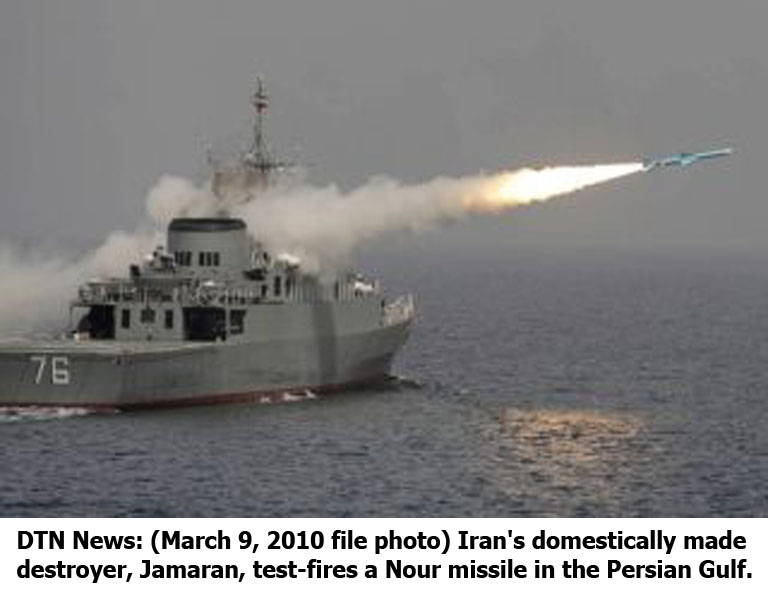
DTN News: Iran Tests Anti-Submarine Torpedo / Iran's Air Force Tests New Air-To-Surface Missiles Source: DTN News / Press TV Iran, Xinhua China (NSI News Source Info) TEHRAN, Iran - May 11, 2010: Iran's navy has successfully test-fired an anti-submarine torpedo on the fifth day of its military maneuvers in the country's southern waters. The navy carried out successful drills aimed at tracking and targeting hostile submarines, Iranian military spokesman Rear Admiral Qasem Rostamabadi announced Sunday. The torpedoes were fired from Iran's domestically-built destroyer, Jamaran -- a multi purpose warship that blends anti-submarine capabilities with defense systems against surface and air attacks. Admiral Rostamabadi said the 1,420-ton destroyer, launched earlier this year, will be dispatched to the Gulf of Aden and Indian Ocean following the drills in the Persian Gulf and the Sea of Oman. The six-phase exercise backed by Iranian military's air and ground forces, dubbed Velayat 89, will continue for another three days. Iran's Air Force Tests New Air-To-Surface Missiles xinhuanet.com 05/11/2010 TEHRAN, May 10 (Xinhua) -- A senior Army commander said Monday that Iran Air Force tested a series of new air-to-surface missiles on the sixth day of the army's war games in the Strait of Hormuz and northern Indian Ocean, the semi-official Fars news agency reported. Iran's navy started war games in the country's southern waters on Wednesday, the official IRNA news agency reported. The new missiles were fired by the country's Phantom fighters and hit and destroyed the targets successfully, Lieutenant Commander of the Iranian Air Force for the war game General Seyed Mohammad Alawi said in an interview with Fars. "The new missiles have been loaded onto the Army's fighter jets ... They had a fully successful performance today," Alawi was quoted as saying. The new developments have boosted the capability of the Army's fighter jets in confronting naval targets, the commander said. On Sunday, Alawi told Fars that the Iranian Army's Air Force has recently equipped its fighter jets with newly-developed sophisticated electronic warfare systems. The Iranian army also exercised electronic eavesdropping by a special type of aircraft and also used sea patrol airplanes on the fifth day of the war games on Sunday, according to the report. The Navy's military exercise dubbed "Velayat 89" is currently being conducted in the Strait of Hormuz, the Sea of Oman and northern part of Indian ocean. Iran's navy commander Rear Admiral Habibollah Sayyari said Monday that Iran's navy will conduct the military drill in six phases which will last eight days, the local satellite Press TV reported.

DTN News: Israel Has Know-How To Hit Iran Says Ya'alon

DTN News: Israel Has Know-How To Hit Iran Says Ya'alon Source: DTN News / Haaretz By Anshel Pfeffer (NSI News Source Info) JERUSALEM, Israel - May 11, 2010: In a rare public reference to a sensitive subject, a member of the inner cabinet said yesterday that Israel is already essentially in confrontation with Iran and possesses the necessary capabilities to attack the Islamic Republic. Vice Prime Minister and Strategic Affairs Minister Moshe Ya'alon, a former chief of staff of the Israel Defense Forces, made the remarks at a conference on Israel's air power at the Fisher Institute for Air and Space Strategic Studies in Herzliya. The institute was established by the Israel Air Force Association "There is no doubt, looking at the overall situation, that we are already in a military confrontation with Iran," he said. "Iran is the main motivator of those attacking us, with its funding and training of Hezbollah," Ya'alon said. "There is no doubt that [Israel's] technological capabilities, which improved in recent years, have improved range and aerial refueling capabilities, and have brought about a massive improvement in the accuracy of ordnance and intelligence," he said. "This capability can be used for a war on terror in Gaza, for a war in the face of rockets from Lebanon, for war on the conventional Syrian army, and also for war on a peripheral state like Iran." Israel has rarely used the term "war" in official statements on how to deal with Iran's nuclear program. "As far as I'm concerned, offense remains the best form of defense," Ya'alon said, adding that the anti-missile system being developed by the defense establishment "can make things easier for the public, but won't keep Israelis out of shelters in their hour of need. It will, however, significantly reduce the damage caused." An adviser to Ya'alon said the minister had been "speaking in generalities," and did not intend to directly refer to the possibility of an Israeli strike on Iran. Meanwhile, in separate remarks, Deputy Prime Minister Dan Meridor said "there is still time" for diplomacy to work. He sought to play down Israel's interest in having Iran reined in, calling it a global challenge. "If, at the end of the day, Iran does get nuclear, in spite of what America says and wants, this will have grave implications for world order, the balance of power and the rules of the game," said Meridor, who, like Yaalon, belongs to Netanyahu's seven-member inner council. Yaalon's comments came just days after diplomats from 189 nations were gathered in New York for a five-year review of the Nuclear Nonproliferation Treaty, of which Iran is a member, while Israel is not.