Thursday, June 10, 2010

DTN News: NASA's Unmanned Global Hawk Aircraft Conducts Ground Breaking Science Missions

DTN News: NASA's Unmanned Global Hawk Aircraft Conducts Ground Breaking Science Missions
Source: DTN News / Northrop Grumman
(NSI News Source Info) SAN DIEGO, - June 11, 2010: NASA's unmanned Global Hawk aircraft, developed by Northrop Grumman Corporation (NYSE:NOC), completed four science flights over the Pacific Ocean during the month of April. The flights were part of the Global Hawk Pacific (GloPac) mission, a joint project between NASA and the National Oceanic and Atmospheric Administration (NOAA), with Northrop Grumman support. The GloPac mission flights revolutionized the collection of data in the stratosphere. Fitted with 11 science instruments, Global Hawk acquired and transmitted data that has never before been accessible through either manned flights or satellites. Flights reached up to 65,000 feet where information was collected from the air as well as the water and polar ice below. Data from the science instruments were downloaded in real-time to NASA Dryden Flight Research Center where scientists were able to analyze the data, and if necessary, ask the Global Hawk pilot to adjust the flight path to optimize data collection. Flights during the GloPac project ranged from north of the Arctic Circle, over polar ice, down to Hawaii near the equator. NASA Global Hawk completed 82.5 flight hours, with one particular flight lasting 28.6 hours, eight hours of which was spent north of Alaska over the polar ice. Additionally, this was the first time a Global Hawk unmanned air vehicle has flown as far as 85 degrees north latitude. The flights were designed to address several science objectives, including validation and scientific collaboration with NASA earth observation satellite (EOS) missions, principally the Aura satellite, also built by Northrop Grumman. The GloPac payloads collected atmospheric data in the same location at the same time as Aura and other EOS missions to compare and combine results. "Global Hawk is a revolutionary aircraft for science because of its enormous range and endurance," said Paul Newman, co-mission scientist for GloPac and an atmospheric scientist from NASA's Goddard Space Flight Center in Greenbelt, Md. "No other science platform provides the range and time to sample rapidly evolving atmospheric phenomena. This mission is our first opportunity to demonstrate the unique capabilities of this plane, while gathering atmospheric data in a region that is poorly sampled." A Space Act Agreement between NASA Dryden Flight Research Center and Northrop Grumman established a partnership to re-fit and maintain two Global Hawk aircraft transferred from the U.S. Air Force. As part of the Northrop Grumman/NASA partnership, the company contributed to the GloPac missions by developing the GloPac mission plans; confirming aircraft performance through extensive analysis; providing pilots and training for NASA/NOAA pilots; sharing maintenance and operations support; and developing and building a new ground control station and software for aircraft operations. Additionally, under a contract from NASA, Northrop Grumman performed aircraft modification engineering and analysis for installation of the science payloads, which was funded by the science sponsors for each of the 11 sensors. "We have partnered with NASA to provide this new capability for the atmospheric science community," said Carl Johnson, Northrop Grumman vice president of advanced concepts – air and land. "The Global Hawk system has been serving the United States Air Force and Navy and is now serving mankind with critical data from the NASA and NOAA science experiments. Global Hawk is truly global in its reach." Later this year, NASA Global Hawk will examine hurricanes and their formation process. This experiment will explore the possibility of improving hurricane forecasts. The Global Hawk aircraft is proving to be the premier platform for use in high-altitude, long-duration Earth science missions. Northrop Grumman Corporation is a leading global security company whose 120,000 employees provide innovative systems, products, and solutions in aerospace, electronics, information systems, shipbuilding and technical services to government and commercial customers worldwide. Please visit www.northropgrumman.com for more information.
CONTACT:
Sherri Pineda Hargrove Northrop Grumman Aerospace Systems (858) 618-4556 Mobile: (858) 943-1152 sherri.pineda@ngc.com

DTN News: Raytheon Space Sensor Tasked for First-Of-Its-Kind Military Use

DTN News: Raytheon Space Sensor Tasked for First-Of-Its-Kind Military Use
Source: DTN News / Raytheon
(NSI News Source Info) EL SEGUNDO, Calif., - June 11, 2010: Raytheon Company's (NYSE: RTN) hyperspectral imaging sensor known as ARTEMIS is being prepared for a first-of-its-kind tactical military role by the Air Force Space Command. The company's Advanced Responsive Tactically Effective Military Imaging Spectrometer has successfully completed its one-year experimental mission aboard the Air Force Research Laboratory's Tactical Satellite-3. Based on the success of that mission, Raytheon has been notified that the Air Force Space Command will take control of TacSat-3 with the intent to use ARTEMIS in an operational capacity. "The ARTEMIS hyperspectral imager gives military commanders an important new advantage in the asymmetric battlefield," said Bill Hart, vice president for Raytheon Space Systems. "ARTEMIS can detect various man-made and natural materials, which adds a fundamentally new capability for the DoD." Unlike visible imagers, hyperspectral sensors capture light across a wide swath of the electromagnetic spectrum, providing unprecedented spectral detail. That spectral information produces a distinct "signature," which can be compared against the spectral signatures of known objects to rapidly identify potential areas of interest. The ARTEMIS hyperspectral imager combines spectral information with geo-location coordinates in an easy-to-read map. This information is then sent directly to troops on the ground in near real time. "Air Force Space Command looks forward to taking ownership of the TacSat-3 ARTEMIS system," said Lt. Col. Ryan Pendleton, Air Force Space Command, Chief, Operationally Responsive Space Integration. "We plan to operationalize the system as soon as possible to provide direct benefit to warfighters." TacSat-3 originated as part of the U.S. Department of Defense's operationally responsive space initiative, which seeks to give field commanders flexible, affordable options for obtaining real-time tactical surveillance data from space. Aided by the ORS Office, and led by the Air Force Research Laboratory, the TacSat-3 program was designed to demonstrate the feasibility of developing and launching a military payload within extremely tight schedule and budget constraints. "TacSat-3 has been a pathfinder to explore concepts of operation for future ORS systems and demonstrates how great things can be achieved on a small budget and in a short time," said Dr. Peter Wegner, director of the Pentagon's ORS Office. "It has also demonstrated the utility of hyperspectral information to benefit soldiers, sailors, airmen and Marines around the world." Raytheon is discussing with several government customers opportunities for rapidly deploying additional hyperspectral space sensors. "Based on our experience on TacSat-3, we're ready to build operational hyperspectral systems like ARTEMIS quickly and affordably," said Raytheon's Hart. Raytheon Company, with 2009 sales of $25 billion, is a technology and innovation leader specializing in defense, homeland security and other government markets throughout the world. With a history of innovation spanning 88 years, Raytheon provides state-of-the-art electronics, mission systems integration and other capabilities in the areas of sensing; effects; and command, control, communications and intelligence systems, as well as a broad range of mission support services. With headquarters in Waltham, Mass., Raytheon employs 75,000 people worldwide. Contact: John Barksdale 310.647.8224 John_Barksdale@raytheon.com
Raytheon Related News

DTN News: Boeing P-8A Poseidon Completes 1st In-flight Test Of Mission Systems

DTN News: Boeing P-8A Poseidon Completes 1st In-flight Test Of Mission Systems
Source: DTN News / Boeing
(NSI News Source Info) SEATTLE, - June 11, 2010: Boeing [NYSE: BA] P-8A Poseidon aircraft T2 successfully completed the program's first mission systems test flight on June 8 in Seattle. T2 will be used to verify integrated mission systems performance during flights in Seattle and at Naval Air Station Patuxent River, Md. During the three-hour flight, the joint Boeing and Navy test team exercised mission computing on all five operator workstations and successfully demonstrated key systems -- including acoustics, mission planning, tactical data-link, communications, electronic support measures and flight test instrumentation -- for the first time. "This successful flight moves us a step closer to getting the Poseidon and its next-generation radar and sensors into the hands of the warfighter," said Chuck Dabundo, Boeing vice president and P-8 program manager. "Future flights will demonstrate the state-of-the-art systems that will provide the Navy superior performance well into the 21st century." T2 is one of five test aircraft that are being assembled and tested as part of the U.S. Navy System Development and Demonstration contract Boeing received in 2004. Boeing's T1 airworthiness-test aircraft entered flight testing in October 2009 and arrived at the Navy's Patuxent River facility in April 2010. The Navy plans to purchase 117 P-8A anti-submarine warfare, anti-surface warfare, intelligence, surveillance and reconnaissance aircraft to replace its P-3 fleet. Initial operational capability is planned for 2013. A unit of The Boeing Company, Boeing Defense, Space & Security is one of the world's largest defense, space and security businesses specializing in innovative and capabilities-driven customer solutions, and the world's largest and most versatile manufacturer of military aircraft. Headquartered in St. Louis, Boeing Defense, Space & Security is a $34 billion business with 68,000 employees worldwide. Contact: Chick Ramey
The Boeing Company
Office: 253-657-5636
Mobile: 206-851-4147
Doug Abbotts
U.S. Navy
Office: 301-342-7366
Boeing Related News;
*June 10, 2010 - Boeing Presents Contract Offer to Machinists Union in St. Louis *June 10, 2010 - Boeing Receives US Air Force Mission Planning Enterprise Contract-II *June 10, 2010 - Boeing Announces Election of Liddy to Rejoin Board of Directors *June 10, 2010 - Boeing P-8A Poseidon Completes 1st In-flight Test of Mission Systems *June 10, 2010 - Boeing to Demonstrate Unmanned Aerial Vehicle Cooperative Control Technologies for U.S. Air Force

DTN News: Eurofighter Woos Buyers For 10 Billion Euro Order

DTN News: Eurofighter Woos Buyers For 10 Billion Euro Order
* Defence consortium makes offer for final 124 planes * Says needs decision in a year to avoid production gap
* Sources peg value of offer at 10 bln euros
* Brazil fighter competition seen running out of steam
Source: DTN News / Reuters By Tim Hepher Wed Jun 9, 2010 1:09pm EDT
(NSI News Source Info) BERLIN, Germany - June 10, 2010: Defence firms have moved to kickstart negotiations over the Eurofighter Typhoon by asking Britain, Germany, Italy and Spain to invest an estimated 10 billion euros ($13.42 billion) in the next wave of jet fighter production. A spokesman for a consortium of BAE Systems (BAES.L), EADS (EAD.PA) and Finmeccanica (SIFI.MI) told Reuters it had submitted an offer at the end of May -- a move that analysts say could trigger a tug of war over dwindling defence budgets during a European sovereign debt crisis. The spokesman declined to disclose the value of the offer, which covers 124 planes, but defence industry sources at the Berlin Air Show said it was around 10 billion euros. Eurofighter says a decision on whether to build the planes would be needed within a year in order to avoid a production gap it believes would be damaging for exports and hit jobs. The climate for talks is difficult, however, after Germany announced tough defence cuts and Britain promised to defer any major spending decisions until after a strategic defence review. Britain, Germany, Italy and Spain have so far taken delivery of a combined 222 Eurofighter Typhoons out of the 620 they originally ordered. The original order spanned three separate tranches. But the third and final production run of 236 planes had to be split up last year when buyers could only agree to purchase 112 aircraft. Any decision to cancel the rest is likely to trigger calls for compensation as well as intensive lobbying over the fate of 100,000 jobs tied up directly or indirectly in the project. Besides domestic contracts, Saudi Arabia has ordered 70 of the planes and 15 have been sold to Austria. The Typhoon is competing in a number of contests against rival models such as the French Rafale (AVMD.PA), Swedish Gripen SAAB.ST or Boeing's F-18 (BA.N). Switzerland has renewed interest in updating its fighter fleet after suspending a competition last year and could make a decision later in 2010, air show delegates said. Other nearby countries showing interest in deals or evaluating their positions include Serbia, Romania and Turkey. Middle East and Asian demand has been strong as countries face new threats or pressure to renew ageing fleets. But Brazil, actively courted by France as the first foreign buyer for its Dassault-built Rafale, has so far delayed a decision and may have to postpone until after Oct. 3 elections. "We are worried; nothing is happening at the moment," a French industrial source said of the competition, in which Eurofighter is not represented. ($1=.7453 Euro)
(Additional reporting by Matthias Blamont in Paris; editing by Simon Jessop)

DTN News: Airbus Orders Boost Berlin Air Show Profile

DTN News: Airbus Orders Boost Berlin Air Show Profile
Source: DTN News / Reuters
(NSI News Source Info) BERLIN/HELSINKI, - June 10, 2010: Airbus (EAD.PA) announced two more orders at the Berlin Air Show on Thursday, bringing its tally for the week to 67 aircraft orders including a record deal with Emirates for 32 A380 superjumbos. The biennial Berlin show does not usually see major orders, with airlines traditionally preferring to make announcements at larger air shows such as Farnborough in England and Le Bourget in France, which take place on alternate years in July. This year's show, just over a month before Farnborough, had opened with a splash on Tuesday as EADS' Airbus unit announced $14 billion in new orders, including the record $11 billion A380 order for the Arab world's largest airline. "Of course I want that (the Berlin Air Show) gets a boost. I was very happy that we could sign the contract with Emirates here in Berlin, in the presence of (German Chancellor Angela) Merkel," Airbus Chief Executive Tom Enders told reporters on the sidelines of the event at the German capital's Schoenefeld airport on Thursday. Before this year's show, the biggest order ever announced at the Berlin Air Show had been a 3.2 billion euro ($3.9 billion) order for 35 Airbus aircraft by Gulf Air [GULF.UL] in 2008. Merkel had opened the show on Tuesday, just as she was coming under fire from airline executives gathered for the global airline industry body's annual meeting elsewhere in the city for a proposed air travel tax. Announcing its final orders agreed at the Berlin Air Show, Airbus said on Thursday Finnish airline Finnair (FIA1S.HE) and Berlin-based Germania had agreed to buy five aircraft each. Finnair signed a letter of intent to order five new A321ER aircraft worth more than 400 million euros that will replace Boeing 757s (BA.N) used for leisure flights. The airline is the first to order A321s with "Sharklet" wing tip devices that Airbus said would cut the planes' fuel consumption by 4 percent. Fuel is one of an airline's biggest cost factors, alongside staffing. Germania signed a memorandum of understanding to buy five Airbus A319s, with a total list price of $372 million. Germania Chief Commercial Officer John Kohlsaat said in a news conference at the air show that the orders would become firm within a few days. At its meeting earlier this week, the International Air Transport Association gave a surprise forecast for a 2010 profit of $2.5 billion for the airline industry, fanning hopes the global industry would recover more quickly than expected, boosting demand for air travel and airplanes. ($1=.8307 Euro)
(Reporting by Terhi Kinnunen in Helsinki and Maria Sheahan in Berlin; Editing by Hans Peters and Simon Jessop)

Wednesday, June 09, 2010

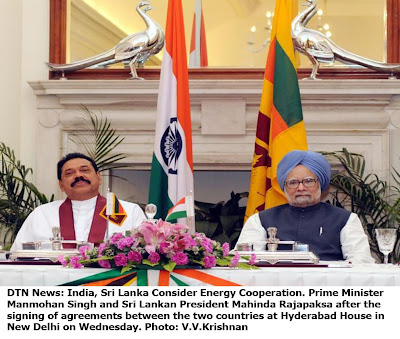
DTN News: India, Sri Lanka Consider Energy Cooperation

DTN News: India, Sri Lanka Consider Energy Cooperation
*To step up high-level military exchanges
*India to assist in the restoration of Palaly Airport and Kankesanthurai Harbour
*Colombo-Tuticorin, Talaimannar-Rameswaram ferry services to be resumed
Source: DTN News / Int'l Media
(NSI News Source Info) NEW DELHI, India - June 10, 2010: Sri Lanka President Mahinda Rajapaksa has proposed discussions on establishing a joint information mechanism on the possibility of oil and gasfields straddling the India-Sri Lanka maritime boundary. In a joint declaration, Prime Minister Manmohan Singh assured Mr. Rajapaksa that this proposal would receive his government's attention and the matter could be discussed further between the two sides. The two countries also agreed to promote dialogue on security and defence issues and step up high-level military exchanges and training of military personnel. Newly recruited Sri Lankan police personnel would be given additional training in Indian institutions. They agreed to institute an annual defence dialogue between the two governments. The two countries would promote the use of space technology for a variety of societal services. India offered to extend the bandwidth to set up satellite-interactive terminals in Sri Lanka. An agreement on conducting a feasibility study for the interconnection of the Indian and Sri Lankan electricity grids was also signed. The two leaders were confident that the agreement would make a significant contribution to enhancing bilateral cooperation in the energy sector. In a step towards strengthening the security and legal framework of the bilateral relationship, Dr. Singh and Mr. Rajapaksa witnessed the signing of the Treaty on Mutual Legal Assistance on Criminal Matters and Agreement on Transfer of Sentenced Prisoners. Both leaders agreed to revive the Joint Commission mechanism and hold its next meeting in the second half of 2010 in order to devise a fuller agenda of bilateral cooperation in various fields. The two leaders were briefed on the progress in discussions between the National Thermal Power Corporation of India and the Ceylon Electricity Board of Sri Lanka on a joint venture to build a 500-MW coal-fired power plant at Sampur in Trincomalee, incorporating environmentally friendly technologies. Sri Lanka expressed its appreciation of India extending an additional concessionary line of credit of $200 million. Mr. Rajapaksa appreciated the credit facilities for about $800 million for railway projects in Sri Lanka. The procurement of rolling stock from India would take place in a phased manner. In the light of past experience, a Steering Committee would oversee the timely completion of the contracted work. In restoring physical and cultural infrastructure and promoting normality in northern Sri Lanka, India agreed to assist in the rehabilitation of the Palaly Airport and the Kankesanthurai Harbour as also help in renovating the Duraiappah Stadium and constructing a cultural centre in Jaffna. India and Sri Lanka agreed to resume ferry services between Colombo and Tuticorin and between Talaimannar and Rameswaram. The two leaders noted the involvement of the Self-Employed Women's Association (SEWA) in addressing rehabilitation of war widows, and witnessed the signing of an MoU on Setting Up of Women's Trade Facilitation Centre and Community Learning Centre at Batticaloa. They also witnessed the signing of the MoU on a Small Development Project Scheme. In bilateral trade, it was agreed that a more comprehensive framework of economic cooperation was required. Officials would hold intensive consultations to develop a framework for sustainable economic partnership and addressing outstanding issues. A CEOs forum would involve the public and private sectors in a dialogue to generate ideas to deepen and broaden the bilateral economic relationship and help chart the future course of business and trade interaction. The two leaders agreed on establishing the Consulate-General of India in Jaffna and in Hambantota to reinforce consular cooperation and friendly links. India welcomed Sri Lanka's interest in establishing an extra post in India, in addition to those in Chennai and Mumbai. They expressed satisfaction with the Joint Statement on Fishing Arrangements of October 2008 and agreed to explore ways to strengthen the safety and security of fishermen and, in this context, directed their officials to revive the meetings of the bilateral Joint Working Group on Fishing. It was also decided to enhance and promote contacts between the fishermen's associations on both sides. Both leaders welcomed the proposal for the restoration of the Tiruketheeswaram temple at Mannar and witnessed the signing of the Programme for Cultural Cooperation for the period 2010-2013. It was agreed to step up links in the educational sector with the two leaders announcing the launching of an “India-Sri Lanka Knowledge Initiative.” Under this Initiative, the University of Colombo would establish a Centre for Contemporary Indian Studies with the support of the Government of India. India announced an expansion of its scholarship programmes in Sri Lanka, including addressing special needs of Northern and Eastern Sri Lanka and upcountry areas. India also responded positively to the request to extend technical assistance to the 10-year Presidential Initiative to steer the island country towards a Trilingual Society by 2020. Both sides agreed to collaborate in the establishment of a research institute on agriculture in the Northern Province of Sri Lanka. Welcoming the growing connectivity between the countries, the two leaders called for greater cooperation in tourism and promotion of people-to-people contacts, especially between youth.
Related India News:

DTN News: Boeing Converted Freighter Joins Cargoitalia's MD-11 fleet

DTN News: Boeing Converted Freighter Joins Cargoitalia's MD-11 fleet
Source: DTN News / Boeing Dt. June 8, 2010
(NSI News Source Info) MILAN, ITALY - June 10, 2010: The Boeing Company [NYSE: BA] is supporting the expansion plans of Cargoitalia S.p.A. by providing the Italy-based, all-cargo operator with its third MD-11 freighter under a long-term lease. Boeing Capital Corporation, the company’s aircraft financing arm, structured the deal for the newly completed MD-11 Boeing Converted Freighter (BCF), with Boeing conducting the modification work at its subcontractor facility in Singapore. Following its acceptance by Cargoitalia, the aircraft flew directly to the operator’s main base at Malpensa Airport here, where it awaits entry into service. The new BCF joins two other MD-11s leased from other sources in the carrier’s scheduled and charter service operations from Italy to the Middle East, Asia and North America. Cargoitalia expects to put it into service on its emerging Milan-Shanghai route beginning in July. “We are very pleased to add an aircraft with the increased quality and capability of the new MD-11 BCF to our fleet. It will be a fundamental tool for developing our cargo network and putting our growth strategy into place,” said Giacomo Manzon, Cargoitalia managing director. Since ALIS Italian Airlines purchased the company in 2008, Cargoitalia has seen a complete turnaround of its operations including almost all of its management and a re-launching of its brand. “Our fleet plan has been a key factor in this, and we are very happy with the performance of the MD-11 freighter. We are considering further fleet development and continue to work on refining our plans and operations, based on one of the most modern freighter models available,” Manzon said. Compared to earlier MD-11s freighters, the new BCF features an updated flight deck and cargo-handling system, better fuel efficiency and increased operating capabilities. It carries a 205,400-pound (93.2 tonne) structural payload at a range of 3,486 nautical miles (6,456 kilometers) at 630,500 pounds (286,000 kg) maximum takeoff weight. The main and lower deck cargo compartments hold a total of 36 96- by 125-in. pallets or containers. The MD-11 freighter is the leader in the 90-tonne freighter class, with some 175 aircraft in active service at well-known cargo operators and freight forwarders worldwide including FedEx, UPS and Lufthansa among others. Boeing Capital has a number of newly converted Boeing freighters on lease to operators including recent customers Aeroflot and Ethiopian Airlines. A sister MD-11 now undergoing conversion will be available for placement later this year. "From a financier’s perspective, investment in a MD-11 freighter conversion is a great move in terms of the aircraft’s residual value. It takes a strong aircraft asset beyond its role as a passenger carrier and extends it to a new cargo-focused life, maximizing its value in the process,” said John Kent, Boeing Capital senior director for Europe. “Cargoitalia’s MD-11BCF brings the engineering expertise of a Boeing-managed conversion with the best in lifecycle support,” said Dan da Silva, vice president, Freighter Conversions, Boeing Commercial Airplanes. “These assure that the airplane will provide superior performance to Cargoitalia’s operation.” Overall, Boeing has converted more than 100 MD-11 passenger airplanes to freighters. Contacts:
John Kvasnosky, Boeing Capital Corp., 206-898-9528 (cell); Bob Saling,
Boeing Commercial Airplanes Cargo/BCF activities, 206-852-3327 (cell); Elena Bollazzi, Cargoitalia Marketing & Communications (phone) +39 0331 663 653. Photo(s) and caption(s) are available with this release on http://boeingmedia.com/

DTN News: Boeing Willing To Let Japan Develop New Deriviative Of F/A-18

DTN News: Boeing Willing To Let Japan Develop New Deriviative Of F/A-18
Source: DTN News / Flight International By Leithen Francis
(NSI News Source Info) TOKYO, Japan - June 10, 2010: Boeing, which is proposing the F/A-18E/F for Japan's forthcoming FX fighter competition, would be willing to let the nation develop its manufacturing capability through the joint development of a new derivative of the Super Hornet. If Japan wanted to further develop the Super Hornet, by coming up with a new derivative, then Boeing would respond positively, says Defense, Space and Security vice-president for international business development Mark Kronenberg. "We would want to come up with a package that helps them with their aspirations," he adds. Japan has yet to issue a request for proposals for the FX competition, but plans to buy 40-50 fighters to replace some of its McDonnell Douglas F-4s.
In the early 1990s, Lockheed Martin worked with Japanese industry to develop the Mitsubishi F-2, a derivative of its F-16, but US law-makers at the time blocked it from transferring some technology. But Kronenberg says technology transfer, with regards to Japan, is less of an issue today. In the 1980s and early 1990s, Japan seemed to be "20ft tall", because the country's corporations were buying so many businesses overseas, but times have changed and US law-makers are now less wary of it, he says. When asked if it is feasible to manufacture 40-50 fighters in Japan under licence, Kronenberg says: "It depends on how much you want to pay to get that new manufacturing capability. I think Japan is willing to pay." He adds that Tokyo's long-term objective is to have the technological and manufacturing capability to develop its own fighter. Some industry observers predict that whichever company wins the FX competition is also likely to win in a subsequent FXX requirement. This is likely to seek over 100 fighters to replace some of Japan's older Boeing F-15s. In a separate development, Japan's nearest neighbour South Korea announced in January that it is studying whether to develop an indigenous fighter. Its government says that if it decides to proceed, completion of the first aircraft would be in 2021. Boeing would also be interested in assisting Seoul with its KFX indigenous fighter programme "if it was part of a long-term path", says Kronenberg. "We would rather partner in significant markets like Korea rather than compete," he says. Maybe longer-term some F-15SE technology could be applied, he adds. The South Korean already operates F-15Ks.

DTN News: Lockheed Martin F-35 Ground-Test Article Completes Testing Five Months Ahead Of Schedule

DTN News: Lockheed Martin F-35 Ground-Test Article Completes Testing Five Months Ahead Of Schedule
Source: DTN News / Lockheed Martin Dt. June 9th, 2010
(NSI News Source Info) FORT WORTH, Texas, - June 10, 2010: The Lockheed Martin [NYSE: LMT] F-35 Lightning II program successfully completed F-35A conventional takeoff and landing (CTOL) full-scale static testing – with zero structural failures – five months ahead of schedule and in less than half the time of legacy programs. The test program was conducted on AG-1, an F-35A dedicated to validating the strength of the jet's airframe. During testing, the strength and stability of the aircraft structure were verified to 150 percent of design limits or 13.5 G's (force of gravity), with 174 critical load conditions, or pressures, applied to the airframe to evaluate its structural integrity. Testing was conducted predominantly at BAE Systems’ Structural & Dynamic Test Laboratory in Brough, England. The U.K. tests began in August 2009 and were accomplished in 295 days – a rate that exceeded the record-setting pace previously established by the F-35B short takeoff/vertical landing static test program. Mick Ord, BAE Systems managing director for the F-35 program, said, "This was a major milestone, and the test results demonstrate that the F-35 has a fantastic airframe. As a principal subcontractor to Lockheed Martin, one of the capabilities BAE Systems brings to the F-35 programme is our structural test expertise. The structural and dynamic test facility at Brough is a centre of excellence in the U.K. Our team has performed admirably to complete the test schedule on AG-1 ahead of program." The F-35 Lightning II 5th generation fighter combines advanced stealth with supersonic speed and high agility, fully fused sensor information, network-enabled operations and lower operational and support costs. Lockheed Martin is developing the F-35 with principal industrial partners Northrop Grumman and BAE Systems. The F-35 program has about 900 suppliers in 43 states, and directly and indirectly employs more than 130,000 people. Thousands more are employed in the F-35 partner countries, which have invested more than $4 billion in the project. Those countries are the United Kingdom, Italy, the Netherlands, Turkey, Canada, Australia, Denmark and Norway. Headquartered in Bethesda, Md., Lockheed Martin is a global security company that employs about 136,000 people worldwide and is principally engaged in the research, design, development, manufacture, integration and sustainment of advanced technology systems, products and services. The Corporation reported 2009 sales of $45.2 billion. Media Contacts: John R. Kent
Office: 817-763-3980
Email: john.r.kent@lmco.com Chris Geisel
Office: 817-763-2643
Email: christian.g.geisel@lmco.com F-35 photos and videos at:

DTN News: First Three C-130J Super Hercules For India Near Completion At Lockheed Martin Facility

DTN News: First Three C-130J Super Hercules For India Near Completion At Lockheed Martin Facility
Source: DTN News / Lockheed Martin - June 9th, 2010
(NSI News Source Info) MARIETTA, Ga., - June 10, 2010: The first three C-130J Super Hercules for India take the final positions on Lockheed Martin’s assembly line in Marietta, Ga. India will receive six aircraft plus support, with the first aircraft arrival in India scheduled for February 2011. The six C-130Js will give the Indian Army and Air Force new special operations capabilities using the world’s most advanced airlifter.
The Indian Air Force purchased six C-130J-30s in early 2008 at a cost of up to US$1.059 billion. It is a package deal with the US government under its Foreign Military Sales (FMS) program, and India has retained options to buy six more of these aircraft for its special forces for combined army-air force operations. Media contact:
Peter Simmons
Communications
Lockheed Martin Aeronautics
678-662-4747