Saturday, July 20, 2013

DTN News - PAKISTAN ~ OSAMA BIN LADEN NEWS: Could The Pakistani Government Have Hidden Bin Laden?

DTN News - PAKISTAN ~ OSAMA BIN LADEN NEWS: Could The Pakistani Government Have Hidden Bin Laden?
*The chaotic state of governance suggests conspiracy on a national scale to protect Bin Laden is fanciful at best.
Source: DTN News - - This article compiled by Roger Smith from reliable sources Al Jazeera
(NSI News Source Info) TORONTO, Canada - July 20, 2013:  The revelation that a Pakistani government dossier regarding Osama bin Laden had leaked to the media immediately brought to mind salacious and popularly held suspicions about the country’s complicity in harbouring the infamous terrorist financier. Bin Laden, who after 9/11 was believed to be on the run in the remote tribal wilderness, eventually was found to be residing, shockingly, in a comfortable home within a quiet Pakistani city with significant military links.


That this city was also home to the Pakistani military’s equivalent of West Point only added to the sense that this was a blatant cover-up and that the Pakistani government was consciously hiding and protecting America’s most wanted terrorist.  Any leaked internal Pakistani documents relating to this affair could then be little else but a documentation of how such a world-beating scheme was pulled off.

However, the dossier which did leak suggests the opposite as true. While the report’s authors do not explicitly rule out state collusion, the picture they paint is one which more strongly reflects bureaucratic chaos and mismanagement than of a finely-tuned, sinister plot. The revelations contained therein may dispel suspicions of any broad, coordinated Pakistani government conspiracy to aid Bin Laden, but they do indict the state in an arguably worse way.

A state without control
There are two competing theses as to how Osama bin Laden may have been able to live for years under the noses of the Pakistani establishment. One posits the necessary collusion of the Pakistani government, while the other assumes structural incompetence led to organisational obliviousness to Bin Laden’s presence on Pakistani soil. Collusion would require an efficiently organised and well-functioning Pakistani state able to keep such an incredible secret, while obliviousness would entail a high-degree of bureaucratic ineptitude and confusion within the state machinery. Even a cursory reading of contemporary Pakistani shows that the latter scenario is the situation which exists at most levels of the country today.

The government is simply too chaotic, disjointed and deeply compromised by the U.S. to have the wherewithal or capacity to engineer such a conspiracy
One may argue in response that the Pakistani government is merely feigning incompetence in order to provide cover for its nefarious activities. In this view the leak of the dossier is simply an alibi to conceal their true role in the Bin Laden saga. But the circumstantial evidence against this hypothesis is too great for it to be plausible. The country is a textbook case of bureaucratic mismanagement and inertia, and the broad organisational integrity required to engineer such a scheme is nowhere in evidence.

Indeed, so greatly has the Pakistani political elite today lost the plot that they themselves cannot protect their own closest kin - as evidenced by the recent kidnapping of former Prime Minister Yousaf Raza Gilani’s son, and the assassination of former President Asif Zardari’s own security chief. Given this reality, it is difficult to fathom how this same class of individuals could have put such an intricate conspiracy over on the entire world. The state is simply not in complete control of events in the way it would need to be for such a thing to be possible - especially not for the countless years in which Osama bin Laden was believed to be hiding out in the country.

As detailed in the report, corruption has trickled down to the point where it is endemic almost everywhere within the Pakistani state. Bin Laden himself is detailed in the dossier to have essentially escaped detection by having his driver bribe a police officer who had pulled his car over for speeding. Even popular media personalities were reported to have been ‘heavily bribed with money, women and alcohol’ in order to print unfavourable news stories about certain factions within the government.

It is worth remembering that the so-called “War on Terror” of the past decade has seen tens of thousands of Pakistanis killed, the country’s name utterly tarnished, the (apparent) fiction of its sovereignty dispelled and its infrastructure reduced to a shambolic state. Even ignoring its protestations of ignorance and incompetence, an objective reading of the circumstances of the Pakistani state does away with the myth that accomplishing a feat such as hiding Bin Laden would even be possible.

A government bought and paid for
The leaked dossier also recounts testimony from former ISI chief Lieutenant-General Ahmed Shuja Pasha in which he says a CIA operative told him: "You are so cheap… we can buy you with a visa, with a visit to the US, even with a dinner… we can buy anyone." Indeed, the picture painted is of a state willing to acquiesce to any US directive at a whim, as well as a society deeply infiltrated by American intelligence operatives.

Page 198 of the report revealed that in discussions with their Pakistani counterparts on a list of counterterrorism demands, American negotiators were reportedly ‘mystified’ that the Pakistani side ‘caved so promptly and completely’. A follow-up list of negotiating points, created in anticipation of inevitable objections, became immediately superfluous as the Pakistani side fell over themselves to immediately acquiesce to every American demand. The depth of Pakistani collusion with the US on politically-sensitive issues such as drone strikes was also revealed, highlighting the extent to which Pakistani leadership considered the lives and legal rights of the country’s citizens to be utterly forfeit in the face of any American request.

Even NGOs were not spared. The report noted that the American NGO “Save the Children” - created ostensibly to vaccinate and inoculate children against various diseases - was in fact a front operation funded and operated by American intelligence.

The report goes on to say that in fact a huge proportion of the NGOs operating in the country were believed to be compromised by foreign intelligence services (specifically those of the United States) but that they could not be completely barred because of the degree to which large parts of the citizenry were forced to rely on them. In essence, the social services of much of the country have today been outsourced to the CIA.

Pakistan a 'failing state' says ISI chief
A more depressing commentary of negligence and corruption would be difficult to find, but it is nonetheless worth pointing out that a Pakistani state so thoroughly compromised by the United States would by its very nature be incapable of engineering a broad conspiracy.

The CIA had penetrated almost every level of the Pakistani state machinery (a reality acknowledged by the authors of the report), making any attempt at comprehensive secrecy nearly impossible. Indeed, the extent to which even Pakistan’s most guarded knowledge - the details of its nuclear weapons program - has today been compromised is a testimony to the inability of the government today to maintain state secrets, let alone grand conspiracies.

The façade of a state
If Americans feel aggrieved or baffled by the series of events which led to Osama bin Laden’s presence in Pakistan, they should reflect on the history which Pakistanis have been dealt by their own government. In a few short decades the citizens of Pakistan have witnessed more ostensibly-conspiratorial episodes than most countries do in their entire histories. 

From the assassination of the country’s first Prime Minister Liaquat Ali Khan, to the mysterious plane-crash death of General Zia ul Haq, to the murder of former Prime Minister Benazir Bhutto (and, in years previous, her brother) and innumerable other high-profile cases, Pakistan has been wracked by a long history of shadowy, unexplained violent events in the public sphere. For these cases Pakistanis have never received answers - let alone accountability.

Are events in Pakistan thus being clandestinely dictated by an Illuminati-type cabal, opaquely engineering events to their own benefit; and so powerful that they are able to brazenly defy the will of the world’s only military superpower?

Or is the government itself merely a collection of various disparate factions with little control over broader national events, each out for their own interests (primarily the accumulation of private wealth at the expense of the citizenry) and maintaining merely the chaotic façade of a contiguous “state”?

Occam’s razor would suggest the latter. In this view, validated in great part by the contents of this leaked report, Pakistan would have neither a coherent desire nor the ability to harbour Osama bin Laden. While it is likely that some individual or small group of individuals somewhere within the incoherent state or military apparatus had knowledge of his whereabouts, the allegation of broad or high-level official collusion is an utterly spurious one.
The government is simply too chaotic, disjointed and deeply compromised by the US to have the wherewithal or capacity to engineer such a conspiracy. The conspiracy narrative is only undermined if one operates on the assumption that this leaked dossier is simply the continuation of the same plot - but there is little evidence in the grand history of infighting and maladministration which is the Pakistani bureaucracy to suggest such Machiavellian foresight.

Ordinary Pakistanis are the ultimate victims of this at once malicious and negligent system. With the Bin Laden episode, Americans merely received a glimpse into the bizarrely opaque and chaotic world Pakistan’s government compels its citizens to live with.

Murtaza Hussain is a Toronto-based writer and analyst focused on issues related to Middle Eastern politics.
Follow him on Twitter: @MazMHussain
The views expressed in this article are the author's own and do not necessarily reflect Al Jazeera's editorial policy.
Sourc:
Al Jazeera

*Link for This article compiled by Roger Smith from reliable sources Al Jazeera
*Speaking Image - Creation of DTN News ~ Defense Technology News 
*Photograph: IPF (International Pool of Friends) + DTN News / otherwise source stated
*This article is being posted from Toronto, Canada By DTN News ~ Defense-Technology News Contact:dtnnews@ymail.com 
©COPYRIGHT (C) DTN NEWS DEFENSE-TECHNOLOGY NEWS

Friday, July 19, 2013

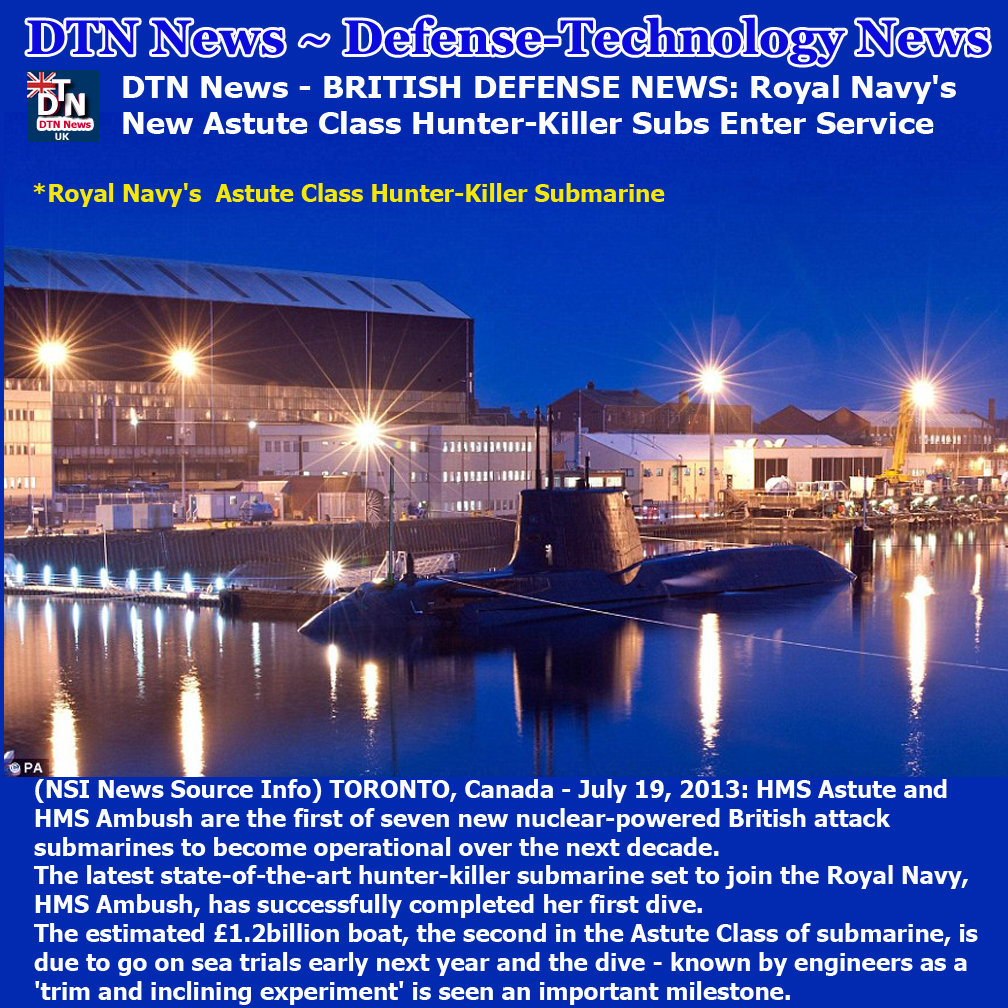
DTN News - BRITISH DEFENSE NEWS: Royal Navy's New Astute Class Hunter-Killer Subs Enter Service

DTN News - BRITISH DEFENSE NEWS: Royal Navy's New Astute Class Hunter-Killer Subs Enter Service
*The Navy’s two most advanced hunter-killer submarines ever have entered service after years of delays.
Source: DTN News - - This article compiled by Roger Smith from reliable sources By Ben Farmer, Defence Correspondent 5:39PM BST 19 Jul 2013
(NSI News Source Info) TORONTO, Canada - July 19, 2013: HMS Astute and HMS Ambush are the first of seven new nuclear-powered British attack submarines to become operational over the next decade.

The Astute class submarines have cost more than £1 billion each and are among the most advanced in the world. They can circumvent the globe without surfacing, carrying a payload of dozens of cruise missiles and torpedoes.

Their sonar is so sensitive that one lurking in the Solent would be able to detect a ship leaving New York harbour 3,500 miles across the Atlantic. Advanced acoustic tiles mean they are virtually silent. They can also stay underwater indefinitely, only needing to surface if the 100-strong crew has run out of food.

The new boats are replacing the Navy's Trafalgar class submarines and the programme has been bedevilled by delays, faults and runaway costs since it began in the mid-1990s.
Naval commanders also faced embarrassment in 2010 when HMS Astute ran aground on rocks off Scotland during sea trials.

Rear Admiral Simon Lister, director of submarines at the Ministry of Defence, said the seven Astute class vessels would be the “backbone of the submarine fleet”.

He said: “They do the power projection, intelligence gathering, patrolling and have that deterrent effect.”

Three more of the 106-yard-long and 7,400 tonne submarines are currently in various stages of production in the vast BAE Systems assembly hall in Barrow-in-Furness and this week the keel was laid for Agamemnon, the sixth submarine. Barrow-in-Furness in Cumbria has built 311 Royal Navy submarines since 1901.

Stuart Godden, engineering director, said the programme to build the submarines was Britain’s most complex engineering project and as difficult as a space programme.
He said: “I think it’s at least as complex as the NASA space programme.”

The submarines have no periscope, but are equipped with an array of powerful sensors which can allow them to carry out spying and eavesdropping missions. Each submarine’s electronics means it has more than 60 miles of cabling.

The Astute class is also the first where every submariner gets their own bed, rather than having to “hot bed” and sleep in shifts.

Engineers say the boats can stay underwater indefinitely, with the only limits to dives being the amount of food they carry and the morale and endurance of the crew.

Most patrols from their base in Faslane, Scotland, will be three months long.

Ricki Rotimi, leading chef on HMS Artful which is nearing completion, said his team would cook four meals a day for the entire crew.

He said: “The rubbish thing is when we start running out of fresh vegetables and fruit, but you just have to get on with it.”

The submarines became operational in the week a Liberal Democrat review of Trident concluded that Britain can maintain a credible nuclear deterrent without a like-for-like replacement of its Trident submarine fleet.

The review, led by Treasury Chief Secretary Danny Alexander, said there are alternatives to the UK's current stance of round the clock patrols by nuclear armed submarines.

Philip Hammond, defence secretary, was scathing about the alternatives, saying they would create a “part time deterrent” and save as little as £50 million a year.

HMS Astute and HMS Ambush are the first submarines in Class accepted by Navy Command, which is responsible for operating all of the Royal Navy’s vessels.

The next three submarines in the Class: Artful, Audacious and Anson are all at varying stages of build and today’s keel laying for Agamemnon marks the next key milestone for the programme.

BAE Systems Maritime Submarines (BAES (MS)) is responsible for delivering all seven Astute Class submarines and for the design of the successor to the Vanguard class, which will carry the UK’s nuclear deterrent.

The MoD has agreed a new contract with BAES (MS) that will not only help to sustain the thousands of highly skilled defence jobs based at Barrow-in-Furness but drive down the costs of building future submarines.

Minister for Defence Equipment, Support and Technology Philip Dunne today signed a new contract will deliver £380M of savings over the next eight years.

This will ensure that the Royal Navy’s submarine capability is delivered efficiently and provides good value for money for the taxpayer.

Minister Dunne, said:

“The keel laying of the sixth submarine, Agamemnon, and the handover of HMS Astute and HMS Ambush to the Royal Navy are huge milestones reflecting significant progress in the programme.

“By ensuring the UK’s submarine programme remains affordable, this new contract will help deliver the Astute Class and pave the way for the future Successor nuclear deterrent submarines and secure around 5,000 jobs at BAE Systems and thousands more who work in over 400 suppliers across the UK submarine supply chain.”

Rear Admiral Simon Lister, the MoD’s Director of Submarines, said:

“This is the sixth submarine in the Astute Class and we expect her to be built more quickly and efficiently than her predecessors, demonstrating the effectiveness of the national submarine building capability in Barrow-in-Furness.


“New techniques by skilled staff in the back office and on the shop floor will deliver this key capability for the Royal Navy."

Related News;
  • 16 Nov 2012
  • 22 Oct 2010
  • 27 Nov 2010
  • HMS Astute groun
    d after catalogue of errors, finds report

    23 Apr 2012

  • *Link for This article compiled by Roger Smith from reliable sources By Ben Farmer, Defence Correspondent 5:39PM BST 19 Jul 2013
    *Speaking Image - Creation of DTN News ~ Defense Technology News 
    *Photograph: IPF (International Pool of Friends) + DTN News / otherwise source stated
    *This article is being posted from Toronto, Canada By DTN News ~ Defense-Technology News Contact:dtnnews@ymail.com 
    ©COPYRIGHT (C) DTN NEWS DEFENSE-TECHNOLOGY NEWS
    DTN News - JAPAN DEFENSE NEWS: Prime Minister Shinzo Abe Visits Island Near Disputed Chain

    DTN News - JAPAN DEFENSE NEWS: Prime Minister Shinzo Abe Visits Island Near Disputed Chain
    Source: DTN News - - This article compiled by Roger Smith from reliable sources AFP
    (NSI News Source Info) TORONTO, Canada - July 19, 2013: (Tokyo) Prime Minister Shinzo Abe on Wednesday visited a coast guard vessel that patrols waters around islands at the center of a dispute with China, as election campaigning stepped up a gear.

    Abe was on the remote Okinawan island of Ishigaki in the East China Sea, 2,000 kilometers southwest of Tokyo, where he told coast guard crew his resolve to stand up for Japan was undimmed.

    “The security environment for our territorial waters has become increasingly serious, as Chinese government ships frequently sail to and roam around waters surrounding Senkaku islands,” Abe said in an address to about 40 coast guard personnel.

    Senkaku is Japan’s name for islands it controls, but which China claims as the Diaoyus.

    “I very much appreciate your efforts to patrol our territorial waters. I will continue to take charge and defend our territory, territorial waters and territorial airspace,” said Abe, who wore a blue Okinawan shirt and a coast guard cap for the occasion.

    Abe’s visit to Ishigaki, which lies less than 200 kilometers off the coast of Taiwan, was the first by a sitting premier in 48 years, national broadcaster NHK said.

    It comes as the dispute with Beijing over the sovereignty the uninhabited, but resource-rich islands further north continues to fester, with little sign of any improvement in sight.

    “The Senkakus are undoubtedly an integral part of Japan, historically and under international law,” Abe said in Ishigaki later in the day. “We won’t budge one bit.”

    The visit comes just a few days ahead of elections for half of the seats in the upper house of parliament, which observers expect to be a shoo-in for Abe’s Liberal Democratic Party.

    Voters have warmed to his economic policies, although many remain wary of his stance on issues including Japan’s warring past and his intention to change the country’s pacifist constitution or strengthen its armed forces.

    Since taking office in December, Abe has visited a number of foreign countries, but has stayed away from China, with whom relations remain more-than-usually prickly.

    Tensions have steadily risen between the two Asian giants, with China frequently sending official ships into waters around the Tokyo-administered islands.

    Vessels from the two countries have for months traded warnings over intrusions into what both regard as their sovereign areas around the islands.

    The long-standing dispute reignited last September when Tokyo nationalised three islands in the chain in what it said was a mere administrative change of ownership from a private landowner.

    China insists the islands were part of its territory until Japan annexed them in 1895.

    *Link for This article compiled by Roger Smith from reliable sources AFP
    *Speaking Image - Creation of DTN News ~ Defense Technology News 
    *Photograph: IPF (International Pool of Friends) + DTN News / otherwise source stated
    *This article is being posted from Toronto, Canada By DTN News ~ Defense-Technology News Contact:dtnnews@ymail.com 
    ©COPYRIGHT (C) DTN NEWS DEFENSE-TECHNOLOGY NEWS

    DTN News - DEFENSE NEWS: The Battle Over Global Hawk

    DTN News - DEFENSE NEWS: The Battle Over Global Hawk
    Source: DTN News - - This article compiled by Roger Smith from reliable sources Air Force Times
    (NSI News Source Info) TORONTO, Canada - July 18, 2013: June is the start of the rainy season in the South Pacific, six months of storms that come in fast and unpredictable. And when the wind starts blowing, that takes its toll on U.S. intelligence-gathering far off in North Korea.

    A substantial amount of the intel on the Hermit Kingdom comes from the three massive Global Hawk unmanned surveillance planes based at Andersen Air Force Base, Guam.

    Because of special flight restrictions, the Global Hawks can’t fly over thunderstorms, nor, without a way to see the clouds ahead, can they go around them. So whenever a hint of bad weather arose on the route Global Hawk was assigned last year from Guam, the missions were canceled. Last year, the unmanned planes were grounded for a month, says a source with knowledge of the operation.

    This susceptibility to South Pacific cyclones is adding new energy to the political hurricane raging in Washington over the future of the expensive unmanned aircraft.

    It’s been a year and a half since the Air Force said it no longer needs the Global Hawk. The service argued that the planes, each built for more than $200 million, don’t do their jobs as well as the time-tested U-2 manned spy plane. So the Air Force wants to take the entire fleet of 18 Global Hawks and park them in the “boneyard” — the aircraft storage facility at Davis-Monthan Air Force Base, Ariz.

    Now the battle lines are forming in what may be an epic contracting war. On the one side, swinging hard, is Global Hawk-maker Northrop Grumman. It has some powerful arguments, and it has members of Congress who say the Air Force needs to fall in line. On the other side is the Air Force, fighting to keep the U-2, which was built by Lockheed Martin.

    'Essential to national security'
    At 70,000 feet, a U-2 pilot flying northwest along the boundary of North Korean airspace can turn his head to the right, and through the visor of his spacesuit, he will see the silhouette of Earth’s curvature. Then he will see a silent green phosphorescent flash before the sky suddenly goes dark.

    They call that flash “the terminator.” No U-2 pilot ever forgets it. Until just two years ago, the U-2 program itself — the workhorse of high-altitude intelligence, surveillance and reconnaissance for 60 years — was due to be terminated, too. For a time, the Global Hawk versus U-2 debate revolved around age. The U-2, its critics said, was of a different era, before unmanned aerial vehicles. After all, any pilot flying the U-2 now wasn’t even born when the program started back in 1955.

    But now, as one Air Force pilot points out, “This is not your grandfather’s U-2.” For example, today’s U-2S jets have pressurized cockpits, although the pilots still wear spacesuits in case anything goes wrong.

    Lockheed Martin’s Robert Dunn said the U-2S has a long way to go before it needs to be decommissioned.

    “The airplanes we are flying today are certified to 75,000 flight hours. The average airframe is 14,000,” he said.

    If the U-2 is the aging champion, then in the other corner of the ring is the upstart Global Hawk. A feat of modern engineering, the autonomous plane can fly for 32 hours straight when conditions are right. That’s far longer than the U-2, though not as high and with a smaller payload.

    Ironically, the now-costly Global Hawk program was birthed during the cutbacks of the Clinton years. The Air Force was enthusiastic about its huge, high-flying unmanned plane, and it pushed for more and more capacity for the planes.

    The first operational lot, the Block 10s, couldn’t carry enough weight, so the next generation was bigger and more ambitious. It was about more sensors, more power, more payload.

    Initially pitched as a $35 million aircraft, costs ballooned over the years by 284 percent, according to the Congressional Research Service. Much of that was due to the Air Force’s shifting requirements. (It’s now estimated at about $220 million per plane including development costs.) The Air Force, for a time, was the Global Hawk’s biggest cheerleader, although the history has been complex and sometimes contradictory.

    In early 2011, for example, the Defense Department’s director of operational test and evaluation said “the system was not operationally effective for conducting near-continuous, persistent ISR operations.”

    Then, in June 2011, shortly before the Global Hawk was fielded, Air Force officials certified the project as “essential to national security.” It was meant to ensure that Congress continued to fund the program, but the proclamation would begin to haunt the service just months later.

    Reversing course
    In January 2012, the Air Force announced a drastic turnaround: It would terminate the Global Hawk program.

    It provoked a firestorm — and a heavy public advocacy campaign on Capitol Hill by those who support the plane. Like many major modern weapons, its subcontractors are widely distributed across the U.S., ensuring a broad base of political support. Northrop Grumman’s website notes that all but 15 states manufacture some part of the Global Hawk. Experts were confounded that the Air Force had changed its mind so quickly.

    And Congress put its foot down.

    In the 2013 National Defense Authorization Act signed earlier this year, Congress told the Air Force it would have to fly the Global Hawks it had already — 16 plus two being built — through the year 2014. The service “shall maintain the operational capability of each RQ-4 Block 30 Global Hawk unmanned aircraft system belonging to the Air Force or delivered to the Air Force.”

    And to make sure no Global Hawk went on to the boneyard, the act was specific: No money “may be obligated or expended to retire, prepare to retire, or place in storage an RQ-4 Block 30 Global Hawk unmanned aircraft system.”

    All of which sets the stage for the current conflict on the Hill.

    Meanwhile, the 2013 Defense Appropriations Act went further. The service had resisted ordering new planes, on the assumption that by the time they were delivered, they’d be going right to the boneyard. Now the Air Force was told to order three of the planes that had previously been budgeted for in 2012. “The Secretary of the Air Force shall obligate and expend funds previously appropriated,” for the plane. But the Air Force has resisted. As another officer said, “Why are they making us spend money on something we don’t want or need?” That attitude has irked some Northrop Grumman supporters on Capitol Hill.

    In May, Rep. James Moran, D-Va., and Rep. Buck McKeon, R-Calif., wrote a stinging letter to Defense Secretary Chuck Hagel demanding that the Air Force do what it was told.

    “The Air Force has continued to ignore clear Congressional intent,” they said.

    And the House Armed Services Committee in June voted for a new defense authorization bill that would force the Air Force to use the Global Hawks until 2016.

    Chasing solutions
    There is much disagreement on how much it would cost to upgrade the Global Hawk Block 30s, where there are shortfalls that need addressing. Take the sensors.

    The Air Force reported to Congress that “upgrades to the GH Block 30 to achieve parity with the U-2 program require an expenditure of approximately $855 million.”

    It might not be able to fly as high, but at least it could photograph as clearly.

    Northrop Grumman’s defenders, eager to get the Air Force to change its mind, say the service is way off the mark. The company has offered to put better cameras on the Global Hawk for $48 million.

    “We’ve looked at that and we’ve addressed it,” said Tom Vice, Northrop Grumman’s president of Aerospace Systems. “We looked at how to open up our architecture. We’ve offered a firm fixed-price offer to the U.S. Air Force to integrate the SYERS sensors onto Global Hawk. And that would cost the Air Force only 6 percent of what the Air Force believed it would cost to upgrade the current Block 30 cameras. Guaranteed price; no risk to the government.”

    Northrop Grumman’s $48 million versus the Air Force $855 million is an unresolved discrepancy, for the moment. One reason it can work: The company wants to simply remove the cameras from the competition — essentially cannibalizing the U-2.

    As for the Global Hawk’s getting grounded in places like Guam, where it can’t be relied on during the rainy season, the plane’s supporters say that’s the Air Force’s fault in the first place because of onerous restrictions. Supporters argue that requiring the plane to fly 10,000 feet over clouds, and limiting it to one route was the problem that caused it to be grounded excessively. Now it’s been given alternative routes, which supporters say will cut back on canceled missions. The difficulty has been that Global Hawk is unmanned, without “sense and avoid” technology to meet air traffic requirements. Normally, a pilot could see the clouds and steer around them, but without a pilot, the Global Hawk can’t do that.

    Northrop Grumman has told the Air Force it can put “weather diversion” cameras in the Guam-based Global Hawks. That way, the operators back at base will be able to see the clouds and reroute, just as they could if the pilot was flying.

    The company pitched the idea to the Air Force, offering to install the cameras for $7 million.

    Bias against drones?
    There are some analysts who believe that, in spite of the Global Hawk’s shortfalls, the Air Force is making a mistake.

    “However you cut it, I think there is a good case for Global Hawk Block 30,” says Mark Gunzinger of the Center for Strategic and Budgetary Assessments. “The reasons cited for retiring the Block 30s don’t stand up under scrutiny. It’s worth questioning.”

    But if the Air Force is really being disingenuous in terminating the Global Hawk, as its critics say, what would be the motive? That’s where the Northrop Grumman defenders are having a difficult time.

    Is it, perhaps, a lingering bias against drones, a preference for the swaggering days of the piloted plane? At a House hearing in May where he castigated the Air Force for its decision on Global Hawk, Moran said as much: “The U-2, as you know, has a pilot. And I suspect that’s the real issue — the pilotless versus the piloted craft, even though the U-2 has been around longer than even some of the members of this subcommittee have been alive.”

    Air Force Chief of Staff Gen. Mark Welsh protested. “Pilot being in the airplane had absolutely nothing to do with it. I couldn’t care less. We want the platform that will do the best job of accomplishing the mission assigned — manned or unmanned — and we’ve said that all along,” Welsh said at a May 9 House Appropriations defense subcommittee hearing.

    And after all, the Air Force has hundreds of unmanned planes and continues to develop new ones. It’s hard to argue that the service simply doesn’t like unmanned aviation anymore.

    If not a bias against planes, others say that it is just stubbornness: The Air Force has dug itself into an untenable position and because of bureaucracy, is unwilling to back down, they say. Still, that does seem like a stretch, given what’s at stake. If the Air Force still says it doesn’t need to spend the hundreds of millions of dollars on a program it finds inadequate, it will be hard to argue with that in an era when sequestration is cutting everyone’s budget.

    This article first appeared in the July issue of C4ISR Journal.

    MEASURING UP
    Here’s a side-by-side comparison of the two platforms:
    ■ Power. The U-2’s engine, with 17,000 pounds of thrust, can push the plane beyond 65,000 feet within a half-hour. “It climbs like a homesick angel,” said a U-2 pilot. The Global Hawk, powered by an engine with just 7,500 pounds of thrust, can take four hours to reach its ceiling of 60,000 feet, critics say.
    ■ Endurance. Global Hawk is the hands-down winner. It can fly up to 32 hours before returning to base. Some say that’s what matters. “This is no time to be getting rid of your long-range, long-endurance assets,” said Rebecca Grant, an analyst who has done work for Northrop Grumman. The U-2 is stretching it to fly 14 hours; more typical flights last 10. But its defenders note that the manned plane can be based closer to the action, say, in South Korea, where flight restrictions bar unmanned aircraft.
    ■ Altitude. Here, U-2 is the king, with a publicly disclosed ceiling of 70,000 and a true ceiling somewhere about 75,000 feet. Global Hawk tops out at 60,000 feet. For the Air Force, this has become the central issue. First, the U-2 gets above the weather.
    The worst storm in the world is “just fireworks below,” said a pilot. But the other issue is visibility. Simple geometry allows the U-2 to see farther into enemy territory than the Global Hawk.
    That really makes a difference. A ceiling of 60,000 feet versus 70,000 doesn’t sound like much, but look at it this way: The main job of the plane in the near future will be flying over the borders of such countries as China and North Korea from international airspace.
    The Air Force likes to see 80 or 100 miles into adversaries’ territory, and the U-2’s added height lets it do that.
    ■ Sensors. That’s what it’s all about. At first glance, the Global Hawk has the edge. It carries three sensors for its intelligence missions, and the U-2 carries only two. On top of that, the Global Hawk can switch in midflight between electro-optical and synthentic aperture radar. “To have the ability for a single weapons system to carry a SAR radar, electro-optical package, and SIGINT package,” said Tom Vice, Northrop Grumman’s president of Aerospace Systems, “it allows to you to fuse all three different types of intelligence products together at the same time.”
    But the Air Force says the U-2 has a far better electro-optical sensor that gives it a hands-down win in the category. In a report to Congress this spring, the Air Force flatly said that “the current U-2 sensors are superior to those of the GH.” Key to that is a camera called SYERS II (Senior Year Electro-optic Reconnaissance System) manufactured by UTC Aerospace. It’s multispectral, unlike the Global Hawk’s camera, and it sees farther.
    ■ Price. The U-2s were all built years ago. It’s a bit like owning a 2000 Honda Accord — it’s already paid for, it will keep on going and it drives great. The Global Hawks, on the other hand, are still coming off the production line. But Northrop Grumman argues that most of the development costs have been spent anyway, and the kinks of building a new system have only recently been ironed out. The Air Force says at this point that it is just spending good money on a system that doesn’t have what it takes.
    As for operating costs, they are equivalent — $33,500 per hour.
    But as Northrop Grumman points out, the Global Hawk doesn’t need training flights and requires fewer takeoffs and landings. Even the Air Force, in a recent report, acknowledged that “the persistence advantage of [Global Hawk] manifests itself in lower execution costs.”
    Among its various proposals, Northrop Grumman has made one that stands out. It is offering to provide a 10-year contractor logistics contract for the Global Hawk Block 30 for $250 million, as a fixed price. It made the offer, though, months after the Air Force decided to terminate the program.


    *Link for This article compiled by Roger Smith from reliable sources Air Force Times
    *Speaking Image - Creation of DTN News ~ Defense Technology News 
    *Photograph: IPF (International Pool of Friends) + DTN News / otherwise source stated
    *This article is being posted from Toronto, Canada By DTN News ~ Defense-Technology News Contact:dtnnews@ymail.com 
    ©COPYRIGHT (C) DTN NEWS DEFENSE-TECHNOLOGY NEWS

    Wednesday, July 17, 2013

    DTN News: U.S. Department of Defense Contracts Dated July 17, 2013

    DTN News: U.S. Department of Defense Contracts Dated July 17, 2013
    Source: U.S. DoD issued No.  518-13 July 17, 2013
    (NSI News Source Info) TORONTO, Canada - July 17, 2013: U.S. Department of Defense, Office of the Assistant Secretary of Defense (Public Affairs) Contracts issued  July 17, 2013  are undermentioned;


    CONTRACTS
    Missile Defense Agency
                Raytheon Integrated Defense Systems, Woburn, Mass. is being awarded a sole-source, cost-plus-incentive-fee, and cost-plus-fixed-fee contract modification to HQ0147-12-C-0005 under a foreign military sales (FMS) case to the United Arab Emirates (UAE), to provide software updates, contractor logistic support, radar repair and return and technical services on the AN/TPY-2 radars being delivered as part of a whole FMS case as an element of the Terminal High Altitude Area Defense (THAAD) system.  The value of this effort is $83,785,417.  Work will be performed in Woburn, Mass., White Sands Missile Range, N.M., and UAE.  The period of performance is through Sept. 30, 2018.  UAE FMS funds in the amount of $83,785,417 will be used to fund this effort.  The Missile Defense Agency, Huntsville, Ala., is the contracting activity (HQ0147). 

    Air Force
                Boeing Co., McDonnell Douglas Corp., St. Louis, Mo., has been awarded a not-to-exceed amount of $75,598,874 firm-fixed-price and cost-reimbursable contract (FA3002-13-D-0012) for courseware development as well as initial and differences training necessary to transition from other F-15 variants to the unique, non-commercial F-15SA weapon system for the Royal Saudi Air Force.  Work will be performed in St. Louis, Mo., and King Khalid Air Base, Khamis Mushayt, Kingdom of Saudi Arabia.  This is a sole-source acquisition.  Fiscal 2011 international funding will be used in this multiyear (100 percent), FMS contract, and FMS customer is The Air Force Security Assistance Training Squadron.  Work is expected to be completed by July 19, 2019.  Air Education and Training Command Contracting Squadron/LGCI (International Contracting Flight), Randolph Air Force Base, Texas, is the contracting activity.  

                Rockwell Collins Inc., Cedar Rapids, Iowa, has been awarded a $13,569,781 firm-fixed-price contract Option III (FA8105-09-C-0004).  Rockwell Collins Inc., shall produce 19 low rate initial production modification kits for the KC-135 CNS/ATM Block 45 upgrade.  Work will be performed in Cedar Rapids, Iowa, and is expected to be completed by May 30, 2014.  Option III is 100 percent funded with fiscal 2013 aircraft procurement funds.  Air Force Life Cycle Management Center/WKKPA, Tinker Air Force Base, Okla., is the contracting activity. 

    Navy
                Tetra Tech Inc., Arlington, Va. (N62470-D-13-8016); GMI-AECOM Joint Venture, Plano, Texas (N62470-D-13-8017); CH2M Hill Inc., Virginia Beach, Va. (N62470-D-13-8018), are each being awarded a firm-fixed-price, indefinite-delivery/indefinite-quantity multiple award contract for various tasks to accomplish natural resource services and compliance and related environmental planning services in support of the U.S. Navy.  The maximum dollar value for all three contracts combined is $75,000,000.  These three contractors may compete for task orders under the terms and conditions of the awarded contract.  No task orders are being issued at this time.  Work will be performed at various Navy, Marine Corps and other sites primarily within the Naval Facilities Engineering Command Atlantic area of responsibility, but also worldwide.  The term of the contract is not to exceed 60 months, with an expected completion date of July 2018.  Fiscal 2013 Naval Environmental Protection Support Service contract funds in the amount of $15,000 are obligated on this award and will expire at the end of the current fiscal year.  This contract was competitively procured via the Navy Electronic Commerce Online website, with seven proposals received.  The Naval Facilities Engineering Command, Atlantic, Norfolk, Va., is the contracting activity. 

                BOSH Global Services*, Newport News, Va. (N65236-13-D-5840); Imagine One StraCon Venture LLC*, Fort Worth, Texas (N65236-13-D-5841); ISHPI Information Technologies Inc.*, Mount Pleasant, S.C. (N65236-13-D-5842); Sentek Global*, San Diego, Calif. (N65236-13-D-5843); Skylla Engineering Ltd.*, Humble, Texas (N65236-13-D-5844); and Chugach Federal Solution Inc.*, Anchorage, Alaska (N65236-13-D-5858) are each being awarded an indefinite-delivery/indefinite-quantity, cost-plus-fixed-fee, with provisions for fixed-price-incentive (firm target) and firm-fixed-price task orders, performance based multiple award contract.  The contracts are for the procurement of decision superiority services including the entire spectrum of non-inherently governmental services and solutions (equipment and services) associated with the full system lifecycle support including research, development, test, evaluation, production and fielding of sustainable, secure, survivable, and interoperable command, control, communications, computers, combat systems, intelligence, surveillance, reconnaissance, information operations, enterprise information services and space capabilities.  The combined cumulative, estimated value of the base year is $19,752,906.  These contracts include options which, if exercised, would bring the cumulative value of these multiple award contracts to an estimated $98,764,531.  Work will be performed worldwide as task orders are issued, and is expected to be completed by July 2014.  If all options are exercised, work could continue until July 2018.  SPAWAR Systems Center Atlantic Navy Working Capital funds in the amount of $10,000 will be obligated at the time of award as the minimum guarantee and will be split among the six awardees; these funds will not expire at the end of the current fiscal year.  This contract action establishes a potential ceiling value, in which funds are obligated on individual task orders for efforts that fall within the core competency areas. The multiple award contracts were competitively procured by full and open competition after exclusion of sources (8(a) set-aside) via the Space and Naval Warfare Systems Center e-Commerce Central website and the Federal Business Opportunities website, with 13 offers received.  The Space and Naval Warfare Systems Center Atlantic, Charleston, S.C., is the contracting activity. 

                Raytheon Missile Systems, Tucson, Ariz., is being awarded a $19,070,236 modification to previously awarded contract (N00024-13-C-5403) for Standard Missile engineering and technical services for the U.S. Navy, other government agencies and foreign military sales.  This contract will provide engineering and technical services for Standard Missile 2, 3 and 6.  These services include research and development efforts; design, systems, and production engineering; technical services; evaluation services; component improvement services; and production proofing services for missile producibility, missile production, and shipboard integration for fiscal years 2013-2017.  This contract includes foreign military sales to Japan (28 percent), Australia (24 percent), Korea (21.5 percent), Germany (8.3 percent), Netherlands (8.3 percent), Taiwan (7 percent), Canada (1.7 percent), and Spain (1.2 percent).  Work will be performed in Tucson, Ariz. (86.8 percent); Andover, Mass. (9.4 percent); Huntsville, Ala. (1.7 percent); Arlington, Va. (1.1 percent); Camden, Ark. (0.7 percent); and White Sands, N.M. (0.3 percent), and is expected to be completed by July 2014.  Fiscal 2013 research, development, test & evaluation, Department of Defense, foreign military sales, fiscal 2013 research, development, test & evaluation, Navy, fiscal 2012 other procurement, Navy funding in the amount of $18,474,253 will be obligated at the time of the award.  Contract funds will not expire at the end of the current fiscal year. The Naval Sea Systems Command, Washington, D.C., is the contracting activity. 

                The Boeing Co., St. Louis, Mo., is being awarded a $17,001,833 cost-plus-incentive-fee, cost-plus-fixed-fee delivery order (#2049) against a previously issued Basic Ordering Agreement (N00019-11-G-0001) for phase I of the next generation jammer (NGJ) pod hardware integration in support of the EA-18G aircraft.  The phase I hardware integration will ensure the development, preparation and delivery of the aircraft modification design is suitable for the technology development stage of the NGJ pod program.  Work will be performed in St. Louis, Mo., and is expected to be completed in October 2014.  Fiscal 2013 research, development, test & evaluation, Navy contract funds in the amount of $10,000,000 will be obligated at time of award, none of which will expire at the end of the current fiscal year.  The Naval Air Systems Command, Patuxent River, Md., is the contracting activity. 

                General Electric Co., Lynn, Mass., is being awarded a $15,691,247 cost-plus-fixed-fee contract for the procurement of time critical parts for incorporation into the T-408-GE-400 gas turbine engine in support of the CH-53K helicopter program.  Work will be performed in Lynn, Mass., and is expected to be completed in December 2016.  Fiscal 2013 research, development, test & evaluation, Navy contract funds in the amount of $15,691,247 will be obligated at time of award, none of which will expire at the end of the current fiscal year.  This contract was not competitively procured pursuant to FAR 6.302-2-1(a)(1).  The Naval Air Systems Command, Patuxent River, Md., is the contracting activity (N00019-13-C-0132). 

                The Boeing Co., St. Louis, Mo., is being awarded an $8,110,882 firm-fixed-price delivery order (#0141) against a previously issued Basic Ordering Agreement (N00019-11-G-0001) for the procurement of 84 engineering change proposal 6282 AYC 1439 A1 retrofit kits in support of the F/A-18 E/F aircraft.  Work will be performed in St. Louis, Mo. (80 percent), and St. Charles, Mo. (20 percent), and is expected to be completed in February 2016.  Fiscal 2013 aircraft procurement Navy contract funds in the amount of $8,110,882 are being obligated at the time of award, none of which will expire at the end of the current fiscal year.  The Naval Air Systems Command, Patuxent River, Md., is the contracting activity.

    U.S. Special Operations Command
                  Northrop Grumman Technical Services Inc., Herndon, Va., was awarded a $12,915,678 cost-plus-fixed-fee contract to provide exercise and training support to command staff, battle staff, and Theater Special Operations Commands.  The majority of the work will be accomplished at MacDill Air Force Base, Fla., (80 percent), the remainder of the work will be performed at various exercise locations throughout the United States and overseas locations.  The term of the contract is not to exceed 12 months with an expected completion date of June 2014.  Fiscal 2013 operations and maintenance funds are being used.  This contract was competed sole source, with only one proposal solicited and received.  Headquarters U.S. Special Operations Command, MacDill Air Force Base, Fla., is the contracting activity (H92222-13-C-0045). 

    *Small Business

    *Link for This article compiled by Roger Smith from reliable sources 
    U.S. DoD issued No.  518-13 July 17, 2013
    *Speaking Image - Creation of DTN News ~ Defense Technology News 
    *This article is being posted from Toronto, Canada By DTN News ~ Defense-Technology News Contact:dtnnews@ymail.com 
    ©COPYRIGHT (C) DTN NEWS DEFENSE-TECHNOLOGY NEWS

    DTN News - GERMAN DEFENSE NEWS: Germany’s Special Forces Command Set to Fly Eurocopter’s EC645 T2 Light Utility Helicopter

    DTN News - GERMAN DEFENSE NEWS: Germany’s Special Forces Command Set to Fly Eurocopter’s EC645 T2 Light Utility Helicopter
    *Eurocopter and the German Federal Ministry of Defense today signed a contract for 15 EC645 T2 Light Utility Helicopters (LUH) to be used by Kommando Spezialkräfte (KSK), Germany’s Special Forces Command. With this order, the Bundeswehr has now joined the customer list for the most powerful model in Eurocopter’s proven EC145 family.
    Source: DTN News - - This article compiled by Roger Smith from reliable sources EADS
    (NSI News Source Info) TORONTO, Canada - July 17, 2013: The contract, worth a total of 194 million euros, includes not just the helicopters but also the related equipment packages to allow KSK to carry out its special operations missions. Deliveries of the 15 aircraft begin in late 2015 and will be completed by mid-2017.

    “By selecting the EC645 T2, the Bundeswehr is setting an international benchmark,” explained Wolfgang Schoder, CEO of Eurocopter Germany, during the contract signing. “They are putting their faith in proven technologies from missions around the world. Among others, the U.S. Army successfully operates a fleet of more than 270 EC145s, the aircraft on which the EC645 T2 is based. This helicopter is an economical, low-risk and quickly available solution to carry out missions for special forces that has already won out several times against international competition.”

    The LUH contract enhances the Special Forces Command’s operational capability. The day and night missions that these helicopters will perform include insertion and extraction of special ops, fire support and reconnaissance.

    The EC645 T2 LUH features a modern digital cockpit with full night vision and a 4-axis autopilot. Its communication equipment including tactical radios enables interoperability among NATO forces. Special ops teams can quickly access the aircraft thanks to its spacious cabin, which has two large sliding side doors and double doors at the rear. The helicopter’s maximum take-off weight is 3.7 tons. Troop safety is improved by the Fenestron shrouded tail rotor, particularly for flight operations in confined landing sites and whenever the rotor is turning on ground.

    In addition, the mission equipment packages include fast rope system, cargo hooks and hoists. The aircraft are also equipped with pintle armament and electro-optical sensors. A self-protection system and ballistic protection further increase crew safety and aircraft survivability. The EC645 T2 is powered by two Turbomeca Arriel 2E engines and is equipped with dual-channel full authority digital engine control (FADEC).

    The helicopter can be strategically airlifted in an Airbus A400M and quickly prepared for the mission upon arrival in a theater of operations.

    In opting for a helicopter from Eurocopter’s EC145 family, the Bundeswehr has selected a model based on one that already performs a wide variety of missions around the world, with some 600 aircraft having been delivered to more than 40 countries. One international reference for the EC145 family’s capabilities and efficiency is the U.S. Army’s LUH program, in which the EC145, designated UH-72A Lakota, has effectively performed light utility helicopter duties since 2006. Of a total order for 322 units, more than 270 aircraft have already been delivered on time and on budget. The U.S. Army has repeatedly held the UH-72A up as an example of a successful procurement program. The EC145 has also been in operation for many years by renowned customers such as France’s Sécurité Civile and Gendarmerie Nationale, Germany’s DRF air rescue organization and the German Automobile Club (ADAC), along with many armed forces and police helicopter units around the world.

    In addition, the EC645 T2 offers the Bundeswehr the potential for increased synergies: given that the German Army Aviation School in Bückeburg has for many years been using the EC135 for pilot training, Eurocopter’s family concept opens up additional benefits in training, operations and logistics for these aircraft.

    About Eurocopter

    Established in 1992, the Franco-German-Spanish Eurocopter Group is a division of EADS, a world leader in aerospace and defense-related services. The Eurocopter Group employs approximately 22,000 people. In 2012, Eurocopter confirmed its position as the world’s No. 1 helicopter manufacturer with a turnover of 6.3 billion Euros, orders for 469 new helicopters and a 44 percent market share in the civil and parapublic sectors. Overall, the Group’s helicopters account for 33 percent of the worldwide civil and parapublic fleet. Eurocopter’s strong international presence is ensured by its subsidiaries and participations in 21 countries. Eurocopter’s worldwide network of service centers, training facilities, distributors and certified agents supports more than 2,900 customers. There are currently more than 11,780 Eurocopter helicopters in service in 148 countries. Eurocopter offers the most comprehensive civil and military helicopter range in the world and is fully committed to safety as the most important aspect of its business.

    For more information, please contact:
    Stéphane CHERY
    Head of International Media Relations
    Eurocopter

    Tel.:+33 4 42 85 60 51
    Fax:+33 4 42 85 89 70
    Pascale FLEURY
    Media Relations France, Eastern and Central Europe, Middle East & Africa
    Eurocopter

    Tel.:+33 4 42 85 62 38
    Fax:+33 4 42 85 89 70
    Cell:+33 6 32 54 05 02
    Gloria ILLAS
    Media Relations Latin America & Southern Europe
    Eurocopter

    Tel.:+33 4 42 85 58 89
    Fax:+33 4 42 85 89 70
    Christoph MÜLLER
    Head of Communications, Eurocopter Germany
    Eurocopter

    Tel.:+49 906 71 57 39
    Fax:+49 906 71 39 39
    Priscilla YIP
    External Communications Asia Pacific
    Eurocopter

    Tel.:+ 65 6 59 27 217
    Fax:+ 65 6 65 90 872


    *Link for This article compiled by Roger Smith from reliable sources EADS
    *Speaking Image - Creation of DTN News ~ Defense Technology News 
    *Photograph: IPF (International Pool of Friends) + DTN News / otherwise source stated
    *This article is being posted from Toronto, Canada By DTN News ~ Defense-Technology News Contact:dtnnews@ymail.com 
    ©COPYRIGHT (C) DTN NEWS DEFENSE-TECHNOLOGY NEWS

    DTN News - DEFENSE NEWS: Airbus Military Welcomes Cameroon As New Operator of CN235 Medium Transport

    DTN News - DEFENSE NEWS: Airbus Military Welcomes Cameroon As New Operator of CN235 Medium Transport
    *Delivery means 61 countries now operate Light & Medium family
    Source: DTN News - - This article compiled by Roger Smith from reliable sources EADS
    (NSI News Source Info) TORONTO, Canada - July 17, 2013: Airbus Military is pleased to welcome the Cameroon Air Force as a new operator of its aircraft with the delivery of a CN235 medium transport. (c) Airbus MilitaryAirbus Military is pleased to welcome the Cameroon Air Force as a new operator of its aircraft with the delivery of a CN235 medium transport. (c) Airbus Military.

    Airbus Military is pleased to welcome the Cameroon Air Force as a new operator of its aircraft with the delivery of a CN235 medium transport.

    The handover makes Cameroon the sixteenth sub-Saharan nation to operate Airbus Military´s family of light and medium aircraft, underlining the range´s suitability for the challenging operating conditions found in the region.

    Altogether 61 countries now operate the Airbus Military light and medium family of airlifters and surveillance aircraft – the C212, CN235 and C295.

    The CN235 is a robust aircraft with a six tonne payload that is well-proven in hot, dusty and humid conditions and on unprepared runways.

    It is flexible and reliable with good short take-off and landing capability, and its cabin can be easily reconfigured for a variety of transport missions such as carrying troops, cargo, mixed loads or for medical evacuation.

    Versatility, and low maintenance and operating costs were key factors in the Cameroon Air Force´s selection of the CN235, which will be used to modernise its transport fleet.

    A high-resolution version of the photo can be downloaded from http://bit.ly/190iS8v 


    Contact for the media:
    Jaime PEREZ-GUERRA
    Head of Communications
    EADS Spain/ Airbus Operations (Spain)/ Airbus Military

    Tel.:+34 91 5 85 59 00
    Fax:+34 91 5 85 74 35
    E-mail:
    jaime.perezguerra@military.airbus.com
    Maggie BERGSMA
    Head of Media Relations
    Airbus Military/ EADS Spain / Airbus (Spain)

    Tel.:+34 91 5 85 76 07
    Fax:+34 91 5 85 74 35
    Kieran DALY

    Cell:+34 689 669 661

      
    *Link for This article compiled by Roger Smith from reliable sources EADS
    *Speaking Image - Creation of DTN News ~ Defense Technology News 
    *Photograph: IPF (International Pool of Friends) + DTN News / otherwise source stated
    *This article is being posted from Toronto, Canada By DTN News ~ Defense-Technology News Contact:dtnnews@ymail.com 
    ©COPYRIGHT (C) DTN NEWS DEFENSE-TECHNOLOGY NEWS