 Russian warships to visit Venezuela on November 24-30
(NSI News Source Info) MOSCOW/CARACAS - November 7, 2008: A task force from Russia's Northern Fleet led by the Pyotr Veliky missile cruiser will visit Venezuela on November 24-30, a spokesman for the Venezuelan Defense Ministry announced Friday.
"A group of Russian warships will visit Caracas on November 24-30, when the first joint naval exercises are due to take place," the spokesman said.
The Northern Fleet task force also includes the large anti-submarine warfare ship Admiral Chabanenko.
The Russian ships are currently in the Mediterranean.
Another Northern Fleet task force, led by the missile cruiser Admiral Kuznetsov, will conduct joint exercises with Black Sea Fleet warships in the Mediterranean in December.
Capt. 1st Rank Igor Dygalo, an aide to the Russian Navy commander, said earlier that the Pyotr Veliky had called at a French naval base for the first time on Wednesday.
He said the ship dropped anchor off Toulon on Wednesday morning, and would remain until Saturday.
Russian warships to visit Venezuela on November 24-30
(NSI News Source Info) MOSCOW/CARACAS - November 7, 2008: A task force from Russia's Northern Fleet led by the Pyotr Veliky missile cruiser will visit Venezuela on November 24-30, a spokesman for the Venezuelan Defense Ministry announced Friday.
"A group of Russian warships will visit Caracas on November 24-30, when the first joint naval exercises are due to take place," the spokesman said.
The Northern Fleet task force also includes the large anti-submarine warfare ship Admiral Chabanenko.
The Russian ships are currently in the Mediterranean.
Another Northern Fleet task force, led by the missile cruiser Admiral Kuznetsov, will conduct joint exercises with Black Sea Fleet warships in the Mediterranean in December.
Capt. 1st Rank Igor Dygalo, an aide to the Russian Navy commander, said earlier that the Pyotr Veliky had called at a French naval base for the first time on Wednesday.
He said the ship dropped anchor off Toulon on Wednesday morning, and would remain until Saturday.
Friday, November 07, 2008
Russian warships to visit Venezuela on November 24-30
Russian warships to visit Venezuela on November 24-30
(NSI News Source Info) MOSCOW/CARACAS - November 7, 2008: A task force from Russia's Northern Fleet led by the Pyotr Veliky missile cruiser will visit Venezuela on November 24-30, a spokesman for the Venezuelan Defense Ministry announced Friday.
"A group of Russian warships will visit Caracas on November 24-30, when the first joint naval exercises are due to take place," the spokesman said.
The Northern Fleet task force also includes the large anti-submarine warfare ship Admiral Chabanenko.
The Russian ships are currently in the Mediterranean.
Another Northern Fleet task force, led by the missile cruiser Admiral Kuznetsov, will conduct joint exercises with Black Sea Fleet warships in the Mediterranean in December.
Capt. 1st Rank Igor Dygalo, an aide to the Russian Navy commander, said earlier that the Pyotr Veliky had called at a French naval base for the first time on Wednesday.
He said the ship dropped anchor off Toulon on Wednesday morning, and would remain until Saturday.

Russia to equip 5 brigades with Iskander missile systems by 2015
 Russia to equip 5 brigades with Iskander missile systems by 2015
(NSI News Source Info) MOSCOW - November 7, 2008: At least five missile brigades deployed on Russia's western border will be equipped with new Iskander-M short-range missile systems by 2015, a Defense Ministry source said on Friday.
"By 2015, the Iskander system will be put in service with five missile brigades, primarily near Russia's western border and in the Kaliningrad Region," the source said.
Russia believes that the placement of high-precision tactical missiles near borders with NATO countries would be the best response to U.S. missile defense plans for Europe.
Moscow has repeatedly expressed its opposition to Washington's plans to place 10 interceptor missiles in Poland and an accompanying radar in the Czech Republic, saying they threaten Russia's national security.
The deployment of mobile Iskander-M missile systems with a range of 500 km (310 miles) in the Kaliningrad region would allow Russia to target almost anywhere in Poland and also parts of Germany and the Czech Republic.
The Iskander-M system is equipped with a solid-propellant single-stage guided missile 9M723K1 (SS-26 Stone) controlled throughout the entire flight path and fitted with a non-separable warhead.
The missile follows a non-ballistic "fuzzy" path, which includes such features as violent maneuvers in the terminal phase of flight and the release of decoys.
It is built with elements of "stealth" technology and has a reduced reflective surface. The altitude of its flight trajectory never exceeds 50 kilometers (30 miles), which makes it even harder to detect and intercept.
The source also said Russia will supply Iskander missile systems to Belarus as part of an "asymmetric" response to the U.S. European missile shield.
"Belarus is our ally and we ... will deliver these systems to that country on a priority and most favorable basis," the official said.
Russia and Belarus, which have maintained close political and economic ties since the collapse of the Soviet Union in 1991, have been in talks for several years on the delivery of Iskander-E systems to equip at least one Belarus missile brigade by 2015.
With its maximum range of 280 km (about 180 miles), Iskander-E is likely to target U.S. missile defense facilities in Poland, which shares a border with Belarus.
Russia to equip 5 brigades with Iskander missile systems by 2015
(NSI News Source Info) MOSCOW - November 7, 2008: At least five missile brigades deployed on Russia's western border will be equipped with new Iskander-M short-range missile systems by 2015, a Defense Ministry source said on Friday.
"By 2015, the Iskander system will be put in service with five missile brigades, primarily near Russia's western border and in the Kaliningrad Region," the source said.
Russia believes that the placement of high-precision tactical missiles near borders with NATO countries would be the best response to U.S. missile defense plans for Europe.
Moscow has repeatedly expressed its opposition to Washington's plans to place 10 interceptor missiles in Poland and an accompanying radar in the Czech Republic, saying they threaten Russia's national security.
The deployment of mobile Iskander-M missile systems with a range of 500 km (310 miles) in the Kaliningrad region would allow Russia to target almost anywhere in Poland and also parts of Germany and the Czech Republic.
The Iskander-M system is equipped with a solid-propellant single-stage guided missile 9M723K1 (SS-26 Stone) controlled throughout the entire flight path and fitted with a non-separable warhead.
The missile follows a non-ballistic "fuzzy" path, which includes such features as violent maneuvers in the terminal phase of flight and the release of decoys.
It is built with elements of "stealth" technology and has a reduced reflective surface. The altitude of its flight trajectory never exceeds 50 kilometers (30 miles), which makes it even harder to detect and intercept.
The source also said Russia will supply Iskander missile systems to Belarus as part of an "asymmetric" response to the U.S. European missile shield.
"Belarus is our ally and we ... will deliver these systems to that country on a priority and most favorable basis," the official said.
Russia and Belarus, which have maintained close political and economic ties since the collapse of the Soviet Union in 1991, have been in talks for several years on the delivery of Iskander-E systems to equip at least one Belarus missile brigade by 2015.
With its maximum range of 280 km (about 180 miles), Iskander-E is likely to target U.S. missile defense facilities in Poland, which shares a border with Belarus.
Indonesia: Islamic Terrorists Unite In Failure
 Indonesia: Islamic Terrorists Unite In Failure
(NSI News Source Info) November 7, 2008: Police believe that only a small minority of Islamic conservatives back terrorism. Even Jemaah Islamiya, long described as the al Qaeda affiliate in the region, has officially turned away from terrorist violence, although some radical members still advocate bombings and such. But most of the radicals have fled the country, and they are being killed or arrested as they desperately seek a sanctuary. Three of these men, arrested earlier this year in Malaysia, went on trial for terrorism last month.
Islamic conservatives have turned to using publicity and political influence to get laws passed to impose more conservative lifestyle rules. These have been met with massive political and popular opposition. Meanwhile, Islamic radical leaders outdo each other with conspiracy theories. For example, senior radical cleric Abu Bakar Bashir now insists that the 2002 Bali bombing (that killed 200) was actually a CIA missile, fired from a ship off shore. Many followers will believe this, but most Indonesians know exactly what happened.
The 2,500 foreign troops and police in East Timor have been able to prevent another outbreak of violence, but have not been able to do much about the underlying causes (massive unemployment). There is still a lot of low level crime, and not much economic investment.
November 3, 2008: In the Maluku islands, three fire bombs (Molotov Cocktails) were set off, one against a government office building. There were no injuries. These islands are about half Christian, and long the scene of Islamic radical violence, which has been in decline.
October 31, 2008: In the last few days, police on the island of Sulawesi have found and disarmed two terrorist bombs, which were planted in a Hindu neighborhood. Islamic terrorists are determined to make a statement, as the execution of three Islamic terrorists approaches. The Hindu minority (three percent of the population) is a particular target of the Islamic extremists, because historically the Hindus are considered pagans, while Christians and Jews are recognized as having some historical connections with Islam.
October 25, 2008: Australia has warned its citizens to stay away from Indonesia, and possible unrest, until the three Islamic terrorists (convicted for their part in the 2002 bombings) are executed sometime in November.
October 21, 2008: Indonesian police arrested five men, and seized bomb making materials. The five, who belonged to several Islamic radical groups, were planning to bomb the largest fuel storage area in the capital. The arrested men appeared to have help from other radical groups (Jundulah, the Islamic State of Indonesia, KOMPAK, FAKTA and a branch of Jemaah Islamiya in Singapore.) Most of these supporting groups appear to be tiny, some with only a few active members. The radicals seem to have found each other, and joined forces to improve their chances of carrying out an attack.
October 20, 2008: In Papua, a pro-independence rally of some 2,000 people, was broken up by police, who arrested fifteen people.
Indonesia: Islamic Terrorists Unite In Failure
(NSI News Source Info) November 7, 2008: Police believe that only a small minority of Islamic conservatives back terrorism. Even Jemaah Islamiya, long described as the al Qaeda affiliate in the region, has officially turned away from terrorist violence, although some radical members still advocate bombings and such. But most of the radicals have fled the country, and they are being killed or arrested as they desperately seek a sanctuary. Three of these men, arrested earlier this year in Malaysia, went on trial for terrorism last month.
Islamic conservatives have turned to using publicity and political influence to get laws passed to impose more conservative lifestyle rules. These have been met with massive political and popular opposition. Meanwhile, Islamic radical leaders outdo each other with conspiracy theories. For example, senior radical cleric Abu Bakar Bashir now insists that the 2002 Bali bombing (that killed 200) was actually a CIA missile, fired from a ship off shore. Many followers will believe this, but most Indonesians know exactly what happened.
The 2,500 foreign troops and police in East Timor have been able to prevent another outbreak of violence, but have not been able to do much about the underlying causes (massive unemployment). There is still a lot of low level crime, and not much economic investment.
November 3, 2008: In the Maluku islands, three fire bombs (Molotov Cocktails) were set off, one against a government office building. There were no injuries. These islands are about half Christian, and long the scene of Islamic radical violence, which has been in decline.
October 31, 2008: In the last few days, police on the island of Sulawesi have found and disarmed two terrorist bombs, which were planted in a Hindu neighborhood. Islamic terrorists are determined to make a statement, as the execution of three Islamic terrorists approaches. The Hindu minority (three percent of the population) is a particular target of the Islamic extremists, because historically the Hindus are considered pagans, while Christians and Jews are recognized as having some historical connections with Islam.
October 25, 2008: Australia has warned its citizens to stay away from Indonesia, and possible unrest, until the three Islamic terrorists (convicted for their part in the 2002 bombings) are executed sometime in November.
October 21, 2008: Indonesian police arrested five men, and seized bomb making materials. The five, who belonged to several Islamic radical groups, were planning to bomb the largest fuel storage area in the capital. The arrested men appeared to have help from other radical groups (Jundulah, the Islamic State of Indonesia, KOMPAK, FAKTA and a branch of Jemaah Islamiya in Singapore.) Most of these supporting groups appear to be tiny, some with only a few active members. The radicals seem to have found each other, and joined forces to improve their chances of carrying out an attack.
October 20, 2008: In Papua, a pro-independence rally of some 2,000 people, was broken up by police, who arrested fifteen people.
Russia Stocking Up On Attack Helicopters
Russia Stocking Up On Attack Helicopters
(NSI News Source Info) November 7, 2008: Russia is buying a dozen Ka-52 scout helicopters in the next year. This aircraft is a Ka-50 variant, called the Alligator. The Russian army is in the process of buying about 40 Ka-50 helicopter gunships. It has bought a sixteen of them over the last seven years, and some saw action in Chechnya. The Ka50 is not considered a replacement for the Mi-24 gunship, but rather as a scout helicopter.
 Ka-52 helicopter gunships
The Ka-50 weighs 11 tons, has a top speed of 350 kilometers an hour and can carry up to two tons of weapons or additional fuel. Normal operating range is 260 kilometers, but with additional fuel tanks, it can stay in the air for up to four hours.
Ka-52 variant has two seats, so that a commander can be carried. Normally, the Ka-50 operates with one pilot. Weapons carried include 30mm or 23mm automatic cannon, plus bombs, missiles and rockets.
The Ka-50 is similar to the U.S. AH64 Apache, which weighs ten tons and can carry about the same amount of weapons. However, the AH-64 has a lower max speed (300 kilometers an hour) and has a two man crew. Developed a decade before the Ka-50, there are over a thousand AH-64s in service. To deal with this, the Ka-52 sells for a third or more less than a comparable model of the AH-64. U.S. scout helicopters weigh less than three tons, but the Russians expect their scouts to do more fighting.
Ka-52 helicopter gunships
The Ka-50 weighs 11 tons, has a top speed of 350 kilometers an hour and can carry up to two tons of weapons or additional fuel. Normal operating range is 260 kilometers, but with additional fuel tanks, it can stay in the air for up to four hours.
Ka-52 variant has two seats, so that a commander can be carried. Normally, the Ka-50 operates with one pilot. Weapons carried include 30mm or 23mm automatic cannon, plus bombs, missiles and rockets.
The Ka-50 is similar to the U.S. AH64 Apache, which weighs ten tons and can carry about the same amount of weapons. However, the AH-64 has a lower max speed (300 kilometers an hour) and has a two man crew. Developed a decade before the Ka-50, there are over a thousand AH-64s in service. To deal with this, the Ka-52 sells for a third or more less than a comparable model of the AH-64. U.S. scout helicopters weigh less than three tons, but the Russians expect their scouts to do more fighting.
Ka-52 helicopter gunshipsRussia's missile gambit could yet backfire: analysts
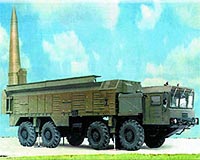 Russia's missile gambit could yet backfire: analysts
(NSI News Source Info) Brussels - November 7, 2008: Russia aims to curb Washington's defence shield ambitions by deploying missiles near Poland but the ploy could backfire and harden US president-elect Barack Obama's stance, analysts say.
President Dmitry Medvedev's decision to set up Iskander missiles in the Kaliningrad territory wedged between Poland and Lithuania -- announced just as Obama was elected -- immediately raised "serious worries" at NATO.
Medvedev said the move would neutralise the security threat posed by the US shield which will link 10 interceptors in Poland to a radar in the Czech Republic by 2013-2014 and is aimed at countering "rogue states" like Iran.
Iskanders carry conventional warheads over a range of up to 280 kilometres but Russia, given its frustration over the US system, could deploy an updated version capable of reaching close to 500 kilometres (300 miles).
This could be in defiance of the Intermediate-Range Nuclear Forces treaty, signed between Moscow and Washington in 1987 and banning missiles with ranges of 500-5,500 kilometres, from which Russia has already threatened to withdraw.
It could also be a new step in rolling back Cold War-era arms accords, after Moscow suspended almost a year ago participation in the Conventional Forces in Europe (CFE) treaty, limiting troop numbers and military equipment in Europe.
But while the deployment might raise new tensions between Russia and NATO -- whose biggest and most powerful member is the United States -- it would not, of itself, significantly change the military balance of power.
"This project to deploy Iskanders, in place of the old Totchka missiles, in the Kaliningrad region already dates from 2000. It was only delayed due to lack of funding," said Joseph Henrotin, at Belgium's Strategic Studies Network.
Even Polish Prime Minister Donald Tusk, whose country is directly in Russia's firing line, considers Medvedev's missile gambit to be "a new political step, not a military one."
Despite this, analysts differ over how the future US administration will respond to the move.
For Francois Heisbourg, special advisor at the Foundation for Research and Security (FRS) in Paris, "this manouevre of intimidation by the Russians could backfire on them."
"If they think that the United States will give up the idea of deploying their anti-missile shield, they're barking up the wrong tree," he said.
Certainly US Democrats have never been quite as enthusiastic as President George W. Bush's Republicans toward this vast and costly -- roughly eight to nine billion dollars a year -- expansion of the defence shield into Europe.
But "Obama is extremely sensitive to anything that might portray him as someone who is easy to intimidate", as his lack of international experience was a factor that his campaign rivals tried to exploit, Heisbourg noted.
"He will not want to give the impression that he is someone who can easily be pushed around, right at the beginning of his mandate," he said.
But according to Andrew Cuchins, at Washington's Center for Strategic and International Studies, Moscow's "public relations" error must not be allowed to drive the wedge deeper between Russia and the United States right now.
"A failed diplomacy with Russia is not workable," he said.
And he warned: "We have not found a way which integrates Russia security concerns into a broader security framework."
"If we don't convince the Russians we are taking these concerns into account, (there will be) no way to negotiate on armaments control and proliferation," he said.
He also said it was vital "to convince the Iranians that Russia and the Americans are serious about cooperating".
"I think there could be, and should be, a greater effort to integrate the Russians into evolving missile defence strategy in Europe," he said.
Russia's missile gambit could yet backfire: analysts
(NSI News Source Info) Brussels - November 7, 2008: Russia aims to curb Washington's defence shield ambitions by deploying missiles near Poland but the ploy could backfire and harden US president-elect Barack Obama's stance, analysts say.
President Dmitry Medvedev's decision to set up Iskander missiles in the Kaliningrad territory wedged between Poland and Lithuania -- announced just as Obama was elected -- immediately raised "serious worries" at NATO.
Medvedev said the move would neutralise the security threat posed by the US shield which will link 10 interceptors in Poland to a radar in the Czech Republic by 2013-2014 and is aimed at countering "rogue states" like Iran.
Iskanders carry conventional warheads over a range of up to 280 kilometres but Russia, given its frustration over the US system, could deploy an updated version capable of reaching close to 500 kilometres (300 miles).
This could be in defiance of the Intermediate-Range Nuclear Forces treaty, signed between Moscow and Washington in 1987 and banning missiles with ranges of 500-5,500 kilometres, from which Russia has already threatened to withdraw.
It could also be a new step in rolling back Cold War-era arms accords, after Moscow suspended almost a year ago participation in the Conventional Forces in Europe (CFE) treaty, limiting troop numbers and military equipment in Europe.
But while the deployment might raise new tensions between Russia and NATO -- whose biggest and most powerful member is the United States -- it would not, of itself, significantly change the military balance of power.
"This project to deploy Iskanders, in place of the old Totchka missiles, in the Kaliningrad region already dates from 2000. It was only delayed due to lack of funding," said Joseph Henrotin, at Belgium's Strategic Studies Network.
Even Polish Prime Minister Donald Tusk, whose country is directly in Russia's firing line, considers Medvedev's missile gambit to be "a new political step, not a military one."
Despite this, analysts differ over how the future US administration will respond to the move.
For Francois Heisbourg, special advisor at the Foundation for Research and Security (FRS) in Paris, "this manouevre of intimidation by the Russians could backfire on them."
"If they think that the United States will give up the idea of deploying their anti-missile shield, they're barking up the wrong tree," he said.
Certainly US Democrats have never been quite as enthusiastic as President George W. Bush's Republicans toward this vast and costly -- roughly eight to nine billion dollars a year -- expansion of the defence shield into Europe.
But "Obama is extremely sensitive to anything that might portray him as someone who is easy to intimidate", as his lack of international experience was a factor that his campaign rivals tried to exploit, Heisbourg noted.
"He will not want to give the impression that he is someone who can easily be pushed around, right at the beginning of his mandate," he said.
But according to Andrew Cuchins, at Washington's Center for Strategic and International Studies, Moscow's "public relations" error must not be allowed to drive the wedge deeper between Russia and the United States right now.
"A failed diplomacy with Russia is not workable," he said.
And he warned: "We have not found a way which integrates Russia security concerns into a broader security framework."
"If we don't convince the Russians we are taking these concerns into account, (there will be) no way to negotiate on armaments control and proliferation," he said.
He also said it was vital "to convince the Iranians that Russia and the Americans are serious about cooperating".
"I think there could be, and should be, a greater effort to integrate the Russians into evolving missile defence strategy in Europe," he said.
Book Reveals Failed Delta Hunt for bin Laden
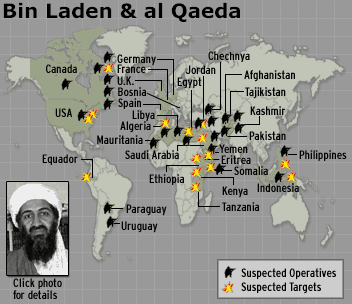 Book Reveals Failed Delta Hunt for bin Laden
(NSI News Source Info) Military.comby Christian Lowe - November 7, 2008: It was bitter cold. The harsh wind swept across their high mountain redoubt with only thin native blankets to shelter them from the bitter Afghan air. They were hours from resupply, carrying only what they could on their backs.
And that's just how they wanted it.
Peering through their high-tech spotting scopes and talking in low whispers to pilots above, the Delta Force operators high in the mountains of Tora Bora were warmed by the thought that they, more than anyone else in that desolate land, were killing more perpetrators of the 9/11 attacks than anyone else in the world.
For nearly a week, 40 of America's best trained, most elite Soldiers from the 1st Special Forces Operational Detachment Delta, or "Delta Force," combed the 14,000 foot peaks with wavering Afghan militia allies to hunt down the world's most wanted man: Osama bin Laden. In a first ever account, the man who shepherded those bearded warriors into Tora Bora's thin mountain air writes of the near misses, frustrated plans and weak-kneed guerrillas that stymied their quest for al Qaeda's top commanders.
Writing under the name "Dalton Fury," the Delta Force commander -- a major at the time - gives a detailed look in "Kill bin Laden: A Delta Commander's Account of the Hunt for the World's Most Wanted Man" how the unit prepared for, planned and executed its complicated mission.
For Delta, it was an unprecedented task. A force best know for lightning-fast counterterrorism raids, long range reconnaissance and high value target snatches, the operators on the Tora Bora mission had to work a hybrid plan that combined unconventional warfare, intelligence collection, long-range logistics and close air support - all while waiting for the call to swoop down on an Osama hideout at a moment's notice.
"We went into a hellish land that was considered impregnable and controlled by al Qaeda leaders who had helped defeat the Soviet Union," Fury writes. "We killed them by the dozen. Many more surrendered. ... And we heard the demoralized -- bin Laden speak on the radio, pleading for women and children to fight for him."
"Then he abandoned them all and ran from the battlefield," Fury adds with some satisfaction. "Yes. He ran away."
(Though Military.com knows Fury's true name, we will honor his wishes and not reveal it here.)
As Fury tells it, his Delta colleagues racked up an impressive body count and thought for a while they had actually killed the al Qaeda leader or his deputy. But a reader can clearly see between the lines of "Kill bin Laden" that Fury was frustrated with his unit's lack of success in killing their key target. While dropping JDAMs on terrorist caves was gratifying, Fury never mentions a single shot fired by his operators in the entire early December 2001 engagement -- cold comfort to some of the best combat marksmen in the world who were itching for a up-close fight.
Fury is also disappointed by his commanders' reluctance to engage his operators more into the fight, mandating the reliance on Afghan militias to do most of the heavy lifting. His unit proposed two plans to corner bin Laden. One involved a backdoor, high-altitude mountaineering assault from the Pakistan border, the other called for sowing GATOR anti-personnel mines along the most likely approaches and escape routes to stymie an al Qaeda escape long enough for a commando assault.
Both plans were rejected by higher headquarters -- or the White House -- and Fury was left to the worst possible alternative: a frontal assault.
"Kill bin Laden" is one of the most detailed and informative descriptions of a battle forgotten by most Americans, but one that was truly the closest the West gotten to bin Laden since 9/11. It's not the "tell all" of Eric Haney's "Inside Delta Force" but compares well with Gary Bernsten's "Jawbreaker" in it's revelation of black ops.
And that's where Fury has bumped into the most controversy. Some in the Army Special Force community have rejected Fury for his breach of Delta's code of silence - a written and un-written rule among operators that one never speaks to outsiders of their endeavors. Credible online forums have already revealed Fury's true name, ignoring his pleas for anonymity for fear of endangering his family.
Fury declined several requests for an interview with Military.com to discuss this issue and details of his book.
Revealing his missions and opening Delta to the world in even this small way has earned "Kill bin Laden" scorn from portions of the special operations community. But Fury's critics never dispute his facts.
So give "Kill bin Laden" a read; the author did the American public a service by explaining to the victims of 9/11 how America tried to kill the mastermind behind that horrifying day, and it could serve to remind us all that "enemy number one" is still out there - and so is Delta, hunting him to the ends of the Earth.
Book Reveals Failed Delta Hunt for bin Laden
(NSI News Source Info) Military.comby Christian Lowe - November 7, 2008: It was bitter cold. The harsh wind swept across their high mountain redoubt with only thin native blankets to shelter them from the bitter Afghan air. They were hours from resupply, carrying only what they could on their backs.
And that's just how they wanted it.
Peering through their high-tech spotting scopes and talking in low whispers to pilots above, the Delta Force operators high in the mountains of Tora Bora were warmed by the thought that they, more than anyone else in that desolate land, were killing more perpetrators of the 9/11 attacks than anyone else in the world.
For nearly a week, 40 of America's best trained, most elite Soldiers from the 1st Special Forces Operational Detachment Delta, or "Delta Force," combed the 14,000 foot peaks with wavering Afghan militia allies to hunt down the world's most wanted man: Osama bin Laden. In a first ever account, the man who shepherded those bearded warriors into Tora Bora's thin mountain air writes of the near misses, frustrated plans and weak-kneed guerrillas that stymied their quest for al Qaeda's top commanders.
Writing under the name "Dalton Fury," the Delta Force commander -- a major at the time - gives a detailed look in "Kill bin Laden: A Delta Commander's Account of the Hunt for the World's Most Wanted Man" how the unit prepared for, planned and executed its complicated mission.
For Delta, it was an unprecedented task. A force best know for lightning-fast counterterrorism raids, long range reconnaissance and high value target snatches, the operators on the Tora Bora mission had to work a hybrid plan that combined unconventional warfare, intelligence collection, long-range logistics and close air support - all while waiting for the call to swoop down on an Osama hideout at a moment's notice.
"We went into a hellish land that was considered impregnable and controlled by al Qaeda leaders who had helped defeat the Soviet Union," Fury writes. "We killed them by the dozen. Many more surrendered. ... And we heard the demoralized -- bin Laden speak on the radio, pleading for women and children to fight for him."
"Then he abandoned them all and ran from the battlefield," Fury adds with some satisfaction. "Yes. He ran away."
(Though Military.com knows Fury's true name, we will honor his wishes and not reveal it here.)
As Fury tells it, his Delta colleagues racked up an impressive body count and thought for a while they had actually killed the al Qaeda leader or his deputy. But a reader can clearly see between the lines of "Kill bin Laden" that Fury was frustrated with his unit's lack of success in killing their key target. While dropping JDAMs on terrorist caves was gratifying, Fury never mentions a single shot fired by his operators in the entire early December 2001 engagement -- cold comfort to some of the best combat marksmen in the world who were itching for a up-close fight.
Fury is also disappointed by his commanders' reluctance to engage his operators more into the fight, mandating the reliance on Afghan militias to do most of the heavy lifting. His unit proposed two plans to corner bin Laden. One involved a backdoor, high-altitude mountaineering assault from the Pakistan border, the other called for sowing GATOR anti-personnel mines along the most likely approaches and escape routes to stymie an al Qaeda escape long enough for a commando assault.
Both plans were rejected by higher headquarters -- or the White House -- and Fury was left to the worst possible alternative: a frontal assault.
"Kill bin Laden" is one of the most detailed and informative descriptions of a battle forgotten by most Americans, but one that was truly the closest the West gotten to bin Laden since 9/11. It's not the "tell all" of Eric Haney's "Inside Delta Force" but compares well with Gary Bernsten's "Jawbreaker" in it's revelation of black ops.
And that's where Fury has bumped into the most controversy. Some in the Army Special Force community have rejected Fury for his breach of Delta's code of silence - a written and un-written rule among operators that one never speaks to outsiders of their endeavors. Credible online forums have already revealed Fury's true name, ignoring his pleas for anonymity for fear of endangering his family.
Fury declined several requests for an interview with Military.com to discuss this issue and details of his book.
Revealing his missions and opening Delta to the world in even this small way has earned "Kill bin Laden" scorn from portions of the special operations community. But Fury's critics never dispute his facts.
So give "Kill bin Laden" a read; the author did the American public a service by explaining to the victims of 9/11 how America tried to kill the mastermind behind that horrifying day, and it could serve to remind us all that "enemy number one" is still out there - and so is Delta, hunting him to the ends of the Earth.
French Defense Firms to Transfer High Technology to India
 French Defense Firms to Transfer High Technology to India
(NSI News Source Info) November 7, 2008: France has cleared its aerospace and defence companies to go ahead to undertake complete transfer of technology (TOT) of strategic systems for the $10 billion Indian contract for acquisition of 126 multi-role combat aircraft. Key technologies that can be transfered include AESA radars, stealth composites and advanced missiles network enabled technologies."The French government has given us all clearance for technology transfer of all key systems," said JPHP Chabriol, senior vice president, D'assault Aviation, the manufacturers of French fighters Rafael -- one of the prominent contestants for the Indian contract -- as his new fighter Rafael prepares for the test in Indian conditions in mid-June next year. France's approval comes even as the US companies may have to seek the State administration and Congressional clearances before parting with the technologies like AESA radar, which ironically has been pioneered by the US defence majors.According to the field trial schedule sent to the bidding companies, the contending fighters are to undergo resistance to humidity trials in south Indian city of Bangalore, tests for heat and dust in Thar desert in Jodhpur and cold trials in snowy wilderness of Ladakh.Major French aerospace companies D'assault, Thales and Snecma have joined hands to float Rafael International to popularize the French fighter worldwide. While D'assault will hold 60 per cent stake in the new company, Thales which provides 90 per cent avionics for the fighter and its engine maker Snecma will hold 20 per cent each. "Rafael makes sense for the IAF after Mirages," Chebriol said expressing his company's determination to stay in the Indian market.
US Military Adds Heavy Trucks Under FHTV-III
 US Military Adds Heavy Trucks Under FHTV-III
With its bridge buy of FMTV medium trucks in place and the re-compete proceeding, and initial awards for the potential JLTV Hummer replacement designs underway, the next order of business on the US Army’s agenda was a new Family of Heavy Tactical Vehicles’ multi-year contract: FHTV-III.
Oshkosh has provided the core of this capability for over 20 yeas now. Its Heavy Expanded Mobility Tactical Trucks (HEMTT) and their 13-ton payloads are the mainstay of the FHTV fleet, serving in variants that include M977/985 Cargo, M978 Fueler, M982/983 Tractors, and M984 Wrecker; they also serve as heavy transporters for Patriot and THAAD air defense systems. M1074/75 Palletized Load Systems (PLS) and PLS trailers (PLST) are best known for their automated container/pallet loading arms, and for their Universal Power Interface Kit (UPIK) that can add modules for firefighting, construction, cranes, et. al. The M1000/1070 Heavy Equipment Transporters (HET) are flatbeds that can transport a 70-ton Abrams tank – or anything less – in order to save wear and tear on expensive armored vehicles and on the roads. A specialized FHTV truck called the M1977 CBT can even lay bridges.
US Military Adds Heavy Trucks Under FHTV-III
With its bridge buy of FMTV medium trucks in place and the re-compete proceeding, and initial awards for the potential JLTV Hummer replacement designs underway, the next order of business on the US Army’s agenda was a new Family of Heavy Tactical Vehicles’ multi-year contract: FHTV-III.
Oshkosh has provided the core of this capability for over 20 yeas now. Its Heavy Expanded Mobility Tactical Trucks (HEMTT) and their 13-ton payloads are the mainstay of the FHTV fleet, serving in variants that include M977/985 Cargo, M978 Fueler, M982/983 Tractors, and M984 Wrecker; they also serve as heavy transporters for Patriot and THAAD air defense systems. M1074/75 Palletized Load Systems (PLS) and PLS trailers (PLST) are best known for their automated container/pallet loading arms, and for their Universal Power Interface Kit (UPIK) that can add modules for firefighting, construction, cranes, et. al. The M1000/1070 Heavy Equipment Transporters (HET) are flatbeds that can transport a 70-ton Abrams tank – or anything less – in order to save wear and tear on expensive armored vehicles and on the roads. A specialized FHTV truck called the M1977 CBT can even lay bridges.
Analysis: Why 2009 could be the year of the Gripen
 Analysis: Why 2009 could be the year of the Gripen
(NSI News Source Info) November 7, 2008: The next 18 months will see Brazil, Croatia, Denmark, India, the Netherlands, Norway, Romania and Switzerland make final selections for their respective fighter procurement competitions, with sales of up to 523 aircraft worth at least USD35 billion-USD40 billion at stake.
It will be a truly crucial period in shaping the future of the global fighter market.
The common link between these eight contests is the presence of the Saab Gripen in the bidding process. So far the Gripen's success in the export market has been limited, with contracts for 60 aircraft in place across the Czech Republic (14), Hungary (14), South Africa (26) and Thailand (6). Saab hopes, and Jane's Defence Forecasts believes, that the next 18 months may see this number increase significantly.
Competition is fierce to fill these eight national requirements, with the following among the Gripen's competitors in the various contests: Boeing's F/A-18E/F Super Hornet; Dassault's Rafale; the Eurofighter Typhoon; Lockheed Martin's F-16 Fighting Falcon and F-35 Lightning II; and RAC MiG's MiG-35.
Jane's believes the Gripen team has reasons for optimism, however.
First of all, in terms of the aircraft's capability, Saab is offering its enhanced Gripen NG (Next Generation) variant for the Brazilian, Danish, Dutch, Indian and Norwegian requirements, which incorporates a number of significant improvements over the baseline Gripen C/D. These enhancements include: an active electronically scanned array radar developed in conjunctionwith Thales (due to begin flight testing in 2009); General Electric F-414G engines, which provide increased thrust and maximum take-off weight; additional weapons stores; enhanced avionics and electronic warfare capabilities; and increased range.
These new capabilities are currently being developed through the Gripen Demonstrator programme, which was approved by Sweden's Defence Materiel Administration (FMV) in October 2007 and unveiled the following April. According to Saab, further enhancements will be rolled out in three-year increments, to enable continuous development of the platform over the life of the programme and removing the need for comprehensive and expensive mid-life upgrade programmes. Development and incorporation of specific customer-funded requirements is also envisaged as part of a 50-year programme plan.
While currently in the developmental stage, the Gripen NG programme would be accelerated in the event of a contract win and the aircraft would be available to enter service from 2014.
With regard to cost, the Gripen NG is viewed by Jane's as competitive in terms of both acquisition and through-life support costs when compared to its rivals. Bob Kemp, sales and marketing director for Gripen International, citing figures produced for the Dutch fighter contest, said Saab believes that the Gripen NG, as part of an 85-aircraft fleet, would cost EUR6 billion (USD7.6 billion) less than the F-35 in terms of life-cycle costs over a 30-year period.
At a unit cost of between USD50 million andUSD60 million, the Gripen also offers the lowest-cost platform in terms of acquisition expenditure. By comparison, according to Fiscal Year 2009 US Air Force (USAF) and US Navy (USN) budgetary documentation, the unit costs of the F-35 and F/A-18E/F are USD83.1 million and USD82.7 million respectively.
Unsurprisingly in such a competitive market, each of the contenders in these fighter contests has its strengths and weaknesses and much will depend on the specific circumstances, priorities and requirements of the customer nations. As such, some contests are better suited to the Gripen proposal than others, particularly in Europe.
Analysis: Why 2009 could be the year of the Gripen
(NSI News Source Info) November 7, 2008: The next 18 months will see Brazil, Croatia, Denmark, India, the Netherlands, Norway, Romania and Switzerland make final selections for their respective fighter procurement competitions, with sales of up to 523 aircraft worth at least USD35 billion-USD40 billion at stake.
It will be a truly crucial period in shaping the future of the global fighter market.
The common link between these eight contests is the presence of the Saab Gripen in the bidding process. So far the Gripen's success in the export market has been limited, with contracts for 60 aircraft in place across the Czech Republic (14), Hungary (14), South Africa (26) and Thailand (6). Saab hopes, and Jane's Defence Forecasts believes, that the next 18 months may see this number increase significantly.
Competition is fierce to fill these eight national requirements, with the following among the Gripen's competitors in the various contests: Boeing's F/A-18E/F Super Hornet; Dassault's Rafale; the Eurofighter Typhoon; Lockheed Martin's F-16 Fighting Falcon and F-35 Lightning II; and RAC MiG's MiG-35.
Jane's believes the Gripen team has reasons for optimism, however.
First of all, in terms of the aircraft's capability, Saab is offering its enhanced Gripen NG (Next Generation) variant for the Brazilian, Danish, Dutch, Indian and Norwegian requirements, which incorporates a number of significant improvements over the baseline Gripen C/D. These enhancements include: an active electronically scanned array radar developed in conjunctionwith Thales (due to begin flight testing in 2009); General Electric F-414G engines, which provide increased thrust and maximum take-off weight; additional weapons stores; enhanced avionics and electronic warfare capabilities; and increased range.
These new capabilities are currently being developed through the Gripen Demonstrator programme, which was approved by Sweden's Defence Materiel Administration (FMV) in October 2007 and unveiled the following April. According to Saab, further enhancements will be rolled out in three-year increments, to enable continuous development of the platform over the life of the programme and removing the need for comprehensive and expensive mid-life upgrade programmes. Development and incorporation of specific customer-funded requirements is also envisaged as part of a 50-year programme plan.
While currently in the developmental stage, the Gripen NG programme would be accelerated in the event of a contract win and the aircraft would be available to enter service from 2014.
With regard to cost, the Gripen NG is viewed by Jane's as competitive in terms of both acquisition and through-life support costs when compared to its rivals. Bob Kemp, sales and marketing director for Gripen International, citing figures produced for the Dutch fighter contest, said Saab believes that the Gripen NG, as part of an 85-aircraft fleet, would cost EUR6 billion (USD7.6 billion) less than the F-35 in terms of life-cycle costs over a 30-year period.
At a unit cost of between USD50 million andUSD60 million, the Gripen also offers the lowest-cost platform in terms of acquisition expenditure. By comparison, according to Fiscal Year 2009 US Air Force (USAF) and US Navy (USN) budgetary documentation, the unit costs of the F-35 and F/A-18E/F are USD83.1 million and USD82.7 million respectively.
Unsurprisingly in such a competitive market, each of the contenders in these fighter contests has its strengths and weaknesses and much will depend on the specific circumstances, priorities and requirements of the customer nations. As such, some contests are better suited to the Gripen proposal than others, particularly in Europe.
Saab Proposes JAS-39 Gripen Sale to Swiss Air Force
Saab Proposes JAS-39 Gripen Sale to Swiss Air Force
(NSI News Source Info) November 7, 2008: Swedish aerospace/defence firm Saab announced on the 2nd July that it had provided Switzerland with a proposal to possibly sell combat jets to the Swiss Air Force.
"Switzerland has a need to replace its fighter aircraft [Northrop] F-5E/F Tiger II and [Saab’s JAS-39] Gripen is one of three potential suppliers", Saab stated, adding: "The exact number of required aircraft has not been disclosed."
At the end of June, the official publication for the Swedish government wrote that Switzerland could acquire as many as 33 Gripens, adding that permission had been sought at governmental level for an offer to be made.
Saab stated, additionally, that agreements had been drawn up between it and Pilatus [Swiss aircraft firm]/ Rheinmetall Schweiz AG in association with the potential sale.
"The agreement between Saab and Pilatus regards future cooperation in the aviation area and is the result of discussions initiated as part of industrial cooperation activities in the event Switzerland should decide to buy Gripen fighter aircraft to replace its F-5E/F Tiger”, the Swedish firm said.
Gripen Operators
The JAS-39 Gripen is operated by the air forces of South Africa, Hungary and the Czech Republic, as well as Sweden, with the total order book currently standing at 236.
It is one of six types in contention to win a highly-coveted Indian Air Force contract for 126 new combat aircraft.
Potential Gripen Orders
Additionally, it emerged earlier this year that Saab is offering the Gripen to Norway as a replacement for the Royal Norwegian Air Force’s F-16s. In this latter capacity, it is up against the Lockheed Martin F-35 Lightning II Joint Strike Fighter (JSF).
Meanwhile, India is in the process of comparing it to five other types – the French Rafale, the Russian Mig 35, the Eurofighter Typhoon and the US-built F/A18E/F Super Hornet, as well as the F-16.
Subscribe to:
Posts (Atom)












