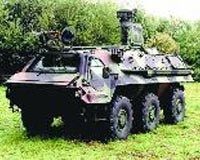
 TenCate Presents New Lightweight Composite Armour Solution
(NSI News Source Info) Rotterdam, Netherlands - November 11, 2008: On Thursday November 6, 2008 during the NIVD - the Symposium and Exhibition for Defence and Security in Ahoy Rotterdam, The Netherlands - TenCate Advanced Armour is presenting a new armour solution in lightweight composite for vehicle protection.
The new composite armour with TenCate Armourtex BM is designed to defeat roadside bombs used in conflict zones such as Iraq and Afghanistan.
The balance between protection and mobility is a key factor in vehicle design, both for military and civilian applications. The weight of the armour protection therefore needs to be as low as possible while affording the greatest levels of protection.
TenCate Advanced Armour has designed a new composite armour solution with TenCate Armourtex BM to defeat explosive formed projectiles generated from improvised explosive devices. The weight is considerably lighter than traditional steel armour thus providing excellent protection of the men and women in the vehicle, while minimising the added weight to the vehicle.
TenCate Advanced Armour aims at a system approach by working together with vehicle manufacturers in order to establish the optimal configuration for vehicle protection.
The new armour will be ideal for the protection of armoured personnel carriers for the latest threat requirements. Excellent properties qualify the material for many present projects, as well as for future requirements. The nature of the new armour will also allow it to be a cost effective solution.
TenCate Presents New Lightweight Composite Armour Solution
(NSI News Source Info) Rotterdam, Netherlands - November 11, 2008: On Thursday November 6, 2008 during the NIVD - the Symposium and Exhibition for Defence and Security in Ahoy Rotterdam, The Netherlands - TenCate Advanced Armour is presenting a new armour solution in lightweight composite for vehicle protection.
The new composite armour with TenCate Armourtex BM is designed to defeat roadside bombs used in conflict zones such as Iraq and Afghanistan.
The balance between protection and mobility is a key factor in vehicle design, both for military and civilian applications. The weight of the armour protection therefore needs to be as low as possible while affording the greatest levels of protection.
TenCate Advanced Armour has designed a new composite armour solution with TenCate Armourtex BM to defeat explosive formed projectiles generated from improvised explosive devices. The weight is considerably lighter than traditional steel armour thus providing excellent protection of the men and women in the vehicle, while minimising the added weight to the vehicle.
TenCate Advanced Armour aims at a system approach by working together with vehicle manufacturers in order to establish the optimal configuration for vehicle protection.
The new armour will be ideal for the protection of armoured personnel carriers for the latest threat requirements. Excellent properties qualify the material for many present projects, as well as for future requirements. The nature of the new armour will also allow it to be a cost effective solution.
Monday, November 10, 2008
TenCate Presents New Lightweight Composite Armour Solution
TenCate Presents New Lightweight Composite Armour Solution
(NSI News Source Info) Rotterdam, Netherlands - November 11, 2008: On Thursday November 6, 2008 during the NIVD - the Symposium and Exhibition for Defence and Security in Ahoy Rotterdam, The Netherlands - TenCate Advanced Armour is presenting a new armour solution in lightweight composite for vehicle protection.
The new composite armour with TenCate Armourtex BM is designed to defeat roadside bombs used in conflict zones such as Iraq and Afghanistan.
The balance between protection and mobility is a key factor in vehicle design, both for military and civilian applications. The weight of the armour protection therefore needs to be as low as possible while affording the greatest levels of protection.
TenCate Advanced Armour has designed a new composite armour solution with TenCate Armourtex BM to defeat explosive formed projectiles generated from improvised explosive devices. The weight is considerably lighter than traditional steel armour thus providing excellent protection of the men and women in the vehicle, while minimising the added weight to the vehicle.
TenCate Advanced Armour aims at a system approach by working together with vehicle manufacturers in order to establish the optimal configuration for vehicle protection.
The new armour will be ideal for the protection of armoured personnel carriers for the latest threat requirements. Excellent properties qualify the material for many present projects, as well as for future requirements. The nature of the new armour will also allow it to be a cost effective solution.

Canada Awards C$2 Billion Frigate Upgrade Contracts
_1.jpg/300px-HMCS_Regina_(FFH_334)_1.jpg) Canada Awards C$2 Billion Frigate Upgrade Contracts
(NSI News Source Info) GATINEAU - November 10, 2008: The Minister of Public Works and Government Services Canada, the Honourable Christian Paradis, and the Honourable Peter Gordon MacKay, Minister of National Defence and Minister for the Atlantic Gateway, today announced that the Government of Canada awarded two long-term contracts to Lockheed Martin Canada for the Combat Systems Integration (CSI) Design and Build and In-Service Support elements of the modernization of Canada’s 12 Halifax Class Navy frigates. “We are committed to supporting the Canadian Forces and determined to provide them with the best equipment available to do their jobs,” said Minister Paradis. “Through industrial regional benefits, this contract will also benefit the economy at a time of global economic uncertainty.” “The Conservative government considers the defence of Canada’s territorial waters a priority,” said Minister MacKay. “The modernization of our Navy frigates will ensure that our sailors are provided with first-class ships in order to defend Canada and promote Canadian interests abroad." The CSI contract, valued at approximately $1.4 billion, is for upgrading the command and control systems, redesigning the operations room and reconfiguring the ships’ mast to accommodate a new radar suite for Canada’s 12 frigates. The In-Service Support contract is valued at approximately $600 million and will ensure long-term support of the Combat Systems. The Halifax Class frigates were built in early 1990 and now require upgrades and systems modernization, particularly in the areas of marine engineering, command, control and combat systems.
Canada Awards C$2 Billion Frigate Upgrade Contracts
(NSI News Source Info) GATINEAU - November 10, 2008: The Minister of Public Works and Government Services Canada, the Honourable Christian Paradis, and the Honourable Peter Gordon MacKay, Minister of National Defence and Minister for the Atlantic Gateway, today announced that the Government of Canada awarded two long-term contracts to Lockheed Martin Canada for the Combat Systems Integration (CSI) Design and Build and In-Service Support elements of the modernization of Canada’s 12 Halifax Class Navy frigates. “We are committed to supporting the Canadian Forces and determined to provide them with the best equipment available to do their jobs,” said Minister Paradis. “Through industrial regional benefits, this contract will also benefit the economy at a time of global economic uncertainty.” “The Conservative government considers the defence of Canada’s territorial waters a priority,” said Minister MacKay. “The modernization of our Navy frigates will ensure that our sailors are provided with first-class ships in order to defend Canada and promote Canadian interests abroad." The CSI contract, valued at approximately $1.4 billion, is for upgrading the command and control systems, redesigning the operations room and reconfiguring the ships’ mast to accommodate a new radar suite for Canada’s 12 frigates. The In-Service Support contract is valued at approximately $600 million and will ensure long-term support of the Combat Systems. The Halifax Class frigates were built in early 1990 and now require upgrades and systems modernization, particularly in the areas of marine engineering, command, control and combat systems.
(EDITOR’S NOTE: Announcing its intention to award the two contracts described above, the Canadian government on Sept. 5, 2008 had said that:
“Today’s announcement is part of an overall $3.1 billion program to modernize the Halifax Class Frigates which involves the following five key contracts:
--Two contracts totalling approximately $2 billion to be awarded to Lockheed Martin (as per today’s announcement): The Combat Systems Integration contract, and the Command & Control System In-Service Support contract.
--Two Multi-ship Refit contracts totalling $900 million, awarded to Halifax Shipyards and Victoria Shipyards in March 2008.
--The Platform System Design Agent contract valued at $150 million, awarded to Fleetway Inc. in October 2006. The contractor will be required to provide industrial benefits equal to 100 per cent of the total value of the contract.”)
Spain’s Marsans Signs for 61 Airbus Aircraft
 Spain’s Marsans Signs for 61 Airbus Aircraft
(NSI News Source Info) TOULOUSE, France - November 10, 2008: Grupo Marsans, the largest tourism and transport group in Spain and fourth in Europe, has signed a firm order with Airbus for the purchase of 61 Airbus aircraft including four A380s, ten A350-900s, five A330-200s and 42 A320 Family aircraft (of which 12 A319s, 25 A320s and five A321s). These aircraft will be operated by Grupo Marsans’ subsidiary or related airlines. This new order adds to the previous order for 12 A330-200s and will bring Grupo Marsans’ total orders with Airbus to 73 aircraft. On the occasion of the announcement, Gonzalo Pascual, President of Grupo Marsans, said: "This important order allows Grupo Marsans to put into action its mid- and long-term development plan, to enhance our position on the short and long-haul sector by incorporating the most efficient aircraft available on the market today and tomorrow. In addition to the overall fleet enhancement this represents, we are particularly proud that, with the A380, we will become the first A380 customer and operator in Spain and Latin America.” “This order, which basically covers all our product range, including the most recent ones such as the A380 and A350, represents a major vote of confidence. It will allow Grupo Marsans to benefit from the operational commonality of the Airbus product range in the best way possible,” said John Leahy, Airbus Chief Operating Officer Customers. “With this purchase, Grupo Marsans, who control various airlines in Europe and Latin America, will have the most efficient and modern aircraft fleet available to further strengthen and develop their operations both within Spain, regionally and internationally”, he added. Being greener, cleaner, quieter and smarter, the A380 is already setting new standards for air transport and the environment. In addition to offering unequalled levels of passenger comfort, space and quietness in the cabin, the A380 has unmatched levels of operating costs and fuel efficiency, consuming less than three litres per passenger per 100 kilometres. Its new-generation engines and superb aerodynamic performance mean that the A380 not only complies with today’s noise limits, it is also significantly quieter than any other large aircraft flying today. With a range of 8 200 nm / 15 200 km, and seating 525 passengers in a standard three-class layout while being much more eco-efficient, the A380 is the ideal equipment to alleviate traffic congestion at busy airports, while coping with growth. Including this contract, total firm orders for the aircraft now stand at 196 from 17 customers. The A350 XWB (Xtra Wide-Body) Family is Airbus’ response to widespread market demand for a series of highly efficient medium-capacity long-range wide-body aircraft. With a range of up to 8,300 nm / 15,400 km, it is available in three basic passenger versions: the A350-800 accommodating 270 passengers, the A350-900 seating 314, and the A350-1000 for 350 passengers in a typical three-class layout. The A350 XWB has the widest fuselage in its category, offering unprecedented levels of comfort, the lowest operating costs and lowest seat mile cost of any aircraft in this market segment. With power supplied by two new generation Rolls Royce Trent XWB engines, the A350 XWB Family is designed to confront the challenges of high fuel prices, rising passenger expectations, and environmental concerns. Total firm orders for the aircraft, including this contract, now stand at 463 from nearly 30 customers. With a true wide-body fuselage allowing very high comfort standards, the A330-200 is able to accommodate seat and class configurations to suit the diverse customer requirements. It has a range of up to 6,750 nm / 12,500 km with a full passenger load. Its large under-floor cargo holds can also carry standard pallets and containers side-by-side. It also has the excellent operational flexibility necessary to serve a wide range of route structures, providing operators with very low operating cost per seat. Its proven record of economy and superior passenger comfort provides operators with a significant competitive advantage in the market today. Orders for the A330 stand at around 1000. The A320 Family, which also includes the A318, A319 and A321, is recognized as the benchmark in the single-aisle aircraft market and has over 6,300 orders and more than 3,600 deliveries to its credit. Airbus is an EADS Company.
Spain’s Marsans Signs for 61 Airbus Aircraft
(NSI News Source Info) TOULOUSE, France - November 10, 2008: Grupo Marsans, the largest tourism and transport group in Spain and fourth in Europe, has signed a firm order with Airbus for the purchase of 61 Airbus aircraft including four A380s, ten A350-900s, five A330-200s and 42 A320 Family aircraft (of which 12 A319s, 25 A320s and five A321s). These aircraft will be operated by Grupo Marsans’ subsidiary or related airlines. This new order adds to the previous order for 12 A330-200s and will bring Grupo Marsans’ total orders with Airbus to 73 aircraft. On the occasion of the announcement, Gonzalo Pascual, President of Grupo Marsans, said: "This important order allows Grupo Marsans to put into action its mid- and long-term development plan, to enhance our position on the short and long-haul sector by incorporating the most efficient aircraft available on the market today and tomorrow. In addition to the overall fleet enhancement this represents, we are particularly proud that, with the A380, we will become the first A380 customer and operator in Spain and Latin America.” “This order, which basically covers all our product range, including the most recent ones such as the A380 and A350, represents a major vote of confidence. It will allow Grupo Marsans to benefit from the operational commonality of the Airbus product range in the best way possible,” said John Leahy, Airbus Chief Operating Officer Customers. “With this purchase, Grupo Marsans, who control various airlines in Europe and Latin America, will have the most efficient and modern aircraft fleet available to further strengthen and develop their operations both within Spain, regionally and internationally”, he added. Being greener, cleaner, quieter and smarter, the A380 is already setting new standards for air transport and the environment. In addition to offering unequalled levels of passenger comfort, space and quietness in the cabin, the A380 has unmatched levels of operating costs and fuel efficiency, consuming less than three litres per passenger per 100 kilometres. Its new-generation engines and superb aerodynamic performance mean that the A380 not only complies with today’s noise limits, it is also significantly quieter than any other large aircraft flying today. With a range of 8 200 nm / 15 200 km, and seating 525 passengers in a standard three-class layout while being much more eco-efficient, the A380 is the ideal equipment to alleviate traffic congestion at busy airports, while coping with growth. Including this contract, total firm orders for the aircraft now stand at 196 from 17 customers. The A350 XWB (Xtra Wide-Body) Family is Airbus’ response to widespread market demand for a series of highly efficient medium-capacity long-range wide-body aircraft. With a range of up to 8,300 nm / 15,400 km, it is available in three basic passenger versions: the A350-800 accommodating 270 passengers, the A350-900 seating 314, and the A350-1000 for 350 passengers in a typical three-class layout. The A350 XWB has the widest fuselage in its category, offering unprecedented levels of comfort, the lowest operating costs and lowest seat mile cost of any aircraft in this market segment. With power supplied by two new generation Rolls Royce Trent XWB engines, the A350 XWB Family is designed to confront the challenges of high fuel prices, rising passenger expectations, and environmental concerns. Total firm orders for the aircraft, including this contract, now stand at 463 from nearly 30 customers. With a true wide-body fuselage allowing very high comfort standards, the A330-200 is able to accommodate seat and class configurations to suit the diverse customer requirements. It has a range of up to 6,750 nm / 12,500 km with a full passenger load. Its large under-floor cargo holds can also carry standard pallets and containers side-by-side. It also has the excellent operational flexibility necessary to serve a wide range of route structures, providing operators with very low operating cost per seat. Its proven record of economy and superior passenger comfort provides operators with a significant competitive advantage in the market today. Orders for the A330 stand at around 1000. The A320 Family, which also includes the A318, A319 and A321, is recognized as the benchmark in the single-aisle aircraft market and has over 6,300 orders and more than 3,600 deliveries to its credit. Airbus is an EADS Company.
Chinese Hi-Tech Smart Bombs
 Chinese Hi-Tech Smart Bombs
(NSI News Source Info) November 10, 2008: China has been showing (at trade shows) a family of smart bombs. They look similar to the U.S. two decade old JDAM series. The Chinese smart bombs appear to be available for half ton bombs (the FT-1), and one version of the guidance kit has small wings, that enables the bomb to glide 15-20 kilometers to its target. There is a quarter ton bomb (FT-3) in development. These bombs apparently can be fitted with several types of satellite guidance (GPS, Russian GLONASS or the local Chinese system, in addition to the less accurate non-satellite inertial guidance system that JDAM also uses as a backup.) GPS guided bombs are not high tech anymore, although laser guided bombs are a little more tricky to design.
Chinese Hi-Tech Smart Bombs
(NSI News Source Info) November 10, 2008: China has been showing (at trade shows) a family of smart bombs. They look similar to the U.S. two decade old JDAM series. The Chinese smart bombs appear to be available for half ton bombs (the FT-1), and one version of the guidance kit has small wings, that enables the bomb to glide 15-20 kilometers to its target. There is a quarter ton bomb (FT-3) in development. These bombs apparently can be fitted with several types of satellite guidance (GPS, Russian GLONASS or the local Chinese system, in addition to the less accurate non-satellite inertial guidance system that JDAM also uses as a backup.) GPS guided bombs are not high tech anymore, although laser guided bombs are a little more tricky to design.
Hamas Has It's Own Mind
 Hamas Has It's Own Mind
(NSI News Source Info) November 10, 2008: Peace deals with the Palestinians still don't work. Despite the assistance of Fatah, the West Bank is still full of terrorists, and hostile Palestinians who simply attack any Israelis they can get close to. Hamas cannot, or will not, control terrorist groups in Gaza, and rockets and mortar shells continue to be fired from Gaza into southern Israel.
The Israeli settler movement gets a lot of blame for the friction, but the settlers were removed from Gaza when Israeli security forces left Gaza three years ago. The result? Now Gaza has become a terrorist base, spewing "Israel must be destroyed" propaganda. The settlers believe the Gaza experience justifies breaking the law to expand the settlements in the West Bank. There, a quarter million Jewish settlers live among ten times as many Palestinians. Most adult male settlers belong to the army reserve, and six battalions of police that look after the West Bank settlements are pro-settler. The settlers believe their presence prevents West Bank terrorism from becoming stronger, and many non-settler Israelis agree. But the settlers terrorize the Palestinians around them, providing endless fodder for pro-Palestinian propagandists. The issue has split Israel politically, and created a radical fringe of settlers who are threatening a program of assassinations against Israeli politicians who oppose the settlements.
Despite the many breaches of the ceasefire agreement in Gaza, Israel has agreed to continue talks with Hamas and Fatah. Hamas now says it is willing to make peace with Israel if there is a return to the 1967 borders. But that means Israel giving up Jerusalem, which the majority of Israelis will not do. Moreover, Hamas continues to spew its "Israel Must Be Destroyed" propaganda internally, especially to children, indicating that their long term goal is not peace. Hamas also preaches, usually just in its Arab language propaganda, that making a peace deal with Israel is a good tactic, to take the pressure off Hamas while forces are built up for a decisive strike against the enemy. But Israel might go for some kind of peace deal with Hamas, in the hope that the Hamas will eventually irritate Palestinians sufficiently to trigger an anti-Hamas backlash. The inability of Hamas to get the Gaza economy going, and the increasing intrusiveness of the Hamas lifestyle police is a long term liability for Hamas. Meanwhile
November 8, 2008: Eight more rockets were fired into Israel from Gaza, but Hamas says it is willing to continue maintaining that the ceasefire still exists, if the Israelis will.
November 7, 2008: On the Gaza border, Israeli troops exchanged fire with Palestinian terrorists, who fired to RPG rockets at Israeli troops who were destroying two Palestinian roadside bombs.
November 6, 2008: Israel completed a four day military exercise in the north, in preparation for another rocket attack by Hezbollah. Israel is preparing for Syria to join in next time.
November 5, 2008: Palestinians fired several dozen Kassam rockets into Israel from Gaza, in retaliation for the Israeli raid yesterday to take out the Palestinian kidnapping tunnel.
November 4, 2008: Israeli troops entered Gaza for the first time since the June 19th ceasefire, in order to destroy a 250 meter long tunnel Palestinian terrorists were digging under the security fence. The terrorists apparently planned to use the tunnel to try and kidnap Israeli soldiers for ransom. The Israeli ground operation was accompanied by air attacks. At least seven Hamas gunmen were killed, mostly by air attack. Two years ago, Palestinian terrorists in Gaza used a similar tunnel to grab an Israeli soldier, whose ransom is still being negotiated (Hamas wants hundreds more convicted terrorists freed than the Israelis are willing to let go).
Taliban Surprised Action On Wanat
 Taliban Surprised Action On Wanat
(NSI News Source Info) November 10, 2008: Last July 13th, the Taliban managed to carry out a surprise attack on a new base being built in the Afghan town of Wanat. A force of 72 U.S. and Afghan troops suffered 39 casualties (nine U.S. dead, and 26 American and four Afghan wounded). The 200 Taliban suffered about a hundred casualties (up to fifty dead, but it was difficult to get an exact count because smart bombs were used, which tend to blow bodies apart, and the Taliban will try to drag their dead away, to prevent identification.)
The U.S. Army investigated the battle, but did not answer the question of why it took so long (95 minutes) for MEDEVAC (medical evacuation) helicopters to arrive. It also took nearly two hour (108 minutes) for the first reinforcements to show up. Before then, there was artillery support (over 90 shells), smart bombs, Hellfire missiles (from a Predator UAV) and a helicopter gunship. The UAVs and AH-64s arrived within 30 minutes. There are still questions about U.S. intelligence work, and how the Taliban were able to assemble that large a force, so close to U.S. troops, without being detected.
The Taliban attack was carried out early in the morning (4:20 AM) after the enemy has sneaked into town and told the locals to leave. These same civilians had warned the coalition force that the Taliban were going to attack. But those warning had been coming daily, since the troops moved into Wanat on July 8th and began building an FOB (Forward Operating Base) in an area about 300 meters long and 100 meters wide. There was also an outpost on small hill 50 meters away, manned by nine troops. Two thirds of the defending troops were American. The enemy attack was well planned, with the Taliban firing from three sides. The enemy tried to overrun the base, and at one point some of them entered through a breach in a wall, but were killed or forced back. The battle lasted four hours, ending when the Taliban survivors pulled out. U.S. troops moved out of Wanat on July 15th.
The Taliban tried to make this out to be a big victory, but there was never any video released, as is usually the case with real or imagined victories. Apparently their video guy was blown up, as no video cameras were found among all the debris.
Honeywell Wins Production Contract for the Micro Air Vehicle (MAV)
Honeywell Wins Production Contract for the Micro Air Vehicle (MAV)
(NSI News Source Info) November 10, 2008: Honeywell will deliver 90 Micro Air Vehicles (MAV) Block II under a $65 million production contract received this week. Once fielded next year, MAV will become the first system developed as part of the US Army 'Future Combat Systems' (FCS) program to enter operational service. Initial systems have already been deployed with US forces in Iraq.
 Micro Air Vehicles
Micro Air Vehicles
The MAV system recently received the trademark 'T-Hawk', can be carried in a backpack. It is equipped with video cameras and video datalink, relaying video images from the hovering MAV, directly to the operator's handheld terminal. Each system consists of two air vehicles and one ground control unit. All systems are expected to be delivered through 2009, beginning in the second quarter. Honeywell is also offering a civilian version for law enforcement use; such systems are currently being evaluated by the Miami Dade Police Department.The cylindrical vehicle weighs 17 pounds and measures 14 inches in diameter. It can hover at height, descend to inspect hazardous areas or perch at high vantage points, searching for threats without exposing warfighters to enemy fire. The T-Hawk is designed to operate over mission durations exceeding 40 minutes of flight, at maximum speed of 40 knots. It is capable of take off and land vertically from complex desert and urban terrains without using runways or helipads at altitudes of 7000 ft.The system requires minimal operator training and includes two airborne vehicles and a portable ground station used to guide the aircraft and receive images from the cameras. The ground station can be used to program a flight path for the T-Hawk or control it manually. The aircraft also can be optionally equipped with electro-optical cameras for daylight operations or infrared cameras for night missions.
British Forces in Afghanistan to Receive 1,200 New Armored Vehicles
British Forces in Afghanistan to Receive 1,200 New Armored Vehicles
(NSI News Source Info) November 10, 2008: The British Ministry of Defense announced a plan to deploy nearly 1,200 new armored vehicles to bolster the protection and mobility of British troops engaged in combat in Afghanistan. The cost of the decision, announced by Defence Secretary John Hutton on 29 October, 2008 is estimated at £700 Million.
 Panther Command and Liaison Vehicle (CLV) Light Armoured 4x4, United Kingdom
The plan focuses on the procurement of over 400 new 'tactical support vehicles', worth about £350 Million, to augment or replace up-armored trucks currently operated in theater. Due to the vulnerability of supply convoys, armored vehicles are overtasked in convoy protection missions. The deployment of payload optimized, highly protected TSV will improve the protection and load capacity of convoys, balancing the demand for escort vehicles. In addition to the new package, new shipments of 'Ridgeback' 4x4 protected patrol vehicles and Panther armored command vehicles and Buffalo route clearing heavy vehicles are expected to be deployed to Afghanistan early in 2009.
The Royal Marines are also seeking the replacement of BV206 Viking articulated tracked vehicle with a new high mobility 'cross-country' vehicle that will provide better armor protection than the Viking could. The Marines are seeking to buy over 100 such vehicles, dubbed “Warthog”. MOD is evaluating several options for such a vehicle, including an improved BAE Systems Hagglunds BV206 or a Bronco, from ST Dynamics. The Army is highly satisfied with its version of 'cross country' vehicle, the Jackal and is planning to continue buying 100 additional vehicles under the newly announced package. Additional equipment to be introduced are several route clearing vehicles, based on Force protection Buffalo, recently introduced by the Italian and Canadian armies operating in theater.The British army requires three distinct categories of Tactical Support Vehicles (TSV) including a heavy armored flat-bed truck called 'Wolfhound' (TSV Heavy), which will be based on heavy platforms, such as the Cougar they are called to support. These vehicles will have the highest levels of mine blast protection. A light weight armored vehicle will also be procured, to fulfil multi-purpose various logistical missions. This flat-bed vehicle, dubbed 'COYOTE' (TSV Light) is required to support the all-terrain capable Jackal equipped units, operating in the harsh terrain of Afghanistan. A third class of medium-size medium protected TSV called Husky (TSV Medium) is also required to be utilized as load carrier, ambulance and mobile command post support. The Husky will also provide transportation and logistical support in areas where the heavy Mastiff and the heavy TSV cannot operate.
Further procurement and modifications are also being implemented with current vehicles, including 30 new Cougar vehicles (both 4x4 and 6x6) to be used as training vehicles. Armor upgrades are introduced with the Panther, facilitating theater specific protection as well as communication equipment. Snatch-Vixen, a new variant of the LandRover, specially designed for Afghanistan has also been produced, with extra power and payload which to enhance the mobility of the protected vehicle. This variant of the LandRover received a new running gear, chassis reinforcements, more powerful engine, and other modified automotive components to give the vehicle more power and the ability to carry a greater load.
Panther Command and Liaison Vehicle (CLV) Light Armoured 4x4, United Kingdom
The plan focuses on the procurement of over 400 new 'tactical support vehicles', worth about £350 Million, to augment or replace up-armored trucks currently operated in theater. Due to the vulnerability of supply convoys, armored vehicles are overtasked in convoy protection missions. The deployment of payload optimized, highly protected TSV will improve the protection and load capacity of convoys, balancing the demand for escort vehicles. In addition to the new package, new shipments of 'Ridgeback' 4x4 protected patrol vehicles and Panther armored command vehicles and Buffalo route clearing heavy vehicles are expected to be deployed to Afghanistan early in 2009.
The Royal Marines are also seeking the replacement of BV206 Viking articulated tracked vehicle with a new high mobility 'cross-country' vehicle that will provide better armor protection than the Viking could. The Marines are seeking to buy over 100 such vehicles, dubbed “Warthog”. MOD is evaluating several options for such a vehicle, including an improved BAE Systems Hagglunds BV206 or a Bronco, from ST Dynamics. The Army is highly satisfied with its version of 'cross country' vehicle, the Jackal and is planning to continue buying 100 additional vehicles under the newly announced package. Additional equipment to be introduced are several route clearing vehicles, based on Force protection Buffalo, recently introduced by the Italian and Canadian armies operating in theater.The British army requires three distinct categories of Tactical Support Vehicles (TSV) including a heavy armored flat-bed truck called 'Wolfhound' (TSV Heavy), which will be based on heavy platforms, such as the Cougar they are called to support. These vehicles will have the highest levels of mine blast protection. A light weight armored vehicle will also be procured, to fulfil multi-purpose various logistical missions. This flat-bed vehicle, dubbed 'COYOTE' (TSV Light) is required to support the all-terrain capable Jackal equipped units, operating in the harsh terrain of Afghanistan. A third class of medium-size medium protected TSV called Husky (TSV Medium) is also required to be utilized as load carrier, ambulance and mobile command post support. The Husky will also provide transportation and logistical support in areas where the heavy Mastiff and the heavy TSV cannot operate.
Further procurement and modifications are also being implemented with current vehicles, including 30 new Cougar vehicles (both 4x4 and 6x6) to be used as training vehicles. Armor upgrades are introduced with the Panther, facilitating theater specific protection as well as communication equipment. Snatch-Vixen, a new variant of the LandRover, specially designed for Afghanistan has also been produced, with extra power and payload which to enhance the mobility of the protected vehicle. This variant of the LandRover received a new running gear, chassis reinforcements, more powerful engine, and other modified automotive components to give the vehicle more power and the ability to carry a greater load.
Panther Command and Liaison Vehicle (CLV) Light Armoured 4x4, United KingdomSweden Plans to Equip Mechanized Battalions with Hundreds of Wheeled APCs beginning 2014
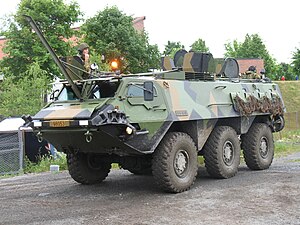 Sweden Plans to Equip Mechanized Battalions with Hundreds of Wheeled APCs beginning 2014
(NSI News Source Info) November 10, 2008: The new Wheeled APC wil replace tracked vehicles including the PBV302, Swedish Hägglunds BV206(S) and Russian origin MT-LB, as well as several wheeled 6x6 APC variants of the Patria PASI Series
The Swedish Defence Materiel Administration (FMV) announced a request for Quotation (RFA) for the delivery of hundreds of wheeled armored personnel carriers to equip Swedish Army mechanized battalions by 2014. The new vehicles are required to replace aeging tracked and wheeled APCs currently operational as armored personnel, combat support and combat service support carriers. In the past years FMV considered the development of an indigenous platform (SEP) but cancelled this plan. BAE Systems is expected to be one of the candidates for the new program, offering a new wheeled platform derived from the SEP program. Other offers are expected from international bidders such as General Dynamics Land Systems, and fromFrance, Germany and Finland. The new vehicles are required to replace aeging APCs currently operational as armored personnel, combat support and combat service support carriers, including tracked platforms such as the PBV302, Swedish Hägglunds BV206(S) and Russian origin MT-LB, and well as several wheeled 6x6 APC variants of the Patria PASI (XA-180/202 and 203).
FMV decided that the new armored vehicles should be wheeled. Initially, 113 vehicles would be required to equip mechanized 'medium weight' battalions. Overall, up to 150 vehicles will be needed, to augment and replace some of the APCs currently supporting heavy armor battalions equipped with Leopard 2 and CV90 tanks. The basic requirement is for 74 APCs, 10 company command vehicles, 18 armored ambulances, four communications carriers and seven repair vehicles.
FMV also requests an option to double its order as well as split or differ some of the logistical support packages. The vehicles are scheduled to be operational in the first battalion by 2014. Proposals for this tender are expected by the end of November with contracts to be concluded in the first half of 2009.
Sweden Plans to Equip Mechanized Battalions with Hundreds of Wheeled APCs beginning 2014
(NSI News Source Info) November 10, 2008: The new Wheeled APC wil replace tracked vehicles including the PBV302, Swedish Hägglunds BV206(S) and Russian origin MT-LB, as well as several wheeled 6x6 APC variants of the Patria PASI Series
The Swedish Defence Materiel Administration (FMV) announced a request for Quotation (RFA) for the delivery of hundreds of wheeled armored personnel carriers to equip Swedish Army mechanized battalions by 2014. The new vehicles are required to replace aeging tracked and wheeled APCs currently operational as armored personnel, combat support and combat service support carriers. In the past years FMV considered the development of an indigenous platform (SEP) but cancelled this plan. BAE Systems is expected to be one of the candidates for the new program, offering a new wheeled platform derived from the SEP program. Other offers are expected from international bidders such as General Dynamics Land Systems, and fromFrance, Germany and Finland. The new vehicles are required to replace aeging APCs currently operational as armored personnel, combat support and combat service support carriers, including tracked platforms such as the PBV302, Swedish Hägglunds BV206(S) and Russian origin MT-LB, and well as several wheeled 6x6 APC variants of the Patria PASI (XA-180/202 and 203).
FMV decided that the new armored vehicles should be wheeled. Initially, 113 vehicles would be required to equip mechanized 'medium weight' battalions. Overall, up to 150 vehicles will be needed, to augment and replace some of the APCs currently supporting heavy armor battalions equipped with Leopard 2 and CV90 tanks. The basic requirement is for 74 APCs, 10 company command vehicles, 18 armored ambulances, four communications carriers and seven repair vehicles.
FMV also requests an option to double its order as well as split or differ some of the logistical support packages. The vehicles are scheduled to be operational in the first battalion by 2014. Proposals for this tender are expected by the end of November with contracts to be concluded in the first half of 2009.
After Protest, U.S. Army Stops JLTV Work
 After Protest, U.S. Army Stops JLTV Work
(NSI News Source Info) November 10, 2008: The U.S. Army placed a stop-work order on the Joint Light Tactical Vehicle (JLTV) program on Nov. 7, the same day Northrop-Oshkosh protested the service's technology-development contract awards. The JLTV program will halt for at least several weeks until an Army-led joint board resolves the appeal.
"There will be both a legal examination of the basis of the appeal and a review of the process," a senior Army official said. "They will look at who was on the source selection and look at whether they followed procedures and were objective. The findings will be brought up to the acquisition executive level and might even go all the way up to Mr. Young [Pentagon acquisition chief John Young]. You saw what happened with the tanker protest, where the Air Force did not want to move forward until the appeal was resolved."
On Oct. 29, the Army-Marine Corps team selected BAE Systems-Lockheed Martin, BAE-Navistar and General Tactical Vehicles (GTV) to receive 27-month, $60 million development contracts.
In their Nov. 7 protest to the Government Accountability Office (GAO), Northrop-Oshkosh officials, whose bid was rejected, said they were not told they needed to have a fully assembled demonstrator vehicle.
"We were not informed that a demonstrator was a significant factor in the determination of the maturity of the design," Northrop spokesman Jay McCaffrey said.
The GAO and Army-led board will examine whether there is a solid case to be made that Northrop-Oshkosh was not told all of the parameters of the JLTV proposal, the Army official said.
General Tactical Vehicles, a joint venture between Humvee-maker AM General and General Dynamics Land Systems (GDLS), released a short statement following the stop-work order.
"I've been advised by our GTV contracts group that we received notice from the JLTV program contract officer of the formal request and receipt of a Stop Work order last Friday evening. The GTV group has no other comment going forward," Pete Keating, GDLS vice president of communications, said in a written statement.
After Protest, U.S. Army Stops JLTV Work
(NSI News Source Info) November 10, 2008: The U.S. Army placed a stop-work order on the Joint Light Tactical Vehicle (JLTV) program on Nov. 7, the same day Northrop-Oshkosh protested the service's technology-development contract awards. The JLTV program will halt for at least several weeks until an Army-led joint board resolves the appeal.
"There will be both a legal examination of the basis of the appeal and a review of the process," a senior Army official said. "They will look at who was on the source selection and look at whether they followed procedures and were objective. The findings will be brought up to the acquisition executive level and might even go all the way up to Mr. Young [Pentagon acquisition chief John Young]. You saw what happened with the tanker protest, where the Air Force did not want to move forward until the appeal was resolved."
On Oct. 29, the Army-Marine Corps team selected BAE Systems-Lockheed Martin, BAE-Navistar and General Tactical Vehicles (GTV) to receive 27-month, $60 million development contracts.
In their Nov. 7 protest to the Government Accountability Office (GAO), Northrop-Oshkosh officials, whose bid was rejected, said they were not told they needed to have a fully assembled demonstrator vehicle.
"We were not informed that a demonstrator was a significant factor in the determination of the maturity of the design," Northrop spokesman Jay McCaffrey said.
The GAO and Army-led board will examine whether there is a solid case to be made that Northrop-Oshkosh was not told all of the parameters of the JLTV proposal, the Army official said.
General Tactical Vehicles, a joint venture between Humvee-maker AM General and General Dynamics Land Systems (GDLS), released a short statement following the stop-work order.
"I've been advised by our GTV contracts group that we received notice from the JLTV program contract officer of the formal request and receipt of a Stop Work order last Friday evening. The GTV group has no other comment going forward," Pete Keating, GDLS vice president of communications, said in a written statement.
Subscribe to:
Posts (Atom)