Monday, November 24, 2008

Pentagon Defers F-22 Funding Decision to Next Administration

Pentagon Defers F-22 Funding Decision to Next Administration
(NSI News Source Info) WASHINGTON - November 24, 2008: To avoid unnecessary taxpayer spending, Defense Department officials here are only partially funding the expansion of F-22 Raptor aircraft production, leaving the decision for further expansion to the incoming presidential administration.
John J. Young Jr., the undersecretary of Defense for acquisition, technology and logistics, told members of the air and land forces subcommittee of the House Armed Services Committee in a Nov. 19 hearing that he has approved $50 million for advance procurement for four F-22s.
DOD officials will include the purchase of these four aircraft in the second fiscal 2009 supplemental budget request, he said.
The decision on whether to use the rest of the $140 million allocated in the 2009 National Defense Authorization Act for advance procurement for up to 16 more F-22s will be up to the President-elect Barack Obama administration in January, Mr. Young said. Procurement of the four F-22s provides a bridge to give the new administration every option with the program. "The department is acting responsibly, consistent with (Defense Secretary Robert M. Gates') commitment and congressional direction, seeking to ensure that each tax dollar is used carefully and efficiently," he said.
DOD officials are delaying the advance procurement on the remaining 16 aircraft to save taxpayer money should the President-elect Obama administration decide not to purchase the aircraft, Mr. Young said. However, he acknowledged, if the new administration delays its decision on the F-22s past January, it could face higher costs from the manufacturers.
The National Defense Authorization Act authorizes advance procurement for the F-22s until March, and if the decision on the remaining aircraft doesn't come until then, there is a very real chance the cost for the planes could go up, Mr. Young said. However, he cautioned that the estimates for those higher prices are based on industry estimates that haven't been negotiated. "I'm not ignoring the industry estimates, but I'm also not granting them credibility, and so ... if we do nothing until March, I could face -- and that's what I was told by industry -- a cost, which I would seek to negotiate away on behalf of the government," Mr. Young said.
Countering committee members' claims that he was acting in defiance of Congress by not funding all 20 aircraft, Mr. Young said the law doesn't require him to buy the planes all at once, and his goal is to save the taxpayers’ money.
"Can I buy that advance procurement as four plus 16, instead of 20, and impose no additional cost on the taxpayer and preserve the total flexibility and option of the next administration to come and discuss with the Congress whether they want to buy the airplanes behind the advance procurement? And that is the option, having convinced myself that that is possible, we sought to execute," he said.
DOD officials have done a legitimate analysis of the F-22 program, and though some Air Force officials may disagree, Secretary Gates said he believes the department is on its way to the right mix of aircraft, Mr. Young said.
"From Secretary Gates down, there has been a hard look at that analysis and a view that it is a higher priority to do other things in the Defense Department than buy additional F-22s at this time," he said.

Polish AF Crews Complete C-130E Training

Polish AF Crews Complete C-130E Training
(NSI News Source Info) November 24, 2008: Poland’s first two C-130E Hercules aircrews recently completed 11 weeks of C-130E flight training in the United States, and will soon return to Poland.
The flight training was conducted in Nashville by the 118th Airlift Wing, a unit of the Tennessee Air National Guard. Classroom and flight simulator training as well as maintenance training was also conducted at Little Rock Air Force Base, Arkansas.
Poland will receive 5 refurbished and upgraded C-130E Hercules aircraft, with the aircraft and training being financed by $98.5 million dollars in grant money under the Foreign Military Financing program.
The aircraft will be based at Powidz Air Base as part of the 3rd Air Transport Brigade. Each C-130E is operated by a crew of 5 Airmen; Pilot, Co-Pilot, Navigator, Flight Engineer, and Loadmaster.
The C-130E can carry up to 6 pallets of equipment or 92 combat troops. The first Polish C-130E is scheduled to arrive in December and all 5 are scheduled to be delivered by the end of 2009.

Pakistan Army on the offensive against Taliban/al Qaeda

Pakistan Army on the offensive against Taliban/al Qaeda (NSI News Source Info) ISLAMABAD - November 24, 2008: Pakistan's eight-month-old civilian government has disbanded the political wing of the military intelligence agency ISI to concentrate its focus on counter-terrorism, the foreign minister said on Sunday. The support and cooperation of Pakistan's Inter-Services Intelligence (ISI) Directorate is regarded as vital to the West in fighting the threat of al Qaeda globally, and defeating the Taliban insurgency in neighbouring Afghanistan. But critics call it a "state within a state", and Pakistan's civilian leaders have regularly accused its political wing of involvement in the overthrow of their governments. Neighbouring Afghanistan and India view the ISI with great distrust. Foreign Minister Shah Mehmood Qureshi said the ISI's political wing had been disbanded, and described it as a "positive development". "ISI is a precious national institution and it wants to focus fully on counter-terrorism activities," the state-run Associated Press of Pakistan quoted him as saying.
Soldiers of the Pakistan army seen in Pakistan's troubled tribal area of Mohmand, Monday, Nov. 24, 2008. Pakistani forces have killed 25 suspected militants in a two-week operation to secure the frontier city of Peshawar, which sits on a key supply route for US and NATO troops in Afghanistan, an official said Monday Pakistan Army soldiers take a vantage position overlooking Pakistan's tribal area of Mohmand, Monday, Nov. 24, 2008
A Pakistani army soldier stands near ammunition and gadgets army claimed they confiscated from militants in Ishra Banda in Pakistan's tribal area of Mohmand, Monday, Nov. 24, 2008
Pakistan army soldiers show ammunition and gadgets, they claimed they confiscated from militants, to the media in Ishra Banda in Pakistan's tribal area of Mohmand, Monday, Nov. 24, 2008
The report did not say when the decision was taken.
The army has ruled Pakistan for more than half its history since 1947. Consequently, issues related to the military are closely watched in the region as well as by nuclear-armed Pakistan's Western allies.
MILITARY PUSHED BACK
The latest chapter of military rule ended with the defeat of parties loyal to former army chief Pervez Musharraf in polls in February, and Musharraf's resignation as president in August.
His successor as president, Asif Ali Zardari, and Prime Minister Yousaf Raza Gilani signalled their intention to exert more control over the ISI in July, but backtracked from an attempt to bring it under the ambit of the Interior Ministry.
Senior officials say army chief General Ashfaq Kayani, who himself served as ISI head, has been supportive of Pakistan's return to civilian-led democracy while insisting that the army must look after its own affairs.
Since becoming army chief in November last year, Kayani has taken several steps to take the army out of politics, including ordering all officers out of civilian posts and barring them from meeting politicians.
He appointed a new ISI chief in September and replaced several senior officers.
The political wing was established by Zulfikar Ali Bhutto, Pakistan's first popularly elected prime minister, in the 1970s.
Bhutto was toppled and hanged by the military in the late 1970s. His daughter Benazir Bhutto had also accused ISI officials of conspiring to destabilise her two governments in the 1990s.
She was assassinated in December last year campaigning for election, but her husband, Zardari, led her Pakistan Peoples Party to victory.
GREATER RESPECT?
Security analysts said the decision was good for the ISI.
"The involvement of ISI in politics has been a major controversy in Pakistan. This decision will help it in earning respect in the eyes of people of Pakistan, particularly at a time when it is facing the major challenge of terrorism," former army general-turned-analyst Talat Masood said.
The ISI is known to have wielded great influence on foreign and security policies, especially towards India and Afghanistan.
It played a key role in distributing arms and money, covertly supplied by the United States and Saudi Arabia, to Islamist guerrilla groups for a jihad, or holy war, against the Soviet occupation of Afghanistan in the 1980s.
Critics say the ISI was also instrumental in creating the Taliban movement in Afghanistan in the 1990s.
Pakistan officially stopped backing the Taliban after becoming a U.S. ally in 2001, and the ISI has helped the United States eliminate hundreds of al Qaeda fighters since then.
But the agency, or at least agents within it, are often accused of playing a double game and treating the Afghan Taliban and some jihadi groups as assets rather than enemies.
Some members of Pakistan's security apparatus regard these militants groups as tools to gain leverage in Afghanistan and Indian Kashmir in the long term, according to analysts.
The United States is believed to have privately urged the new government to rein in the ISI, particularly in the wake of a suicide attack on the Indian embassy in Kabul last July.
Washington demanded that Pakistan investigate Indian and Afghan accusations that the ISI was involved in the attack, which Pakistan denied.

Karzai: Obama promises Afghanistan more aid

Karzai: Obama promises Afghanistan more aid
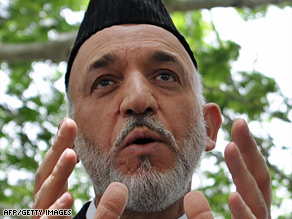
(NSI News Source Info) KABUL, Afghanistan - November 24, 2008: Afghan President Hamid Karzai said President-elect Barack Obama assured him Saturday that the United States would send more aid and pay more attention to his war-torn country, according to Karzai's office, but Obama aides declined to confirm the call had included specific promises. Afghan President Hamid Karzai says Barack Obama has promised Afghanistan more aid. Obama and Karzai spoke by phone Saturday. Karzai's office said Obama told him the United States was committed to helping the people of Afghanistan and bringing peace and stability to the country. The Afghan president said he again congratulated Obama on his election and told him that he hoped his presidency would lead to prosperity for the American people, his office said. Two aides in Obama's transition office declined to go into details about what, if anything, the president-elect had pledged to Karzai. Obama told Karzai he "looked forward to working together on Afghan security after January 20," according to one aide, but the incoming president stressed that "until then, there is one president, and it is President Bush." Obama takes office January 20. The incoming administration has been careful to show it is not stepping on the White House's toes or making any promises to world leaders. The transition aide also noted that Obama was returning a congratulatory call from Karzai, so the incoming president did not initiate the conversation. Obama made Afghanistan a key focus of his foreign policy during the campaign, saying that he would make it the central front in the war on terror if elected. In an interview with CNN last July, Obama criticized Karzai's government, saying it "has not gotten out of the bunker and helped organize Afghanistan and [the] government, the judiciary, police forces in ways that would give people confidence." A week after that interview, Obama met with Karzai in Kabul.

Sunday, November 23, 2008

North Korea vows to go ahead with border closure

North Korea vows to go ahead with border closure (NSI News Source Info) SEOUL - November 24, 2008: North Korea on Monday said that it would go ahead with its threat to effectively close its land border with the South, including expelling South Korean managers from an industrial site just inside its border, from Dec. 1. The reclusive state first warned nearly two weeks ago it would end traffic across the heavily armed border with its wealthy neighbour but this is the first time it has given details of the action it would take. North Korea's KCNA news agency said the measures were the first steps "to be taken in connection with the evermore undisguised anti-DPRK (North Korea) confrontational racket of the south Korean puppet authorities." It will also suspend all tours to its border city of Kaesong, near the industrial park run by a South Korean firm, and halt rail traffic across the border. The Kaesong industrial park is the only significant commercial relationship between the Koreas, divided for more than half a century. KCNA said North Korea would selectively expel South Koreans from the industrial park. The site is home to nearly 90 South Korean companies which operate there to make use of cheap North Korean labour. The North has notified companies operating in Kaesong that it would allow some personnel to remain so that the plants can keep running, South Korea's Unification Ministry spokesman Kim Ho-nyeon later told reporters. The move follows the end of a decade of unconditional aid from the South since conservative President Lee Myung-bak took office early this year with promises to invest heavily there only if Pyongyang moved to disable its nuclear weapons programme. Lee made clear at the weekend he would not back down in the face of mounting tension with the North which accuses him of trying to reignite war on the Korean peninsula. Last month, it threatened to reduce the South to rubble unless it stopped civic groups sending the anti-Pyongyang leaflets across the border. Regional powers plan to resume talks in Beijing next month with the North on a deal to dismantle its atomic weapons programme in exchange for aid and a chance to end its international isolation.

Force Protection Selected for United Kingdom Wolfhound Tactical Support Vehicle

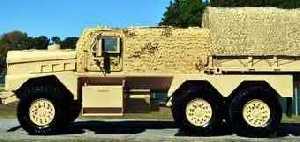
Force Protection Selected for United Kingdom Wolfhound Tactical Support Vehicle (NSI News Source Info) Ladson, SC - November 24, 2008: Force Protection Inc.’s speed of response and ability to perform to customer requirements is playing a key role in winning new orders for its range of survivability solutions. Chairman and Chief Executive Officer Michael Moody, pointed to Force Protection’s selection by the United Kingdom Ministry of Defence as the preferred bidder for the Wolfhound Tactical Support Vehicle (Heavy) program as an example of the way his company is strengthening its capability to respond to urgent operational requirements, “We completed design work and built two prototypes for Wolfhound, which is based on our highly successful Cougar vehicle, in just 90 days. During this time we also carried out blast tests and mobility trials.” Executive Vice President for Customer Operations Damon Walsh stated, “The selection of Force Protection to produce the Wolfhound confirms our responsiveness to customer needs. We offer our customers, including the United Kingdom Ministry of Defence, the flexibility to set aggressive production schedules to meet their unique requirements. In addition, our vehicles, once delivered, continue to demonstrate an operational readiness rate exceeding 90 percent. Many truck manufacturers worldwide offer the capability to deliver large quantities; what sets Force Protection apart is having both delivery performance capability and the most survivable, sustainable vehicles in the field.” Force Protection proposes to deliver these vehicles in conjunction with their UK integration partner, NP Aerospace. Two customised Cougar variants are already featured in major United Kingdom Ministry of Defence programs. The Mastiff 6x6 is in service with British forces in Afghanistan and Iraq. Deliveries of the Ridgback 4x4 began in August of this year. The United Kingdom Ministry of Defence has also recently ordered 24 more Mastiffs together with 14 Force Protection Buffalo route clearance vehicles. Michael Moody said that the increasing adoption of Force Protection vehicles by the UK, the United States, Italy, France, Canada and Iraq was evidence that the company had, “The right technology at the right time. Cougar and Buffalo continue to prove their worth as the most survivable, sustainable vehicles on the battlefield.”

U.K. MoD Selects Navistar for Mission Specific Tactical Support Vehicle

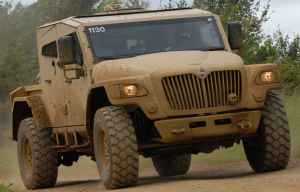
U.K. MoD Selects Navistar for Mission Specific Tactical Support Vehicle (NSI News Source Info) WARRENVILLE, Ill. - November 24, 2008: Navistar Defense, LLC today expanded its worldwide customer list to include the United Kingdom through the Ministry of Defence’s Tactical Support Vehicle (TSV) program. The United Kingdom announced in late October that it had earmarked £350 million (~US$525 million) for 400 TSV units. Navistar has formally entered into contract negotiations to provide 260 TSV Husky units based off its International® MXT™ platform to meet an urgent need. The company anticipates that the contract will be ratified in early 2009. The Husky, which is the medium TSV variant, will be procured for specific missions in three vehicle types: utility, ambulance and command vehicle. Currently, delivery of the vehicles is scheduled to begin in the first half of the 2009 calendar year. “Navistar is proud to participate in the TSV program and offer the U.K. a flexible MXT platform that can be rapidly modified to meet urgent requirements,” said Robert Puhalovich, sales director, Navistar Defense. “We will continue to deliver on our commitment to provide a comprehensive value solution that includes military vehicles, and worldwide parts and field service support.” The MXT is designed to fill a gap that exists between the smaller traditional armored 4x4’s that may be payload challenged, and the larger class of Mine Resistant Ambush Protected (MRAP) vehicles that may be mobility restrained for certain mission requirements. "Leveraging our current commercial capabilities and assets allows Navistar Defense to rapidly respond," said Archie Massicotte, president, Navistar Defense. "Providing the International MXT for the TSV program is another example of how Navistar Defense is not only supporting the U.S. military, but NATO allies." Final assembly of the MXT TSV units will occur at the company’s West Point, Miss., assembly plant, which has produced more than 5,300 International® MaxxPro™ MRAP vehicles. MXT Husky units will be powered by MaxxForce D 6.0 L V8 engines. The TSV contract award follows Navistar’s selection in October as one of nine finalists to compete to replace the U.K.’s light tactical wheeled vehicle fleet in the highly-competitive Operational Utility Vehicle Systems (OUVS) program. Navistar will provide vehicles for testing and trials in 2009 to replace a portion of the army’s fleet, which includes Land Rover, Wolf, Reynolds Boughton RB-44 and Pinzgauer vehicles. Current estimates place the opportunity at greater than 4,000 units. Vehicles submitted for the OUVS program will also be based on the MXT platform.
BAE Systems Completes Production Of Mine Resistant Ambush Protected Vehicles

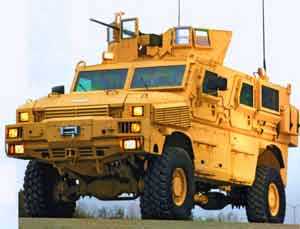
BAE Systems Completes Production Of Mine Resistant Ambush Protected Vehicles (NSI News Source Info) ARLINGTON, Virginia - November 24, 2008: BAE Systems has completed production of more than 5,000 Mine Resistant Ambush Protected (MRAP) vehicles under existing contracts with the U.S. Army and U.S. Marine Corps. Ceremonies to commemorate this milestone were held this week at BAE Systems MRAP-related sites in Charlotte, Michigan and Sealy, Texas. The events celebrate the completion of a 22-month production run for two BAE Systems variants of the MRAP – the Caiman and the RG33; the U.S. Government has purchased 2,868, and 2,182 of those vehicles, respectively. The final Caiman rolled off the assembly line this week, and the RG33L was delivered to the government on Wednesday. Additional RG33 and Caiman variants will be delivered to the government in coming months. "The BAE Systems' Team has excelled in its support of our Armed Services in its time of urgent need. Caiman has been On Time-On Target." said Chris Chambers, Vice President, Medium/Heavy Vehicles at BAE Systems. "By any measure Caiman is a success: contract award to production deliveries in 43 days; an unmatched, exemplary delivery to contract and a vehicle protection and reliability record that has enabled our troops to complete their vital mission." “The RG33 represents an unprecedented story of success that reflects industries unsurpassed rapid response to the Department of Defense’s immediate requirement to defeat an ever evolving threat,” said Matt Riddle, Vice President, Wheeled Combat Vehicles at BAE Systems. “From design to fielding in less than six months, the RG33 has proven itself worthy in combat and has well earned the respect and accolades of its U.S. military crewmen.” The Caiman and RG33 were developed in 2006 to provide U.S. warfighters in Iraq a vehicle that would protect them against rocket-propelled grenades, roadside bombs and explosively formed projectiles. Prototypes of both vehicles were delivered in January 2007; the first production contracts were awarded to the RG33 in February 2007 and to the Caiman in July 2007. The Caiman, RG33 and other MRAP models have since replaced many of the unarmored or lightly armored vehicles used for combat-related missions in Iraq. The Caiman As a member of the Family of Medium Tactical Vehicles (FMTV), the Caiman shares many features and components, vastly reducing current and future logistic and training loads and allowing sharing of technology advancements such as stability control, on/off-board power or diagnostic/prognostic systems. Additionally, it offers an adaptable, applique-based protective system allowing rapid future transformation to match changing threats or removal to vastly reduce the vehicle weight and a high volume under armor with leading payload capacity. The Caiman continues to achieve a sustained operational readiness rate average of 95 percent and has been utilized throughout the spectrum of operations. Manufacturing of the Caiman is coordinated between six of BAE Systems’ facilities in Cincinnati, Ohio; Louisville, Kentucky; Phoenix, Arizona; Monroe, North Carolina; Sealy, Texas; and Orangeburg, South Carolina. RG33 The RG33 sets the standard for mine-protected vehicles in the 20 to 40-ton weight class, providing superior performance through enhanced survivability, advanced mobility, mission flexibility, rapid availability and vehicle commonality। It features a state-of-the art v-shaped hull that provides superior blast protection against symmetrical, asymmetrical and unconventional explosive hazards. With its large modular interior, high-mobility chassis and extensive equipment options, the RG33 is an integrated, proven, survivable, blast-protected vehicle. The versatility of the RG33 is represented in the many variants of the vehicle – 4x4 and 6x6 configurations, an armed utility variant, a variant designed for Special Operations Command, an ambulatory variant and a command and control variant.

General Dynamics Awarded $64 Million for Tank Upgrades

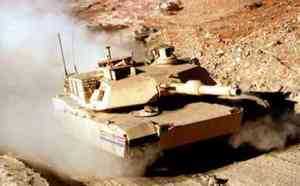
General Dynamics Awarded $64 Million for Tank Upgrades (NSI News Source Info) STERLING HEIGHTS, Mich. – November 24, 2008: The U.S. Army TACOM Lifecycle Management Command has awarded $63.7 million to General Dynamics Land Systems, a business unit of General Dynamics, to upgrade 180 tanks under the Abrams Improved Systems Enhancement Package (SEP) Reset (ISR) program. As part of the reset program, M1A2 SEP Version One tanks are upgraded to the SEP Version Two configuration, which includes improved displays, sights, power, and a tank-infantry phone. The M1A2 SEP Version Two is the most technologically advanced Abrams tank and can accommodate future technology improvements to ensure compatibility with the Army’s Future Combat Systems. Work will be performed in Anniston, Ala.; Tallahassee, Fla.; Sterling Heights, Mich.; and Scranton, Pa. Work is expected to be completed by September 2010.

Maryland keen to further trade ties with India

Maryland keen to further trade ties with India (NSI News Source Info) Washington - November 23, 2008: The life sciences hub of Maryland is keen to expand ties with India that presents great opportunities for trade and attracting new investment, particularly in cutting edge fields, says the US state's governor Martin O'Malley. 'We believe that India presents Maryland with some of our greatest opportunities for developing new trade partnerships and attracting new direct investment across a variety of sectors,' O'Malley said in the keynote address at the 4th Annual Maryland-India Business Roundtable. 'Today, Maryland and India already are conducting a considerable amount of trade. We export products like electronics, pharmaceuticals and aircraft and aviation products, and we import hundreds of millions of dollars from India as well,' he said at the event in Greenbelt Saturday. 'The very good news is that our exports to India are growing,' said O'Malley noting, 'In all of 2006, our exports to India totalled $103 million. By July of this year, we had already reached $113 million.' Maryland, surrounding the capital city of Washington on the south and west, is home to some 50,000 Indian-Americans. With the highest median household income of any state at $68,080 in 2007, Maryland is a life sciences hub with over 350 biotechnology firms, making it the third largest such cluster in the US. Institutions and agencies located throughout Maryland include the University System of Maryland, The Johns Hopkins University, Howard Hughes Medical Institute, Celera Genomics, Human Genome Sciences (HGS), the J. Craig Venter Institute (JCVI), the Food and Drug Administration (FDA) and the National Institutes of Health (NIH). Maryland also welcomed in July five Indian technology companies, which established pilot offices at the Rockville Innovation Centre - beating out New York, Virginia and New Jersey, O'Malley said. 'For both India and Maryland, the life sciences present a panoply of vast opportunity, both in terms of our ability to compete in an increasingly knowledge-based global economy,' O'Malley said. They also provide a chance to 'offer some moral leadership in our world, to develop and proliferate these cures, these treatments, these technologies which can heal both our own neighbours here at home and our global neighbours across a world that's growing ever more flat and interdependent by the day', he added. 'Because both Marylanders and Indians recognise that our greatness isn't about how many smart bombs we can drop, we can continue to strengthen our ties with India and develop new opportunities to expand our partnerships in cutting edge fields like the life sciences and information technology,' O'Malley said. Stressing the importance of strengthening ties with countries beyond national borders in order to compete in this global economy, O'Malley noted a number of Maryland counties have have organised delegations of business executives to China, India, Europe and South Korea. To attract Indian companies to Maryland, the state plans to focus on industry sectors in which both Maryland and India are strong: biotechnology, pharmaceuticals and health care management, information technology and engineering services, and aerospace and defence. India's recent decision to allow foreign direct investment in the defence sector has created an ongoing modernization plan of its armed forces, and enormous new investment opportunities in the civil aviation sector, the governor's office noted. Maryland's Department of Business and Economic Development plans to attend the AERO India Conference in February to help attract foreign direct investment and help Maryland businesses expand their business in India. Founded in 2004, the Maryland-India Business Round Table Inc. (MIBRT) aims to foster cooperation and promote trade and investment between businesses operating in India and Maryland.