Sunday, November 30, 2008

Taliban kill 'US spy' in Pakistani tribal area: official

Taliban kill 'US spy' in Pakistani tribal area: official
(NSI News Source Info) MIRANSHAH - November 30, 2008: Taliban militants hanged and shot dead an Afghan man in a restive Pakistani tribal area bordering Afghanistan, accusing him of spying for the US, an official said on Sunday. The body of Ajab Khan, 35, was found in the tribal district of North Waziristan on Sunday, a local administration official told AFP. Militants have killed several people, accusing them of spying on their activities on behalf of the Pakistani government and US forces operating across the border in Afghanistan Khan's body had bullet wounds and there was rope tied around his neck, indicating he was hanged and later shot, the official said. A note found with Khan's body said he had been killed because he was spying for US forces. Militants have killed several people, accusing them of spying on their activities on behalf of the Pakistani government and US forces operating across the border in Afghanistan. The northwest has been wracked by violence since hundreds of Taliban and Al-Qaeda rebels fled there after the US-led invasion of Afghanistan in late 2001.

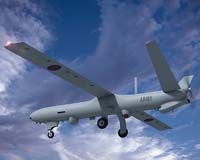
Thales WATCHKEEPER Successfully Passes First System Flight Trial

Thales WATCHKEEPER Successfully Passes First System Flight Trial (NSI News Source Info) London, UK - November 30, 2008: Thales UK has announced the successful first system flight trials of the WATCHKEEPER unmanned air vehicle (UAV), with the autonomous flight taking place under the system guidance of the WATCHKEEPER ground control software and fully integrated within the ground control station (GCS). These trials of the UAV, which operates with dual payloads, will continue into 2009, and will validate the key mission system capability of the WATCHKEEPER system. This is another significant step forward in the WATCHKEEPER programme and follows closely from the first successful flight trials of the WATCHKEEPER air vehicle in April 2008 and the demonstration of the WATCHKEEPER Automatic Take-Off and landing (ATOL) capability in August 2008. The control software has been produced by Thales UK at its Crawley facility. The GCS has been designed and manufactured in the UK by UAV Tactical Systems Ltd (U-TacS), the Thales UK/Elbit Systems joint company site in Leicester. During the first successful flight trials at Elbit's facilities in Israel, the WATCHKEEPER UAV was controlled by the WATCHKEEPER GCS using Thales-developed software and performed an automatic take-off and landing. This initial stage of systems trials will provide an essential link between the various sub-system level trials and the full WATCHKEEPER systems trials to be undertaken in the UK next year. The WATCHKEEPER system test programme includes: + System command and control of UAV from WATCHKEEPER GCS + Initial assessment of system data link performance + Dual payload installation + Generation and exploitation of payload imagery (the 'imagery chain') + WATCHKEEPER avionics system trials (IFF and airborne radio assessment) + Further systems ATOLS assessment + Electrical power system performance with dual payloads installed Mark Barclay, Managing Director of Thales UK's aerospace business, says: "This is another major step forward on the WATCHKEEPER programme and one of a number of trials that are scheduled over the coming months. We have made steady progress since the contract was signed in 2005 and I am particularly pleased that Thales and our external partners continue to deliver in line with the agreed customer schedule."

Russia, India to step up anti-terror interaction - Kremlin

Russia, India to step up anti-terror interaction - Kremlin (NSI News Source Info) MOSCOW - November 30, 2008: Russia and India will step up their anti-terrorist cooperation in the wake of militant attacks on India's financial capital that killed nearly 200 people, the Kremlin press office said on Sunday. Russian President Dmitry Medvedev held a telephone conversation on Sunday with Indian Prime Minister Manmohan Singh, the Kremlin press office said. "Both sides expressed their intention to intensify anti-terrorist interaction. These issues will be discussed during the forthcoming visit by the Russian president to India and within the framework of the Russian-Indian working group for combating international terrorism," the Kremlin press office said. Terrorists swept through Mumbai on Wednesday night, armed with submachine guns and grenades attacking hotels, the railway station, a cinema, and a hospital. The three-day rampage killed 174 people, including more than 20 foreigners

Iran proposes building nuclear power plants with Arab states

Iran proposes building nuclear power plants with Arab states (NSI News Source Info) TEHRAN - November 30, 2008 Iran on Sunday proposed building light-water nuclear power plants jointly with neighboring Arab countries. The proposal was put forward by Gholamreza Agazadeh, Iranian vice-president and head of Iran's Atomic Energy Organization, who spoke at a conference on nuclear power plants, environment and sustainable development. "Iran is ready to provide very soon a comprehensive plan for the proposal if it were approved in generalities by the Persian Gulf littoral states," the Iranian news agency IRNA quoted Agazadeh as saying. Iran is under three sets of relatively mild UN Security Council sanctions over its controversial nuclear program, which it insists has purely civilian goals. Western powers led by the United States, along with Israel, accuse Tehran of attempting to develop nuclear weapons, something Iran has consistently denied. Iran is completing the construction of its first nuclear power plant at Bushehr in the south of the country with the assistance of Russian specialists. The $1bln project is subject to UN monitoring following Iran's refusal to halt its uranium enrichment program and Western suspicions that Tehran is seeking to build nuclear weapons. The Bushehr nuclear power plant is expected to be launched in the first half of 2009.

Mumbai attacks push India and Pakistan into deep water

Mumbai attacks push India and Pakistan into deep water
(NSI News Source Info) NEW DELHI - November 30, 2008: Outrage in India over the Mumbai attacks risks sparking a dangerous escalation in tensions with Pakistan, analysts say, even as Islamabad cautions against any knee-jerk reaction. Having accused "elements in Pakistan" of involvement in the ruthless attacks that left 195 dead in India's financial capital, the government here is now under extreme public pressure to exact some form of visible retribution.
The two nuclear-armed South Asian rivals are past masters of the art of military and diplomatic brinkmanship, but the stakes are heightened by looming general elections in India in which national security will be a key issue. In a televised address to the nation on Thursday, Prime Minister Manmohan Singh vowed that the perpetrators and organisers of the Mumbai assault would be made to pay "a heavy price".
On Saturday, Singh called a meeting of India's army, navy and air force chiefs. But while India would like to lean heavily on Islamabad to ensure it delivers on repeated promises to prevent Pakistani territory being used for anti-India activities, analysts say the government's options are limited.
Pakistani protesters shout anti-terror slogans in Lahore. The demonstration was organised after the terrorist attacks in the Indian city of Mumbai. Outrage in India over the Mumbai attacks risks sparking a dangerous escalation in tensions with Pakistan, analysts say, even as Islamabad cautions against any knee-jerk reaction
Former national security adviser Brajesh Mishra said New Delhi would be constrained by a lack of proof that Islamabad had any direct role in the attacks. "There is little to suggest that the gunmen were sponsored by the Pakistani government," Mishra said. The scale and style of the assaults -- involving multiple targets and hostage-taking -- bore "the hallmarks of Al-Qaeda attacks in the Middle East and North Africa," Mishra said.
"These are new elements that differentiate the Mumbai attacks from the parliament attack." In 2001, gunmen from the Pakistan-based Lashkar-e-Taiba militant group attacked the Indian parliament, resulting in the complete rupture of diplomatic ties and pushing the rivals to the brink of war.
Supporters of the Pakistan Awami Tehrik (Pakistan People's Movement) march against the Indian government's claim that Pakistani based militants were behind the Mumbai attacks at a rally in Lahore November 30, 2008. Pakistan's government has begun rallying support both at home and abroad as tension flared with old rival India after a bloody militant assault on the Indian city of Mumbai
Former foreign secretary Kanwal Sibal all but ruled out the possibility of India resorting to any cross-border military response. "The Indian leadership would have to weigh very carefully the consequences of using the military option in the wider context of peace and stability in the region," Sibal said.
Pakistani President Asif Ali Zardari appealed for calm on Saturday and argued that any increase in Indian-Pakistani tensions would be a victory for the extremists. "Whoever is responsible for the brutal and crude act against the Indian people and India are looking for reaction," Zardari said in an interview with Indian CNN-IBN television.
"We have to rise above them and make sure ourselves, yourself and world community guard against over-reaction," he said. Kalim Bahadur, a retired professor of international relations, said India might find it difficult to take a hard line with Pakistan, given that Zardari's government was still finding its feet and itself battling Islamic militants.
"The Pakistani president's grip on power is not strong. We have seen that Zardari says things, then he is contradicted or he has to clarify what he has said. "The situation seems to be that the democratic government has no control over extremist elements," Bahadur said.
Independent security analyst K. Subrahmanyam suggested that a primary motive for the Mumbai attacks could well have been a desire to "wreck the peace process" launched by India and Pakistan in January 2004.
Given the targeting of foreigners by the Mumbai attackers, Subrahmanyam said New Delhi had an opportunity to rally international pressure on Islamabad to cut support to Islamist groups. Another analyst, C.Uday Bhaskar, urged Singh and his government to keep the engagement with Pakistan on track while carefully monitoring Islamabad's actions in the coming weeks. "Snapping links is not a desirable option," he said.

Saturday, November 29, 2008

U.S. Intelligence Focuses on Pakistani Group as Substantial Evidence Emerge

U.S. Intelligence Focuses on Pakistani Group as Substantial Evidence Emerge (NSI News Source Info) November 29, 2008: American intelligence and counterterrorism officials said Friday that there was mounting evidence that a Pakistani militant group based in Kashmir, most likely Lashkar-e-Taiba, was responsible for this week's deadly attacks in Mumbai.
The officials cautioned that they had reached no firm conclusions about who was responsible for the attacks, or how they were planned and carried out. Nevertheless, they said that evidence gathered in the past two days pointed to a role for Lashkar-e-Taiba or possibly another group based in Kashmir, Jaish-e-Muhammad, which also has a track record of attacks against India.
The officials requested anonymity in describing their current thinking and declined to discuss specifics of the intelligence that they said pointed to Kashmiri militants. In the past, the American and Indian intelligence services have used communications intercepts to tie Kashmiri militants to terrorist strikes. Indian officials may also be gleaning information from at least one captured gunman who participated in the Mumbai attacks.
According to one Indian intelligence official, during the siege the militants have been using non-Indian cellphones and receiving calls from outside the country, evidence that in part led Indian officials to speak publicly about the militants’ external ties.
Lashkar-e-Taiba denied any responsibility on Thursday for the terrorist strikes. American intelligence agencies have said that the group has received some training and logistical support in the past from Pakistan’s powerful spy service, the Directorate for Inter-Services Intelligence, or I.S.I., and that Pakistan’s government has long turned a blind eye to Lashkar-e-Taiba camps in the Kashmir region, a disputed territory over which India and Pakistan have fought two wars.
Officials in Washington said Friday that there was no evidence that the Pakistani government had any role in the attacks. But if evidence were to emerge that the operation had been planned and directed from within Pakistan, that would certainly further escalate tensions between India and Pakistan, bitter, nuclear-armed rivals. It could also provoke an Indian military response, even strikes against militants’ training camps.
American and Indian officials were pursuing the possibility that the attackers arrived off the coast of Mumbai in a large ship and then boarded smaller boats before initiating their attack.An American counterterrorism official said there was strong evidence that Lashkar-e-Taiba had a “maritime capability” and would have been able to mount the sophisticated operation in Mumbai.
Senior Bush administration officials sought to keep the tensions from boiling over on Friday by maintaining steady contact with Indian officials. Secretary of State Condoleezza Rice spoke by phone with Pranab Mukherjee, India’s foreign minister, and one of Ms. Rice’s deputies spoke with the Indian foreign secretary.
In what was seen as a sign of Pakistan’s concern about a possible Indian response, Pakistani officials announced Friday that the head of the I.S.I. would go to India to help the Indian government with its investigation. On Friday evening, however, Pakistani officials indicated that a lower-level I.S.I. representative might make the trip.
American and Indian officials have for years blamed Lashkar-e-Taiba for a campaign of violence against high-profile targets throughout India, including the December 2001 attack on the Indian Parliament building in New Delhi and an August 2007 strike at an amusement park in Hyderabad. At times, Indian officials have also said Jaish-e-Muhammad was responsible for the attack on Parliament.
That attack prompted the Bush administration to try to freeze Lashkar-e-Taiba’s assets and press Gen. Pervez Musharraf, Pakistan’s president at the time, to crack down on the group’s training operations in Pakistan.A State Department report released this year called Lashkar-e-Taiba “one of the largest and most proficient of the Kashmiri-focused militant groups.” The report said that the group drew financing in part from Pakistani expatriates in the Middle East, and that it used a front organization called Jamaat ud-Daawa to coordinate charitable activities, like relief for the victims of the October 2006 earthquake in Kashmir.
The report said the actual size of the group was unknown, but estimated it at “several thousand” members.
Recently, some of the group’s operations have shifted from Kashmir to Pakistan’s Federally Administered Tribal Areas and even to Afghanistan to attack American troops. American officials and terrorism experts said the group had not sent large numbers of operatives into Afghanistan, but had embedded small teams with Taliban units to gain fighting experience.
“Afghanistan is an operating war zone, so they can get active training as the Kashmir front has slowed down a bit,” said Seth Jones, a terrorism expert at the RAND Corporation.
The group is believed by experts to have at least a loose affiliation with Al Qaeda. In March 2002, a Qaeda lieutenant, Abu Zubaydah, was captured in a Lashkar-e-Taiba safe house in Faisalabad, Pakistan, according to the State Department report.
Lashkar-e-Taiba is not known to have singled out Westerners in past terrorist attacks, as the gunmen in Mumbai seem to have done. But one counterterrorism official said Friday that the group “has not pursued an exclusively Kashmiri agenda” and that it might certainly go after Westerners to advance broader goals.Even as a Kashmiri connection to the attacks began to emerge on Friday, American officials said they were puzzled by some developments. For instance, they said they knew next to nothing about a group called the Deccan Mujahedeen, which issued a claim of responsibility for the attacks.
Terrorism experts have said there is no evidence of that group’s involvement in past strikes, and they speculated that another group fabricated the name to mask responsibility

Afghanistan Today

Afghanistan Today November 29, 2008 News Source Info NSI US soliders on a patrol in Paktika province on November 28, 2008. Troops killed 44 militants in Afghanistan, officials said Saturday, as around a dozen police and soldiers were still missing following a major clash and believed to be in Taliban hands.
British soldiers keep watch at the scene of a suicide car attack in Kabul November 27,2008. A suicide car bomber struck a convoy of foreign troops near the U.S. embassy in Kabul on Thursday, killing one civilian and wounding six more, the head of the Afghan capital's police force said.

HAL eyes Eurocopter partnership

HAL eyes Eurocopter partnership November 28, 2008: Hindustan Aeronautics Limited (HAL) is reportedly considering a partnership with Eurocopter for the manufacture of 187 military helicopters. The Dhruv Advanced Light Helicopter (ALH), multi-role and multi-mission helicopter is in service with the Indian Army
A HAL official told Flight Global that a western partner could help expedite the design and production process.
"We hope to begin the initial work on the light utility helicopter next year. It would take around five years to completely design and develop a new helicopter, and an experienced Western partner would help in every stage," explained a HAL official.
HAL, which will also maintain the new helicopters, is expected to create a new division to oversee the LUH (light utility helicoper) programme.
The LUH unit would operate independently from the company's existing Dhruv advanced light helicopter and light combat 'copter projects.
Eurocopter recently announced plans to significantly expand its operations in India. According to Ludovic Boistot of Eurocopter, the Indian military market offered "big potential, as the military has undertaken a programme of modernisation and replacing its fleet".
The firm currently counts 480 helicopters on active service in the country."
Rapidly growing economy, increasing reliance on air transport, service to tourist destination and religious places and find of new gas reserves and the demand in other sectors will give big push to helicopter industry in this country," added Boistot.
It should be noted that over 10,000 Eurocopter helicopters are currently in service, with at least 2,800 customers in 140 countries.

China and South Korea set up Hotline

China and South Korea set up Hotline (NSI News Source Info) November 29, 2008: China and South Korea have set up a military hotline, to avoid accidental clashes between their sea and air forces. At each end, military personnel are on duty 24/7, prepared to quickly defuse any encounters. The South Korea end of the hot line is at the headquarters of the South Korean 2nd Fleet, which is 70 kilometers south of the capital, Seoul. South Korean Air Force officers, based at the Daegu air base, 300 kilometers southeast of Seoul, are linked to the 2nd Fleet hotline operation. The Chinese end of the hotline is at their Northern Fleet headquarters at Qingdao (formerly "Tsingtao") at the tip of the Shandong peninsula, which is on the 38th parallel, pointing at Korea, across the Yellow Sea. This hotline is the only one that exists with China. South Korea also has a hotline with Japan (established in 1997) and Russia (established in 2000). The principal point of friction at sea is the nearly 200 Chinese fishing boats that enter South Korean waters illegally each year, seeking the valuable crabs found there. Chinese and South Korean warships patrol the area, to try and prevent the poaching, and sometimes encounter each other. Both nations also fly air patrols over the Yellow Sea.

Iraqi Navy Patrolling Coast

Iraqi Navy Patrolling Coast (NSI News Source Info) November 29, 2008: Having recently received several new patrol boats, and after several years of training, Iraqi sailors and marines are now beginning to take over complete responsibility for patrolling and guarding offshore oil facilities and checking ships and boats that move along Iraq's 58 kilometer coastline.
Shipping has to be monitored for smugglers and terrorists. Since 2003, the U.S. (coast guard, navy, marines) and the British Royal Navy has undertaken these tasks.
Currently, there are about 2,000 Iraqis assigned to the navy, coast guard and marines.