Showing posts with label US Amred Forces. Show all posts

Tuesday, December 08, 2009

DTN News: U.S. and South Korea Hold Combined Exercise

DTN News: U.S. and South Korea Hold Combined Exercise
*Source: DTN News / Int'l Media
(NSI News Source Info) YEOJU-GUN, South Korea - December 9, 2009: U.S. soldiers from 2nd battalion, 2nd aviation regiment, 2nd combat aviation brigade, 2nd infantry division and South Korean soldiers participate in the combined air assault exercise on December 8, 2009 in Yeoju-gun, South Korea. South Korean army and U.S. soldiers conducted a air assault exercise to prepare for possible aggression by North Korea, which the South remains technically at war with since the end of the Korean War in 1953.
South Korean Army soldiers aim their machine guns during a South Korea-U.S. combined air assault exercise to prepare for possible aggression by North Korea in Yeoju, South Korea, Tuesday, Dec. 8, 2009. U.S. President Barack Obama's envoy began a rare trip to North Korea Tuesday for the highest-level talks with the communist nation in more than a year as a senior U.S. official warned of strong sanctions against Pyongyang unless it rejoins international nuclear talks.

Tuesday, December 01, 2009

DTN News: Oshkosh Corporation Commemorates Handoff Of 1,000th M-ATV To U.S. Armed Forces

DTN News: Oshkosh Corporation Commemorates Handoff Of 1,000th M-ATV To U.S. Armed Forces *Source: DTN News / Oshkosh Corporation (NSI News Source Info) OSHKOSH, Wis. - December 2, 2009: Oshkosh Corporation (NYSE:OSK) marked the handoff of the 1,000th MRAP All Terrain Vehicle (M-ATV) to the U.S. Armed Forces on Nov. 30 at a ceremony with military leadership at the company’s facilities in Oshkosh, Wis.Brig. Gen. Michael Brogan, commander of the Marine Corps Systems Command, signs a ceremonial DD250 to commemorate the handoff of the 1,000th M-ATV to the U.S. Armed Forces. Brig. Gen. Michael Brogan, commander of the Marine Corps Systems Command, was the keynote speaker at the event. Having exceeded the government’s delivery schedule for five consecutive months, Oshkosh is ramping up production to 1,000 vehicles per month in December and continuing at that level through April 2010. “We understood the urgency of the M-ATV program to save American lives and leaned forward in advance of receiving the contract to build vehicles and prepare our operations for this high-quantity production,” said Robert G. Bohn, Oshkosh Corporation chairman and chief executive officer. “Our workforce has embraced this important mission and made countless personal sacrifices to produce these vehicles quickly to protect those that are sacrificing for our safety. They will continue to deliver these life-saving vehicles along with replacement parts and field support, as long as necessary.” Since being awarded the production contract on June 30, 2009, Oshkosh has received four additional awards from the U.S. Army Tank-automotive and Armaments Command Life Cycle Management Command (TACOM LCMC) to supply a total of 6,219 M-ATVs. Oshkosh also has received orders for spare kits and to send its factory-trained field service representatives (FSR) to Afghanistan to provide training and maintenance support for the vehicles. The aggregate amount of the five awards is valued at $3.2 billion. The M-ATV is the U.S. military’s newest MRAP model, combining the protection levels of legacy MRAPs with improved mobility and durability to handle Afghanistan’s mountainous cross-country terrain and unimproved roads. The vehicle uses the Oshkosh-patented TAK-4® independent suspension system, which has undergone more than 500,000 miles of government testing, to achieve a 70-percent off-road profile capability and 16 inches of independent wheel travel. The system also is used on the Marine Corps’ Medium Tactical Vehicle Replacement (MTVR) and Logistics Vehicle System Replacement (LVSR), as well as the Army’s Palletized Load System (PLS A1). Existing Oshkosh Defense manufacturing facilities have available production capacity for all current and pending military vehicle programs, including the M-ATV and the U.S. Army’s Family of Medium Tactical Vehicles (FMTV), as well as any surges in production. Oshkosh Defense teamed with Plasan North America to provide an advanced armor solution for the M-ATV. Plasan also developed the armor system used on more than 5,000 legacy MRAPs and thousands of Oshkosh MTVR Armored Cabs already in theater. Photo Caption: Brig. Gen. Michael Brogan, commander of the Marine Corps Systems Command, is joined by Andy Hove, Oshkosh Corporation executive vice president and president, Defense, left, and Gordon Kranz, executive director of engineering and analysis for the Defense Contract Management Agency, as he signs a ceremonial DD250 to commemorate the handoff of the 1,000th M-ATV to the U.S. Armed Forces at a ceremony on Nov. 30 at the company's facilities in Oshkosh, Wis. About Oshkosh Defense Oshkosh Defense, a division of Oshkosh Corporation, is an industry-leading global designer and manufacturer of tactical military trucks and armored wheeled vehicles, delivering a full product line of conventional and hybrid vehicles, advanced armor options, proprietary suspensions and vehicles with payloads that can exceed 70 tons. Oshkosh Defense provides a global service and supply network including full life-cycle support and remanufacturing, and its vehicles are recognized the world over for superior performance, reliability and protection. For more information, visit http://www.oshkoshdefense.com/. About Oshkosh Corporation Oshkosh Corporation is a leading designer, manufacturer and marketer of a broad range of specialty access equipment, commercial, fire & emergency and military vehicles and vehicle bodies. Oshkosh Corp. manufactures, distributes and services products under the brands of Oshkosh®, JLG®, Pierce®, McNeilus®, Medtec®, Jerr-Dan®, Oshkosh Specialty Vehicles, Frontline™, SMIT™, CON-E-CO®, London® and IMT®. Oshkosh products are valued worldwide in businesses where high quality, superior performance, rugged reliability and long-term value are paramount. For more information, log on to http://www.oshkoshcorporation.com/.

Wednesday, November 04, 2009

DTN News: U.S. Military Officials Showcase Armored All-terrain Vehicle

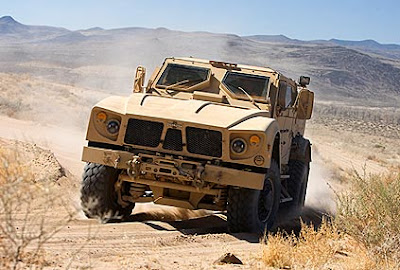
DTN News: U.S. Military Officials Showcase Armored All-terrain Vehicle *Source: DTN News / U.S Department of Defense; issued November 2, 2009 (NSI News Source Info) WASHINGTON, USA - November 5, 2009: Senior Defense Department officials Nov. 2., showcased a more agile, downsized version of the military’s family of super-armored vehicles now arriving in Afghanistan. Brig. Gen. Michael M. Brogan, commander of Marine Corps Systems Command, speaks to reporters during an event at the Pentagon displaying the M-ATV, a new armored all-terrain vehicle, Nov. 2, 2009. DoD photo by Navy Petty Officer 1st Class Molly A. Burgess Brig. Gen. Michael M. Brogan, commander of Marine Corps Systems Command, speaks to reporters during an event at the Pentagon displaying the M-ATV, a new armored all-terrain vehicle, Nov. 2, 2009. DoD photo by Navy Petty Officer 1st Class Molly A. Burgess (Click photo for screen-resolution image);high-resolution image available. Because Afghanistan’s mountainous terrain requires a more agile vehicle than the mine-resistant, ambush-protected vehicles used in Iraq, the MRAP vehicle was modified to produce a lighter, all-terrain vehicle known as the M-ATV, said Ashton B. Carter, undersecretary of defense for acquisition, technology and logistics. The new vehicles will replace up-armored Humvees. Like the version used in Iraq, the new trucks feature armor and V-shaped hulls to deflect roadside-bomb blasts, Carter. M-ATVs “will similarly be a live-saver in Afghanistan,” he added. Defense Secretary Robert M. Gates pushed to develop the new vehicle quickly, Carter said, noting the first production order was provided to Wisconsin-based manufacturer Oshkosh Corp. in June. Vehicles already are arriving in Afghanistan, Carter said, noting he has test-driven an M-ATV. “These are superior vehicles,” he told reporters. The military is planning to buy more than 6,500 M-ATVs, Carter said, with about 690 having been accepted. “We will continue to make changes in the MRAP-ATV as we get feedback from soldiers [on] how to improve it,” Carter said. U.S. soldiers in Afghanistan are training with the first 41 M-ATVs that have arrived there, said Marine Corps Brig. Gen. Michael Brogan, commander of Marine Corps Systems Command at Quantico, Va. Marines, too, will get M-ATVs, he said. The M-ATV weighs about 5 tons less that the 40,000-pound regular MRAP, Brogan said, noting the new vehicle also features an independent suspension and a shorter wheelbase to better negotiate Afghanistan’s rocky hills. The M-ATV “was designed from the ground up to have mobility that’s roughly equivalent to an up-armored Humvee, yet retain the survivability features that are inherent in the baseline MRAP vehicles,” Brogan said. The major contributor to the M-ATV’s increased mobility, he said, is its four-wheel independent suspension. “That’s what provides that off-road capability,” Brogan said, noting that the baseline MRAPs have rigid-axle suspensions that perform poorly on uneven, hilly terrain. Meanwhile, Brogan said, early-production MRAPs, called “Cougars,” are being taken out of theater and having their rigid suspensions replaced with suspensions better-suited for Afghanistan’s lack of roads and challenging geography. Brogan noted differences between the terrain in Iraq and that in Afghanistan. “The terrain in Afghanistan is significantly more formidable,” he said. There is far less infrastructure, and that infrastructure that does exist is more austere.” The base cost for the M-ATV is about $437,000 per vehicle. As fitted with the necessary equipment for deployment, each vehicle costs about $1.4 million, shipping to Afghanistan included, Brogan said.

Monday, September 14, 2009

DTN News: Raytheon-Led Littoral Warfare Weapons Team Demonstrates Successful Underwater Launch

DTN News: Raytheon-Led Littoral Warfare Weapons Team Demonstrates Successful Underwater Launch
*Source: DTN News / Raytheon
(NSI News Source Info) TEWKSBURY, Mass., - September 14, 2009: Raytheon Company (NYSE: RTN) marked a developmental milestone when it successfully demonstrated the underwater launch of a Raytheon AIM-9X air-to-air test missile shape from a submerged Tomahawk Capsule Launching System. This successful test is a significant step in demonstrating payload flexibility for submarines. Conducted at the U.S. Army's Aberdeen Test Center, Aberdeen, Md., the test marked the first time an AIM-9X test missile shape has been launched from underwater. It is part of the Littoral Warfare Weapon (LWW) program managed by the Department of the Navy's Program Executive Office of Submarines. "The Littoral Warfare Weapon program will test and develop increased capabilities as the U.S. Navy continues to expand undersea warfare in the littoral arena," said Michael Del Checcolo, vice president of Engineering, Raytheon Integrated Defense Systems. "This successful launch demonstrates a new degree of submarine self-defense capability against threats our warfighters may encounter from the air, land and sea." Raytheon's LWW approach leverages the technologies and expertise of a team of industry and military partners, including Northrop Grumman and the Naval Undersea Warfare Center in Newport, R.I. Integrated Defense Systems is Raytheon's leader in Global Capabilities Integration providing affordable, integrated solutions to a broad international and domestic customer base, including the U.S. Missile Defense Agency, the U.S. Armed Forces and the Department of Homeland Security. Raytheon Company, with 2008 sales of $23.2 billion, is a technology and innovation leader specializing in defense, homeland security and other government markets throughout the world. With a history of innovation spanning 87 years, Raytheon provides state-of-the-art electronics, mission systems integration and other capabilities in the areas of sensing; effects; and command, control, communications and intelligence systems, as well as a broad range of mission support services. With headquarters in Waltham, Mass., Raytheon employs 73,000 people worldwide.

Wednesday, September 09, 2009

DTN News: Raytheon Unveils SPY-5 ~ An Affordable, Advanced Naval X-Band Radar

DTN News: Raytheon Unveils SPY-5 ~ An Affordable, Advanced Naval X-Band Radar *Source: DTN News / Raytheon
(NSI News Source Info) TEWKSBURY, Mass., - September 9, 2009: Raytheon Company (NYSE: RTN) has developed a new naval radar -- AN/SPY-5, a multitracking, target-illuminating system for surface combatants that can simultaneously search, detect and precisely track multiple surface and air threats. The Raytheon-developed SPY-5 is an open architecture, phased-array radar system, providing an advanced and affordable self-defense solution for small and large surface ships operating in the littorals and other maritime environments. "SPY-5 is an affordable, effective and reliable radar system that provides critical capabilities for naval forces around the globe," said Raytheon Integrated Defense Systems' Charles "Tom" Bush, vice president of Seapower Capability Systems. "The radar delivers the capabilities of multiple radar systems to counter a broad range of threats in a single, cost-effective solution." SPY-5's mission capabilities include low-altitude horizon search; focused volume search; surface search; missile and surface gunfire control; simultaneous threat illumination; and missile midcourse guidance and terminal homing -- capabilities previously only achievable through multiple radar solutions. These tasks can be performed simultaneously with an innovative advanced radio frequency phase shifter phased-array system technology. An open architecture system, SPY-5 is compatible with all digital combat management systems, and the radar's range, accuracy and beam agility enable the full performance of the Evolved SeaSparrow Missile. The radar's high level of compatibility with existing combat systems maximizes the ship's firepower with minimal alterations or added costs. The radar delivers all of the performance benefits of larger, heavier and more costly active array systems while providing full 360-degree azimuth coverage via three 120-degree beam faces. SPY-5's size, weight and overall self-defense capabilities make it equally well suited for smaller navy ships with a displacement of less than 1,000 tons as well as large-deck aircraft carriers and amphibious assault ships. SPY-5's X-band energy is generated by the proven and widely deployed MK 73 solid-state transmitter system. Because the system uses transmitters that are already installed, upgrading and modernizing many existing systems is greatly simplified and can be accomplished at a relatively low cost. In addition, SPY-5 is designed for continuous operation for extended mission periods. Integrated Defense Systems is Raytheon's leader in Global Capabilities Integration, providing affordable, integrated solutions to a broad international and domestic customer base, including the U.S. Missile Defense Agency, the U.S. Armed Forces and the Department of Homeland Security. Raytheon Company, with 2008 sales of $23.2 billion, is a technology and innovation leader specializing in defense, homeland security and other government markets throughout the world. With a history of innovation spanning 87 years, Raytheon provides state-of-the-art electronics, mission systems integration and other capabilities in the areas of sensing; effects; and command, control, communications and intelligence systems, as well as a broad range of mission support services. With headquarters in Waltham, Mass., Raytheon employs 73,000 people worldwide.

Saturday, August 22, 2009

DTN News: Saigon 2009 ~ Afghanistan Is Today's Vietnam. No Question Mark Needed.

DTN News: Saigon 2009 ~ Afghanistan Is Today's Vietnam. No Question Mark Needed.
(NSI News Source Info) WASHINGTON, USA - August 22, 2009: For those who say that comparing the current war in Afghanistan to the Vietnam War is taking things too far, here's a reality check: It's not taking things far enough. From the origins of these North-South conflicts to the role of insurgents and the pointlessness of this week's Afghan presidential elections, it's impossible to ignore the similarities between these wars. The places and faces may have changed but the enemy is old and familiar. The sooner the United States recognizes this, the sooner it can stop making the same mistakes in Afghanistan. Soldiers with the U.S. Army's 1st Platoon Apache Company, 2nd Battalion 87th Infantry Regiment, part of the 3rd Combat Brigade 10th Mountain Division based out of Fort Drum, N.Y. , search for insurgents after their convoy was hit with an improvised explosive device and gun fire in the Tangi Valley of Afghanistan's Wardak Province Wednesday Aug. 19, 2009. Even at first glance the structural parallels alone are sobering. Both Vietnam and Afghanistan (prior to the U.S. engagement there) had surprisingly defeated a European power in a guerrilla war that lasted a decade, followed by a largely north-south civil war which lasted another decade. Insurgents in both countries enjoyed the advantage of a long, trackless, and uncloseable border and sanctuary beyond it, where they maintained absolute political control. Both were land wars in Asia with logistics lines more than 9,000 miles long and extremely harsh terrain with few roads, which nullified U.S. advantages in ground mobility and artillery. Other key contributing factors bear a striking resemblance: Almost exactly 80 percent of the population of both countries was rural, and literacy hovered around 10 percent. In both countries, the United States sought to create an indigenous army modeled in its own image, based on U.S. army organization charts. With the ARVN in South Vietnam and the ANA in today's Afghanistan, assignment of personnel as combat advisors and mentors was the absolute lowest priority. And in both wars, the U.S. military grossly misled the American people about the size of the indigenous force over a protracted period. In Afghanistan, for example, the U.S. military touts 91,000 ANA soldiers as "trained and equipped," knowing full well that barely 39,000 are still in the ranks and present for duty. The United States consistently and profoundly misunderstood the nature of the enemy it was fighting in each circumstance. In Vietnam, the United States insisted on fighting a war against communism, while the enemy was fighting a war of national reunification. In Afghanistan, the United States still insists on fighting a secular counterinsurgency, while the enemy is fighting a jihad. The intersection of how insurgencies end and how jihads end is nil. It's hard to defeat an enemy you don't understand, and in Afghanistan, as in Vietnam, this fight is being played out in a different war. This is but the tip of the iceberg of a long list of remarkable parallels. What's really startling are the deeper strategic connections. The United States lost the war in Vietnam, historical revisionism notwithstanding, because of a fatal nexus of political and military failure, and the exact same thing is happening in Afghanistan. As Andrew Krepinevich noted many years ago, the army failed in Vietnam because it insisted on fighting a war of maneuver to "find, fix, and destroy" the enemy (with what became known as "search and destroy missions") instead of protecting the people in the villages. Today these tactics are called "sweep and clear missions," but they are in essence the same thing -- clearing tiny patches of ground for short periods in a big country in hopes of killing enough enemy to make him quit. But its manpower pool was not North Vietnam's Achilles heel and neither is it the Taliban's. Almost exactly the same percentage of personnel in Afghanistan has rural reconstruction as its primary mission (the Provincial Reconstruction Teams) as had "pacification" (today's "nation-building") as their primary mission in Vietnam, about 4 percent. The other 96 percent is engaged in chasing illiterate teenage boys with guns around the countryside, exactly what the enemy wants us to do. Meanwhile the political failure in Kabul is Saigon déjà vu. A government that is seen as legitimate by 85 or 90 percent of the population is considered the sine qua non of success by counterinsurgency experts. After the Diem coup, this was never possible in Vietnam, as one incompetent and utterly corrupt government succeeded another. None was legitimate in the eyes of the people. Contemporary descriptions of the various Saigon governments read almost exactly like descriptions of the Karzai government today. Notwithstanding all the fanfare over this week's presidential voting in Afghanistan, the Kabul government will never be legitimate either, because democracy is not a source of legitimacy of governance in Afghanistan and it never has been. Legitimacy in Afghanistan over the last thousand years has come exclusively from dynastic and religious sources. The fatal blunder of the United States in eliminating a ceremonial Afghan monarchy was Afghanistan's Diem Coup: afterwards, there was little possibility of establishing a legitimate, secular national government. It doesn't matter who wins the August elections for president in Afghanistan: he will be illegitimate because he is elected. We have apparently learned nothing from Vietnam.
(Thomas H. Johnson is a research professor of the Department of National Security Affairs and director of the Program for Culture and Conflict Studies at the Naval Postgraduate School in Monterey, California. M. Chris Mason is a retired Foreign Service officer who served in 2005 as political officer for the PRT in Paktika and presently is a senior fellow at the Program for Culture and Conflict Studies and at the Center for Advanced Defense Studies in Washington, D.C.)

Sunday, August 02, 2009

DTN News: Oshkosh Corporation Awarded $1.06 Billion Order For 1,700 Additional M-ATVs

DTN News: Oshkosh Corporation Awarded $1.06 Billion Order For 1,700 Additional M-ATVs
*Source: DTN News / Oshkosh Corporation (NSI News Source Info) Oshkosh, Wis. - August 2, 2009: Oshkosh Corporation (NYSE:OSK) announced today that it has received an additional $1.06 billion delivery order from the U.S. Army Tank-automotive and Armaments Command Life Cycle Management Command (TACOM LCMC).
Oshkosh Defense is committed to providing the best protection and mobility to our Warfighters – in the most threatening of circumstances, through the most treacherous terrain. They deserve a vehicle that is engineered specifically for their difficult missions – to move them in and get them out as safely as possible. They deserve the Oshkosh® M-ATV. The Oshkosh M-ATV incorporates rugged, durable components and systems for maximum Warfighter mobility and survivability. Derived from the Medium Tactical Vehicle Replacement (MTVR) platform, the M-ATV incorporates TAK-4® independent suspension system with battle-tested technology. It has the wheel travel, payload capacity, side slope stability, vehicle durability, extreme mobility and necessary Warfighter protection for today’s and tomorrow's fight. In today’s most challenging battle zones, the M-ATV is the combat-tested, mobile, survivable, durable solution – to get Warfighters to the fight and back again. The only solution is the Oshkosh M-ATV.
Oshkosh Defense will deliver 1,700 additional MRAP All Terrain Vehicles (M-ATV) to the U.S. Armed Forces by February 2010. The contract also includes aftermarket parts packages to be supplied by April 2010, along with field service support. The delivery order follows an initial $1.05 billion delivery order Oshkosh Defense received for 2,244 M-ATVs on June 30. “At Oshkosh, our main focus is to ensure that M-ATVs are waiting in theater for the Warfighters when they arrive, rather than having the Warfighter wait for the vehicle,” said Robert G. Bohn, Oshkosh Corporation chairman and chief executive officer. “We are confident in our ability to ramp up production to 1,000 per month in December and this additional order will allow us to sustain that rate of production through February 2010.” Oshkosh also announced it surpassed its first delivery requirements for 45 vehicles in July, by providing 46 units. “The target was 45 but we were able to deliver an additional vehicle. It’s an absolute testament to the quality and spirit of our customer, our employees and our suppliers who have come together to combine resources and work toward achieving a common mission – to serve our troops in Afghanistan,” stated Bohn. Advance production of the M-ATV began weeks before the first delivery order was awarded. With a highly skilled workforce, decades of continuous production of tactical wheeled vehicles, robust manufacturing capabilities and available capacity, Oshkosh Defense expects to meet the government’s accelerated M-ATV delivery schedule while fully maintaining all other existing and proposed military vehicle programs. The Oshkosh® M-ATV’s superior mobility, which includes a 70 percent off-road profile capability, is achieved through the incorporation of the Oshkosh TAK-4® independent suspension system. The system has undergone more than 400,000 miles of government testing and is standard equipment on the more than 10,000 Medium Tactical Vehicle Replacements (MTVR) used by the Marines and Navy Seabees, and also on the Army’s next-generation Palletized Load System (PLS) and the Marine Corps’ Logistics Vehicle System Replacement (LVSR). Oshkosh Defense teamed with Plasan North America to provide an advanced armor solution for the M-ATV. Plasan also developed the armor system used on more than 5,000 legacy MRAPs and thousands of Oshkosh Armored Cab MTVRs already in theater. Visit www.oshkoshdefense.com for specific product information. About Oshkosh Corporation
Oshkosh Corporation is a leading designer, manufacturer and marketer of a broad range of specialty access equipment, commercial, fire & emergency and military vehicles and vehicle bodies. Oshkosh Corp. manufactures, distributes and services products under the brands of Oshkosh®, JLG®, Pierce®, McNeilus®, Medtec®, Jerr-Dan®, BAI™, Oshkosh Specialty Vehicles, Frontline™, SMIT™, CON-E-CO®, London® and IMT®. Oshkosh products are valued worldwide in businesses where high quality, superior performance, rugged reliability and long-term value are paramount. For more information, log on to www.oshkoshcorporation.com

Friday, July 31, 2009

DTN News: U.S. Shifting Drones' Focus To Taliban

DTN News: U.S. Shifting Drones' Focus To Taliban *In Afghanistan, the military is moving away from targeting Al Qaeda in favor of stabilizing the country.
*Source: DTN News / Los Angeles Times By Julian E. Barnes
(NSI News Source Info) KABUL, Afghanistan - July 31, 2009: Reporting from Kabul, Afghanistan -- U.S. military leaders have concluded that their war effort in Afghanistan has been too focused on hunting Al Qaeda, and have begun to shift Predator drone aircraft to the fight against the Taliban and other militants in order to prevent the country from slipping deeper into anarchy.The move, described by government and Defense Department officials, represents a major change in the military's use of one of its most precious intelligence assets. It also illustrates the hard choices that must be made because the drones are in short supply.
A Reaper drone, which comes equipped with Hellfire missiles and precision-guided bombs, takes off from Kandahar air base in southern Afghanistan. Such unmanned aircraft are to be used to hunt specific insurgent targets.
Senior government officials say that defeating Al Qaeda remains the overriding U.S. objective. However, they have determined that the best way to do that is by strengthening and stabilizing Afghanistan and neighboring Pakistan, rather than endlessly looking for important Al Qaeda figures.
But a shortage of drone aircraft could limit the effectiveness of the thousands of additional troops being sent as part of the Obama administration's new focus on Afghanistan, officials say. A preliminary review has concluded that the command in Afghanistan requires up to four times as many Predators as it currently has.
To try to meet the demand, the military has shifted about eight Predator drones assigned to special operations forces in Afghanistan to conventional forces. It is refocusing them on major insurgent strongholds rather than on scouring remote mountain ranges for suspected terrorists.
In addition, the U.S. military's Central Command is planning to send about a dozen more drones to Afghanistan, representing about a 25% increase. Among them are aircraft being reassigned from Iraq, despite resistance from the U.S. command there.
The sweeping redeployment means that insurgent groups that have carried out ambushes and roadside bombings will for the first time be tracked by dozens of drones capable of remaining over a target for hours undetected, identifying key individuals, and firing missiles within a matter of seconds.
A focus on hunting Al Qaeda reflected priorities set early in the aftermath of the Sept. 11 attacks. A move away from that strategy could invite protest from U.S. politicians and experts who believe that it could allow the organization to rebuild strength.
Osama bin Laden and the most senior Al Qaeda leadership planned the Sept. 11 attacks from Afghanistan, which was ruled by the Taliban until a U.S.-led invasion ousted it. The Al Qaeda leadership is believed to have reestablished itself across the border in Pakistan. U.S. military and intelligence services are also using drones to attack Al Qaeda figures and their Taliban allies there.
U.S. military officials believe mid-level Al Qaeda figures remain in Afghanistan, where special operations forces have been directed to hunt them down. The military also has long hoped it could learn clues to Bin Laden's whereabouts by spying on his former associates.
Despite the shift, the special operations forces retain a substantial amount of Predators. But officials say they are working to ensure that unconventional missions are more closely aligned with the new counterinsurgency strategy of the overall force.
But top military officials have concluded that they need to keep Afghanistan from sliding further into chaos in order to keep Al Qaeda from rebuilding there. Doing so will require a campaign to build confidence in the government and make the population feel more secure.
"We have been overly counter-terrorism-focused and not counter-insurgency-focused," said one U.S. official.Senior government officials said Bin Laden remained a prime target but that they needed to focus on fighting the Taliban.
"We might still be too focused on Bin Laden," the official said. "We should probably reassess our priorities."
Although military officials emphasize that the drones will be used primarily as spy planes, the aircraft are armed. Predators carry two Hellfire missiles. Reaper drones, which are also being sent, are armed with Hellfires and precision-guided bombs.
Airborne attacks carry their own set of risks for the war effort. Afghan officials have repeatedly complained about civilian deaths resulting from airstrikes, and the Taliban seeks to make maximum use of such incidents' propaganda value.
A new directive from the top commander in Afghanistan is forcing the military to be more careful about airstrikes. But with up to 20 more drones dedicated to the task, the military may have more chances to attack key Taliban leaders.
Army Gen. Stanley A. McChrystal, the new U.S. commander in Afghanistan, made it clear in a recent interview that protecting the Afghan population, not hunting suspected terrorists, was his priority.
"I don't think there is enough focus on counter-insurgency. I am not in a position to criticize counter-terrorism," he said. "But at this point in the war, in Afghanistan, it is most important to focus on almost classic counter-insurgency."
Under McChrystal's order, the command has been doing an extensive review of how it uses its reconnaissance and surveillance aircraft. Rather than spread the drones throughout the country so that all regional commands get the use of the planes for a little while each day, McChrystal wants to use the predators in a more concentrated fashion.
Top commanders are ending the practice of blindly trolling for information with the Predators. McChrystal said the best way to use intelligence aircraft is to watch a single target for days, even weeks.
The preliminary review found that the command in Afghanistan could use as many as 40 to 45 combat air patrols of Predators -- as many as 180 individual drones. That total is more than the military has in its inventory.
The shift of assets from Iraq is sensitive. Military officials said that U.S. generals in Iraq resisted, arguing that intelligence assets will be needed even after the U.S. drawdown speeds up next year.
But the Obama administration's primary military effort is now clearly Afghanistan. And a senior Defense official said Central Command, which has operational control over both wars, made its moves to shift Predator drones in consultation with McChrystal and the commander in Iraq, Army Gen. Ray Odierno.
In addition to the drones, Army Gen. David H. Petraeus, the head of Central Command, has ordered combat engineer units, road-clearance teams, helicopters and other equipment to move from Iraq to Afghanistan.
The military also plans to increase the number of U2 flights.The advanced camera on the U2 is useful in spotting locations where roadside bombs have been placed, but only if the planes fly over the same area every 24 hours.
In addition, all of the Air Force's unmanned Global Hawks are going to be shifted to Afghanistan, officials said.
Times staff writer Greg Miller in Washington contributed to this report.

Thursday, July 30, 2009

DTN News: Oshkosh Defense’s Past Performance Ensures Timely Vehicle Delivery For FMTV Program

DTN News: Oshkosh Defense’s Past Performance Ensures Timely Vehicle Delivery For FMTV Program *Source: DTN News / Oshkosh Corporation
(NSI News Source Info) OSHKOSH, Wis. - July 30, 2009: With a track record of exceptional service to U.S. Armed Forces that spans decades, Oshkosh Defense, a division of Oshkosh Corporation (NYSE:OSK), brings a history of on-time vehicle delivery to military customers in its bid for the U.S. Army’s Family of Medium Tactical Vehicles (FMTV) competitive rebuy. Having produced more than 67,000 military class vehicles in its U.S. manufacturing facilities since 1942, Oshkosh has the proven capabilities to meet customers’ delivery schedules and surge requirements, as well as successfully integrate new technologies when needed. “We currently provide a range of medium and heavy military trucks to the U.S. Army and the U.S. Marine Corps,” said Andy Hove, Oshkosh Corporation executive vice president and president, Defense. “Our manufacturing approach allows us to manage the large variations necessary to deliver a military vehicle program like the Army’s Family of Heavy Tactical Vehicles and FMTV while maintaining deliveries on or ahead of schedule. We also can incorporate advanced technologies, such as the Oshkosh TAK-4® independent suspension system, into the vehicles with each delivery order.” Existing Oshkosh manufacturing facilities have available production capacity for all current and proposed military vehicle programs, including FMTV and the recently awarded M ATV contract. These same facilities also can accommodate any surges in production required for the FMTV program. The company continues to refine production plans and technology integration, while delivering outstanding medium and heavy tactical wheeled vehicles to the government. Production processes also have evolved specifically for the FMTV fleet to meet new requirements. The FMTV program is a five-year, multibillion dollar contract award for the production of an estimated 23,000 vehicles and trailers for the Army. The contract includes all FMTV models, with an initial order of more than 800 trucks and 600 trailers expected for fiscal year 2009. Oshkosh Defense has already made pre-award investments in the FMTV production line and the design of an FMTV long-term armor strategy (LTAS)-compliant cab at no cost to the government, ensuring a “hot” start to the program and timely production deliveries. Oshkosh Defense is the only current manufacturer of medium and heavy tactical wheeled vehicles in the U.S. defense industry. The company’s use of an advanced integrated assembly line has allowed for the simultaneous production of as many as 10 vehicle models with 29 variations. A highly skilled in-house engineering team coupled with an experienced production workforce help Oshkosh continually improve vehicle quality levels through design innovations, assembly process improvements and lean manufacturing. About Oshkosh Defense
Oshkosh Defense, a division of Oshkosh Corporation, is an industry-leading global designer and manufacturer of tactical military trucks and armored wheeled vehicles, delivering a full product line of conventional and hybrid vehicles, advanced armor options, proprietary suspensions, and vehicles with payloads that can exceed 70 tons. Oshkosh Defense provides a global service and supply network including full life-cycle support and remanufacturing, and its vehicles are recognized the world over for superior performance, reliability and protection. For more information, visit www.oshkoshdefense.com. About Oshkosh Corporation
Oshkosh Corporation is a leading designer, manufacturer and marketer of a broad range of specialty access equipment, commercial, fire & emergency and military vehicles and vehicle bodies. Oshkosh Corp. manufactures, distributes and services products under the brands of Oshkosh®, JLG®, Pierce®, McNeilus®, Medtec®, Jerr-Dan®, BAI™, Oshkosh Specialty Vehicles, Frontline™, SMIT™, CON-E-CO®, London® and IMT®. Oshkosh products are valued worldwide in businesses where high quality, superior performance, rugged reliability and long-term value are paramount. For more information, log on to www.oshkoshcorporation.com.

Friday, July 10, 2009

DTN News: Force Protection, Inc. Amends Award Announcement For $77 Million Of Contracts For Cougar Independent Suspension Upgrade Kits

DTN News: Force Protection, Inc. Amends Award Announcement For $77 Million Of Contracts For Cougar Independent Suspension Upgrade Kits *Source: DTN News / Force Protection, Inc.
(NSI News Source Info) LADSON, S.C.- July 10, 2009: Force Protection, Inc. (NASDAQ: FRPT), a leading designer, developer and manufacturer of life saving survivability solutions and provider of total life cycle support for those products, today amends its announcement from July 6, 2009 that it has received contracts for both Phase 1 and Phase 2 installation of specifically redesigned TAK-4 independent suspension kits for 1,317 Cougar MRAPs.
The aggregate amount of the award is $77 million, as further discussed below, not the previously reported $70 million. The Phase 1 award under modification to Contract M67854-07-D-5031 from the United States Marine Corps Systems Command was made on June 16, 2009 for $21.4 million and the Phase 2 was awarded on Thursday, July 2, 2009 for an additional $59 million, of which $56 million relates to independent suspension kits. The work is expected to be completed prior to February, 2010 and will be performed by both Force Protection’s staff of field service representatives (FSR) and by FSRs from Oshkosh Corporation (NYSE: OSK) under a subcontract from Force Protection. The modification for the purchase of the hardware associated with this installation work was awarded on April 8, 2009 in the amount of $158.1 million, bringing the total cost for this independent suspension upgrade program, thus far, to approximately $235.5 million. The awards under these contract modifications are subject to definitization.
Michael Moody, Chief Executive Officer of Force Protection, commented, “We are pleased to have received these awards to install this much needed, high-performance mobility upgrade package for approximately a third of our deployed fleet of Cougar MRAPs. This award demonstrates our ability to capture a range of opportunities to provide service, support, spares and training. We are excited to leverage our recent investment in our Kuwait-based logistics and service depot, which we believe has significantly increased our ability to serve our customer and the war-fighter with faster response and more comprehensive service.”
About Force Protection, Inc.
Force Protection, Inc. is a leading American designer, developer and manufacturer of survivability solutions, predominantly blast- and ballistic-protected wheeled vehicles currently deployed by the U.S. military and its allies to support armed forces and security personnel in conflict zones. The Company’s specialty vehicles, the Cougar, the Buffalo and the Cheetah, are designed specifically for reconnaissance and urban operations and to protect their occupants from landmines, hostile fire, and improvised explosive devices (IEDs, commonly referred to as roadside bombs). The Company also is the developer and manufacturer of ForceArmor™, an armor package providing superior protection against explosively formed projectiles (EFPs), now available for a wide range of tactical-wheeled vehicles. The Company is one of the original developers and primary providers of vehicles for the U.S. military’s Mine Resistant Ambush Protected, or MRAP, vehicle program. For more information on Force Protection and its vehicles, visit http://www.forceprotection.net/.
Force Protection, Inc. Safe Harbor Language
This press release contains forward looking statements that are not historical facts, including statements about our beliefs and expectations. These statements are based on beliefs and assumptions of Force Protection’s management, and on information currently available to management. These forward looking statements include, among other things: the growth and demand for Force Protection’s vehicles, service, support and training, including the Tactical Support Vehicle, the ForceArmor™ kits and other vehicles; the rate at which the Company will be able to produce and deliver these products and provide services and support; the Company’s ability to develop new technologies and products, and the effectiveness of these technologies and products; the Company’s execution of its business strategy and strategic transformation, the Company’s increased ability to serve its customers abroad; and the Company’s expected financial and operating results, including its revenues and cash flow, for future periods. Forward-looking statements speak only as of the date they are made, and the Company undertakes no obligation to update any of them publicly in light of new information or future events. A number of important factors could cause actual results to differ materially from those contained in any forward-looking statements. Examples of these factors include, but are not limited to, the ability to fulfill the above orders on a timely basis, the ability of the subcontractor to perform, the ability to effectively manage the risks in the Company’s business; the ability to develop new technologies and products and the acceptance of these technologies and products; the ability to obtain new orders for its vehicles and products; the Company’s ability to identify and remedy its internal control weaknesses and deficiencies, and other risk factors and cautionary statements listed in the Company’s periodic reports filed with the Securities and Exchange Commission, including the risks set forth in the Company’s Annual Report on Form 10-K for the year ended December 31, 2008, as updated in the Quarterly Report on Form 10-Q for the period ended March 31, 2009.

Friday, June 19, 2009

DTN News: Afghanistan's Operation Phoenix

DTN News: Afghanistan's Operation Phoenix *Source: Global Research by Stephen Lendman (NSI News Source Info) - KABUL, Afghanistan: June 19, 2009: On June 15, AP reported that "Gen. Stanley McChrystal, a four-star American general with a long history in special operations, took charge of US and NATO troops in Afghanistan (today), a change in command the Pentagon hopes will turn the tide in an increasingly violent eight-year war." U.S. Gen. Stanley McChrystal arrives to his assumption of a command ceremony as the head of U.S. and NATO forces in Afghanistan in Kabul, Monday, June 15, 2009. McChrystal is a hired gun, an assassin, a man known for committing war crime atrocities as head of the Pentagon's infamous Joint Special Operations Command (JSOC) - established in 1980 and comprised of the Army's Delta Force and Navy Seals, de facto death squads writer Seymour Hersh described post-9/11 as an "executive assassination wing" operating out of Dick Cheney's office. A 2006 Newsweek profile called JSOC "part of what Vice President Dick Cheney was referring to when he said America would have to 'work on the dark side' after 9/11." It called McChrystal then "an affable but tough Army Ranger" with no elaboration of his "dark side" mission. In his May 17 article titled "Obama's Animal Farm: Bigger, Bloodier Wars Equal Peace and Justice," James Petras called him a "notorious psychopath" in describing him this way: His rise through the ranks was "marked by his central role in directing special operations teams engaged in extrajudicial assassinations, systematic torture, bombing of civilian communities and search and destroy missions. He is the very embodiment of the brutality and gore that accompanies military-driven empire building." His resume shows contempt for human life and the rule of law - a depravity Conrad described in his classic work, "Heart of Darkness:" the notion of "exterminat(ing) all the brutes" to civilize them, and removing lesser people to colonize and dominate them by devising battle plans amounting to genocide. In June 2001, McChrystal became Chief of Staff, XVIII Airborne Corp. After the Afghanistan invasion, he was appointed Chief of Staff, Combined Joint Task Force 180, Operation Enduring Freedom. In September 2003, he was Commanding General, Joint Special Operations Command (JSOC). In February 2006, he became Commander, Joint Special Operations - Command/Commander, Joint Special Operations Command Forward, United States Special Operations, then in August 2008 General Director, the Joint Staff until his current appointment as US/NATO Afghanistan commander. Detailed information of his role in these capacities is classified and unacknowledged, but Human Rights Watch (HRW) revealed some of what he directed in its July 22, 2006 report titled "No Blood, No Foul" - meaning short of drawing blood, all abuses were acceptable and wouldn't result in investigations or prosecution. HRW reported soldiers' firsthand accounts of detainee abuse by Task Force 20/121/6-26/145 at Baghdad's Camp Nama (an acronym for Nasty-Ass Military Area) and elsewhere in Iraq. JSOC's assignment was (and still is) to capture or kill "high-value" combatants, including Saddam Hussein, Abu Musab Al-Zarqawi, and many hundreds of Iraqis targeted in sweeping capture and extermination missions that include lots of collateral killings and destruction. Through most of 2003 and 2004, detainees were held at interrogation facilities like Camp Nama at Baghdad International Airport (BIAP). With good reason, it was off-limits to the ICRC and most US military personnel. In summer 2004, it was moved to a new location near Balad and also had facilities in Fallujah, Ramadi and Kirkuk. US personnel and former detainees reported torture and abuse as common practice, including beatings, confinement in shipping containers for 24 hours in extreme heat, exposure to extreme cold, death threats, humiliation, psychological stress, and much more. Sergeant Jeff Perry (a pseudonym he requested to avoid recrimination) was a Camp Nama special interrogator during the first half of 2004. He said task force members were military special forces and CIA personnel, none of whom revealed ranks or last names to maintain secrecy. Five interrogation rooms were used, the harshest called the "black room" where everything was black with speakers in the corners and on the ceiling. A table and chairs were in one corner for a boom box and computer. Detainees were stripped naked and subjected to stress standing, sleep deprivation, loud noise, strobe lights, beatings, dousing with cold water, and other abuses. Harshness levels were less severe in other rooms, the "soft room" being least extreme and used for cooperating detainees. However, throughout interrogations, they were shifted from one room to another, but those put in the "black room" were considered the most high-value. Treatment authorization in writing or by computer came from the camp's command structure - signed by "whoever was in charge at the time" reporting to McChrystal or one of his subordinates. Sergeant Perry saw him visit Camp Nama several times, and said its commanding officer told interrogators that the White House or Donald Rumsfeld were briefed on the information they obtained. He also learned that the facility was "completely closed off" and secret, and that ICRC, other investigators, and the Army's Criminal Investigation Command (CID) were forbidden access to it. In March 2006, The New York Times published a feature article based on interviews with over a dozen US personnel who served at Camp Nama or were familiar with its operations. Their accounts corroborated Perry's and included details of other abuses. Much of the same information came out about torture at Guantanamo and other overseas US prisons, including Camp Cropper, Iraq (near Baghdad Airport) now expanded to hold up to 2000 detainees. HRW reviewed hundreds of "credible allegations of serious mistreatment and torture (as) standard operation procedure" at locations throughout Iraq involving special forces, CIA, and others. Its report is based on firsthand accounts from three locations between 2003 - 2005 when McChrystal was in charge of Special Ops. On March 31, 2009 on Democracy Now, Seymour Hersh said US forces conducted assassinations in a dozen or more countries, including in Latin and Central America. "And it's been going on and on and on," he said. George Bush "authorized these kinds of actions in the Middle East" and elsewhere...." Now Obama's doing the same thing. "And the idea that the American president would think he has the constitutional power or the legal right to tell soldiers....to go out and find people based on lists and execute them is just amazing to me...." During his tenure, Defense Secretary Rumsfeld gave the Special Operations Command (SOCOM) authority to carry out killings anywhere on the globe. Hersh said "it operates out of Florida, and it involves a lot of wings." One is "the Joint Special Op - JSOC. It's a special (Navy Seals and Delta Force) unit....black units, the commando units....And they promote from within. It's a unit that has its own promotion structure. And one of the elements....about getting ahead....is the number of kills you have," especially high-value targets. Cheney was deeply involved. Robert Gates likely is now. Targeting goes on in a lot of countries besides Iraq and Afghanistan, including Colombia, Eritrea, Madagascar, Kenya, or anywhere to "kill people who are believed....to be Al Qaeda....Al Qaeda-linked or anti-American" - fictitious outside enemies without which Obama's wars can't continue nor could they under George Bush.. In his book "America's War on Terrorism," Michel Chossudovsky uncovered evidence that Al Qaeda was a CIA creation from the Soviet-Afghan 1980s war, and in the 1990s Washington "consciously supported Osama bin Laden, while at the same time placing him on the FBI's 'most wanted list' as the World's foremost terrorist." He remains so today, even though David Ray Griffin's new book ("Osama Bin Laden: Dead or Alive?") provides convincing evidence that he died in late 2001, a conclusion many US counterterrorism experts support and believe his conveniently timed video messages are fakes. Capturing or Killing Bin Laden In a January 2009 CBS television interview, Obama suggested that he's dead by saying "whether he is technically alive or not, he is so pinned down that he cannot function. My preference (is) to capture of kill him. But if we have so tightened the noose that he's in a cave somewhere and can't even communicate with his operatives, then we will meet our goal of protecting America." Nonetheless, White House spokesman Robert Gibbs responded to the latest purported bin Laden statement that it's "consistent with messages we've seen in the past from al Qaeda threatening the US and other countries that are involved in counterterrorism efforts." So it's no surprise that top administration orders reach field commanders like McChrystal to capture or kill the usual suspects. From known reports about him, he carries them out with relish. The Obama administration gave him carte blanche authority to choose his staff for their assigned mission - expand the Af-Pak war with more troops, funding, stepped up counterinsurgency, targeted killings, and secret drone and other attacks against any targets he chooses in either country. He'll also have more political control, possibly with a Washington-appointed civilian authority to run the Afghanistan government day to day, making Hamid Karzai more of a figurehead than currently. Obama's war aims to pacify the country and Afghan/Pakistan border areas through scorched earth terror, targeted assassinations, and as much mass killing as it takes to prevail. McChrystal has the job, a man one observer said "comes from a world where killing by any means is the norm and a blanket of government secrecy provides the necessary protection." All the greater with Obama's endorsement. Former 82nd Airborne Division commander General David Rodriquez, Defense Secretary Gates' top military aide, will be his deputy. Gates praised McChrystal for his "unique skill set in counterinsurgency" and said the mission of both men and their team "requires new thinking and new approaches by our military leaders." Clearly implied are the Special Ops skills they possess in what an unnamed Defense Department official called "unconventional warfare....to track and kill insurgents." These tactics kill many hundreds, displace hundreds of thousands, and enrage civilians on both sides of the Af-Pak border. Yet pursuing them is Obama's top war strategy priority that may include Iraq as violence there heats up. Operation Phoenix From 1968 - 1973, the CIA ran or was involved in the Phoenix Program with US Special Forces and its own Military Assistance Command Vietnam-Special Operations Group (MACV-SOG) involving covert missions to crush the National Liberation Front (NLF resistance called the Viet Cong or VC). One person involved called the operation a "depersonalized murder program" to remove opposition and terrorize the population into submission. In 1975, Counterspy magazine said it was "the most indiscriminate and massive program of political murder since the Nazi death camps of world war two." It even targeted certain US military personnel considered security risks and members of the South Vietnamese government. In simple terms, the program conducted mass killings and seizures of suspected NLF members and collaborators with special emphasis on high-value targets - by some estimates around 80,000 or more before it ended. Wayne Cooper was a Foreign Service officer at the time. He spent 18 months in Vietnam, most of it as a Phoenix advisor at Cantho in the Mekong Delta. He called the operation a "disreputable, CIA-inspired effort, often deplored as a bloody-handed assassination program (and) a failure." In the mid-1960s, it began as a CIA "Counter Terror (CT) program "never recognized by the South Vietnamese government." It "recruited, organized, supplied and directly paid CT teams whose function was to use Vietcong techniques, kidnappings and intimidation - against the Vietcong leadership." By 1968, the program was expanded and called Intelligence Coordination and Exploitation (ICEX), then Phoenix. From General William Westmoreland and "Ambassador-for-pacification Robert Komer" on down, "neutralizing" the VC was top priority. Westmoreland took charge. A Civil Operations and Rural Development Support (CORDS) organization was established, under which Phoenix was run. Cooper cited numerous problems for its failure and criticized experts sifting through them to get it right next time. He called the program a "gimmick" unable to "compensate for South Vietnam's" popular opposition to the war and concluded that no counterinsurgency can succeed under those circumstances. Certainly not in Afghanistan and Iraq, two countries historically opposed to foreign occupations with a record of brave resistance to end them. They represent what the CIA called Vietnam during that earlier era - "the grand illusion of the American cause;" the latest Washington misadventures no matter how long they go on, whatever amounts are spent on them, or how much mass killing and destruction persist under any command. America hasn't won a war (or fought a legal one) since WW II, something Obama might consider as he plans his next move. Stephen Lendman is a Research Associate of the Centre for Research on Globalization. He lives in Chicago and can be reached at lendmanstephen@sbcglobal.net.

DTN News: Oshkosh Defense Completes 7,500 Miles Of M-ATV Durability Testing

DTN News: Oshkosh Defense Completes 7,500 Miles Of M-ATV Durability Testing *Sources: DTN News / Oshkosh Defense
(NSI News Source Info) OSHKOSH, Wis. - June 19, 2009: Oshkosh Defense, a division of Oshkosh Corporation (NYSE:OSK), is on target to complete 10,000 miles of on- and off-road durability testing of its MRAP All Terrain Vehicle (M-ATV) at the Nevada Automotive Test Center, further proving the vehicle’s endurance through extended operations in challenging environments. Oshkosh Defense is committed to providing the best protection and mobility to our Warfighters – in the most threatening of circumstances, through the most treacherous terrain. They deserve a vehicle that is engineered specifically for their difficult missions – to move them in and get them out as safely as possible. They deserve the Oshkosh® M-ATV. The Oshkosh M-ATV incorporates rugged, durable components and systems for maximum Warfighter mobility and survivability. Derived from the Medium Tactical Vehicle Replacement (MTVR) platform, the M-ATV incorporates TAK-4® independent suspension system with battle-tested technology. It has the wheel travel, payload capacity, side slope stability, vehicle durability, extreme mobility and necessary Warfighter protection for today’s and tomorrow's fight. In today’s most challenging battle zones, the M-ATV is the combat-tested, mobile, survivable, durable solution – to get Warfighters to the fight and back again. The only solution is the Oshkosh M-ATV. Oshkosh Defense has already performed more than 7,500 miles of independent testing using its own time and resources to ensure the vehicle would be ready for operations on Afghanistan’s harsh terrain and to identify any possible enhancements that could be made. Rigorous testing is part of the Oshkosh standard process to make certain its vehicles are ready to withstand the demanding environments in which they operate. “This is a significant milestone that showcases the durability and off-road capabilities of the Oshkosh M-ATV,” said Andy Hove, Oshkosh Corporation executive vice president and president, Defense. “We are committed to providing the U.S. Armed Forces with a high-performance vehicle that answers the urgent-need requirement in Afghanistan. Our independent testing is helping us accomplish that.” The testing has confirmed the vehicle’s exceptional off-road performance, which is benefited by the integration of the Oshkosh TAK-4® independent suspension system, and validated the durability of its entire integrated system. Utilizing vehicle components and technologies that are already in combat, the Oshkosh M-ATV is the most mission-proven option available to the U.S. Armed Forces. It is based on the combat-tested Oshkosh® Medium Tactical Vehicle Replacement (MTVR) chassis and features the same C7 engine used on the U.S. Army’s current medium fleet. The vehicle’s superior armor and survivability system was provided by Plasan North America, which contributed the armor for more than 5,000 MRAPs in theater. The TAK-4 system is the only readily available and theater-tested off-road suspension system used by the U.S. military for this class of vehicle. Oshkosh recently received a contract to equip more than 1,500 MRAPs with TAK-4 suspension and continues to work with the military to evaluate using it on additional MRAP models. The advanced suspension system, which has undergone more than 400,000 miles of government testing, is also featured on the U.S. Army’s Palletized Load System (PLS-A1) as well as the U.S. Marine Corps’ MTVR and Logistics Vehicle System Replacement (LVSR). The Oshkosh M-ATV is delivered with the survivability, mobility, mission-proven and production-ready solutions required for Afghanistan. The vehicle is based on a combat-proven chassis that has been successfully operating for years in the most difficult off-road missions in Afghanistan, Iraq and around the world. About Oshkosh Defense Oshkosh Defense, a division of Oshkosh Corporation, is an industry-leading global designer and manufacturer of tactical military trucks and armored wheeled vehicles, delivering a full product line of conventional and hybrid vehicles, advanced armor options, proprietary suspensions and vehicles with payloads that can exceed 70 tons. Oshkosh Defense provides a global service and supply network including full life-cycle support and remanufacturing, and its vehicles are recognized the world over for superior performance, reliability and protection. For more information, visit www.oshkoshdefense.com. About Oshkosh Corporation Oshkosh Corporation is a leading designer, manufacturer and marketer of a broad range of specialty access equipment, commercial, fire & emergency and military vehicles and vehicle bodies. Oshkosh Corp. manufactures, distributes and services products under the brands of Oshkosh®, JLG®, Pierce®, McNeilus®, Medtec®, Jerr-Dan®, BAI®, Oshkosh Specialty Vehicles, Frontline™, SMIT™, Geesink™, Norba™, Kiggen™, CON-E-CO®, London® and IMT®. Oshkosh products are valued worldwide in businesses where high quality, superior performance, rugged reliability and long-term value are paramount. For more information, log on to www.oshkoshcorporation.com.

Friday, June 12, 2009

DTN News: Turkey’s Military Cooperation With Iraq

DTN News: Turkey’s Military Cooperation With Iraq *Source: Today's Zaman (NSI News Source Info) ANKARA, Turkey - June 12, 2009: In parallel with the Iraqi-Turkish political and economic rapprochement, the start of a military-to-military cooperation between the two neighbors itself, even if it does not immediately result in substantial activity on the ground, is very positive, signaling the beginning of a new period of mutual trust. Turkish Prime Minister Recep Tayyip Erdogan, seen here in April 2009. Turkey and Iraq have signed a preliminary accord on military cooperation, the Turkish army said. Turkey's military dialogue with Iraq is possible because the US, currently planning to pull out of the country, has prepared the groundwork for this to happen. As a result, Gen. Ergin Saygun, then deputy chief of general staff, made an unannounced visit to Iraq on Jan. 15, 2008, meeting with Lt. Gen. Nasier Abadi, deputy chief of staff of the Iraqi Joint Forces. At the time, Abadi described Gen. Saygun's visit to his country as the one that broke the ice in their countries' relations. The ongoing military-to-military talks between the two neighbors resulted in the signing of a military cooperation agreement last Tuesday in Ankara between the visiting Lt. Gen. Abadi and Gen. Hasan Iğsız, Turkey's deputy chief of general staff who replaced Gen. Saygun last year. A memorandum of understanding (MoU) was signed on June 9 between Turkey and Iraq paving the way for cooperation in military training, as well as in technical and scientific issues, said a statement posted on the Web site of the General Staff on June 10. The statement said preparations for the MoU had been under way for over a year, but didn't give any further details. Turkey's signing of a military MoU with Iraq comes soon after an April 29 defense industry cooperation agreement was inked in İstanbul with Syria, another eastern neighbor of Turkey. As Syria and Turkey signed the agreement, their border units launched joint land exercises for the first time, signaling progress in efforts to increase mutual trust between the militaries of the two countries. The Iraqi-Turkish military cooperation agreement signed last Tuesday following Syrian-Turkish military rapprochement is the continuation of a long-time Turkish effort to create a peaceful environment with its neighbors as a whole and with the volatile Middle East in general. The Iraqi-Turkish military MoU establishes the basis for the two countries to discuss in depth Turkey's decades-long concerns over the outlawed Kurdistan Workers' Party (PKK), whose members are based in the Kurdish-dominated northern part of Iraq. This military cooperation may enable support for Ankara in reducing the PKK threat coming from northern Iraq. Gen. Abadi said in January of last year, soon after Gen. Saygun's visit to his country, that Turkey also had the potential to help build the Iraqi armed forces with its experience in this field. According to Abadi's remarks at the time, operational military cooperation with Turkey did not only include intelligence sharing on the PKK, but also the training of Iraqi military personnel as well as getting possible logistical support from Turkey. The Turkish government has also engaged in dialogue with Iraqi Kurds on both the PKK and energy issues as the first oil began flowing from northern Iraq to Turkey's Yumurtalık pipeline in the south recently. With the supply of US real-time intelligence on the PKK, Turkish warplanes have been bombing PKK hideouts in northern Iraq since December 2007 under parliamentary consent. Last year, Iraq, Iraqi Kurds, Turkey and the United States formed a joint committee and established a command center in Arbil, northern Iraq, to track the activities of the PKK and to carry out measures to curb terrorist activity. The critical question that arises now as Iraq and Turkey have signed the military MoU is whether both countries will start talks on whether and how the Iraqi government and the military will allow Turkey to stage cross-border attacks inside northern Iraq to pursue the PKK once the US withdraws from Iraq. The US will withdraw most of its combat troops in the next 18 months. Roughly one-third of the troops will stay through 2011 to provide security and training. There is a necessity for Turkey to obtain Iraqi as well as Iraqi Kurdish permission if it continues cross-border operations after the US withdrawal. Turkey should get this permission before the US troops leave Iraq so that the Iraqi military can learn how to cooperate and coordinate with Turkey in supplying real-time intelligence. I hope Turkey won't need to stage cross-border operations into northern Iraq in 2011 as many Turks' patience wore thin a long time ago over the continued emphasis on military methods in dealing with PKK violence. But if they remain a necessity, then Turkey has to begin discussions with the Iraqis on the matter before the US withdraws.

Thursday, June 11, 2009

DTN News: ITT Wins $363 Million Contract For Sincgars Radios

DTN News: ITT Wins $363 Million Contract For Sincgars Radios
*Source: U.S Department of Defense
(NSI News Source Info) PENTAGON - June 11, 2009: ITT Corp., Fort Wayne, Ind., was awarded on Jun. 4, 2009 a $363,120,648 24-month-base-firm-fixed-price contract for a Single Channel Ground Airborne Radio System baseline systems control, system enhancements and logistics support to ITT.
SINCGARS (Single Channel Ground and Airborne Radio System) is a Combat Net Radio (CNR) currently used by U.S. and allied military forces. The radios, which handle voice and data communications, are designed to be reliable, secure and easily maintained. Vehicle-mount, backpack, airborne, and handheld form factors are available. SINCGARS uses 25 kHz channels in the VHF FM band, from 30 to 87.975 MHz. It has single-frequency and frequency hopping modes. The frequency-hopping mode has a slow hop rate (on the order of 100 Hz), which is well within the ECM capabilities of modern follow-on jammers, so it no longer provides anti-jam security against technologically advanced adversaries.
The base year quantities are 58,000 receiver transmitters, 34,800 VAA/INCs and 34,800 radio frequency amps.
Work is to be performed in Fort Wayne, Ind., with an estimated completion date of Jun. 04, 2011. Bids were solicited on IBOP with two bids received. CECOM Acquisition Center, Fort Monmouth, N.J., is the contracting activity (W15P7T-09-C-J002).

Tuesday, June 09, 2009

DTN News: Raytheon Receives $217 Million For Volume Search Radar For Zumwalt And CVN 78

DTN News: Raytheon Receives $217 Million For Volume Search Radar For Zumwalt And CVN 78 *Source: Raytheon Company
(NSI News Source Info) TEWKSBURY, Mass. - June 9, 2009: Raytheon Company was awarded a $217 million U.S. Navy contract for two Volume Search Radar (VSR) arrays for the Zumwalt-class destroyer program and the USS Gerald R. Ford (CVN 78). With these constraints in mind the Navy developed what was initially known as the "CVN-21" program, which ultimately evolved into CVN-78, Gerald R. Ford. Improvements were made through developing technologies and more efficient design. Major design changes include a larger flight deck, improvements in weapons and material handling, a new propulsion plant design that requires fewer personnel to operate and maintain, and a new smaller island that has been pushed aft. Technological advances in the field of electromagnetics have led to the development of an Electromagnetic Aircraft Launching System, (EMALS), and an Advanced Arresting Gear, (AAG). An integrated warfare system has been developed to support flexibility in adapting the infrastructure of the ship to future mission roles. The new Dual Band Radar (DBR) combines S-band and X-band radar in a single system. With new design and technology the Ford will have a 25% increase in sortie generation, threefold increase in electrical generating capacity, increased operational availability, and a number of quality life improvements. "This contract demonstrates the Navy's continuing confidence in the maturity of this radar technology and the capability of the industry team to deliver the Zumwalt-class radar suite and combat system," said Raytheon Integrated Defense Systems' (IDS) Michael Sosin, Zumwalt program manager and vice president of Integrated Warfare Systems. The Navy's Dual Band Radar combines the benefits of S-band and X-band radar capabilities to provide superior performance in a wide range of environments, while its innovative open architecture software design allows automatic operation with minimal human intervention. The S-band VSR radar arrays, built by Lockheed Martin, are integrated with Raytheon's SPY-3 X-band Multi-Function Radar to form the advanced DBR, which is currently undergoing testing at the Navy's Engineering Test Center, Wallops Island, Va. Under the contract, Raytheon will procure long-lead materials for the VSR and will manufacture, test and deliver the radar system for the CVN 78 to support carrier air operations. The contract includes an option to produce a second VSR unit for the Zumwalt-class destroyer program. Work will be performed at Raytheon's Surveillance and Sensor Center, Sudbury, Mass., and Lockheed Martin, Moorestown, N.J. Integrated Defense Systems is Raytheon's leader in Global Capabilities Integration, providing affordable, integrated solutions to a broad international and domestic customer base, including the U.S. Missile Defense Agency, the U.S. Armed Forces and the Department of Homeland Security. Raytheon Company, with 2008 sales of $23.2 billion, is a technology and innovation leader specializing in defense, homeland security and other government markets throughout the world. With a history of innovation spanning 87 years, Raytheon provides state-of-the-art electronics, mission systems integration and other capabilities in the areas of sensing; effects; and command, control, communications and intelligence systems, as well as a broad range of mission support services. With headquarters in Waltham, Mass., Raytheon employs 73,000 people

Friday, June 05, 2009

DTN News: Oshkosh Defense Global Aftermarket Capabilities Ready To Provide In-Theater M-ATV Support

DTN News: Oshkosh Defense Global Aftermarket Capabilities Ready To Provide In-Theater M-ATV Support
*Source: Oshkosh Corporation (NSI News Source Info) OSHKOSH, Wis. - June 5, 2009: With a potential order of 2,080 to 10,000 MRAP All Terrain Vehicles (M-ATV), U.S. Armed Forces will benefit from an extensive aftermarket program to support vehicle operations on Afghanistan’s rugged terrain. Oshkosh Defense, a division of Oshkosh Corporation, boasts a full range of global aftermarket capabilities to meet these needs. The Oshkosh M-ATV offering is equipped with the TAK-4® independent suspension system, which has has undergone more than 400,000 miles of government testing and is used on the MTVR, LVSR and PLS A1. Oshkosh Defense has the ability to provide the complete spectrum of service and support to the M-ATV fleet in the Afghan theater. Fully trained Oshkosh personnel are available to conduct training, maintenance, repair or supply services for any of the Armed Forces utilizing the Oshkosh® M-ATV vehicle. Building on their experience from Operation Iraqi Freedom, Oshkosh personnel can even construct and operate service facilities on any of the forward operating bases that might require more support than internal assets can provide. “Our aftermarket parts and service support in the region means less vehicle downtime and reduced costs for our military customers,” said Andy Hove, Oshkosh Corporation executive vice president and president, Defense. “Whether the demand is for replacement parts, remanufactured vehicles or technical support, our global team can help the soldiers and Marines in the field with a full range of aftermarket capabilities for the M-ATV to keep their missions on the move.” To support extended operations, major repair and refurbishment centers could be set up to rebuild severely damaged or worn vehicles. Oshkosh has already proven this concept in the Jahra Service Facility in Kuwait, where the company has been performing work on the Theater-Provided Equipment Refurbishment (TPER) program. The TPER program refurbishes the entire family of heavy and line-haul vehicles operating in Iraq, and returns them to fully mission-capable status. Partnering with the military, Oshkosh uses the facility to repair and refurbish vehicles that are highly worn due to battle damage, high mileage, extended usage and extreme temperatures. The Oshkosh M-ATV offering is equipped with TAK-4® independent suspension system, which also is used on the U.S. Marine Corps’ Medium Tactical Vehicle Replacement (MTVR) and Logistics Vehicle System Replacement (LVSR), as well as the U.S. Army’s modernized Palletized Load System (PLSA1). The Oshkosh M-ATV’s TAK-4 system is the only proven and mission-ready independent suspension designed for off-road operations, and has undergone more than 400,000 miles of government testing. TAK-4 provides the Oshkosh M-ATV with a 70 percent off-road mission profile capability and allows it to thrive in Afghanistan’s mountainous terrain. Oshkosh recently received a contract to retrofit more than 1,500 existing Mine Resistant Ambush Protected (MRAP) vehicles with the TAK-4 independent suspension system. The upgrades will enable these MRAPs to be used off-road in the arduous environment of Afghanistan. Oshkosh also is working with the government and other original MRAP manufacturers to increase the off-road mobility of existing MRAP vehicles. Additionally, the Oshkosh M-ATV features commonality with existing vehicles, including the PLS, MTVR, LVSR, MRAP vehicles and the Family of Medium Tactical Vehicles (FMTV), which ensures parts will be readily available within the logistics system. Oshkosh Defense delivers the M-ATV with the survivability, mobility, mission-proven and production-ready solutions required for Afghanistan. About Oshkosh Defense
Oshkosh Defense, a division of Oshkosh Corporation, is an industry-leading global designer and manufacturer of tactical military trucks and armored wheeled vehicles, delivering a full product line of conventional and hybrid vehicles, advanced armor options, proprietary suspensions and vehicles with payloads that can exceed 70 tons. Oshkosh Defense provides a global service and supply network including full life-cycle support and remanufacturing, and its vehicles are recognized the world over for superior performance, reliability and protection. For more information, visit www.oshkoshdefense.com. About Oshkosh Corporation
Oshkosh Corporation is a leading designer, manufacturer and marketer of a broad range of specialty access equipment, commercial, fire & emergency and military vehicles and vehicle bodies. Oshkosh Corp. manufactures, distributes and services products under the brands of Oshkosh®, JLG®, Pierce®, McNeilus®, Medtec®, Jerr-Dan®, BAI®, Oshkosh Specialty Vehicles, Frontline™, SMIT™, Geesink™, Norba™, Kiggen™, CON-E-CO®, London® and IMT®. Oshkosh products are valued worldwide in businesses where high quality, superior performance, rugged reliability and long-term value are paramount. For more information, log on to www.oshkoshcorporation.com.

Tuesday, April 14, 2009

Northrop Grumman's LITENING Precision Targeting System Surpasses One Million Operational Hours Milestone

Northrop Grumman's LITENING Precision Targeting System Surpasses One Million Operational Hours Milestone
(NSI News Source Info) ROLLING MEADOWS, Ill. - April 14, 2009: Northrop Grumman Corporation April 13, announced the achievement of over one million operational hours for the company's LITENING precision targeting and sensor systems currently deployed with U.S. and allied forces. "LITENING continues to be the precision targeting system most called on, indicated by the one million operational hours milestone," said Mike Lennon, vice president of Targeting and Surveillance Programs at Northrop Grumman's Defensive Systems Division. "LITENING has pioneered such advanced targeting technologies as precisely aligned and stable sensors, coordinated air-to-ground and air-to-air capabilities through laser spot search and track and laser markers, data links for coordinated air-ground attack and J-series weapons employment capabilities, and we continue to refine our system today as proven by the cutting-edge LITENING G4." Of the more than one million hours accumulated to date, just under half have been logged under deployed and combat conditions, with an operational availability of over 97 percent for over two consecutive years, performance unequaled in industry, Lennon noted. LITENING Advanced Targeting (AT) pods have proven their combat capabilities and inherent flexibility to adapt to changing operational requirements. Rapid integration on a wide variety of aircraft (AV-8B, A-10A/C, B-52H, EA-6Bs, F-15E, F-16 and F/A-18s), plus the wide fielding of internal data links are just two examples of the benefits realized by the warfighter. Customers for LITENING include all components of the U.S. Air Force (active duty, Air National Guard (ANG) and Air Force Reserve Command (AFRC)), the U.S. Marine Corps (active duty and reserves), the Italian and Spanish navies, the Israeli Air Force, the Royal Australian Air Force, the Royal Netherlands Air Force, the Finnish Air Force and the Portuguese Air Force. Since its introduction in 1999 with the ANG and AFRC, the LITENING system has undergone four spiral upgrades to ensure continued combat relevance in an ever-changing battlespace. LITENING G4 is the next step in the evolution of the LITENING family and applies the latest in sensor technology to achieve unprecedented levels of target detection, recognition and identification ranges. The LITENING G4 pod includes an advanced 1k forward-looking infrared sensor, a 1,024 x 1,024 pixel charge-coupled device (1k CCD), laser target imaging, advanced high power laser and advanced next-generation data links. Deliveries of the LITENING G4 system will begin in mid-2009. The LITENING G4 technology and capability is also available in a kit form that allows existing LITENING users to upgrade their currently fielded LITENING pods to this new and advanced standard. Northrop Grumman Corporation is a leading global security company whose 120,000 employees provide innovative systems, products, and solutions in aerospace, electronics, information systems, shipbuilding and technical services to government and commercial customers worldwide.

Saturday, April 11, 2009

BAE Systems Receives $35.3 Million Award For Outer Tactical Vest From Defense Logistics Agency

BAE Systems Receives $35.3 Million Award For Outer Tactical Vest From Defense Logistics Agency
(NSI News Source Info) PHOENIX, Arizona ― April 11, 2009: BAE Systems has received a $35.3 million award to produce and deliver 75,000 Outer Tactical Vests (OTVs) from the Defense Logistics Agency. Contract requirements will be carried out at BAE Systems facilities in Jefferson City and Grainger County, Tennessee. “BAE Systems’ Tennessee operations produce products like the OTV, as well as deliver the latest technology in Improved Outer Tactical Vests to our Armed Forces around the globe,” said Joe Coltman, vice president of Personnel Protection Systems for BAE Systems. Production for this contract includes the OTV carrier, ballistic inserts, yoke collar, throat protector and groin protector. The OTV, when combined with Small Arms Protective Insert (SAPI) plates, provides advanced protection against fragments from mines, grenades, mortar shells, artillery fire and rifle projectiles. “The new BAE Systems contract will maintain tactical vest production at its Jefferson City and Grainger County facilities and allow Tennessee’s strong work force to continue to help protect our soldiers,” said Congressman Zach Wamp. BAE Systems’ Personnel Protection Systems has manufactured more than 330,000 OTVs since the product’s inception in 2003. Over 155,000 Improved Outer Tactical Vests, an advanced version of the OTV fielded to the U.S. Army, have been manufactured by BAE Systems to date. Deliveries for the OTV are scheduled for completion within 2009. BAE Systems employs nearly 700 employees at its soft armor facilities, part of BAE Systems’ Security & Survivability Systems line of business, a technology leader in protective, survivability and security products. About BAE Systems BAE Systems is the premier global defense, security and aerospace company delivering a full range of products and services for air, land and naval forces, as well as advanced electronics, security, information technology solutions and customer support services. With approximately 105,000 employees worldwide, BAE Systems' sales exceeded £18.5 billion (U.S. $34.4 billion) in 2008.

Friday, April 03, 2009

Alenia Talks With Northrop About C-27J Role

Alenia Talks With Northrop About C-27J Role
(NSI News Source Info) April 3, 2009: Italy's Alenia Aeronautica and Northrop Grumman are discussing a possible role for the American giant on the $2 billion program to furnish the U.S. Army and Air Force with C-27J tactical transports, according to sources at the two companies. The C-27J has a 35% increase in range and a 30% increase in service ceiling over the original G.222. The Italian Air Force, Hellenic Air Force, Bulgarian Air Force, Romanian Air Force, United States Army and the United States Air Force have ordered the C-27J. Alenia is offering Canada the C-27J as a CC-115 Buffalo replacement. Lithuania ordered the C-27J as Antonov An-26 replacement. The GMAS team promoted the C-27J in the U.S. Army and Air Force's Joint Cargo Aircraft competition against Raytheon and EADS North America's C-295. Both the U.S. Army and Air Force JCA orders combined are expected to top 100 aircraft. The JCA will eventually replace the existing C-23 Sherpa, C-12 Huron and C-26 Metroliners. The C-27J had completed the U.S. Department of Defense's Early User Survey evaluations by November 2006, flying 26 hours and surpassing all the JCA program requirements. The GMAS team also announced that the C-27J will be assembled at a facility at Cecil Field, Duval County, Florida. While the final selection of the JCA was expected to be announced in March 2007, the decision came on 13 June 2007, when the Pentagon selected the C-27J as its Joint Cargo Aircraft. A contract worth US$2.04 billion was awarded to the L-3 Communications team for 78 C-27Js along with training and support on 13 June 2007. On 22 June 2007, Raytheon formally protested the award of the JCA contract to the Alenia C-27J. On 27 September 2007, the GAO announced that it had denied Raytheon’s protest, thereby allowing the Pentagon to go ahead with the C-27J procurement. Prior to Raytheon's protest, the first C-27J aircraft were to begin delivery to the joint U.S. Army-Air Force test and training program in June 2008. The first flight of a US C-27J occurred on 17 June 2008. The C-27J was being considered as a sole-source contract by the Government of Canada as a future replacement for its current search and rescue airfleet, the contract being worth approximately C$3 billion as of January 2007. Romania ordered seven C-27Js for delivery from 2008 to replace Antonov An-24 and An-26 aircraft, beating the EADS CASA C-295. However, the order was blocked by the government in February 2007 upon a legal challenge filed by EADS. In June 2007, the order was confirmed again when the Romanian court rejected EADS' complaint. The Romanian government officially signed a contract for the delivery of seven C-27Js on 7 December 2007. The C-27J is a probable contender for a Royal Australian Air Force requirement for light airlifer to replace its aging DHC-4 Caribou. Currently orders stand at Italy (12), Greece (12 + 3 options), Bulgaria (5), Lithuania (3), Morocco (4), Romania (7), and United States (78). The US Air Force is shifting US$32 million from the Pentagon's 2008 budget to purchase a C-27J for its Special Operations Command. The AC-27J will be equipped using proven hardware and systems to reduce risk. Alenia is partnered with L-3 Communications which is serving as the U.S. prime contractor on the effort to supply 78 of the aircraft to the Pentagon. Two have already been delivered. It remains unclear whether Northrop would step into the role vacated by Boeing, which pulled out of the C-27J program in February after more than two years of difficult negotiations with Alenia, largely over investment levels. Alenia executives have repeatedly said that the company alone - or working with other arms of its giant parent Finmeccanica - could easily handle U.S. production of the aircraft even without another American partner. Boeing was to serve as co-manager of Alenia's planned assembly line in Florida, ensuring a major U.S. platform provider was on board the C-27J program. Northrop could work with Alenia on final assembly of aircraft at a new factory in Jacksonville, Fla., which Alenia plans to build. Even before Boeing pulled out of talks earlier this year, Alenia said it would start building the U.S. assembly facility on its own to ensure it wouldn't miss its delivery deadlines. Alenia will break ground April 25 to have the line operational by April 2010. In the meantime, the first 13 planes are being delivered from Alenia's production line near Turin, Italy. Northrop and Alenia declined to comment.