Showing posts with label indian Military. Show all posts

Saturday, March 24, 2012

DTN News - DEFENSE NEWS: India’s Military Inferiority Complex

DTN News - DEFENSE NEWS: India’s Military Inferiority Complex
*Indian officials are preoccupied by China’s growing military power. They would do better to fix their own incoherent defense establishment.

(NSI News Source Info) TORONTO, Canada - March 24, 2012: Modern India is economically and strategically buoyant, and has every reason to feel confident as the 21st century progresses. So it’s strange to think that this same confident place is developing an inferiority complex over China’s military power.
Never mind that New Delhi just announced a hefty 13 percent defense budget increase for 2012-13, or that the country is now the world’s biggest importer of military systems. Most Indian commentators seem to have digested these two pieces of news by focusing on the downside: that the country’s $39 billion defense budget remains quite modest compared with the $106 billion military budget at China’s disposal.
The critics should bear two things in mind before giving into defense budget envy. First, a 13 percent increase is actually very generous in the context of an Indian economy that’s only expected to grow by7.6 percent in the coming year. Larger increases aren’t only unaffordable but also strategically untenable, as they would alarm neighboring countries.
Second, the Indian military has long since accepted two facts of strategic life: that the Chinese military will always be bigger; and that it will always be richer.
That doesn’t mean the Chinese military will necessarily be better, and overcoming the comparative disadvantages of wealth and scale is what Indian military strategy, at least vis-à-vis China, is all about. The solution comes in two parts. First, the Indian military knows it has to focus on quality rather than quantity, investing in weapon systems that China, hindered by international arms embargoes, cannot match. It then also means capitalizing on regional unease about China’s rise and on forging smart alliances. China might be more powerful, but India knows it can be more popular.
The Indian media is therefore over hasty in viewing defense matters through the China inferiority lens. The Times of India, for example, headlined last week’s defense budget announcement by bemoaning the fact that the “Military plays catch-up but China [is] a long march ahead.
That’s a self-defeating way to look at things. The important questions Indians should be asking are whether their government is giving defense the resources it needs – and based on successive double-digit spending increases, you’d have to say that it is; and whether that money is being used wisely to bankroll a coherent military modernization strategy. It’s when you look more closely at this second point that you begin to appreciate that India – not China – is its own worst enemy.
Writing in the Business Standard, Ajai Shukla observed this week that the Indian Army is being starved of funds, while the Navy and Air Force soak up all the investment. Indeed, the numbers don’t look good from the Army’s perspective. The Air Force has a capital expenditure to operational cost ratio of two to one; the ratio for the Navy is about three to two. By contrast, the Army spends six times as much on day-to-day running costs as it does on new equipment.
However, such ratios are a fact of life when you have an army of over a million active personnel whose poor pay and conditions you are attempting to upraise over time. China, with its 2 million increasingly well-paid troops, has exactly the same headache of rising everyday bills eating away at budget increases. And there’s also no getting away from the fact that India, despite its expanding resources, can’t buy everything at once. With several costly Air Force and Navy programs currently underway, such as the procurement of the Dassault Rafale fighter and new naval frigates, the Army has been obliged to wait in line. Now, it can rightfully claim to have moved to the front of the queue.
Of greater concern is the tenacious ineptitude of India’s defense bureaucracy. In the last financial year, as in most others, the Defense Ministry failed to spend all of the cash at its disposal thanks purely to red tape. That’s the first thing that needs to be fixed.
The government then needs to redouble its efforts to introduce a functioning procurement system. More often than not, India’s attempts to buy equipment become tortuous and wasteful. In January, Army Chief Gen. V.K. Singh, himself a recent victim of his country’s eccentric bureaucracy, suggested wearily that, “the procurement game is a version of snakes and ladders where there is no ladder but only snakes, and if the snakes bite you somewhere, the whole thing comes back to zero.” His exasperation centered on the army’s efforts, initiated 10 years ago, to buy new artillery; the process has just resulted in the blacklistingof six foreign defense contractors but, as yet, no new guns.
Another example is the acquisition of 75 much-needed Pilatus PC-7 Mk II trainer aircraft, announced last year, which now faces delays – like so many procurements before it – over allegations of irregularities in the bidding process. Worryingly, though perhaps predictably, questions are now also being asked about the flagship Rafale procurement.
Third, the government should re-evaluate the role of the domestic defense industry, which currently does a lot of things badly. It should be made to start doing a few things well. India’s Defense Research and Development Organization (DRDO) recently complained that it doesn’t have enough money – but that has never been its problem. The agency has a track record of initiating overambitious programs and then executing them poorly, as the travails of the Tejas light combat aircraft, to name but one example, continue to demonstrate. For the sake of both the taxpayer and the military, the Defense Ministry should focus the DRDO and the defense industry on developing a realistic core of indigenous capabilities, and then just import everything else.
So India is wrong to feel inferior just because China has more soldiers and more money. The problem is the incoherence of India’s defense establishment, from industry through to government – therein lies the inferiority. It’s a danger to Indian security that has nothing to do with China, and that’s within India’s own power to put right.

Related Features

*Link for This article compiled by Roger Smith from reliable sources By Trefor Moss - The Diplomat
*Speaking Image - Creation of DTN News ~ Defense Technology News 
*This article is being posted from Toronto, Canada By DTN News ~ Defense-Technology News Contact:dtnnews@ymail.com 
©COPYRIGHT (C) DTN NEWS DEFENSE-TECHNOLOGY NEWS 


Monday, March 05, 2012

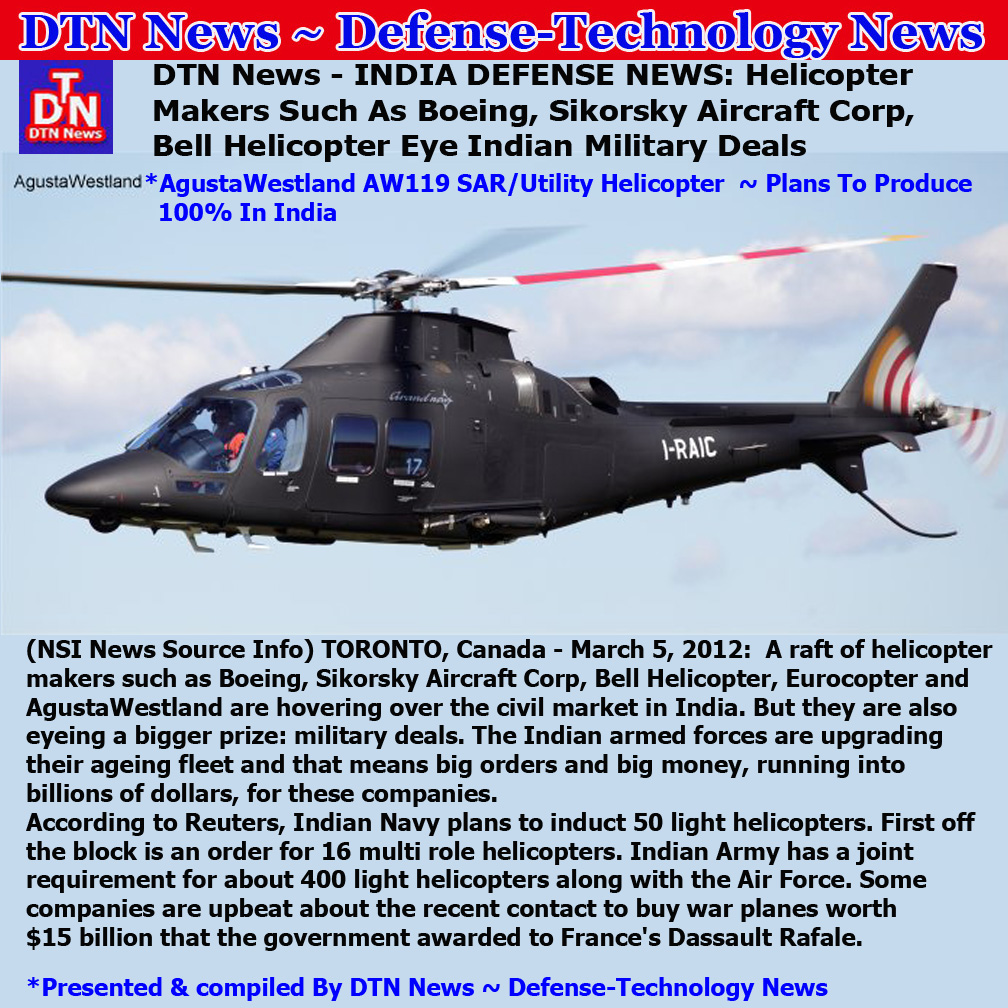
DTN News - INDIA DEFENSE NEWS: Helicopter Makers Such As Boeing, Sikorsky Aircraft Corp, Bell Helicopter Eye Indian Military Deals

DTN News - INDIA DEFENSE NEWS: Helicopter Makers Such As Boeing, Sikorsky Aircraft Corp, Bell Helicopter Eye Indian Military Deals
Source: DTN News - - This article compiled by Roger Smith from reliable sources Economic Times
(NSI News Source Info) TORONTO, Canada - March 5, 2012:  A raft of helicopter makers such as BoeingSikorsky Aircraft CorpBell HelicopterEurocopter andAgustaWestland are hovering over the civil market in India. But they are also eyeing a bigger prize: military deals. The Indian armed forces are upgrading their ageing fleet and that means big orders and big money, running into billions of dollars, for these companies. 

According to Reuters, Indian Navy plans to induct 50 light helicopters. First off the block is an order for 16 multi role helicopters. Indian Army has a joint requirement for about 400 light helicopters along with the Air Force. Some companies are upbeat about the recent contact to buy war planes worth $15 billion that the government awarded to France's Dassault Rafale. 

Mick Maurer, president of Sikorsky Military Systems, says the procurement process in India is getting better. "It is more rigorous and more transparent. We believe that suits us very well." Maurer says in the long term, Sikorsky sees a 3:1 ratio vis-a-vis the military and commercial sales in terms of the size of the market. But he says both are very complementary markets. Many of the machines can be used for commercial and quasi-defence activities. 

If the civil copter market in India has come alive, it is thanks to the armed forces. Foreign companies in the defence market are bound by what is called offset obligations. India's defence procurement policy rules that foreign companies require that win contracts of 300 crore or more must procure equipment worth at least 30% of the deal amount from local suppliers to boost the homegrown arms industry. 

The Indian military has also become smarter, according to foreign company executives. "Sometimes manufacturers give a special price on aircraft, but raise the price on the support side. India has become aware of this and now looks at the total lifecycle costs in deals," says Maurer. 

The upshot is that companies like Sikorsky and Eurocopter have partnered Indian counterparts to set up base in India. Sikorsky has formed two joint ventures with the Tatas to make helicopter cabins and aircraft components. Eurocopter, which formed an Indian unit in 2010, has tieups with the Mahindras, the Tatas and governmentowned Hindustan Aeronautics Limited. AgustaWestland, the helicopter unit of Finmeccanica SpA of Italy, has a joint venture with the Tatas called Indian Rotorcraft. 

All these companies plan to expand in India. Textron, the parent company of Bell Helicopter, has opened a new global technology centre in Bangalore with more than 400 engineers. Bell plans to expand the workforce there over the next year, says the company's India head, BS Singh Deo. An AgustaWestland spokesman says the company recently opened a new larger office in Delhi. Copter makers are also expanding the customer support network by establishing authorised service centres along with a posse of engineers and technicians. 

All this bodes well for the commercial market. The AgustaWestland spokesman says construction work is about to start on the Indian Rotorcraft's facility in Hyderabad , which will produce the company's eight-seat utility helicopter AW119. Sikorsky eventually plans to produce helicopters that are virtually "100% done here" . "We are already a local company," says Maurer.


*DTN India  @DTNIndia ~ Available on Twitter
Comprehensive Daily News on India Today ~ © Copyright (c) DTN News Defense-Technology News

*Link for This article compiled by Roger Smith from reliable sources Economic Times
*Speaking Image - Creation of DTN News ~ Defense Technology News 
*This article is being posted from Toronto, Canada By DTN News ~ Defense-Technology News Contact:dtnnews@ymail.com 
©COPYRIGHT (C) DTN NEWS DEFENSE-TECHNOLOGY NEWS

Wednesday, August 24, 2011

DTN News - U.S. INDIA DEFENSE NEWS: Routine Interactions Build U.S-India Defense Relations

DTN News - U.S. INDIA DEFENSE NEWS: Routine Interactions Build U.S-India Defense Relations
(NSI News Source Info) TORONTO, Canada / WASHINGTON, August 24, 2011: The U.S.-India defense relationship is a natural partnership created by shared interests and values and driven by increasingly routine day-to-day interactions, a senior Defense Department official said here today.
Robert Scher, deputy assistant secretary of defense for South and Southeast Asia, spoke to an audience at the New America Foundation.
Day-to-day successes that lay the groundwork for the U.S.-India defense relationship are rarely in the spotlight, Scher said, “but they are an important factor in driving our relationship forward and helping us understand each other.”
The U.S.-India relationship is a priority for the Obama administration and the Defense Department, Scher said, one that President Barack Obama has called a defining partnership of the 21st century. In recent years, he added, high-level visits have cemented the commitment of both nations to the bilateral relationship.
Indian Prime Minister Manmohan Singh visited the United States in 2009, and Obama traveled to India in 2010. Secretary of State Hillary Rodham Clinton’s July attendance at the U.S.-India Strategic Dialogue was her second trip there as secretary of state.
“India is a major regional and global power,” Scher said. “We view our relationship with India as a partnership of equals -- two nation states with a commonality of security interests in the Indian Ocean region and beyond.”
Scher said the most important thing the United States is doing in its defense relationship with India is building mutual trust and understanding that will help to ensure that common values and interests can translate into common approaches.
Three key areas in the U.S.-India defense relationship are people-to-people ties, military engagement and defense sales, the deputy assistant secretary of defense said.
Examples of people-to-people ties include attendance by service members from both nations at U.S. and Indian military educational institutions, Scher said.
“In 2010, we had nearly 100 members of the Indian armed services at military schools or courses in the United States,” he said. “These educational interactions are fantastic opportunities to share perspectives, understand cultural mindsets and simply become friends with colleagues.”
All three of the Indian military’s current service chiefs went to school in the United States during their careers, Scher noted.
“Air Marshal [Norman Anil Kumar] Browne graduated from the Air Command and Staff College, he said. “General [Joginder Jaswant] Singh is a graduate of both the U.S. Army Ranger School and the U.S. Army War College. And Adm. [Nirmal Kumar] Verma is a graduate of the U.S. Naval War College.”
In the United States, Scher added, retired Navy Adm. Walter L. Doran attended the Indian Defense Service Staff College in Wellington, Tamil Nadu, India, in 1979. There, he formed a close relationship with Indian colleagues who included former Indian Chief of Naval Staff Adm. Arun Prakash and Adm. Sureesh Mehta.
“This has real-world implications,” Scher said. “During his 10 years as admiral of the Pacific Fleet, Admiral Doran’s personal relationship with Admiral Prakash proved instrumental in initiating coordination between the U.S. and Indian response efforts to the 2004 Indian Ocean tsunami.”
The U.S. Naval Postgraduate School recently formalized a memorandum of understanding with India’s Defense Institute of Advanced Technology, he added.
“This September,” Scher told the group, “they will jointly conduct a defeating-terrorism workshop that will bring together senior leaders from both sides, including the director general of India’s Defense Research Development Organization and the [U.S.] chief of naval research to discuss ways to leverage research capabilities to contribute to the defeat of terrorism.”
A similar workshop on cybersecurity is planned for the near future, he said.
In January, the executive director of the Air Force Research Laboratory visited India with a team of Air Force scientists, Scher said. They returned to the United States with proposals for further discussions in 18 new technological areas, including nanomaterials, roadside-bomb detection and high-temperature super alloys.
“Several of these will likely lead to agreements for the exchange of technical information or collaborative research projects that will add to the dozen or so such agreements established between the two countries since 2005,” he said.
Military-to-military engagements are another element of the U.S.-India defense partnership, Scher said.
“We partner with the Indians on a number of educational, doctrinal, institutional, training and other subject matter exchanges,” he added. “These engagements and exercises provide opportunities for our militaries to work together and learn from each other, … and most importantly, they improve our ability to address real-life challenges.”
India routinely has more exercises with the United States than with any other country, Scher noted. “Over the last six years, we’ve done nearly 50 major exercises with India, … and our exercises are evolving in complexity,” he said.
Over a decade, Malabar, a regularly scheduled bilateral naval field training exercise with India, has advanced from little more than a passing exercise to a full engagement that exercises all functional warfare areas, Scher said.
“Malabar allows our navies to work cooperatively in integrated air and missile defense, antisubmarine and naval special warfare scenarios, for example,” he said.
In September, Scher said, in one of the first major interactions with the Indian coast guard, “we’re going to send a training team of subject matter experts to India to work with the Indian coast guard on counterterrorism and antipiracy-related boarding measures.”
The major U.S. exercise with the Indian army, Yudh Abyhas, started in 2004 as the first conventional army-to-army training with India since 1962, Scher said.
“The exercise, in addition to sharing training and capabilities, promotes cooperation between our armies on partner readiness,” he said. “The first deployment of Stryker vehicles outside the United States other than to a war zone was to India [to support their participation] in Yudh Abyhas.”
The practical effect of such interaction is to allow the two nations to make progress on issues of shared interest, such as maritime security, Scher said.
“The United States and India share a clear desire for freedom of navigation and unimpeded sea lines of communication, particularly in the Indian Ocean,” he said. “And through our military engagements this year, we will seek to deepen cooperation on key issues such as maritime domain awareness, countering piracy and humanitarian assistance and disaster relief.”
Together, the United States and India have an important role in fostering multilateral cooperation in Asia and supporting the emerging regional security architectures, Scher said.
“Overall,” he added, “we will increasingly look to India’s leadership and partnership in promoting and maintaining security in the region and the world.”
Defense sales to India increased from virtually no defense trade relationship in the 1990s to nearly $6 billion today in foreign military sales alone, Scher said.
“It is clear that the Indian military in the future will routinely use U.S. equipment and all services across a full range of mission areas,” he added.
The United States and India, Scher said, “are destined to be closer because of our shared interests and values, democracy, human rights and our desire for a stable, secure and inclusive world economy.”
All of this, he added, “makes us natural partners.”
By Cheryl Pellerin American Forces Press Service U.S. DoD
*Speaking Image - Creation of DTN News ~ Defense Technology News
*This article is being posted from Toronto, Canada By DTN News ~ Defense-Technology News

©

COPYRIGHT (C) DTN NEWS DEFENSE-TECHNOLOGY NEWS

Friday, September 03, 2010

DTN News: India Accuses Pakistan Of Ceasefire Violation Aimed At Infiltrating Militants Across LoC

DTN News: India Accuses Pakistan Of Ceasefire Violation Aimed At Infiltrating Militants Across LoC
Source: DTN News
(NSI News Source Info) NEW DELHI, India - September 4, 2010: India’s army accused Pakistan of violating a ceasefire along their militarised border, accusing it of trying to push militants into divided Kashmir under the cover of fire. A defence spokesman said Indian military posts in southern Kashmir came under small arms and mortar fire from across the border in a pre-dawn skirmish with Pakistani troops that lasted around two hours. “Pakistani troops opened unprovoked firing at Indian posts and targeted several positions in Poonch” district, Lieutenant Colonel Biplab Nath said in Indian Kashmir’s winter capital Jammu. “Our soldiers retaliated to the firing,” Nath said, adding there were no casualties on the Indian side in Poonch, a hilly Kashmir district some 240 kilometres northwest of Jammu. The Press Trust of India quoted an Indian commander as saying dozens of mortar shells exploded around Indian posts. “It is ceasefire violation and it was aimed at infiltrating militants into this side of the Line of Control (LoC),” brigadier S. Dua said, referring to a de facto border which divides the Indian and Pakistani zones of Kashmir. India has in the past accused the Pakistani army of providing covering fire for infiltrating militants. Islamabad denies the charge. India and Pakistan have fought two of their three wars over the mainly Muslim region of Kashmir, which is held in part by each country but claimed in full by both. They agreed to a ceasefire along the LoC in 2003 and began a peace process in 2004. Since then there have been sporadic clashes with both sides accusing each other of violating the truce. An insurgency against New Delhi’s rule in Indian Kashmir has raged since 1989.
**This article is being posted from Toronto, Canada By DTN News ~ Defense-Technology News, contact: dtnnews@ymail

Monday, May 18, 2009

Indonesia May Have Role In India's Regional Plan

Indonesia May Have Role In India's Regional Plan
(NSI News Source Info) NEW DELHI - May 18, 2009: The Defence Ministry may redraw India's defense strategy in the southeast, giving extra importance to relations with Indonesia. Some active-duty and retired Indian military officials have suggested more diplomacy with Jakarta and joint exercises with Indonesian troops, ministry sources here said. Efforts also should be made to check the growing Chinese military buildup in the Indian Ocean region, a senior Defence Ministry official said, noting that China already has a base in the Coco Islands, leased from Myanmar, from which it monitors India's ballistic missile testing range. Indian defense planners have been told that India's Sunda-Banka, Lombok-Makassar and Ombai-Wetar straits are becoming strategic sea passages much like the Strait of Malacca, Defence Ministry sources said. A senior ministry official said India and Indonesia have been strengthening their defense ties for some time, and the two countries have even explored the possibility of joint production of weapons and military equipment. The two countries have also discussed joint patrols by Indian and Indonesian warships in the Strait of Malacca, the region's favored sea route for large ships, including oil tankers from the Arabian Gulf. An Indonesian diplomat said that Jakarta is interested in buying the BrahMos supersonic anti-ship missile, jointly developed by India and Russia. Indonesia also is interested in the co-production with India of radars, electronic equipment and artillery weapons, the diplomat said.

Friday, April 03, 2009

U.S. Delays Engines To India For Indian Navy Frigate

U.S. Delays Engines To India For Indian Navy Frigate (NSI News Source Info) April 3, 2009: An abrupt halt to work on installing U.S.-made engines in a new class of Indian Navy frigate in January sparked outrage in India. Indian newspapers decried "Washington's penchant for imposing sanctions and restrictions." Rumors blamed an "over-enthusiastic State Department bureaucrat" and an ominous arms export policy review by the new Obama administration. Unnamed officials suggested that the United States had become an unreliable supplier of goods to the Indian military. INS Shivalik will be the lead ship of the Shivalik class frigate of Indian Navy. The first ship INS Shivalik was launched on April 19, 2003. Shivalik is a mountain range in the Himalayas that extends 2500 km. The crest of the ship INS Shivalik shows the Shivalik mountain range and the Ramadao sword. Now officials from both governments say it was all a misunderstanding. Frank Ruggiero, acting assistant secretary for political-military affairs at the State Department, called it "a fairly large misunderstanding" over licensing requirements. An Indian Defense Ministry official called it an impasse over a technical clause in Indian defense-procurement procedures. The problem has been solved, Ruggiero said March 27, stressing there was no review of military sales to India, and none is planned. The issue will be fully resolved in the next two weeks, the ministry official said. Work on installing the engines has resumed, said Rick Kennedy, a spokesman for General Electric, which manufactured the engines. Here's how the three parties explain this peculiar predicament: The Indian Navy is building a new class of frigates, India's first stealthy warships. The first ship, INS Shivalik, which was supposed to begin sea trials this spring, is to be powered by two GE LM2500 gas turbine engines. The engines, which are used around the world in warships, ferries, supply ships and cruise vessels, can be exported without a license from the U.S. State Department. But when they are sold for military use, they cannot be installed until the State Department approves a type of license called a "technical assistance agreement," or TAA. GE did not realize it needed such a license until Jan. 22, Kennedy said. "The law on this is not black and white," but after considerable internal discussion, GE "decided to err on the side of caution." The alternative could mean significant fines, he said. There was no stop-work dictum from the State Department, Kennedy said. Ruggiero said that GE applied for a TAA until mid-February and the State Department issued the license March 12. The wait caused about a two-month delay in engine work on the Shivalik, Kennedy said. Resentment in India The delay raised resentment in India, where defense and military officials were already chafing at the strings that come attached to many U.S. arms. India has resisted End User Monitoring (EUM) agreements, Communications and Information Security memoranda and Logistics Supply Agreements, each of which impose restrictions on what foreign buyers can do with U.S.-made weapons. None of those agreements apply to the engine deal, a State Department official said. While Indian national security, defense and military officials have consented to EUM strictures, they bristle at being required to permit the physical inspection of weaponry and equipment supplied by the United States. Under U.S. law, all nations buying sophisticated American military equipment must agree to various oversight provisions, including seeking Washington's permission before reselling it. Some 90 nations have accepted the conditions. Indian and U.S. officials have been discussing EUM provisions for three years, but it has come to a head as U.S. contractors start to make inroads into the Indian market. In mid-February, a key U.S. official met with Indian officials at the Aero India show in Bangalore. But for now, progress appears stalled until a new Indian government is elected May 16. Alternate Engines? As the engine installation delay dragged on, some Indian officials vowed to look for other engine suppliers. In the past, Indian warships have been powered by Russian and Ukrainian gas turbines. A senior Indian Navy official said the U.S. license requirement confirmed Indian suspicions that the United States might not be a reliable supplier for the country's military needs. But an Indian Defence Ministry official said it is too early to tell whether the engine flap has dented U.S.-Indian defense ties. One local analyst agreed, noting that Washington had recently green-lighted the sale of jet-powered Boeing P-8I maritime patrol aircraft. Ruggiero said defense trade relations with India remain good and trade is increasing. U.S. sales of military items to India amounted to about $1 billion in 2008 and are expected to rise to about $2.5 billion in 2009, he said. One troublesome deal "should not be treated as a case that might adversely affect the bilateral defense relations," said Deba Mohanty, senior fellow in security studies at the Observer Research Foundation. "One needs to wait for a while to see the fate of some of the future deals which are in the pipeline," he said. A Washington-based analyst said the dispute shows that the relationship has entered an interesting new phase. "How badly does each side need the other, and how far is each willing to go to realize their partnership? [U.S. President] Barack Obama's election adds a new chapter to the maneuvering between the two states, one in which the expectation by the United States will be on India to meet it more than halfway," said Dhruva Jaishankar, a South Asian affairs analyst with the Brookings Institution. Three of the 12 planned Shivalik frigates are under construction at Mazagon. The first was originally planned for launch this month. They are expected to cost $300 million each. They will carry land-attack Klub cruise missiles.

Friday, March 20, 2009

India Buys Israeli Spy Satellite

India Buys Israeli Spy Satellite (NSI News Source Info) NEW DELHI - March 20, 2009: India has bought a spy satellite from Israel with day-and-night viewing capability to boost surveillance capabilities in the aftermath of the Mumbai militant attacks, a report said March 20. Indian Remote Sensing satellites (IRS) are a series of Earth Observation satellites, built, launched and maintained by Indian Space Research Organisation of India as part of the Indian space program. The IRS series provides remote sensing services to the country.* Following are the remote sensing satellites planned by ISRO to be launched next strengthening the fleet of IRS satellites and widening their applications: *RISAT (Radar Imaging Satellite): A microwave remote sensing mission with Synthetic Aperture Radar (SAR) operating in C-band and having a 6 x 2 meter planar active array antenna based on trans-receiver module architecture. SAR is an all weather-imaging sensor capable of taking images in cloudy and snow covered regions and also both during day and night. RISAT weighs 1,750 kg. It is slated to be launched in 2008-2009. *Oceansat-2: It is envisaged to continue the service of OCEANSAT-1. It will carry an Ocean Colour Monitor (OCM) and a Ku-band pencil beam scatterometer. It is scheduled to be launched in March 8 2008 on board PSLV. *Resourcesat-2: It will have imaging sensors similar to RESOURCESAT-1. Payload electronics have been miniaturised to reduce the overall weight. RESOURCESAT-2 is planned for launch by PSLV in 2009-10. *Resourcesat-3: A follow on to Resourcesat-2, it will carry more advanced LISS-III-WS (Wide Swath) Sensor having similar swath and revisit capability as Advanced Wide Field Sensor (AWiFS), thus overcoming any spatial resolution limitation of AWiFS. Satellite would also carry Atmospheric Correction Sensor (ACS) for quantitative interpretation and geophysical parameter retrieval. It slated to be launched during 2011-12. *CARTOSAT-3: A continuation of Cartosat series , it will have a resolution 30 cm and 6km swath suitable for cadastre and infrastructure mapping and analysis. It would also enhance disaster monitoring and damage assessment. It is slated to be launched during 2011-12. *Oceansat-3: Oceasat-3 would carry Thermal IR Sensor, 12 channel Ocean Color Monitor, Scatterometer and Passive Microwave Radiometer. IR Sensor and Ocean Color Monitor would be used in the analysis for operational Potential Fishing Zones. Satellite is mainly for Ocean biology and sea state applications. It is slated to the launched aboard PSLV in 2012-13. The satellite, which can see through clouds and carry out day-and-night all-weather imaging, has been one of the long-standing demands of the Indian military, the NDTV news channel said. The 650-pound RISAT 2 will be launched by India's Polar Satellite Launch Vehicle rocket in the next few weeks, the report said. Indian scientists were in the process of integrating the satellite and the rocket at the Sriharikota space port in southern India, it said. The acquisition was fast-tracked after the Nov. 26-29 Mumbai siege in which 10 gunmen went on a shooting spree. India says the attackers came by boat from the Pakistani port city of Karachi to Mumbai, based on its investigations and the confession of the lone gunman captured alive after the 60-hour siege, in which 165 people were killed. India's existing satellites get blinded at night and in the monsoon season. NDTV said the new acquisition would also provide New Delhi with the capability to track incoming hostile ballistic missiles. India treated Israel like a pariah for decades, but has forged close military links with Tel Aviv in recent years with the Jewish state replacing France in 2007 as its second-largest arms supplier after Russia.

Monday, March 02, 2009

Missile Defense In India

Missile Defense In India
(NSI News Source Info) March 2, 2009: A few weeks ago, Indian officials held preliminary talks with the United States about purchasing a missile defense shield from it. "India is a partner of ours, and we want to provide it with whatever it needs to protect itself," a U.S. official told the Financial Times. Already, Indian officials and scientists have witnessed some simulations of the U.S. missile defense system, along with a couple of live tests. Washington even has offered to sell the Patriot Advanced Capability-3 system to India. Article Highlights *Recently, Indian officials approached the United States about purchasing a missile defense shield. *New Delhi's once casual interest in missile defense has intensified as its regional threats have increased. *The United States believes that a strong New Delhi can help protect U.S. assets in South Asia and counterbalance China. A few weeks ago, Indian officials held preliminary talks with the United States about purchasing a missile defense shield from it. "India is a partner of ours, and we want to provide it with whatever it needs to protect itself," a U.S. official told the Financial Times. Already, Indian officials and scientists have witnessed some simulations of the U.S. missile defense system, along with a couple of live tests. Washington even has offered to sell the Patriot Advanced Capability-3 system to India. India's interest in strategic missile defense dates back to 1983 when New Delhi initiated an "Integrated Missile Development Program." The program included not only offensive missiles such as the nuclear-capable Prithvi and Agni, but also the Akash, a surface-to-air missile that had the potential to provide India with theater missile defense capabilities. Later in the 1990s, India's Defence Research & Development Organization and the country's military discussed initiating conceptual missile defense studies. Around the same time, the Indian military had a few conversations with Israel and Russia about how they could help New Delhi advance its air defense systems. Although such talk clearly demonstrated an Indian interest in missile defense, it was confined to professional military officers and low-level bureaucrats. The interest of India's elected leadership intensified a few years later, their support growing for a variety of reasons. First, 9/11 and the subsequent war in Afghanistan turned Pakistan into a U.S. ally, triggering speculation that the Pakistani government might be overturned by anti-American Islamic fundamentalists who would then control Islamabad's nuclear arsenal. And if Pakistani nuclear weapons fell into such hands, India feared it might be the first target. Secondly, some in India believe that a domestic missile defense capability might be able to check Pakistan more generally. Ever since Islamabad obtained nuclear weapons, it has emboldened its strategy of supporting insurgencies within India to settle outstanding political differences--i.e., Kashmir. Missile defense, the argument goes, would prove instrumental in providing New Delhi reassurance and protection since Pakistan's nuclear weapons could be countered both offensively and defensively. Finally, few countries in the world face the missile threats that India does. Of course, there's Pakistan and its Ghauri and Shaheen missile series--both of which possess ranges longer than 1,000 kilometers. But there's also nearby China, a fellow nuclear-armed state equipped with DF-21 missiles that can travel more than 2,000 kilometers. So it's no surprise that the upper-echelons of the Indian government have begun to show significant interest in defense technologies that can, at least theoretically, combat such threats. A ballistic missile flight from Sargodha, Pakistan, could reach New Delhi in about 5-7 minutes. As such, Indian missile defense proponents envision the system working as follows: A technically complex and vast constellation of early warning sensors would detect the missile immediately after it is launched. This part of the system is already more or less in place; the Green Pine radar, which India purchased from Israel around 2002 and is situated about 200 kilometers north of New Delhi, can detect a missile 90 seconds after it has been launched--at least on a preliminary basis. The next step is to determine whether the signal picked up by the radar is that of an incoming missile or a false alarm. Complicating matters is that India and Pakistan share a border, making for shorter ballistic missile flights. For example, the estimated total missile flight times are 8-13 minutes for ranges of 600-2,000 kilometers. The flight times can be even less if the missile is flown in a depressed trajectory. Such a short time period places stringent conditions on procedures for evaluating and verifying warnings. There would be no time to consult or deliberate after receiving this warning. In other words, any response would have to be predetermined, presenting a significant likelihood of accidental nuclear war from false alarms. Oddly, despite such potentially catastrophic consequences, in India the debate about missile defense has become a debate about India's burgeoning ties with Washington as a part of New Delhi's "Next Steps in Security Partnership"--a 2002 diplomatic initiative between the United States and India to expand their cooperation in civilian nuclear activities and civilian space programs, along with broadening their dialogue on missile defense to promote nonproliferation and to ease the transfer of advanced technologies to India. For the United States, missile defense initially was only one aspect of its budding bilateral relationship with New Delhi. But over time missile defense has come to represent something larger in the relationship. Quite simply, it represents Washington's implicit support for India against Pakistan, without, of course, supporting an explicit Indian recourse to offensive military strategies. Along these lines, there's every reason to expect the United States to continue to be supportive of India's emergence as a counterweight to China. Ultimately, technology will decide the operational capability of missile defense in India. But for the time being, it can be assumed that New Delhi's decisions with regard to missile defense are strongly linked to the changing tenor of U.S.-Indian relations.



