Showing posts with label US Forces. Show all posts

Sunday, December 09, 2012

DTN News - AFGHAN WAR: Troops Rescue Kidnapped US Doctor In Afghanistan

DTN News - AFGHAN WAR: Troops Rescue Kidnapped US Doctor In Afghanistan
Source: DTN News - - This article compiled by Roger Smith from reliable sources AFP/Yahoo Singapore
(NSI News Source Info) SINGAPORE - December 9, 2012: US soldiers killed seven Taliban insurgents in a successful pre-dawn raid to rescue a kidnapped American doctor in eastern Afghanistan on Sunday, the NATO force in the war-torn country said.

The mission was launched when intelligence showed that Dr Dilip Joseph was in "imminent danger of injury or death", NATO's International Security Assistance Force said in a statement.

Joseph was abducted on December 5 by Taliban insurgents in the Surobi district of Kabul province.

"Today's mission exemplifies our unwavering commitment to defeating the Taliban," said General John Allen, the commander of US and ISAF forces in Afghanistan.

"I'm proud of the American and Afghan forces that planned, rehearsed and successfully conducted this operation. Thanks to them, Dr Joseph will soon be rejoining his family and loved ones."

Joseph was now "undergoing evaluations", the statement said, without giving further details.
A security source told AFP that the doctor had been involved in building clinics in Afghanistan but details of his capture were not immediately available.

Hazrat Mohammad Haqbeen, the district governor of Surobi told AFP that the man was kidnapped along with an Afghan colleague who was released in return for a ransom earlier in the week.

And "today the American national was freed in an operation. We don't know the details of the operation," Haqbeen told AFP.

He said the men were kidnapped in Surobi but were held in a village in the Qarghayi district of the neighbouring province of Laghman. The governor said the US citizen was visiting a clinic when captured.

An ISAF spokesman said the rescue had been launched when multiple intelligence sources indicated that he was in immediate danger. "We felt we had to act now," he told AFP.
Seven of the doctor's captors were killed in the operation, which involved combined US and Afghan forces, he said.

He gave no further details of where the doctor had been held or on the rescue operation itself, saying they could be announced later in the day.

Surobi outside Kabul had been under the control of French troops until April this year, when responsibility for security was handed to Afghan forces as part of France's accelerated withdrawal from the country.

France ended its combat mission in Afghanistan last month, two years before allied nations contributing to the 100,000-strong US-led NATO force are due to depart.

Surobi, about 50 kilometres east of Kabul and along a key highway linking the capital to neighbouring Pakistan, experiences sporadic Taliban-linked terrorism.

General Emam Nazar, the former commander of the 3rd Brigade of the Afghan army, told AFP in April that 80 to 100 insurgents were based in Surobi.

"Sometimes our enemies appear on the highway, but they can't resist us. Our forces smash them. It happened several times but they never got out of it alive," he added.

When French troops were stationed there, two French journalists were abducted in December 2009 and held for more than 500 days before being released in a secret deal which reportedly involved ransom.

Westerners are a prize target for the Taliban Islamists, who have waged an 11-year insurgency since being toppled from power in a US-led invasion in 2001. Regular gangsters not linked to the rebels are also involved in the kidnappings.

In June, NATO special forces rescued two foreign women working for a Swiss-based charity who had been kidnapped and held in a cave in Afghanistan's remote and mountainous northern Badakhshan province. Five captors were killed in the raid.


MORE ABOUT THE STORY


*Link for This article compiled by Roger Smith from reliable sources AFP/Yahoo Singapore
*Speaking Image - Creation of DTN News ~ Defense Technology News 
*This article is being posted from Toronto, Canada By DTN News ~ Defense-Technology News Contact:dtnnews@ymail.com 
©COPYRIGHT (C) DTN NEWS DEFENSE-TECHNOLOGY NEWS

Tuesday, June 19, 2012

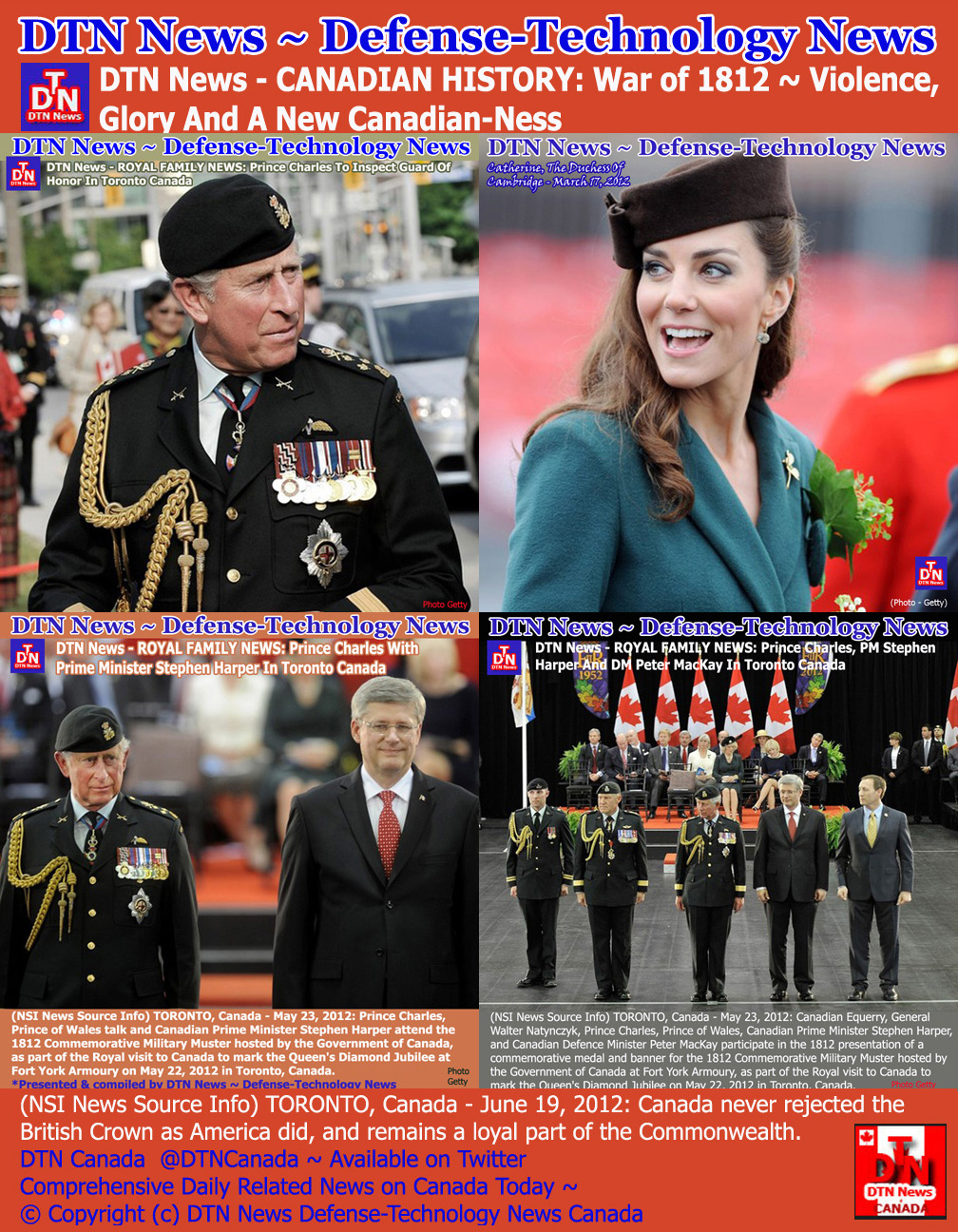
DTN News - CANADIAN HISTORY: War of 1812 ~ Violence, Glory And A New Canadian-Ness

DTN News - CANADIAN HISTORY: War of 1812 ~ Violence, Glory And A New Canadian-Ness
Source: DTN News - - This article compiled by Roger Smith from reliable sources BBC News
(NSI News Source Info) TORONTO, Canada - June 19, 2012: Canada today is seen as a harmonious nation of hockey, mounties and maple leaves, in peaceful contrast to its often fractious and noisy neighbour to the south. But Canadian-ness itself was born amid the blood, gunpowder and glory of the War of 1812, writes Grant Stoddard.


As a British-born newcomer to Canada, I've noticed Canadians see their Canadian-ness as the sum total of their shared values, interests and beliefs.

By contrast, in other places national identity is more typically linked to battles, popular uprisings and improbable triumphs in the face of adversity: the Boston Tea Party, the storming of the Bastille, the October Revolution.
This led me to assume that while Canada is a wonderful place to live, it lacked a rousing origin story.
Imagine my surprise when I discovered that the story of the birth of Canadian-ness - which began 200 years ago this week - is as rollicking, bloody, stirring and inspiring as they come.
Canadians famously cannot bring themselves to brag, so I am taking it upon myself to recount the series of events that paved the long road to Canadian nationhood. Hold on to your toque!
Challenges and disunity
Lt Col Charles De SalaberryDe Salaberry led a combined forced of 1,350 that drove off 4,000 US troops.
In the years after the American Revolution, Britain set about creating a mirror-state to the north of the 13 rebellious former colonies.
Hoping in part to entice the US back into the empire, Britain aimed to demonstrate that life in North America could be happier and more stable under her administration.
There were challenges: the territory in what is now Canada was rugged, under-developed and thinly populated.
Furthermore, the main groups of people living there did not like each another very much.
First Nations tribes resented the unrelenting European expansion into the heart of the continent. Disaffected French Catholics had settled along the St Lawrence River in the early 1600s and remained after Britain finally wrested control of Canada from France in 1763. British inhabitants of Nova Scotia, known as the "14th Colony", had not joined their sister colonies in revolt.
And tens of thousands relocated north after the American War of Independence: refugee crown loyalists and former black slaves rewarded with their freedom for fighting alongside the British.
The new arrivals were so numerous that Britain carved a new colony - New Brunswick - out of Nova Scotia to accommodate them. Yet even after the influx, the US still had about 20 times the population of what was now called British North America.
The British government encouraged even more immigration from the US by offering free land and low taxes. These opportunist migrants, who had little loyalty to the British crown, were euphemistically called the Late Loyalists.
At the dawn of the 19th Century, what is now Canada was no melting pot or even patchwork quilt but rather a hodgepodge of disparate groups who held wildly varying opinions on British rule and American republicanism and a deep distrust of one another.
By 1812, with the British embroiled in war with France, US hawks moved to take advantage of their northern neighbour's disunity, finish the job of the revolution and kick the British off the North American continent once and for all.
Proponents of war were confident that the fractious Canadians would greet US forces as liberators, with former President Thomas Jefferson quipping that annexing the vast territory would be "a mere matter of marching" and could be completed within a few months.
An 1833 lithograph of the Battle of the ThamesNative leader Tecumseh was killed by a US soldier at the Battle of the Thames in Ontario, shown in a detail from an 1833 lithograph
One of the leaders of the invasion force was US General William Hull, a 58-year-old veteran of the revolution who had been reluctant to take part.
He promised the Canadians liberty and prosperity, while also threatening "instant destruction" and a "war of extermination" at the first whiff of collusion between the Canadians and the natives.
Though some Canadians took heed, others, regardless of their allegiances, were uninterested in receiving liberty and prosperity at the point of an American sword. So they took up arms.
Bravery and patriotism
In battles on both sides of the border, vastly outnumbered Canadian militiamen, British regular troops and First Nations warriors inspired by Shawnee warrior Tecumseh overcame the Americans.
Stephen Harper and Prince CharlesCanada never rejected the British Crown as America did, and remains a loyal part of the Commonwealth
A force led by British Maj Gen Isaac Brock and Tecumseh captured Detroit from Gen Hull, taking almost 2,500 American regulars and militiamen captive with only 300 hundred British regulars, 400 Canadian militiamen and 600 natives.
At the Battle of the Chateauguay near Montreal, French Canadians repelled a US attack. Under the leadership of Charles de Salaberry, 50 regulars, 400 volunteers, 900 militiamen and 180 Mohawks drove off 4,000-strong US force.
Despite their difficult history with British rule, Les Canadiens had proved their bravery and patriotism beyond a doubt.
Their victory inspired yet another improbable defence of Canada just over two weeks later at the Battle of Crysler's Farm, in which 900 British regulars and Canadian militiamen repulsed 8,000 US troops.
By the war's end, both York (now Toronto) and Washington DC had been put to the torch by invaders; the British bombardment of Ft McHenry in Baltimore had inspired a new national anthem; and Gen Andrew Jackson had routed the British Army at the Battle of New Orleans.
But the map of North America had hardly changed.
Three native men who fought with the British, photographed in 1882Canada's First Nations tribes' hopes for an independent state died after the War of 1812; above, three men who fought with the British, photographed in 1882
The US withdrew to well within the boundaries of the 13 colonies. Inexperienced British diplomats gave away her territorial gains at the negotiating table, while bullish and skilled US negotiators rejected the British-backed idea of an independent "buffer state" for the indigenous tribes between the US and British North America.
This betrayal of the natives hastened the demise of native autonomy in North America, as the US turned its attention from annexing lands in the north to pushing west toward the Pacific Ocean.
The War of 1812 was declared in Washington 200 years ago yesterday.
The British and Americans drew and the natives lost, leaving the fledgling Canadians with the best claim to victory.
In the spirited defence of their way of life, they surprised both the invaders and one another with their resourcefulness, co-operation and tenacity in the face of an invasion force with an overwhelming numerical advantage.
In that sense, their struggle was not unlike the American Revolution a generation earlier.
What Canadian-ness actually means continues to evolve and remains a perennial topic of discussion both domestically and internationally.
Nevertheless, its beginnings can be traced back to 18 June 1812, when her fractious inhabitants stood together against subjugation by a foreign power.
The 33.5 million people living in Canada today - fully one-fifth of whom are foreign-born - have this patchwork vanguard to thank for their country's steady path to progressive prosperity.

*Link for This article compiled by Roger Smith from reliable sources BBC News
*Speaking Image - Creation of DTN News ~ Defense Technology News 
*This article is being posted from Toronto, Canada By DTN News ~ Defense-Technology News Contact:dtnnews@ymail.com 
©COPYRIGHT (C) DTN NEWS DEFENSE-TECHNOLOGY NEWS

Saturday, November 13, 2010

DTN News: Analysis Afghanistan - Nine Years On, The Taliban Have A Message For West

DTN News: Analysis Afghanistan - Nine Years On, The Taliban Have A Message For West
(NSI News Source Info) TORONTO, Canada - November 13, 2010: When NATO leaders gather for a summit in Lisbon next week, where Afghanistan will top the agenda, they can expect a message waiting for them from the Taliban.

That message may well be a violent demonstration of their staying power, even though Washington and U.S. and NATO commanders have been talking up recent successes in Afghanistan before the summit and a strategy review by President Barack Obama next month.

This comes as many European NATO members begin to look at how long they can keep justifying their commitments to an increasingly unpopular war, and as Obama remains committed to beginning a gradual drawdown of U.S. troops from July 2011 before the 2014 goal set by Kabul to take total security responsibility.

The Taliban have proved in the past they are well aware of the world beyond the deserts and fields of Afghanistan's south and its inaccessible mountains and valleys in the east and north, timing attacks to coincide with major events.

Four suicide bombers attacked the main U.N. compound in western Herat city last month, an assault the Islamist group said was in response to the U.N. Security Council renewing the mandate for NATO forces in Afghanistan 10 days earlier.

"From one side, the Taliban would like to show that the United States could not defeat them militarily in the past nine years and from other side want to introduce themselves as an acceptable political force, too," said Ghulam Jelani Zwak, director of the Afghan Analytical and Advisory Center.

On Saturday, as many as 14 Taliban fighters staged a bold assault on an airport and NATO base in Jalalabad in the east. At least 10 insurgents were killed, witnesses and police said.

The day before that, a suicide car bomber attacked a NATO convoy on Kabul's outskirts, wounding two soldiers, the first attack in the city in three months.

These extend a recent pattern of daring attacks by Taliban-led insurgents, including a massed raid by up to 80 fighters on a NATO outpost in southeastern Paktika province at the start of November, a different tactic to the usual Taliban hit-and-run raids.

At least 15 insurgents were killed in a pitched battle after a similar attack on a patrol in southern Helmand on Thursday.

At the same time, the insurgents' political rhetoric has become more moderate and more frequent, just as Washington and NATO have been talking up their gains. Analysts say the Taliban are trying to position themselves as a legitimate political alternative.

MORALE BOOST

Zwak traces the Taliban response back to Obama's announcement last December that a "surge" of 30,000 extra troops -- meant to push insurgents to the negotiating table -- would be followed by the drawdown from July 2011.

"This announcement created the morale among the opponents that America is facing defeat and will leave Afghanistan, and if Americans leave, then the Taliban should present themselves as an alternative to the current government," he told Reuters.

Violence is at its worst across Afghanistan since the Taliban were overthrown by U.S.-backed Afghan forces on November 13, 2001, with military and civilian casualties at record levels and support for the war sagging in Washington and European capitals.

Recent weeks have seen a wider acceptance of the need for a negotiated settlement to the conflict, with reports emerging of contacts between the Afghan government and senior Taliban leaders to explore the possibility of talks.

"The Taliban show considerable prowess in the arts of propaganda," said Matt Waldman, an analyst at Havard University who has been in contact with the Taliban and was a security adviser for the British and European parliaments.

"Their most important statements seek to mobilize Afghan support for the Taliban, and increasingly, to undermine Western support for the war and counter concerns about the movement," Waldman said.

Among the most important of recent political messages was one attributed to the Afghan Taliban's reclusive, one-eyed leader, Mullah Mohammad Omar, in September.

It assures Afghans of good governance, a Taliban government run by a consultative body based on "talent and honesty" and spoke of unity and the rights of tribes and women.

During their austere five years in power, the Taliban denied women the right to work outside the home and made them wear the all-enveloping burqa, drawing wide international criticism.

Omar's message even spoke of the need to address pollution and to combat the trade in illegal drugs. Afghanistan produces 90 percent of the world's opium used to produce heroin, an illicit trade that helps fund the insurgency.

The Taliban also criticize President Hamid Karzai for what they say is the endemic corruption in his government. The West argues that corruption inhibits the growth of state institutions and aids the insurgency.

The Taliban's last message was addressed to the U.S. Congress last weekend, when Obama was in India, after Obama's Democrats suffered major reversals in U.S. mid-term elections.

"Will you be able to obtain your long-term goals in the region only through the war in Afghanistan?" it asked.

(Editing by Paul Tait and Daniel Magnowski)

*This article is being posted from Toronto, Canada By DTN News ~ Defense-Technology News, contact: dtnnews@ymail.com
© Copyright (c) DTN News Defense-Technology News

Wednesday, February 24, 2010

DTN News: Afghanistan TODAY February 25, 2010 ~ Afghan Wounded Tell Of More Left Behind In Marjah

DTN News: Afghanistan TODAY February 25, 2010 ~ Afghan Wounded Tell Of More Left Behind In Marjah *Source: DTN News / By Kathy Gannon The Associated Press (NSI News Source Info) LASHKAR GAH, Afghanistan - February 25, 2010: Taxis turned into ambulances ferry wounded civilians out of the combat zone in southern Afghanistan, but one man's long trip to a hospital began with a two-hour wheelbarrow ride. An Afghan man recuperate from his injuries an Italian charitable hospital in Lashkar Gah, Helmend province, southern Afghanistan, Wednesday, Feb. 24, 2010. At the whitewashed Italian-run Emergency Hospital in Helmand's dusty provincial capital of Lashkar Gah, most of the civilian wounded recuperating from the Marjah battlefield said their injuries were caused by "the foreign soldiers," a claim that could hurt U.S. efforts to win Afghan hearts and minds. Mohammad's legs were peppered with shrapnel when a bomb exploded nearby. His brother found him unconscious and lifted him into the only thing he could find, pushing him in the wheelbarrow before he flagged a taxi. Mohammad, who is from the Nad Ali district around Marjah, is one of 40 civilians treated at Emergency Hospital in Lashkar Gah since the Afghan-NATO offensive in Marjah began on Feb. 13. Both of his legs were in casts. Steel pins protruded from his right leg. Most of the wounded civilians recuperating at the whitewashed Italian-run hospital said their injuries were caused by "the foreign soldiers" - a claim that does not bode well for international and Afghan forces who are trying to get residents to renounce the Taliban and embrace the Afghan government. Bernard Metraux, the head of the International Committee of the Red Cross in Helmand province, told The Associated Press on Wednesday that as many as 40,000 people trapped by fighting in and around Marjah have little to no access to medical care. During a medevac mission, U.S. Army flight medic Sgt. Bryan Eickelberg, of Arden Hills, Minn. , center, and Crew Chief Sgt. Robert Wengeler, of Spokane Wash. , left, both of Task Force Pegasus, provide emergency medical care to an unidentified injured Afghan National Army soldier, while airborne over Helmand province, Afghanistan, Wednesday Feb. 24, 2010. Pegasus crews provide the fast medical evacuation of those wounded in Marjah, as U.S. and Afghan troops take part in an assault on Taliban strongholds. Others unidentified. The taxi-ambulance transport strategy took several rounds of painstaking negotiations with all sides in the conflict including Taliban fighters, who at times helped navigate the wounded through minefields to get them to medical care, he said. The taxis managed to transport about 30 wounded to Lashkar Gah, 20 miles (30 kilometers) northeast of Marjah. "All the taxi drivers can access some areas, but we could only evacuate a very small number," Metraux said in the dusty provincial capital.
He added that about 400 families from the area fled to Lashkar Gah before the fighting began, while another 300 families went to neighboring Nimroz province. If they return, they'll face explosives that militants have hidden in compounds and doorways. Metraux said an accurate toll of civilians killed or wounded in military assault will not be known until health officials can move freely in the area. Pinning down a toll will be difficult in an area where the line between civilian and Taliban is a murky one. For many of those interviewed by The AP, the Taliban who are fighting coalition forces are villagers, underscoring the dilemma international forces face trying to rout the Afghan government's armed opposition. "There is no difference between Taliban and the civilian people. The Taliban are the rural people. They are our people," said Musa Jan, who arrived a week ago from Marjah. He spoke to the AP outside a makeshift warehouse in Lashkar Gah where the government was distributing essentials to war victims. Jan and 25 members of his family escaped the fighting by piling into a three-taxi convoy.
"The fight was continuing when we were trying to get out," said Jan, who said he paid about $35 for each of the three taxis. "That was all our money, and now we have to come here and beg." Jan said his neighbors house was bombed by an aircraft, killing five occupants inside, including children. On the hospital lawn, three wounded civilians took turns explaining how their injuries were caused by either aircraft bombardments or shooting from "foreign soldiers." They didn't know the nationalities of the soldiers, and it was not clear how they identified them as foreign. Sayed Lal said he was going to his home when he was hit. "They shot me. They came at night. They were foreigners," he said. "I was outside in the field with a friend." Lal's legs were covered with a thin white shawl. He fidgeted with his black beard as he told of three other villagers he claimed had been injured. Twenty-two-year-old Assadullah, sporting a closely cropped beard, said he was on his motorcycle when "Americans fired at me." "I don't know why they shot at me," said Assadullah whose arm was shattered by bullets. "I didn't even know they were there." Abdul Hamid, 12, said a raid conducted by a party of "foreign soldiers" opened fire outside his house. "I was in front of my house, and they were running and shooting," the boy said. "I tried to get back into my house, but they shot me in the leg, and there were more bullets, and they shot me again in my belly. Near me some other people fell into a canal. Then they called a plane and they bombarded." Hamid said that afterward, the troops said one person outside the house was a Taliban fighter. "He wasn't," the boy said. "He was a civilian."
Sultan Mohammed who fled last Friday from Marjah said he had to walk for several hours before a motorcyclist gave him a lift. He said the Taliban fled when the soldiers came to his area. "But who are the Taliban? They are the rural people," he said. Mohammed said residents had not had problems from the Taliban - that they brought security to the area. "We were not unhappy with the Taliban," he said. "The government didn't do anything for us. Before the government didn't help us."

Sunday, February 21, 2010

DTN News: Afghanistan TODAY February 21, 2010 ~ NATO Says Operation Moshtarak Is Making Progress

DTN News: Afghanistan TODAY February 21, 2010 ~ NATO Says Operation Moshtarak Is Making Progress *Source: DTN News / VOA (NSI News Source Info) KABUL, Afghanistan - February 21, 2010: NATO officials said Sunday the route clearance offensive by international forces is making progress in Afghanistan's southern Helmand province, a Taliban outpost. U.S. Marines with NATO forces keeps vigil as Marines and Afghan National Army (ANA) soldiers setup a joint military base in north of Marjah, city of Helmand province.
The alliance says Operation Moshtarak has improved freedom of movement in the area. British, U.S. and Afghan forces began the ground offensive in the town of Marjah as part of an effort to regain control of one of the Taliban's largest remaining strongholds.
However, NATO officials said in a statement the combined forces have encountered IED (improvised explosive device) strikes, weapon finds, and some small arms fire.
Meanwhile, NATO announced Sunday it has captured two militants, including a suspected Taliban commander. The men were detained Friday.
On Saturday, Afghan President Hamid Karzai renewed his call for the Taliban to accept peace and join with the government.
Reuters news agency quotes a Taliban spokesman Sunday rejecting the president's call for peace, saying Mr. Karzai is only a puppet who cannot represent a nation or a government. During a speech at the opening session of the Afghan parliament in Kabul, Mr. Karzai also urged international troops to prevent civilian deaths. Crew Chief Spc. Timothy Johns, left, of Mitchell, S.D. , with Task Force Pegasus, waits while a British Army soldier refuels his Black Hawk helicopter following a medevac mission, at Camp Bastion, Helmand province, southern Afghanistan, Saturday Feb. 20, 2010. Pegasus crews have come under fire daily while on missions evacuating those wounded as U.S. and Afghan troops take part in the assault in the Taliban-held town of Marjah.
NATO says it is committed to reducing civilian casualties as it continues its offensive in Marjah. The alliance said its troops killed a civilian in Marjah Friday, after a man dropped a box that troops believed was a bomb and began running towards NATO forces. At least 16 civilians have been killed since the beginning of the offensive.
U.S.-led NATO forces and Afghan troops launched a major offensive against the Taliban on February 13.
At least 12 NATO troops and about 120 insurgents have been killed during the fighting. Hundreds of Afghans are fleeing the violence. Some information for this report was provided by Reuters.

Saturday, February 20, 2010

DTN News: Afghanistan TODAY February 20, 2010 ~ Marines Do Heavy Lifting As Afghan Army Lags In Battle

DTN News: Afghanistan TODAY February 20, 2010 ~ Marines Do Heavy Lifting As Afghan Army Lags In Battle *Source: DTN News / By C. J. Chivers ~ The New York Times (NSI News Source Info) MARJA, Afghanistan- February 20, 2010: As American Marines and Afghan soldiers have fought their way into this Taliban stronghold, the performance of the Afghan troops has tested a core premise of the American military effort here: in the not-too-distant future, the security of this country can be turned over to indigenous forces created at the cost of American money and blood.U.S. Marine St SGT Christopher Whitman, from Clearwater FL, and from 3rd Battalion, 6th Marine Regiment runs carrying an Afghan National Army soldier who was shot in the lower leg during a battle with the Taliban in Marjah in Afghanistan's Helmand province on Saturday Feb. 20, 2010. Scenes from this corner of the battlefield, observed over eight days by two New York Times journalists, suggest that the day when the Afghan Army will be well led and able to perform complex operations independently, rather than merely assist American missions, remains far off. The effort to train the Afghan Army has long been troubled, with soldiers and officers repeatedly falling short. And yet after nearly a decade of American and European mentorship and many billions of dollars of American taxpayer investment, American and Afghan officials have portrayed the Afghan Army as the force out front in this important offensive against the Taliban. Statements from Kabul have said the Afghan military is planning the missions and leading both the fight and the effort to engage with Afghan civilians caught between the Taliban and the newly arrived troops.In this Saturday, Feb. 20, 2010 image made from video, a U.S. Marine carries a wounded Afghan National Army soldier onto a Task Force Pegasus Black Hawk medevac helicopter, where U.S. Army flight medic Sgt. Michael G. Patangan, right, from Houston, Texas, waits for his patient, in Marjah, Helmand province, southern Afghanistan. Pegasus crews have come under fire daily in Marjah while on missions evacuating those wounded as U.S. and Afghan troops take part in an assault on the Taliban stronghold. But that assertion conflicts with what is visible in the field. In every engagement between the Taliban and one front-line American Marine unit, the operation has been led in almost every significant sense by American officers and troops. They organized the forces for battle, transported them in American vehicles and helicopters from Western-run bases into Taliban-held ground, and have been the primary fighting force each day. The Afghan National Army, or A.N.A., has participated. At the squad level it has been a source of effective, if modestly skilled, manpower. Its soldiers have shown courage and a willingness to fight. Afghan soldiers have also proved, as they have for years, to be more proficient than Americans at searching Afghan homes and identifying potential Taliban members — two tasks difficult for outsiders to perform. By all other important measures, though — from transporting troops, directing them in battle and coordinating fire support to arranging modern communications, logistics, aviation and medical support — the mission in Marja has been a Marine operation conducted in the presence of fledgling Afghan Army units, whose officers and soldiers follow behind the Americans and do what they are told. That fact raises questions about President Obama’s declared goal of beginning to withdraw American forces in July 2011 and turning over security to the Afghan military and the even more troubled police forces. There have been ample examples in the offensive of weak Afghan leadership and poor discipline to boot. In northern Marja, a platoon of Afghan soldiers landed with a reinforced Marine rifle company, Company K, Third Battalion, Sixth Marines, which was inserted by American Army helicopters. The Marine officers and noncommissioned officers here quickly developed a mixed impression of the Afghan platoon, whose soldiers were distributed through their ranks. After several days, no Marine officer had seen an Afghan use a map or plan a complicated patrol. In another indicator of marginal military readiness, the Afghan platoon had no weapons heavier than a machine gun or a rocket-propelled grenade. Afghan officers organized no indirect fire support whatsoever in the week of fighting. All supporting fire for Company K — airstrikes, rockets, artillery and mortars — was coordinated by Marines. The Afghans also relied entirely on the American military for battlefield resupply. Moreover, in multiple firefights in which Times journalists were present, many Afghan soldiers did not aim — they pointed their American-issued M-16 rifles in the rough direction of the incoming small-arms fire and pulled their triggers without putting rifle sights to their eyes. Their rifle muzzles were often elevated several degrees high. Shouts from the Marines were common. “What you shooting at, Hoss?” one yelled during a long battle on the second day, as an Afghan pulled the trigger repeatedly and nonchalantly at nothing that was visible to anyone else. Not all of their performance was this poor.
Sgt. Joseph G. Harms, a squad leader in the company’s Third Platoon, spent a week on the western limit of the company’s area, his unit alone with what he described as a competent Afghan contingent. In the immediacy of fighting side by side with Afghans, and often tested by Taliban fighters, he found his Afghan colleagues committed and brave. “They are a lot better than the Iraqis,” said the sergeant, who served a combat tour in Iraq. “They understand all of our formations, they understand how to move. They know how to flank and they can recognize the bad guys a lot better than we can.” Capt. Joshua P. Biggers, the Company K commander, said that the Afghan soldiers “could be a force multiplier.” But both Marines suggested that the Afghan deficiencies were in the leadership ranks. “They haven’t had a chance yet to step out on their own,” Sergeant Harms said. “So they’re still following us.” Shortfalls in the Afghan junior officer corps were starkly visible at times. On the third day of fighting, when Company K was short of water and food, the company command group walked to the eastern limit of its operations area to supervise two Marine platoons as they seized a bridge, and to arrange fire support. The group was ambushed twice en route, coming under small-arms fire from Taliban fighters hiding on the far side of a canal. After the bridge was seized, Captain Biggers prepared his group for the walk back. Helicopters had dropped food and water near the bridge. He ordered his Marines and the Afghans to fill their packs with it and carry it to another platoon to the west that was nearly out of supplies. The Marines loaded up. They would walk across the danger area again, this time laden with all the water and food they could carry. Captain Biggers asked the Afghan platoon commander, Capt. Amanullah, to have his men pack their share. He refused, though his own soldiers to the west were out of food, too. Captain Biggers told the interpreter to put his position in more clear terms. “Tell him that if he doesn’t carry water and chow, he and his soldiers can’t have any of ours,” he said, his voice rising. Captain Amanullah at last directed one or two of his soldiers to carry a sleeve of bottled water or a carton of rations — a small concession. The next day, the Afghan soldiers to the west complained that they had no more food and were hungry. It was not the first time that Captain Amanullah’s sense of entitlement, and indifference toward his troops’ well-being, had manifested itself. The day before the helicopter assault, at Camp Leatherneck, the largest Marine base in Helmand Province, a Marine offered a can of Red Bull energy drink to an Afghan soldier in exchange for one of the patches on the soldier’s uniform. Captain Amanullah, reclining on his cot, saw the deal struck. After the Afghan soldier had taken possession of his Red Bull, the captain ordered him to hand him the can. The captain opened it and took a long drink, then gave what was left to his lieutenant and sergeants, who each had a sip. The last sergeant handed the empty can back to the soldier, and ordered him to throw it away. The Marines watched with mixed amusement and disgust. In their culture, the officers and senior enlisted Marines eat last. “So much for troop welfare,” one of them said. Lackluster leadership took other forms. On Friday night, a week into the operation, Captain Biggers told the Afghan soldiers that they would accompany him the next day to a large meeting with local elders. In the morning, the Afghans were not ready. The Marines stood impatiently, waiting while the forces that were said by the officials in Kabul to be leading the operation slowly mustered. Captain Biggers, by now used to the delays, muttered an acronym that might sum up a war now deep into its ninth year. “W.O.A.,” he said. “Waiting on the A.N.A.”

Wednesday, February 10, 2010

DTN News: Factors Contributing To Iraq's Security After U.S. Forces Withdraw

DTN News: Factors Contributing To Iraq's Security After U.S. Forces Withdraw *Source: RAND Corp. ~ Featured Research (NSI News Source Info) TORONTO, Canada - February 11, 2010: As it withdraws troops from Iraq, the United States must work not only to maintain security in that nation, but also focus on how the action will impact other regional interests, according to a study issued today by the RAND Corporation. The study presents an analytical framework for policymakers to examine the shifting motivations and capabilities of the groups that affect Iraq's security, as well as options for U.S. responses to continuing challenges. "Many of Iraq's problems will take generations to solve," said Terrence K. Kelly, one of the study's authors and a senior operations researcher at RAND, a nonprofit research organization. "As U.S. troops leave Iraq, it's important to take every step possible to encourage Iraqis to address these problems in a constructive fashion." Among the major problems facing Iraq are longstanding tensions between the majority Arab population and the minority Kurds, who are located primarily in the country's oil-rich northern region. The study recommends that U.S. forces remain in the north as long as possible and that the United States provide senior military professionals at every level to serve as "honest brokers" who can mediate disputes and develop long-term relationships with their Iraqi counterparts. "It will be important for the U.S. government to continue to work to try to mitigate tensions on the border between the Arab and Kurdish populations, and how U.S. forces withdraw from Iraq will be more important than the rate at which they withdraw," Kelly said. Iraq has become more stable since 2006-2007, mainly because the main political factions—Sunni, Kurd and Shi'a—are participating in the political process. At the same time, extremist violence will likely continue in Iraq, regardless of the U.S. troop drawdown. As in other war-torn countries, many of Iraq's power brokers have spent their entire adult lives relying on violence to achieve political goals and that approach is not going to vanish overnight, Kelly said. But such violence is unlikely to escalate into large-scale conflict unless one of the main Iraqi factions—the ones with the ability to field small armies—resorts to violence to achieve political goals. The United States should use its diplomatic and military strengths to keep these major political actors in the political process. Kelly says the current situation is more of a strategic calculation by these groups, rather than a newfound embrace of democracy. The scales could be tipped by any one of a number of factors—political disaffection, electoral failure, economic hardship or inequity, disputes over land and resources, shifts in the balance of armed power, or harsh treatment or provocation. In addition, the United States' ability to prevent large-scale conflict has limits and will decline as its forces leave Iraq. The best leverage will be from U.S. support for improved Iraq Security Force capabilities, and then only if the Iraq Security Force acts in the interests of a unified Iraqi state, rather than any particular faction. To that end, long-term U.S.-Iraq military cooperation should have three missions: aiding in the training, equipping, advising and operational support of the Iraq Security Force; partnering in the promotion of professional qualities in the Iraq Security Force and security ministries; and continuing to mediate between Kurd and Arab forces. The study, "Security in Iraq: A Framework for Analyzing Emerging Threats as U.S. Forces Leave," can be found at www.rand.org. Other authors of the report are David C. Gompert, formerly of RAND, and Jessica Watkins of RAND Europe. The study was sponsored by the Office of the Secretary of Defense and conducted within the International Security and Defense Policy Center of the RAND National Defense Research Institute, a federally funded research and development center sponsored by the Office of the Secretary of Defense, the Joint Staff, the Unified Combatant Commands, the Department of the Navy, the Marine Corps, the defense agencies and the defense Intelligence community.

Wednesday, January 27, 2010

DTN News: Afghanistan In Pictures Of The Day January 27, 2010

DTN News: Afghanistan In Pictures Of The Day January 27, 2010 *Source: DTN News (NSI News Source Info) - January 27, 2010: Afghanistan In Pictures Of The Day January 27, 2010, military activities and actions by Afghan National Army, US Forces, ISAF Forces to contain terrorism by Ismalic militants, Taliban and al Qaeda elements in Afghanistan.Men with an Afghan security division monitor traffic for suicide bombers and Taliban along a busy shopping street on January 27, 2010 in Kabul, Afghanistan. A major international conference on stabilizing Afghanistan is set to begin in London this coming Thursday. Attendees to the event will include foreign ministers, US Secretary of State Hillary Clinton and Afghan President Hamid Karzai.U.S. Army Spc. Jeremey Foley runs to deliver a 120mm mortar bomb to fellow members of his team, which barraged a nearby Taliban position, at Combat Outpost Michigan, in the Pech Valley, Kunar province, northeastern Afghanistan, Wednesday Jan. 27, 2010. The soldiers from the 2-12 Infantry, Task Force Lethal at COP Michigan regularly receive small and large-arms fire from Taliban militants who operate in the hillsides overlooking the base.U.S. Army mortar teams deliver a barrage of 120mm mortar bombs at a nearby Taliban position, at Combat Outpost Michigan, in the Pech Valley, Kunar province, northeastern Afghanistan, Wednesday Jan. 27, 2010. The soldiers from the 2-12 Infantry, Task Force Lethal at COP Michigan regularly receive small and large-arms fire from Taliban militants who operate in the hillsides overlooking the base.German Bundeswehr army soldiers of the International Security Assistance Force (ISAF) instruct Afghan National police men during their drill in the German army camp in Feyzabad, north of Kabul, September 21, 2008. It would be a mistake to set a concrete date for the withdrawal of German troops from Afghanistan because it could encourage the Taliban, Chancellor Angela Merkel said January 27, 2010. Germany on Tuesday outlined a news strategy for its role in Afghanistan, saying it would send at least 500 extra soldiers there and nearly double its civilian aid to help create the conditions to start a withdrawal from next year.U.S. Army mortarman Spc. Jeremy Foley, right, who was working guard duty, and an Afghan soldier, open the gate to let out a convoy, at Combat Outpost Michigan, in the Pech Valley, Kunar province, northeastern Afghanistan, Tuesday, Jan. 26, 2010. COP Michigan regularly receives fire from Taliban militants who operate in the hillsides of the Pech Valley.

Saturday, December 26, 2009

DTN News: Afghanistan TODAY December 27, 2009 (Part # 2) ~ Elite U.S. Force Expanding Hunt In Afghanistan

DTN News: Afghanistan TODAY December 27, 2009 (Part # 2) ~ Elite U.S. Force Expanding Hunt In Afghanistan *Source: DTN News / The New York Times By Eric Schmitt (NSI News Source Info) BAGRAM AIR BASE, Afghanistan - December 27, 2009: Secretive branches of the military’s Special Operations forces have increased counterterrorism missions against some of the most lethal groups in Afghanistan and, because of their success, plan an even bigger expansion next year, according to American commanders. (Officers at Bagram Air Base expect a major fight in Marja)
The commandos, from the Army’s Delta Force and the Navy’s classified Seals units, have had success weakening the network of Sirajuddin Haqqani, the strongest Taliban warrior in eastern Afghanistan, the officers said. Mr. Haqqani’s group has used its bases in neighboring Pakistan to carry out deadly strikes in and around Kabul, the Afghan capital. Guided by intercepted cellphone communications, the American commandos have also killed some important Taliban operatives in Marja, the most fearsome Taliban stronghold in Helmand Province in the south, the officers said. Marine commanders say they believe that there are some 1,000 fighters holed up in the town.
Although President Obama and his top aides have not publicly discussed these highly classified missions as part of the administration’s revamped strategy for Afghanistan and Pakistan, the counterterrorism operations are expected to increase, along with the deployment of 30,000 more American forces in the next year. American and Afghan troops in Helmand Province. Special Operations units are stepping up attacks on insurgents, officers say. The increased counterterrorism operations over the past three or four months reflect growth in every part of the Afghanistan campaign, including conventional forces securing the population, other troops training and partnering with Afghan security forces, and more civilians to complement and capitalize on security gains. American commanders in Afghanistan rely on the commando units to carry out some of the most complicated operations against militant leaders, and the missions are never publicly acknowledged. The commandos are the same elite forces that have been pursuing Osama bin Laden, captured Saddam Hussein in Iraq in 2003 and led the hunt that ended in 2006 in the death of Abu Musab al-Zarqawi, the leader in Iraq of the insurgent group Al Qaeda in Mesopotamia. In recent interviews here, commanders explained that the special-mission units from the Joint Special Operations Command were playing a pivotal role in hurting some of the toughest militant groups, and buying some time before American reinforcements arrived and more Afghan security forces could be trained. “They are extremely effective in the areas where we are focused,” said one American general in Afghanistan about the commandos, speaking on the condition of anonymity because of the classified status of the missions. Gen. David H. Petraeus, who is in charge of the military’s Central Command, mentioned the increased focus on counterterrorism operations in testimony before the Senate Foreign Relations Committee on Dec. 9. But he spoke more obliquely about the teams actually conducting attacks against hard-core Taliban extremists, particularly those in rural areas outside the reach of population centers that conventional forces will focus on. “We actually will be increasing our counterterrorist component of the overall strategy,” General Petraeus told lawmakers. “There’s no question you’ve got to kill or capture those bad guys that are not reconcilable. And we are intending to do that, and we will have additional national mission force elements to do that when the spring rolls around.” Senior military officials say it is not surprising that the commandos are playing such an important role in the fight, particularly because Gen. Stanley A. McChrystal, the senior American and NATO officer in Afghanistan, led the Joint Special Operations Command for five years. In addition to the classified American commando missions, military officials say that other NATO special operations forces have teamed up with Afghan counterparts to attack Taliban bomb-making networks and other militant cells. About six weeks ago, allied and Afghan special operations forces killed about 150 Taliban fighters in several villages near Kunduz, in northern Afghanistan, a senior NATO military official said. Some missions have killed Taliban fighters while searching for Pfc. Bowe R. Bergdahl, who was reported missing on June 30 in eastern Afghanistan. The Taliban in July posted a video on jihadist Web sites in which the soldier identified himself and said that he had been captured when he lagged behind on a patrol. A second video was released on Friday. “We’ve been hitting them hard, but I want to be careful not to overstate our progress,” said the NATO official, speaking on the condition of anonymity in order to describe the operations in detail. “It has not yet been decisive.” In Helmand, more than 10,000 Marines, as well as Afghan and British forces, are gearing up for a major confrontation in Marja early next year. Brig. Gen. Larry Nicholson, the senior Marine commander in the south, said in a recent interview, “The overt message we’re putting out is, Marja is next.” General Nicholson said there were both “kinetic and nonkinetic shaping operations” under way. In military parlance that means covert operations, including stealthy commando raids against specific targets, as well as an overt propaganda campaign intended to persuade some Taliban fighters to defect. Military officials say the commandos are mindful of General McChrystal’s directive earlier this year to take additional steps to prevent civilian casualties. In February, before General McChrystal was named to his current position, the head of the Joint Special Operations Command, Vice Adm. William H. McRaven, ordered a halt to most commando missions in Afghanistan, reflecting a growing concern that civilian deaths caused by American firepower were jeopardizing broader goals there. The halt, which lasted about two weeks, came after a series of nighttime raids by Special Operations troops killed women and children, and after months of mounting outrage in Afghanistan about civilians killed in air and ground attacks. The order covered all commando missions except those against the top leaders of the Taliban and Al Qaeda, military officials said. Across the border in Pakistan, where American commandos are not permitted to operate, the Central Intelligence Agency has stepped up its missile strikes by Predator and Reaper drones on groups like the Haqqani network. But an official with Pakistan’s main spy agency, the Inter-Services Intelligence directorate, or I.S.I., said there had also been more than 60 joint operations involving the I.S.I. and the C.I.A. in the Federally Administered Tribal Areas and Baluchistan in the past year. The official said the missions included “snatch and grabs” — the abduction of important militants — as well as efforts to kill leaders. These operations were based on intelligence provided by either the United States or Pakistan to be used against the Taliban and Al Qaeda, the official said. “We can expect to see more U.S. action against Haqqani,” a senior American diplomat in Pakistan said in a recent interview. The increasing tempo of commando operations in Afghanistan has caused some strains with other American commanders. Many of the top Special Operations forces, as well as intelligence analysts and surveillance aircraft, are being moved to Afghanistan from Iraq, as the Iraq war begins to wind down. “It’s caused some tensions over resources,” said Lt. Gen. Charles H. Jacoby Jr., the second-ranking commander in Iraq. Richard A. Oppel Jr. contributed reporting from Islamabad, Pakistan.