Monday, September 22, 2008

NKorea preparing to restart nuclear reactor: official

NKorea preparing to restart nuclear reactor: official
(NSI News Source Info) Panmunjom, Korea (AFP) September 22, 2008: North Korea, accusing Washington of breaking a nuclear disarmament deal, said Friday it is working to restart its atomic reactor and no longer wants US concessions promised under the pact. "We are making thorough preparations to restore (nuclear facilities)," said foreign ministry official Hyon Hak-Bong. "You may say we have already started work to restore them to their original status," he told reporters at the border truce village of Panmunjom before the start of talks between the two Koreas on energy aid. The US State Department confirmed North Korea was moving "closer and closer" to restarting the plutonium-producing plant, and urged the regime to pull back. "They haven't got to that point yet (of restarting) and we would urge them not to get to that point," department spokesman Sean McCormack told reporters. "They have a choice. They can go down the pathway of having different and better relationship with the world... or they can keep themselves isolated, move the process backward. So we'll see," McCormack said in Washington in reaction to the comments. The foreign ministry in Pyongyang said separately that work has been under way "since some time ago" to restore the reactor in response to the US failure to drop the North from a terrorism blacklist. "Now that the US true colours are brought to light, the DPRK (North Korea) neither wishes to be delisted as a 'state sponsor of terrorism' nor expects such a thing to happen," a ministry spokesman told the official news agency. "It will go its own way." The energy talks went ahead Friday despite the deadlock in a six-nation aid-for-disarmament deal, which appeared to be making progress this summer. The hardline communist state, which tested an atomic weapon in October 2006, began disabling its ageing reactor and other plants at Yongbyon last November under the pact with South Korea, the US, Japan, China and Russia. But it announced last month it had halted work in protest at Washington's refusal to drop it from the blacklist, as promised under the deal. Washington says the North must first accept strict outside verification of a nuclear inventory which Pyongyang handed over in June. Foreign ministry official Hyon said such demands for what he called "forceful inspections" are not part of the six-party deal. Similar demands for a "robber-like inspection method" led to war in Iraq, he said in opening remarks at the Panmunjom talks, adding that the US wants "to go anywhere at any time to collect samples and carry out examinations with measuring equipment." Hyon said the North had "perfectly and flawlessly" completed 90 percent of disablement work including the extraction of 4,740 spent fuel rods. In return for disablement, negotiating partners promised the impoverished state one million tons of heavy fuel oil or equivalent energy aid. Nearly half has so far been delivered and Hwang Joon-Kook, chief of the South Korean delegation, said the rest would be sent. "We also want to make sure that the six-party process does not go backward," Hwang said in his own opening remarks. In Seoul, Foreign Minister Yu Myung-Hwan said it is unclear whether the North intends to turn the nuclear clock back "or whether it is another bargaining move." A senior South Korean foreign ministry official said Friday's talks reached no agreement and the two sides failed to set a date for the next meeting. He said Seoul's delegation urged the North to take part in talks on verification methods. "We told them that there will be a problem in (delivering) energy aid if disablement is not done." In London, the International Institute for Strategic Studies said Thursday the North could put its nuclear programme back on track in less than a year. Uncertainty over the health of leader Kim Jong-Il means its nuclear stalemate with Washington is likely to continue, it added. Kim, 66, failed to appear at a September 9 anniversary parade. South Korean officials said he underwent brain surgery following a stroke but is recovering well. Hyon rejected the reports about Kim's health as malicious. "That's sophism by evil people wanting to break up unity between the two Koreas," he said.

Venezuela To Buy Chinese Combat Planes: Chavez

Venezuela To Buy Chinese Combat Planes: Chavez
(NSI News Source Info) CARACAS (AFP) - September 22, 2008: Venezuela will buy combat and training aircraft from China this week, leftist Venezuela President Hugo Chavez confirmed in a television broadcast Sunday. The purchases will be made as part of a six-country tour, Chavez said in his broadcast of the "Alo President" television program from the Miraflores presidential palace in Caracas, hours before leaving on a "strategic interest" trip to Cuba, China, Russia, Belarus, France and Portugal. Chavez, a staunch foe of the US government, confirmed that during his stay in Beijing he will purchase 24 K-8 aircraft "to train fighter pilots." The planes could be part of Venezuela's air force by next year. The president also confirmed that while in Beijing he will arrange the construction of tanker vessels in Chinese shipyards, with the aim of installing a shipyard in Venezuela in the near future. These plans come in addition to the construction of a refinery in China to process oil from Venezuela, and plans to create a bi-national company to install a refinery in the remote oil-rich Orinoco region in eastern Venezuela. Caracas provides 500,000 barrels of oil per day to Beijing, a trade which is expected to increase to one million barrels a day by 2012. Chavez, who describes China as a strategic ally, will move forward with a six billion dollar bilateral investment fund. China will contribute four billion dollars to the fund, and Venezuela two billion dollars. Caracas will use the fund for "socialist productive projects." "Before we had to go to Washington to beg for money. Not now. Now we negotiate with the Chinese," said Chavez. Chavez announced that during his visit to Beijing the investment fund will benefit from an additional four billion dollars for further "development" in Venezuela. After China, Chavez will head to Moscow. Venezuela in recent years has been broadening its military ties to Moscow, and Chavez backed Russia in the recent Georgian conflict. Last week, Russian supersonic Tu-160 bombers for the first time flew training runs with Venezuela in an area of the Caribbean traditionally considered the US military's sphere of influence. Chavez's trip is expected to last until September 27.

Russian strategic bombers to join military drills with Belarus

Russian strategic bombers to join military drills with Belarus (NSI News Source Info) MOSCOW - September 22, 2008: Russian strategic bombers will conduct practice launches of various types of missiles on October 6-12 during large-scale Russia-Belarus military exercises which started Monday, the Air Force commander said. The Stability-2008 exercises will last until October 21 in various regions of Russia and Belarus with the goal of practicing strategic deployment of the Armed Forces, including the nuclear triad, to counter potential threats near the Russian border. "The exercise will involve the majority of personnel and strategic aircraft in service with strategic aviation," Col. Gen. Alexander Zelin said. "The crews will deploy the entire range of on-board weaponry." According to various sources, the Russian Air Force currently has in service at least 141 Tu-22M3 Backfire-C, 40 Tu-95 Bear-H and 16 modernized Tu-160 Blackjack strategic bombers. The bombers carry long-range cruise missiles and short-range nuclear missiles as primary weaponry. Moscow has repeatedly stressed the need to continue the development of Russia's Strategic Nuclear Forces, including its airborne component, and said they should be able to respond promptly and effectively to any aggression. The Russian Air Force combat training program has scheduled more than 200 exercises with 350 live firing drills for the second half of 2008.

Russian warships head to the Atlantic, Caribbean

Russian warships head to the Atlantic, Caribbean (NSI News Source Info) MOSCOW - September 22, 2008:- A Russian naval task force departed Monday on a tour of duty in the Atlantic Ocean, including joint naval drills with the Venezuelan navy in November, a Navy spokesman said. "A naval task force from the Northern Fleet, comprising the nuclear-powered missile cruiser Pyotr Velikiy, the large ASW ship Admiral Chabanenko, and support ships, left the Severomorsk base early Monday to conduct training exercises in the Atlantic," Capt. 1st Rank Igor Dygalo said. Pyotr Velikiy is a Kirov (Orlan) class nuclear-powered guided missile heavy cruiser, which has practically unlimited operational range and carries 20 SS-N-19 Shipwreck surface-to-surface missiles with either nuclear or high-explosive warheads and about 500 surface-to-air missiles of different types, supplemented by a large number of other weaponry. Dygalo said that during the tour of duty the Russian warships would participate in joint naval exercises with the Venezuelan navy on November 10-14, in line with the 2008 training program and in order to expand military cooperation with foreign navies. "During the exercise, ships and naval aircraft will practice coordinated maneuvering, search-and-rescue, and communications," Dygalo said. Venezuelan President Hugo Chavez earlier confirmed that Venezuela would hold joint naval exercises with Russian warships in the Caribbean and said the Russian navy would receive a warm welcome in the Latin American country. Russia announced last year that its Navy had resumed and would build up a constant presence in different regions of the world's oceans. A task force from the Northern Fleet, consisting of the Admiral Kuznetsov aircraft carrier, the Udaloy-Class large AWS ships Admiral Levchenko and Admiral Chabanenko, as well as auxiliary vessels, conducted from December 2007 to February 2008 a two-month tour of duty in the Mediterranean Sea and North Atlantic.

The Grenades Of Iraq

The Grenades Of Iraq (NSI News Source Info) September 22, 2008: As roadside bombs, snipers and large scale ambushes (with machine-guns and RPGs) decline in Iraq, the few terrorists still in play remain desperate to kill Americans. They are now increasingly relying on hand grenades, often unreliable improvised ones. This is a dangerous business, and often gets the user killed. American casualties are few, especially since the grenadiers insist on trying to lob their weapons down the hatches of American vehicles. The terrorists discovered, too late, that this is difficult. Many don't even complete the toss, as alert U.S. troops spot and shoot them. Most terrorist organizations in Iraq have been destroyed, or much reduced in terms of manpower, money and weapons. They can no longer afford to manufacture, emplace and use roadside bombs. That takes technical skill, a large team, and money (most techies will not work for free, nor will arms merchants supply bomb making materials for free.) Snipers were a problem for a while, but over the last few years, those few men who had learned sniping skills in Saddams army, and had sniper grade rifles and scopes, have been hunted down and killed. American technology has played a role in all this, providing equipment that detects roadside bombs, and snipers. Jammers prevent roadside bombs from going off. Homemade grenades are more difficult to fabricate than terrorists think. Just having a mortar shell or RPG warhead, and a blasting cap is not enough. Real grenades are hard to come by, as U.S. and Iraqi troops have been finding and destroying a growing number of illegal weapons caches. A year ago, you could get a grenade on the black market for about ten bucks, now it costs two or three times that, if you can find them at all. The arms merchants are being targeted by Iraqi police and shut down. That's a matter of self-defense, as Iraqi security forces are more often a target than U.S. troops. Many terrorists survive a failed grenade attack, at least the ones smart enough to approach U.S. troops from the safety of a crowd of civilians. They know American troops are told not to fire into a crowd unless they have a specific target and a clear shot. But these grenade tossers are not popular with civilians, because the grenades tend to hurt more Iraqis than Americans. Iraqi police often get enough tips from bystanders to hunt down and arrest the terrorist.

India And Israel Work Together Against Terrorism

India And Israel Work Together Against Terrorism (NSI News Source Info) September 22, 2008: Israel and India are increasing their cooperation in the fight against Islamic terrorism. Israeli special operations troops are going to India, to exchange information, ideas and techniques with their Indian counterparts. India has been suffering from Islamic violence for centuries, but Israel has been at the forefront in developing effective weapons, equipment and tactics to deal with the problem. Last year, Israeli troops went to Kashmir, and shared their knowledge of how to keep Islamic terrorists from sneaking across borders. Although the Israeli experience is largely related to desert and semi-tropical borders, it is applicable for the mountains and forests more typical of Kashmir as well. The Israeli methods are highly dependent on many types of sensors, and computer software that can "learn" which combination of sensor readings indicate some guys with guns trying to move through an area. Israel has already sold India millions of dollars worth of night vision devices, which the Indians have used with great success against the terrorist line crossers. The Israeli sensors were not always as successful as they should be, and the Israeli trainers and technical experts went to Kashmir to work out the kinks, and set the stage for some large new sensor sales. India has been able to supply Israel with a lot of useful intelligence on al Qaeda activities, and what Iran is up to. India has maintained good relations with Iran, which has been a trading partner for thousands of years. In this case, tradition and mutual-need trumps religious differences. India also has a good informant network in Pakistan and Afghanistan.

Somalia: Chaos Continues Without End In Sight

Somalia: Chaos Continues Without End In Sight (NSI News Source Info) September 22, 2008: The pirates operating off the north coast of Somalia are currently holding eleven ships and 200 sailors. Pirates are demanding a million dollars or more per ship from the owners. This has pushed up insurance rates to over $10,000 per ship moving through the Gulf of Aden (going to or coming from the Suez canal). Some 60 ships have been attacked off Aden this year, with pirates using two or three large fishing ships as "mother ships" to get pirates and their speed boats several hundred kilometers off the north Somali coast, in the middle of the Gulf of Aden, where most of the ship traffic is. More nations are sending aircraft and warships to patrol the Gulf of Aden. But none of these nations are willing to go ashore to destroy pirate bases, and some are restricting the use of force (against the pirates) by their warships. The clan and warlord violence has left about 900 dead in the last three months. Some of the gangs are united by religion, but all are out to make money. Everyone has to live, and dozens of separate clan or warlord gangs use their guns to get whatever they can. The chaos has left a third of the population (nearly four million people) in danger of starvation. Yet the foreign aid groups that are trying to supply food, provide the best targets for attacks from armed gangs. In Mogadishu, clans battling for control of the city, have turned their attacks on African Union peacekeepers. The attacking clans used to control the city, but lost out because they were allied with the Islamic Courts. These Islamic radicals tried to invade Ethiopia, which triggered an invasion by Ethiopian troops, who now help garrison Mogadishu, and support the new clan militias which have taken control of the city. But the clans that were forced out, keep attacking, and using refugee camps outside the cities as bases. Most of the attacks only hurt civilians, because the weapon of choice is mortars, roadside bombs or random rifle fire. The Islamic gangs cannot win in a direct battle with the Ethiopians, so they are trying to create more chaos to force the Ethiopians out. September 17, 2008: Commercial aircraft have stopped using the Mogadishu airport, after threats of attacks by Islamic groups. But peacekeeper flights continue to come in. September 15, 2008: Islamic Courts gangs have threatened to shut down the airport in Mogadishu. They can do this by firing on aircraft landing or taking off from the airport, which is by the seashore. Two Ugandan peacekeepers have been killed by roadside bombs in the past two days. The peacekeepers spend most of their time guarding their base and the airport, along with the roads that connect the two. French commandos freed two French citizens in the north, who had their sailing ship seized by pirates on the 2nd. September 14, 2008: Several hundred Ethiopian troops withdrew from the central Somali city of Beledweyn, and Islamic Courts gunmen moved in later. Gangs of Islamic Courts gunmen have been raiding throughout southern Somalia for the last few months. Gunmen kidnapped two more aid workers (for the UN World Food Program). The two Somalis are apparently being held for ransom, as bandits know that the food aid groups have cash.

The Russian Connection With Hamas & Hezbollah

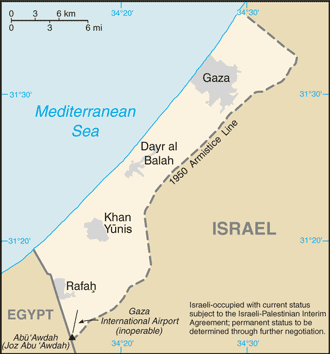
The Russian Connection With Hamas & Hezbollah (NSI News Source Info) September 22, 2008: The blockade of Gaza has made the smuggling tunnels a major business, despite regular collapses and Egyptian police finding and destroying them. There's too much money to be made by operating a tunnel, so while the Egyptians discover and destroy at least one a day, work on another one begins. Hamas taxes the tunnels, obtaining nearly $4 million a year from that alone. Hamas operates some of the tunnels, making more money from smuggling in consumer goods. But the tunnels are also used to bring weapons in from Egypt, where police and government officials are bribed to look the other way. Meanwhile, Fatah announced plans to retake control of Gaza by force. While Fatah has established control over the West Bank, any move on Gaza would require cooperation from the Israelis. Something will have to be done about Hamas, because of the growing arsenal of rockets, and continued announcements that Hamas will eventually attack Israel and, with the help of Iran, destroy Israel. The Israeli armed forces believe that Russia is using its intelligence forces, both agents inside Israel and spy satellites and ships, to collect information on Israel and pass it on to Hezbollah in Lebanon. The Israelis believe this has been going on for several years, apparently as part of some deal with Iran. Several corruption investigations have caught up with Israeli prime minister Ehud Olmert, who has now resigned. The new prime minister will be former Mossad operative (and current foreign minister) Tzipi Livni. It's uncertain how much, if any, change there will be because of this. September 18, 2008: Settler violence continued in the West Bank, as police removed settlers from an illegal outpost, and settlers responded by setting fires and damaging Palestinian property. September 16, 2008: In Gaza, battles between Hamas and clan gangs left eleven dead, including a child and a pro-al Qaeda terrorist (who was protected by the gang). Hamas control of Gaza is not complete. September 15, 2008: A member of the Iraqi parliament (Sunni Arab Mithal Alusi), was punished by his fellow members for visiting Israel to attend a peace conference. The Iraqi parliament is dominated by Shia Arabs, many of whom are pro-Iranian (and Iran continues to publicly call for the destruction of Israel. September 13, 2008: In the West Bank, a Palestinian sneaked into an Israeli settlement and stabbed a nine year old boy. Several dozen of the men from the settlement grabbed their weapons and went to the nearby Palestine village and damaged cars and buildings with rocks and bullets. Six Palestinians were wounded. The Israeli police could not go into the Palestinian village right away because the army controls access to Palestinian areas and it took some time to contact the army and coordinate police-army operations to get the rioting settlers out of the village.

Sunday, September 21, 2008

The US Navy’s Nuclear Propulsion Contracts

The US Navy’s Nuclear Propulsion Contracts
(NSI News Source Info) September 22, 2008: Several navies around the world currently use nuclear propulsion in at least some ships and submarines: The USA has had an all-nuclear submarine fleet for over 50 years, a policy that dates back to Adm. Hyman Rickover. As our readers were quick to point out, Britain’s sale of its SSK Upholder Class to Canada (as the problem-plagued Victoria Class) made them an all-nuclear fleet as well. China, France and Russia use naval nuclear propulsion within mixed submarine fleets, and India is currently working to join this club via its SSN program. On the surface, France’s trouble-plagued FNS Charles de Gaulle carrier joins America’s carriers, which will soon become an all-nuclear fleet with the retirement of the USS Kitty Hawk [CVN 63].
The saga of the Charles de Gaulle serves as a reminder that adapting nuclear propulsion technology to the small spaces of a submarine, or fitting them to a surface warship, is no trivial feat. Much can go wrong, even in nations that have used nuclear naval propulsion for some time. On the flip side, advances in design can offer significant benefits. The new nuclear plants in America’s Virginia Class and Seawolf Class fast attack subs, Britain’s new Astute Class fast attack submarines, and the USA’s forthcoming CVN-78 Gerald R. Ford Class aircraft carriers, offer designs that will save billions over the life of each ship by eliminating the standard mid-life reactor refueling. This Spotlight article currently covers related American nuclear propulsion contracts since the beginning of FY 2006. Note that all contracts noted here are awarded by The US Naval Sea Systems Command in Washington, DC, and that completion date or other additional information are provided for Naval Nuclear Propulsion Program contracts as a matter of official policy. Other contracts related to maintenance, however, may show completion dates. The latest item is a $6-10 billion contract to Bechtel, which will take over operation of the Bettis and Knolls Atomic Power Laboratories in 2009… The Contracts (FY 2006 – Present) Sept 18/08: Bechtel Marine Propulsion Corp. in San Francisco, CA receives a cost plus fixed fee contract for “Naval Nuclear Propulsion work.” What this means is that Bechtel Marine Propulsion Corporation (BMPC) has been awarded contracts to operate the Bettis and Knolls Atomic Power Laboratories, under a 5-year contract with the Department of Energy (DOE) and the U.S. Navy’s Naval Sea Systems Command (NAVSEA). This contract was competitively procured, with 3 offers received via the U.S. Department of Energy’s Industry Interactive Procurement System (N00024-08-C-2103). The Bettis Atomic Power Laboratory is currently operated by Bechtel Bettis, Inc.; it has facilities in Pittsburgh, PA; Idaho Falls, ID; and Charleston, SC. The Knolls Atomic Power Laboratory in Schenectady, NY, is currently operated by Lockheed Martin subsidiary KAPL, Inc. BMPC will assume operation of the Bettis and Knolls Atomic Power Laboratories on Feb 1/09, following a 4-month transition period. Bechtel’s release values this contract at $6 billion, but the Pentagon’s DefenseLINK adds that the contract includes options which, if exercised, would bring the cumulative value to an estimated $9.724 billion. Work will be performed in Schenectady, NY (30%); Idaho Falls, ID (15%); and Pittsburgh, PA (55%). April 16/08: Bechtel Plant Machinery Inc. in Pittsburgh, PA received an $80.2 million cost-plus-fixed-fee contract modification to previously awarded contract (N00024-07-C-2100) for Naval Nuclear Propulsion Components. Work will be performed in Pittsburgh, PA (99%) and Schenectady, NY (1%). Feb 22/08: Bechtel Plant Machinery Inc. in Pittsburgh, PA received a $312.6 million modification to previously awarded cost-plus-fixed fee contract (N00024-08-C-2118) for Naval nuclear propulsion components. Work will be performed in Pittsburgh, PA (68.3%, and Schenectady, NY (31.7%). Dec 6/07: Bechtel Plant Machinery Inc. in Pittsburgh, PA received a $165.7 million modification to previously awarded contract (N00024-07-C-2100) for Naval Nuclear Propulsion Components. Work will be performed in Pittsburgh, PA (74%), and Schenectady, N.Y. (26%). Oct 16/07: Bechtel Plant Machinery Inc. in Pittsburgh, PA received a $282.3 million cost-plus-fixed fee contract for Naval Nuclear Propulsion Components. Work will be performed in Pittsburgh, PA (62%) and Schenectady, NY (38%). The contract was not competitively procured (N00024-08-C-2118). Oct 16/07: Bechtel Plant Machinery Inc. in Pittsburgh, PA received a $124.4 million cost-plus-fixed fee modification to previously awarded contract (N00024-07-C-2102) for additional naval nuclear propulsion components. Work will be performed in Pittsburgh, PA (52%) and Schenectady, NY (48%) (N00024-07-C-2102). Oct 12/07: Bechtel Bettis Inc., Bettis Atomic Power Laboratory, West Mifflin, PA received a $450.7 million cost-plus-fixed-fee modification to previously awarded contract (N00024-98-C-4064) for Naval Nuclear Propulsion work at the Bettis Atomic Power Laboratory. Work will be performed in West Mifflin, PA. Contract funds in the amount of $242.2 million will expire at the end of the current fiscal year. GlobalSecurity.org notes that: “Bettis [Atomic Power Laboratory] is engaged solely in the design and development of naval nuclear propulsion plants. The Naval Nuclear Propulsion Program is a joint Navy/DOE program responsible for all matters pertaining to Naval nuclear propulsion. This Program is distinct from the remainder of DOE both by Presidential Executive Order and by statute. The Lab provides technical support for the safe and reliable operation of existing Naval reactors. Bettis designed reactor plants for the first nuclear-powered submarine (USS Nautilus), the first nuclear-powered aircraft carrier (USS Enterprise), all of the Nimitz-class aircraft carriers, and the USS Seawolf [attack submarines]. ...A major new initiative for the Laboratory is design of the nuclear propulsion plants and electrical power systems for the next class of US Navy aircraft carriers". Whose new reactor is an important part of the effort to slash their lifetime costs by up to $5 billion per ship. Oct 11/07: KAPL Inc. (Knolls Atomic Power Laboratory) in Schenectady, NY received a $168.9 million cost-plus-fixed-fee modification to previously awarded contract (N00024-00-C-4011) for Naval nuclear propulsion work at the Knolls Atomic Power Laboratory. Work will be performed in Schenectady, NY. Contract funds in the amount of $109 million will expire at the end of the current fiscal year. June 6/07: Bechtel Plant Machinery Inc. in Schenectady, NY received a $69.9 million cost-plus-fixed-fee modification to previously awarded contract (N00024-07-C-2100) for Naval nuclear propulsion components. Work will be performed in Pittsburgh, PA (85%) and Schenectady, NY (15%). April 30/07: Bechtel Plant Machinery Inc. in Schenectady, NY received a $13.4 million cost-plus-fixed fee modification to previously awarded contract (N00024-07-C-2101) for additional naval nuclear propulsion components. Work will be performed in Schenectady, NY. Feb 28/07: Bechtel Plant Machinery Inc. in Schenectady, NY received a $7.8 million modification to previously awarded contract (N00024-07-C-2102) for additional naval nuclear propulsion components. Work will be performed in Schenectady, NY. Oct 17/06: Bechtel Plant Machinery Inc. in Schenectady, NY received a $267.5 million cost-plus-fixed fee contract for naval nuclear propulsion components, raising its contracts awarded to $442.2 million total since Oct 1/06. Work will be performed in Pittsburgh, PA (52%) and Schenectady, NY (48%). The contract was not competitively procured (N00024-07-C-2101). DID has covered previous awards to Bechtel Plant Machinery for naval nuclear propulsion components, including the previous 2 entries, plus FY 2006 awards for $166.3 million in December 2005, and another $272.2 million in October 2005. A FY 2006 award for $35.6 million was also made in on May 25, 2006, but not covered by DID at the time. Oct 16/06: Bechtel Plant Machinery Inc. in Schenectady, NY received a $44.8 million cost-plus-fixed fee contract for naval nuclear propulsion components, which can be added to the Oct. 12, 2006 award to get a total of $174.7 million. Work will be performed in Schenectady, NY. The contract was not competitively procured (N00024-07-C-2102). Oct 12/06: Bechtel Plant Machinery Inc. in Schenectady, NY received a $129.9 million cost-plus-fixed fee contract for Naval nuclear propulsion components. Work will be performed in Schenectady, NY (48%) and Pittsburgh, PA (52%). The contract was not competitively procured (N00024-07-C-2100) Oct 12/06: Bechtel Bettis Inc., Bettis Atomic Power Laboratory in West Mifflin, PA received a $461.1 million cost-plus-fixed fee modification to previously awarded contract N00024-98-C-4064 for naval nuclear propulsion work (FY 2006 award: $480.7 million). Work will be performed in West Mifflin, PA. This action represents funding of the contract’s 7th year of effort, and contract funds in the amount of $104.7 million will expire at the end of the current fiscal year. Oct 12/06: KAPL Inc. (Knolls Atomic Power Laboratory) in Schenectady, NY received a $160.4 million cost-plus-fixed-fee modification to previously awarded contract N00024-00-C-4011 for Naval nuclear propulsion work at the Knolls Atomic Power Laboratory during fiscal year 2007 (FY 2006 award: $138.6 million). Work will be performed in Schenectady, NY. This represents funding for the contract’s 7th year of performance, and funding in the amount of $25.5 million will expire at the end of the current fiscal year (N00024-00-C-4011). Oct 11/06: General Dynamics Electric Boat Corp. in Groton, CT received an $18.7 million cost-plus-fixed-fee, level of effort contract for reactor plant planning yard services for nuclear-powered submarines and support yard services for Navy moored training ships. This work generally includes engineering services for lifecycle support, maintenance and modernization of the reactor plants and selected propulsion-plant systems of Los Angeles, Trident and Seawolf-class submarines, and the nuclear research submarine NR-1. Additionally, Electric Boat provides similar services for all systems on the Navy’s moored training ships in Charleston, SC. Work will be performed in Groton, CT (95%) and Charleston, SC (5%), and is expected to be complete by September 2007. This contract was not competitively procured by the Naval Sea Systems Command in Washington, DC (N00024-07-C-2103). May 25/06: Bechtel Plant Machinery Inc. Schenectady, N.Y., is being awarded a $35,611,256 cost-plus-fixed fee modification to previously awarded contract (N00024-02-C-2102) for Naval nuclear propulsion components. Work will be performed in Pittsburgh, PA (68%) and Schenectady, NY (32%). Dec 20/05: Bechtel Plant Machinery Inc. in Pittsburgh, PA received a $166,318,354 cost-plus-fixed-fee modification to previously awarded contract (N00024-02-C-2102) for naval nuclear propulsion components. Work will be performed in Pittsburgh, PA (73%) and Schenectady, NY (27%). Oct 20/05: KAPL Inc. Knolls Atomic Power Laboratory in Schenectady, NY received a $138.6 million cost-plus-fixed fee modification to previously awarded contract (N00024-00-C-4011) for naval nuclear propulsion work at the Knolls Atomic Power Laboratory. Work will be performed in Schenectady, NY. Oct 20/05: Bechtel Bettis Inc. at Bettis Atomic Power Laboratory in West Mifflin, PA, received a $480.7 million cost-plus-fixed-fee modification to previously awarded contract (N00024-98-C-4064) for naval nuclear Propulsion work at the Bettis Atomic Power Laboratory. Work will be performed in West Mifflin, PA. Oct 18/05: Bechtel Plant Machinery Inc. in Pittsburgh, PA received a $279,237,437 cost-plus-fixed-fee contract for Naval nuclear propulsion components. Work will be performed in Schenectady, NY (50%) and Pittsburgh, PA (50%). Contract funds will not expire at the end of the current fiscal year. The contract was not competitively procured (N00024-06-C-2106). Oct 14/05: Bechtel Plant Machinery Inc. in Pittsburgh, PA received a $30,200,000 cost-plus-fixed-fee modification to previously awarded contract (N00024-04-C-2104) for Naval Nuclear Propulsion Components. Work will be performed in Pittsburgh, PA.

Israel Goes For Light And Cheap

Israel Goes For Light And Cheap (NSI News Source Info) September 21, 2008: Israel is buying 28,000 U.S. M72A7 66mm one-shot anti-tank rockets. The 7.7 pound weapon has a range of 200 meters and is useful against structures as well as armored vehicles (although only the side armor of the latest tanks is vulnerable). The two pound warhead is designed to have some anti-personnel effect. Also ordered are 60,000 training rockets (which are fired from a reusable version of the M72) for practice. The A7 model can be fired from inside a building. The $2,000 M72 is the cheapest weapon in this class, and light enough for infantrymen to carry several.