 "Syria, the UAE, Malaysia, India and some other countries have shown an interest in the missile system," said Rosoboronexport official Nikolai Dimidyuk. Russia also will seek to export the Iskander-E to Algeria, Kuwait, Singapore, Vietnam and South Korea, he added.
The United States currently manufactures and exports nothing like the Iskander-E -- NATO designation SS-26 Stone. RIA Novosti described the weapons system as "a tactical surface-to-surface missile complex designed to deliver high-precision strikes at a variety of ground targets at a range of up to 280 kilometers (170 miles)." The Iskander-E carries only a single warhead with a payload of up to 880 pounds, staying within the parameters determined by the Missile Technology Control Regime.
The report also noted that the Iskander-E is equipped with "stealth" technology and it has the capacity for variable flight trajectory, making it much more difficult for ballistic missile defense to shoot it down.
Because the missiles are solid-fueled, they can be launched extremely quickly, again reducing to virtually zero the chances of knocking them out before launch with a pre-emptive airstrike. RIA Novosti said the second missile on a TEL could be fired within a minute of the first one being launched.
The missiles are also exceptionally accurate with a circular-error probability -- CEP -- of only 30 meters (around 100 feet).
RIA Novosti said a single Iskander battery includes a number of TELs, loaders and a command vehicle. "Target acquisition is supported by a mobile data-processing center," it said.
Dimidyuk said the Russian armed forces were already creating a combat brigade of Iskander-M SRBM -- short-range ballistic missile -- systems that would have "longer ranges and heavier payloads than the export -- Iskander-E -- version."
"The system has been adopted in service with Russia's armed forces, and, as far as I know, a brigade (of Iskander systems) is being formed," Dimidyuk said.
Russia already has threatened to deploy the Iskander in its Kaliningrad region on the Baltic Sea.
RIA Novosti cited three-star Col. Gen. Viktor Yesin, a former commander of the Russian Strategic Missile Forces, as telling the Moscow newspaper Nezavisimaya Gazeta in July that the Kremlin could rapidly move its Iskander-M missiles to Kaliningrad or the former Soviet republic of Belarus, a loyal Russian ally, to put them within range of hitting the new U.S. BMD base being built in Poland.
The Iskander is the ideal weapon to use in any pre-emptive strike to knock out the kind of high-tech ballistic missile defense system, such as the U.S. Army's Patriot and the Israeli Arrow, that is designed to be effective against intermediate-range ballistic missiles -- IRBMs -- or shorter-range weapons. That makes them a deadly threat to the new BMD base to hold 10 Ground-based Mid-course Interceptors -- GBIs -- that the United States is building in Poland to defend Western Europe and the Eastern Seaboard of the United States from the threat of any future Iranian intercontinental ballistic missile --ICBM -- that could carry nuclear warheads.
The Iskander-E is relatively small and light, with a launch weight of 3,800 kilograms (8,360 pounds), RIA Novosti said. That means it can be moved on a transporter erector launcher -- TEL -- vehicle that can hold two of them, greatly increasing survivability from pre-emptive air attack and doubling the launch system's firepower.
The Iskanders therefore would pose a formidable threat to the U.S. GBIs in Poland, and if Russia sells them to Syria, they could knock out Israel's most advanced early warning radar facilities in a pre-emptive strike, leaving the country defenseless against nuclear-capable Iranian IRBMs and cruise missiles.
If Russia sold Syria enough Iskander-Es, they also would pose a threat, combined with Hezbollah's more than 10,000 missiles, mainly on multiple-launch rocket systems -- MLRS -- of disrupting mobilization procedures of the Israeli army in any future war with Syria on the Golan Heights.
The beauty of the Iskander concept is that it employs a venerable, highly reliable, mature technology, cost-effectively allowing it to knock out the vastly more expensive BMD systems that it targets.
In this respect, it parallels the effectiveness of the U.S. Army Air Force's North American P-51 Mustang piston engine combat fighters in World War II that shot down hundreds of technically vastly superior, but far less numerous and far less cost-effective German Messerschmitt Me-262 jet fighters.
The Iskander therefore serves notice that even in the cutting-edge, super-high-tech world of ballistic missile defense, there is an important role for older, simpler, far cheaper technologies to play "spoiler" roles that can destroy or disrupt the much more ambitious -- and expensive -- defense systems that nations put their trust in.
"Syria, the UAE, Malaysia, India and some other countries have shown an interest in the missile system," said Rosoboronexport official Nikolai Dimidyuk. Russia also will seek to export the Iskander-E to Algeria, Kuwait, Singapore, Vietnam and South Korea, he added.
The United States currently manufactures and exports nothing like the Iskander-E -- NATO designation SS-26 Stone. RIA Novosti described the weapons system as "a tactical surface-to-surface missile complex designed to deliver high-precision strikes at a variety of ground targets at a range of up to 280 kilometers (170 miles)." The Iskander-E carries only a single warhead with a payload of up to 880 pounds, staying within the parameters determined by the Missile Technology Control Regime.
The report also noted that the Iskander-E is equipped with "stealth" technology and it has the capacity for variable flight trajectory, making it much more difficult for ballistic missile defense to shoot it down.
Because the missiles are solid-fueled, they can be launched extremely quickly, again reducing to virtually zero the chances of knocking them out before launch with a pre-emptive airstrike. RIA Novosti said the second missile on a TEL could be fired within a minute of the first one being launched.
The missiles are also exceptionally accurate with a circular-error probability -- CEP -- of only 30 meters (around 100 feet).
RIA Novosti said a single Iskander battery includes a number of TELs, loaders and a command vehicle. "Target acquisition is supported by a mobile data-processing center," it said.
Dimidyuk said the Russian armed forces were already creating a combat brigade of Iskander-M SRBM -- short-range ballistic missile -- systems that would have "longer ranges and heavier payloads than the export -- Iskander-E -- version."
"The system has been adopted in service with Russia's armed forces, and, as far as I know, a brigade (of Iskander systems) is being formed," Dimidyuk said.
Russia already has threatened to deploy the Iskander in its Kaliningrad region on the Baltic Sea.
RIA Novosti cited three-star Col. Gen. Viktor Yesin, a former commander of the Russian Strategic Missile Forces, as telling the Moscow newspaper Nezavisimaya Gazeta in July that the Kremlin could rapidly move its Iskander-M missiles to Kaliningrad or the former Soviet republic of Belarus, a loyal Russian ally, to put them within range of hitting the new U.S. BMD base being built in Poland.
The Iskander is the ideal weapon to use in any pre-emptive strike to knock out the kind of high-tech ballistic missile defense system, such as the U.S. Army's Patriot and the Israeli Arrow, that is designed to be effective against intermediate-range ballistic missiles -- IRBMs -- or shorter-range weapons. That makes them a deadly threat to the new BMD base to hold 10 Ground-based Mid-course Interceptors -- GBIs -- that the United States is building in Poland to defend Western Europe and the Eastern Seaboard of the United States from the threat of any future Iranian intercontinental ballistic missile --ICBM -- that could carry nuclear warheads.
The Iskander-E is relatively small and light, with a launch weight of 3,800 kilograms (8,360 pounds), RIA Novosti said. That means it can be moved on a transporter erector launcher -- TEL -- vehicle that can hold two of them, greatly increasing survivability from pre-emptive air attack and doubling the launch system's firepower.
The Iskanders therefore would pose a formidable threat to the U.S. GBIs in Poland, and if Russia sells them to Syria, they could knock out Israel's most advanced early warning radar facilities in a pre-emptive strike, leaving the country defenseless against nuclear-capable Iranian IRBMs and cruise missiles.
If Russia sold Syria enough Iskander-Es, they also would pose a threat, combined with Hezbollah's more than 10,000 missiles, mainly on multiple-launch rocket systems -- MLRS -- of disrupting mobilization procedures of the Israeli army in any future war with Syria on the Golan Heights.
The beauty of the Iskander concept is that it employs a venerable, highly reliable, mature technology, cost-effectively allowing it to knock out the vastly more expensive BMD systems that it targets.
In this respect, it parallels the effectiveness of the U.S. Army Air Force's North American P-51 Mustang piston engine combat fighters in World War II that shot down hundreds of technically vastly superior, but far less numerous and far less cost-effective German Messerschmitt Me-262 jet fighters.
The Iskander therefore serves notice that even in the cutting-edge, super-high-tech world of ballistic missile defense, there is an important role for older, simpler, far cheaper technologies to play "spoiler" roles that can destroy or disrupt the much more ambitious -- and expensive -- defense systems that nations put their trust in.
Monday, October 06, 2008
Russia Eyes New Customers For Iskander E Missile
Russia Eyes New Customers For Iskander E Missile
(NSI News Source Info) Washington - October 6, 2008: A surprising number of countries, including some with warm ties to the United States, are interested in buying Russia's short-range but formidable Iskander-E ballistic missile.
A senior executive of Rosoboronexport, the coordinating Russian arms exporting agency, stated Wednesday that Kuwait, South Korea and the United Arab Emirates -- all traditional U.S. allies -- were interested in buying the Iskander, RIA Novosti reported Thursday.
 "Syria, the UAE, Malaysia, India and some other countries have shown an interest in the missile system," said Rosoboronexport official Nikolai Dimidyuk. Russia also will seek to export the Iskander-E to Algeria, Kuwait, Singapore, Vietnam and South Korea, he added.
The United States currently manufactures and exports nothing like the Iskander-E -- NATO designation SS-26 Stone. RIA Novosti described the weapons system as "a tactical surface-to-surface missile complex designed to deliver high-precision strikes at a variety of ground targets at a range of up to 280 kilometers (170 miles)." The Iskander-E carries only a single warhead with a payload of up to 880 pounds, staying within the parameters determined by the Missile Technology Control Regime.
The report also noted that the Iskander-E is equipped with "stealth" technology and it has the capacity for variable flight trajectory, making it much more difficult for ballistic missile defense to shoot it down.
Because the missiles are solid-fueled, they can be launched extremely quickly, again reducing to virtually zero the chances of knocking them out before launch with a pre-emptive airstrike. RIA Novosti said the second missile on a TEL could be fired within a minute of the first one being launched.
The missiles are also exceptionally accurate with a circular-error probability -- CEP -- of only 30 meters (around 100 feet).
RIA Novosti said a single Iskander battery includes a number of TELs, loaders and a command vehicle. "Target acquisition is supported by a mobile data-processing center," it said.
Dimidyuk said the Russian armed forces were already creating a combat brigade of Iskander-M SRBM -- short-range ballistic missile -- systems that would have "longer ranges and heavier payloads than the export -- Iskander-E -- version."
"The system has been adopted in service with Russia's armed forces, and, as far as I know, a brigade (of Iskander systems) is being formed," Dimidyuk said.
Russia already has threatened to deploy the Iskander in its Kaliningrad region on the Baltic Sea.
RIA Novosti cited three-star Col. Gen. Viktor Yesin, a former commander of the Russian Strategic Missile Forces, as telling the Moscow newspaper Nezavisimaya Gazeta in July that the Kremlin could rapidly move its Iskander-M missiles to Kaliningrad or the former Soviet republic of Belarus, a loyal Russian ally, to put them within range of hitting the new U.S. BMD base being built in Poland.
The Iskander is the ideal weapon to use in any pre-emptive strike to knock out the kind of high-tech ballistic missile defense system, such as the U.S. Army's Patriot and the Israeli Arrow, that is designed to be effective against intermediate-range ballistic missiles -- IRBMs -- or shorter-range weapons. That makes them a deadly threat to the new BMD base to hold 10 Ground-based Mid-course Interceptors -- GBIs -- that the United States is building in Poland to defend Western Europe and the Eastern Seaboard of the United States from the threat of any future Iranian intercontinental ballistic missile --ICBM -- that could carry nuclear warheads.
The Iskander-E is relatively small and light, with a launch weight of 3,800 kilograms (8,360 pounds), RIA Novosti said. That means it can be moved on a transporter erector launcher -- TEL -- vehicle that can hold two of them, greatly increasing survivability from pre-emptive air attack and doubling the launch system's firepower.
The Iskanders therefore would pose a formidable threat to the U.S. GBIs in Poland, and if Russia sells them to Syria, they could knock out Israel's most advanced early warning radar facilities in a pre-emptive strike, leaving the country defenseless against nuclear-capable Iranian IRBMs and cruise missiles.
If Russia sold Syria enough Iskander-Es, they also would pose a threat, combined with Hezbollah's more than 10,000 missiles, mainly on multiple-launch rocket systems -- MLRS -- of disrupting mobilization procedures of the Israeli army in any future war with Syria on the Golan Heights.
The beauty of the Iskander concept is that it employs a venerable, highly reliable, mature technology, cost-effectively allowing it to knock out the vastly more expensive BMD systems that it targets.
In this respect, it parallels the effectiveness of the U.S. Army Air Force's North American P-51 Mustang piston engine combat fighters in World War II that shot down hundreds of technically vastly superior, but far less numerous and far less cost-effective German Messerschmitt Me-262 jet fighters.
The Iskander therefore serves notice that even in the cutting-edge, super-high-tech world of ballistic missile defense, there is an important role for older, simpler, far cheaper technologies to play "spoiler" roles that can destroy or disrupt the much more ambitious -- and expensive -- defense systems that nations put their trust in.
"Syria, the UAE, Malaysia, India and some other countries have shown an interest in the missile system," said Rosoboronexport official Nikolai Dimidyuk. Russia also will seek to export the Iskander-E to Algeria, Kuwait, Singapore, Vietnam and South Korea, he added.
The United States currently manufactures and exports nothing like the Iskander-E -- NATO designation SS-26 Stone. RIA Novosti described the weapons system as "a tactical surface-to-surface missile complex designed to deliver high-precision strikes at a variety of ground targets at a range of up to 280 kilometers (170 miles)." The Iskander-E carries only a single warhead with a payload of up to 880 pounds, staying within the parameters determined by the Missile Technology Control Regime.
The report also noted that the Iskander-E is equipped with "stealth" technology and it has the capacity for variable flight trajectory, making it much more difficult for ballistic missile defense to shoot it down.
Because the missiles are solid-fueled, they can be launched extremely quickly, again reducing to virtually zero the chances of knocking them out before launch with a pre-emptive airstrike. RIA Novosti said the second missile on a TEL could be fired within a minute of the first one being launched.
The missiles are also exceptionally accurate with a circular-error probability -- CEP -- of only 30 meters (around 100 feet).
RIA Novosti said a single Iskander battery includes a number of TELs, loaders and a command vehicle. "Target acquisition is supported by a mobile data-processing center," it said.
Dimidyuk said the Russian armed forces were already creating a combat brigade of Iskander-M SRBM -- short-range ballistic missile -- systems that would have "longer ranges and heavier payloads than the export -- Iskander-E -- version."
"The system has been adopted in service with Russia's armed forces, and, as far as I know, a brigade (of Iskander systems) is being formed," Dimidyuk said.
Russia already has threatened to deploy the Iskander in its Kaliningrad region on the Baltic Sea.
RIA Novosti cited three-star Col. Gen. Viktor Yesin, a former commander of the Russian Strategic Missile Forces, as telling the Moscow newspaper Nezavisimaya Gazeta in July that the Kremlin could rapidly move its Iskander-M missiles to Kaliningrad or the former Soviet republic of Belarus, a loyal Russian ally, to put them within range of hitting the new U.S. BMD base being built in Poland.
The Iskander is the ideal weapon to use in any pre-emptive strike to knock out the kind of high-tech ballistic missile defense system, such as the U.S. Army's Patriot and the Israeli Arrow, that is designed to be effective against intermediate-range ballistic missiles -- IRBMs -- or shorter-range weapons. That makes them a deadly threat to the new BMD base to hold 10 Ground-based Mid-course Interceptors -- GBIs -- that the United States is building in Poland to defend Western Europe and the Eastern Seaboard of the United States from the threat of any future Iranian intercontinental ballistic missile --ICBM -- that could carry nuclear warheads.
The Iskander-E is relatively small and light, with a launch weight of 3,800 kilograms (8,360 pounds), RIA Novosti said. That means it can be moved on a transporter erector launcher -- TEL -- vehicle that can hold two of them, greatly increasing survivability from pre-emptive air attack and doubling the launch system's firepower.
The Iskanders therefore would pose a formidable threat to the U.S. GBIs in Poland, and if Russia sells them to Syria, they could knock out Israel's most advanced early warning radar facilities in a pre-emptive strike, leaving the country defenseless against nuclear-capable Iranian IRBMs and cruise missiles.
If Russia sold Syria enough Iskander-Es, they also would pose a threat, combined with Hezbollah's more than 10,000 missiles, mainly on multiple-launch rocket systems -- MLRS -- of disrupting mobilization procedures of the Israeli army in any future war with Syria on the Golan Heights.
The beauty of the Iskander concept is that it employs a venerable, highly reliable, mature technology, cost-effectively allowing it to knock out the vastly more expensive BMD systems that it targets.
In this respect, it parallels the effectiveness of the U.S. Army Air Force's North American P-51 Mustang piston engine combat fighters in World War II that shot down hundreds of technically vastly superior, but far less numerous and far less cost-effective German Messerschmitt Me-262 jet fighters.
The Iskander therefore serves notice that even in the cutting-edge, super-high-tech world of ballistic missile defense, there is an important role for older, simpler, far cheaper technologies to play "spoiler" roles that can destroy or disrupt the much more ambitious -- and expensive -- defense systems that nations put their trust in.
"Syria, the UAE, Malaysia, India and some other countries have shown an interest in the missile system," said Rosoboronexport official Nikolai Dimidyuk. Russia also will seek to export the Iskander-E to Algeria, Kuwait, Singapore, Vietnam and South Korea, he added.
The United States currently manufactures and exports nothing like the Iskander-E -- NATO designation SS-26 Stone. RIA Novosti described the weapons system as "a tactical surface-to-surface missile complex designed to deliver high-precision strikes at a variety of ground targets at a range of up to 280 kilometers (170 miles)." The Iskander-E carries only a single warhead with a payload of up to 880 pounds, staying within the parameters determined by the Missile Technology Control Regime.
The report also noted that the Iskander-E is equipped with "stealth" technology and it has the capacity for variable flight trajectory, making it much more difficult for ballistic missile defense to shoot it down.
Because the missiles are solid-fueled, they can be launched extremely quickly, again reducing to virtually zero the chances of knocking them out before launch with a pre-emptive airstrike. RIA Novosti said the second missile on a TEL could be fired within a minute of the first one being launched.
The missiles are also exceptionally accurate with a circular-error probability -- CEP -- of only 30 meters (around 100 feet).
RIA Novosti said a single Iskander battery includes a number of TELs, loaders and a command vehicle. "Target acquisition is supported by a mobile data-processing center," it said.
Dimidyuk said the Russian armed forces were already creating a combat brigade of Iskander-M SRBM -- short-range ballistic missile -- systems that would have "longer ranges and heavier payloads than the export -- Iskander-E -- version."
"The system has been adopted in service with Russia's armed forces, and, as far as I know, a brigade (of Iskander systems) is being formed," Dimidyuk said.
Russia already has threatened to deploy the Iskander in its Kaliningrad region on the Baltic Sea.
RIA Novosti cited three-star Col. Gen. Viktor Yesin, a former commander of the Russian Strategic Missile Forces, as telling the Moscow newspaper Nezavisimaya Gazeta in July that the Kremlin could rapidly move its Iskander-M missiles to Kaliningrad or the former Soviet republic of Belarus, a loyal Russian ally, to put them within range of hitting the new U.S. BMD base being built in Poland.
The Iskander is the ideal weapon to use in any pre-emptive strike to knock out the kind of high-tech ballistic missile defense system, such as the U.S. Army's Patriot and the Israeli Arrow, that is designed to be effective against intermediate-range ballistic missiles -- IRBMs -- or shorter-range weapons. That makes them a deadly threat to the new BMD base to hold 10 Ground-based Mid-course Interceptors -- GBIs -- that the United States is building in Poland to defend Western Europe and the Eastern Seaboard of the United States from the threat of any future Iranian intercontinental ballistic missile --ICBM -- that could carry nuclear warheads.
The Iskander-E is relatively small and light, with a launch weight of 3,800 kilograms (8,360 pounds), RIA Novosti said. That means it can be moved on a transporter erector launcher -- TEL -- vehicle that can hold two of them, greatly increasing survivability from pre-emptive air attack and doubling the launch system's firepower.
The Iskanders therefore would pose a formidable threat to the U.S. GBIs in Poland, and if Russia sells them to Syria, they could knock out Israel's most advanced early warning radar facilities in a pre-emptive strike, leaving the country defenseless against nuclear-capable Iranian IRBMs and cruise missiles.
If Russia sold Syria enough Iskander-Es, they also would pose a threat, combined with Hezbollah's more than 10,000 missiles, mainly on multiple-launch rocket systems -- MLRS -- of disrupting mobilization procedures of the Israeli army in any future war with Syria on the Golan Heights.
The beauty of the Iskander concept is that it employs a venerable, highly reliable, mature technology, cost-effectively allowing it to knock out the vastly more expensive BMD systems that it targets.
In this respect, it parallels the effectiveness of the U.S. Army Air Force's North American P-51 Mustang piston engine combat fighters in World War II that shot down hundreds of technically vastly superior, but far less numerous and far less cost-effective German Messerschmitt Me-262 jet fighters.
The Iskander therefore serves notice that even in the cutting-edge, super-high-tech world of ballistic missile defense, there is an important role for older, simpler, far cheaper technologies to play "spoiler" roles that can destroy or disrupt the much more ambitious -- and expensive -- defense systems that nations put their trust in.

Swords and Shields: Iran's missile allies
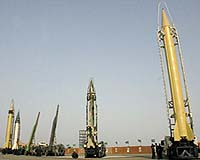 Swords and Shields: Iran's missile allies
(NSI News Source Info) October 6, 2008: It is expected that the Shahab 4 and Shahab 5 would have, in addition to inertial navigation systems, advanced navigation technology, possibly sold by Russia, which could be competing with China in the lucrative Iranian ballistic missile market.
Swords and Shields: Iran's missile allies
(NSI News Source Info) October 6, 2008: It is expected that the Shahab 4 and Shahab 5 would have, in addition to inertial navigation systems, advanced navigation technology, possibly sold by Russia, which could be competing with China in the lucrative Iranian ballistic missile market.
Attempts to thwart Iran's missile ambitions are hampered by the fact that Tehran is being backed by Russia and China. These powers are actually partners in the Iranian ballistic missile and space programs, which they view as both geopolitically desirable -- to dilute U.S. influence -- and lucrative.
It is likely that Iran's Explorer-1 rocket is the result of the country's advanced ballistic missile program.
The greater the range and payload capacity, the more capable is a missile to serve as a civilian SLV (satellite launch vehicle). Thus, the launching of the Iranian rocket could mark a threshold in Tehran's development of longer-range ballistic missiles.
And it is highly unlikely that, without plans to deploy nuclear warheads on its ballistic missiles, the Islamic Republic of Iran would be developing civilian space launch capability when commercial space launch services are readily and cheaply available from French Guyana to Russia to India and China.
It is expected that the Shahab 4 and Shahab 5 would have, in addition to inertial navigation systems, advanced navigation technology, possibly sold by Russia, which could be competing with China in the lucrative Iranian ballistic missile market.
The navigation systems of these missiles would have the Russian Glonass satellite navigation capability, Moscow's answer to the U.S.-developed Global Positioning System, or GPS. The GLONASS system is expected to have global reach with 24 satellites in orbit by the end of 2009, and to provide by 2011 a level of accuracy to civilians of 1 meter. The GLONASS system will be compatible with the U.S. GPS and Europe's future Magellan systems.
Russia's Topol-M ICBM has a guidance system featuring inertial navigation compatible with GLONASS. Eventually, the Iranian ballistic missiles would be capable of being armed with nuclear, chemical, high explosive -- HE -- and conventional warheads, and possibly special warheads as in some Russian ballistic missiles like electro-magnetic pulse -- EMP -- and anti-radiation against radars.
Russian, Chinese and North Korean cooperation would be desirable and necessary to stop Iran's missile program, albeit today it is politically inconceivable, due to U.S.-Russian tensions over Georgia and North Korean efforts to restart its nuclear program.
Although China is not a member of the Wassenaar Arrangement, which limits the spread of advanced weapons technology (the successor of CoCom -- the Coordinating Committee for Multilateral Export Controls) and the Missile Technology Control Regime, Russia is. Pressure should be exerted on Moscow to abide by these control regimes.
China should be invited once again to become a member of these regimes, and should be persuaded to act as a responsible power and thus work as part of the international community to help stop the exports of its own and North Korean missile technology, and to exert pressure on Iran to halt its growing missile program.
Beyond that, only deployment of missile defense systems in the Middle East and Europe, and Iran's fear of nuclear retaliation, may prevent Tehran from deploying nuclear-tipped intermediate-range ballistic missiles -- IRBMs -- and intercontinental ballistic missiles -- ICBMs -- in the future. The Cold War experiences of the 20th century -- or worse -- may revisit the Middle East, Europe and the United States in the years to come.
Snakes and Rotors: The USMC’s H-1 Helicopter Program
Snakes and Rotors: The USMC’s H-1 Helicopter Program
(NSI News Source Info) October 6, 2008: The US Marines’ helicopter force is aging on all levels, from CH-46 Sea Knights far older than their pilots to the 1980s era UH-1N Hueys and AH-1W Cobra attack helicopters that make up the Corps’ helicopter assault force. While the V-22 program has staggered along for almost 2 decades under accidents, technical delays, and cost issues, replacement of the USMC’s backbone helicopter assets has languished. Given the high-demand scenarios inherent in the current war, other efforts are clearly required.
 UH-1Y and AH-1Z
 UH-1Y and AH-1Z
Enter the H-1 program, the USMC’s plan to remanufacture 100 of the Marines’ old UH-1N Hueys and 180 of its AH-1W Super Cobra attack helicopters into advanced variants. The new versions would discard the signature 2-bladed rotors for modern 4-bladed improvements, redo the aircraft’s electronics, and add improved engines and weapons to offer a new level of performance. At least, that was the idea. It hasn’t quite worked out that way, and the H-1 program has encountered its own share of delays and issues. Nevertheless, the program survived its review, and continues on into the low-rate initial production stage and OpEval Phase II.
India: LCA Tejas by 2010 - But Foreign Help Sought With Engine
India: LCA Tejas by 2010 - But Foreign Help Sought With Engine
(NSI News Source Info) October 6, 2008: India’s fighter strength has been declining in recent years, as the MiG-21s that form the largest component of its fleet are lost in crashes, or retired due to age and wear. Some MiG-21s are being modernized to MiG-21bis ‘Bison’ configuration, while other current fighter types are undergoing modernization programs in order to maintain the fighter force until replacements can arrive. On which note, an ongoing tender has Russian, French, American, Swedish and European manufacturers dueling for a multi-billion dollar, 126+ plane light-medium fighter sale.
 Tejas LCA
 Tejas LCA
This still leaves India without a low-end solution to the twin problems besetting its overall fleet: numbers, and age. The MiG-21bis program adds years of life to those airframes, but that extended lifespan is still quite finite; by 2020, it is very unlikely that any MiG-21s will remain in service. As for the MMRCA program, it may replace some of India’s mid-range fighters – but that still leaves replacement of the MiG-21 fleet unfulfilled. In this environment, the status of the Tejas Light Combat Aircraft (LCA) project matters a great deal to the Indian Air Force’s future prospects, as their level of confidence in its longer-term success will affect their immediate buys. The choices made in the LCA’s design will also affect the lightweight fighter’s export potential, which in turn feeds back into the overall program’s costs and viability for India over its lifetime.
The latest additions to this article include a whirlwind of developments around the indigenous Kaveri engine. As some predicted, the Kaveri engine project’s performance failures have finally killed it as a fighter engine; its place will be filled by GE’s F404 for now, ad a foreign development partnership has been struck with France’s Snecma. The indigenous radar project has also run into severe trouble, so IAI Elta has been tapped as a foreign partner, and Israeli radars are about to be fitted so testing can go forward.
Military Action Not Enough: Afghanistan Minister
 Military Action Not Enough: Afghanistan Minister
(NSI News Source Info) KABUL - October 6, 2008: Military action alone will not solve Afghanistan's conflict, which must also be tackled on the political front, the defense minister said October 5 amid fresh talk about negotiations with Taliban.
"The war that we are fighting now does not have only a military solution," Defense Minister Mohammad Rahim Wardak told reporters.
"We have to fight it on different fronts, political, military and financial fronts," he said.
Karzai last week called on fugitive militant leader Mullah Mohammad Omar, who is on a U.S. "most wanted" list, to step forward for negotiations to end a seven-year-long insurgency that has paralyzed post-Taliban reconstruction.
He said he had been asking Saudi Arabia for two years to help engage the Taliban militia in peace talks.
Wardak reiterated the Afghan government position that negotiations with Taliban were with the condition that the militants accept the post-Taliban constitution.
"Anyone who wants to get to power should try political means and elections," he said.
In September 2007, the Afghan president said for the first time that he was ready to talk to Mullah Omar after earlier saying that he wanted negotiations with lower-level militant leaders.
Afghan and international efforts to defeat the Taliban on the battlefield have made little headway with the violence only mounting year on year, raising alarm in a country trying to rebuild after decades of war.
Military Action Not Enough: Afghanistan Minister
(NSI News Source Info) KABUL - October 6, 2008: Military action alone will not solve Afghanistan's conflict, which must also be tackled on the political front, the defense minister said October 5 amid fresh talk about negotiations with Taliban.
"The war that we are fighting now does not have only a military solution," Defense Minister Mohammad Rahim Wardak told reporters.
"We have to fight it on different fronts, political, military and financial fronts," he said.
Karzai last week called on fugitive militant leader Mullah Mohammad Omar, who is on a U.S. "most wanted" list, to step forward for negotiations to end a seven-year-long insurgency that has paralyzed post-Taliban reconstruction.
He said he had been asking Saudi Arabia for two years to help engage the Taliban militia in peace talks.
Wardak reiterated the Afghan government position that negotiations with Taliban were with the condition that the militants accept the post-Taliban constitution.
"Anyone who wants to get to power should try political means and elections," he said.
In September 2007, the Afghan president said for the first time that he was ready to talk to Mullah Omar after earlier saying that he wanted negotiations with lower-level militant leaders.
Afghan and international efforts to defeat the Taliban on the battlefield have made little headway with the violence only mounting year on year, raising alarm in a country trying to rebuild after decades of war.
Italian Air Force Flies Strix Mini-UAV in NATO Trials
Italian Air Force Flies Strix Mini-UAV in NATO Trials
(NSI News Source Info) ROME - October 6, 2008: The Italian Air Force is flying a new Italian mini-UAV it has acquired in a NATO trial in Sardinia, an Italian official said.
The Strix, a hand- or catapult-launched flying wing planned for special-forces use, has been sold by small Italian firm Alpi Aviation to the Italian Air Force, said Col. Sandro Sampaoli.
 Strix Mini-UAV
 Strix Mini-UAV
Alpi Aviation has also sold a demonstrator to Italy's Selex Galileo, which will market the UAV, an Alpi Aviation manager said.
Equipped with daytime video and infrared camera, the man-portable Strix has an advertised range of 7.8 miles, a maximum payload weight of 3.3 pounds and a maximum endurance of 135 minutes.
The Strix lined up Sept. 29 alongside Italian Army Raven UAVs, as well as U.S.-operated Maveric, Raven, Vector-P and Wasp UAVs in NATO's Trial Imperial Hammer exercise in Sardinia, which is being managed by Sampaoli.
"The Strix, which has now reached Initial Operating Capability, will operate with Air Force force protection units during Trial Imperial Hammer and in future with Air Force Special Forces," Sampaoli said.
He said the Air Force had brought one ground station and three Strix UAVs to Sardinia.
The UAVs join a range of manned aircraft in a trial involving 17 nations and over 1,000 personnel designed to improve time-sensitive targeting through data-sharing across platforms and among NATO partners, with a focus on asymmetric warfare, said Capt. Herbie Hopp, chairman of NATO's SIGINT-EW working group. UAVs would be involved in IED-locating exercises in Sardinia, he said.
U.S. Army MRAP Breakthrough
U.S. Army MRAP Breakthrough
(NSI News Source Info) October 6, 2008: U.S. Army Seeks To Apply Rapid-Fielding Lessons to Other Vehicles. The Pentagon's speedy development of the Mine Resistant Ambush Protected (MRAP) vehicle - two years from concept to mass deployment - changed the way the U.S. Army operates in Iraq and Afghanistan and reshaped its tactical-vehicle plans.
"How long did it take us to bring the Bradley to the field? Ten years. How long did it take to develop MRAP? Nine months," said U.S. Army Lt. Gen. Stephen Speakes, deputy chief of staff for programs, G8. "Now we are over 10,000. This is just a remarkable ability that we've had to transform the way we modernize the force and deliver capability."
 Mine Resistant Ambush Protected (MRAP) vehicle
 Mine Resistant Ambush Protected (MRAP) vehicle
The U.S Army has fielded more than 7,000 of the 14- to 24-ton vehicles since the program began in late 2006.
"Just yesterday [Sept. 8] we had an MRAP strike and we had four soldiers walk away from it," said U.S. Army Lt. Gen. James Thurman, deputy chief of staff for operations, G3. "Compared to an up-armored Humvee against the same type of explosive, nine times out of 10 there are no injuries in an MRAP other than bumps, bruises and scrapes. And we're talking about sizable amounts of explosives."
Thurman said the Army has been taking lessons from the MRAP effort to the joint program office.
There have been drawbacks to the fast pace. Soldiers had less time to train on the vehicles, whose height, size and high center of gravity made them prone to rolling over: 24 accidents in Iraq, fewer than 10 in Afghanistan, Thurman said.
"Every one of these things that we have looked at has been a different situation where you've been on a canal or a situation where the road tips over," he said. "We've brought that into the Army resource board and brought rollover training."
Now, the Army is beginning to implement formal MRAP training along with specific tactics, techniques and procedures designed to cut down on rollovers. Army commanders are getting their first surrogate trainers so soldiers can train on MRAPs with the same characteristics they experience in combat, Speakes said.
"The other thing we were faced with is putting MRAPs into the hands of soldiers and not having the time to develop a robust training infrastructure or the ability to put substantial numbers of soldiers through a training operation back home. The maturing of the MRAP fielding concept has led to rollover training. The real risk was the reality that soldiers were dying in combat without the protection," he said.
Pentagon officials sought to reduce rollovers by buying smaller, redesigned MRAPs, a suggestion from commanders in Afghanistan, where rugged terrain was especially difficult to navigate in heavy vehicles. On Sept. 4, officials ordered 822 smaller MRAPs from Navistar. The rugged terrain in Afghanistan requires that MRAPs be more mobile and capable off-road, MRAP program managers said.
Most of the Sept. 4 order is made up of Navistar's 15-ton MaxxPro Dash, a four-wheel-drive that is 2 to 4 tons lighter, 2 feet shorter in height and 8 inches shorter in length than the previous three MaxxPro variants.
But Army leaders say the compromises were worth it as a response to increasing deaths from roadside bombs.
"I think we also have to remember that we knew going in that the ability to design and build a vehicle that would give us this kind of resistance to IED blasts meant that there were going to be trade-offs, which are high weight and high ground clearance," Speakes said. "All of us who know that traditionally what you want is low ground clearance and minimum weight. It is always a question of trade-off."
"The concept of underbody ballistic protection, V-shaped hull and standoff distance from the blast meant that we would have a challenge with off-road stability. Also, in Iraq we don't have a mature road infrastructure. The typical road along a canal is a built-in challenge to military operations from the Humvee on up, so we knew we were operating with a design that was optimized for protection and have given up certain elements of all-around operational capability."
The Army plans a fleet of 12,000 MRAPs, which will in the future be used less as general-purpose combat vehicles and more for missions such as route clearance, counter-IED, and command and control.
JLTV
The success of the MRAPs' armor and hull has influenced the emerging Joint Light Tactical Vehicle (JLTV) program, which aims to build a tougher and higher-tech replacement for the Humvee.
"Our strategy right now requires the Army to have 144,000 [Humvees and JLTVs]. It is obvious that MRAPs will not be a dominant part of our TWV [tactical wheeled vehicle] strategy, but we have learned some very important lessons that we will carry forward into our TWV strategy. such as training and protection," Speakes said.
"What we don't want is a light tactical vehicle that weighs 40,000 pounds. Right now we are paying a high price for the protection side of things so we are trying to balance performance, payload and protection as we move forward to JLTV," Speakes said.
Already, the lightest JLTV variant is slated to weigh 14,000 to 16,000 pounds, several tons heavier than an up-armored Humvee.
"The other thing we want, which is something you don't see in MRAP right now, is scalable armor. We've got a substantial body of lessons learned," he said.
The MRAP program will continue to shape combat vehicle decisions, Speakes and Thurman said.
"What size vehicle will you need in the future? What kind of armor? How do you use composites? What is the nature of the threat that we are going to be facing? What we gotta do is focus on the future security needs of the country. I believe we are going to be involved in this for a while. There are no victory laps," Thurman said. "If you take what's going on in Iraq lately if you look up and you've got a government that is starting to function. The economy is better, violence is down."
The pace and jointness of the MRAP program is influencing procurement practices across the services, Speakes said.
"This was the whole Department of Defense effort," Speakes said. "There was Navy PEO [program executive office] and an OSD [office of the secretary of defense] acquisition authority personally chairing the meetings. Everybody was working on joint distribution and joint concepts. That is so far removed from where we were five years ago,"
China denounces proposed US arms sales to Taiwan: state media
China denounces proposed US arms sales to Taiwan: state media
(NSI News Source Info) BEIJING (AFP) - October 6, 2008: China on Saturday denounced proposed US arms sales to Taiwan worth 6.5 billion dollars, according to state media, warning "there is only one China in the world, and that Taiwan is a part of China."
Chinese Foreign Ministry spokesman Liu Jianchao said the government and people firmly opposed the move, which would seriously damage China's interests and Sino-US relations.
Vice Foreign Minister He Yafei has summoned the charge d'affaires of the US Embassy to protest the US move, according to a spokesman, the state Xinhua news agency said.
 AH-64D Apache Longbow helicopter
 AH-64D Apache Longbow helicopter
The Pentagon notified Congress Friday of 6.5 billion dollars in possible arms sales to Taiwan that would include advanced interceptor missiles, Apache attack helicopters and submarine-launched missiles.
The Defence Security and Cooperation Agency said the proposed sales were aimed at improving Taiwan's defences and would not alter the basic military balance in the region.
But Liu said China firmly opposed arms sales by the United States to Taiwan, according to the Xinhua report.
The proposed deal violated the principles set in three joint communiques between China and the United States, Liu said.
It would grossly interfere in China's internal affairs, endanger national security and disturb the peaceful development of cross-strait relations, he added.
"It is only natural that this move would stir up strong indignation of the Chinese government and people," he said, according to Xinhua.
"We sternly warn the United States that there is only one China in the world, and that Taiwan is a part of China," Liu said.
He called on the United States to cancel the proposed arms sale and end military links with Taiwan.
If the proposed deal went ahead, it would end a year-long lull in US arms sales to Taipei, which has enjoyed improved relations with China since President Ma Ying-jeou was elected earlier this year on a platform of easing tensions with the mainland.
"All foreign military sales are discussed and approved (based on) long established inter-agency procedure, and we only recently finished that procedure with regard to these notifications for Taiwan," a State Department official said.
Taiwanese President Ma on Saturday thanked Washington for the planned deal with the island, while reiterating his pledge to improve ties with rival China.
"President Ma Ying-jeou would like to thank the US government.... He is committed to upholding national sovereignty and security while promoting cross-strait peaceful developments," said presidential spokesman Wang Yu-chi.
"This also shows that Taiwan and the US have entered an era of mutual trust and the discord in the past eight years is over," Wang said.
The proposed sales would involve 330 Patriot Advanced Capability (PAC-3) missiles worth up to 3.1 billion dollars and 30 AH-64D Apache Longbow helicopters worth 2.5 billion dollars.
Taiwan has asked to buy 31 UGM-84L submarine launched Harpoon anti-ship missiles valued at up to 200 million dollars.
It also requested 182 Javelin guided missiles with 20 Javelin command launch units worth 47 million dollars.
"The proposed sale will help improve the security of the recipient and assist in maintaining political stability, military balance and economic progress in the region," the DSCA said.
Congress has 30 days to raise objections to the proposed sales.
The announcements followed a visit to the United States this week by Taiwanese defence minister Chen Chao-min, the first of its kind since 2002.
Taiwan and the mainland have been governed separately since they split in 1949 at the end of a civil war but Beijing sees the island as part of its territory awaiting reunification, by force if necessary.
China has repeatedly threatened to invade Taiwan should the island declare formal independence.
Germany Awaits New Capabilities of Air-to-Ground Eurofighter
 Germany Awaits New Capabilities of Air-to-Ground Eurofighter
(NSI News Source Info) BERLIN - October 6, 2008:German Air Force officials have confirmed that the air-to-ground version of the Eurofighter Typhoon EF2000 will enter service before the end of 2009.
Incorporation of an attack-optimized version of the fighter jet into the Luftwaffe boosts the capabilities of the service which, until now, had used the fighter only for pilot training and, since June 3, limited air defense duties in Germany's southern sector.
Germany Awaits New Capabilities of Air-to-Ground Eurofighter
(NSI News Source Info) BERLIN - October 6, 2008:German Air Force officials have confirmed that the air-to-ground version of the Eurofighter Typhoon EF2000 will enter service before the end of 2009.
Incorporation of an attack-optimized version of the fighter jet into the Luftwaffe boosts the capabilities of the service which, until now, had used the fighter only for pilot training and, since June 3, limited air defense duties in Germany's southern sector.
In contrast to the United Kingdom and Italy, Germany plans to replace its fleet of Panavia Tornado interdictors with the new jet, starting with Jagdbombergeschwader 31 'Boelcke' (Fighter-Bomber Wing 31, JBG 31), based at Nörvenich, near Cologne.
Infrastructure at the Nörvenich base is being prepared for induction of the air-to-ground Eurofighter Typhoon. According to local press reports, upwards of 130 million euros ($180.1 million) is to be spent on modernization of the base and neighboring barracks in the next five years.
Ultimately, JBG 31 will receive 35 Eurofighters, the first of which are due to be accepted in December 2009. However, first deliveries depend on the first operational wing, at Neuburg in Bavaria, achieving its initial complement of 24 aircraft.
Luftwaffe officials confirmed that the air-to-ground aircraft will initially be optimized for use of the GBU-54 Laser Joint Direct Attack Munition (JDAM). Luftwaffe acquisition of this weapon was announced by Boeing in July, and Germany is the first international customer for the weapon.
Introduction of LJDAM gives the Luftwaffe a precision-attack capability usable in asymmetric warfare. The GBU-24 Paveway laser-guided bomb and Taurus standoff weapon currently in the arsenal are considered too large for that type of combat.
Boeing said that delivery of LJDAM kits is expected to begin in mid-2009, although the Luftwaffe admits that a full air-to-ground capability will not be realized until 2011-12. In the interim, ground-attack training will focus on use of the Eurofighter's internal 27mm gun.
Germany has contracted for 180 Eurofighters, although the status of the final Tranche 3 deliveries (68 aircraft) is under discussion. Eurofighter GmbH, the plane's manufacturer, admits that two nations have requested information on reducing Tranche 3 numbers. One option raised by Eurofighter is a possible split in the Tranche 3 process, whereby orders would be further separated into more affordable supplementary packages without any changes in the hardware itself.
Eurofighter wants a final decision on Tranche 3 in early 2009 at the very latest.
Russia, North Korea break ground on rail link project
 Russia, North Korea break ground on rail link project
(NSI News Source Info) VLADIVOSTOK - October 6, 2008: Russia and North Korea began Saturday the reconstruction of a railroad from Russia's Khasan to North Korea's sea port of Rajin, a project estimated at 150 million euros ($207 million).
Russian Railways (RZD) CEO Vladimir Yakunin and North Korean Railways Minister Chon Kil Su attended a groundbreaking ceremony in Tumangang on the border.
The Russian rail monopoly and North Korea's Railways Ministry signed in April 2008 a contract for the reconstruction of the 55-km Khasan-Rajin section that will link Russia's Trans-Siberian railroad to the North Korean port city of Rajin. Eurasia's largest transcontinental railroad of over 10,000 km will be established as a result.
Cargo transshipment from Asia to Europe along the route will take 14 days, while sea freight shipping takes 45 days.
The completion of just the first stage of the project will make it possible to attract up to 100,000 containers annually to the Trans-Siberian railroad, a spokesman for Far Eastern Railways said.
Russia, North Korea break ground on rail link project
(NSI News Source Info) VLADIVOSTOK - October 6, 2008: Russia and North Korea began Saturday the reconstruction of a railroad from Russia's Khasan to North Korea's sea port of Rajin, a project estimated at 150 million euros ($207 million).
Russian Railways (RZD) CEO Vladimir Yakunin and North Korean Railways Minister Chon Kil Su attended a groundbreaking ceremony in Tumangang on the border.
The Russian rail monopoly and North Korea's Railways Ministry signed in April 2008 a contract for the reconstruction of the 55-km Khasan-Rajin section that will link Russia's Trans-Siberian railroad to the North Korean port city of Rajin. Eurasia's largest transcontinental railroad of over 10,000 km will be established as a result.
Cargo transshipment from Asia to Europe along the route will take 14 days, while sea freight shipping takes 45 days.
The completion of just the first stage of the project will make it possible to attract up to 100,000 containers annually to the Trans-Siberian railroad, a spokesman for Far Eastern Railways said.
Subscribe to:
Posts (Atom)












