Tuesday, March 06, 2012

DTN News - CHINA THE FIRE DRAGON : Assessing China's Strategy ~ By Stratfor

DTN News - CHINA THE FIRE DRAGON : Assessing China's Strategy ~ By Stratfor
Source: DTN News - - This article compiled by Roger Smith from reliable sources By George Friedman - Stratfor
(NSI News Source Info) TORONTO, Canada - March 6, 2012: Simply put, China has three core strategic interests.

Paramount among them is the maintenance of domestic security. Historically, when China involves itself in global trade, as it did in the 19th and early 20th century, the coastal region prospers, while the interior of China -- which begins about 100 miles from the coast and runs about 1,000 miles to the west -- languishes. Roughly 80 percent of all Chinese citizens currently have household incomes lower than the average household income in Bolivia. Most of China's poor are located west of the richer coastal region; this disparity of wealth time and again has exposed tensions between the interests of the coast and those of the interior. After a failed rising in Shanghai in 1927, Mao Zedong exploited these tensions by undertaking the Long March into the interior, raising a peasant army and ultimately conquering the coastal region. He shut China off from the international trading system, leaving China more united and equal, but extremely poor.
The current government has sought a more wealth-friendly means of achieving stability: buying popular loyalty with mass employment. Plans for industrial expansion are implemented with little thought to markets or margins; instead, maximum employment is the driving goal. Private savings are harnessed to finance the industrial effort, leaving little domestic capital to purchase the output. China must export accordingly.
China's second strategic concern derives from the first. China's industrial base by design produces more than its domestic economy can consume, so China must export goods to the rest of the world while importing raw materials. The Chinese therefore must do everything possible to ensure international demand for their exports. This includes a range of activities, from investing money in the economies of consumer countries to establishing unfettered access to global sea-lanes.
The third strategic interest is in maintaining control over buffer states. The population of the historic Han Chinese heartland is clustered in the eastern third of the country, where ample precipitation distinguishes it from the much more dry and arid central and western thirds. China's physical security therefore depends on controlling the four non-Han Chinese buffer states that surround it: Manchuria, Inner Mongolia, Xinjiang and Tibet. Securing these regions means China can insulate itself from Russia to the north, any attack from the western steppes, and any attack from India or Southeast Asia.
Controlling the buffer states provides China geographical barriers -- jungles, mountains, steppes and the Siberian wasteland -- that are difficult to surmount and creates a defense in depth that puts any attacker at a grave disadvantage.

Challenged Interests

Today, China faces challenges on all three of these interests. 
The economic downturn in Europe and the United States -- China's two main customers -- has exposed Chinese exports to increased competition and decreased appetite. Meanwhile, China has been unable to appropriately increase domestic demand and guarantee access to global sea-lanes independent of what the U.S. Navy is willing to allow.
Those same economic stresses also challenge China domestically. The wealthier coast depends on trade that is now faltering, and the impoverished interior requires subsidies that are difficult to provide when economic growth is slowing substantially.
In addition, two of China's buffer regions are in flux. Elements within Tibet and Xinjiang adamantly resist Han Chinese occupation. China understands that the loss of these regions could pose severe threats to China's security -- particularly if such losses would draw India north of the Himalayas or create a radical Islamic regime in Xinjiang.
The situation in Tibet is potentially the most troubling. Outright war between India and China -- anything beyond minor skirmishes -- is impossible so long as both are separated by the Himalayas. Neither side could logistically sustain large-scale multi-divisional warfare in that terrain. But China and India could threaten one another if they were to cross the Himalayas and establish a military presence on the either side of the mountain chain. For India, the threat would emerge if Chinese forces entered Pakistan in large numbers. For China, the threat would occur if large numbers of Indian troops entered Tibet.
China therefore constantly postures as if it were going to send large numbers of forces into Pakistan, but in the end, the Pakistanis have no interest in de facto Chinese occupation -- even if the occupation were directed against India. The Chinese likewise are not interested in undertaking security operations in Pakistan. The Indians have little interest in sending forces into Tibet in the event of a Tibetan revolution. For India, an independent Tibet without Chinese forces would be interesting, but a Tibet where the Indians would have to commit significant forces would not be. As much as the Tibetans represent a problem for China, the problem is manageable. Tibetan insurgents might receive some minimal encouragement and support from India, but not to a degree that would threaten Chinese control.
So long as the internal problems in Han China are manageable, so is Chinese domination of the buffer states, albeit with some effort and some damage to China's reputation abroad.
The key for China is maintaining interior stability. If this portion of Han China destabilizes, control of the buffers becomes impossible. Maintaining interior stability requires the transfer of resources, which in turn requires continued robust growth of the Chinese coastal economy to generate the capital to transfer inland. Should exports stop flowing out and raw materials in, incomes in the interior would quickly fall to politically explosive levels. (China today is far from revolution, but social tensions are increasing, and China must use its security apparatus and the People's Liberation Army to control these tensions.)
Maintaining those flows is a considerable challenge. The very model of employment and market share over profitability misallocates scores of resources and breaks the normally self-regulating link between supply and demand. One of the more disruptive results is inflation, which alternatively raises the costs of subsidizing the interior while eroding China's competitiveness with other low-cost global exporters.
For the Chinese, this represents a strategic challenge, a challenge that can only be countered by increasing the profitability on Chinese economic activity. This is nearly impossible for low value-added producers. The solution is to begin manufacturing higher value-added products (fewer shoes, more cars), but this necessitates a different sort of work force, one with years more education and training than the average Chinese coastal inhabitant, much less someone from the interior. It also requires direct competition with the well-established economies of Japan, Germany and the United States. This is the strategic battleground that China must attack if it is to maintain its stability.

A Military Component

Besides the issues with its economic model, China also faces a primarily military problem. China depends on the high seas to survive. The configuration of the South China Sea and the East China Sea render China relatively easy to blockade. The East China Sea is enclosed on a line from Korea to Japan to Taiwan, with a string of islands between Japan and Taiwan. The South China Sea is even more enclosed on a line from Taiwan to the Philippines, and from Indonesia to Singapore. Beijing's single greatest strategic concern is that the United States would impose a blockade on China, not by positioning its 7th Fleet inside the two island barriers but outside them. From there, the United States could compel China to send its naval forces far away from the mainland to force an opening -- and encounter U.S. warships -- and still be able to close off China's exits.
That China does not have a navy capable of challenging the United States compounds the problem. China is still in the process of completing its first aircraft carrier; indeed, its navy is insufficient in size and quality to challenge the United States. But naval hardware is not China's greatest challenge. The United States commissioned its first aircraft carrier in 1922 and has been refining both carrier aviation and battle group tactics ever since. Developing admirals and staffs capable of commanding carrier battle groups takes generations. Since the Chinese have never had a carrier battle group in the first place, they have never had an admiral commanding a carrier battle group.
China understands this problem and has chosen a different strategy to deter a U.S. naval blockade: anti-ship missiles capable of engaging and perhaps penetrating U.S. carrier defensive systems, along with a substantial submarine presence. The United States has no desire to engage the Chinese at all, but were this to change, the Chinese response would be fraught with difficulty.
While China has a robust land-based missile system, a land-based missile system is inherently vulnerable to strikes by cruise missiles, aircraft, unmanned aerial vehicles currently in development and other types of attack. China's ability to fight a sustained battle is limited. Moreover, a missile strategy works only with an effective reconnaissance capability. You can't destroy a ship if you don't know where it is. This in turn necessitates space-based systems able to identify U.S. ships and a tightly integrated fire-control system. That raises the question of whether the United States has an anti-satellite capability. We would assume that it does, and if the United States used it, it would leave China blind.
China is therefore supplementing this strategy by acquiring port access in countries in the Indian Ocean and outside the South China Sea box. Beijing has plans to build ports in Myanmar, which is flirting with ending its international isolation, and Pakistan. Beijing already has financed and developed port access to Gwadar in Pakistan, Colombo and Hambantota in Sri Lanka, Chittagong in Bangladesh, and it has hopes for a deepwater port at Sittwe, Myanmar. In order for this strategy to work, China needs transportation infrastructure linking China to the ports. This means extensive rail and road systems. The difficulty of building this in Myanmar, for example, should not be underestimated.
But more important, China needs to maintain political relationships that will allow it to access the ports. Pakistan and Myanmar, for example, have a degree of instability, and China cannot assume that cooperative governments will always be in place in such countries. In Myanmar's case, recent political openings could result in Naypyidaw's falling out of China's sphere of influence. Building a port and roads and finding that a coup or an election has created an anti-Chinese government is a possibility. Given that this is one of China's fundamental strategic interests, Beijing cannot simply assume that building a port will give it unrestricted access to the port. Add to this that roads and rail lines are easily sabotaged by guerrilla forces or destroyed by air or missile attacks.
In order for the ports on the Indian Ocean to prove useful, Beijing must be confident in its ability to control the political situation in the host country for a long time. That sort of extended control can only be guaranteed by having overwhelming power available to force access to the ports and the transportation system. It is important to bear in mind that since the Communists took power, China has undertaken offensive military operations infrequently -- and to undesirable results. Its invasion of Tibet was successful, but it was met with minimal effective resistance. Its intervention in Korea did achieve a stalemate but at horrendous cost to the Chinese, who endured the losses but became very cautious in the future. In 1979 China attacked Vietnam, but suffered a significant defeat. China has managed to project an image of itself as a competent military force, but in reality it has had little experience in force projection, and that experience has not been pleasant.

Internal Security vs. Power Projection

The reason for this inexperience stems from internal security. The People's Liberation Army (PLA) is primarily configured as a domestic security force -- a necessity because of China's history of internal tensions. It is not a question of whether China is currently experiencing such tensions; it is a question of possibility. Prudent strategic planning requires building forces to deal with worst-case situations. Having been designed for internal security, the PLA is doctrinally and logistically disinclined toward offensive operations. Using a force trained for security as a force for offensive operations leads either to defeat or very painful stalemates. And given the size of China's potential internal issues and the challenge of occupying a country like Myanmar, let alone Pakistan, building a secondary force of sufficient capability might not outstrip China's available manpower but would certainly outstrip its command and logistical capabilities. The PLA was built to control China, not to project power outward, and strategies built around the potential need for power projection are risky at best.
It should be noted that since the 1980s the Chinese have been attempting to transfer internal security responsibilities to the People's Armed Police, the border forces and other internal security forces that have been expanded and trained to deal with social instability. But despite this restructuring, there remain enormous limitations on China's ability to project military power on a scale sufficient to challenge the United States directly.
There is a disjuncture between the perception of China as a regional power and the reality. China can control its interior, but its ability to control its neighbors through military force is limited. Indeed, the fear of a Chinese invasion of Taiwan is unfounded. It cannot mount an amphibious assault at that distance, let alone sustain extended combat logistically. One option China does have is surrogate guerrilla warfare in places like the Philippines or Indonesia. The problem with such warfare is that China needs to open sea-lanes, and guerrillas -- even guerrillas armed with anti-ship missiles or mines -- can at best close them.

Political Solution

China therefore faces a significant strategic problem. China must base its national security strategy on what the United States is capable of doing, not on what Beijing seems to want at the moment. China cannot counter the United States at sea, and its strategy of building ports in the Indian Ocean suffers from the fact that its costs are huge and the political conditions for access uncertain. The demands of creating a force capable of guaranteeing access runs counter to the security requirements inside China itself.
As long as the United States is the world's dominant naval power, China's strategy must be the political neutralization of the United States. But Beijing must make certain that Washington does not feel so pressured that it chooses blockade as an option. Therefore China must present itself as an essential part of U.S. economic life. But the United States does not necessarily see China's economic activity as beneficial, and it is unclear whether China can maintain its unique position with the United States indefinitely. Other, cheaper alternatives are available. China's official rhetoric and hard-line stances -- designed to generate nationalist support inside the country -- might be useful politically, but strain relations with the United States. It doesn't strain relations to the point of risking military conflict, but given China's weakness, any strain is dangerous. The Chinese feel they know how to walk the line between rhetoric and real danger with the United States. It is still a delicate balance.
There is a perception that China is a rising regional and even global power. It may be rising but it is still far from solving its fundamental strategic problems and further yet from challenging the United States. The tensions within China's strategy are certainly debilitating, if not fatal. All of its options have serious weaknesses. China's real strategy must be to avoid having to make risky strategic choices. China has been fortunate for the past 30 years being able to avoid such decisions, but Beijing utterly lacks the tools required to reshape that environment. Considering how much of China's world is in play right now -- Sudanese energy disputes and Myanmar's political experimentation leap to mind -- this is essentially a policy of blind hope.

*Link for This article compiled by Roger Smith from reliable sources By George Friedman - Stratfor
*Speaking Image - Creation of DTN News ~ Defense Technology News 
*This article is being posted from Toronto, Canada By DTN News ~ Defense-Technology News Contact:dtnnews@ymail.com 
©COPYRIGHT (C) DTN NEWS DEFENSE-TECHNOLOGY NEWS


Monday, March 05, 2012

DTN News: U.S. Department of Defense Contracts Dated March 5, 2012

DTN News: U.S. Department of Defense Contracts Dated March 5, 2012
(NSI News Source Info) TORONTO, Canada - March 5, 2012: U.S. Department of Defense, Office of the Assistant Secretary of Defense (Public Affairs) Contracts issued  March 5, 2012 are undermentioned;


CONTRACTS
U.S. SPECIAL OPERATIONS COMMAND
            AAI Corp., Hunt Valley, Md., an operating unit of Textron Systems, a Textron, Inc. company, was awarded a three-year contract to provide intelligence, surveillance, and reconnaissance service in support of U.S. Special Operations Command with the Mid-Endurance Unmanned Aircraft System II.  The value of the contract was approved up to $600,000,000.  AAI will provide the service with contractor-owned and contractor-operated equipment.  Work will be performed in Hunt Valley, Md., and overseas.  U.S. Special Operations Command Headquarters Procurement Division, MacDill Air Force Base, Fla., is the contracting activity.

NAVY
            General Dynamics Armament and Technical Products, Williston, Vt., is being awarded a $7,789,950 modification to a previously awarded firm-fixed-price contract (N00421-10-C-0024) to exercise an option for 21 M61A2 20mm Lightweight Gatling Gun Systems in support of fiscal 2012 F/A-18 E/F aircraft.  Work will be performed in Williston, Vt., and is expected to be completed in February 2014.  Contract funds will not expire at the end of the current fiscal year.  The Naval Air Warfare Center Aircraft Division, Patuxent River, Md., is the contracting activity.

*Link for This article compiled by Roger Smith from reliable sources U.S. DoD issued No. 155-12 March 5, 2012
*Speaking Image - Creation of DTN News ~ Defense Technology News 
*This article is being posted from Toronto, Canada By DTN News ~ Defense-Technology News Contact:dtnnews@ymail.com 
©COPYRIGHT (C) DTN NEWS DEFENSE-TECHNOLOGY NEWS

DTN News - INDIA DEFENSE NEWS: Air Force And Army Conducting Joint Military Exercise In NEFA

DTN News - INDIA DEFENSE NEWS:  Air Force And Army Conducting Joint 
Military Exercise In NEFA
*Ground-and-air war games, China in mind
Source: DTN News - - This article compiled by Roger Smith from reliable sources The Telegraph - Calcutta
(NSI News Source Info) TORONTO, Canada - March 5, 2012: The air force and the army are conducting an exercise across the eastern and northeastern states to test defences and special operations in the event of hostilities with China. This is the largest exercise of its kind.

“This time we are focused on the Brahmaputra Valley, Arunachal Pradesh, Sikkim and Mizoram to exercise our entire capabilities in all roles in conjunction with the army to disrupt enemy intrusion and take the battle to the adversary,” Air Marshal M. Matheswaran, senior air staff officer of the Shillong-headquartered Eastern Air Command, told The Telegraph.

Codenamed “Pralay”, the exercise was designed by the Calcutta-headquartered Eastern Army Commander, Lt General Bikram Singh, and the Eastern Air Commander, Air Marshal S. Varthaman.

The exercise area is spread over the eight northeastern states and Bengal but action is mostly concentrated along the Brahmaputra Valley and Arunachal.

The air force has also deployed its assets from other commands to the east and northeast for the exercise, which is expected to conclude on March 3. “Pralay” began on February 29 but the mobilisation for it started on February 20.

More than 70 aircraft — including the airborne warning and control system (AWACS) planes, Sukhoi 30MKi, MiG-29, MiG-27 and Mirage 2000 combat planes — have been deployed.

This is the first time that the Israeli Phalcon AWACS are being tested in a simulated combat environment on such a scale. AWACS are designed to detect, acquire and designate targets for other fighter aircraft. Mid-air refuellers have also been deployed to practise long-range strike missions.

“Drills that will help us validate joint operational directives in the valleys and the hills are being emphasised,” Matheswaran said.

The air force spokesperson, Wing Commander Gerard Galway, said the eastern command holds an annual exercise. But the deployment of assets from the western and central air commands to the east shows that the scale this time is much larger.

The war-gamed scenario is of a short but intense conflict. Matheswaran said the AFNET — the air force’s own optic-fibre cable grid — was being used for voice, data and visual communication.

“This exercise is bringing out the net-centric capabilities that we are developing,” he said. The exercise would culminate by concentrating on a few unspecified areas in Assam and Arunachal.

The army’s 33, 3 and 4 Corps, headquartered in Sukna (north Bengal), Tezpur (Assam) and Rangapahar (Nagaland), are in the loop for the exercise. The 33 and 4 Corps have dual responsibilities for counter-insurgency and the China front.

In an unrelated exercise, platoons of the Indonesian and Indian armies are practising at the Counter-Insurgency and Jungle Warfare School in Vairante, Mizoram.

“Exercise Garuda Shakti” is the first joint platoon-level training programme for the two armies. In an outdoor drill named “Chakravyuh”, the platoons practised busting an insurgent hideout in Mizoram’s Lushai Hills early on Thursday after a nightlong march.

“They are very sincere, devoted, well-prepared and eager to learn,” the school’s commandant, Major General A.K. Sen, said of the Indonesian troops as they “slithered” from the Indian Air Force’s Mi-17 helicopters, flown from the Kumbhirgram airbase in Silchar, Assam.

The training and attack drills were coordinated in two mixed platoons (of around 30 soldiers each) of Kostrad (the Indonesian army’s strategic reserve command) and Indian infantry troops. The exercise ends tomorrow.

China talks

India and China today agreed to soon start a maritime cooperation dialogue to prevent incidents between their growing naval forces. The suggestion had come from the Chinese.

S.M. Krishna and Yang Jiechi met today for the first foreign minister-level annual dialogue, their discussions focusing on confidence-building measures and strengthening the Brics (Brazil, Russia, India, China and South Africa) forum.

In another first, the Chinese embassy here issued a detailed statement on Yang’s meetings with Krishna, Vice-President Hamid Ansari and Prime Minister Manmohan Singh. The Chinese mission generally avoids engaging with much of the Indian media, which Beijing believes to be biased against China.

However, it would seem Beijing has eventually recognised the importance of the media in shaping public perceptions of India-China ties. Foreign ministry spokesperson Syed Akbaruddin today said China had agreed to allow Zee TV to broadcast in China.


*DTN India  @DTNIndia ~ Available on Twitter
Comprehensive Daily News on India Today ~ © Copyright (c) DTN News Defense-Technology News

*Link for This article compiled by Roger Smith from reliable sources The Telegraph - Calcutta
*Speaking Image - Creation of DTN News ~ Defense Technology News 
*This article is being posted from Toronto, Canada By DTN News ~ Defense-Technology News Contact:dtnnews@ymail.com 
©COPYRIGHT (C) DTN NEWS DEFENSE-TECHNOLOGY NEWS


DTN News - AUSTRALIAN DEFENSE NEWS: Quickstep Wins Military Aircraft Contract

DTN News - AUSTRALIAN DEFENSE NEWS: Quickstep Wins Military Aircraft Contract
Source: DTN News - - This article compiled by Roger Smith from reliable sources 9News
(NSI News Source Info) TORONTO, Canada - March 5, 2012: Australia's Quickstep Holdings says it has been awarded the tender to build part of the C-130J Hercules military transport aircraft.

The Perth-based company said on Monday it would be the sole supplier of the wing flaps on Lockheed Martin's C-130J.

Quickstep managing director Philippe Odouard said in a statement the wing flaps would be built at Bankstown Airport in Sydney's west and could create 60 jobs.

The Bankstown site was previously used by current supplier Boeing Aerostructures Australia, before it consolidated its manufacturing facilities at Fishermans Bend in Melbourne.

Quickstep said first aircraft parts were due to be delivered in 2014 and that it had secured a right of first refusal on most of Boeing's existing C-130J manufacturing facilities at Bankstown Airport in Sydney.

The company closed up 2.5 cents, or 15.15 per cent, at 19 cents.

Royal Australian Air Force C-130J  Hercules Medium Transport Aircraft - Performance

The Royal Australian Air Force operates two models of the ubiquitous Hercules medium transport, the C-130H and the C-130J. They are operated by No 37 Squadron, based at RAAF Base Richmond, near Sydney.

The Hercules is a key part of the Air Force fleet, providing medium to long range transport with an excellent short dirt runway capability, allowing it to perform:

*Tactical or strategic transport duties

-Troop transport
-Special forces insertion
-Parachuting (both static-line and free-fall)
-Airdrop of stores and equipment, including four-wheel drives, inflatable boats and artillery pieces
-Search and survivor assistance, including airdrop of Air-Sea Rescue Kits (life rafts, radios, water, emergency rations)
-Disaster relief, delivering necessities domestically (eg, Katherine floods, 1998) and internationally (eg, Pakistan earthquakes, 2005)
-Medical evacuations, whether as a result of military action (eg, Timor, 1999), terrorist bombings (eg, Bali, 2002 and 2005) or natural disasters (eg, Boxing Day 2004 Indian Ocean tsunami).


*DTN Australia  @DTNAustralia ~ Available on Twitter
Comprehensive Daily News on Australia Today ~ © Copyright (c) DTN News Defense-Technology News

*Link for This article compiled by Roger Smith from reliable sources 9News
*Speaking Image - Creation of DTN News ~ Defense Technology News 
*This article is being posted from Toronto, Canada By DTN News ~ Defense-Technology News Contact:dtnnews@ymail.com 
©COPYRIGHT (C) DTN NEWS DEFENSE-TECHNOLOGY NEWS


DTN News - RUSSIA DEFENSE NEWS: Northern Fleet Gets Modernized Anti-Submarine Plane

DTN News - RUSSIA DEFENSE NEWS: Northern Fleet Gets Modernized Anti-Submarine Plane
Source: DTN News - - This article compiled by Roger Smith from reliable sources Ria Novosti 
(NSI News Source Info) TORONTO, Canada - March 5, 2012: The Russian Navy's Northern Fleet has accepted into service a modernized Ilyushin Il-38N anti-submarine warfare aircraft, which will also carry out electronic intelligence (ELINT) duties, the Northern Fleet's press spokesman Captain Vadim Serga said on Monday.

"A modernized Il-38N was accepted into service at a Northern Fleet air base" he said. "It has a wider range of combat capabilities. These aircraft can be used for mapping the magnetic and gravitational fields of the Northern Ice sea, and also for conducting scientific oceanographic research and underwater and air reconnaissance," he added.
He did not specify if the aircraft was the first of its type to be delivered to the Northern Fleet.
The majority of the fleet's Il-38s will be modernized to the new standard, according to a source who spoke to RIA Novosti. The Il-38N is fitted with the Novella sensor system, capable of detecting targets within a 320 km radius of the aircraft as well as radar observation of underwater, surface and airborne targets.
The Novella system includes a digital computer manned by two operators. The system also has a new high resolution thermal imaging system, a magnetic anomaly detection system, an optical detection system (including laser, TV and thermal channels), gravitational anomaly detector and other equipment.

 
*DTN Russia  @DTNRussia ~ Available on Twitter
Comprehensive Daily News on Russia Today ~ © Copyright (c) DTN News Defense-Technology News

*Link for This article compiled by Roger Smith from reliable sources Ria Novosti
*Speaking Image - Creation of DTN News ~ Defense Technology News 
*This article is being posted from Toronto, Canada By DTN News ~ Defense-Technology News Contact:dtnnews@ymail.com 
©COPYRIGHT (C) DTN NEWS DEFENSE-TECHNOLOGY NEWS


DTN News - DEFENSE NEWS: Fifth Generation Fighters Crucial To Air Superiority

DTN News - DEFENSE NEWS: Fifth Generation Fighters Crucial To Air Superiority
Source: DTN News - - This article compiled by Roger Smith from reliable sources U.S. Air Force
(NSI News Source Info) TORONTO, Canada - March 5, 2012: The Air Force is the world's most advanced air and space force and, with the integration of fifth generation aircraft, is gaining new tactical advantages that transcend beyond just stealth into areas such as enhanced maneuverability, multi-role capabilities and fused sensor and avionics systems that can communicate with other weapons systems.

That's why it is imperative that U.S. forces continue to develop and begin to use fifth-generation fighters as they transition to the new Pacific-based strategy, according to Lt. Gen. Herbert J. "Hawk" Carlisle, Deputy Chief of Staff for Operations, Plans and Requirements, Headquarters U.S. Air Force.
During the Air Force Association monthly breakfast here Feb. 28, he said fifth-generation fighters, such as the F-35 Joint Strike Fighter and the F-22 Raptor, are critical to maintaining air superiority and global precision attack core competencies.
"The threat environment is continuing to grow, so as we look at how we're going to maintain those competencies in the future, that's where fifth generation fighters come in," he said. "It's not just about stealth."
"The F-22 is better than any other aircraft in the world at air-to-ground except for the F-35, and the F-35 is better than any other aircraft in the world at air-to-air except for the F-22," said Carlisle.
The general said the Air Force can continue to maintain the most elite fourth generation aircraft in the world, but that won't prepare the U.S. to handle threats in the future.
"Our Air Force has got to keep evolving to meet these new challenges as we move forward into the future," said Carlisle.
To illustrate this evolution and fifth generation fighter jet technology, the general shared a scenario in which an F-22 data-links coordinates to a Navy submarine-launched tomahawk missile onto a target.
"Now you have two stealth platforms, a submarine and an F-22, communicating with naval ordnance," he said.
That level of interoperability is a large part of what makes the fifth generation aircraft so vital to the Air Force and U.S. military in general, he added. Aircraft must not only be stealth, but also be highly maneuverable, be able to conduct multiple roles, and these aircraft must also be able to handle sensor and avionics information in a network integrated way not only for the pilot, but for the entire joint force.
"We have to have a fused system capability and have them networked and integrated across the force," he said. "To me, that's as important on a fifth-generation fighter as anything."
 
*DTN Aviation - - @DTNAviation ~ Available on Twitter
Comprehensive Daily News on The Aviation World of Today ~ © Copyright (c) DTN News Defense-Technology News

*Link for This article compiled by Roger Smith from reliable sources U.S. Air Force
*Speaking Image - Creation of DTN News ~ Defense Technology News 
*This article is being posted from Toronto, Canada By DTN News ~ Defense-Technology News Contact:dtnnews@ymail.com 
©COPYRIGHT (C) DTN NEWS DEFENSE-TECHNOLOGY NEWS


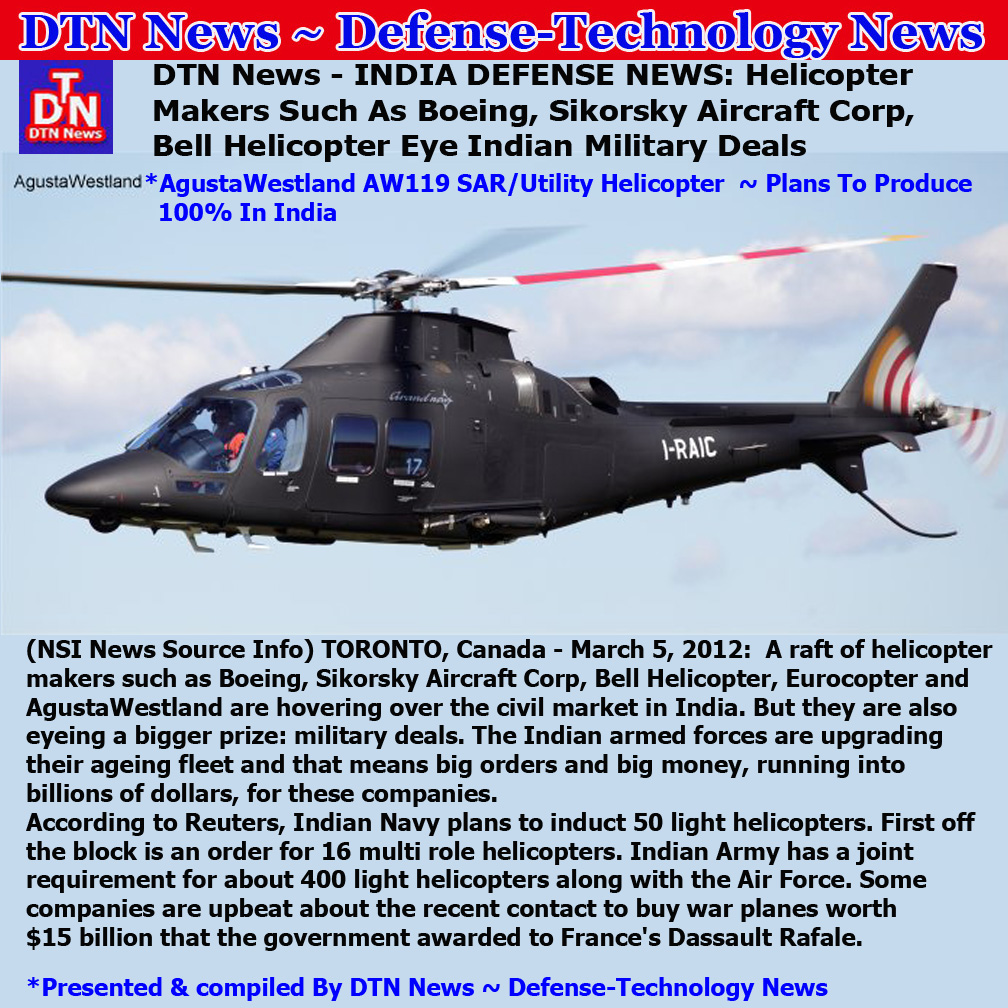
DTN News - INDIA DEFENSE NEWS: Helicopter Makers Such As Boeing, Sikorsky Aircraft Corp, Bell Helicopter Eye Indian Military Deals

DTN News - INDIA DEFENSE NEWS: Helicopter Makers Such As Boeing, Sikorsky Aircraft Corp, Bell Helicopter Eye Indian Military Deals
Source: DTN News - - This article compiled by Roger Smith from reliable sources Economic Times
(NSI News Source Info) TORONTO, Canada - March 5, 2012:  A raft of helicopter makers such as BoeingSikorsky Aircraft CorpBell HelicopterEurocopter andAgustaWestland are hovering over the civil market in India. But they are also eyeing a bigger prize: military deals. The Indian armed forces are upgrading their ageing fleet and that means big orders and big money, running into billions of dollars, for these companies. 

According to Reuters, Indian Navy plans to induct 50 light helicopters. First off the block is an order for 16 multi role helicopters. Indian Army has a joint requirement for about 400 light helicopters along with the Air Force. Some companies are upbeat about the recent contact to buy war planes worth $15 billion that the government awarded to France's Dassault Rafale. 

Mick Maurer, president of Sikorsky Military Systems, says the procurement process in India is getting better. "It is more rigorous and more transparent. We believe that suits us very well." Maurer says in the long term, Sikorsky sees a 3:1 ratio vis-a-vis the military and commercial sales in terms of the size of the market. But he says both are very complementary markets. Many of the machines can be used for commercial and quasi-defence activities. 

If the civil copter market in India has come alive, it is thanks to the armed forces. Foreign companies in the defence market are bound by what is called offset obligations. India's defence procurement policy rules that foreign companies require that win contracts of 300 crore or more must procure equipment worth at least 30% of the deal amount from local suppliers to boost the homegrown arms industry. 

The Indian military has also become smarter, according to foreign company executives. "Sometimes manufacturers give a special price on aircraft, but raise the price on the support side. India has become aware of this and now looks at the total lifecycle costs in deals," says Maurer. 

The upshot is that companies like Sikorsky and Eurocopter have partnered Indian counterparts to set up base in India. Sikorsky has formed two joint ventures with the Tatas to make helicopter cabins and aircraft components. Eurocopter, which formed an Indian unit in 2010, has tieups with the Mahindras, the Tatas and governmentowned Hindustan Aeronautics Limited. AgustaWestland, the helicopter unit of Finmeccanica SpA of Italy, has a joint venture with the Tatas called Indian Rotorcraft. 

All these companies plan to expand in India. Textron, the parent company of Bell Helicopter, has opened a new global technology centre in Bangalore with more than 400 engineers. Bell plans to expand the workforce there over the next year, says the company's India head, BS Singh Deo. An AgustaWestland spokesman says the company recently opened a new larger office in Delhi. Copter makers are also expanding the customer support network by establishing authorised service centres along with a posse of engineers and technicians. 

All this bodes well for the commercial market. The AgustaWestland spokesman says construction work is about to start on the Indian Rotorcraft's facility in Hyderabad , which will produce the company's eight-seat utility helicopter AW119. Sikorsky eventually plans to produce helicopters that are virtually "100% done here" . "We are already a local company," says Maurer.


*DTN India  @DTNIndia ~ Available on Twitter
Comprehensive Daily News on India Today ~ © Copyright (c) DTN News Defense-Technology News

*Link for This article compiled by Roger Smith from reliable sources Economic Times
*Speaking Image - Creation of DTN News ~ Defense Technology News 
*This article is being posted from Toronto, Canada By DTN News ~ Defense-Technology News Contact:dtnnews@ymail.com 
©COPYRIGHT (C) DTN NEWS DEFENSE-TECHNOLOGY NEWS