Saturday, July 26, 2008

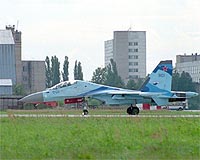
Russia: Sukhoi Su-35

Russia's Sukhoi Su-35
July 26, 2008: Su-35 is considered to be one of the world's most advanced fighters. The first prototype of the Su-35 was completed last year (2007) at the Komsomolsk-on-Amur aviation Production Association (KnAAPO) and was displayed in public for the first time during the MAKS 2007 airshow. The aircraft is equipped with two AL-37F (Saturn 117S) engines, designed as modern derivatives of the AL-31F. The new engine is developing 16% increase in power (14,500 kg maximum thrust) it is fitted with independent (asymmetric) thrust vectored nozzles, a new fan, high and low pressure turbines and improved digital controls. The new engines are also more robust, offering lower maintenance requirements and longer lifespan (up to 4,000 hours between main overhaul). The aircraft uses a triple-redundant 'fly by wire' flight control; compared to its predecessors, Su-35 has an improved, integrated aerodynamic and propulsion control enabling the flight control system to perform acceleration, deceleration, roll, pitch and yaw utilizing thrust vectoring in addition to classic aerodynamic control, alleviating the need for the super-sized air-brake and canards used in previous models. Availability of improved controls enabled the designers to reduce the aircraft radar signature (radar cross section RCS), particularly in head-on engagement pattern. (± 60° off axis). The aircraft is fitted with 12 hardpoints for external loads weighing a total 8,000 kg. Advanced Avionics: The cockpit has a 'glass cockpit' design, utilizing two large 15" multi-function color LCD displays, a head-up display and full HOTAS functionality. The main sensor is an X-band E-Slavia radar allowing detection and tracking up to 30 air targets while scanning a wide sector (track while scan). The radar and fire control can simultaneously engage up to eight targets. Production models will be fitted with the Tikhomirov NIIP Irbis radar, capable of detecting and tracking aerial targets with average radar cross-section of three square meters, operating at ranges of up-to 400 km (216nm). Irbis offers a wide area coverage of Irbis 70 to 120° with azimuth resolution of (in 2 -2.5 times), increased range, and better ECCM compared to its predecessors. The development of this radar began in 2004. The system completed ground tests in the lab and is preparing for the initial test flights on a Su-30MK2 testbed.

Auto News: Jaguar sales in top gear; Land Rover softens

Jaguar sales in top gear; Land Rover softens 26 July, 2008 - NEW DELHI/LONDON: When Tata Motors bought Jaguar and Land Rover, conventional wisdom was that Jag was a drag and Land Rover the deal steal. A month down the road, things have changed dramatically. Jaguar sales, based on the XF, have been in top gear, but Land Rover is now hitting skid row. The problem: while the Jag is a small-volume brand, Land Rover is the brand that brings in the numbers and a reversal in the latter’s fortune could spell trouble. Sources say there could be pressure on JLR pension schemes if the current market volatility continues. According to a study by Pension Protection Fund-a British body that helps protect employees of bankrupt companies-final-salary pension schemes saw their surplus shrink from £53 billion to just £8 billion due to stock market skids between end-May and end-June. The deficit of loss-making schemes jumped from £46 billion to £63 billion during the period. However, the official JLR spokesperson explained that “as of now JLR pension plans are okay. We can’t comment on specific monthly performance of pension schemes, but at the time of the deal the pension plans were stabilising and Ford put in $600 million”. Land Rover has had a bumpy ride ever since the American market for gas-guzzling SUVs started softening. Its June sales in the US tumbled more than 40% to 2,200 units, down from 4,160 units last June. Cumulative American numbers in the first six months of 2008 came down to 16,492 from 22,842 in 2007. Back home too it hasn’t had a great run, with fortunes fluctuating since March. In June, its west Europe sales dropped 36% as the craze for fuel-efficiency gripped both sides of the Atlantic.

Nigeria: Oil workers kidnapped

Oil workers kidnapped in Nigeria July 26, 2008: Eight foreign oil workers have been kidnapped by Nigerian militants. In the early hours of Saturday, a group of gunmen in a speed boat attacked a petroleum tanker on the Bonny river in the south of the country. Two people were shot and injured while eight oil workers, believed to include a number of Russians, were kidnapped. More than 200 foreign oil workers have been kidnapped in the Niger Delta over the past two years but often released after payment of ransom. It is believed the tanker belonged to Global Gas and Refining Ltd, a Nigerian subsidiary of US-based Global Energy Inc, which has been stationed along the Bonny river for more than two years. Lt Col Sagir Musa, military spokesman in the eastern Niger Delta, said: "Around six heavily armed bandits attacked an LPG (liquefied petroleum gas) tanker, shot two civilians and abducted eight of the expatriates, whose identity is not yet ascertained." He said the two civilians had been wounded but not killed during the attack, which took place between 0100 and 0400 (0000-0300 GMT). Lt Col Musa said no group had claimed responsibility, but the motive was believed to be financial. Late on Thursday, 12 people were kidnapped from a boat near the Niger Delta. Seven of them were later freed but five people remain captive.

DTN News: Attack Becomes Defence In Helmand

DTN News: Attack Becomes Defence In Helmand
(NSI News Source Info) Helmand - July 26, 2008: At 3.30am, lit by a three-quarter moon, a line of heavily armed men filed out of their British Army base. Just a few hours earlier their Helmand camp had been attacked by mortars and rockets, but now they were preparing to take the fight back to the Taleban. The notorious "green zone" of trees and fields is just a few hundred metres from forward operating base Inkerman in the Helmand river valley, but it's where the insurgents fight from. The mission was using darkness to push deep into their territory and then strike at first light. They expected to meet heavy resistance, but they couldn't have predicted that their well-planned offensive would turn into a race back to camp within hours. It's been a hot, dusty and already bloody summer for the 2nd Battalion of the Parachute Regiment. Their base is a northern buffer to stop attacks on Sangin - an important town where a fragile bubble of security has been created to try and win people over by improving their lives. And the Taleban now have an arsenal of weapons to throw at UK forces: rockets and mortars fired into the camp, ambushes with small arms fire and rocket propelled grenades, booby traps or roadside bombs, and suicide bombers. Just a few weeks earlier three British soldiers were killed within sight of their base after a suicide bomber rushed a patrol and blew himself up. Thoughts of that attack and of the bombs now so regularly planted for them would have been in the troops' minds as they took up their positions and waited for sunrise. A look at the scene of a battle in AfghanistanBefore they left news had come in of another British serviceman being killed and two badly injured further up the valley. By first light they had overheard the Taleban who had been taken by surprise and they started to move quickly through the compounds looking for weapons. Then word came back to the commanding officer, Maj Stuart McDonald who had come to Inkerman base with reinforcements from 3 Para, that they had seen Taleban fighters, and he gave the order to open fire. A rattle of a machine gun was heard from just ahead and using a remote controlled spotter plane to identify insurgent positions he called in mortar fire and artillery. The troops cheered and laughed as the bombs struck and the smoke rose. As we pushed forward, one soldier we saw on the patrol grinned and said: "At least we got them first this time." For once Maj McDonald and British troops here were on the offensive. With the cover of tree lines, high-walled mud compounds, two-metre high corn and deep irrigation ditches the Taleban are difficult to fight on their own territory. They have a network of spies, or "dickers" as they are known, who watch British movements and report back to the fighters. It's the same tactic that was used in Northern Ireland and it's very effective for planning ambushes or laying improvised bombs in the path of the soldiers. But this time they were caught out. A sniper moved forward to watch a tree line just a few hundred metres ahead. We moved up next to him as more mortars were called in. We felt them overhead, there was a eerie whizzing sound and then the fields shook with smoke and dust. But amid the explosions, shouts from behind to "check fire" - stop firing - were heard. The first mortar had fallen short and landed where we had been sitting amid the command group. The soldier we had been chatting to had been hit by shrapnel. It wasn't life threatening, but he'd lost a lot of blood when an artery in his arm was punctured. The second in command, Capt Sean Williams, had also been hit in the knee by shrapnel. It was surprising more troops were not injured or even killed in the blast. The mortar bomb had been faulty - it had not been human error - but a week after a British Apache helicopter fired on friendly forces in the same valley, it was a reminder of how risky fighting these operations can be. Suddenly the operation went from offensive to defensive - they were a kilometre and a half (about a mile) from base and the Taleban had the advantage. Through the thick mud of irrigated fields and over open ground the stretcher bearers moved as fast as they could, finally reaching the safety of camp and a medical helicopter. Maj McDonald was expecting to be ambushed, but the Taleban "dickers" were not quick enough. Following the patrol for a few hours was just a snapshot of a typical day in Helmand - moving a short distance from a base, clashing with the Taleban and then pulling back into camp. It's a strange war where neither side seems to gain much ground, and it was amazing how one small incident changed the whole dynamic - from attacking to defending. Commanders say more troops would mean they could hold the gains they make and stop this cycle of taking and re-taking ground, but Helmand is a very big place and would need thousands more troops to make that difference.

DTN News: India HAL To fly Into Latin America Market With Cheetah

DTN News: India HAL To fly Into Latin America Market With Cheetah
(NSI News Source Info) NEW DELHI - July 26, 2008: After tasting success with its Advanced Light Helicopter (ALH) Dhruv’ helicopters, state-owned Hindustan Aeronautics Ltd (HAL) is poised to make further inroads into the Latin American market with its light helicopter Cheetah. According to highly placed sources in the ministry of defence (MoD), “Surinam and Colombia have expressed interest in the ‘Cheetah’ helicopters.” These countries have seen the performance of these helicopters and a team will probably travel there for the display, sources said. The Cheetah is a multi-functional, simple, light-weight helicopters which has specially been designed for operations over long distances. The five-setter Cheetah, can be used for observation, surveillance, logistic support, earth research and rescue operations. “The Cheetah has been manufactured by the HAL for both military and civil purposes and is the version of the SA 315 Lama under licence of Turbomeca in France,” explained officials. “The queries that we have received for the Latin American countries are for the civilian usage,” said sources. These machines have the ability over the latest technologies like a hydraulic servo control, ultra sensitive constant speed indicator and a automatic start system so that the machine can be started in a very short time. Presently, the MoD is working on a plan to acquire 400 light helicopters for the armed forces to replace its ageing Cheetah and Chetak fleet, which the Army and Air Force have been using for more than three decades. India is expected to buy half of the helicopters from a yet-to-be decided foreign vendor and the state-run HAL will be asked to design and build the remaining. Also, for the India Navy’s rotary UAVs, an agreement has already been reached with IAI of Israel for joint development, under which the conversion of the Cheetah helicopter will be done with introduction of automated controls. “The choice of Cheetah was obvious as we have them in large numbers, all the three services use them and they are time-tested. While the contract has yet not been signed, we have started work on collection of aerodynamic data on Cheetah helicopter so that necessary flight control systems can be developed,” said officials of HAL. To start with, two Cheetah helicopters will be converted—one in India and another in Israel. Subsequently, HAL will produce fresh Cheetah helicopters with the automatic control system in place.

Friday, July 25, 2008

How Taliban is using technology

How Taliban is using technology
26 July, 2008 - KABUL: The once media-shy Taliban have gone hi-tech with DVDs, mobile phone messages, ring-tones, emails and a website to publicise their exploits and lambast their Afghan and Western enemies, a think-tank said. The Taliban hanged televisions and music tapes from trees in an effort to stamp out corrupting Western influences during their hardline Islamist rule of Afghanistan from 1996 to 2001. Their leaders had only one computer, Afghanistan experts say.
But after US-led and Afghan forces toppled the austere movement following the September 11, 2001, attacks, the militants regrouped and re-launched their insurgency in 2005, copying the tactics of roadside and suicide bombs from Iraq. Now, the Taliban have also created a "sophisticated communications apparatus" using the full range of media allowing them to project an "increasingly confident movement,” the International Crisis Group (ICG) said in a report. With their own website, magazines, DVDs, audio cassettes, pamphlets and mobile phones, the ICG says, the Taliban are able to capitalise on mistakes made by the government and its allies and reveal their own “inflated tales of battlefield exploits.” Taliban statements emailed to the media talk of killing “puppet terrorists,” meaning Afghan security forces, and destroying "occupation tanks" and seizing their arms. So-called night-letters are delivered to homes warning Afghans against cooperating with the government and international troops, while DVDs, text and video messages are aimed at the more tech-savvy.
Alienation The ICG said the Afghan government and its allies must try harder to combat weakening public support and alienation caused by arbitrary detentions and civilian casualties which the Taliban are able to exploit through their media. "Whatever the military benefits of arbitrary detentions, they are far outweighed by the alienation they cause," the ICG said. A series of air strikes by international forces in Afghanistan in the last month, Afghan officials say, have killed more than 60 civilians. "The effectiveness of aerial bombardment, even if strictly exercised within the bounds of international law, must be considered against the damage to popular support," the ICG said. The Taliban, it said, are not going to be defeated militarily and are resistant to outside criticism. "Rather the legitimacy of its ideas and actions must be challenged more forcefully by the Afghan government and citizens," the ICG said. Militants should be held to public account for killing civilians and targeting community leaders through open trials, and the Afghan government and its international allies should similarly be bound by the rule of law, the ICG said. "Ultimately, winning popular support is not about telling local communities that they are better off today. It is about proving it," it said.

Venezuela to sell oil at $100 a barrel to Spain: Chavez

Venezuela to sell oil at $100 a barrel to Spain: Chavez
July 25, 2008 - MADRID: Venezuela will sell Spain up to 10,000 barrels of oil per day at 100 dollars a barrel in exchange for imports of medical equipment and other goods, Venezuelan President Hugo Chavez said on Saturday. The roughly 400 million dollars (255 million euros) which will be raised from the sale of this oil will be deposited in a bank account in Madrid which will be used by Venezuela to pay for the imports, he said in an interview with Spanish public television TVE .
"This could allow us to create a new international financial architecture in the future. It is a trial, an invention, I think it is time to start inventing new mechanisms of cooperation," he said, adding the oil sales would start "soon". "This will allow us to import food, medical equipment, technology, technology for wind energy which is of great interest to us," he added. Chavez said the agreement was finalised during his meeting with Spanish Prime Minister Jose Luis Rodriguez Zapatero on Friday in Madrid. Oil prices hovered around 125 dollars a barrel on Friday after reaching a record high of over 147 dollars on July 11. Venezuela already provides oil at reduced prices to several Latin American countries including Cuba. Chavez said he had also agreed during his visit to allow Repsol to boost its presence in the Orinoco oil belt in eastern Venezuela. "You will have oil supplies guaranteed for 100 years because Venezuela has oil for 200 years," he told TVE . Venezuelan state-owned oil firm PDVSA estimates there are a total 235 billion barrels of crude in the Orinoco belt. Chavez's visit to Spain was the last stop of a tour of Europe that has already taken in Russia, Belarus and Portugal.

SOF To Convert One C-27J To Gunship Lite

SOF To Convert One C-27J To Gunship Lite July 25, 2008: The Pentagon is planning this fiscal year to buy one C-27 for quick modification as a prototype gunship to augment U.S. Air Force Special Operations Command’s (AFSOC) existing AC-130 fleet. A $1.8 billion reprogramming request from the Pentagon for FY ’08 includes a set aside for $32 million for the purchase of a single C-27, which would be modified to include “proven/known” weapons, sensors and other tactical systems for what AFSOC is calling an AC-XX Gunship Lite prototype. “This prototype will serve as a risk mitigation effort to field a new platform to operate in austere locations, with increased operational flexibility and a smaller support tail of manpower and logistics,” the reprogramming request states, noting the effort is a new start. The U.S. Army and Air Force are already on contract to buy the first C-27Js for use as light cargo transports. The aircraft are being built by an L-3/Alenia North America team, with Boeing continuing negotiations to help stand up a U.S.-based final assembly plant in Florida. Another $11.5 million is requested to execute an AC-XX feasibility study and engineering analyses associated with the so-called Gunship Lite. Further funding for the procurement of the aircraft is likely to be in the FY ’10 budget, which is now being crafted at the Pentagon. In congressional testimony earlier this year, the Special Operations Command’s (SOCOM) chief said SOCOM was trying to roll out a small fleet of gunship-oriented C-27Js but was struggling under competing Air Force budget pressures, as well as the need to pursue necessary funds via an unfunded priority list to Congress that is not part of the regular appropriations process. He told senators that it would be an “exaggeration” to say SOCOM and the Air Force were equally eager to fund the small gunship variant, but the armed service supported the combatant command’s effort nevertheless (Aerospace DAILY, March 10). SOCOM, which has limited acquisition authority of its own, listed $30 million for a “gunship lite prototype” as a high priority in its annual unfunded procurement wish list this year. Meanwhile, AFSOC has also dashed its plans to field a 30mm weapon on the AC-130U gunship. Command officials had hoped to replace the AC-130’s 40mm and 25mm weapons with a common 30mm system. But it fell short in testing. “Flight-testing revealed that it is operationally unsuitable due to unsatisfactory gunfire accuracy,” the reprogramming says. Legacy systems AFSOC is adding the 40mm and 25mm weapons back to the four AC-130Us delivered with the 30mm gun configuration. The omnibus includes a request to shift funding from the 30mm program back into the legacy systems. Also for AFSOC, the Pentagon requests $7.5 million be transferred from an account for the MC-130W weapon system trainer to one that will purchase a U-28A trainer. AFSOC has begun to purchase the modified Pilatus PC-12 fixed wing aircraft for use in low-profile intratheater lift missions. A separate line-item in the omnibus reprogramming also calls for $23.9 million to be dedicated toward the purchase of six PC-12s for use as communications relay systems for the Air Force. The mission is now being handled by C-130s and EA-6B Prowlers, which are badly needed to conduct other missions. This is also a new start program.

Cooperation a key to the international aviation market

Cooperation a key to the international aviation market 25/ 07/ 2008: MOSCOW - On July 14-20, Farnborough, a town in Hampshire, England, 30 miles west of London, hosted the 46th International Air Show, the largest such event featuring the latest achievements of the global aircraft industry. Spectators liked the prototype Boeing B-787 Dreamliner that remained grounded during the show and the low-noise Airbus A-380 jumbo jet that thrilled everyone with its clean lines and smooth performance. Russian aircraft makers displayed mock-ups of the Mikoyan-Gurevich MiG-29-OVT Fulcrum air-superiority fighter with a vectored-thrust engine, the Sukhoi Su-35 Flanker, multi-role fighter and the civilian Sukhoi SuperJet-100 medium-haul airliner. In contrast, on July 7, military attaches from South East Asia and Latin America were shown a prototype Su-35 in Zhukovsky near Moscow. Why did the Russians bring only aircraft mock-ups to Farnborough? Should our companies attend the show without taking part in demonstration flights? Mikhail Pogosyan, CEO of Russian aviation giant Sukhoi Holding Company, said foreign experts appreciated the national aircraft industry's development levels, and he said the Su-35 and the SSJ-100 were currently being tested. Instead of taking part in expensive demonstration flights, the company wanted to streamline both planes and to finance more important projects, Pogosyan told RIA Novosti. Nevertheless, Russian companies, including Sukhoi, were very popular at the show in Farnborough. Sukhoi Civil Aircraft, a Sukhoi Holding subsidiary, and the Avialeasing Company offering professional services in aircraft leasing signed a preliminary contract for the delivery of 24 SSJs in Farnborough. SuperJet International, a joint venture involving Sukhoi Holding, Sukhoi Civil Aircraft and Italy's aerospace engineering corporation Alenia Aeronautica, a subsidiary of Finmeccanica, said it had signed two more contracts for the sale of 25 SSJ-100s. The company said Aeroflot, the largest Russian airline, as well as companies in France, Italy and The Netherlands, had ordered 100 airliners to date, and that delivery would begin next year. The Farnborough Air Show highlighted cooperation and co-production arrangements between Russian and foreign companies. Colonel General Vladimir Popovkin, Russia's Deputy Defense Minister in charge of weapons procurement, General Staff Chief Army General Nikolai Makarov and Air Force Commander Colonel General Alexander Zelin, visited Farnborough on July 14. General Popovkin later told Russian journalists that every aircraft displayed in Farnborough was the result of international cooperation. "Isolated decisions and isolated production are becoming history," General Popovkin said, promising that non-strategic Russian military aircraft would also feature foreign-made equipment. Russian armored vehicle producers recently bought thermal imaging systems, also known as infrared night vision devices, worth $1 billion, from France's company Thales. The Su-30MKI multi-role fighter being supplied to India features French, Israeli and British avionics. The SSJ-100 program involved 30 foreign companies, including Boeing, Snecma, Alenia Aeronautica, Thales and Honeywell International. Russia's United Aircraft-Building Corporation (UABC) that consolidates private and state assets manufacturing, designing and selling military, civilian, freight, and unmanned aircraft and the European Aeronautic Defense and Space Company (EADS) signed a contract to convert 30 A-320 and A-321 passenger airliners into cargo planes for AerCap, a global aviation and leasing company based in The Netherlands. Fifteen of these airliners will be refitted in Lukhovitsy near Moscow, and the rest in Dresden, Germany. This will make it possible to retain skilled workers in both countries and to pave the way for long-term cooperation. Sergei Chemezov, CEO of Russian Technologies, an emerging industrial behemoth with assets in many sectors, from defense to automotive to civil aviation, discussed a Russian-U.S. joint venture now being established in Verkhnyaya Salda in the North Ural Region. Until recently, billets supplied by Russia's VSMPO-AVISMA, the world's largest titanium producer, to Boeing and Airbus were machined at plants in Europe and in Japan and used for load-bearing structures of the B-787 Dreamliner and the A-380 landing gear. This production will now be relocated to Russia. Boeing finds the deal profitable because the billets no longer have to be delivered to Europe and Japan and because Verkhnyaya Salda workers are paid less than their foreign counterparts. VSMPO-AVISMA will also profit from processing titanium shavings. There are many other examples of cooperation between Russian and foreign companies. Pogosyan said that 20 years ago, the Soviet Union returned to Farnborough for the first time in 50 years, displaying its Su-24 Fencer tactical bomber and Su-25 Frogfoot ground-attack jet, the Su-27 Flanker, MiG-29 Fulcrum and MiG-31 Foxhound fighters there. At that time, the U.S.S.R. had the reputation of a formidable military superpower. Things have changed a great deal since then. The Russian aircraft industry now offers military and civilian aircraft, air-traffic safety, servicing, repair and upgrade systems and related logistics. Moscow is actively involved in international co-production arrangements and is ready to implement other mutually beneficial projects. Russian companies need to take part in international air shows such as Farnborough, and in Le Bourget near Paris, in Berlin, Singapore, Cape Town and on Langkawi Island, Malaysia, to promote Moscow's economic and political interests.

Sukhoi Su-35 Flanker

Sukhoi Su-35 Flanker
Moscow - July 25, 2008 The Sukhoi Su-35 Flanker is not quite a fifth-generation combat fighter, but it comes very close to being one. Under current plans, Russia will not be producing a fifth-generation air superiority fighter until 2015. However, the technical characteristics of the Sukhoi Su-35BM are high enough to fulfill this task, outmatching all the modern American, French and European Union generation 4-plus fighter designs, including the Super Hornet, Rafale and Typhoon. The Sukhoi Su-35 is able to withstand even the world's only fifth-generation fighter now in production, the F-22, though it is much cheaper than the American fighter -- its cost is around $40 million, compared with $300 million for the F-22. Regarding the Russian Defense Ministry's plans, the question emerges whether Russian industry would be capable of launching production in the required numbers within the scheduled period. The answer is more likely to be positive: The industrial capacities are beyond doubt, as the production of numerous modifications of Sukhoi Su-27s and Sukhoi Su-30s for export is on the rise. What the program requires is uninterrupted state funding. With the Sukhoi Su-35 launched into mass production in 2011, the 182 aircraft ordered by the Russian Defense Ministry would be delivered by 2020. By that time the Russian air force would have between 120 and 140 upgraded Sukhoi Su-27s and 30 to 40 fifth-generation fighters, enabling the air force to maintain its combat potential in the next two to three decades. There have been many successful designs in the history of aviation, but only a few could match rising combat requirements for a number of years, like the famous piston-engined Messerschmitt Bf-109 and North American P-51 Mustang air superiority combat fighters of World War II, the Tupolev Tu-95 Bear and Boeing B-52 Stratofortress strategic bombers, and the Sukhoi Su-27. The T-10 prototype made its maiden flight in 1977 and another flight in 1981 after major improvements. The fighter went into mass production as late as 1984, and it still has the combat potential sufficient to remain one of the world's best aircraft. The Sukhoi Su-35BM, taking to the skies in 2008, showed even higher performance, an unprecedented improvement on a design developed 30 years ago. It's not easy to forecast what lies ahead for the Sukhoi Su-35, but no doubt it will live through a few decades of service with gradual renewal of armament and avionics, until the moment when this fighter, along with more sophisticated aircraft, will be replaced by aerial vehicles based on new physical principles. (Ilya Kramnik is a military commentator for the RIA Novosti news agency. This article is reprinted by permission of RIA Novosti. The opinions expressed in this article are the author's and do not necessarily represent those of RIA Novosti.) (United Press International's "Outside View" commentaries are written by outside contributors who specialize in a variety of important issues. The views expressed do not necessarily reflect those of United Press International. In the interests of creating an open forum, original submissions are invited.)