Sunday, September 21, 2008

The US Navy’s Nuclear Propulsion Contracts

The US Navy’s Nuclear Propulsion Contracts
(NSI News Source Info) September 22, 2008: Several navies around the world currently use nuclear propulsion in at least some ships and submarines: The USA has had an all-nuclear submarine fleet for over 50 years, a policy that dates back to Adm. Hyman Rickover. As our readers were quick to point out, Britain’s sale of its SSK Upholder Class to Canada (as the problem-plagued Victoria Class) made them an all-nuclear fleet as well. China, France and Russia use naval nuclear propulsion within mixed submarine fleets, and India is currently working to join this club via its SSN program. On the surface, France’s trouble-plagued FNS Charles de Gaulle carrier joins America’s carriers, which will soon become an all-nuclear fleet with the retirement of the USS Kitty Hawk [CVN 63].
The saga of the Charles de Gaulle serves as a reminder that adapting nuclear propulsion technology to the small spaces of a submarine, or fitting them to a surface warship, is no trivial feat. Much can go wrong, even in nations that have used nuclear naval propulsion for some time. On the flip side, advances in design can offer significant benefits. The new nuclear plants in America’s Virginia Class and Seawolf Class fast attack subs, Britain’s new Astute Class fast attack submarines, and the USA’s forthcoming CVN-78 Gerald R. Ford Class aircraft carriers, offer designs that will save billions over the life of each ship by eliminating the standard mid-life reactor refueling. This Spotlight article currently covers related American nuclear propulsion contracts since the beginning of FY 2006. Note that all contracts noted here are awarded by The US Naval Sea Systems Command in Washington, DC, and that completion date or other additional information are provided for Naval Nuclear Propulsion Program contracts as a matter of official policy. Other contracts related to maintenance, however, may show completion dates. The latest item is a $6-10 billion contract to Bechtel, which will take over operation of the Bettis and Knolls Atomic Power Laboratories in 2009… The Contracts (FY 2006 – Present) Sept 18/08: Bechtel Marine Propulsion Corp. in San Francisco, CA receives a cost plus fixed fee contract for “Naval Nuclear Propulsion work.” What this means is that Bechtel Marine Propulsion Corporation (BMPC) has been awarded contracts to operate the Bettis and Knolls Atomic Power Laboratories, under a 5-year contract with the Department of Energy (DOE) and the U.S. Navy’s Naval Sea Systems Command (NAVSEA). This contract was competitively procured, with 3 offers received via the U.S. Department of Energy’s Industry Interactive Procurement System (N00024-08-C-2103). The Bettis Atomic Power Laboratory is currently operated by Bechtel Bettis, Inc.; it has facilities in Pittsburgh, PA; Idaho Falls, ID; and Charleston, SC. The Knolls Atomic Power Laboratory in Schenectady, NY, is currently operated by Lockheed Martin subsidiary KAPL, Inc. BMPC will assume operation of the Bettis and Knolls Atomic Power Laboratories on Feb 1/09, following a 4-month transition period. Bechtel’s release values this contract at $6 billion, but the Pentagon’s DefenseLINK adds that the contract includes options which, if exercised, would bring the cumulative value to an estimated $9.724 billion. Work will be performed in Schenectady, NY (30%); Idaho Falls, ID (15%); and Pittsburgh, PA (55%). April 16/08: Bechtel Plant Machinery Inc. in Pittsburgh, PA received an $80.2 million cost-plus-fixed-fee contract modification to previously awarded contract (N00024-07-C-2100) for Naval Nuclear Propulsion Components. Work will be performed in Pittsburgh, PA (99%) and Schenectady, NY (1%). Feb 22/08: Bechtel Plant Machinery Inc. in Pittsburgh, PA received a $312.6 million modification to previously awarded cost-plus-fixed fee contract (N00024-08-C-2118) for Naval nuclear propulsion components. Work will be performed in Pittsburgh, PA (68.3%, and Schenectady, NY (31.7%). Dec 6/07: Bechtel Plant Machinery Inc. in Pittsburgh, PA received a $165.7 million modification to previously awarded contract (N00024-07-C-2100) for Naval Nuclear Propulsion Components. Work will be performed in Pittsburgh, PA (74%), and Schenectady, N.Y. (26%). Oct 16/07: Bechtel Plant Machinery Inc. in Pittsburgh, PA received a $282.3 million cost-plus-fixed fee contract for Naval Nuclear Propulsion Components. Work will be performed in Pittsburgh, PA (62%) and Schenectady, NY (38%). The contract was not competitively procured (N00024-08-C-2118). Oct 16/07: Bechtel Plant Machinery Inc. in Pittsburgh, PA received a $124.4 million cost-plus-fixed fee modification to previously awarded contract (N00024-07-C-2102) for additional naval nuclear propulsion components. Work will be performed in Pittsburgh, PA (52%) and Schenectady, NY (48%) (N00024-07-C-2102). Oct 12/07: Bechtel Bettis Inc., Bettis Atomic Power Laboratory, West Mifflin, PA received a $450.7 million cost-plus-fixed-fee modification to previously awarded contract (N00024-98-C-4064) for Naval Nuclear Propulsion work at the Bettis Atomic Power Laboratory. Work will be performed in West Mifflin, PA. Contract funds in the amount of $242.2 million will expire at the end of the current fiscal year. GlobalSecurity.org notes that: “Bettis [Atomic Power Laboratory] is engaged solely in the design and development of naval nuclear propulsion plants. The Naval Nuclear Propulsion Program is a joint Navy/DOE program responsible for all matters pertaining to Naval nuclear propulsion. This Program is distinct from the remainder of DOE both by Presidential Executive Order and by statute. The Lab provides technical support for the safe and reliable operation of existing Naval reactors. Bettis designed reactor plants for the first nuclear-powered submarine (USS Nautilus), the first nuclear-powered aircraft carrier (USS Enterprise), all of the Nimitz-class aircraft carriers, and the USS Seawolf [attack submarines]. ...A major new initiative for the Laboratory is design of the nuclear propulsion plants and electrical power systems for the next class of US Navy aircraft carriers". Whose new reactor is an important part of the effort to slash their lifetime costs by up to $5 billion per ship. Oct 11/07: KAPL Inc. (Knolls Atomic Power Laboratory) in Schenectady, NY received a $168.9 million cost-plus-fixed-fee modification to previously awarded contract (N00024-00-C-4011) for Naval nuclear propulsion work at the Knolls Atomic Power Laboratory. Work will be performed in Schenectady, NY. Contract funds in the amount of $109 million will expire at the end of the current fiscal year. June 6/07: Bechtel Plant Machinery Inc. in Schenectady, NY received a $69.9 million cost-plus-fixed-fee modification to previously awarded contract (N00024-07-C-2100) for Naval nuclear propulsion components. Work will be performed in Pittsburgh, PA (85%) and Schenectady, NY (15%). April 30/07: Bechtel Plant Machinery Inc. in Schenectady, NY received a $13.4 million cost-plus-fixed fee modification to previously awarded contract (N00024-07-C-2101) for additional naval nuclear propulsion components. Work will be performed in Schenectady, NY. Feb 28/07: Bechtel Plant Machinery Inc. in Schenectady, NY received a $7.8 million modification to previously awarded contract (N00024-07-C-2102) for additional naval nuclear propulsion components. Work will be performed in Schenectady, NY. Oct 17/06: Bechtel Plant Machinery Inc. in Schenectady, NY received a $267.5 million cost-plus-fixed fee contract for naval nuclear propulsion components, raising its contracts awarded to $442.2 million total since Oct 1/06. Work will be performed in Pittsburgh, PA (52%) and Schenectady, NY (48%). The contract was not competitively procured (N00024-07-C-2101). DID has covered previous awards to Bechtel Plant Machinery for naval nuclear propulsion components, including the previous 2 entries, plus FY 2006 awards for $166.3 million in December 2005, and another $272.2 million in October 2005. A FY 2006 award for $35.6 million was also made in on May 25, 2006, but not covered by DID at the time. Oct 16/06: Bechtel Plant Machinery Inc. in Schenectady, NY received a $44.8 million cost-plus-fixed fee contract for naval nuclear propulsion components, which can be added to the Oct. 12, 2006 award to get a total of $174.7 million. Work will be performed in Schenectady, NY. The contract was not competitively procured (N00024-07-C-2102). Oct 12/06: Bechtel Plant Machinery Inc. in Schenectady, NY received a $129.9 million cost-plus-fixed fee contract for Naval nuclear propulsion components. Work will be performed in Schenectady, NY (48%) and Pittsburgh, PA (52%). The contract was not competitively procured (N00024-07-C-2100) Oct 12/06: Bechtel Bettis Inc., Bettis Atomic Power Laboratory in West Mifflin, PA received a $461.1 million cost-plus-fixed fee modification to previously awarded contract N00024-98-C-4064 for naval nuclear propulsion work (FY 2006 award: $480.7 million). Work will be performed in West Mifflin, PA. This action represents funding of the contract’s 7th year of effort, and contract funds in the amount of $104.7 million will expire at the end of the current fiscal year. Oct 12/06: KAPL Inc. (Knolls Atomic Power Laboratory) in Schenectady, NY received a $160.4 million cost-plus-fixed-fee modification to previously awarded contract N00024-00-C-4011 for Naval nuclear propulsion work at the Knolls Atomic Power Laboratory during fiscal year 2007 (FY 2006 award: $138.6 million). Work will be performed in Schenectady, NY. This represents funding for the contract’s 7th year of performance, and funding in the amount of $25.5 million will expire at the end of the current fiscal year (N00024-00-C-4011). Oct 11/06: General Dynamics Electric Boat Corp. in Groton, CT received an $18.7 million cost-plus-fixed-fee, level of effort contract for reactor plant planning yard services for nuclear-powered submarines and support yard services for Navy moored training ships. This work generally includes engineering services for lifecycle support, maintenance and modernization of the reactor plants and selected propulsion-plant systems of Los Angeles, Trident and Seawolf-class submarines, and the nuclear research submarine NR-1. Additionally, Electric Boat provides similar services for all systems on the Navy’s moored training ships in Charleston, SC. Work will be performed in Groton, CT (95%) and Charleston, SC (5%), and is expected to be complete by September 2007. This contract was not competitively procured by the Naval Sea Systems Command in Washington, DC (N00024-07-C-2103). May 25/06: Bechtel Plant Machinery Inc. Schenectady, N.Y., is being awarded a $35,611,256 cost-plus-fixed fee modification to previously awarded contract (N00024-02-C-2102) for Naval nuclear propulsion components. Work will be performed in Pittsburgh, PA (68%) and Schenectady, NY (32%). Dec 20/05: Bechtel Plant Machinery Inc. in Pittsburgh, PA received a $166,318,354 cost-plus-fixed-fee modification to previously awarded contract (N00024-02-C-2102) for naval nuclear propulsion components. Work will be performed in Pittsburgh, PA (73%) and Schenectady, NY (27%). Oct 20/05: KAPL Inc. Knolls Atomic Power Laboratory in Schenectady, NY received a $138.6 million cost-plus-fixed fee modification to previously awarded contract (N00024-00-C-4011) for naval nuclear propulsion work at the Knolls Atomic Power Laboratory. Work will be performed in Schenectady, NY. Oct 20/05: Bechtel Bettis Inc. at Bettis Atomic Power Laboratory in West Mifflin, PA, received a $480.7 million cost-plus-fixed-fee modification to previously awarded contract (N00024-98-C-4064) for naval nuclear Propulsion work at the Bettis Atomic Power Laboratory. Work will be performed in West Mifflin, PA. Oct 18/05: Bechtel Plant Machinery Inc. in Pittsburgh, PA received a $279,237,437 cost-plus-fixed-fee contract for Naval nuclear propulsion components. Work will be performed in Schenectady, NY (50%) and Pittsburgh, PA (50%). Contract funds will not expire at the end of the current fiscal year. The contract was not competitively procured (N00024-06-C-2106). Oct 14/05: Bechtel Plant Machinery Inc. in Pittsburgh, PA received a $30,200,000 cost-plus-fixed-fee modification to previously awarded contract (N00024-04-C-2104) for Naval Nuclear Propulsion Components. Work will be performed in Pittsburgh, PA.

Israel Goes For Light And Cheap

Israel Goes For Light And Cheap (NSI News Source Info) September 21, 2008: Israel is buying 28,000 U.S. M72A7 66mm one-shot anti-tank rockets. The 7.7 pound weapon has a range of 200 meters and is useful against structures as well as armored vehicles (although only the side armor of the latest tanks is vulnerable). The two pound warhead is designed to have some anti-personnel effect. Also ordered are 60,000 training rockets (which are fired from a reusable version of the M72) for practice. The A7 model can be fired from inside a building. The $2,000 M72 is the cheapest weapon in this class, and light enough for infantrymen to carry several.

Saturday, September 20, 2008

Indian AWACS Moving Forward on 2 Fronts

Indian AWACS Moving Forward on 2 Fronts (NSI News Source Info) September 21, 2008: In February 2006, “India’s Air Force Looks to Enhance Its Reach With Upgrades & Force Multipliers” discussed India’s growing shift toward aircraft that would give it the ability to patrol and act at extended ranges. In January 2004, India and Israel signed a $1.1 billion contract for 3 Phalcon airborne warning and control system (AWACS) aircraft, as part of a $1.5 billion tripartite agreement with Russia. The Prem PS-90 engines in the upgraded IL-76TD aircraft will make operation in India’s hot climates easier, and the system will also reportedly make heavy use of Russian electronics, including a partial glass cockpit. Israel Aerospace Industries’ Phalcon system is built around an ELTA EL/M-2075 AESA L-band radar, then adds electronic and communications intelligence gathering (ELINT and COMINT) capabilities. The system can also receive transmissions from other air and ground stations, and uses sensor fusion to provide a complete picture of the battlespace. IAI had already delivered an earlier-model 707-based “Condor” system to Chile, and has created a Phalcon variant for Israel and Singapore that fits into a Gulfstream 550 business jet. India already operates the IL-76 as its strategic transport aircraft and aerial refueling tanker (IL-78), however, and made its decision accordingly. Now reports are surfacing that India will extend its AWACS capabilities on 2 fronts, even as its original order will be delayed again. India’s AWACS: Platforms & Programs India’s Phalcon will use a conventional AWACS radome mounted on top, rather than the front and side structural modifications made to Chile’s Condor and the G550 Gulfstream jets. Because the Elta radar scans in 360 degrees automatically, however, the radome will be fixed rather than rotating. Mission sensors and electronics are now being fitted. India was supposed to receive the first A-50I/IL-76TD Phalcon in December 2007, but Uzbekistan’s Tashkent Aircraft Production Organization (TAPO) was late customizing the airframes. India’s first A-50I Phalcon underwent maiden flight tests in November 2007, and again in January and February 2008. Flight certification was to begin in May 2008, with first delivery set for September 2008; but first delivery now looks like it will only take place in Q1 2009. This could push final delivery of the first 3 aircraft out to 2011. Final delivery overall will be extended even longer. In April 2008, India reportedly picked up the option for 3 more IL-76 Phalcon AWACS aircraft, in a deal worth up to $2 billion. Jane’s Defence Weekly issued a concurring report later in the week, but placed the deal’s value at $1 billion. Assuming that the equipment sets are the same and inflation is 3% per year, note that repeating 2004’s $1.5 billion deal works out to about $1.7 billion by 2008. Delivery of these 3 additional planes would be expected to take place in 2011-12.
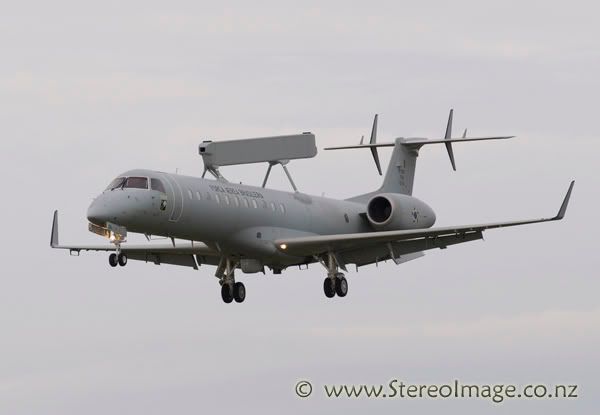
EMB 145 Erieye
According to a report carried in The Hindu, this may not be the final word on India’s AWACs fleet. India has a great deal of territory to cover, and even 6 AEW&C aircraft can easily mean just 4 operational aircraft at any given time. The Indian Air Force appears to be taking the “brittle swords lesson” to heart, and is looking for another 3 small-mid size surveillance aircraft to act as counterparts to the larger Ilyushin Phalcons. While a G550 Phalcon would provide systems commonality, India’s platform of choice fr this project is Embraer’s ERJ 145 business/ regional jet. The Hindu reported a timeline that had aircraft delivery beginning in 2011, with full operational capability by 2013. The 3 aircraft together are expected to cost around R 1,800 crore (about $385 million) total when fully equipped. Subsequent reports indicate a July 2008 contract with Embraer for the aircraft. Under the agreement, Brazil’s Embraer will act as the overall system integrator, supplying the jets, mounting the radar and electronics on or into the EMB-145 fuselage, and ensuring that the altered jets retain acceptable flight performance, and handling flight recertification. The militarized ERJ 145 comes in several versions, including maritime surveillance and electronic intelligence versions. The most common variant, currently operated by Brazil and Greece, is the EMB 145 Erieye airborne early warning and control (AEW&C) aircraft1. It uses the same Saab Erieye AESA radar that will be mounted on Pakistan’s new Saab 2000 turboprop AEW&C fleet. There are some blind spots with its “dorsal blade” configuration, most notably to the front, but flight patterns can be planned around those gaps to ensure good coverage of the area in question. The Hindu report did not specify the radar involved, except to say that it is “from the [Indian] Electronics and Radar Development Establishment”. A September 2005 ACIG report claimed that the radar would be similar to Saab’s Erieye, and the accompanying illustration from India’s DRDO Centre for Airborne Systems (CABS) certainly looks very similar. This systems work with DRDO will be the real key to the Embraer AEW&C project’s success or failure. India’s state-owned DRDO research and development agency will be heavily involved in a number of areas. According to The Hindu, the Bangalore-based Centre for Airborne Systems (CABS) is responsible for overall integration of the electronic systems, mission computer, display and data handling. CABS is reportedly working with the private sector firm Astra Microwave Products of Hyderabad to develop transmit-receive multimodules [JPG format] for the radar; doing so at a reasonable cost is always a challenge for AESA radars, however, and India’s experience with the type is limited. DRDO’s Defence Avionics Research Establishment will be involved with the jet’s self-protection systems, electronic warfare suites and communication support systems; their Defence Electronics Application Laboratory will be involved with the primary sensors, communication systems and data link; and DRDO’s Defence Electronics Research Laboratory will be involved with “counter-support measures.” DRDO’s radar record is cause for some concern – the multimode radar being developed for the Tejas lightweight fighter isn’t performing properly yet, for instance, and foreign radars like the Elta M-2032 in India’s Sea Harriers are reportedly under consideration as substitutes in order to keep the already-late program on track. DRDO was also responsible for “Project Guardian/Airawat,” which suffered a disastrous project failure in 1999 when the HS-748 turboprop AWACS testbed aircraft crashed, killing several engineers and scientists who were critical to the project. The ERJ aircraft are the proposed successors to that effort. Updates and Developments Sept 18/08: The Times of India quotes Defence ministry sources as saying that the first IL-76 Phalcon will now land in India only around January-February 2009, though they are pushing IAI to deliver the aircraft before the end of 2008 despite “technical hitches in the integration work”. The Times’ report adds that India signed a $210-million deal with Brazilian firm Embraer in July 2008 for 3 EMB-145 aircraft. The intent of the INR 18 billion (about $385 million) project is to modify them with DRDO-provided radar and command systems; if that works, the jets would begin arriving in 2011-2012. India is also reportedly on course to acquire 4 more Israeli tethered aerostats and EL/M-2083 radars, at a cost of around $300 million. This follow-on to the aerostat radars inducted from 2004-2005 has reportedly been cleared by the Defence Acquisitions Council; if adopted, it would raise India’s total Airborne Early Warning aerostat purchases to about $445 million. Aerostat-mounted radars trade the advantage of mobility for incredible persistence, and are especially useful for watching key coastline and key border regions, or defending high value areas. Sept 14/08: Zee News quotes Indian Army Maj. Gen. (Retd) Mrinal Suman, writing in the September issue of Indian Defence Review, as saying that India paid twice as much as it should have for its initial order of A-50 Phalcon AWACS aircraft. ”...inability to negotiate contracts astutely has been the biggest weakness of the entire defence procurement regime…. as the vendors exploit ambiguities in the contract language, especially with respect to delivery schedules, warranties, after sales support and penalties for default.” Suman retired as Technical Manager (Land Systems) in the Indian Defence Ministry’s acquisition wing. May 16/08: The Calcutta Telegraph reports that the first 3 IL-76 Phalcons will be delayed: “A source in the Indian Air Force has confirmed that the delivery of the first Phalcon will be delayed. It was expected in September but is now more likely to reach India only at the end of the first quarter of 2009… delivery of two Aerostat radars… will also be delayed. This is the second time that the delivery schedule of the Phalcons has been disrupted. The original schedule envisaged the delivery of the first aircraft in November 2007, the second in August 2008 and the third in the second half of 2009…. The delays, however, have not dissuaded the air force from working through a proposal to ask for three more Phalcons in a follow-on order estimated at $2 billion.” April 13/08: India Defense reports that India is pleased enough to pick up the option for 3 more IL-76 Phalcon AWACS aircraft, in a deal worth up to $2 billion. Jane’s Defence Weekly issued a concurring report later in the week, but placed the deal’s value at $1 billion. Assuming that the equipment sets are the same and inflation is 3% per year, note that repeating 2004’s $1.5 billion deal works out to about $1.7 billion by 2008. Delivery of these 3 additional planes would be expected to take place in 2011-12. Footnotes 1 The terms AWACS and AEW&C can be used interchangeably. Many militaries are gravitating toward the more cubmersome “AEW&C” as standard nomenclature these days. Additional Readings & Sources Israeli Weapons – Phalcon Spyflight – Boeing 707 Phalcon The Hindu (April 20/08) – Brazilian jets to serve as eye in the sky for IAF Domain-b (April 16/08) – India to place follow-on order for three Phalcon AWACS with Israel: report Defense Technology International (April 2008) – Sky Watch: India’s air force is expanding surveillance operations. Shows an Indian IL-76/A-50, before it leaves for Israel. Air Combat Information Group (Sept 12/05) – India’s flying Testbeds. Mentions the ill-fated HS-718 project, and adds an illustration of the planned ERJ-145 variant. DID – Sweden Finalizes Saab 2000 AEW&C Contract With Pakistan. Includes details re: the Erieye radar.

Russia, France sign contract to launch 10 rockets from Kourou

Russia, France sign contract to launch 10 rockets from Kourou (NSI News Source Info) SOCHI - September 21, 2008: Russia's space agency and French satellite launch firm Arianespace signed a contract on Saturday to launch 10 Russian Soyuz-ST carrier rockets from the Kourou space center in French Guiana. The contract was signed by Russian Federal Space Agency head Anatoly Perminov and Arianespace Chairman and CEO Jean-Yves Le Gall after a session of a bilateral inter-governmental commission, which took place on the sidelines of the investment forum under way in Russia's Black Sea resort Sochi. "The contract envisions the purchase of ten Soyuz carrier rockets to be launched from the space center in Guiana... The contract is estimated at a total of $300-$400 million," Le Gall said adding that the first launch is scheduled for late 2009. The Kourou launch site is intended mainly for the launch of geostationary satellites. Its proximity to the equator will enable the Soyuz-ST to put into orbit heavier satellites than from Baikonur in Kazakhstan and Plesetsk in northern Russia. Under a contract signed in June with Arianespace, the Soyuz will have a separate launch pad near Sinnamari, a village 10 kilometers (6 miles) north of the site used for the Ariane-5, the main European-made booster. Launches of Soyuz spacecraft are the key part of the Russian-French program of cooperation in space exploration. Le Gall said three or four Soyuz boosters are planned to be launched annually as of 2010.

Russia's Fesco bids for Exxon's $300mln icebreaker project

Russia's Fesco bids for Exxon's $300mln icebreaker project (NSI News Source Info) SOCHI - September 21, 2008: Russian transportation group Fesco is bidding in a tender announced by U.S. oil major Exxon to build icebreakers worth a total of $300 million, Fesco's president said on Friday. Yevgeny Ambrosov said Fesco, the largest operator of icebreakers in the Russian Far East, has filed a preliminary bid for the tender and plans to use borrowed funds to finance the project. "Considering that we have long been working with Exxon, we have good prospects in this tender," Ambrosov said. Exxon Neftegas Limited, a subsidiary of U.S. oil major Exxon, is the operator of the Sakhalin I oil and gas project off Russia's Pacific Coast in the Far East with recoverable reserves estimated at 2.3 billion barrels of oil and 485 billion cubic meters of natural gas.

Indonesia in talks to buy Russian amphibious tanks

Indonesia in talks to buy Russian amphibious tanks (NSI News Source Info) MOSCOW - September 21, 2008: Indonesia is negotiating a deal to buy Russian amphibious tanks, the country's ambassador to Moscow said Friday. "We are currently discussing the possibility of buying amphibious tanks from Russia," Hamid Awaluddin told a RIA Novosti news conference. He did not specify the make or the number of tanks under consideration, but stressed that military-technical cooperation between Russia and Indonesia was developing "quite successfully." In late August, Russia's state-run arms exporter Rosoboronexport and the Indonesian Defense Ministry signed a $40 million contract for the delivery of 20 BMP-3F infantry fighting vehicles, to be made in 2010. The BMP-3F is specially designed for operations at sea, and with improved seaworthiness and buoyancy it can handle continuous amphibious operation for seven hours. The vehicle is capable of engaging targets at a range of up to 6 km with its antitank guided missile system 9K116-3 Basnya.

Analysis: A case for the US increasing its Raptor purchase

Analysis: A case for the US increasing its Raptor purchase
(NSI News Source Info) September 21, 2008: Since US President George W Bush's 1 May 2003 speech aboard the USS Abraham Lincoln (CVN-72) declaring an end to major combat operations in Iraq, the US Air Force (USAF) has been fighting a low-intensity war on two fronts for which its inventory is poorly suited. Since that time the USAF has been criticised for spending its strained budget on programmes that have little or no relevance to events on the ground in Afghanistan and Iraq. It has been argued in Washington that money could be better spent on platforms with more immediate applications, particularly with regards to intelligence, surveillance and recconnaisance (ISR) assets. Lockheed Martin's costly F-22 Raptor fighter aircraft is seen as an example of this unresponsive procurement strategy with the number to be acquired reduced from 381 to 183 as a result of political and budgetary pressures. Given Russia's invasion of Georgia on behalf of the breakaway region of South Ossetia on 8 August, some of the lost emphasis on preparing to fight potential future conventional war is likely to have been rediscovered. Jane's believes the case for extending the procurement of the F-22 has seemingly been strengthened by events in the Caucasus. While the conflict in Georgia will not establish a firm requirement for additional Raptors, it will give more credence to those voices that advocate the potential for future conflict with advanced states. After almost two decades of post-Soviet neglect, the Russian Air Force has begun a long, slow process of modernisation, the centrepiece of which is a plan to induct a fifth-generation fighter aircraft of its own by 2015. Simultaneously, in China both Shenyang Aircraft Corporation and Chengdu Aircraft Corporation have been involved in a fifth-generation fighter programme, dubbed J-XX. While Jane's understands that it is doubtful these aircraft will be as technologically advanced as their US counterparts, both aircraft have been designed with Lockheed Martin's fifth-generation F-22 and F-35 Lighting II Joint Strike Fighter (JSF) in mind. While the JSF programme will ensure that an additional 1,763 F-35 fifth-generation multirole fighters will enter service with the USAF alongside the F-22, it should be remembered that the F-35 was designed with a 70 per cent air-to-ground and 30 per cent air-to-air focus. While this does not mean that the Chinese and Russian designs will be a more a capable air superiority platform, neither does it guarantee that the F-35 will have the upper hand. The F-22 represents the technological pinnacle of the USAF's current air-to-air combat capability, while the F-35 does not.

Northrop Grumman secures carrier construction award

Northrop Grumman secures carrier construction award (NSI News Source Info) September 21, 2008: Northrop Grumman Shipbuilding has secured a USD5.1 billion contract for detailed design and construction of the first of a new class of nuclear-powered aircraft carrier for the US Navy. The work on Gerald R Ford (CVN 78) will include engineering, integration, advanced planning, design weight estimates, lifecycle support products, production planning and test and evaluation. The first steel was actually cut at the company's Newport News, Virginia, facility in August 2005, beginning advanced procurement work under a separate USD2.7 billion contract. The 100,000 ton, 333 m-long ship is scheduled to launch in 2013 and commission in September 2015. Eleven Ford-class carriers are planned, with construction continuing through to 2058. Image:An artist's impression of Gerald R Ford, which is scheduled to enter service in 2015 (Northrop Grumman Shipbuilding)

British Army Powerful Demonstration of Military Equipment

British Army Powerful Demonstration of Military Equipment (NSI News Source Info) Source: UK Ministry of Defence - September 21, 2008: Unmanned Aerial Vehicles scanned the horizon for enemy action. Jackal vehicles with their awesome firepower raced ahead using the latest surveillance and targeting systems. Infantry stood ready to strike with deadly sniper rifles, mortars and grenade machine guns - this wasn't a major operation in Afghanistan but the UK's largest demonstration of military equipment purchased urgently for troops in Iraq and Afghanistan. Hundreds of pieces of equipment and over 500 people gathered on Salisbury Plain for a powerful demonstration of the advanced technology and cutting-edge equipment that is supporting our troops on operations. From the heavily armoured Mastiff patrol vehicle - a hero of recent operations in Afghanistan, to sophisticated thermal imaging sights and the latest state-of-the-art cameras and remote weapons systems - all were on site and demonstrating their effect to those present. Baroness Taylor, Minister for Defence Equipment and Support said: "The Urgent Operational Requirements (UOR) process is an undisputed success - over £3Bn of extra money has been spent on new equipment for operations in Iraq and Afghanistan - from new armoured vehicles like Mastiff and Ridgback to remote weapon systems which are protecting the soldiers in their bases. "Working with our partners in industry, we have responded quickly to the evolving and often unpredictable threats our soldiers face on operations. We have listened to the feedback from the ground and procured state-of-the-art kit to meet the urgent needs of our troops. The large display of equipment here today is testament to the effectiveness of that UOR process." All the equipment demonstrated today has been recently procured or upgraded through the urgent operational requirement process, with funds coming directly from the Treasury and separate to the defence budget. Major General Bill Moore CBE, Director General Logistic Support and Equipment, Land Forces said: "The Army is well equipped on operations. The equipment fielded in both Afghanistan and Iraq, when coupled with offensive tactics, techniques and procedures enables our soldiers to seize the initiative and conduct successful operations against the insurgents. It is also saving lives." BACKGROUND NOTES: 1. The operational demonstration gave those present the opportunity to view an impressive selection of weapons, vehicles and upgrades. In most cases the equipment has been sourced and delivered in record time, thanks to the UOR process. 2. Personal protection is a vital subject and so in addition to a scenario-based demonstration of the equipment and static stands, there were specific briefings on: a) CAMP PROTECTION: New Operational Base Remote Weapon System ENFORCER by Selex and the cutting edge CORTEZ. State-of-the-art threat detection systems such as aerostat mounted cameras and ground movement sensors can produce information overload - the CORTEZ system fuses these inputs and displays them on a single user friendly digital map. If the camp is under direct threat, the new ENFORCER remote weapons system is ready to respond. b) INDIVIDUAL PROTECTION: Dismounted Close Combat - infantrymen have undergone the most radical upgrade of all. A unique opportunity to compare a soldier from 2003 with the amount of personal equipment issued on current operations. The 2008 version now benefits from the latest target acquisition and night fighting technology that add as much to personal protection as the body armour. c) VEHICLE PROTECTION: The UOR process is inherently flexible and can be just as effective in adding upgrades to equipment when new threats are detected as well as procuring new vehicles. A Warrior Fighting Vehicle was compared and contrasted from its standard variant to the new Theatre Entry Standard (Warrior (TES)) which benefits from a large number of upgrades. d) TACTICAL PROTECTION: Armour helps and mobility can keep us safer but the best protection for our troops comes from knowing what the enemy intends to do. Tactical Commanders can now see the threats that lie over the next hill. The latest versions of Unmanned Aerial Vehicle such as Desert Hawk and Hermes were on display. As a recent addition to the armoury, industry representatives were on hand to explain their role in opening up this latest new tactical dimension. (ends) Infantry Kit "Incomparable" With Five Years Ago (Source: UK Ministry of Defence; issued Sept. 18, 2008) Following improvements to the Urgent Operational Requirement system in recent years the personal kit of infantry soldiers has changed dramatically reflecting the needs of fighting counter-insurgencies in hot environments. The equipment issued to infantry soldiers has needed to develop fast over the last five years as the threat against them has continued to evolve. Urgent Operational Requirements can, in some cases, mean that kit is bought off the shelf rather than being procured and tailor made to order, speeding up the process considerably. In just five years, according to one Royal Marine, the Dismounted Close Combat Capability of the individual soldier has moved forward in "quantum leaps". Lieutenant Colonel Paul Kearney has served with the Royal Marines for 14 years and deployed to Afghanistan last year and Iraq the year before: "It's absolutely incomparable what we used five years ago to what we use now," he said. "The problem now is we have so much kit you have to choose what to take out with you each day and tailor what you need." The most important weapon system in any war is ultimately the infantry; in a modern counter-insurgency their role is even more fundamental and their personal protection an issue of strategic importance. The Osprey Body Armour is just one of the pieces of individual kit that have been developed in the last five years. It includes a fragmentation jacket with ballistic plates designed to stop armour piercing rounds which covers the entire torso and includes the capability to add side ballistic plates to protect the kidney and side profile. There are now detachable collars and epaulettes to protect the neck, upper arms and armpit area from fragmentation. Lt Col Kearney said of Osprey: "Before you had a little plate that covered your vital organs, Osprey fills your whole body and having something as robust as Osprey gives you an awful lot of confidence." ESS or OAKLEY goggles and glasses have also now replaced plastic goggles and plastic sunglasses, offering much greater fragmentation protection and the Mark 6 Helmet gives far better ballistic protection than the general issue helmet worn in 2003. Clothing has also improved significantly in the last five years, with lightweight material including Microfibre fast-wicking tee shirts and Microfibre fast-wicking socks which pull water away from the skin. In Afghanistan, explained Lt Col Kearney, troops drink 10 litres of water a day causing a lot of sweating and the possibility of chafing which this clothing prevents. In 2003 troops were issued with standard issue socks, cotton/ polyester mix tee shirts and 'desertised' standard combat boots: "The boots now are good," added Lt Col Kearney. "LOWA and MEINDL are the boots of choice and up until a couple of years ago the lads were buying them themselves as they were so good! But it's good to see the system now buying the kit the guys really want." The weapons systems for infantry soldiers have also improved significantly over the last five years with many more different types of firepower available for an eight man infantry team. The challenges of today's operational theatres mean that teamwork has never been more important and the infantry section reflects the variety and skill mix required within any great team. The idea of a generic infantryman is consigned to history as modern infantrymen each have a specific role within the team. The equipment issued reflects this more modern approach and so, in addition to the generic protection levels, they are issued with the more specific kit mix required to achieve their more specific role. Lt Col Kearney explained further: "Five years ago everyone had an SA80 Rifle and occasionally a Light Support Weapon. Now we have MIMIMI Light Machine Guns, and Under-Slung Grenade Launchers which give us the ability to pop things over hills rather than fire straight. It's much safer to fire from behind a rock. "The thing about weapons systems now is they are much safer for us as it allows us to choose the best weapon for every specific situation. "The UOR process has also upgraded the SA80 A1 Rifle, which had some criticism, to the SA80 A2 which is an excellent weapon, very robust and rarely breaks down." For Lt Col Kearney though the most impressive change in the last five years for the individual soldier has been the increased capability in Surveillance and Target Acquisition: "Protection and firepower have increased immeasurably but it is a genuine night fighting capability that takes modern infantrymen to the next level," he said. Five years ago individual soldiers were issued with Sight Unit Small Arms Triluxs, Image Intensified Common Weapon Sights and Binoculars. Now they also get Advanced Combat Optical Gun sights, Thermal Imaging Systems, Head Mounted Night Vision Systems, VIPER 2+ Thermal Imaging Weapon Sights, and Target Locating Systems. "Target Acquisition and night fighting capability. That's the thing that really sets us apart. You can go in at night and they can't see you. Being able to hit the enemy where it is really vulnerable, that saves lives. "In a low tech counter-insurgency it is technology that gives British soldiers the edge in combat. This ability now means that routine infantry soldiers now have a capability that was previously the exclusive preserve of Special Forces." (ends) Security, surveillance and 'Super Sangars' (Source: UK Ministry of Defence; issued Sept. 18, 2008) Hundreds of pieces of new equipment and over 500 people have been massing on Salisbury Plain for a powerful demonstration of the advanced and cutting-edge technology which is supporting troops on operations. From the heavily armoured Mastiff patrol vehicle - a hero of recent operations in Afghanistan - to sophisticated thermal imaging sights and the latest state-of-the-art cameras and Remote Weapons Systems (RWS) - all have been on site today, Thursday 18 September 2008, all demonstrating their effectiveness to those present. They are all key players in the Urgent Operational Requirements (UOR) process, funded by extra Treasury money to provide the fast equipment solutions that ever-changing operations demand. UORs deliver the speed and flexibility needed to adapt and respond to requirements specific to particular operational environments and emerging threats. Two examples of this newly unveiled equipment which really caught the eye during the Salisbury Plain demo are expected to really improve the safety of Service personnel on operations. When it comes to the protection of Forward Operating Bases (FOBs) and Contingency Operating Bases (COBs), a robust approach to security has proved effective. By using soldiers to physically patrol bases and monitor activity around the perimeter using low range radar equipment, although very effective, this requires a lot of manpower which could be used elsewhere on the base. Each base has a Sangar which is in effect a barricade and look-out station monitoring the overall security for military personnel on site as well as in the surrounding areas. Sangars are fortified positions and standby base entrances to improve the level of security. Those manning the Sangars have to physically raise their bodies into the direct line of fire to either survey the area or return fire, which causes significant safety risks. A new 'Super Sangar' was unveiled at the UOR Day which plans to eradicate many of the security risks that can leave a base open to attack, creating a multi-layered surveillance and integrated strike capability. The Contingency Operating Base in Basra is acting as the testing ground for some revolutionary new equipment, the same as the systems used in Warrior and Bulldog vehicles, which have day and night Intelligence, Surveillance, Target Acquisition & Reconnaissance (ISTAR) capabilities combined with effective weapon systems. Five Sangars around the perimeter of the COB have already been fitted with RWS's, which allow the operator to control not only return fire without physically putting themselves at risk, but also by being able to see a small screen inside the Sangar, the operator can monitor the area from a position of much greater safety. Capability Integration Manager at the Equipment Directorate Land Forces, Major Donald Hodgson, explained: "We have three ISO containers stacked on top of each other with the RWS fitted on top of that. In total, they come in at around 10 feet with a daylight camera and a thermal imagery camera to allow soldiers to sit inside the structure protected by bullet-proof windows. This gives us the method of providing enhanced optical capability as well as being able to fire weapons from inside a protected area. "So far we have found that the 'Super Sangar' has been effective overcoming the challenges we needed it to and we've recorded less break-ins, as well as significantly less indirect fire attacks. There is a feeling that when people see the capability of the 'Super' Sangar that it may be rolled out in Afghanistan." The 'Super Sangar' was trialled, tested and legally approved within four months and became operational at the COB Basra in July 2008. To ensure full capability is achieved with the new equipment, troops already in theatre will undergo additional training, although Bulldog operators will only require refresher training as they have already used the equipment in the vehicles. A full programme will also be included in pre-deployment training. Another addition to base protection in the form of camp surveillance is currently being developed at the Land Warfare Centre in Netheravon, and is planned to be rolled out to Afghanistan throughout 2009. Cortez is a force protection asset which uses sensors to protect FOBs, large camps, Observation Posts and Patrol Bases, and includes cameras and balloons to execute this. The new breed of Cortez should be an improved version of the existing equipment by fusing together a variety of monitoring devices into a single source of display. Lieutenant Colonel Gordon Falkner, from ISTAR Operations and Training, said: "Bases spend a lot of time guarding themselves which is vital to the security of the base. The new system will allow soldiers to do what they do best. "Manpower will be slashed and will allow troops to be released to do other things. Operators will be able to watch troops on the ground from further distances with the new and improved equipment which will significantly extend the range of visibility." The new Cortez will be manned by Subject Matter Experts (SME's) from the Territorial Army (TA) who will provide specialist advice to operators from the regular Army. It is expected that the latest generation of Cortez will be up and running by 2009 and will be syndicated across bases throughout the year.

Lockheed Martin Team Delivers Nation's First Littoral Combat Ship to U.S. Navy

Lockheed Martin Team Delivers Nation's First Littoral Combat Ship to U.S. Navy (NSI News Source Info) Source: Lockheed Martin - September 21, 2008: Accepted by the US Navy on Sept. 18, the future USS Freedom is the first Littoral Combat Ship to enter service. It will be commissioned in November. (US Navy photo)MARINETTE, Wis. --- The Lockheed Martin led industry team delivered the nation's first Littoral Combat Ship, Freedom (LCS 1), to the U.S. Navy today. The delivery milestone marks the Navy's preliminary acceptance of LCS 1, clearing the way for the ship's crew to prepare her for commissioning and service. "This is a truly exciting day for the Navy. Today marks a critical milestone in fulfilling the need and realizing the vision we began just a few years ago," Capt. James Murdoch, the LCS Program Manager said. "Despite our challenges, the Navy and industry have continued to press on to build and deliver the first ship of a unique class, a ship class that will give our Nation our own asymmetric advantages against future maritime threats." "I am extremely proud of all the men and women of Lockheed Martin, Marinette Marine, Gibbs & Cox and Bollinger whose hard work has successfully delivered Freedom to the fleet," said Dan Schultz, vice president and general manager of Lockheed Martin's Maritime Security & Ship Systems business. "Our team is prepared to build more of these agile warships to give the Navy unsurpassed capabilities and dominance in the littorals." The 378-foot Freedom -- a survivable, semi-planing steel monohull -- will help the Navy defeat growing threats and provide access and dominance in the littoral battlespace. Reaching speeds over 40 knots and displacing 3,000 metric tons, Freedom is a fast, maneuverable and networked surface combatant with operational flexibility to execute focused missions, such as mine warfare, anti-submarine warfare, surface warfare and the potential for a wide range of additional missions including maritime interdiction and humanitarian/disaster relief. In 2004, the Navy awarded a contract to the Lockheed Martin team to develop the first LCS. Construction began in February 2005 and Freedom was christened and launched in September 2006. This represents less than half the time typically required to design, build, launch and deliver a first-in-class combatant. Freedom successfully completed sea trials in August 2008 and will be commissioned on November 8, 2008 in Milwaukee, WI and eventually home-ported in San Diego, CA. The Lockheed Martin-led industry team for LCS also includes naval architect Gibbs & Cox, ship builders Marinette Marine, a subsidiary of The Manitowoc Company, Inc. and Bollinger Shipyards, as well as best-of-industry domestic and international teammates to provide a flexible, low-risk war fighting solution. Headquartered in Bethesda, MD, Lockheed Martin is a global security company that employs about 140,000 people worldwide and is principally engaged in the research, design, development, manufacture, integration and sustainment of advanced technology systems, products and services. The corporation reported 2007 sales of $41.9 billion. (ends) Navy Accepts Delivery of Future USS Freedom (Source: US Navy; issued September 18, 2008) WASHINGTON --- Supervisor of Shipbuilding Gulf Coast officially accepted delivery of Freedom (LCS 1) on behalf of the Navy from the Lockheed Martin/Marinette Marine/Gibbs and Cox team in Marinette, Wis., Sept. 18. "This is a truly exciting day for the Navy. Today marks a critical milestone in fulfilling the need and realizing the vision we began just a few years ago," said Capt. James Murdoch, the LCS program manager. "Despite our challenges, the Navy and industry have continued to press on to build and deliver the first ship of a unique class, a ship class that will give our nation asymmetric advantages against maritime threats." Since builder's and acceptance trials this summer, the Navy and the Lockheed Martin team have been working to prepare the ship for delivery, sail away and commissioning. With acceptance by the Navy, the LCS crew will move aboard and prepare the ship to depart Marinette Marine for Milwaukee, the location of the ship's commissioning. Upon commissioning, the ship will sail out of the Great Lakes and down the East Coast for Norfolk, Va., making a number of port calls along the way. Prior to delivery, the Navy's Board of Inspection and Survey (INSURV) conducted acceptance trials aboard LCS 1 Aug. 17-21. INSURV found the ship to be "capable, well-built and inspection-ready" and recommended that the Chief of Naval Operations authorize delivery of the ship. Because the trials were conducted in Lake Michigan, some ship systems, including aviation and combat systems, could not be demonstrated. Systems not demonstrated during recent trials will be presented to INSURV in early 2009 trials in Norfolk and in the open ocean. The second ship of this class, Independence (LCS 2), is currently being built by General Dynamics in the Austal USA shipyard in Mobile, Ala. Independence is scheduled to be christened next month in Mobile. Freedom class ships will help the U.S. Navy defeat growing littoral, or close-to-shore, threats including mine warfare, anti-submarine warfare and surface warfare. Littoral combat ships are fast, easy to maneuver and are equipped with interchangeable mission modules that allow commanders to meet changing warfare needs.